In the realm of digital entrepreneurship, online casino affiliate websites have emerged as a lucrative venture. These platforms serve as intermediaries between online casinos and potential players, driving traffic and earning commissions for their referrals. Building a successful online casino affiliate website requires a well-structured strategy and careful execution. This article presents six essential steps to guide aspiring affiliate marketers in their journey towards creating a thriving online casino affiliate website.
1. Market Research and Niche Selection
In the competitive realm of online casinos, market research and niche selection play a pivotal role in determining success. The process involves proactive investigation and astute decision-making to tailor offerings to specific target audiences. Thorough market research involves the analysis of trends, player preferences, and emerging technologies. By delving into customer behaviour and preferences, online casinos can identify unmet demands and potential niches.
This information enables them to tailor their games, promotions, and overall experience to resonate with their target demographic. Niche selection then becomes crucial in carving a distinct identity within the market. A casino might opt to focus on themes such as fantasy, retro gaming, or live dealer experiences, catering to a specific group of players.
This specialization enhances player engagement and loyalty by offering unique and tailored experiences. Cashlib casinos online are the best example. The synergy between market research and niche selection empowers online casinos to make informed decisions, driving competitiveness and fostering a loyal player base. As the industry evolves, the ability to adapt and cater to specific market segments becomes a defining factor for online casino success.
2. Domain Name and Hosting
Choosing a relevant and memorable domain name is the next step. It should reflect the chosen niche and be easy to remember. Once the domain is selected, securing reliable hosting is essential to ensure fast loading times and minimal downtime. A user-friendly and responsive website design is equally important to provide a seamless experience to visitors across various devices.
3. Quality Content Creation
Compelling and informative content is the heart of any affiliate website. Creating engaging articles, reviews, and guides about online casinos, games, strategies, and industry news will attract and retain visitors. The content should be well-researched, original, and optimized for search engines (SEO) to ensure visibility on search result pages. Incorporating keywords related to the chosen niche can significantly boost the website’s search engine ranking.
4. Integration of Affiliate Programs
The integration of affiliate programs in online casinos has emerged as a pivotal strategy, propelling the iGaming industry’s growth. Online casinos are increasingly recognizing the potential of affiliate partnerships to enhance their visibility and customer base. These programs enable third-party individuals or entities to promote the casino’s offerings on their platforms, earning commissions for every referred player.
Affiliate programs provide a symbiotic relationship. Affiliates leverage their reach and marketing prowess to attract players, while casinos benefit from an expanded player pool. This dynamic partnership not only amplifies the casino’s online presence but also offers affiliates a chance to monetize their online traffic effectively. The integration process is seamless. Casinos provide affiliates with unique tracking links and creative assets. When a player registers or deposits through an affiliate’s link, the affiliate gets credit for the referral.
With real-time tracking and reporting tools, casinos and affiliates can monitor performance and optimize their strategies. The integration of affiliate programs in online casinos has revolutionized the way iGaming platforms market themselves. This collaborative approach drives growth, benefits both parties and contributes to the industry’s overall expansion. As the online casino landscape continues to evolve, affiliate programs remain a powerful tool for sustained success.
A successful online casino affiliate website offers a seamless user experience. It includes intuitive navigation, fast loading times, and clear calls to action. Incorporating user reviews, testimonials, and interactive elements such as forums or live chat can enhance user engagement. Regularly updating content and keeping visitors informed about the latest industry trends and promotions will encourage repeat visits and build credibility.
6. Marketing and Promotion
To drive traffic to the website, effective marketing and promotion strategies are essential. Utilizing a combination of SEO techniques, social media marketing, email campaigns, and paid advertising can help reach a broader audience. Engaging with the target audience through social media platforms and establishing the website as an authority in the chosen niche can significantly boost its credibility and visibility.
Final Thoughts
Building a successful online casino affiliate website demands a strategic approach that encompasses market research, quality content creation, effective affiliate program integration, user engagement, and well-executed marketing efforts. By following these six essential steps, aspiring affiliate marketers can create a platform that not only drives traffic to online casinos but also generates substantial revenue through commissions. As the online gambling industry continues to thrive, those who master the art of creating and managing online casino affiliate websites stand to benefit from this burgeoning digital marketplace.
When embarking on a business journey, you want to get your sales and marketing strategies right. In this context, understanding the key distinctions and interconnections between these two significant functions can hugely impact your operation’s success.
To that end, let’s discuss some insights into their roles, differences, and why they ultimately matter in achieving substantial growth for your venture.
Understanding the Dissimilarities Between Sales and Marketing
To ensure your business thrives, it’s crucial to understand the difference between sales and marketing. These are not just two random or interchangeable words: they have unique functions in any commercial setup.
For all intents and purposes, marketing is about creating interest in your products or services. It involves a broad set of activities aimed at attracting potential customers through branding strategies, market research, product development, and promotional tactics.
On the other hand, sales focus on persuading prospects to make a purchase. It directly deals with customer interactions, such as explaining features and benefits or overcoming objections, to close transactions effectively. Recognizing these differences can help you assign resources wisely for optimum success.
The Significant Role of Both Sales and Marketing in Your Venture
Establishing a strong business model demands shrewd implementation of both sales and marketing strategies. Each plays a pivotal role, but they tackle different stages of the customer journey.
The process typically begins with marketing efforts to create awareness about your offerings. It’s all about building brand image, catching the audience’s attention, fostering relationships, and creating an environment for potential customers to learn more about what you have on offer.
Then enters sales — it takes the lead nurtured by marketing to convert into purchasing decisions. This involves one-on-one conversations or communications aimed at providing solutions tailored to meet individual needs or wants. Comprehending these roles not only promotes better collaboration between departments but can also provide valuable insights into improving your overall business approach.
Why Hire a Sales Enablement Consultant?
Engaging a sales enablement consultant can be a game-changer. This professional helps to streamline sales processes and augment team efficiency, leading to improved conversions and bottom-line growth.
And if you’re wondering how to navigate the intricacies of hiring such an expert, rest easy, as turning towards a comprehensive guide to selecting a sales enablement consultant is an excellent starting point. It’ll provide clarity on what kind of qualifications or experiences they should have relative to your industry or business size.
Remember that their goal is not just about lending expertise in selling but also creating winning strategies tailored exclusively to your specific needs.
Sales Versus Marketing: Mastering Balance for Optimal Business Growth
Achieving a harmonious balance between sales and marketing can significantly enhance your business growth. Here’s why:
Shared Vision: Aligning both sales and marketing around shared goals promotes seamless collaboration, ensuring resources are utilized effectively.
Improved Engagement: Constructive interaction between the teams allows for more comprehensive customer profiling, enabling the personalization of strategies for better user engagement.
Quick Adaptation: Regular communication results in faster feedback loops from market response to strategic changes. This helps both sides to adapt rapidly.
In summary, mastering this equilibrium is not about choosing one over the other. It’s about cohesively integrating these functions. Not only does this synergy unlock accelerated revenue growth, but it also provides a sustainable competitive advantage in an increasingly challenging marketplace.
Wrapping Up
Ultimately, effective sales and marketing strategies are not standalone entities but interwoven facets in a prosperous business canvas.
Fostering their harmonious integration helps boost your brand’s visibility, elevate customer experience, and ultimately steer your venture toward its growth objectives. So gear up to harness these powerhouses for your enterprise’s success!
PFU America, Inc., the U.S.-based subsidiary of PFU Limited and the leader in document scanning solutions, launched the newest document scanner in its workgroup lineup — the RICOH fi-8040 — which integrates “DirectScan” capabilities for workflow efficiency and enhanced user experiences by eliminating the need for a PC.
Compact and equipped with a 4.3-inch touch screen, the RICOH fi-8040 has been optimized for shared environments, supports LAN and USB connectivity, and is the ideal document scanner for small and medium-sized businesses (SMBs) across healthcare, retail, government, and more.
What RICOH fi-8040 Offers
The RICOH fi-8040 allows users to scan using the same methods they have in the past while also being equipped for modern and future methods as it builds upon the success of its predecessor, the RICOH fi-7030. There have been numerous improvements to key functionalities, including an increase to scanning speeds by nearly 1.5 times compared to its predecessor — up to 40 pages per minute, or 80 images per minute at 200/300 dpi. In addition, a Manual Feed Mode enables users to scan folded documents, and a variety of other documents, without the need for a carrier sheet.
Other Key Features
Other key features of the RICOH fi-8040 include:
DirectScan functionality thateliminates the need for a PC by setting storage location and scanning configurations in advance, and leveraging the touch screen to select a task and destination. Users can now scan directly to network folders, FTP/FTPS/SFTP servers, and attach and send scans directly by email without using a PC* via a simple and intuitive interface, creating more efficient data sharing for SMBs.
Clear Image Capture is a dedicated, image correction technology that produces high quality images with minimal color shift and line distortion. The scanner driver, “PaperStream IP,” compatible with standard ISIS and TWAIN applications, is a simplified and user-friendly interface that provides icon visibility for uncomplex setting configurations and automatically produces clear image data, supporting OCR accuracy.
Expanded networking compatibility support as the fi-8040 works with USB3.2 and wired LAN for connectivity in environments without wireless connections, freeing users from having to stand by a computer when scanning.
Google began testing links within the Search Generative Experience AI-generated snapshot answers earlier this month. Well, it seems that test is over. Google is no longer showing links or citations in its AI-generated answers.
Link test. Here is a screenshot of the links/citations in these answers. Please note our original coverage showcased three different formats for links in the SGE answers. (You can click on the screenshots below to enlarge them.)
Here is what I see now, SGE answers without any links:
Test is gone. Some of you were unable to see the SGE links test while it was live. But those people who were in the test noticed the links were gone from Google’s AI-generated responses starting yesterday afternoon.
I was in the test, but Google is now no longer showing me links. And so were several others, including Danny Goodwin, Managing Editor of Search Engine Land.
Here are posts from others who no longer see the links:
Have GSE content/citation links been removed?
Maybe an okay thing until better baked out. Noticed soo many that were wrong/out of context (on-page text didn't support the GSE content). cc @JohnMu@lilyraynyc@rustybrick
Why we care. One of the biggest complaints about the Search Generative Experience is that you cannot click from the text of the AI-generated answer to the source of the information. Having links in these generative answers makes this experience more useful. Hopefully, Google will bring back links within these generative AI answers in the future. But right now, Google has stopped this test.
Postscript. Google’s Search Liaison replied on Twitter saying, “We’ve always had corroborating links. That hasn’t changed. The carousel that we launched with is still there; you can use the menu icon to open for links to appear inline. That said, the experimenting we’ve done with different formats is not over so changes will continue.”
The practice of relying solely on search volume as the defining metric for keyword research is becoming a relic of the past.
While it can provide a glimpse into the popularity of a keyword, search volume doesn’t necessarily equate to relevance, nor does it ensure a successful content strategy.
Future-proofing keyword research requires a more holistic approach that considers not just the quantity of searches but the quality, context, and evolving expectations of users.
In this article, we’ll look at why modern SEOs must look beyond mere search volume.
We’ll also unpack the new signals that should inform strategic planning, the importance of understanding user intent, and how to build a robust, resilient keyword strategy fit for the future of search.
Why search volume doesn’t cut it anymore
The evolution of the digital search landscape means we need a more comprehensive and discerning approach.
Let’s dive into why search volume is no longer the definitive metric for contemporary SEO.
A shift in user intent understanding and complex search queries
As search engines have evolved, so have users. Today’s online searchers are more adept at framing detailed and specific queries, expecting precise answers.
For example, rather than searching “best shoes,” a user might query “best running shoes for marathons under $100.”
While these long-tail queries might have lower search volumes, they offer high intent, making them invaluable for content strategies.
Therefore, SEO strategists must consider their content approach and how their brand is positioned to meet the needs of the keywords they identify during keyword research.
Understanding user intent and the search journey is vital when creating a content strategy.
Brands that truly understand their audience are better positioned to create engaging content.
They are able to move a user through the journey toward conversion in a way that a simple “monthly search volume” metric wouldn’t provide insight upon.
By understanding user intent, you can map your content strategies more effectively against the needs of your audience, as opposed to a method of “this has the highest volume; therefore, it is most important.”
Rise of voice search and conversational queries
With the increasing adoption of voice-activated devices, users often pose questions in a conversational manner.
This has led to increased natural language queries that don’t always align with traditional keyword research based solely on search volume.
Voice search can be a beneficial SEO strategy consideration for brands. However, if a brand were to rely solely on search volume as the driving force behind strategy consideration, such opportunities would be missed.
And then there is AI search, probably the fastest evolving consideration within this conversation and something that content strategists are exploring as we prepare for SGE integration at a large scale on Google SERPs.
Search Generative Experience has the potential to dramatically alter how SEOs approach content creation.
The more conversational style of search we have seen emerge on voice search platforms is likely to be replicated as Google places its conversational chat functionality at the top of Google’s SERPs.
We are yet to fully understand the impact this developing technology will have on our content approaches.
But if voice search is anything to go off, expect searches to become more conversational, visual, and personable – ultimately human!
The rise of alternative search platforms
As the go-to search engine, Google is being challenged, particularly by Gen-Z audiences, seeking specific types of content to meet their needs, pains, wants, and desires.
Platforms like Pinterest, TikTok, Instagram, and YouTube have emerged as powerful search engines in their own right.
A keyword might not boast a high search volume on Google, but it could be trending on TikTok or extensively searched for on YouTube.
It’s essential to recognize these platform-specific nuances and adapt keyword strategies accordingly.
The search landscape is dynamic, and the metrics that mattered yesterday may not hold the same weight today.
Proactive reactivity is the name of the game here. An annual look at the search volume of queries in designing a content strategy will no longer set strategies up for success.
Instead, strategists should look to Google Trends, GLIMPSE, other search platforms and even forum sites like Reddit and Discord to understand what topics matter most to users.
Historically, it was assumed high search volume signified high importance.
Now we can combine a multitude of data points as content signals, ensuring that trends are actively optimized and catered for within our content strategies as a result of being proactively reactive.
Future-proof keyword research signals and why they matter
As we transition into a more intricate search ecosystem, it’s clear that keyword research requires a more multifaceted approach. While search volume remains a valuable metric, several other important signals have risen.
Understanding and leveraging these signals is essential for any SEO strategist wishing to stay ahead of the curve.
Here’s a closer look at these future-proof metrics and their significance.
Keyword relevance
Today’s search engines are honed to prioritize user intent.
A keyword with high search volume but low relevance can increase bounce rates and diminish user satisfaction.
Ensuring your content aligns directly with user intent provides value and enhances the likelihood of higher rankings.
Keyword difficulty
This metric gives insights into how challenging it would be to rank for a particular keyword.
Assessing factors like backlink profiles, domain authority, and content quality of top-ranking page helps you gauge the feasibility of achieving top rankings and strategize accordingly.
Click-through rate (CTR) potential
A keyword might have a high search volume, but the organic CTR might be low if the SERP is cluttered with ads, featured snippets, and other SERP features.
By assessing the potential organic click opportunities, you can make informed decisions about which keywords are likely to drive actual traffic to your site.
User engagement metrics
Metrics such as bounce rate, dwell time, and pages per session offer a glimpse into how users interact with your content.
High engagement indicates that your content is resonating with users, which search engines regard as a sign of quality and relevance.
Search trends
What’s trending today might be obsolete tomorrow.
By keeping an eye on seasonal fluctuations and emerging trends, you can position your content to ride the wave of popularity while also avoiding dated or fading topics.
Search features, SGE and Perspectives opportunities
Modern SERPs are more than just a list of blue links.
There are potential opportunities for SGE strategy planning and the emerging “Perspectives” rollouts which could also impact how users conduct searches, engage with content and therefore inform the strategies we create.
Targeting these features can amplify visibility and drive more organic traffic.
‘Search everywhere’ potential
A SERP is not a Google-only phenomenon. SEOs must consider other search platform opportunities.
If users conduct searches away from Google, strategies can adapt and pivot toward content creation on those platforms delivering audiences content where they want and expect to see it.
In this emerging change in search, SEO professionals need to broaden their horizons and adopt a more holistic approach to keyword research.
By integrating these signals into strategies, we can ensure more robust, relevant, and future-proof strategic outcomes.
function getCookie(cname) {
let name = cname + “=”;
let decodedCookie = decodeURIComponent(document.cookie);
let ca = decodedCookie.split(‘;’);
for(let i = 0; i <ca.length; i++) {
let c = ca[i];
while (c.charAt(0) == ' ') {
c = c.substring(1);
}
if (c.indexOf(name) == 0) {
return c.substring(name.length, c.length);
}
}
return "";
}
document.getElementById('munchkinCookieInline').value = getCookie('_mkto_trk');
The role of topic clusters and pillar content
To stand out in the vast sea of online content, you must first have a well-structured approach to content creation.
Enter topic clusters and pillar content.
These two methods have significantly redefined how content is organized and delivered.
How broader topics drive a cohesive content strategy
Topic clusters revolve around a central theme or “pillar.”
This pillar content covers the primary topic in depth, while supplementary articles or “cluster content” delve into sub-topics or related facets.
Together, they form a cohesive interlinked structure or web of knowledge on a topic.
This method ensures that users have a comprehensive resource to refer to.
If someone lands on a sub-topic, they can easily navigate to the main pillar content to gain broader insights or explore related areas.
They will also likely move forward or back through the journey via internal linking.
For search engines, this interlinked approach enhances the crawlability and context of your content, potentially boosting your domain’s topical authority.
The advantage of owning a topic area and becoming an authority
By consistently creating valuable content around a specific topic and interlinking pillar and cluster content, you establish your domain as a go-to resource for that subject.
Search engines prioritize websites that offer in-depth and authoritative content. Owning a topic area isn’t just about quantity but quality and structure.
When your site becomes a recognized authority on a subject, you’re more likely to earn backlinks, get cited, and, most importantly, gain the trust of your audience.
Over time, this trust can translate into higher organic rankings, SERP feature appearances, and potential SGE appearances as the “single source of truth,” ultimately leading to increased traffic.
By embracing topic clusters and pillar content, brands can provide a richer user experience, simplify site navigation, and position themselves as industry leaders in their niche.
Semantic search and the importance of context
The introduction of semantic search has shifted the focus from simple words to the deeper meaning and context behind them, essentially the “why” behind the “what.”
Even if a user’s query isn’t an exact match, search engines can discern and deliver results that fit the context and intent of the query. This leap has ushered in a significant shift in SEO strategies.
Gone are the days of “keyword stuffing,” where repetition was the norm. Today, the emphasis is on topic depth, relevance, and the semantic relationships between terms.
As search engines strive to provide the most pertinent content in response to user queries, content creators must produce materials that are comprehensive, rich in context, and true to user intent.
Evolve your keyword strategy for modern SEO
The days of linear keyword targeting and isolated tactics have given way to a more comprehensive and user-centric approach.
Successful SEO today is an amalgamation of content relevance, technical prowess, and a deep understanding of user intent and behavior.
The challenge and opportunity lie in embracing these multifaceted changes. Ensuring your strategies resonate with search algorithms and, most importantly, with the audiences you aim to serve.
As we look ahead, the fusion of quality content, robust technology, and an unwavering focus on the user promises to be the beacon that guides the future of SEO.
In today’s workplace, employees have a range of rights protected under various federal laws. Understanding these rights can help prevent discrimination, ensure fair treatment, and create a safe work environment for all. In this article, we’ll explore a few major laws governing employee rights in the United States.
Fair Labor Standards Act (FLSA)
The Fair Labor Standards Act sets the minimum wage, overtime pay, recordkeeping, and child labor standards for employees in the private sector as well as in federal, state, and local governments. Some key provisions include the federal minimum wage, required overtime pay for certain hourly employees, and restrictions on child labor.
Family and Medical Leave Act (FMLA)
The Family and Medical Leave Act allows eligible employees to take up to 12 weeks of unpaid, job-protected leave per year for certain family and medical reasons. This includes the birth and care of a newborn child, adoption or foster care placement, caring for a spouse, child, or parent with a serious health condition, and receiving treatment for the employee’s own serious health condition.
The FMLA also provides military caregiver leave and qualifying exigency leave for employees with family members in the military. Employers can streamline the process of managing these leaves by implementing a leave of absence management system, which can help ensure compliance and reduce the administrative burden on the HR department.
Title VII of the Civil Rights Act of 1964
Title VII of the Civil Rights Act prohibits discrimination in employment based on race, color, religion, sex (including pregnancy), and national origin. This law applies to employers with 15 or more employees, including federal, state, and local governments. Title VII also provides protections against retaliation for employees who report or oppose such discrimination.
Americans with Disabilities Act (ADA)
The Americans with Disabilities Act prohibits discrimination against qualified individuals with disabilities in job application procedures, hiring, firing, advancement, compensation, and other terms and conditions of employment. Key ADA provisions include reasonable accommodations for employees with disabilities, prohibition of discrimination based on the perception of a disability, and appropriate medical examination requirements during and after the hiring process.
Age Discrimination in Employment Act (ADEA)
The Age Discrimination in Employment Act protects employees who are 40 years of age or older from discrimination based on age in hiring, promotion, discharge, compensation, and other conditions of employment. This law applies to employers with 20 or more employees, including federal, state, and local governments.
Equal Pay Act (EPA)
The Equal Pay Act, part of the FLSA, requires that men and women receive equal pay for substantially equal work performed in the same establishment. The EPA defines ‘substantially equal’ work as jobs that require similar skill, effort, and responsibility and are performed under similar working conditions. Employers cannot reduce the wages of either sex to comply with the EPA.
Occupational Safety and Health Act (OSHA)
The Occupational Safety and Health Act is designed to promote a safe and healthy workplace for employees in the United States. OSHA establishes and enforces standards for working conditions and addresses harmful substances, fall protection, machine guarding, and more. Employers must provide a workplace free from recognized hazards and comply with OSHA standards.
Combating Workplace Harassment
Workplace harassment is another critical issue that employees should be aware of for their protection. In certain situations, harassment may be identified as a form of discrimination when it’s based on any of the protected categories under Title VII, ADA, and ADEA. Employers are required to provide a work environment free from harassment and should have established policies and procedures for reporting and resolving such issues.
Employee Privacy Rights
Employees have the right to a certain level of privacy in the workplace, including the contents of personal mail, telephone conversations, and computer files. Employers must balance their need to monitor employees for security or productivity reasons with the employees’ right to privacy. Infringing upon these rights could lead to legal repercussions for the employer.
Whistleblower Protections
Whistleblower protections are in place to protect employees who report illegal or unethical activities within an organization. Various laws, such as the Sarbanes-Oxley Act and the Whistleblower Protection Act, provide rights and protection to employees who disclose information about wrongdoing within their workplace. These laws help ensure that employees can report concerns without fear of retaliation or discrimination.
Conclusion
These laws, along with additional protections for workplace harassment, privacy, and whistleblowing, create a legal framework to protect employees’ rights, foster equal opportunity, and ensure a safe working environment. As an employee, understanding these laws can help you stand up for your rights and navigate potential workplace challenges. Employers must adhere to these laws to maintain a fair and flourishing workplace for everyone.
If you want to be relevant in the search engine results pages, creating content the aligns with search intent is important.
A user’s intent is the reason behind their query. Search engines aim to provide results that best satisfy the intent for a particular query.
Here are my tips on optimizing for search intent and improving your content to match what searchers are looking for.
1. Identify search intent
It’s simple but important to start by identifying the intent before you jump into optimization.
Broadly speaking you’ll classify search queries into one of the top 3 types of search intent:
Navigational intent: The primary aim is to find a specific website.
Transactional intent (a.k.a. commercial intent): The main goal is to buy something.
Informational intent: The objective is to learn something.
If you’re working at scale, you can do this quickly using tools like Semrush, Ahrefs and Sistrix.
Their keyword research automatically includes intent classification to get things off the ground.
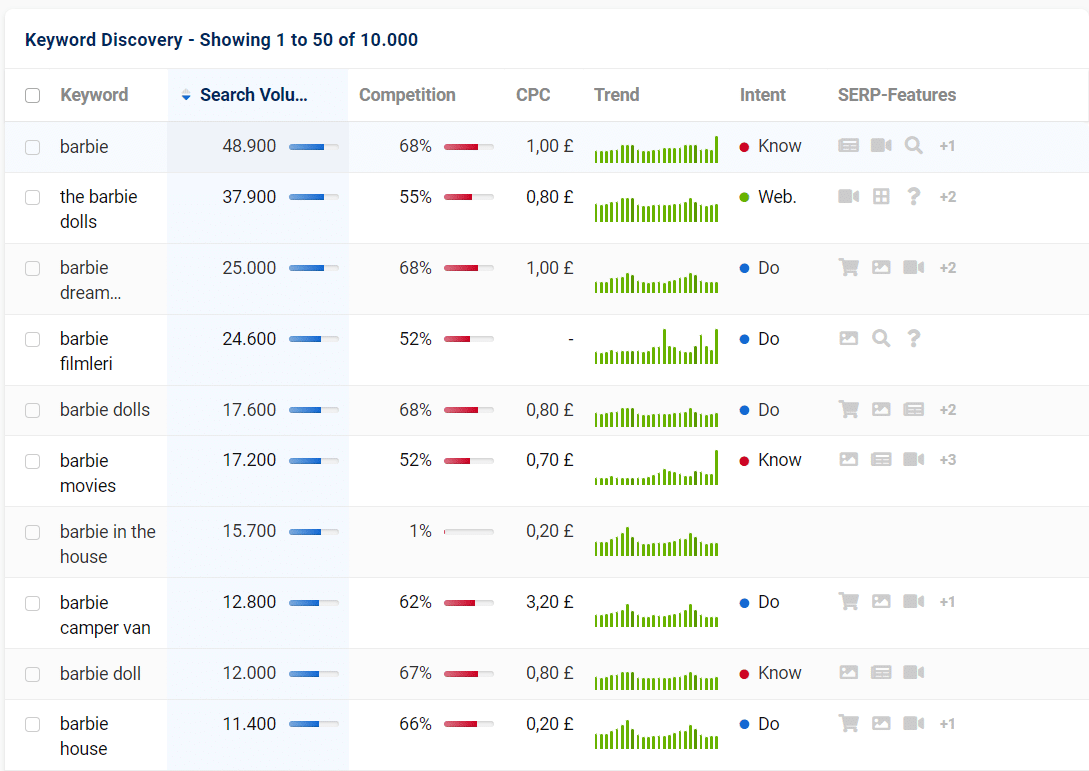
In the example above, you can clearly see the difference in intent between people looking for Barbie products to buy (with the commercial or ‘do’ intent) and queries relating to the movie with an informational (or ‘know’) intent.
Using these types of search intent to get a basic classification will set you off on the right track.
For example, you could find that you have a transactional page for a certain query when you could be creating or updating a rich informational resource to better match user intent.
It’s better to start with this information than discover it when you’ve already put a lot of work into optimizing a page, so this is an important step. It’s not always as obvious as you might think.
2. Put yourself in their shoes
Now you have a general intent classification, try to think like your intended audience.
We’ve all searched for different types of answers and know what good results look like.
Consider what you want to see and be honest about whether your current page or content provides that. If not, can you see where it’s lacking?
Getting a clear picture of the search intent optimization approach you’re aiming for makes it much easier to plan your content. Think like the user you’re trying to attract.
3. Review the SERPs
Take a break from research tools and use a search engine to look at what’s ranking for the topic you’re trying to optimize for. This is so important.
I’ve been surprised countless times by what I think people want and what is actually ranking. Sometimes we can be too close to our own products or industries we work in to see the bigger picture.
Look at the search results and assess what already ranks.
What type of page is it?
What is the content like?
How does yours compare?
You might see that most of the content that satisfies search intent talks about something you’ve missed or formats things differently.
It won’t always be that obvious, but it’s well worth reviewing the SERPs and looking for similarities in the top-performing pages.
4. Analyze your current results
Look at your current ranking and click-through rate for your chosen query. If your content isn’t ranking well, this could indicate a search intent problem.
Examine your engagement metrics, such as bounce rate and time on page.
If people aren’t engaging with what’s on your page, you probably haven’t satisfied their search request as well as you could have.
To help with optimizing content, see if you can find a similar page with better engagement metrics and compare the differences. This can help you to spot opportunities for improvement.
5. Consider mixed intent
Broad keywords with a high search volume may often have various intents, so think about your different audiences.
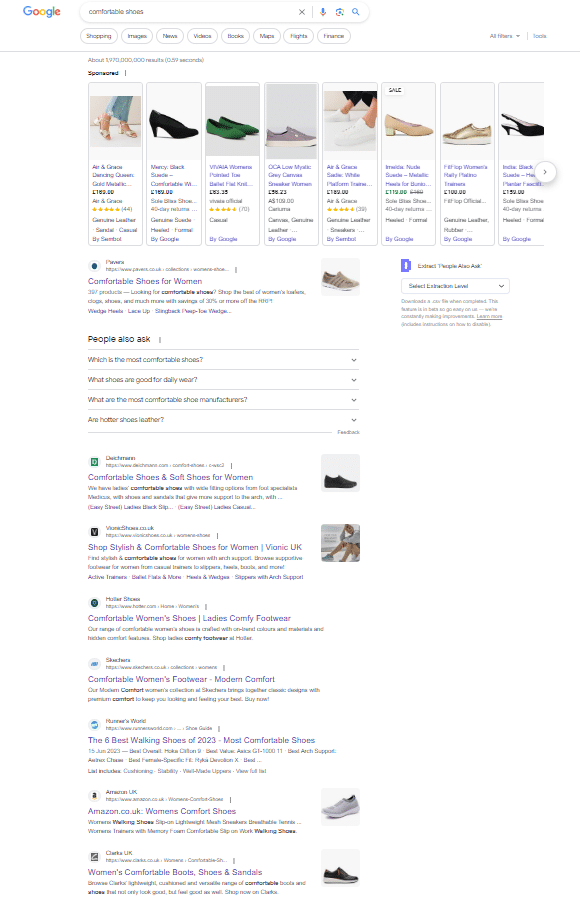
Let’s take the phrase “comfortable shoes.” It’s most likely to be a person looking to buy some comfortable shoes. But they probably have more questions.
We can see this mixed intent coming through in the SERPs, with most of the top pages showing products to satisfy a transactional search intent but some providing information to fulfill informational search intent:
Click to enlarge image
In this case, you’ll need to choose which user intent will most benefit you. For example, if you are running an ecommerce site, you’ll choose to optimize for commercial intent as it’s more likely to align with your goals.
6. Examine ambiguous intent
Sometimes, the user’s intent is ambiguous.
There could be different meanings behind the words they’ve used in their query, and they haven’t given enough detail to qualify this.
For example, if we type “sliding doors”’” into the search bar, you can see the following results:
Click to enlarge image.
The SERPs show:
Shopping results for people who want to buy doors.
Information about the 1998 film.
PAAs about both the product and the film.
This is quite confusing, but the likelihood is that there will be a collection of people searching with the same phrase, but behind that are two completely different intents.
Search engines cannot tell exactly what the person intended, so they serve both results. If you want to rank, what do you do?
The best option is to satisfy the intent you’re interested in as best you can, as you can’t change these mixed results.
Someone looking for a product isn’t going to click on the film results, even if they rank higher.
So focus on making your page relevant to the traffic you want to gain, optimizing for this specific search intent.
7. Use AI to complete the picture
If you’re an in-house SEO working in a small team or simply want to kick start or verify your ideas, why not ask your favorite AI to give you a list of likely search intents for your main topic?
“Ask GPT-4 to “provide a list of likely search intents for someone searching Google for [running shoes],” and you’ll get a list of ideas.”
This helps ensure you’re not working in a silo or overlooking some possible search intents that don’t resonate as much with you personally but are important to others.
It can help you to optimize your outline to cover many likely micro intents, creating a more well-rounded overall page or piece of content.
8. Update title tags and meta descriptions to match intent
Using the right language in title tags and meta descriptions can clearly indicate that your content satisfies the user’s search intent.
This could help improve click-through rates as searchers can see immediately that your page will provide what they need.
Including words like “buy” or “get” for transactional queries and “learn” or ‘discover’ for informational queries can help your result to stand out.
If we look at the query “how to make pancakes,” the top-ranking recipe sites use their title tags to guide users by including words like “easy,” “simple,” “best,” or “perfect” to capture the right audience for their page.
These words help to clarify the search intent, as less experienced bakers might be looking for a simple recipe, but others could be after a recipe to impress.
9. Use keyword clusters
While you’re researching your search query, take note of keyword clustering.
A single page rarely ranks for just one query, so keyword clustering tools can help create a bigger picture regarding search intent.
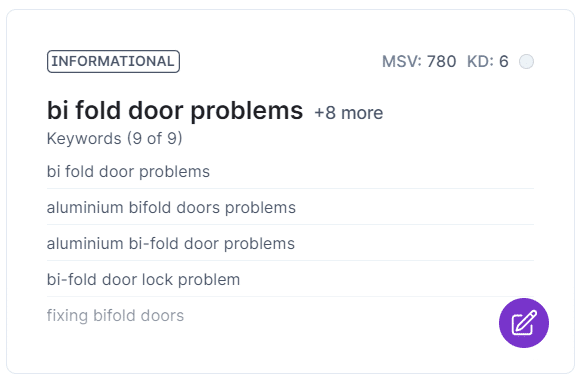
For example, if you’re trying to create content to satisfy the specific phrase “bifold door problems,” the keyword cluster below can help to identify which problem areas to cover:
So if your content is missing the mark, you can consider adding more detail about aluminum options and problems with the locks to fulfill that keyword intent better.
Get the daily newsletter search marketers rely on.
function getCookie(cname) {
let name = cname + “=”;
let decodedCookie = decodeURIComponent(document.cookie);
let ca = decodedCookie.split(‘;’);
for(let i = 0; i <ca.length; i++) {
let c = ca[i];
while (c.charAt(0) == ' ') {
c = c.substring(1);
}
if (c.indexOf(name) == 0) {
return c.substring(name.length, c.length);
}
}
return "";
}
document.getElementById('munchkinCookieInline').value = getCookie('_mkto_trk');
10. Check the SERP features
When you carry out a Google search, pay attention to the SERP features you see. Is there a People also ask box, knowledge panel, an image pack or a local pack?
These features give an indication of the search intent. They’re there to help users find what they want so pay attention to what’s available.
11. Use the SERP features
Now you’ve seen the search features, can you use these? For example, what are the PAAs shown in the search engine results? Could your informational content better satisfy search intent if you include the answers to some of these?
Perhaps an image pack indicates that your content might benefit from more visuals. Plenty of video results could suggest that including your own unique video might enrich your page.
12. Use the right format
Formatting is important in helping people process information and discover answers for themselves. And that makes it vital when it comes to search intent too.
For example, if the user’s primary aim is to browse products, their intent will be best satisfied with a product listing page.
Let’s say we’re searching “dresses for weddings.” Our aim is probably to look at the styles available and decide what we like and what will suit us.
So it’s not surprising that all the top results are product listing pages:
No other page format comes in the top results. This only deviates when more informational articles appear much lower down the results page.
A category page that directed users to subcategories like midi, maxi, mini or different colored dresses rather than listing products would be less likely to satisfy the intent of this type of shopper.
This is because they are unlikely to have reached that stage in their decision-making process yet. They don’t know what type of dress they need and are searching for inspiration, so while the overall intent is to buy a product, the micro-intent is to browse.
13. Include supporting entities
The concept of matching search intent is straightforward, but creating relevant content that satisfies a user’s needs is much more complex.
Intent and entities are inextricably linked. Entities help search engines determine the meaning of content, and what content means confirms whether it satisfies a certain intent.
The best way to demonstrate that you satisfy intent is to really understand the topic and the pain points of your target audience. Then, create high-quality content that provides solutions.
To do this, you’ll need to research related entities and include them in your content, showing a depth and breadth of knowledge about the topic in question.
After all, if someone is looking for information on a complex or niche subject, they’re more likely to trust an expert’s advice over a generalist’s.
You can optimize for search intent by improving on these factors. If you have a more experienced person available within your organization, ask them to contribute, review or fact-check your content.
You can also expand on E-E-A-T factors by asking subject matter experts from outside your company for quotes, contributions or analysis.
15. Check your language
Just as using the right language in title tags and meta descriptions can be beneficial, so can carrying it through the rest of your copy.
If you write in a way that demonstrates you’re answering a question or fulfilling a need to a reader, they are more likely to engage with your content and feel that you have satisfied their query.
In some cases, this might be as simple as adding language that reflects the intent such as ‘buy now’ or ‘for sale’ within transactional pages.
However, you might need to review the readability to make sure your content communicates clearly and effectively. Consider the words you use and whether they align with the intent. Address pain points directly and make it clear you are doing so.
16. Get human feedback
Once you’re clear about the intent and what you’re trying to achieve, ask others to read and review your content for this intent.
Do they feel it satisfies the intent? Can they suggest any improvements?
After all, your content is for real people, so it’s important to get another perspective. This is ideal if you can get your page reviewed by your target audience.
But if it isn’t possible, simply asking one or two colleagues to review your content might be enough to identify areas for improvement.
17. Get AI feedback
If you’re short on time, or in a small team, you could ask AI to review for intent. It’s always a good sense check anyway and might give you some useful optimization ideas.
For example, I’ve added some of my own content and asked ChatGPT to:
“Create a list of search intent that it fulfills. List the intents in bullet points along with the sentiment”.
This is a good sense check to see if it identifies the intent you’d aimed for. You can even ask a simple question like:
“Does this copy satisfy a transactional intent?”
And ask follow-up questions based on the response. This can help you to generate ideas for improving your content based on intent.
18. Check your calls to action
Have you included CTAs in your content and do these match the intent?
While “buy now” might be your go-to for transactional intent, you might use phrases like “learn more” or “sign up” on more informative pages.
Review any calls to action to see if they support the intent. Adjust these if necessary.
19. Continuously improve
Search intent and search engine’s understanding of it can often change.
Like any optimization work, it’s best to keep reviewing and improving your top pages to ensure they still fulfill the intent.
Remember, you’re trying to help users accomplish their purpose
When you’re optimizing for search intent, you won’t go too far wrong if you put your users at the heart of everything you do.
That being said, not every user is the same and the intent behind queries, especially broader ones, can be nuanced.
Search engines are already working with this type of information at scale and serving the results they determine to best satisfy the intent of a query for most users.
A combination of thorough research in and outside the SERPs, planning, execution and feedback are all essential to ensure you fulfill user intent and create helpful and useful content.
IPG Mediabrands advised its clients to temporarily pause campaigns using Google’s Performance Max.
The company issued a “privacy alert” email in response to allegations in a new report that YouTube ads may have led to improperly tracking children.
Brands using PMax may inadvertently violate the Children’s Online Privacy Protection Act (COPPA) as a result, according to the study conducted by Adalytics.
Why we care. If brands are found to be in violation of COPPA, they may have to pay a significant financial penalty just as YouTube did in 2019 when it spent a record $170 million to settle similar charges.
Have any laws been broken? Under COPPA, online services must get parental consent before collecting data for targeted advertising purposes from children under the age of 13.
Adalytics researchers found the platform serving personalized ads from more than 300 brands on “made for kids” videos. When viewers clicked on these campaigns, they were redirected to the brand’s website, which sometimes resulted in dropping cookies on the user’s browser.
IPG Mediabrands investigates. In response to the findings, IPG Mediabrands conducted its own investigation. They reportedly found that at least one of its clients, which was running an adult-targeted campaign, had its ad feature on a “made for kids” channel.
If a child had clicked on the ad, tracking pixels from the brand’s website would have gathered data from the child as well as their associated ID. This data would then have been shared with Google’s PMax.
IPG Mediabrands, which manages $40 billion in marketing investment worldwide, reportedly concluded that a full investigation was needed to identify the full extent of the impact on its clients.
What has IPG Mediabrands said? A spokesperson for IPG Mediabrands told Search Engine Land that the email was an “early, unapproved draft of an internal-only note that was not reflective of our broader organizational POV. This was retracted. This was not sent to clients.”
The email in question – which was obtained by Business Insider – read:
“Because placement reporting is not available for PMAX, we recommend that clients temporarily pause PMAX until the efficacy of the above controls are validated on non-PMAX campaigns where placement reporting is available.”
“Clients should consult with their legal, privacy/infosec, website, and data teams to consider potential exposure, and determine the appropriate process for identifying and removing data potentially collected from children. For example, advertisers may assess data in their CDPs that originated from YouTube as a traffic source.”
“These recommendations are being made on the basis of the probability of FTC scrutiny, as well as in light of the evidence of waste in advertising investment against unintended audiences.”
What has Google said? Dan Taylor, Google’s Vice President of Global Ads, said the Adalytics study was “flawed”. Addressing the report in a post on X (formerly known as Twitter), he stated:
“[This is the] 2nd time [Adalytics has] produced faulty research about Google advertising this summer. Here are 6 facts about how we protect kids on YouTube that Adalytics gets completely wrong or ignores.”
“#1 We don’t personalize ads to kids, ever. And we treat everyone who watches Made for Kids content as a child, regardless of their age.”
“#2 We built YouTube Kids as a dedicated app designed from the ground up to be a safer experience for kids to explore, with tools for parents and caregivers to guide their journey. The YouTube Kids app has never had personalized ads either.”
“#3 Made for Kids content has ads but we restrict the types of products that can be advertised: e.g. no ads for video games or media unsuitable for children, no ads about dating and relationship, no ads for food and beverage.”
“#4 Google does not share with advertisers what content/video a person was watching when they click on an ad. That means advertisers never know if a click came from someone watching Made for Kids content, regardless of their age.”
“#5 Advertisers, with a single click, can choose to opt out of Made for Kids content. The opt-out, called Content Suitable for Families, prevents advertisers from having their ads run alongside Made for Kids content. Adalytics doesn’t appear to know this.”
“#6 Cookies ≠ ad personalization. Cookies are permitted under COPPA for statistical reporting, for spam and fraud detection and for frequency capping. They are critical to YouTube creators’ monetization which encourages a rich diversity of content on YouTube.”
“#7 Though we only just received the report, what we have reviewed shows no violations of our commitments nor privacy policies. Given Adalytics’ last report was debunked by 2 independent organizations, we do not put much stock in the accuracy of their research.”
“#8 The NYTimes, who was given early access to the report, couldn’t even verify the bulk of Adalytics’ claims. It does not corroborate Adalytics’ accusations and in fact found the opposite: no violation of COPPA, no personalization of ads to kids, and no improper use of cookies.”
“#9 Adalytics’ report has no substance and tries to make a gotcha when there is none. We offered to meet with them weeks ago and heard crickets. Do they have the credentials and expertise to publish these reports?”
Deep dive. Read Adalytics’ YouTube study in full for more information on its research. Read Google’s official documentation on how ads work on YouTube for supervised accounts for more information.
Beauty and brains? That’s a lucrative combination. Attractive females possess a unique advantage, blending charisma with enterprise. Explore the myriad ways to turn head-turning appeal into a profitable venture, all while embracing empowerment and authenticity.
The demand for feet pictures is on the rise. Many individuals and businesses are interested in purchasing these images for a variety of purposes, from art to advertising.
Platforms like FeetFinder have emerged to cater to this niche market, offering a space for sellers to connect with potential buyers.
Before diving into this venture, it’s essential to do thorough research. Checking FeetFinder reviews can provide insights into user experiences and platform reliability.
While it is profitable to sell feet pics, it’s crucial to prioritize safety and anonymity. In the digital age, unconventional methods like this have become viable means of income, but caution is always advised.
Become a Content Creator
Content sites like Buy Me A Coffee and similar companies have revolutionized content creation. They provide direct links between creators and their audience.
They allow for a broader range of content, from cooking classes to intimate photoshoots.
The key is authenticity. Subscribers are drawn to genuine content and a real connection. Building a loyal fanbase is essential.
Regular interactions, updates, and exclusive content keep subscribers engaged. While this offers great earning potential, it also requires a thick skin.
Criticism and competition are rife, but for many, the rewards outweigh the challenges.
Professional Hugger
The concept of professional hugging is gaining traction. It taps into the basic human need for touch.
In our digital age, loneliness is prevalent. Professional huggers fill this void, offering solace and a listening ear.
They cater to a diverse clientele, from the elderly to busy professionals. Sessions are often tailored to individual needs. Some clients might need silent comfort, while others may want to talk.
It’s essential to maintain a non-judgmental and open demeanour. Trust is the foundation of this profession. While it’s unconventional, the benefits of human touch are undeniable.
Get Paid To Chat With Guys
Earning by chatting online is an emerging trend. Many platforms connect women with men willing to pay for conversation.
Topics can range from daily life to specialized advice. Some men are overseas and seek cultural exchanges or language practice.
Others might be looking for insights into women’s perspectives. It’s essential to establish clear boundaries from the start.
Transparency about the nature of the chat is crucial. While it can be lucrative, it’s vital to prioritize safety.
Using reputable platforms and avoiding sharing personal details can help ensure a positive experience.
Freelance Modelling
The world of freelance modelling is vast and varied. Without agency ties, models have the freedom to choose their projects.
This autonomy can lead to diverse portfolio-building opportunities. From local brand shoots to international campaigns, the sky’s the limit.
Social media plays a pivotal role in a freelancer’s success. Platforms like Instagram act as portfolios, showcasing a model’s versatility.
Building a personal brand is essential. Engaging with photographers, makeup artists, and designers can open doors.
While the journey can be challenging, the rewards of self-direction and varied experiences make it worthwhile.
Become a Fashion Influencer
Fashion influencers don’t just wear clothes; they tell stories. Their style choices inspire and influence their audience.
With the rise of social media, their reach has become global. Collaborations with brands can lead to exclusive launches or sponsored content.
However, maintaining authenticity is crucial. Followers value genuine recommendations over blatant advertising.
Continuous learning about fashion trends, photography, and audience engagement strategies can elevate an influencer’s game.
It’s a dynamic field, constantly evolving with fashion cycles and technological advancements.
Try Your Hand In Acting
The world of acting is vast and varied. From commercials to blockbuster movies, opportunities abound.
Networking events, film festivals, and workshops can provide invaluable industry insights.
Building a portfolio with diverse roles showcases versatility. An actor’s resilience is tested not just by their ability to adapt to roles, but also by handling criticism and competition.
Every role, big or small, adds to an actor’s journey, refining their craft. It’s a profession of passion, dedication, and continuous growth.
Fitness Trainer
A fitness trainer’s role goes beyond the gym. They act as motivators, counsellors, and educators.
Their expertise guides individuals through fitness journeys, ensuring safe and effective workouts.
They must stay updated with the latest fitness trends and research. Personalizing routines to cater to different body types and needs is crucial.
They also address challenges like injuries or health conditions. Building a loyal client base requires dedication, continuous learning, and genuine care. Their impact is profound, transforming not just bodies, but lifestyles and mindsets.
Become An Inspiration For Artists
Being an inspiration is an intimate experience. It’s about sharing a part of oneself with an artist. You can often influence the direction of an artist’s work, bringing new perspectives and emotions.
Their features, stories, or personalities become the artist’s canvas. Over time, many inspirations have gained recognition, becoming as iconic as the artworks they inspired.
The relationship between an artist and their inspiration is symbiotic. While the artist draws inspiration, you gain a sense of legacy. Their collaboration results in art that resonates across time and cultures.
Greeter
A greeter (or hostess) sets the tone for an establishment. They greet guests with warmth and professionalism.
Their role is pivotal in managing the flow of patrons. Reservations, wait times, and seating arrangements fall under their purview.
Their demeanour can enhance a guest’s overall experience. It’s not just about managing tables; it’s about creating a welcoming atmosphere.
They handle challenges with grace, from disgruntled customers to overbookings. Effective communication with the service staff ensures smooth operations.
Being a greeter requires multitasking, patience, and a genuine love for hospitality. Their impact is often understated, but they are the first and last impression of any dining experience.
Disclaimer: MoneyMagpie is not a licensed financial advisor and therefore information found here including opinions, commentary, suggestions or strategies are for informational, entertainment or educational purposes only. This should not be considered as financial advice. Anyone thinking of investing should conduct their own due diligence.
Amazon Sponsored Product ads will now appear on third-party premium apps and websites.
Pinterest, BuzzFeed, Hearst Newspapers, Raptive and Ziff Davis brands like Lifehacker and Mashable are among the brands that are partnering up with the retail giant to increase reach for its Sponsored Product ad product.
The news comes after Amazon announced a multi-year collaboration with Pinterest to become its first ever third-party advertising partner back in April.
Why we care. Expanding the reach of Amazon Sponsored Product ads means marketers can potentially achieve higher conversion rates and increased return on ad spend, positioning their brands for success in a dynamic digital landscape. The new feature could also help address the attribution issue on Pinterest, which has proved to be a budget-limiting factor for advertisers, as huge discrepancies have previously been reported between the Pinterest dashboard and Google Analytics.
How it works. Amazon will identify users on the third-party platforms that are likely to be interested in your product by analyzing relevant page context, the campaign and cost-per-click parameters that you have already established. It will then display your campaign to this audience.
All ads on the third-party platforms will link back to your Amazon product page, enabling potential customers to easily make a purchase in just a couple of clicks.
Eligibility. Sponsored Products will only appear on third party premium apps and websites if they meet the following criteria:
The product must be in stock.
The product includes trusted Amazon shopping attributes such as Prime delivery promise, ratings and accurate pricing information.
Next steps. You don’t need to take any action for your Sponsored Products to appear on third-party premium apps or websites – Amazon will enable this feature automatically for you.
Campaign reporting will be available n the Sponsored Products placement report, which can be downloaded in the report centre.
What has Amazon said? Colleen Aubrey, senior vice president, Amazon Ads Products and Technology, said:
“Sponsored Products has always been about helping customers discover products they may love.”
“We’ve been building and evolving Sponsored Products in our store for more than 10 years, leveraging advanced machine learning algorithms to show advertising that’s highly relevant for customers, and therefore highly effective for the advertisers that choose to use it.”
“We are excited to now apply what we’ve learned about connecting customers and products in meaningful ways to a range of great websites and apps.”
Get the daily newsletter search marketers rely on.
function getCookie(cname) {
let name = cname + “=”;
let decodedCookie = decodeURIComponent(document.cookie);
let ca = decodedCookie.split(‘;’);
for(let i = 0; i <ca.length; i++) {
let c = ca[i];
while (c.charAt(0) == ' ') {
c = c.substring(1);
}
if (c.indexOf(name) == 0) {
return c.substring(name.length, c.length);
}
}
return "";
}
document.getElementById('munchkinCookieInline').value = getCookie('_mkto_trk');
What has Pintrest said? Martha Welsh, Chief Strategy Officer at Pinterest, told Search Engine Land:
“We’re excited to enter this next phase of our third-party partnership with Amazon Ads to bring more shoppable content onto the platform along with a great consumer buying experience. Shopping on Pinterest has never been easier.”
“Now through our partnership, advertisers on Amazon are able to have their products appear in our search results, making ads on Pinterest even more relevant and actionable.”
“Shopping is one of the top requests we receive from our users – more than 50% of users say they come to Pinterest to shop – and we’re continuing to deliver more ways to go from inspiration to action. We’re in the early stages of testing right now and seeing encouraging results.”


 (@BritneyMuller)
  鈴木謙一 (@suzukik)
  (@lilyraynyc)