Kroger’s new self-service ad platform: What you need to know

Kroger is breaking away from Microsoft to take its advertising platform – Kroger Precision Marketing – in-house.

The new system, which the grocer has spent the last year working on, is currently in beta but all marketers are set to transition in the fall.

Why we care. With 2,700 stores across 35 states, Kroger is the largest supermarket chain in the US and has historically worked with more than 2,000 brands. Marketers that launched campaigns using the old ads platform noted it was “clunky” and unnecessarily time-consuming as they were forced to navigate multiple systems to get a campaign live. The new platform, however, acts as a one-stop shop where marketers can both get their ads live and access data, meaning they can make informed decisions faster to potentially get a better ROI.

“It wasn’t a decision we took lightly because Microsoft has been a great partner,” Dan Mayer, VP, Media Platform, Kroger Precision Marketing at 84.51˚, told Search Engine Land. “But this new platform gives [marketers] more control and the ability to act on data and insights much more quickly – we’re excited for that.”

Highlights. The new platform will provide marketers with the power to:

  • Reach relevant audiences using search-based insights and custom ad groups.
  • Design, iterate, and activate creative messages within the platform.
  • Customize and save multiple creative templates by brand and product.
  • Optimize all campaign elements including budgets, messaging, and flighting.
  • Build reports and boost performance against deterministic retail data – including sales lift, household penetration and unit lift.  

Although Kroger is excited to roll out its new ad platform, Mayer emphasized that the system will always be a “work in progress” and that the team is looking forward to hearing feedback from clients.

  • “The media space is incredibly dynamic so there is lots more to come. We want to continue to enhance its features and functionalities,” Mayer said.

Read on for highlights from my recent Q&A with Mayer for more details around Kroger’s new self-service ad platform.

Kroger’s ‘biggest pain point’

Marketers had been submitting feedback to Kroger about the interface of its old platform, explaining it was unnecessarily time-consuming to get a campaign live.

  • “One of the biggest pain points was the creative of it.
  • “Targeted onsite ads in particular was a bit of a disjointed experience because the campaign process started in one spot but you’d have to jump out to build that creative in another spot – and then you’d have to come back in again!
  • “The current state is a little clunky if I’m being honest. There are multiple systems [marketers] have to navigate to get a campaign live. We needed to somehow bring that one experience into one platform.”

Taking back control

For Kroger, addressing marketers’ biggest pain point resulted in it taking the tough decision to move away from Microsoft and creating an in-house self-service ad platform, so that its team of scientists could provide real-time data for more control.

  • “We like to think we have a healthy obsession with our customer experience and optimizing that experience.
  • “[Going in-house] gives us more direct control over that experience as it allows us to offer our data insights and science much more seamlessly and quickly.
  • “We now own the roadmap, we own the decision on priority and what we can get into production and when, whereas in the past we depended on partners to bring that stuff to market.
  • “With our new platform, [marketers] can now come directly to us through a single entry point and stay contained within that platform. You’re not bouncing out onto other platforms to execute campaigns.”

Verdict from marketers so far…

Although the new platform is still in beta and it’s very early days, Kroger has already started collecting feedback.

  • “The feedback from marketers so far has been relief because of how we’ve simplified the process for them.
  • “Marketers seem to appreciate the ease of use now – especially when it comes to setting up and activating campaigns.
  • “They’re also excited by the science we’re bringing to them – and how much more quickly. We’ve successfully deployed science previously but now that is a much quicker process and advertisers can see the benefit of that in the form of increased performance of their campaigns.
  • “But when we were making this platform, there were certainly points at which we thought we had everything covered then we’d go and test it and we realized oh we’ve missed that so we’ve got to add a component of a feature. So I’m excited to get more feedback from our advertisers because this is a work in progress.”

Next steps

Kroger’s new ad platform won’t be rolled out to all marketers until the fall, however, the company is already looking to next year and beyond.

  • “We’ll have all advertisers coming over by the end of the year and we’ll be open to the feedback they have to give as we continue to enhance the features and functionalities.
  • “Marketers will be able to give feedback on the ad platform.
  • “We will also continue to build the platform out across our other advertising experiences across our off site portfolio later this year and into next year.
  • “We’re not reporting revenue or our financial goals at the time, but we expect to continue to rapidly grow. Watch this space!”

The post Kroger’s new self-service ad platform: What you need to know appeared first on Search Engine Land.

Original source: https://searchengineland.com/kroger-self-service-ad-platform-429480

Meta rolls out multiple updates to enhance Facebook video experience

Meta has started rolling out a series of updates to enhance the Facebook video experience.

The social networking platform has:

  • Introduced new editing tools.
  • Redesigned video Explore.
  • Simplified its video tab.
  • Increased engagement opportunities.

Why we care. Facebook has transformed into a one-stop shop where people can enjoy the best of both Instagram and Facebook Reels. This is great news for marketers advertising their campaigns on Instagram as they now have access to the Facebook audience, even if they don’t have an active profile, and so their potential reach is greater than ever before. In addition, the simplified redesign means that Facebook users will find it easier than ever to discover new content, providing another opportunity for brands to reach new potential customers.

New video editing capabilities. Meta is rolling out Reels editing tools to Feed videos to help you create more dynamic content. The new tools include:

  • Seamless editing: If you use the Meta Business Suite, you can access audio, music and text editing features already available on Reels. These new tools will help you layer and time creative elements more easily, potentially resulting in a higher-quality end product.
  • More clip editing tools: You will now have the option to speed up, reverse or replace clips, offering more opportunities to get creative with your content.
  • Enhanced audio: You can now experiment more with sound, including adding music and audio clips, recording voiceovers and reducing unwanted noise
  • HDR access: You can now upload HDR videos from your phones to Reels. The clips uploaded can also now be played back in full HDR, resulting in a high-quality end product.

Get the daily newsletter search marketers rely on.

<input type="hidden" name="utmMedium" value="“>
<input type="hidden" name="utmCampaign" value="“>
<input type="hidden" name="utmSource" value="“>
<input type="hidden" name="utmContent" value="“>
<input type="hidden" name="pageLink" value="“>
<input type="hidden" name="ipAddress" value="“>

Processing…Please wait.

function getCookie(cname) {
let name = cname + “=”;
let decodedCookie = decodeURIComponent(document.cookie);
let ca = decodedCookie.split(‘;’);
for(let i = 0; i <ca.length; i++) {
let c = ca[i];
while (c.charAt(0) == ' ') {
c = c.substring(1);
}
if (c.indexOf(name) == 0) {
return c.substring(name.length, c.length);
}
}
return "";
}
document.getElementById('munchkinCookieInline').value = getCookie('_mkto_trk');


Simpler navigation. Facebook is aiming to make its video content as easy to discover as possible and so has started rolling out a number of changes, including design modifications and new features:

  • One-stop shop video tab: People can now access all videos from Reels to Live content to long-form on the video tab, previously known as Facebook Watch.
  • Highlighted recommended reels: Facebook users will be served a new horizontal reels section in the Video tab, highlighting recommended reels.
  • New layout: Making navigation even simpler, the Video tab will soon appear in the shortcut bar (although the tabs in the shortcut bar update in accordance with what features people use most).

Improved discovery and user experience. Facebook is also making it easier than ever for its users to discover videos about popular topics and trends by redesigning video Explore. The platform works by serving content it thinks the user will enjoy and find interesting by using a combination of human curation and machine learning.

More engagement opportunities. Not only will Instagram Reels be served on Facebook, helping brands to reach more people than ever before, people now have the opportunity to write comments on these clips without having to switch between the apps.

What has Meta said? Meta said via a statement published in the Facebook Newsroom:

  • “We’ve started to roll out updates that will bring more Reels editing tools to Feed, making it even easier to create dynamic videos on Facebook. Whether posting a video for friends and family to see, or trying to reach people who share similar interests, our video editing tools will make it possible for people to express themselves in new ways via Reels or long-form videos.”
  • “Video is core to Facebook – short videos could be posted to Feed as early as 2007. Nowadays, our unique cross-section of Reels, long-form and Live content brings people to Facebook to watch videos about the things they like, new stuff they’d want to know about, and to engage with real people with similar interests.”
  • “We continue to invest heavily in video, so today we’re sharing the latest ways we’re making it possible for people to create, explore, and engage with video on Facebook.”
  • “But this is just the beginning. We’ll continue developing more tools for creators so they can express themselves, build an audience and earn money, along with the discovery and personalization features that give you more control over your experience.”

The post Meta rolls out multiple updates to enhance Facebook video experience appeared first on Search Engine Land.

Original source: https://searchengineland.com/meta-updates-to-enhance-facebook-video-experience-429549

When will you receive the cost of living payments?

If you’re on many types of benefits you’re probably wondering ‘when will I receive my cost of living payments?’

In the 2022 Autumn Statement, Chancellor Jeremy Hunt unveiled cost of living help for millions across the UK. It was revealed people would receive up to £1,350 directly into their bank accounts, starting from spring of this year. 

The cost-of-living payments announced by Mr Hunt include a £900 sum for those on benefits, £300 for pensioners and £150 for those with disabilities. It is unlikely that households will qualify for all three payments. However, if you do, you will automatically be paid the full amount of £1,350. 

If you claim pension credit, attendance allowance and are eligible for the winter fuel payment, you will receive the amount in full, directly into your bank account. You do not need to ask for the help – the Department for Work and Pensions (DWP) will get in touch with you. 

Eligibility requirements, bank codes to look for on your bank statement and exact dates for the payments will be announced nearer to spring time. All payments are tax-free and do not count toward your benefits cap. This means it will not have an impact on the benefits you receive. 

Spring

From spring of this year, the first £300 of the £900 cost of living payment was paid directly into claimants’ bank accounts. The payment was split into three instalments. Over eight million people will have received this into their bank accounts. 

To be eligible, households must have been claiming at least one of the following benefits: 

  • Income-based Jobseeker’s Allowance 
  • Income-related Employment and Support Allowance 
  • Income Support 
  • Pension Credit 
  • Tax Credits (Child Tax Credit and Working Tax Credit) 
  • Housing Benefit 
  • Social Fund (Sure Start Maternity Grant, Funeral Payment, Cold Weather Payment) 
  • Universal Credit 

Summer

Over six million people with disabilities across the UK will receive a payment of £150 during the warmer months. As of yet, it is unknown what the exact eligibility criteria or date will be. However, the previous £150 cost of living payments were available to those receiving at least one of the following: 

  • Attendance Allowance 
  • Constant Attendance Allowance 
  • Disability Living Allowance for adults 
  • Disability Living Allowance for children 
  • Personal Independence Payment 
  • Adult Disability Payment (in Scotland) 
  • Child Disability Payment (in Scotland) 
  • Armed Forces Independence Payment 
  • War Pension Mobility Supplement 

August Bank Holiday

The usual state pension support will also be going out in August. The August Bank Holiday on Monday 28, however, means those expecting to receive payment on this date can expect it to be paid them a working day earlier – likely Friday 25 August.

This will also apply to those expecting to receive the following in August:

  • Universal Credit
  • State Pension
  • Pension Credit
  • Disability Living Allowance
  • Personal Independence Payment
  • Attendance Allowance
  • Carer’s Allowance
  • Employment Support Allowance
  • Income Support
  • Jobseeker’s Allowance

Autumn

As the weather turns chilly again, the second £300 cost of living payment will be paid to those eligible. Exact dates to be released in due course. 

Winter

Across the UK, millions of pensioners will receive another £300 payment. It is still unknown whether households will qualify for this payment if they usually receive the Winter Fuel Payment. 

Previously, you qualified for the last Pensioner Cost of Living payment if: 

  • You were born on or before September 25, 1956 
  • You lived in the UK for at least one day during the week of September 2022 (ie September 19 to 25, 2022) in what is known as the ‘qualifying week’. 

Spring 2024

Next spring – although it seems a lifetime away – a further £299 cost of living payment will be made.

Further details for qualifying criteria will be announced nearer the time, according to the DWP. 

The post When will you receive the cost of living payments? appeared first on MoneyMagpie.

Original source: https://www.moneymagpie.com/make-money/when-will-you-receive-the-cost-of-living-payments

How Reality Capture Software Transforms the Construction Processes

Home Business Magazine Online

The reality capture software has revolutionized the construction industry by transforming various processes and providing significant benefits throughout the project lifecycle. The capture software has made construction more efficient and accurate with instant collaboration and increased work efficiency. This article will discuss some key ways this software has impacted construction processes and continues to revolutionize the construction documentation sector.

1. Accurate Documentation

Reality software has simplified and streamlined the as-built documentation process. Rather than having to review paper documents and photographs to identify relevant information, engineers can capture, analyze and edit. The software captures millions of data points by utilizing technologies such as laser scanning, photogrammetry, or LiDAR (Light Detection and Ranging) to create accurate 3D models of the physical environment.

2. Improved Project Visualization and Communication

Reality software has revolutionized the way construction teams communicate. Stakeholders can view models immediately to review project information more quickly and efficiently. 3D models can be updated throughout the process, providing a historical archive of phases and revisions. In addition, model check-offs can be issued digitally and signed electronically, eliminating mistakes or delays due to miscommunication.

3. Enhanced Design and Planning Processes

The software also helps reduce delays by facilitating efficient construction and planning processes. Visual representations of construction sites and location-specific images are clearly laid out in a single platform for easy navigation. With the help of this software, engineers can quickly identify and resolve issues before they escalate into problems.

4. Streamlined Construction Documentation

The software has also led to a more streamlined documentation process. Contract documents, as-builts, and BIM models have all been enhanced with recent innovations in digital workflow. Engineers can create virtual work orders for construction services at the click of a button. At the same time, AEC (Architectural Engineering Consultant) firms can integrate the software into their systems to provide better cost estimations.

5. Quality Control and Clash Detection

The capture software has improved communication and collaboration among construction professionals. Early coordination allows for more efficient construction management, providing insights into upcoming project phases and the status of open tasks. This allows for better quality control by allowing engineers to identify potential clashes within a single platform rather than going through paper documents or performing time-consuming field checks.

6. Efficient Facility Management and Maintenance

The software has also improved facilities management and maintenance practices, allowing for more accurate records. With a single platform, engineers can identify and resolve issues more easily before they escalate into bigger problems. Tools that allow teams to compare images of old structures with their current state provide accurate assessments of maintenance-related costs.

7. Improved Construction Scheduling

Building projects are more efficient today thanks to this software. It has enabled teams to plan and schedule projects more accurately, improving outcomes. This software helps expedite the process by compressing the timeline while reducing costs and minimizing risks. It can even help speed up the construction process by organizing communications between personnel, contractors, and stakeholders.

8. Enhanced Safety and Security

Safety is a top priority for building contractors; however, the reality, software has helped improve the safety and security of construction sites. Visual representations of construction sites allow engineers to inspect on-site for structural damage or other issues that could impact the community. With visibility into the project site from multiple angles, teams can take necessary precautions to ensure a safe environment for the community.

9. Improved Bidding Processes

The software has also led to significant competitive advantages in construction bidding processes. Clients can evaluate bids more accurately by accessing accurate representations of proposed solutions. The software allows clients to compare different proposals, ultimately choosing the best solution for their needs.

Bottom Line

In conclusion, this software has transformed the construction industry by improving accuracy, efficiency, collaboration, and decision-making. It has become an invaluable tool for construction professionals, enabling them to streamline processes, reduce costs, and deliver projects more effectively.

The post How Reality Capture Software Transforms the Construction Processes appeared first on Home Business Magazine.

Original source: https://homebusinessmag.com/home-office/computers-and-software/how-reality-capture-software-transforms-construction-processes/

7 Things to Consider When Upgrading Your Flooring

Home Business Magazine Online

Upgrading your flooring is a significant overhaul that will transform the look and feel of your home. Whether you’re remodelling a single room, the whole house or just updating the floors; choosing the right flooring is crucial. Apart from aesthetics, it’s essential to consider factors like cleanliness, durability and maintenance. This article will explore 7 things to consider when upgrading your flooring.

Cleanliness

Cleanliness is a top priority for any homeowner. Different flooring materials require varying levels of maintenance and upkeep. For instance, solid wood floors are relatively easy to clean and maintain, requiring regular sweeping and occasional polishing. Carpets, on the other hand, tend to accumulate dust, allergens and stains, which means they require regular vacuuming and occasional professional cleaning.

When updating your flooring, consider your lifestyle, household members and any pets to ensure a clean and hygienic living space.

Style and Aesthetics

The flooring may not be the most noticeable feature of a room, but it is one of the largest and therefore sets the tone for the entire space. It is important to consider the style and aesthetics of your home when selecting what floor to use.

Solid wood flooring provides a timeless and elegant appeal, while laminate and luxury vinyl tiles (LVTs) offer a wide variety of patterns and designs to suit different interior styles.

Look at some interior design magazines to see how your favourite interior styles are paired with different flooring surfaces and get some inspiration.

Durability and Longevity

Flooring is a long-term investment, so durability should be a key consideration. Depending on the area of your home, durability will be either more or less important. You’ll also need to consider the moisture exposure of your rooms when selecting your flooring.

Laminate or LVTs are great for high-traffic areas such as hallways and living rooms. In areas that see a lot of moisture, like the kitchen and bathroom, waterproof materials are recommended. LVTs are very popular in bathrooms for this reason.

Maintenance and Upkeep

The level of maintenance and upkeep you’re willing to put into your floor will largely depend on your lifestyle. If you have access to a good handyman and cleaner, or you have a lot of time to dedicate to the house, you may be more inclined to go for something that needs a little more TLC.

Solid wood flooring, for example, may need refinishing periodically to maintain its appearance. Carpets require frequent vacuuming and professional deep cleaning. Be realistic about the time and effort you can dedicate to maintaining your flooring, as neglecting proper care can lead to premature wear and damage.

Comfort and Noise Reduction

The comfort of your flooring is an important aspect, it is your home after all! Solid wood flooring and laminate can be hard on the feet, so adding rugs or using underfloor heating can enhance comfort. Carpets, on the other hand, provide a soft and cushioned feel underfoot.

You’ll also want to consider the noise reduction properties of your chosen flooring, particularly if you live in a terraced house or flat. Carpeting or cork flooring can help absorb sound, or you can add noise-reducing underlays to other types of floor.

Environmental Impact

With increasing awareness of environmental sustainability, many homeowners prefer eco-friendly flooring options. Consider materials that are renewable, recyclable or made from sustainable sources.

Bamboo and cork are popular choices as they grow quickly and are renewable. Additionally, some manufacturers have recycled or reclaimed wood flooring options.

Budget

Last but not least, budget is always going to play a significant role in deciding what flooring you choose. Like with most things, the recommendation is to spend as much as you can afford, with the intention of reducing the cost of replacing it in the future.

If you have a large budget and wish to reduce incurring further costs in the future, high-quality engineered wood is a good option. Engineered wood offers more durability than solid wood, meaning it can last longer with less maintenance.

If you have a smaller budget but durability is still important to you, LVTs are a great option.

Conclusion

When considering your flooring, there are lots of things to think about! We recommend ordering free samples and then going over the points raised above. Test their durability, and what they look like at different times of day, under both artificial and natural light.

You may find some flooring looks different inside your house, so try a few similar shades together to find the perfect floor for you.

The post 7 Things to Consider When Upgrading Your Flooring appeared first on Home Business Magazine.

Original source: https://homebusinessmag.com/lifestyles/home-improvement/7-things-consider-when-upgrading-flooring/

Daily Mail ‘set to sue’ Google over Bard copyright issues

Google may soon be facing fresh legal action over copyright issues from the owner of the Daily Mail.

The search engine allegedly has illegally taken hundreds of thousands of the newspaper’s articles to train its ChatGPT rival, Bard.

Daily Mail and General Trust (DMGT), the publishing house owned by Lord Rothermere, has reportedly already sought legal advice and is preparing to officially file a lawsuit against Google imminently, according to the Telegraph.

Why we care. As Pierre Far explained in Crawlers, search engines and the sleaze of generative AI companies, search engines used to give website operators full control over the crawling and indexing of their content. However, the rise of generative AI, built on large language models trained on web content, has changed all that. Many content creators and publishers are not happy about what Google and OpenAI have done and fear this could have detrimental effects.

What has Google done? Google allegedly created a dataset to develop Bard using 1 million articles from news publishers, without their permission or knowledge. It’s claimed that 75% of these stories were lifted from the Daily while the remaining 25% come from CNN’s website.


Get the daily newsletter search marketers rely on.

<input type="hidden" name="utmMedium" value="“>
<input type="hidden" name="utmCampaign" value="“>
<input type="hidden" name="utmSource" value="“>
<input type="hidden" name="utmContent" value="“>
<input type="hidden" name="pageLink" value="“>
<input type="hidden" name="ipAddress" value="“>

Processing…Please wait.

function getCookie(cname) {
let name = cname + “=”;
let decodedCookie = decodeURIComponent(document.cookie);
let ca = decodedCookie.split(‘;’);
for(let i = 0; i <ca.length; i++) {
let c = ca[i];
while (c.charAt(0) == ' ') {
c = c.substring(1);
}
if (c.indexOf(name) == 0) {
return c.substring(name.length, c.length);
}
}
return "";
}
document.getElementById('munchkinCookieInline').value = getCookie('_mkto_trk');


Why the Daily Mail and CNN? Google allegedly used content created by these publishers because they both summarise articles in bullet points at the top of every story. It’s claimed that the search engine tested Bard’s capabilities by presenting it these bullet point summaries with missing text, then asking the chatbot to fill in the blanks based on the main body of the copy.

What has Google said? Google, DMGT and CNN have all declined to comment on the reports.

More legal troubles. News of this potential lawsuit comes just days after eight plaintiffs in the US, including a best-selling author from Texas, accused Google of illegally using copyrighted content and stealing the personal information of millions of Americans to train its AI products. The individuals filed a proposed class action lawsuit in San Francisco last week, and if Google is found guilty, it could be ordered to pay out $5 billion in compensation.

Dig deeper. Crawlers, search engines and the sleaze of generative AI companies

The post Daily Mail ‘set to sue’ Google over Bard copyright issues appeared first on Search Engine Land.

Original source: https://searchengineland.com/daily-mail-sue-google-bard-copyright-429486

How to create SMART SEO goals (with examples)

Like any endeavor, SEO works best with clearly defined and articulated goals. 

If you only set vague SEO goals like “get more leads” or “get more traffic,” you will lack focus and direction.

Vague goals fail to provide a map forward and feed into wasted time and generalist SEO work that will do little to help your mission. 

This article will provide an overview of why setting specific goals is essential and how it helps push you forward and direct your SEO efforts. 

Why goals matter

A goal provides you with a target to aim at. 

Having a target to aim at allows you to sanity check your actions and ensure the way you spend your SEO time is in service of the goal. 

Goals also help you measure your progress, which in SEO is crucial. You may be making no progress, meaning you must change your tactics or update your goals. 

Likewise, progress towards a goal gives you a feeling of accomplishment and motivation that can help you keep pushing when SEO can sometimes feel overwhelming.

What are SEO goals?

SEO goals aim to progress your SEO and support your broader marketing and business objectives. Typically, you will target awareness and engagement with prospective customers on search engines. 

When looking to improve your SEO, you will look at rankings, impressions, click-through rates, clicks and the subsequent engagement of that traffic. You may also consider aspects such as the size of an opportunity (keyword volume and impressions). 

Creating practical goals is the first step in crafting an SEO strategy, and should consider the following five steps:

  • Specificity: The goal must be clearly defined so it can be measured.
  • Measurable: Goals must be quantifiable so you can track progress. 
  • Achievable: Goals should be realistic within your resources.
  • Relevant: Goals should map to higher-order business and marketing goals.
  • Time-bound: Goals must consider time to aid the measurement.

Fortunately, this being marketing, there is a handy mnemonic to help us remember these critical factors in practical SEO goal setting: SMART goals. 

SMART goals for SEO

The SMART goals framework is not new. It is widely used in project management, personal development and psychology. 

I believe in using time-proven marketing concepts within our SEO work. Often, intersecting your SEO skills with these battle-tested marketing concepts can really drive performance. 

We have seen in our agency that using SMART goals for SEO is a smart move.

Let’s look at how the stages break down and examples of how you can create your own SMART SEO goals. 

S: Specific

Specificity is the first step toward creating actionable SEO goals.

As an example, better rankings are not a specific goal. Ranking in the top 3 results for keyword X nationally is a specific goal. 

A broader yet specific goal could also be improving organic traffic by 25%, but as you become less specific, you must also apply some critical thinking about how you will achieve this and state this in your goal. 

Questions to ask yourself or your team include:

  • What are we trying to achieve?
  • How does this help us achieve our marketing goals?
  • What do we need to do to achieve this?

Then you make this goal more specific:

  • “Improve organic traffic by 25% by improving the rankings for all our commercial keywords on our category pages. “

It is also useful to ensure you build your specific goal on top of clearly defined business and marketing goals. This provides a hierarchical set of goals so you can question whether this SEO goal helps you achieve your marketing goals. 

Your goals should be crystal-clear and connected to our business objectives so that everyone from the boardroom to the marketing department understands what success looks like.

M: Measurable

To understand if you are making progress towards a goal and if that goal is truly helping you achieve the underlying goals, we must make the goal measurable.  

Fortunately, with SEO, we have plenty of touchpoints we can use to track success. 

There are many SEO KPIs, and the right measurement metrics depend upon your goals, but the following should help get you started.

SEO metrics

  • Rank for main converting keywords (local/organic).
  • Rank for secondary benchmark keywords (local/organic).
  • Organic clicks (Search Console).
  • Organic impressions (Search Console).
  • Organic CTR (Search Console).
  • Organic average position (Search Console).
  • Trust and citation balance.

Link building metrics

  • Total links built.
  • Number of links from authority sites.
  • Number of links from relevant sites.
  • SEO Tool Domain and Page Metrics. 

Real-world metrics

  • Increase in organic traffic.
  • Increase in the number of pages on the site that generate traffic.
  • Increase in non-branded search traffic.
  • Percentage increase in organic conversions.
  • Organic Impressions (Search Console).

Just remember to identify metrics that will help you track progress and not just the end goal so you can identify if your tactics are working! 

A: Achievable

When it comes to SEO, how realistic and attainable your goal is requires some soul-searching and hard truths. 

We don’t want to aim too low; goals should be aggressive. However, we must ensure that our goals are realistic within your resources (money, manpower etc) and a sometimes harsh search reality. 

A helpful job here is to search for your keywords and pay close attention to the search results. What do you see? Who is ranking? What types of results are there? Where are the opportunities? What could you do better? 

When it comes to deciding what is achievable, this is not always easy in itself. We could look at typical SEO metrics from third-party tools, and that has its place, but I would suggest a more nuanced and qualitative approach. Consider competitor SEO metrics, but focus on what you could do better. 

If your look at “what is achievable” through the lens of “what could you do better” then your SEO strategy is quality driven rather than metric driven. 

This enables you to set more exciting goals and works more with what Google is looking for (to deliver the best possible results). 

Key areas to consider here are:

  • Quality: What can you do better? 
  • SEO feasibility: Are you in the same league as the page 1 results?
  • Situation: Are you in the same league as the big players on the first page?
  • Resources: Do you have the resources to hit these goals?

Sometimes you won’t progress as you had hoped. This is inevitable, and it is just as important, possibly more so, to understand when you are not making progress so you can adjust your strategy accordingly. 

Ultimately, the best SEO goals are never born fully formed; they grow and develop over time as you target them and evolve your approach. 

R: Relevant

It is very easy to end up chasing the wrong goals. 

There are two ways to ensure an SEO goal is truly relevant:

  • Explain how this SEO goal helps you achieve your overall marketing goals.
  • Cross-reference this with conversion data from paid search.

You are looking to come at this from a common sense perspective to explain the theory and then back that up with data where possible. 

By proving from two directions, you help ensure this is a truly relevant goal that will help drive your marketing forward. 

You want to end up with a statement along the lines of:

  • “We want to rank for [x] to improve our visibility and traffic from customers searching for a [x]. This will help us generate more local awareness and drive more enquiries and sales. Paid search data shows us this keyword has a 10% conversion rate so we know this traffic is highly valuable and will drive leads and sales.” 

Ultimately, with relevance, you are just quickly checking in that this is a sensible use of your resources and connects to the overall mission. 

T: Time-bound

All goals need to have a target date to achieve. If you don’t have that deadline, then you don’t know when to give up or assess progress. 

SEO is different from most marketing tactics as it can take longer to achieve. Therefore, we may not see any actual hard results (sales or leads). 

So, introducing time-bound goals for SEO, along with milestones showing progress, is essential to know you are not chasing rainbows and things are moving in the right direction. 

Determining how long how long SEO will take is not easy, so rather than striving for perfection, do your best and then review as you make progress. 

SMARTeR SEO goals

To make SMART goals work as well as possible for SEO I propose an additional step being a regular “Review.” By reviewing your progress, you can amend your goal based on the progress. 

For instance, if you are far from the top position and are moving a few spaces forward each month, you may decide this is too slow and is not aligned with needing results within three months. 

To leverage SMART goals for SEO, then factor in a weekly or monthly review to ensure you feed any learnings back into the goal setting. 

Using SMART goals for SEO

At my SEO agency, many inquiries will simply state that they want to rank #1 for a given keyword (or set of keywords). This is not a SMART goal.

SMART goals need to state why that goal will help achieve the business and marketing objectives.

Having this conversation within your business or with an agency is incredibly powerful and helps really dig into what your goals should be. 

SEO is difficult, so by talking goals through thoroughly, you apply critical thinking to goal setting to maximize your efforts in the right direction. 

You should end up with a simple statement that represents your overall SMART goal approach. Often, you will also have statements for the individual goals that the meta goal represents. 

Something like:

  • “We want to achieve leads from organic search by 50% over 12 months. We will do this by moving our target keywords from positions 6-10 to positions 1-5.”

Here’s a breakdown:

  • Specific: We want to increase leads from organic search by 50%.
  • Measurable: Easily measurable through rankings, organic traffic and results.
  • Achievable: We can create better content than what is currently number one. 
  • Relevant: This will help us drive more sales from proven keywords. 
  • Timeline: 12 months gives us a deadline.

This approach also allows you to conduct a simple situation analysis and identify if elements of your digital marketing toolbox are not up to the job. 

Maybe you lack content assets for your SEO campaigns, or your website SEO is just not dialed in.

Whatever the issue, setting SMART goals will help you identify problems and sharpen up your SEO and digital marketing in 2023 and beyond.

SEO SMARTer, not harder

In the rush to go digital, it is all too easy to forget to get the foundation of your marketing dialed in. 

Tools like the 4 Ps, SWOT analysis and SMART goals can ensure your SEO is strategic to maximize results.

The post How to create SMART SEO goals (with examples) appeared first on Search Engine Land.

Original source: https://searchengineland.com/smart-goals-seo-288724

Amazon Prime Day 2023 sets U.S. sales record: $12.7 billion

Amazon Prime Day 2023 broke records to become the retailer’s most successful to date.

The two-day event, which took place on July 11 and 12, saw year-on-year spending shoot up by 6.1% to $12.7 billion in the U.S., according to Adobe Analytics data.

Prime members splashed out on more than 375 million products worldwide and saved over $2.5 billion on Amazon’s discounted deals.

Why we care. Amazon Prime Day is soaring in popularity and with such a high footfall of traffic, it’s an excellent time for marketers to advertise and optimize on the platform for maximum reach. For those advertising on Amazon already, it may be worth considering increasing ad spend. The bi-annual event provides brands with the opportunity to not only strengthen their relationship with existing customers but also reach and attract new ones, which could potentially help drive brand awareness and result in a higher ROI.

What categories reported the biggest increase in sales? Surges in spend were reported across several categories by Adobe. In comparison to average daily sales in June:

  • Appliance sales increased by 52%
  • Toy sales increased by 27%
  • Apparel sales increased by 24%
  • Electronics sales increased by 12%
  • Stationary and office supplies sales increased by 76%

“Prime Day has become one of the biggest e-commerce moments of the year, as consumers latch onto major discounts from a number of different retailers. The record spending shows us that consumers are tapping into their inner bargain hunters, stocking up on specific categories such as electronics and apparel while the discounts remain steep,” said Vivek Pandya, lead analyst at Adobe Digital Insights.


Get the daily newsletter search marketers rely on.

<input type="hidden" name="utmMedium" value="“>
<input type="hidden" name="utmCampaign" value="“>
<input type="hidden" name="utmSource" value="“>
<input type="hidden" name="utmContent" value="“>
<input type="hidden" name="pageLink" value="“>
<input type="hidden" name="ipAddress" value="“>

Processing…Please wait.

function getCookie(cname) {
let name = cname + “=”;
let decodedCookie = decodeURIComponent(document.cookie);
let ca = decodedCookie.split(‘;’);
for(let i = 0; i <ca.length; i++) {
let c = ca[i];
while (c.charAt(0) == ' ') {
c = c.substring(1);
}
if (c.indexOf(name) == 0) {
return c.substring(name.length, c.length);
}
}
return "";
}
document.getElementById('munchkinCookieInline').value = getCookie('_mkto_trk');


What discounts were offered? Amazon offered discounts across all categories of its product portfolio – although not all products were included:

  • Electronics were discounted by up to 16%
  • Apparel was discounted at 13%
  • Toy were discounted by up to 15%
  • Sporting goods were discounted at 9%
  • Furniture was discounted at 7%

Additional findings. In addition to identifying how much customers spent, the Adobe Analytics report also identified how customers are changing their buying process:

  • Buy Now Pay Later (BNPL) orders were up 19.5% year-on-year and accounted for 6.4% of all online orders.
  • BNPL generated $461 million in revenue.
  • BNPL was primarily used for products purchased in apparel, furniture/home and electronics categories
  • Smartphone sales were up 42.7% year on year and drove 43.7% of sales

When is the next Amazon Prime Day? Amazon is yet to confirm if there will definitely be a second Prime Day this year. However, last year, in addition to hosting the two-day sale in July, Amazon also hosted one Oct. 11 and 12.

Retail Media Networks. A new force this year, retail media networks (RMNs) also contributed to Prime Day returns. Traffic referred to retail websites from RMNs increased by more than 70% over last year, according to Salesforce.

  • “Ads on retail media networks caught consumers’ eyes throughout Prime Day. We saw a huge surge in traffic from this emerging media – making it a critical component of the marketing mix,” said Rob Garf, Salesforce’s VP and GM of retail.

Additional reporting on this story from Chris Wood.

The post Amazon Prime Day 2023 sets U.S. sales record: $12.7 billion appeared first on Search Engine Land.

Original source: https://searchengineland.com/amazon-prime-day-best-record-sales-429407

5 Google Analytics 4 ‘flaws’ that you can use to your advantage

Marketers have criticized Google Analytics 4 since it was released in late 2020.

The list of complaints is long – from the move from user tracking to event tracking, to the missing standard reports, and the replacement of bounce rate with engagement rate, to name just a few. 

GA4 is the predominant platform for measuring website performance and user behavior. (This is partly because it is free, and many competitors disappeared over the years as they couldn’t give away their software at no cost.) 

Although some will argue that GA4 falls short in many areas, I believe that many of these perceived flaws are, in fact, true improvements to the product. 

This article explores five main criticisms of GA4 and sheds light on how they actually contribute to its improvement.

1. Data discrepancies and disruptions

One primary concern about GA4 is the potential for data discrepancies and disruptions. This also happened in 2012, when users were forced to change from the original Google Analytics (GA2) to Universal Analytics (GA3, AKA UA).

With each iteration, the method used by any analytics tool for calculating unique users and sessions changes. This is to measure more accurately these critical data points used in virtually all key performance indicators (KPIs).

Critics argue that the new data model and measurement protocol lead to inconsistencies, making relying on GA4 for accurate reporting difficult. This is a flaw in their logic.

By not understanding the differences, they assume it is inaccurate, while the reality is that it is more accurate than UA. 

This is why analytics professionals (like myself) have been advocating for businesses to enable GA4 for well over a year now. This ensures you have a full year of data for meaningful comparisons (comparing GA4 vs. UA with over a year of data).

For various reasons, many organizations waited or didn’t bother to review the configuration until the last minute to ensure correct data collection. They are now faced with a great challenge when conducting period comparative analysis.

Users must embrace this opportunity, revisit their measurement plans and adopt a more comprehensive and holistic approach to data analysis. With GA4, organizations can leverage multiple data sources (through third-party data imports) and integrate them to gain a deeper understanding of their users and their journey, which was nearly impossible with UA. 

2. Learning curve and interface complexity

GA4 introduces a revamped user interface and a different approach to reporting, leading to a steep learning curve for many users.

Any change in a UI is difficult. GA4’s UI has been completely overhauled with no similarities to its predecessor. Critics argue that the complexity of the new interface hinders its adoption and usability. 

This should not be a surprise to any user. Most software upgrades to new versions come with a new UI. With any new UI, there is always a learning curve. 

The redesigned interface reflects a shift toward a more user-centric approach. It empowers all users (marketers and analysts) to explore data in a more intuitive and customizable manner, enabling deeper analysis and uncovering hidden patterns.

The new customizable interface lets you make the GA4 interface truly your own. Remove reports that do not apply to your business. Add custom reports that are tailored to your organization. Organize and group reports into meaningful categories. (No need to learn how Google thinks reports should be named or grouped!)

While the initial learning curve may be daunting, the long-term benefits of improved data interpretation and actionable insights and a fully customizable interface far outweigh this temporary inconvenience.

3. Limited historical data

Another critique of GA4 is its limited compatibility with historical data from UA. Users argue that this limitation hampers the ability to conduct meaningful trend analysis and track long-term performance accurately.

This is not new.

The same attitude was taken when GA migrated to UA. Back in 2012, there wasn’t an option either to port old data into the new measurement logic of UA. This left businesses with comparing apples to oranges (before and after the change) in their data.

Many analytics professionals have long advocated and argued that there was little analytics insight to gain from revisiting data more than a year old and most certainly over two years old. The pandemic’s impact on many businesses makes comparing year-over-year data meaningless, and so does comparing the past months to the same period from three or four years prior. 

Websites and apps have been updated, marketing strategies modernized and the global economy and user preferences have changed. Unless your reporting considers this, simply reporting users, sessions and even sales numbers out of context was and still is meaningless.

Event data retention

The new maximum GA data storage limit of 14 months is disconcerting compared to the previous “unlimited” option. To address this issue, Google has given all accounts a free BigQuery (data warehouse) account. By storing your data here, you still get virtually an unlimited time frame of storage.

Granted, configuring and using BigQuery is not simple. It entails a steep learning curve and time commitment that is beyond many Google Analytics users, especially those without their own data team.

With limited historical data, you must reevaluate your approach to measurement. How are you going to evaluate success? Adopting GA4 enables us to revisit our data collection strategies and redefine KPIs. 

This shift prompts a fresh perspective on data analysis, focusing on real-time and forward-looking insights rather than relying solely on historical trends. Consequently, we can better align strategies with current market dynamics and adapt swiftly to changing consumer behavior.

While digital analytics helps evaluate marketing performance, it is far more effective at generating questions than answering them. Reviewing your analytics for user behavior changes — and then investigating why — yields greater value than simply using it to validate campaign effectiveness.

4. Reduced customization options

GA4 offers a more streamlined approach to event tracking and customization compared to its predecessor.

Critics claim that this reduction in customization options (custom reports only) limits the ability to track specific user actions and tailor analytics to individual business needs. However, this apparent flaw ushers in a new era of efficiency. 

GA4 enables marketers and analysts to focus on the most critical metrics and outcomes by simplifying event tracking. It forces us to reevaluate our tracking requirements and prioritize the metrics that truly matter, leading to more concise and actionable insights.

The reduced customization options promote a more standardized approach to analytics, facilitating benchmarking and industry-wide comparisons.

US vs. GA4

Despite critics’ claims of a reduction in customization, GA4 does offer greater levels of customization to the UI.

You can (using the library feature) completely customize the user interface and add any number of custom reports and report sections.

With a little effort, the entire UI can be customized to your business needs. 

GA4 library

By doing so, commonly required reports become easily accessible.

Reports that were never used can be removed from the UI.

The result is faster access to data yielding greater productivity.

With the growing emphasis on user privacy, GA4’s stricter data collection and consent management mechanisms have drawn criticism. Critics argue that the enhanced privacy measures limit the availability of data for analysis and hinder marketers’ ability to understand their audience fully.

However, this perceived flaw is crucial to building trust and transparency. By embracing privacy-centric practices, businesses can strengthen their relationships with users and establish themselves as ethical data stewards.

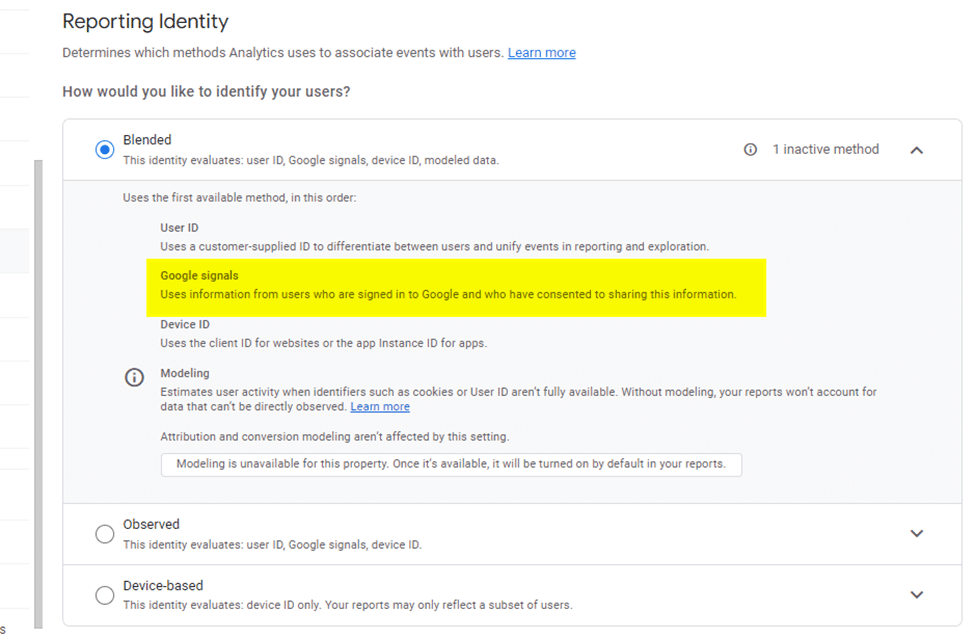
As part of the migration to GA4, website and app privacy policies must be reviewed. For sites that have enabled Google signals as part of the “Reporting Identity” and operate under the legal aspects of GDRP, this review is critical.

Reporting identity - Google signals

Embrace changes in your measurement approach

Once you get past the initial surprise of the new interface and understand why the top five complaints about it are actually positive improvements, you will likely begin to appreciate GA4.

While items are missing from the standard features, there is hope that Google will add these back in a future release. (The annotation tool and ability to save predefined segments from standard reports are missed by users.) 

Although many marketers widely consider the rollout of the GA4 upgrade as “one of the worst ever,” it brings improvements that will likely be embraced by most users within a few months.

The post 5 Google Analytics 4 ‘flaws’ that you can use to your advantage appeared first on Search Engine Land.

Original source: https://searchengineland.com/google-analytics-4-flaws-improvements-429418

Understanding the Financial Advantages of 3PL Warehouse Inventory Management

Home Business Magazine Online

In today’s rapidly evolving commercial environment, businesses must constantly seek out innovative ways to streamline operations and maintain a competitive edge. One such approach lies in leveraging the services of third-party logistics providers (3PLs). In particular, employing 3PLs for warehouse inventory management can offer a host of financial advantages.

3PL Warehouse Inventory

The realm of inventory management with 3PL warehouse services is vast and ripe with opportunities for businesses to tap into. The convenience of having a dedicated team of professionals handle inventory with precision, accuracy, and speed offers peace of mind for businesses. It means they can concentrate on the core areas that need their attention, knowing that their inventory is in capable hands. Moreover, it goes beyond just management—it’s about utilizing resources wisely, making data-driven decisions, and capitalizing on efficiencies that drive financial success. In a world where supply chain disruptions can drastically affect bottom lines, the stability and reliability that 3PL services offer are invaluable assets. As more businesses recognize these financial and operational benefits, the role of 3PLs in inventory management is only set to grow in importance.

Cost-Efficiency and Scalability

3PL warehouse services can provide significant cost savings, one of the most compelling financial benefits.

  1. Reduced Capital Expenditure: Investing in warehouse infrastructure, technology, and staff training can be a substantial financial burden for companies. By using a 3PL warehouse, businesses can reduce these capital expenses, as the 3PL provider takes on the responsibility of maintaining and updating the warehouse infrastructure.
  2. Scalability: With a 3PL, businesses can scale their warehouse space and logistics needs based on demand. This flexibility allows for efficient resource use, avoiding paying for unused space during slower periods and easily expanding capacity during peak seasons.
  3. Operational Cost Savings: 3PLs have specialized knowledge and systems to optimize warehouse operations, leading to decreased operational costs. Efficient inventory management can reduce waste and overstock situations, saving resources and funds.

Risk Mitigation and Enhanced Focus

Utilizing a 3PL warehouse for inventory management can also help mitigate risk and allow businesses to focus on their core competencies, offering long-term financial benefits.

  • Risk Mitigation: Inventory management carries inherent risks, including damage, theft, and obsolescence. 3PL providers have systems in place to minimize these risks, such as advanced security measures and effective inventory rotation strategies. The financial burden associated with these risks is thus transferred to the 3PL.
  • Enhanced Focus: By outsourcing inventory management to a 3PL, businesses can focus on their core operations, like product development, sales, and customer service. This enhanced focus can lead to improved products and services, potentially increasing revenue and profitability.

Investing in Technological Advancements

3PLs typically invest in the latest logistics and inventory management technologies, providing another financial advantage for businesses that use their services.

  • Access to Advanced Technology: With 3PLs, businesses can benefit from cutting-edge warehouse management systems, automation, and data analytics tools without making a significant investment.
  • Improved Accuracy and Efficiency: These technologies can significantly enhance inventory accuracy and operational efficiency, leading to faster order fulfillment, improved customer satisfaction, and ultimately, increased sales.

Strengthening Business Relationships and Increasing Market Reach

Partnering with an experienced 3PL provider can be beneficial in strengthening relationships with suppliers, customers, and other business partners. This advantage often translates to financial gains, contributing to the overall business health.

  • Improved Supplier Relations: A 3PL provider with an established network can negotiate better terms with suppliers, thanks to their volume leverage. These improved relations can lead to cost savings, higher quality service, and potentially advantageous payment terms.
  • Expanded Market Reach: With their extensive logistics networks, 3PLs can facilitate access to markets that might otherwise be challenging or costly to reach. This advantage can lead to increased sales, market share, and revenue growth.

Investing in Sustainability with 3PLs

In the current business environment, sustainability is not only a social responsibility but also a financial strategy. A growing number of consumers prefer to support companies with sustainable practices, and 3PLs can help businesses meet these expectations.

  1. Sustainable Operations: Many 3PLs implement environmentally friendly practices, such as efficient energy use and waste reduction. By leveraging these practices, companies can enhance their sustainability credentials, appealing to a wider customer base.
  2. Cost Savings: Sustainable practices often result in cost savings. For example, efficient energy use and waste reduction can lead to lower operational costs. Similarly, more efficient routing and load optimization can reduce fuel consumption, leading to savings in transportation costs.

In summary, partnering with a 3PL for warehouse inventory management provides numerous financial advantages. From cost efficiency and scalability to risk mitigation, focus enhancement, and access to advanced technology, these services can significantly boost a business’s financial health. Further advantages, such as strengthened business relationships, expanded market reach, and sustainability, reinforce the value of this strategic investment. In the face of growing market complexity and competition, engaging a 3PL can be a key driver for business success.

In Short

The 3PL warehouse inventory management offers multiple financial benefits, from direct cost savings to risk mitigation and increased operational focus. Moreover, these services grant businesses access to advanced technology that can lead to improved efficiency and customer satisfaction, driving increased sales and revenue. Thus, in an increasingly complex and competitive business landscape, investing in 3PL warehouse inventory management can be a strategic move towards achieving financial health and long-term success.

The post Understanding the Financial Advantages of 3PL Warehouse Inventory Management appeared first on Home Business Magazine.

Original source: https://homebusinessmag.com/management/operations/understanding-financial-advantages-3pl-warehouse-inventory-management/