Finances are a crucial aspect of any business and therefore need proper planning to help it move from one level to the next. If your company is doing great, but you don’t know how to manage your money, you might not see the impact of that growth.
There are many ways to handle finances, but it all depends on the type of business that you run. While hiring a good accountant for your company is essential, understanding your finances is even more critical.
Here are a few tips to help you with this in 2023.
1. Have Convenient Payment Options
Customers today have embraced everyday banking that allows them to make payments conveniently. A business serious about increasing its annual income will provide multiple payment options for clients to ensure they do not lock out anyone.
For example, modern everyday banking with Netspend visa prepaid cards is one of the payment options that customers who want to manage their spending can use. If you are keen on grabbing every customer, having that as an option will make you the better brand.
2. Do Not Mix Business and Personal Finances
One rule of thumb in any business is to avoid mixing personal and business money accounts. There should be a clear line between the two to ensure that you do not mix up the money and end up with unexplainable losses. Opening a business account and dedicating it to purely business funds will help you with your calculations.
You will see a clear distinction between how your company is doing financially and how your personal investments look. You can see where you need to improve by investing more time and energy. Paying yourself a salary instead of channeling your work income to your personal bank account is one way to create that separation.
3. Have the Basic Financial Documents
A company cannot run well without proper financial documents like a balance sheet, profit and loss statement, and cash flow statement. These three documents will outline your company’s financial position at any point and help you see the trajectory of your business.
You can get a professional accountant to help you create the documents or invest in good bookkeeping software. The goal is to have documents where you record all transactions to help you calculate the profits or losses for your company.
4. Monitor Your Money Movements
You could hire an accountant to manage your money, but you can only ensure that everything makes sense by monitoring the books. Know how each document works to understand how your money is moving.
A little financial knowledge will help you know when something is wrong with your business finances, and you can fix it before everything crumbles. If you are using bookkeeping software, learning to track money’s movements will help you optimize your capital and make profits.
5. Plan and Pay Your Taxes
Paying taxes is part of running a company and could jeopardize your establishment if ignored. Consult an expert to help you plan your taxes to avoid legal trouble. You should pay taxes based on your business structure, which is why talking to a professional is good. Also, taxes are time sensitive, and you should know when to pay to avoid penalties affecting your business finances.
Conclusion
Proper management of business finances can propel your company to the highest level possible. You should know where to inject your capital to see maximum growth for your business.
Also, a plan where the company funds its growth will help you avoid huge losses. Manage your business finances better today by following the above tips.
Advertisers have a responsibility not to promote content or engage in behavior that risks harm to our users, employees, or the Ads ecosystem. If we see such content or behavior, we may take action, including but not limited to restricting or blocking your ads or suspending your account.
Why we care. All advertisers, even those for Display and Video 360 must adhere to the policies or risk their accounts being suspended. You can review the full policies here.
Google is now rolling out two different Google search algorithm updates simultaneously, the December 2022 helpful content system and the December 2022 link spam update. The helpful content update started on December 5th, and the link spam update started on December 14th. Both updates are not finished rolling out, in fact, Google said that the helpful content update “is going to take longer” to complete than the two-week timeline previously given.
I asked several data providers to send me data on what they are seeing with the Google search results during these updates, keep in mind, it is somewhat hard to look at data in aggregate and say this ranking volatility is related to one update over another. But nevertheless, I wanted to share what the data providers are noticing.
Data providers
RankRanger. Let’s start with RankRanger who sent us data broken out by the start of each update. Generally, but not always, the first few days after an update is rolled out by Google is where you’d see the most volatility. So they went with that premise and sent us data on each update.
The December 2022 helpful content update was less impactful and less volatile than the first helpful content update, according to RankRanger. You can see from the chart below the average position change was less in December than in August.
Diving deeper, you can see that the average top three, top five and top ten search results, the data says the December update fluctuations were lower in the top five results and substantially lower in the top three.
RankRanger also showed the volatility of the December helpful content update by niche or industry:
The December 2022 link spam update was less impactful and less volatile than the July 2021 link spam update, according to RankRanger. You can see from the chart below the average position change was less in December than in July 2021.
Diving deeper, you can see that the average top three, top five and top ten search results, the data says the December update fluctuations were lower in the top five results and substantially lower in the top three.
RankRanger also showed the volatility of the December link spam update by niche or industry:
Semrush. The folks at Semrush did not try to break it out by the helpful content update versus link spam update, and I don’t blame them for not doing that. They just had their data for the past few weeks since that is when the two December algorithm updates began.
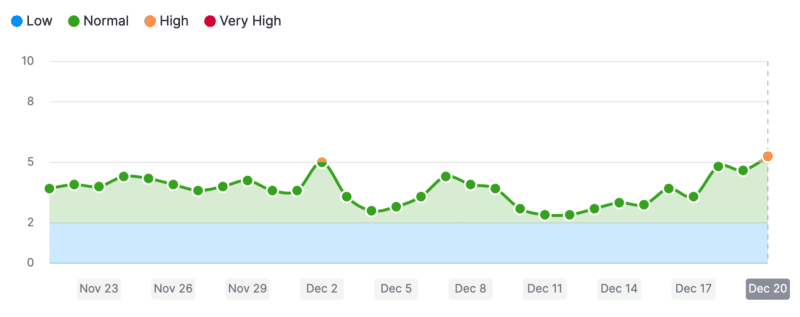
The Semrush sensor has been pretty calm, with a little blip today into the “high” volatility range:
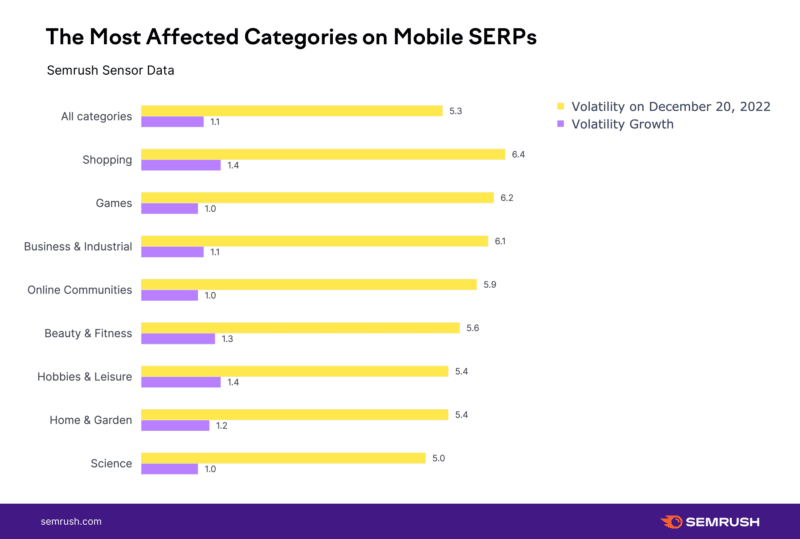
If you drill into each niche or industry, you will see some categories were more impacted than others. It is interesting to see it differ by mobile and desktop search:
SISTRIX. SISTRIX also sent over some data in a different format. Steve Paine from the company told us that they did find evidence of volatility in their data for the link spam update but when it came to the helpful content update, finding such evidence was harder. He said “overall there isn’t a huge movement in SERPs,” the company posted some examples on their blog.
SISTRIX sent me these two additional examples of specific sites hit by these updates:
Moz. Dr. Pete Meyer from Moz told us, “I’m seeing some pretty heavy algorithm flux over this past weekend,” but he has not have had enough time to dig through all the data. Overall, Moz data shows that it has been “a noisy month, Google-wise,” he said. The issue is that it “hasn’t been easy to separate things,” like the other data providers showed as well.
You can see that Mozcast showed a lot of hot weather on December 14th, which is likely related to the link spam update.
seoClarity. The folks at seoClarity sent me a graph showing the day-over-day change in Google search results they calculated across all the keywords in their data. They noticed a spike on December 2nd and then “gyrations” on the 7th, 8th, and 9th and then a massive change on December 15th.
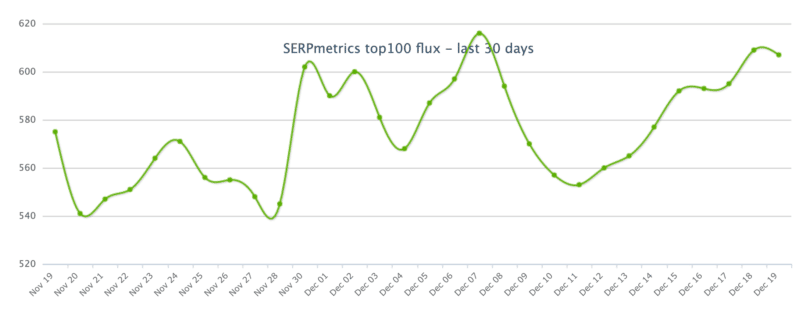
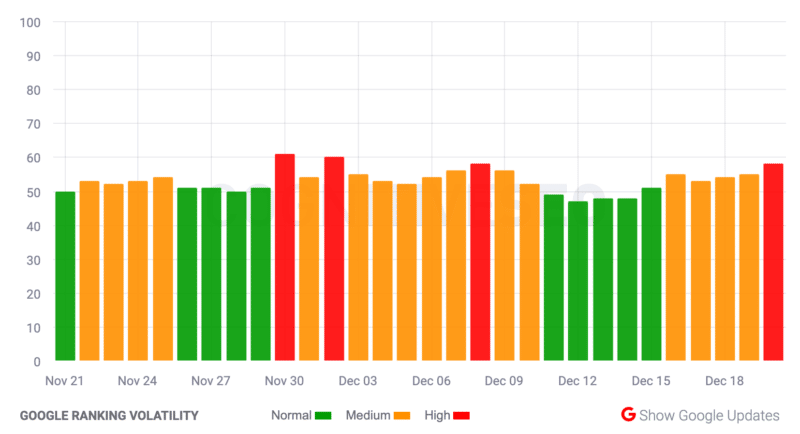
Other data providers. Here is a list of other data providers charts that are available publicly.
Why we care. As I said above, both updates are still rolling out at the time this was published. It is very hard to accurately say that one ranking change in aggregate is related to a specific ranking update when both are rolling out at the same time. That being said, it is likely easier to look at individual sites and know if the site was hit by a link algorithm versus a helpful content algorithm, especially if you look at the links and content for that site.
So you will need to do the due diligence and dig into sites impacted by each update on an individual basis. This just shows you that it appears that these updates did show movement and did cause ranking volatility in aggregate.
The supply chain is a critical part of any business. It’s the process that brings products and services from suppliers to customers. This process can be complex and involves many aspects, including transportation, warehousing, and distribution.
The security of the supply chain is essential to protect your business from evolving threats. As a business owner, you must understand the risks and implement the necessary security measures. Here are a few crucial steps to take to protect your business from evolving threats in the supply chain:
1. Comply with the National Institute of Standards and Technology (NIST) Cybersecurity Framework
Supply chains face countless threats due to the vast data that organizations need to move and share. Threats to the cyberinfrastructure of a company can have profound implications, both within the organization and with external partners. This is why complying with the NIST cybersecurity framework is so important.
Organizations can identify, protect, respond, and recover from potential cyber threats to supply chains when they adhere to these standards. The framework also allows organizations to stay ahead of evolving threats by providing security systems and protocols that predict future risks and vulnerabilities. You can read more about the NIST framework and how to implement it before going that route.
2. Conduct an Audit of Your Supply Chain Processes Regularly
Regular supply chain audits are essential to protect your business from evolving threats in many industries. Business owners or managers can stay one step ahead and continuously adapt their processes to the newest risks and threats.
Auditing keeps companies up-to-date with developments in laws, regulations, and supplier relationships. You also allow your business to monitor technology updates to deal with any changes efficiently.
Reviewing your business’s internal operations is critical, but an external audit provides valuable insights into potential risks. These risks include cybersecurity issues or foreign currency prices related to imports and exports. As threats continue to change, regular audits are essential for any company to maintain a competitive edge in the ever-evolving supply chain world.
Partnering with trusted service providers in the supply chain is an effective way for businesses to secure their operations from threats. Organizations can develop plans and proactive strategies to identify, address, and respond quickly to potential risks by creating relationships with reliable partners.
Trusted partners can also provide valuable insight into best practices for security and infrastructure, helping strengthen the overall supply chain’s resilience. Working together creates a collaborative network that puts everyone on the same page regarding security strategy, allowing you to implement safeguards quickly if any new threats arrive.
Before working with a service provider, check their qualifications. At a minimum, they should have certifications or licenses to provide the services your business requires.
4. Set a Contingency Plan
Complying with the NIST cybersecurity framework, auditing, and bringing in reliable partners can help to address evolving threats. Still, setting a contingency plan in place should be part of your plan.
It doesn’t matter how secure your supply chain processes are or how well you work with trusted partners. Some things can still go wrong, and preparing for unexpected issues is crucial.
For example, say a server crashes or hackers compromise one of your suppliers. An established contingency plan will make the recovery process more manageable. A backup plan safeguards your business so you can bounce back from any disruptions quickly and efficiently, minimizing any potential damage to your supply chain.
5. Employee Training
Implementing all the above strategies is key to protecting your supply chain from evolving threats. Still, your business is at risk without proper team member training.
Your employees are a crucial part of any supply chain. It’s vital to ensure they have the knowledge and skills to keep your operations running smoothly.
Providing cybersecurity best practices and compliance requirements helps your employees prepare themselves for any potential risks in the future. You also improve their capability in data collection and retention or vendor management.
Educating and training your team is essential to any comprehensive risk management strategy, so prioritize it in your business operations. Ongoing employee education and solid internal processes safeguard your supply chain to withstand any new threats that come its way.
Conclusion
Dealing with evolving threats in the supply chain is a continuous process that requires constant vigilance and attention. Partnering with trusted actors, developing a contingency plan, and prioritizing employee training ensure your supply chain remains resilient and responsive to new risks as they emerge. With these strategies, you can be confident in your ability to weather any challenge that comes your way.
Every year, over 40 million tons of electronic waste are generated worldwide. That’s almost equivalent to dumping 800 laptops in landfills every few seconds. While it’s great that technological advancements have allowed us to create impressive pieces of technology, it means that we’ve created more than what’s actually needed.
In particular, the rate of the manufacturing and production of these items has undoubtedly sped up the effects of global warming. That said, striking a balance between innovation and being environmentally responsible is important. Companies can do a lot to help in this mission. Here is a list of recommendations that can help protect the environment.
#1 Use of Recyclable Items
A million tons of electronic waste is dumped every year. You can use rechargeable batteries instead of alkaline batteries. You can charge USB batteries multiple times. Go for biodegradable products and stop using single-time-use plastic. You can use phone cases, water bottles, or daily-used items that are made of biodegradable substances. Use paper bags instead, or reuse plastic bags as much as possible.
#2 Use of Natural Source of Power
Cut the power consumption by switching to a renewable source of energy i.e., solar energy. You can use solar fans, solar-powered gadgets, solar lights, and solar panels to save electricity. ExpressVPN’s green tech list gives a detailed idea on saving energy and green tech! You can use solar batteries to power your gadgets. Nowadays, effective solar batteries are available that can back up power for a longer duration. So, cloudy weather will not be a problem anymore.
#3 Use of Smart Gadgets to Reduce Power Consumption
You can switch to smart gadgets that can be controlled remotely. Use sensor-based gadgets like LED bulbs, smart thermostats, and smart plugs that can be programmed according to your needs. Such gadgets have power auto cuts and automatically switch off when no one uses them for a longer duration. This will cut the cost of the electricity bill as well as save a lot of energy.
#4 Use of Homegrown Items to Cut Packaging Waste
You can grow your own veggies to consume. You can have your small garden to cater to your basic needs. Use home tools to cultivate them. Thus, this will help you to switch from packaged food and reduce a lot of packaging waste. Community cultivation will reduce plastic packaging and the use of artificial chemicals that harm the environment.
#5 Go for Electric Vehicles
Last but not least, go for electric vehicles like electric bikes, electric cars, and electric cycles. Though they are more expensive than the usual vehicles, they don’t emit high pollution. So, it will benefit the environment in the long run. You can gradually shift to electric cars and use electric chargers instead of using petroleum.
Final Words
Ideally, you have found this article on using green tech and implementing environmentally conscious practices helpful. You can read more amazing articles on the official website of Viebly. Do you have ideas on using green technology and ways to protect the environment? Share your valuable thoughts in the comments. We would love to hear from you.
Whilst standard cable assemblies might get the job done for certain simple installations, they often fail to meet the requirements of more complicated, specific applications. Every set-up and application will be slightly different, meaning custom cable assemblies are often required to provide satisfactory solutions.
Standard cable assemblies can be great, providing you with an easy solution for simple or generic applications. But if your application is unique, or particularly complex, you’ll likely require a custom cable assembly. By relying on out-of-the-box cable assemblies, and forcing them to conform to your requirements, you might encounter certain issues. You might experience a loss of efficiency, or potentially more severe technical issues that could result in damage to equipment, property, and even individuals.
Here’s a list of the numerous benefits of custom cable assemblies, as well as a brief description of what they actually are, and what their typical applications are.
What are custom cable assemblies?
A cable assembly in essence is just a group of cables bound together in a single unit for convenience. A single cable assembly might contain cables of varying lengths, colours and constructions.
Custom cable assemblies are just that: custom-made assemblies for the specific needs of a certain application or business. They’re not only made to order for the individual application but also designed specifically for the industry and purpose -everything from automotive components to medical devices.
Mainbenefits of custom cable assemblies
Accuracy
Custom cable assemblies can provide optimised and accurate cable setups for applications. This means that applications can run as intended, and without a loss of efficiency due to sub-par cable management. This is particularly vital for sensitive, or precise applications.
Flexibility
With a custom cable assembly, you can make small changes to your cable configurations as the requirements of your application change over time. This might include changes to the number of wires or the lengths of wires within the assemblies. With off-the-shelf cable assemblies, this simply wouldn’t be possible, and you’d have to invest in a whole new assembly if your changing requirements demanded it.
Materials
Investing in custom cable assemblies gives you complete control over the materials that go into the construction of the cables. You can ensure that high-quality materials are used for all wiring, in addition to being able to employ specific insulative materials for cable jackets when required.
Quality assurance
When required, custom cable assemblies can be manufactured using higher quality materials than certain standard solutions. Additionally, custom assemblies can also be tested in their actual usage environment, meaning you can guarantee suitability and functionality. With many standard cable assemblies, you really have no guarantee of suitability until you test them out yourself, especially if your application is unique.
Longevity
Custom assemblies often have a longer lifespan than standard cable assemblies because they aren’t mass-produced. Instead, they’re built specifically to fit your needs and work within your budget constraints while still providing all the functionality required by your application or system specifications. Customising each assembly helps ensure they’ll last longer without needing maintenance repairs later on down the road (which means less downtime).
Performance
Custom cable assemblies are designed, constructed, and tested with the specific usage requirements of your application in mind. This results in a level of performance and reliability which is often superior to that of standard cable assemblies.
Time-saving and ease of setup
You’d be forgiven if you initially thought an off-the-shelf solution was always quicker to set up and install. In many instances you’d be wrong. It can sometimes be very difficult to try and retrofit standard cable assemblies to specific applications, with some attempts being completely futile.
If your application requires it, you’ll save yourself time and money by opting for a custom cable assembly in the first place.
Minimise waste
When you use custom cable assemblies, everything is designed and constructed to the exact specifications of your usage requirements, meaning you’ll have the correct amount of each component, and there will be no trimming, cutting, or waste necessary.
Volumes
However many cables you need for your application, you’ll be able to get them when you work with a custom cable assemblies manufacturer. You won’t have to worry about a manufacturer of standard assemblies running out of stock, or charging you large amounts for high-volume orders.
Applications of custom cable assemblies
With all the benefits of custom cable assemblies, it’s no wonder they’re used for a wide range of critical applications where high performance is vital and technical issues cannot be allowed to interfere with functionality. Here’s a list of industries and applications that rely on custom cable assemblies:
Automotive
In the automotive industry, mass usage of custom cable assemblies is required to ensure the efficient assembly of the internal electronics of various vehicle types.
Medical
Hospitals and other medical facilities have very specific requirements for their cable assemblies. This ensures all equipment functions as intended and conditions such as temperature and humidity can be maintained at appropriate levels.
Artificial intelligence and industry 4.0
Industrial systems require a variety of sensors, scanners, and control systems to operate in accordance with industry 4.0. Custom cable assemblies are required for the efficient integration of these control systems.
Renewables and power distribution
Equipment for electricity generation such as wind turbines and solar panels, in addition to systems for power distribution and transmission, require extensive custom cable assemblies
Communications and telematics
We live in the information age, and the fast, efficient transmission of data has become an integral part of society. Custom cable assemblies are used to set up networks that facilitate this transfer of information.
Military
Ensuring military bases, and all the specialist equipment they contain, remain powered is critical for international security and the confidentiality of information. Custom cable assemblies are used to ensure these systems operate at an optimal capacity and are safeguarded against failure.
Final thoughts from Cornelius Electronics – A leading custom cable assembly manufacturer
If you’re looking for a custom cable assembly manufacturer, Cornelius Electronics asserts that they have you covered. They’ve been providing bespoke cable assembly solutions across a range of industries for over 40 years, and have built up a reputation for their quality of work.
Their team of skilled IPC-trained electricians offers the high-quality installation of custom cable solutions, manufactured at their state-of-the-art production facility, which is located in the UK.
By investing in a custom cable assembly, you may save time, money, and ensure your applications function exactly as intended.
Facebook is the most-used social media platform in the world. It boasts 2.96 billion monthly active users.
Most likely, you’re on Facebook and use it often. But is your business on Facebook?
Not only that, is your business on Facebook and using a content marketing strategy?
If your audience hangs out on the social media giant, you should answer “yes” to all of the above. Because just existing on Facebook isn’t enough.
If you want to tap into the potential reach you can achieve there, you need a plan. Goals. Consistency. You need to publish the right type of content at the right time.
Let’s look at how to set up your Facebook content marketing.
How Facebook can contribute to your brand’s overarching content marketing strategy
As part of an overarching content marketing strategy, publishing on Facebook can help grow your reach and build brand awareness. It can even drive more traffic to your website and generate leads.
Because of the sheer reach of Facebook, the opportunities for connecting with your audience are far and wide.
By establishing a brand presence there, you may be able to tap into segments of your audience that don’t exist anywhere else online.
By the way, you don’t have to spend a penny on Facebook content marketing if you don’t want to (or if you don’t have the budget).
As long as you have the means to create high-quality content, you can post that content (and distribute other types of content) for free on Facebook.
Initial steps for marketing on Facebook: Create a Facebook Business Page
Before we go any further, first make sure you have a Page set up on Facebook. You can’t market on the platform without one. That includes advertising, by the way.
A “Page” is Facebook-speak for a business profile. These differ significantly from personal profiles, as they offer unique and beneficial features and tools tailored for businesses.
Pages also showcase business-specific information that’s helpful to your audience and customers, like a call-to-action button you can tailor to your brand and what you’d like visitors to do (“Contact Us”, “Call Now”, “Sign Up”, etc.).
You’ll need to fill out some basic information about your business, including your brand name, brand category, and a short bio. Once you have a basic Page created, you can add more detailed information and customize it further to reflect your business.
Invite friends, peers, customers, etc. to like your page
Once you have your Page set up, a good first step is to invite your current customers, friends, peers, and whoever else might be interested in liking the page.
On Facebook, a Page like is equivalent to a follow. People who like your page will automatically see your posts in their feeds and be able to follow your activity, including all the content you post.
Sending out like invites is thus a quick way to notify your existing Facebook audience that you’ve established your business in a more official way there.
Get the daily newsletter search marketers rely on.
function getCookie(cname) {
let name = cname + “=”;
let decodedCookie = decodeURIComponent(document.cookie);
let ca = decodedCookie.split(‘;’);
for(let i = 0; i <ca.length; i++) {
let c = ca[i];
while (c.charAt(0) == ' ') {
c = c.substring(1);
}
if (c.indexOf(name) == 0) {
return c.substring(name.length, c.length);
}
}
return "";
}
document.getElementById('munchkinCookieInline').value = getCookie('_mkto_trk');
How to create a Facebook content marketing strategy
With your Page set up for your business, you can start planning out your Facebook content marketing strategy.
In general, this should mesh with your overarching content marketing strategy, with your website and blog set as priority #1.
Why do I not recommend focusing 100% of your content efforts on Facebook?
Why Facebook shouldn’t be your #1 content marketing channel
Because you don’t own your Facebook account – not like you own your website and the content that lives there.
In fact, any content you post to their platform is fair game. As soon as you post or share something, your rights to that content become very limited. Meanwhile, Facebook’s rights to that content expand like a balloon:
Building your platform entirely on the borrowed land of social media is a huge gamble. That’s why, even though you’ll spend a good amount of effort publishing content on Facebook, most of it should point back to your site.
For example, every content piece you post on Facebook can include links pointing to:
Your blog content.
An email newsletter sign-up page.
A lead magnet.
A specific landing page for a product or service.
TL;DR
Maintaining a presence on Facebook can and should build awareness around your brand and nurture leads, but it shouldn’t be the main focus of your content marketing.
Instead, set Facebook as the second or even third priority in your content plan, and ensure every major piece you publish there points back to your website in some way so you can capture leads.
With that out of the way, now we can get into building your strategy for content marketing on Facebook.
1. Set goals for your Facebook content marketing
What do you hope to achieve by content marketing on Facebook?
Figure this out before you do anything else. Your goals will drive every action you take as you build out the rest of your plan.
Don’t overcomplicate it, either. Your goals can be extremely simple, such as:
Drive more traffic to your website.
Build brand awareness.
Generate leads.
Then, decide how you’ll track and measure your goal(s). For example, you can use Google Analytics to track what percentage of your website visitors are coming from your Facebook posts or Page over time.
2. Define your Facebook marketing audience
With goals set, next, make sure you understand exactly what your audience looks like on Facebook.
If you’ve already done audience research for your larger marketing strategy, you can rely on that here, too. Just drill down deeper to discover what goals, challenges, preferences, and habits might be particular to the people who find you on Facebook versus other channels.
If you’re starting from square one, look for insights from 1:1 connections with people who fit the mold of your ideal customer. Interview them to discover what makes them tick, the kind of content they need, and how you can help them.
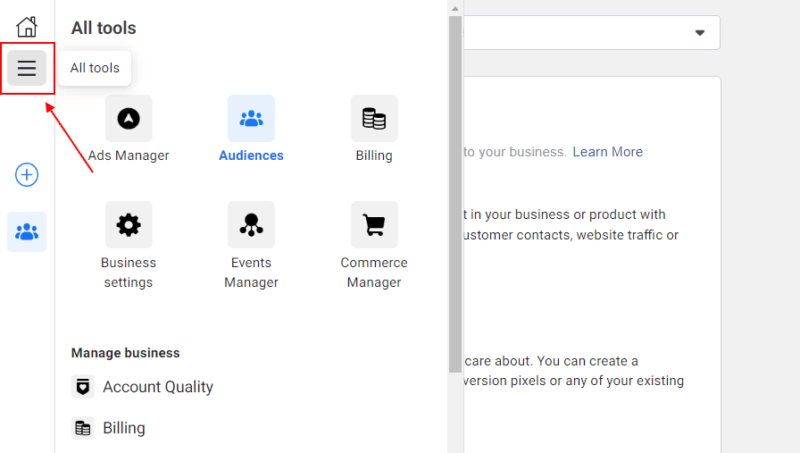
If you have a pool of existing Facebook followers, use the free Audience Insights tool to find out more about them, including demographics and behavioral data. To find it, go to the Ads Manager and click on the menu icon in the left toolbar (“All tools”).
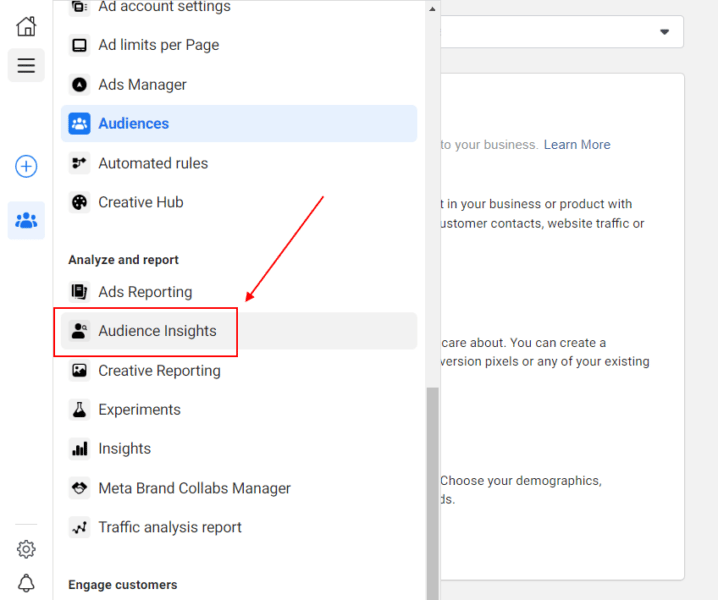
Then scroll down to the Analyze and report section and click Audience Insights.
By the way, Facebook has an official tutorial for using Audience Insights if you’re unsure where to start.
3. Decide what you’ll post and how often
Once you know who you’re creating for, you can nail down what types of content you’ll post and how often.
This is important to document because it:
Establishes accountability.
Keeps your efforts focused.
Let’s start with what you’ll post. To figure it out, consider these questions:
What kind of content does my audience crave, and what do they like to see on Facebook?
Example: Your audience might like to read in-depth text posts. Maybe they prefer shareable images and infographics. Or perhaps they want bite-sized tips and short videos. Or maybe they enjoy a mixture of all three!
If you’re unsure about which content types will land, experiment to see what sticks.
What topic areas can I focus on that lean on my expertise and help my audience?
Example: You sell content writing services for health food brands. Your content mainly focuses on providing content writing tips and tricks around health, wellness, and cooking.
Next, determine how often you’ll post, including when.
Keep in mind best practices for posting on social media as you decide.
Facebook recommends posting at least once per week, but most experts will tell you to post 1-2 times per day, with a max total of 3-7 posts per week.
Don’t post more often than your brand can handle, however. If you commit to posting too often without the staff, resources, or time to do it, your post quality will tank, which will also tank your reputation.
Lastly, schedule posts for a specific time of day, preferably when your audience is most likely to be browsing Facebook.
You can rely on stats to find optimal post times, or you can simply experiment to see what posting times get the best engagement from your particular audience.
4. Create and follow brand style guidelines
If you’re already posting content on other channels like a blog, you may have brand style guidelines defined at this point.
If you’re starting from scratch or don’t have any guidelines, however, your next step is to create some.
Brand style guidelines lay out the voice, tone, and personality of your brand. Anyone who creates content for your brand can follow the guidelines and write in your style so your content stays consistent (i.e., it always sounds like the same person is talking/communicating) across channels.
This will help your audience not only remember your brand but also associate your brand with a specific style.
Your brand style guidelines can include:
Your preferred brand voice (the personality of your brand).
Your preferred tone (how you sound when you write/speak/communicate).
Punctuation and grammar preferences (Oxford commas, anyone?).
Rules for how to use and refer to your brand name in content.
Rules for using visuals in content.
Rules for displaying your logo.
Rules for writing social media posts, including how to format captions, how to use hashtags, and how to use emojis.
Sources of inspiration.
Document them once and keep them updated. This is a tool you can and will use over and over as you create content for all of your channels, not just Facebook.
5. Create a social media calendar
How are you going to keep track of all of your Facebook post topics, including the day/time you’ll publish each one?
How will you stay ahead of creating and posting content, so you’re never last-minute scrambling to get a post ready?
You need a social media calendar.
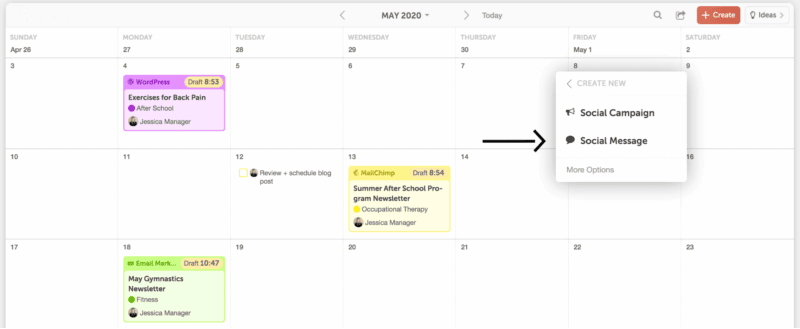
This handy tool is a must for every content strategy. Whether you use a simple spreadsheet or a more robust tool like Airtable, Trello, MeetEdgar, or CoSchedule, you need a calendar to organize, plan, and track your content pieces, including the day/time they’ll be published.
CoSchedule’s Marketing Calendar
Depending on your needs and the tool you choose, you can keep one calendar with tabs for each channel, or you can separate your calendars (one for your blog, one for Facebook, etc.).
A good calendar will include weekly and monthly views of your content schedule, so you can see the mix of content you have going out from a bird’s eye view. This helps you ensure you’re posting the right mix of formats with a good array of topics.
More advanced paid tools like MeetEdgar and CoSchedule even have features that let you schedule posts in advance, so you don’t have to worry about posting at the right times.
6. Engage
In the phrase “social media”, the main word is “social.”
That means, to be successful with content marketing on Facebook, you need to not just post, but also engage.
A few tips:
Be responsive. Respond as promptly as possible (within reason) to comments, tags, and messages.
Have conversations. Don’t be afraid to get more in-depth with your comments. Ask questions, offer ideas, and be friendly.
Give customer service. Depending on the business, many customers turn to Facebook to get in touch when they’re having a problem with a product or service. (64% of people would rather send a message than call a business.) Use customer service skills to address these.
Share and engage with others’ content. Keep what you share relevant to your audience, but do share, and don’t forget to drop likes and comments.
Hire help if necessary. Most brands hire social media managers for a reason: keeping up with all of the above plus posting regularly can be draining, and absolutely a full-time job.
7. Track and analyze results
Whatever your goals for content marketing on Facebook, you should track your progress toward them by periodically checking out relevant data.
For example, if your goal is to build your brand awareness, you might track Page views and Page likes – both of which you’ll find on Facebook’s built-in Page Insights.
Here you’ll also find a record of all the posts you’ve published, including metrics for each one like reach and engagement. This will be super useful as you’re fine-tuning the content types and topics you post.
The best Facebook post types for content marketing
For the highest engagement, you’ll probably need to post a mix of content types to Facebook and rotate through them. Here are your best bets.
Text posts
Although a myriad of post types have come to the forefront in recent years (short video! Live video! Stories!), text-only posts are still a strong standby.
This post type enjoys the highest engagement rate (0.13%) of all possible types, including videos.
Text-only posts are best kept short and sweet (short posts get the most views). Use them to share a hot take or ask a question.
Link posts
Link posts – you guessed it – include a link to content outside of Facebook.
This type of post is great for sharing your best blog content, a new product or service, a lead magnet, or even an email list sign-up page.
Sprinkle link posts throughout your content calendar to encourage your Facebook audience to visit your website. (If your website/blog is your primary content channel, this is the place where you will convert and capture leads.)
Photo posts
Photo posts feature a single image (or a carousel of images). They can include a short caption or hashtags and are the second-best type of post for engagement on Facebook.
Depending on your industry, there are lots of options for sharing photos: beautiful product photography, day-in-the-life snapshots, infographics, quotes, and more.
Videos
Videos are incredibly engaging and communicate like no other type of media. On Facebook, there are a few different video types you can post:
Short videos and reels: This format is Meta’s answer to the popularity of TikTok.
Live videos: Stream to your followers, who can watch you and comment/interact in real time.
Standard videos: You can also upload longer videos, such as tutorials, interviews, demos, or webinar recordings to Facebook.
Grow your reach with Facebook content marketing
Content marketing on Facebook is a worthy addition to your overarching marketing efforts.
The platform is the most-used social network in the world, hosting billions of users monthly.
If your audience uses Facebook (and they most likely do), you should maintain a consistent presence there with valuable content to engage their interest and nurture their connection.
The key is to focus on your website and blog content first and then use Facebook as a secondary channel to widen your reach.
With smart content strategy, you’ll be able to integrate and manage your Facebook content marketing with your blog content marketing so they connect seamlessly.
Ultimately, customers want to connect with the brands they like on social media. Don’t let that opportunity get away.
Google has retired Web Light, Google’s mechanism to serve pages and content faster, using a more lightweight version of that page, to those with slower internet connections. Google said, “while this feature has worked as intended and enabled broader access to the richness of the web, increased affordability of more powerful smartphones has diminished the need for such functionality.”
What was Web Light. Google launched Web Light in 2015 as Google Lite, which was designed to help those with slow mobile connections on their search results page. Google would take the page, remove a lot of the heavier images and media and just show the searcher the text of the page. In 2018, Google even added a Search Console filter to see what pages were being served over Web Light.
Google’s message. As noted above, Google said, “We introduced Web Light to enable us to serve faster, lighter pages to people searching on entry-level devices. While this feature has worked as intended and enabled broader access to the richness of the web, increased affordability of more powerful smartphones has diminished the need for such functionality. We remain committed to evolving and refining the Search experience to meet the changing needs of our users.”
Web light user agent retired. With this news, Google retired the user agent for Web Light named “googleweblight.” So you should no longer see this user agent showing up in your log files.
Documentation removed. Google has also removed the help documentation for web light, so the only way to access the docs is to go to the Wayback Machine.
Why we care. A lot of publishers were not huge fans of Web Light because some felt it resulted in less revenue or no revenue. Plus, publishers do not like when their web pages and content do not look as they expect. In any event, this feature has been retired going forward.
One of the responsibilities of a business is to handle different kinds of valuable information that includes financial information, customer data, and other important company documents. Securing these valuable assets is crucial to the success of a company, especially if you have a business website or a mobile app.
If a hacker were to steal customer information from your site because of lack of proper security measures, your business will become accountable and it may damage your company reputation. On the other hand, ensuring the security of digital assets can positively impact your bottom-line.
With that said, it’s only proper that you take some measures in protecting your digital assets. Take a look at the following strategies on how to do it.
1. Identify and List All Your Digital Assets
Even if you already have the maximum level of security and protection, there’s still a chance that some of your digital assets will either be stolen or exploited. Although you can minimize the damage by addressing the issue right away, it might be a challenging task if it was done discreetly. It is for this reason that you should always make a list of all your digital assets.
Start by identifying all assets then sort them in a particular order so you can easily track where they are stored. It’s critical that all these vital pieces of information should be compiled together and be accessible to update at the same time. By updating them regularly, you can easily spot any abnormality with any of the digital assets and then act fast to fix the issue.
2. Invest in a Secure Cloud Storage Solution
You don’t want your valuable customer or company data to be stolen by hackers. This is the kind of situation you would not want to happen, as it can cause permanent damage to your business’ reputation. As such, you need to invest in a secure cloud storage solution that ensures the protection of your digital assets from hackers.
Cloud storage is an essential tool that provides businesses with two essential benefits: easy data sharing and a secure platform where you can store, manage, and archive all kinds of data. It enables easy collaboration between different teams because the information can be accessed anywhere and anytime. Also, cloud storage solutions employ the best security measures in the platform to ensure the protection of valuable data.
There are tons of cloud storage services to choose from on the internet like Google Drive. But it is strongly recommended that you find the best alternatives for Google Drive that offer better security and advanced features when it comes to protecting your business data.
3. Backup Regularly
Data loss is a major issue when it comes to digital files. It even happens frequently because of different reasons such as human error or negligence that led to the compromise of your data. Of course, hacking is another common issue that you can’t possibly eliminate.
Since there’s no surefire way to prevent data loss, it’s critical that you always backup your company’s important files regularly. This will help ensure that you won’t lose all your digital assets in case something happens.
All you have to do is simply make a copy of the digital files and save them on an external hard drive or on a secure cloud storage platform.
As previously mentioned, human error is one of the main reasons why your digital assets could be at risk. Your employees may unintentionally leak valuable company data or they may fall victim to phishing scams.
Although you can train your employees to keep this from happening, educating them about cybersecurity is really not an easy undertaking. Your best option is to simply limit the number of employees who can access your digital assets. For instance, access to all valuable data should only be granted to the employees who truly require it.
Another reason why you should put some restrictions is that your employees may exploit the company’s digital assets for their own good. You can sue them if they use your business’ valuable data for their own profit. But if you had them sign a protective agreement, you may not be able to hold them accountable for such an illegal act.
Final Thoughts
Understanding the importance of digital assets to the success of your business is critical. Despite appearing to be ordinary files, they are the foundation of your firm. With the ever-growing number of cyber-attacks happening each day, it’s essential that you invest in ensuring the security and protection of your company’s digital assets.
As a small restaurant owner, you have to be creative and resourceful with your money. The industry is harsh, and it’s essential to save money wherever possible in today’s economy. Owner.com reviews some great ways to save money as a small restaurant owner:
1. Focus on Quality Ingredients
Quality ingredients are a must-have for any restaurant. Buying fresh, local ingredients is essential for success in the industry. Buying locally means fresher, better quality ingredients, and often it’s cheaper than buying from large suppliers. It also supports the community’s agricultural economy and helps reduce your carbon footprint.
Buying seasonal produce is another excellent way to save money. It can be cheaper than buying imported produce and will help ensure that the ingredients you’re using are high quality. It is also easy to keep your menu interesting, changing with the seasons.
2. Invest in Technology
Technology can be expensive, but it can also help you save money in the long run. Investing in restaurant management software to track your inventory and sales can help you identify where you’re losing money so that changes can be made quickly and effectively. This technology also helps streamline processes, helping you to save time and labor costs.
A point-of-sale system is another excellent way to keep track of your restaurant’s finances. It simplifies the checkout process for customers and helps you manage your inventory better by giving you real-time reports of what’s selling and what’s not.
3. Educate Your Staff
Educating your staff on the importance of following proper protocols and procedures in the restaurant can help save money by preventing costly errors or mistakes. Staff education can teach them how to properly control portions, track inventory, identify customer needs, and manage their time efficiently. Training your staff in customer service and food safety areas can also help reduce costs in the long run.
Having a team with clear expectations is essential for running a successful restaurant. By taking the time to train your employees properly, you’ll be able to save money and ensure that your restaurant runs smoothly.
4. Negotiate with Suppliers
Negotiating with restaurant suppliers is an excellent way to save money as a small restaurant owner. Don’t hesitate to ask for discounts or better terms on your orders. You can also look for new suppliers who offer lower prices than your current ones. Before deciding, research different vendors and compare their prices, delivery times, and terms. Building relationships with suppliers is also essential to get the best deals possible.
5. Cut Back on Wasteful Spending
Wasteful spending is a common problem in restaurants, but it’s something that needs to be addressed if you want to save money. There are several ways to cut back on spending, such as reducing portion sizes or ordering in bulk.
You should also be mindful of unnecessary expenses such as overstocking inventory, using too many napkins, or having excessive employee break times. Eliminating these costs can help ensure you’re making the most of your budget.
6. Utilize Online Marketing
Online marketing is a great way to reach more customers without spending too much money. Utilizing social media platforms, websites, and email campaigns are all cost-effective ways to promote your restaurant and get more customers in the door.
Having an online presence on restaurant review sites such as Yelp and TripAdvisor is also essential. This helps to increase your visibility and can help you attract more customers.
Final Thoughts
Running a small restaurant can be expensive, but there are plenty of ways to save money. By following the tips from owner.com reviews, you’ll be able to keep your costs low and ensure that your business is profitable. With proper planning and budgeting, you can ensure your restaurant is as successful as possible.