In recent years, the Danish finance market has seen a significant rise in the number of loan brokers. If you compare loans at Danish morebanker, you will realize that the Danish mortgage solution provides one of the lowest interest rates in Europe to borrowers and the lowest borrowing rates for the initial prioritized tranche of the property value due to its unique mortgage credit structure.
The integration of a closely regulated framework, credit and risk management, and wholesale funding via a pass-through system provides funding circumstances that are near to those of capital markets through the issuing of uniquely matched bonds for every borrower. The high liquidity and appeal of the bonds due to their high standard of security enable borrowers to pay affordable and competitive rates.
In this article, we’ll look at some aspects of why loan brokers are on the rise.
The Rise of Loan Brokers in Denmark
Loan brokers have become increasingly popular in Denmark in recent years. Where the banks are reluctant to offer loans, loan brokers offer an easy and effortless solution to lenders and borrowers alike.
For borrowers, loan brokers can provide access to a broader range of lenders, increasing the chances of getting a better deal. They can also save time and effort by doing the legwork on behalf of the borrower.
For lenders, loan brokers can provide access to a larger pool of potential borrowers, which can help reduce marketing and advertising costs. In addition, loan brokers can help to speed up the process of approving and disbursing loans. Moreover, loan brokers can help to create a more efficient and competitive market for loans.
Features of the Danish Mortgage Loan Industry
Danish mortgage loans are primarily standardized, and as a result, borrowers’ mortgage lending rates, as well as associated fees and commissions, are highly uniform. The uniform price is accompanied by nearly complete loan standardization, including removing disparities in credit risk amongst borrowers.
This is accomplished by a combination of regulations, including different loan-to-value criteria for commercial and retail borrowers, a measure of quantity rationing, and, to a lesser extent, separate fee structures for business borrowers. Consequently, even though all borrowers have exposure to market-based financing, the uniform pricing and standardization of Danish house mortgages ensure that the market clears through credit rationing instead of risk-based pricing.
The following are the most significant advantages of the Danish mortgage system:
Credit obligation for up to 3 decades.
Transparency in loan costs and payback terms.
Loans secured by mortgages on real estate are priced affordably and competitively in the market.
There is no prepayment penalty. The loan can be paid off by purchasing the underlying bonds at fair value.
The flexibility is perhaps the most impressive factor as mortgage institutions provide adjustable-rate, fixed-rate, and floating-rate loans.
In the Danish mortgage market, there are seven mortgage credit institutions. Some are associated with commercial banks (for example, Nordea Kredit and Realkredit Danmark), whereas others operate independently (e.g., Nykredit, BRFKredit). The five largest lenders control around 95% of the Danish market.
5 Tips for Finding the Best Loan Broker for You
1. Conduct research.
Like any other professional you’re considering dealing with, loan brokers require extensive research. To choose the best option, read reviews, seek recommendations, and compare alternative possibilities.
2. Determine what you require.
Before speaking with a loan broker, you should know exactly what type of loan you want and your financial goals. This will assist the broker in determining which products and services are ideal for you, saving you time in the long run.
3. Take into account fees and commissions.
When looking for a loan broker, inquire about any fees or commissions that may be charged. These can vary based on the type of loan you’re looking for and the broker, so it’s critical to get all the information before making any judgments.
4. Make a written record of everything.
Once you’ve selected a loan broker with whom you feel comfortable working, ensure that all the conditions and terms are written down before proceeding. This will assist in avoiding future misunderstandings and safeguard both parties involved.
5. Do some comparison shopping.
Even if you’ve discovered an excellent loan broker, you should still shop around and evaluate rates from various lenders before determining which loan is best for you.
To sum up, loan brokers are on the rise in the Danish finance market due to their beneficial effects on lenders and borrowers.
If you’re looking for something to do in your spare time that will also contribute productively to your life, then you might want to consider taking up a side hustle. These are little jobs that you do on the side of your regular job, simply to fill your time and get a little more money in your pocket. If you’re not sure what kind of things that you can do here, then it’s a good thing that you’ve come across this article. Down below, we’re going to be taking a look at some of the side hustles that you can consider taking up right now, so keep reading if you would like to find out more.
Starting a Blog
The first thing that we’re going to suggest is that you look into starting a blog. Now, a blog is something that is going to take some time to build up, so don’t start expecting miracles and seeing the money pour in straight away. You have got to remain consistent with this if you’re going to see results, posting content that people are interested in, and will continue to read.
You need to build up a following, and there are a few ways that this can be done. For example, you can make sure you stick to one kind of topic and then write posts about this more often than not. It will keep your blog quite niche, but at least you know the people reading are actually interested.
Driver
If you have passed your test and you have your own vehicle, then you might want to consider becoming some kind of driver. You can take up the mantle as a delivery driver during the hours that you are not working your regular job. There are always places that are hiring for delivery drivers, but you’re also technically self-employed with most companies so it’s the best of both worlds really.
Or, if you didn’t want to be a delivery driver you can consider becoming a taxi of sorts. Just make sure that if you’re going down this route that you have the right insurance such as rideshare insurance to ensure that you are covered in case anything happens.
Child Minding
Are you someone who loves kids, and has the necessary security checks? Or, would be willing to get the necessary checks to give the parents peace of mind? If the answer is yes, then childminding might be one that you should consider. You can do this in your spare time, working out when you’re available to work and when you’re not etc. You can also set your own rates, your own specifications and so on.
It’s important that if this is an option you want to pursue that you are good with children. What we mean by this is that if you know you have a short temper or you aren’t the best when it comes to being patient, then this might not be the route to go down. Make sure that you can get some recommendations and references before you try to get some clients, as they will want to see these before they hire you.
Dog Walking
Who doesn’t love dogs? Everyone loves dogs, and if you’re in need of a new way to get your exercise in for the day while making some money, this is a fantastic idea. You get to spend time walking around with dogs, playing fetch in parks and so much more, so what is there not to love? If you’re a dog person then this wouldn’t even be considered work, it would just be so much fun.
You can advertise this online, on social media, and on bulletin boards in local spaces. There is pretty much always someone looking for someone who is available to walk their dog, so you’re sure to get some attention. You can even set up your own little dedicated account on social media to attract more people.
We hope that you have found this article helpful, and now see some of the side hustle ideas that you can consider taking up in order to make some more money. Everyone could use a side hustle in their life. It’s just about finding the one that is right for you, suiting all of your needs. Now that you’ve got some ideas, you can get started on trying to get some more cash into your bank account each month. We wish you the very best of luck!
Google has updated its search quality raters guidelines for the second time in 2022, only four and a half months since its last update in July 2022. This revised document has some substantial changes to E-A-T, by adding an extra E to E-A-T for “experience.” The document is now about nine-pages longer, adding up to 176 pages up from 167 pages in the previous version.
Double-E-A-T. Yes, Google has added a letter to E-A-T, adding an extra E and going with E-E-A-T. This now stands for experience, expertise, authoritativeness, and trustworthiness.
Experience. What does the new E for experience add? Google said it adds another level of, a new dimension of quality to assess its search results. What is Google looking for with experience? Google said when you write the content, does that “content also demonstrate that it was produced with some degree of experience, such as with actual use of a product, having actually visited a place or communicating what a person experienced?”
Google explained that there are “some situations where really what you value most is content produced by someone who has first-hand, life experience on the topic at hand.”
Google shared this example, “if you’re looking for information on how to correctly fill out your tax returns, that’s probably a situation where you want to see content produced by an expert in the field of accounting. But if you’re looking for reviews of a tax preparation software, you might be looking for a different kind of information—maybe it’s a forum discussion from people who have experience with different services.”
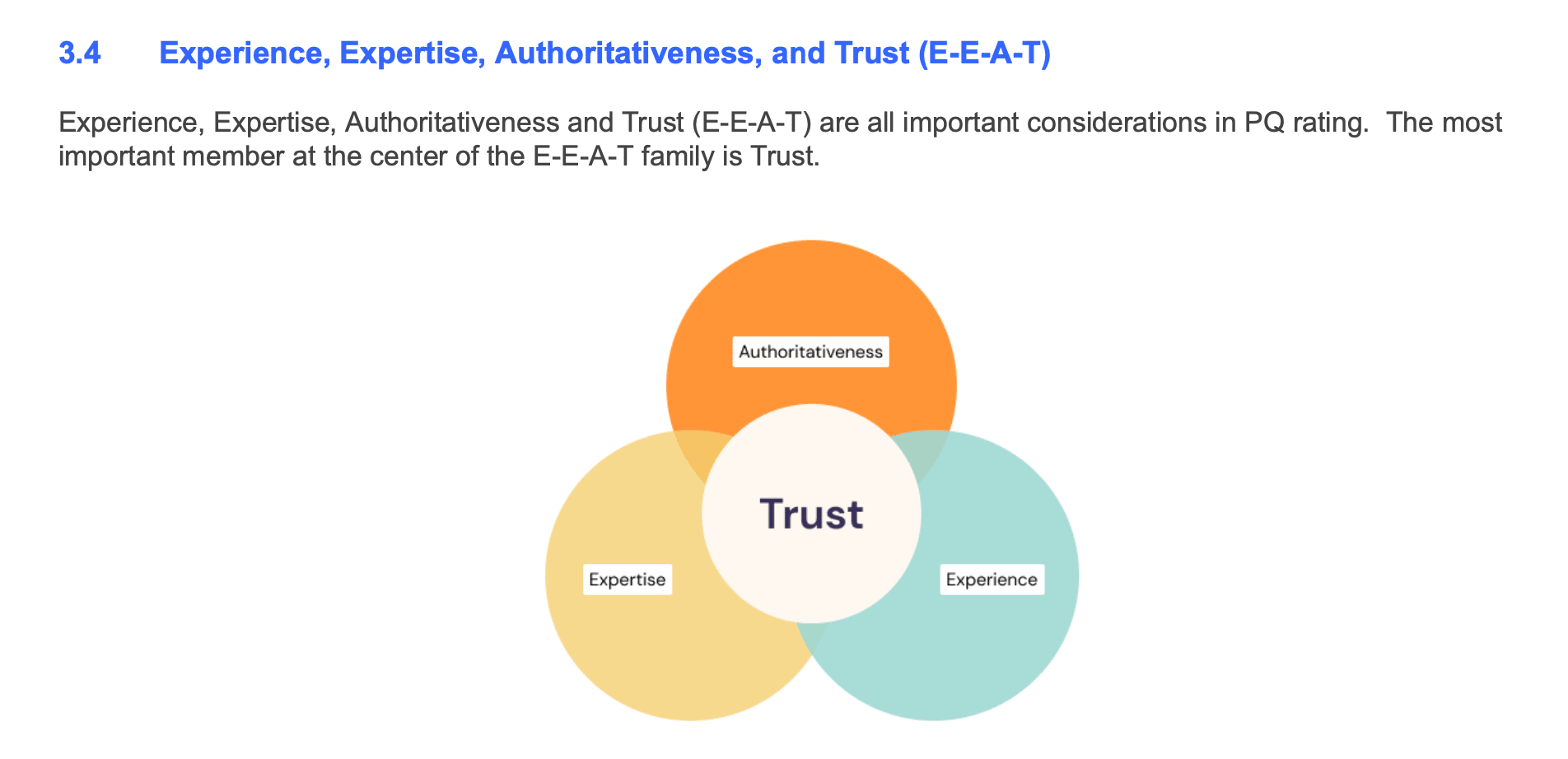
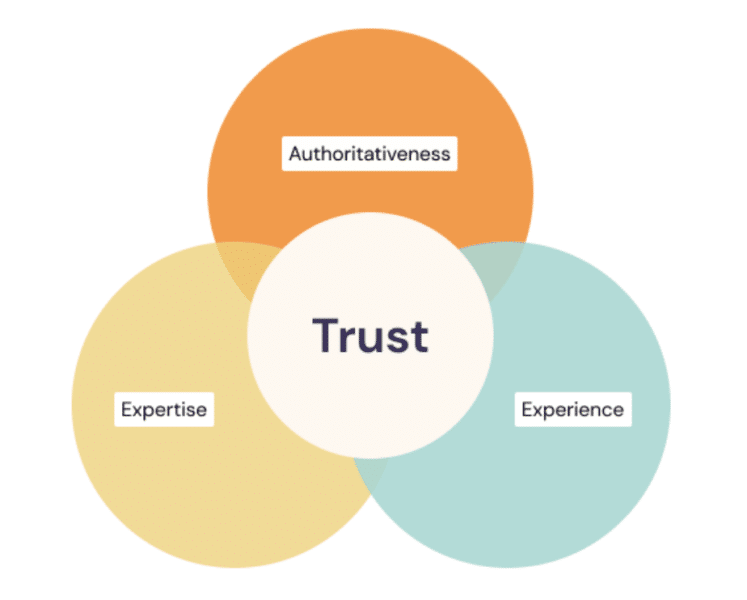
Google said in the updated guidelines that Experience, Expertise and Authoritativenessare important concepts that can support your assessment of trust, with trust being the most important member of E-E-A-T. Here is the diagram Google created to illustrate this on page 26 of the PDF:
Google said, “trust is the most important member of the E-E-A-T family because untrustworthy pages have low E-E-A-T no matter how Experienced, Expert, or Authoritative they may seem.” How does experience differ from expertise? Google said, “pages that share first-hand life experience on clear YMYL topics may be considered to have high E-E-A-T as long as the content is trustworthy, safe, and consistent with well-established expert consensus. In contrast, some types of YMYL information and advice must come from experts.”
One last example and there are many more, of experience mentioned in the guidelines is where Google said on page 51 where Google described when a page has low E-E-A-T when “the content creator lacks adequate experience, e.g. a restaurant review written by someone who has never eaten at the restaurant.”
What else was updated. Google notated on the final page of the revised PDF (download it here), these changes:
Broadly refreshed concepts and rating criteria in ‘Part 1: Page Quality Guideline’ to be more explicitly applicable to all types of websites and content creation models
Clarified guidance on ‘Finding Who is Responsible for the Website and Who Created the Content on the Page’ for different webpage types
Added summary table with the top ‘Page Quality Considerations’ involved in PQ rating, which carry through to each PQ rating section (Lowest to Highest)
Refined/expanded guidance on the following core pillars of Page Quality Rating:
‘Main Content Quality’
‘Reputation for Websites and Content Creators’
‘Experience, Expertise, Authoritativeness, and Trust (E-E-A-T)’
Reordered PQ rating sections from Lowest to Highest; streamlined transitions between these sections; de-duped existing guidance and examples as appropriate
Added more guidance and clarifications to sections: ‘Pages with Error Messages or No MC’, ‘Forums and Q&A Pages’, and ‘Page Quality Rating FAQs’
Reformatted lists of concepts and examples into tables (throughout/as appropriate)
Minor changes throughout (updated language, examples, and explanations for consistency across sections; removed outdated examples; fixed typos; etc.)
Why we care. Although search quality evaluators’ ratings do not directly impact rankings (as Google clarified in the document), they do provide feedback that helps Google improve its algorithms. It is important to spend some time looking at what Google changed in this updated version of the document and compare that to the previous version of the document to see if we can learn more about Google’s intent on what websites and web pages Google prefers to rank. Google made those additions, edits, and deletions for a reason.
The additional dimension of “experience” is an important one that Google has been hinting at for a long time. It is nice to see them document it and pull it out as one of the four core aspects of defining quality.
Google has made significant changes to its Quality Rater Guidelines (QRG) for search.
While Google updates this document several times per year, the latest version, updated today, came with notable changes to the structure of the document, with many new sections and tables added and a total of 11 new pages worth of content.
While there are dozens of important details about what changed, arguably the most important change was the introduction of the letter E to the start of the popular acronym E-A-T.
Introducing E-E-A-T
Google is now introducing the concept of E-E-A-T, which stands for
Experience.
Expertise.
Authoritativeness.
Trustworthiness.
The addition of “experience” indicates that content quality can also be evaluated through the lens of understanding the extent to which the content creator has first-hand experience in the topic.
With this reframing of E-E-A-T, Google also states that “trust” is at the center of this concept and is the “most important member of the E-E-A-T family.”
Google also provides many more clear examples of important concepts, such as:
Evaluating the reputation of websites and content contributors.
The extent to which E-E-A-T matters and how it should be evaluated.
What it means for content to be harmful.
More inclusive language and granularity
Google appears to be evolving its language to be more inclusive and keep up with the times. It added many new mentions of social media platforms, influencers, and how content can take different forms, such as video, UGC, and social media posts.
In this version, Google also takes a granular approach in answering many common questions about how E-E-A-T works and how much it matters for different topics. Google spells out what content should be considered harmful and whether everyday experience is sufficient to produce trustworthy content for the topic at hand.
There are many more changes than what is outlined below.
All SEOs should take time to read through Google’s new guidelines, as they serve as a representation of where Google wants its algorithms to go.
Get the daily newsletter search marketers rely on.
function getCookie(cname) {
let name = cname + “=”;
let decodedCookie = decodeURIComponent(document.cookie);
let ca = decodedCookie.split(‘;’);
for(let i = 0; i <ca.length; i++) {
let c = ca[i];
while (c.charAt(0) == ' ') {
c = c.substring(1);
}
if (c.indexOf(name) == 0) {
return c.substring(name.length, c.length);
}
}
return "";
}
document.getElementById('munchkinCookieInline').value = getCookie('_mkto_trk');
The most significant changes to the QRG
Below are some of the most significant changes to the Search Quality Guidelines in December 2022, broken down by section.
Understanding the Website – Section 2.5
Google updated its guidelines around identifying who operates a website. In the new QRG, Google added the following new guidance:
“Start by finding out who is responsible for the website and who created the content on the page… Then, look for information about the website and/or content creators on the website itself.” (page 15)
This addition implies that it’s important to know who actually owns and operates the website, even if that relationship is not directly clear on the site.
Google also began to refer to the reputation of the “website and/or content creators” instead of just the website, indicating that the reputation of the people contributing content to the website should also factor into consideration when evaluating that website.
Finding Who is Responsible for the Website and Who Created the Content on the Page – Section 2.5.2
When identifying who is responsible for a website, Google states it should be clear who owns the website.
In the previous version of the QRG, Google asked raters to look for which “individual, company, business, foundation, etc.” is responsible for the site.
In this version, Google replaced “foundation” with “organization” and “government agency.”
Google also added:
“…for pages on websites such as forums and social media platforms, people may post content using an alias or username in order to avoid sharing personally identifiable information online. In these cases, the alias or username is an acceptable way to identify the content creator.”
Google also added a brand new table to help quality raters identify who created the main content on a webpage.
Page 17
This table helps raters identify who is responsible for the content on various types of sites, given that some websites entirely control their own content, while others are comprised primarily of user-generated content or contributions from authors.
Google seems to be focused on distinguishing the website owner from the content contributor(s) on that site.
Overall Page Quality Rating – Section 3.0
Google significantly shifted around the order of some of its advice related to rating page quality and analyzing reputation information.
The updated QRG offers a new 3-step process for assessing Page Quality:
Assessing the true purpose of the page and how harmful/deceptive it is
Assessing the potential of the page to cause harm or otherwise be untrustworthy or spammy
(If the rater determines the pages are harmful, untrustworthy or spammy, they should rate them Lowest quality)
If the page is not harmful, the quality rating is based on how well the page achieves its purpose
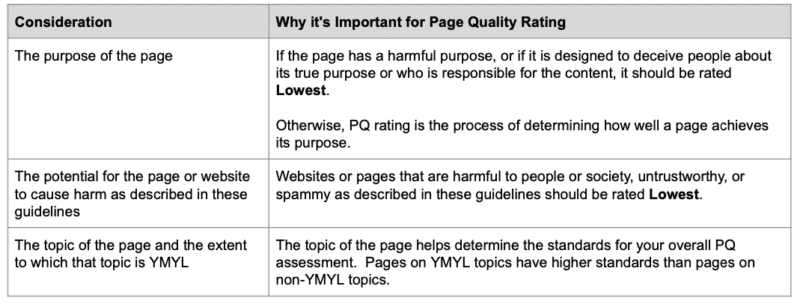
Google also added a new table to consider when evaluating page quality:
Page 19
Page 20
The third consideration asks the rater to consider the “extent to which the topic of the page is YMYL.” This refers to the spectrum of YMYL topics referenced in the previous version (based on their ability to cause harm to the user).
Google introduced a new consideration for understanding the type of website. Some of these considerations include whether the website:
Is a hobbyist site or corporate.
Involves financial transactions or requires payments
Is supported by volunteers or by professionals.
Different types of websites have different page quality expectations
Google also indicated that while ads are necessary for many sites to monetize, the “ways in which ads contribute to user experience”are a consideration for page quality.
As stated in previous sections, the reputation of the website and its content creators contributes to page quality.
And lastly, we have the most significant reveal of the updated Quality Rater Guidelines: E-E-A-T: Experience, Expertise, and Authoritativeness and Trust.
Quality of the Main Content – 3.2
Google made some important changes to how raters should assess the quality of a page’s main content.
In the previous version (page 24), Google stated:
“For all types of webpages, creating high quality MC takes a significant amount of at least one of the following: time, effort, expertise, and talent/skill.”
In the new version (page 22), Google removed the word “time” and added the word “originality.”
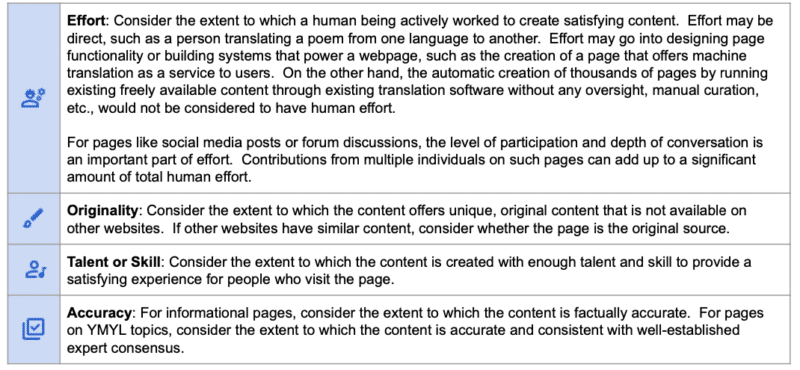
“For most pages, the quality of the MC can be determined by the amount of effort, originality, and talent or skill that went into the creation of the content.”
Google also added a new table to this section, outlining how to assess page quality:
Page 21
Google’s increased focus on effort with a clear explanation of what effort looks like (and doesn’t look like) is a big update to this version of the QRG.
Google seems to be asking raters to focus on how much actual work went into building the content, as opposed to tactics that use automation without oversight or manual curation.
Google is also increasingly focused on the originality of the content and the presence of insights not found elsewhere.
As with previous versions of the QRG, Google also states that accuracy and alignment with expert consensus are important for YMYL topics.
Reputation of the Website and Content Creators – Section 3.3
Google enhanced its recommendations for understanding the reputation of both a website and its content creators.
One important addition is that reputation research depends on the topic of the page content. Google asks raters to think about the reputation of the content creators “in the context of what the page is about.”
The below paragraph is important for understanding this concept:
Page 22
Google also added an important new detail about websites or content creators that create content across many different websites.
In these cases, the quality rater should consider the “underlying company or the content creator,” which means they can look across different websites to obtain reputation information.
Reputation of the Content Creators – 3.3.4
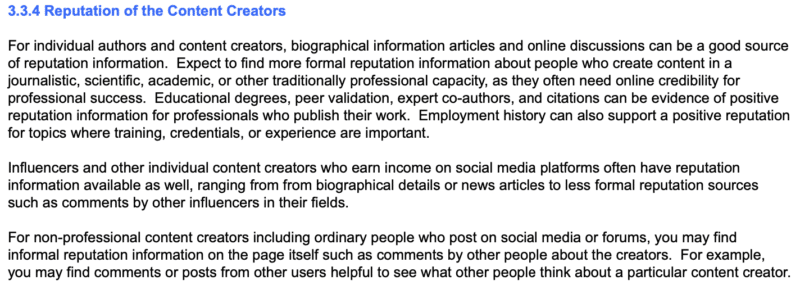
Google expanded its guidelines around identifying the reputation of individual authors and content creators.
This entire section is new and shows how much Google is focused on the reputation of individual content creators (they even mention influencers!):
Page 25
Experience, Expertise, Authoritativeness, and Trust (E-E-A-T) – Section 3.4
Google’s E-A-T has been a hot topic in the SEO community for the past few years. This version of the Quality Rater Guidelines introduces a new, evolved version of E-A-T:
E-E-A-T: Experience, Expertise, Authority and Trust
Along with introducing an extra letter – E for experience – Google now also places “trust” at the center of this ‘family’ of important considerations for page quality.
According to Google (page 27):
“Trust is the most important member of the E-E-A-T family because untrustworthy pages have low E-E-A-T no matter how Experienced, Expert, or Authoritative they may seem.”
Trust is the mechanism by which raters determine if the page is “accurate, honest, safe, and reliable” (page 27). The amount of trust a page requires depends entirely on the nature of the page.
Google provides the example of online stores, which require secure online payment systems and good customer service. It also mentions product review sites – a trustworthy review would help searchers make informed decisions rather than just try to sell the product.
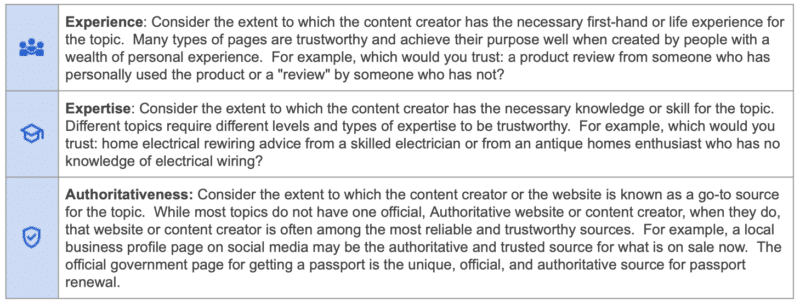
Google introduced a new table to help raters understand how to approach experience, expertise and authoritativeness:
Page 26
The introduction of “experience” to the concept of E-A-T is consistent with many of Google’s updates and communications throughout the past couple of years, particularly related to product review content.
Google focuses on the extent to which content creators have “necessary first-hand of life experience for the topic.” Having significant experience lends itself to trust.
Google uses the example of a product review – someone who has personally used the product has more experience than someone who has not, therefore creating more trust.
For evaluating Trust, the most important “member of the E-E-A-T family,” raters should consider:
What the website says about itself on its About Page or other profile pages.
What others say about the website or its content creators (third-party reviews or references).
What is visible on the page – actual evidence on the page that the content creator can be trusted (e.g., real evidence of them doing the thing they claim to be an expert in).
Google also adds a new important detail about conflicts of interest. A review by the product manufacturer is not trustworthy, nor is the review of an influencer paid to promote the product.
YMYL Topics: Experience or Expertise? – 3.4.1
Google introduced a new table to distinguish when Experience or Expertise is needed for YMYL content. This table aims to answer whether everyday experience or actual expertise is needed for various topics, such as medical conditions, voting, and saving for retirement:
Page 28
This new section indicates that just because a content contributor is not a bonafide expert on a YMYL topic, this does not make the content inherently untrustworthy.
People sharing their stories based on first-hand experience can be considered trustworthy content in certain situations.
Harmful to Self or Other Individuals – Section 4.2
In the previous version of the QRG, Google introduced the notion that YMYL topics are determined based on their ability to cause harm to the user.
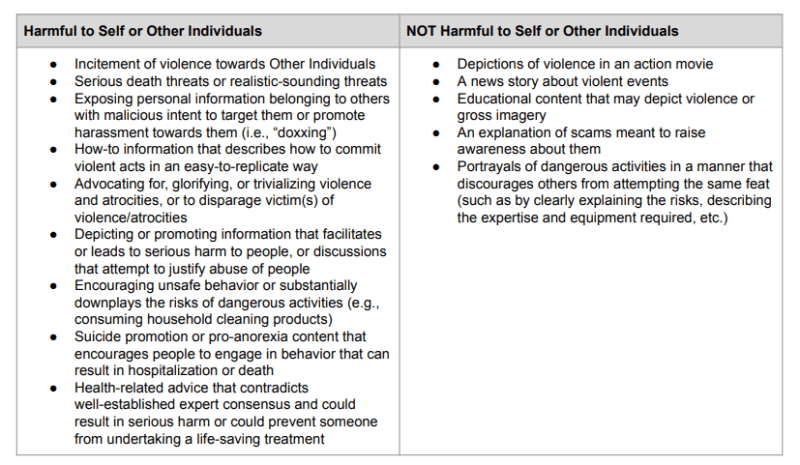
In this new version, Google provided a detailed table with examples of what is considered harmful or not:
Page 32
And a similar table explaining what it means for content to be harmful to groups:
Page 33
These nuances are interesting, given much of the public discourse about freedom of speech across various social platforms in 2022.
Google appears to be drawing a clear line between free speech and violent/harassment speech in its definition of harmful content.
Google also provides clear examples of “harmfully misleading information,” including several popular internet conspiracy theories that are either clearly inaccurate, contradict well-established expert consensus, or are unsubstantiated:
Page 34
Lacking E-E-A-T – Section 5.1
Google provides examples of what it looks like to lack an appropriate level of E-E-A-T for the topic or purpose of the page. These are the examples provided (page 51):
“The content creator lacks adequate experience, e.g. a restaurant review written by someone who has never eaten at the restaurant
The content creator lacks adequate expertise, e.g. an article about how to skydive written by someone with no expertise in the subject
The website or content creator is not an authoritative or trustworthy source for the topic of the page, e.g. tax form downloads provided on a cooking website.
The page or website is not trustworthy for its purpose, e.g. a shopping page with minimal customer service information”
These examples help conceptualize the distinct roles that each letter in E-E-A-T play in evaluating the page quality.
Language updates throughout the document
Throughout the document, Google appears to be editing its language to be more inclusive, such as changing “webmaster” to “website owners” and removing some gendered pronouns (“himself/herself” becomes “themself”).
Pay attention to where Google is going with the QRG
The Quality Rater Guidelines are a crucial document for anyone who works in search marketing because they give us a guidebook for where Google wants its algorithms to go.
Reading between the lines of the language in this document can help inform what Google is looking for in terms of content quality, user experience, and E-E-A-T of websites.
Following these guidelines will help ensure your site and company can achieve visibility in Google search and, ideally, not be negatively impacted by any of their algorithm updates or other penalties.
According to consumer group Which?, many Christmas lights being sold online may not meet UK electrical equipment safety regulations, making them not only dangerous, but illegal.
Which? Tested lights from four retailers – eBay, Amazon, Wish and AliExpress. Shockingly, they found 10 of the 12 sets tested failed to meet UK safety regulations. With the price of each set of lights falling below £15, there is worry that the affordability of these could afford to more consumers buying lights with electrical faults or that fall below regulator standards.
All companies have now removed the lights from their websites, suggesting they take safety extremely seriously. Two sets from both eBay and Amazon failed compliance checks. They were either missing key safety markings or failed to come with instructions.
The consumer group is now calling for online marketplaces to take more responsibility. In fact, Which? Is suggesting legal responsibility be taken in order to stop illegal and unsafe products from being sold to consumers.
The risks
According to Berkshire Fire and Rescue, approximately 60% of house fires are caused by faulty electrical goods.
Some of the lights tested by Which? were found to have easily exposed wires posing a risk electric shock, as well as being a fire hazard. The same lights, sold by retailer Wish were also advertised as being waterproof, but with no evidence found by Which? to back this, the idea of false and misleading advertising when it comes to electrical safety is an extremely worrying prospect.
Which? Recommend that people buy Christmas lights from the high street or directly from a retailer that they recognise.
How to stay safe
Which? give some great tips for staying safe online:
Check your lights aren’t damaged when unpacking your decorations.
Look for things like loose wires, smashed bulbs or a broken control box.
If your lights need replacement bulbs, make sure you use the same type when you replace them.
Switch your lights off when you go out and when you go to bed.
Keep your lights away from anything that can burn easily.
If your lights look like they’ve seen better days, recycle them and buy a new set from an online or high street retailer you trust.
Sue Davies, head of Consumer Protection Policy, said:
“Cheap Christmas lights could be tempting for many of us trying to save money amid the cost of living crisis – but our latest research shows consumers could be putting themselves in danger due to online marketplaces failing to take safety seriously.
“The government must make online marketplaces legally responsible for dangerous and illegal products sold through their sites so that people are better protected.”
Once again, the Bank of England is expected to announce increased interest rates. This will be the ninth consecutive hike in the last year, since December 2021. The latest meeting by the Monetary Policy Committee has resulted in an increased benchmark rate.
The benchmark rate currently stands at 3%, but is forecast to increase to 3.5%. The rate is already at its highest rate for 14 years, after it was increased in November from 2.25% to 3%, the sharpest single increase since 1989. These increases will be felt by both borrowers and savers across the UK.
But with forecasts of interest rates peaking at 4.5% next year, how do increases affect you exactly? Here, we will discuss how these changes could impact your finances.
After a period of low-interest rates, those with a mortgage are now facing increased monthly repayments as a result of high-interest rates. From next year, around 4 million households will face more expensive mortgages, according to the Bank of England.
When the interest rate rise comes into force, approximately 1.6 million people will be impacted. These are mainly the people on variable and tracker mortgages. Half a percentage point added onto to the current rate of 3% will mean an added £49 a month for those n a typical tracker mortgage. Those on a standard variable rate mortgage could see £31 per month being added to their current payment.
On average, those on an average tracker mortgage are paying £333 more monthly compared to December 2021. This amount stands at £210 more per month for those on variable mortgages. This is an additional £3,996 and £2,520 being added to mortgages annually on average over the past 12 months.
In terms of fixed deals, they have also increased. An average two-year fixed deal stood at 2.29% in November 2021. This is now an average of just under 6%, adding hundreds of pounds of repayments monthly.
Savings
Banks and building societies are in charge of the interest rates they offer on their savings accounts. Although interest rates are the highest we have seen in many years, due to inflation outpacing these rates, the amount of money in cash savings accounts is losing value, in real terms.
This means the buying power of your money is still reducing due to inflated prices for good and services.
Credit and loans
Credit cards and loans are also impacted by the Bank of England Interest Rates. Loans could be car loans, bank loans or even debts.
In October of this year, the average annual interest rate on bank overdrafts was a whopping 20.73%. For credit cards, the annual interest rate was averaging at 19.31%, another eyewatering figure. This means it becomes more expensive to borrow money, and debt may grow.
Lenders may even choose to get ahead of increases and put their interest rates up further.
Can you claim tax back when you work from home? It’s cold, gloomy and the days are shorter than we may like. Snow has fallen in many parts of the UK, with many opting to work from home during this period to avoid traffic and delays on their commutes.
But with this comes the worry of energy prices being shifted from employers to employees. Working from home uses far more energy for the worker – from making cups of tea to charging mobile phones, laptops, tablets, and having lights on. It all adds up, with a higher cost being placed on those usually in an office or workplace.
Ofgem, the energy regulator within the UK, recently increased the energy price cap to £3,549 per year for dual fuel for an average household in October 2022. This has caused widespread worry for millions of households across the country. Plus, HMRC have closed phone lines and online services in recent weeks as the result of technical issues, leaving many Brits in limbo, with urgent queries about their tax returns.
What does it cost to work from home?
A recent study by leading tax-refund app, Tommy’s Tax found that 50% of Brits say the cost-of-living crisis is severely crippling their personal finances. Thus, many people are desperate for the tax-refunds they deserve in the current climate.
Half of the working population worked remotely during the peak of the pandemic and associated lockdowns, with 84% planning to continue their at-home work life, according to the Office for National Statistics (ONS). Additionally, reports show that under the current energy price cap, an 8-hour day working from home could cost more than £30 per day – a huge hidden fee.
These costs are hidden, including heating, electricity and broadband connection costs. Improving tax literacy could provide taxpayers with the means to access tax returns without delay, and help those working from home both permanently and on a flexible basis, say Tommy’s Tax.
understanding tax
The research from Tommy’s Tax further found that over one third of Brits (36%) say tax is a topic in life they understand very little about. Just over one quarter of respondents (26%) said they haven’t even thought about their tax bill.
Tommy’s Tax encourage workers to discuss the cost of working from home with their employers. It is up to the employer whether they want to make payments for any additional costs incurred as the result of remote working. The payments are tax-exempt, so some employers may be encouraged to make these payments.
The tax-refund app also suggest that workers may be able to claim a flat rate tax relief of £6 per week. This is to help with the cost of energy and other costs associated with working from home. To claim this, workers do not need to keep receipts, however you must be contractually required to work from home – for example, if your employer does not have a physical office or workspace for you to use.
If workers keep receipts for utility bills such as gas, electricity and the internet, and be able to identify any changes that have occurred as the result of working from home, they may be able to claim tax relief on this. It is a more intrusive approach, but could result in a large amount being received back as the result.
Tommy Mcnally, CEO of Tommys Tax, says:
“The recent drop in temperatures has highlighted to many that there are lots of hidden costs related to working from home. While it may seem that workers are saving in lieu of not having to commute, they may be paying more than they expect when working from home in the form of gas, heating, electricity, broadband and so on. Here at Tommys Tax, we want to highlight that Brits can claim back tax in relation to nearly all of these costs.
“The issue is that there still is a huge knowledge gap when it comes to taxes, and our proprietary research highlights this. It’s more important than ever to stay well-informed in relation to taxes and what workers can claim back when it comes to their line of work.
“That is why we’re here to help with the entire process for workers across the country. One of the ways we help is by educating customers about the various tax rebates that people are eligible for, but don’t make use of and that is where we’re here to help. Taxes can be boring, confusing and anxiety-inducing, but if done right could make a real difference to people’s lives.”
Since cannabis’s medicinal uses and health benefits have spread far beyond the confines of the traditional pharmaceutical industry, many governments are considering legalizing marijuana plantation for general use.
As a result, many home growers and entrepreneurs see it as an excellent opportunity to prepare themselves for seed planting and cultivation. One can also find adequate information regarding the various strains and varieties of cannabis more easily at farmerslabseeds.com with convenient details regarding how to buy cannabis seeds online.
The Most Reliable Seeds
Some of the best-known seeds, with a long track record of producing high-quality yields in a wide range of species, are as follows:
1. The Girl Scout cookies are, overall, considered to be the best marijuana seeds. It is a cross between OG Kush and Durban Poison. The primary effects of this hybrid are euphoria and physical relaxation. It’s not for novice users, but those with a high tolerance from smoking will enjoy its potency. The flowering process takes 10–14 weeks. The GSC is superior to other species because of its resistance to disease and its resilience. The strain thrives best in warm, dry climates, but it is more commonly grown in wetter climates, such as the Pacific Northwest.
They are also great for indoor growing as they are both feminized and auto-flowering, especially if one does not wish to deal with timers and light cycles. But, because of the high levels of caryophyllene present in them, a robust peppery terpene may be pungent when GSC flowers. There is also rarely any need to be concerned about a lack of space, as they grow into stout but compact plants that produce dense and resin-packed buds weighing over 420 grams when properly cared for. As for the correct techniques, one may use the “sea of green” strategy, that is, instead of growing a few plants tall, one keeps them as small as possible using the dense-packing method. This makes it possible to get more grams per square foot and to cut the time it takes to flower to at least 45 days, which speeds up the harvest.
2. The next one on the list is the White Widow Feminized. Funnily enough, its origins are as of yet unknown. Being a hybrid that is well balanced, it just takes about 8 weeks to flower and fares very well outdoors. Also, it does not succumb to bud rot or other diseases. Suffice it to say that this strain, being immensely resilient, makes a perfect choice for novice growers.
It is known to be extremely potent and to greatly stimulate the brain. It is excellent for relaxation therapy and buzz reduction. One may get about 350–400 grams from each plant. If planting indoors, one may look for the auto-flowering version for those unwilling to keep up with light timers and schedules.
Photo by Kindel Media from Pexels
3. The next is Jack Herer Fast Feminized, which flowers the fastest yet, within 6-7 weeks, and is comparatively very easy to grow. In this span, the grower may expect a harvest of 400 grams for each plant.
4. Super Silver Haze Feminized is considered to be the best feminized sativa marijuana seed. It was viral from 1997–1999, and it is a hybrid that is sativa-dominant; it has a warm and long-lasting buzz that is energizing, which is also pleasantly mild. This strain is most commonly credited for creativity enhancement as its CBG content is higher than average; it helps one retain focus and sharpness in cognition. These female marijuana plants are some of the best to grow in climates that are harsh, as they are mainly resistant to diseases.
Points to Note About Breeding
When cultivating seeds, it is crucial to think about the breeder, as not all breeders contain healthy genetics. But even if you manage to find healthy male and female seeds, the hybrid may still be vulnerable to diseases because of the poor quality of the parent seeds.
Staying with breeders who have proven themselves to be reliable within the industry and who are well-known for the high-quality products that they produce in their seed banks is the simplest way to avoid problems of this nature.
In Conclusion
Knowing the different seeds on sale is important, but knowing which ones are right for a given buyer is even more so; the strains mentioned above will make up the vast majority of the market in 2022. Now that you are aware of all of this information, you will be able to select the option that is most suitable to meet your requirements.
Just when you thought the Google Search updates were done for the year, Google has rolled out a December 2022 link spam update. This update will take about two weeks to roll out and is a global update.
What Google said. Google wrote, “Our launch today, which we refer to as the December 2022 link spam update, will take about two weeks to fully roll out. Ranking may change as spammy links are neutralized and any credit passed by these unnatural links are lost. This launch will affect all languages.”
SpamBrain for links. This is leveraging what Google calls SpamBrain, Google referenced it in the 2018 Google spam report, specifically the spam trends section where Google talks about its “machine learning systems” to improve search spam detection.
Google added that SpamBrain can not only “detect spam directly, it can now detect both sites buying links, and sites used for the purpose of passing outgoing links.”
Helpful content system still rolling out. Google is still in the process of rolling out the December 2022 helpful content system, while this spam update is rolling out.
Why we care. Again, if you see ranking declines in Google over the next two weeks, it might be related to this new link spam update. Ensure your links are natural and follow Google’s webmaster guidelines. Work on improving your site to naturally attract new links over time.
As Google wrote with previous link spam updates, “Site owners should ensure that they follow the best practices on links, both incoming and outgoing. Focusing on producing high quality content and improving user experience always wins out compared to manipulating links. Promote awareness of your site using appropriately tagged links, and monetize it with properly tagged affiliate links.”
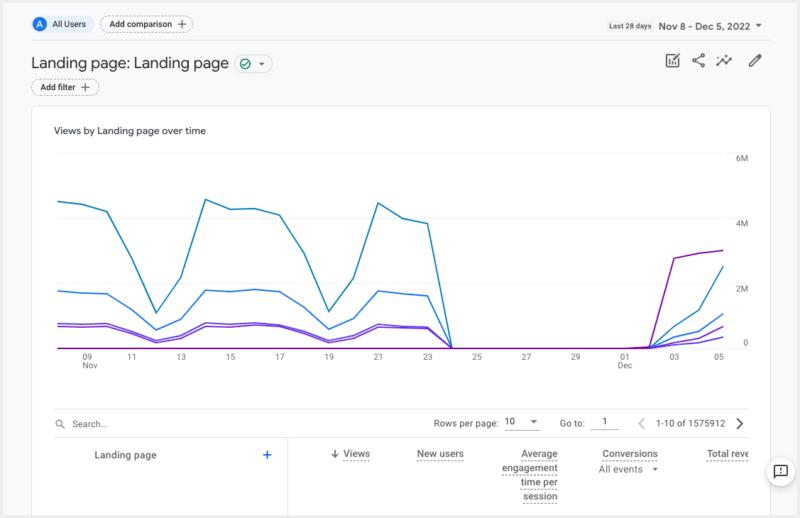
There’s a new report in town, and it’ll help you evaluate and optimize the effectiveness of your landing pages Google Analytics 4 (GA4).
The new report will compare the following metrics:
Average engagement time per session
Conversions
New users
Views
Total revenue
Why we care. You can find the Landing page report in the Engagement topic in the left navigation of your dashboard. If the Engagement topic section isn’t there, you can add the report through the report library.
Use the report to evaluate the effectiveness of your landing pages. If you don’t have GA4 set up yet, use this guide to walk you through the process.
New report types. Google continues to add new report types in GA4. Here are the latest.