Neil Parsont Discusses Excel Data Functions You Need to Know About

Home Business Magazine Online

If you work with data, you know how important it is to manipulate it quickly and easily. That’s where Excel comes in. Experts like Neil Parsont in Boca Raton, FL, understand that Excel is a powerful tool that can help you make sense of your data and find the answers you’re looking for. And, once you know how to use its various functions, you’ll be able to work with data like a pro.

In this article, we’ll introduce you to five essential data functions in Excel that you need to know about. These functions will help you clean up your data, find specific information, and make calculations.

What Is Excel?

Neil Parsont says most people think of Microsoft Excel as a program for creating spreadsheets. While it is undoubtedly true that Excel is an excellent tool for managing numerical data, the program is much more versatile than that. Excel can be used to track household expenses and create complex financial models. Excel is so powerful that businesses often use it for data analysis and decision-making.

One of the things that makes Excel so valuable is its ability to handle large amounts of data. Excel can easily import data from other programs and databases, and it has a variety of built-in functions for cleaning and manipulating data. This makes it an ideal tool for working with data sets that are too large or complex to be managed by hand. Excel’s visual features make it easy to create charts and graphs communicating information clearly and effectively.

Excel is a valuable tool for anyone who needs to work with data. Whether you are a student studying for an exam or a business professional analyzing market trends, Excel can help you make sense of your data and make better decisions.

1. The IF Function

The IF function is one of Excel’s most popular and widely used functions. It allows you to test a condition and return one value if it is met and another if it’s not. For example, let’s say you have a column of student names and their grades. You can use the IF function to return “Pass” if the quality is A, B, or C and “Fail” if the rate is D or F.

2. The VLOOKUP Function

Neil Parsont says the VLOOKUP function allows you to search for a specific value in the first column of a range of cells and return a corresponding value from another column. This function is beneficial when you have large data tables that you need to search through quickly. For example, let’s say you have a list of employees and their ID numbers, and you want to find an employee’s name based on their ID number. You can use the VLOOKUP function to do just that.

3. The COUNTIF Function

The COUNTIF function allows you to count the number of cells that meet specific criteria. This function helps determine how many items are in a given category or range. For example, let’s say you have a list of students’ names and ages and want to know how many students are under 18 years old. You can use the COUNTIF function to find out.

4. The SUMIF Function

The SUMIF function allows you to sum the values in a range of cells that meet specific criteria. This function helps determine the total value of all items in a given category or field. For example, let’s say you have a list of expenses with categories like “travel,” “food,” and “entertainment.” You can use the SUMIF function to sum up all the costs in each class so you can see how much money you’ve spent overall in each category.

5. The INDEX/MATCH Function

The INDEX/MATCH function is two functions that work together — the INDEX function and the MATCH function — to allow you to search for a specific value in a range of cells and return a corresponding value from another column. This function is similar to the VLOOKUP function but more flexible because it doesn’t require your data to be sorted in ascending order (like VLOOKUP does). For example, let’s say you want to find an employee’s name based on their ID number, but your data isn’t sorted in ascending order by ID number. You can find the employee’s name in the INDEX/MATCH function.

Why Are These Data Functions Important?

Neil Parsont says these data functions are essential because they allow you to quickly and easily manipulate your data. With these functions, you can find the answers you’re looking for, make calculations, and clean up your data. So if you work with data, add these essential functions to your toolkit.

Conclusion

These are just five of the many data functions available in Excel — but they’re some of the essential ones for anyone who works with data regularly. If you take the time to learn how to use these functions properly, we’re confident that your data-related tasks will become much easier (and more fun)! You can learn more about Excel and take full in-depth courses to hone your skills, such as the course Neil Parsont created!

The post Neil Parsont Discusses Excel Data Functions You Need to Know About appeared first on Home Business Magazine.

Original source: https://homebusinessmag.com/home-office/computers-and-software/neil-parsont-discusses-excel-data-functions-need-know/

Jasmine teams up with Community Money Advice

Reading Time: 4 mins

Finance Expert Joins Forces With Community Money Advice to Offer You Help This Winter

Finance Expert and founder of MoneyMagpie.com, Jasmine Birtles, who is also patron of debt charity Community Money Advice (CMA), has teamed up with the charity to offer ten tips to streamline your finances and build financial resilience.

With a staggering 91 per cent of people reporting they are feeling the pressure of the cost-of-living crisis and millions of people turning to a second job to help with bills. Jasmine and Martin Bethell of the CMA are looking for as many ways as possible to help people.

“Many of the money troubles people are facing right now are not their fault,” says Jasmine, ”But there are some things we can all do to make a tough situation a little more bearable. There are also definitely ways we can make extra cash on the side to help pay bills and make sure we have at least a few little luxuries that make life better.”

Martin Bethell agrees: “More and more people are really struggling right now to make ends meet and and we think that is really helpful for people to have access to hints and tips that others have found useful. These really can make a difference”

Jasmine and CMA’s top tips

Streamline your utility bills

Make sure you are getting the best deals across the board. Jasmine says, “Often, mobile phones can really rack up our outgoings, so look into getting second accounts on one contract or just out the contract entirely if you already have a phone and get a SIM-only deal. There are loads of really cheap offers there.”

Also, try avoid monthly bank bills. CMA’s Martin Bethell adds that, “There are plenty of none-packaged accounts that have similar deals. Don’t fall for the sales pitch and spend money you don’t need to spend.” 

Stop using your credit cards

Credit card repayments can spiral and when the cost-of-living increases, these can seem unmanageable. First thing to do is speak to your credit card provider and try and negotiate a repayment plan. If, however you are using your card towards your cost of living, then urgently speak to somebody from a debt charity – places such as CMA, StepChange and Turn2Us will be able to help.

“More and more people are using cash as a good way to budget now,” says Jasmine. “With cash you know where you are and once it’s out of your wallet that’s it – you can’t overspend.”

Check Your Eligibility for Income Support and Benefits

A huge amount of people don’t realise that they are eligible for some sort of benefit. Whether it’s a carer’s allowance, a PIP payment or even Universal Credit (UC), you could be entitled to more than you’re getting. Always check to see if you are eligible for help as often UC can help cover some all important bills and living costs which could save you money in ways you hadn’t considered.

Some people don’t realise that these payments can be there for people in employment or for the self-employed too.  They are not just for when you are out of work. Try Turn2Us.org.uk or Entitledto.co.uk to use their calculators and see what you might be entitled to.

Have you got the right tax code?

Check online or call HMRC to be sure you’re not paying too much tax. It has been suggested this year that millions of people are in the wrong tax bracket, if this is so then you could free up hundreds of pounds that you didn’t know you were owed.

Try the tax code checker here https://taxscouts.com/calculator/tax-code-checker/.

Save on Travel

A lot of us have to travel, but many are getting a lot more savvy about it switching to walking and cycling more, car shares and setting up fuel syndicates. Join a car-sharing company like Blablacar or get into renting your car out when you’re not using it on a platform like Hiyacar.com.

Increase Income

There are literally hundreds of ways to make a bit of cash on the side to supplement your income and many are really fun. Whether it’s de-cluttering and selling the stuff online, baking to sell, ironing for others, dog walking or even using cashback sites, people are finding new ways to make some money. We have lots more on MoneyMagpie.com.

Cut Back

The last thing we all feel like doing when the world is scary is cut back on those feelgood things. However, it is sadly a necessity here and there.

Jasmine reminds us, “Millions of us have subscription services we don’t even use. Therefore, just go through your bills and really fine tune your outgoings. But at the same time look for ways to get things for free: what can you share with neighbours and friends? Join some mystery shopping agencies to get free food and entertainment. Search the internet for free days out, free events and free entertainment because it is out there.”

Time When You Shop for Groceries and Make the Most of offers and discounts

Find out when your local supermarkets get their yellow stickers out and this can make a huge difference to your bill. Also, check out the food waste apps such as Olio, UK Harvest and Too Good to Go – as these can save an absolute fortune and really help combat food waste in the process.

Power Efficiency

If you have a smart meter you can check which of your appliances are using the most energy and make sure you use them less. Even if you don’t have a smart meter,  there are now apps that can help you monitor your energy use like Nous.co and Hugo. Using the microwave and air fryer more and the oven less, for example, will make a significant difference to your bills.

Share, share and share

Jasmine says, “The more we can share with our neighbours, friends and families the more we will all have at a lower cost. Share your food, share your tools, share your time (helping to look after each other’s children) and even share your space if you can. That way we all have more but we spend less.”


Both Jasmine and Martin want to impress that however hard the economy crisis is hitting you that help is out there.

The post Jasmine teams up with Community Money Advice appeared first on MoneyMagpie.

Original source: https://www.moneymagpie.com/make-money/jasmine-teams-up-with-community-money-advice

What stakeholders should expect from SEO

SEO is a long-term play and requires patience.

I’ve told this to clients and stakeholders hundreds of times during my career.

After a couple of decades in the industry, I still believe that SEO demands time to see results.

SEO is a long-term commitment that should be considered an investment versus an expense.

It is not advertising and does not have the same type of quick return on investment measurement.

However, I have also seen clients and contacts who were told to wait and look at SEO as long-term, then end up getting burnt anyway.

There’s a difference between being patient and just waiting.

Beyond time, other factors go into a solid SEO client/agency partnership – or even in-house resources and teams – to ensure that expectations are defined and managed, so the effort is ultimately successful.

How to define and manage SEO expectations?

SEO expectations include:

  • The amount of time that SEO takes.
  • Hard costs associated with SEO resource investments (internal or external/agency).
  • Soft costs associated with SEO resource investments.
  • Non-SEO resources needed (copy, UX, dev, IT, approvals, etc.).
  • Level of involvement by client/stakeholders.
  • Competitive landscape.
  • Audience volume.
  • Overall ROI opportunity.

That’s a lot of stuff! There’s likely more to add to the list or nuanced ways to break out some of the items into more bullet points.

SEO is big. There are plenty of moving parts. It takes time, money, and a baseline level of understanding to:

  • Learn what you are getting.
  • Know that ROI is possible.
  • Have decision points down the road that are objective and not based on emotion or incomplete data.

How long does SEO take?

SEO takes time. It is a long-term discipline that requires consistent short-term tactics and implementation.

Whether you have an agency, consultant, or in-house person/team managing SEO, you need to mentally prepare for it to take some time to see significant results.

But that doesn’t mean you should detach from the effort, waiting for it all to be fully optimized and performing to your liking.

If you haven’t seen a strategy, tactical plan and goals, you should ask for one. 

There’s no reason to be “floating” or waiting for updates or results or to be led to believe that you should trust someone to handle SEO and that, at some point down the road, it will magically be “done.”

Promises about how long it will take to see specific results should not be expected or made. However, experienced SEO professionals should be able to give you some reasonable expectations based on their strategy, plan, and process – tied to your goals – or at what points you should see certain milestones.

You should expect to know:

  • What milestones are ahead.
  • What metrics and KPIs you’ll be seeing.
  • The level of communication and input you need in the process.

Get the daily newsletter search marketers rely on.

<input type="hidden" name="utmMedium" value="” />
<input type="hidden" name="utmCampaign" value="” />
<input type="hidden" name="utmSource" value="” />
<input type="hidden" name="utmContent" value="” />
<input type="hidden" name="pageLink" value="” />
<input type="hidden" name="ipAddress" value="” />

Processing…Please wait.

function getCookie(cname) {
let name = cname + “=”;
let decodedCookie = decodeURIComponent(document.cookie);
let ca = decodedCookie.split(‘;’);
for(let i = 0; i <ca.length; i++) {
let c = ca[i];
while (c.charAt(0) == ' ') {
c = c.substring(1);
}
if (c.indexOf(name) == 0) {
return c.substring(name.length, c.length);
}
}
return "";
}
document.getElementById('munchkinCookieInline').value = getCookie('_mkto_trk');


How well should I expect SEO to perform?

This question probably could – and should – come before asking how long it will take. However, it sometimes isn’t asked at all until months into an SEO investment.

This is a key question on the front end of any SEO engagement or investment. Much like how long SEO takes, SEOs are often non-committal and can’t guarantee performance.

However, they should be able to do some modeling and projections based on your historical, current, and opportunistic website and business data combined with audience and competitor research.

Suppose there’s a big opportunity to gain new exposure with rankings for new topics and terms, matched with the right content and ability to serve that audience, getting them to convert in a customer journey. In that case, that can be used to do some projecting.

If you know the full investment in any SEO resource (people and tech) plus the other areas that will be needed (copy, IT, etc.), then you can get a pretty good picture of the total monetary investment.

Your SEO should be able to help you with some data to: 

  • Connect the dots with your business information.
  • Calculate possible conversions. 
  • Work through the math to ensure the potential ROI is positive, making for a good business investment overall.

What does SEO success look like?

SEO success can come in many different forms. Return on investment is the one that comes to mind first.

Beyond that:

  • How is SEO performance influencing your customer journey?
  • Is it generating more or new awareness?
  • Is it moving people through to the next step? 

It may not always lead directly to a conversion. Thought leadership and other aspects of exposure and engagement from SEO traffic could be part of your goals and essential in the success equation.

Having a solid partnership with your SEO team is vital as well.

You should be able to trust them to lead the strategy, be transparent, and have open lines of communication on the goals and ROI metrics, making sure no one is caught off guard.

What are warning signs?

Bad SEO warning signs include:

  • Poor communication.
  • Lack of transparency.
  • No conversation around strategy and goals.

These key items are central to so much of what goes right and wrong with SEO efforts. Time, money invested, goal performance metrics, and what it takes to achieve them are critical.

If any of those components aren’t clear, are glossed over, or are missing from your internal or external SEO resources and team, then it should be a cause for concern.

Keep these in mind before you start or call a timeout with your current partner to resolve any concerns before spending additional time and dollars.

Always set and manage SEO expectations

Unfortunately, I know many people who are skeptical about SEO or have given up on it. That tends to stem from the belief that SEO doesn’t work or that SEO providers can’t be trusted, so the effort isn’t worth it.

I totally get it. I’m not saying I’m perfect or that my team is and that every client we’ve partnered with has had an ideal path to their goal results.

However, you can see a profitable path for your SEO efforts. How? By:

  • Managing expectations.
  • Watching for warning signs.
  • Understanding what makes SEO successful.

Yes, there are a lot of moving parts and pieces. 

Yes, SEO takes time and money.

But it doesn’t have to be something you sit back and wait and see while you write checks.

The post What stakeholders should expect from SEO appeared first on Search Engine Land.

Original source: https://searchengineland.com/what-stakeholders-expect-seo-389400

Twitter adds Official badge, then Musk immediately kills it

Twitter has announced this week that there are now two different verification checkmarks you can have displayed on your profile. Then in response to one creator commenting that his “official” badge disappeared, Elon Musk announced, “I just killed it.”

Twitter product liaison Esther Crawford posted about the new feature, noting the distinction between TwitterBlue subscribers and the “Official” badge. 

A day later, Marques Brownlee posted that his “official” badge which had been on his profile for about 12 hours, was now gone. Musk replied, “I just killed it.”

TwitterBlue. TwitterBlue subscribers ($8 a month), is an opt-in, paid subscription that offers a blue checkmark and access to select features. It does not include ID verification. 

Official. This label is now reserved for government and commercial entities.

Not-at-all confusing. Before Musk’s announcement about killing the “Official” badge, users were left wondering what the point was of having two separate verifications. krellin grumpyman went on Twitter, saying “So… you’re just letting people buy blue checkmarks to feel special while continuing the previous verification system but making it way less obvious?”

So let’s get this straight. The original blue check mark (TwitterBlue) was meant to distinguish those profiles that pay $8 a month and have access to special features. While the new “Official” label is for profiles that meet Twitter’s ID verification process (the old TwitterBlue).

Why we care. The “Official” badge will now be reserved for government and commercial entities. And it looks like the original TwitterBlue checkmark will remain as-is. We’re just as confused as you are, but we’ll try to keep you updated as we lean more.

The post Twitter adds Official badge, then Musk immediately kills it appeared first on Search Engine Land.

Original source: https://searchengineland.com/twitter-adds-official-badge-then-musk-immediately-kills-it-389506

THE AUTUMN STATEMENT ’22: Jasmine’s predictions

Reading Time: 3 mins

The first Autumn Statement under Prime Minister Rishi Sunak’s government is to be announced next Thursday, November 17th. The country has seen much turmoil in the last year. From soaring living costs to rapidly rising inflation. Let’s not forget the eye-watering interest rates! The general public are hotly anticipating what is to come.

This is also new ground for the new chancellor, Jeremy Hunt, who will make the statement next week. There have already been plenty of murmurs about what could be discussed. In light of this, we asked our founder and personal finance expert Jasmine Birtles to give her predictions for what is likely to come next Thursday.


Your opinions on the upcoming budget?

“So, this is the first Autumn Statement from the unpopular Chancellor Jeremy Hunt, brought in by the unelected PM, Rishi Sunak…a man who was not even popular enough with his own party members to be elected by them.
“I personally was behind Kwasi Kwarteng’s mini-Budget as I have been saying for some time that the only way out of our mess – the mess created by the Lockdowns and insane money-printing that went on over the last few years under Boris Johnson and Rishi Sunak’s ‘reign’ – is to go for growth. Cutting taxes across the board would, I believe, have increased growth and therefore increased the tax take which would have covered the costs incurred by Kwarteng’s policy. But our dumb Bank of England didn’t like that and there was, to my mind, quite clearly a stitch-up of Truss and Kwarteng organised through the media so that their policies were never given a chance.
“Now we have the WEF-approved Sunak and Hunt who have forced themselves into power, supported, largely, by the mainstream media, they will bring us a slow and increasingly painful decline I believe.”

What is being speculated?

“We have been hearing rumours that Hunt has been looking for ways to tax us more. One rumour was that he would slap capital gains tax on our residential homes. That would go own like a plate of cold sick with most voters (people who own their own homes are, apparently, more likely to vote than those who don’t). So I suspect that will not be suggested.
“From what I’ve heard, although there are likely to be tax rises, Hunt is looking at making cut-backs rather than increasing taxes so much. However, I do still expect at least stealth taxes, such as the ones Sunak foisted on us. So it’s likely, for example, that he will freeze income tax for even longer than Sunak did to make sure that we all gradually pay more tax as our salaries (we would hope) increase over time.
“There are rumours that there will be extra tax on inheritances too but, again, that would go down very badly with their core voters, as would any cuts that would affect pensioners who make up a large part of their voters. They have already reversed the Kwarteng decision to scrap the increased corporation tax, which I think is a mistake as businesses will need all the help they can get to keep afloat and keep employing people.
“One thing all businesses say is that we need to bring VAT down but I don’t see that happening. It’s unlikely that he will increase VAT though as the economy couldn’t take it.”

What are your predictions?

“We are already seeing cuts in public spending with several arts cuts and I think that will continue together with cuts to local councils, cuts to infrastructure (even though we desperately need that improving) and even cuts to social spending that supports the poor.  I don’t think there will be cuts to benefits for pensioners as they make up a significant number of Tory voters.
“Will there be a National Insurance increase? There may be but it would be a stupid idea. NI is a tax by another name and would significantly impact the economy. As we are coming into a long recession the government needs to do what it can to support business and keep prices down so that people continue to spend. Increasing NI will put more of a burden on businesses and will put less money in workers’ pockets so they will spend less. We need money washing round the system, not drying up in extra taxes.”

Overall thoughts?

“I suspect that this Autumn Statement will try to look like it is fiscally responsible and taking things slowly. In reality it will be squeezing the life out of the economy and out of the low-paid workers. That’s what Sunk’s policies have done in the past and Hunt has similar views.
“I am not hopeful for what we will hear on Thursday.”
What are your predictions for the Autumn Statement next week? Leave your thoughts in the comments!

The post THE AUTUMN STATEMENT ’22: Jasmine’s predictions appeared first on MoneyMagpie.

Original source: https://www.moneymagpie.com/make-money/the-autumn-statement-22-jasmines-predictions

Meta Introduce New Way to Make Money From Instagram

Reading Time: 2 mins

Meta Platforms has announced that it’s adding a host of new features to Instagram, including a tool allowing users to trade digital collectibles, which is being introduced to help Instagram customers make money on the app more easily.

Users will be able to buy non-fungible tokens (NFTs) directly within Instagram, a process that will be tested with a small group of creators in the USA, the company said, with plans to expand to more countries eventually.

HOW TO CURRENTLY MAKE MONEY ON INSTAGRAM

Currently, the most common approach to Instagram monetisation is to partner with brands as an influencer: basically anyone with an online reputation by doing and sharing things to their audiences. Many brands see the immense reach of this, so they partner with influencers on sponsored content like posts, Reels, and Stories that help advertise their products.

You can also become an affiliate, which is all about making actual sales for the partner brand in exchange for a commission: normally a trackable link or unique promo code so that clicks become sales: the promo codes help you make money from different angles.

You can also use Instagram to sell your own merch, sell your photos online, monetize your content by including adverts within it, or finally simply sell stuff, whether it’s furniture, clothing or collectors items, or perhaps have a de-clutter of your home and help save the environment.

NEW SELLING FEATURES

Now, Meta has been introducing features for people to make money on their social media apps as it competes with TikTok and others: it has also announced expansion of access to subscriptions on Instagram to all eligible creators in the USA to help them earn a more stable, regular income on the photo-sharing app.

It is also beginning gifts on Instagram, starting with Reels, allowing creators a new way to earn money from their fan base. They are also launching a professional mode for Facebook profiles so that creators can build a public presence while maintaining their personal Facebook profile.

The post Meta Introduce New Way to Make Money From Instagram appeared first on MoneyMagpie.

Original source: https://www.moneymagpie.com/make-money/meta-introduce-new-way-to-make-money-from-instagram

How to Create a Winning Content Strategy for Business Growth

Home Business Magazine Online

Content marketing is a long-proven strategy for growing a business. Desirable content can be a valuable tool to attract new customers and expand your market.

However, producing content without a content strategy can lead to mixed results. A solid content strategy helps you stay relevant and engaging. If you are struggling with your content and need a solid structure, keep reading.

This article will define what a content strategy is, why it is important, and the steps you need to take to create a winning content strategy.

What Is a Content Strategy?

A content strategy is a structured plan that includes clearly defined goals, a list of topics, a schedule for creating content, a publication calendar, and a method of managing the content. The purpose of your content should be to attract your target audience and achieve your business goals.

With a content strategy, you should get reliable, strong results from your content. Without a content strategy, you may quickly run out of ideas and struggle to produce the content you need to attract the right audience.

A good content strategy is essential to attracting and delighting customers. This is why 70% of marketers choose to invest in content marketing, according to HubSpot’s State of Inbound Marketing Trends report.

7 Steps to Creating a Successful Content Strategy

Content creation requires an investment of time and money. You don’t want your resources to go to waste. With a solid content strategy, you will get a more significant return on your investment.

By following these seven steps, you will be well on your way to a successful content strategy your business can be proud of.

1. Identify Your Goals

What does your business hope to achieve with your content? Do you want to increase sales? Accelerate lead generation? Expand your brand recognition?

Understanding your WHY will ensure that each piece of content has a purpose. Focusing on your goals makes it easier to choose your topics and plan your content.

Defined goals can also help you evaluate your content to see if you’re headed in the right direction. For example, your goal is to increase lead generation across the company, but you haven’t seen much movement for six months. This could lead you to conclude that you aren’t producing the right kind of content.

2. Consider Your Audience

To achieve your content goals, your content needs to focus on a specific audience. That means understanding your existing audience and who you’d like to target. You can consider creating buyer personas. When you create these segments, you define your target audiences and get your marketing and sales team on the same page about who’s an ideal customer.

Essentially, you create fictionalized characters through demographic information, how much money they make, and understanding their interests. If you are a B2B brand, you should create buyer personas outlining the people within an organization who help make purchasing decisions.

Buyer personas can also be helpful when exploring new markets and customer groups. Each year, you should revisit your personas to make sure they reflect your business goals and are still relevant.

3. Solve a Problem

Your brand should offer your customers solutions. That means creating content that addresses those problems from two sides: showing the customers who already use your products how they work and introducing new customers to a potential solution.

In fact, your audience might not realize they have a problem until they see your content. This could pique their interest in your brand and turn them into customers.

By establishing yourself as a hub for solutions, you establish yourself as a helpful resource. Doing so sets you apart as an expert in your industry.

4. Share What Sets You Apart

Depending on your business’s niche, you likely have industry competitors. One great thing about content is that it allows you to show your audience what you offer that makes you unique.

This does not have to be something major. It could be as simple as having a long history of satisfied customers or being the first in your industry to introduce a type of product or service.

5. Choose Content Formats and Channels

There are many content formats to choose from. Blogs, videos, landing pages, and podcasts are some of the top choices. You can also create content on an ever-increasing number of channels.

The formats you choose will depend on where your audience is. If your audience happens to be the young, up-and-coming Generation Z, consider creating a TikTok account and producing short-form videos. However, if your audience includes older business professionals, sharing articles on LinkedIn and your blog may be a better option.

Keep in mind that some types of content will be more expensive to produce than others. But in the long run, you’ll find that investing in the right channels for you and your audience will yield better ROI.

6. Create a Content Calendar

Now that you have a list of topics, content formats, and channels you’ll share on, you can start mapping out your content calendar. This calendar should include a timeline for production along with the publication date.

Utilizing a calendar will give you a place to see all the content you create in one view. Then you know where to cross-post, how much you post, and where you can make changes more easily.

7. Choose a Content Management System

One step you can’t ignore is managing your content strategy. If you are a small business, one person might handle everything. However, larger businesses may need to collaborate across teams to keep everything in line.

Whoever is managing the content, a content management system (CMS) can help ease some of the burdens and keep everyone on track. Some popular choices include WordPress and Squarespace. The CMS you choose will depend on what you need as you manage your content, but you want one that lets you plan your content calendar, produce your content, publish it, and track the results from the same system.

About the Author

Alicia Oakley

Alicia Oakley

I bring to Express Writers 20 years of experience in the fields of education, real estate and entrepreneurship. I love taking teams to the next level. With a Master’s degree in teaching, when I’m not working on our real estate investment portfolio, you can find me teaching the use of an appositive and proper use of the comma to our four children. I’m an avid reader, passionate about education, real estate, staying healthy, and traveling. To learn more about Alicia Oakley, visit our site.

The post How to Create a Winning Content Strategy for Business Growth appeared first on Home Business Magazine.

Original source: https://homebusinessmag.com/growing-a-business/how-to-guides-growing-a-business/how-to-create-winning-content-strategy-business-growth/

How brand marketing helps improve E-A-T signals: An introduction

If you came to SEO from a non-marketing or technical background, it can be beneficial to have a broader understanding of brand marketing. This helps you better ally with your marketing communications colleagues to contribute to improving your website E-A-T. 

In this article, I will share some of the core principles of brand marketing and how they may be reflected in criteria that can positively demonstrate expertise, authoritativeness and trustworthiness.

Note: This is a deep dive into the first part of my SMX Next presentation, which takes place next week on Nov. 16. Register here for free.

Why SEOs should care about brand marketing

In a previous article, I shared the extensive E-A-T auditing process my agency uses. The process is varied and detailed, covering the evaluation of work that may not be under your control. 

For example, one of the checkpoints is to look at the business’s key people to see:

  • How they are referenced and promoted on the site.
  • How much of their research, work, patents and other evidence of expertise is displayed, marked up, and validated through linked references. 

Representing and marketing key people, particularly media-trained spokespeople, is usually the remit of the PR team or agency. 

If you work for a small or micro organization or you are an owner-operator, then perhaps all aspects of marketing communications fall to you. 

In either case, it is really important to understand some of the basics of brand marketing and how mid to large-sized brands behave. This way, you can ensure that the output of brand marketing is communicated in a way that Google can process and evaluate.

Finally, while some aspects of the work that can help validate your E-A-T may not be under your control, you can use this topic to further internal education efforts as to what SEO is and how it can harness the efforts of all marketing teams. 

You can explain to your colleagues how their work has dual purposes and benefits outside of their primary goals. 

As an SEO, this is an exciting opportunity for you to:

  • Coordinate a broad project.
  • Drive awareness of the benefit of SEO in a more accessible, non-technical manner.
  • Implement meaningful improvements for the business.

Let’s get into some principles and commonalities of good brand marketing behaviors so you can replicate this approach for yourself and understand more about how other teams’ work can dovetail into your E-A-T SEO goals.

Why does Google care about brands?

Google cares about brands because consumers care about brands. 

While E-A-T is a relatively new concept coming to life in August 2018, I would argue that it is an evolution of work that can be traced back to updates as early as Vince in 2009, which was informally known in the industry as “the brand update.” 

This update appeared to favor brands, but Google re-framed this as a “trust change.” That the new ranking order appeared to give more weight to brands is more symptom than cause, because [good] brand activity and behavior evince a greater variety of trust signals. 

This matters because this is an example of giving the consumer what they want. Quite simply most consumers are reassured by familiarity and trust brands to deliver on expectations.

Researchers found that 7/10 consumers will buy more from brands they trust and that people abandon purchases if trust is broken, according to the 2021 Future of Marketing Research study by Adobe. 

Moreover, 63% of respondents who indicated they trust a brand, will recommend that brand to their friends. 

Trust is vitally important and can be broken quickly, with the top three reasons respondents gave for leaving a brand relating to misuse of data. 

This a cautionary tale for those who invest time and effort in building brand value, only to lose all benefits through aggressive targeting or failure to remove someone from marketing after opting out.


Get the daily newsletter search marketers rely on.

<input type="hidden" name="utmMedium" value="” />
<input type="hidden" name="utmCampaign" value="” />
<input type="hidden" name="utmSource" value="” />
<input type="hidden" name="utmContent" value="” />
<input type="hidden" name="pageLink" value="” />
<input type="hidden" name="ipAddress" value="” />

Processing…Please wait.

function getCookie(cname) {
let name = cname + “=”;
let decodedCookie = decodeURIComponent(document.cookie);
let ca = decodedCookie.split(‘;’);
for(let i = 0; i <ca.length; i++) {
let c = ca[i];
while (c.charAt(0) == ' ') {
c = c.substring(1);
}
if (c.indexOf(name) == 0) {
return c.substring(name.length, c.length);
}
}
return "";
}
document.getElementById('munchkinCookieInline').value = getCookie('_mkto_trk');


What brand accomplishments communicate trust to consumers?

Strong brands have a purpose outside of commercial goals, commonly referred to as a company vision or mission. 

Similarly, a set of values or beliefs should be shared by founders, leaders and team members which are aligned with the vision. 

Brands have identities that are instantly recognizable, helping to expand reach and familiarity which engenders trust. 

Finally, brands should behave to a certain standard aligned with values and do so consistently. This is what generates trust. 

When consumers see clear and consistent values and ethos around what a brand stands for, purchases move outside of pure necessity and begin to become a part of our perception of identity. This is social identity theory.

“Social identities are most influential when individuals consider membership in a particular group to be central to their self-concept and they feel strong emotional ties to the group. Affiliation with a group confers self-esteem, which helps to sustain the social identity.” 

Campbell Leaper: Advances in Child Development and Behavior

If we buy into this social identity as personality, it is clear to see why broken trust leads to a sharp rejection as per the Adobe study findings. 

What is a brand vision?

A brand vision or mission statement is simply the brand’s purpose and reason for being.

The most successful global brands that are instantly recognizable exist for much more than the purpose of commercial growth.

Good vision statements are:

  • Driven by purpose.
  • Challenging.
  • Contribute to some degree of greater societal good.
  • Forward-looking and reaching.
  • Recognizable and suitable.

Here are some fun examples that you will likely know. Have a read of these vision statements and see if you can identify the brand they belong to. (I’ll note the answers at the end of this article.)

  • “To bring the best user experience to its customers through innovative hardware, software, and services.”
  • “To inspire and nurture the human spirit – one person, one cup and one neighborhood at a time.”
  • “Our deepest purpose as an organization is helping support the health, well-being, and healing of both people — customers, team members, and business organizations in general — and the planet.”

Note that all of these examples are entirely non-commercial and speak to impacting society and even the planet positively.

Jenna Tiffany, Chartered Marketer and author of Marketing Strategy, states in the book that “transformation of ‘vision’ into ‘sales targets’ can be devastating for a brand and company culture.” 

This is because, without a guiding purpose, there is no action framework outside of the pursuit of profit and revenue, leading to actions becoming disparate and inconsistent. 

To ensure consistency and purpose in operations, most good brands lean into a set of non-commercial values.

What are brand values?

According to The Branding Journal, brand values are:

“[F]oundational beliefs that can steer action and encourage customer loyalty.”

Take the story of Whitney Wolfe Herd and how she founded Bumble, as an example. She took the company to IPO last year and made history as the youngest woman to ever take a company public.

Wolfe Herd’s ambitions for the company were driven by a broader goal to make online dating a safer space. In a Time interview, author Charlotte Alter references Wolfe Herd’s strong belief in the value of brand. 

“Wolfe Herd sees Bumble less as a dating app, a social platform or a tech company than as a brand. It’s the word that she uses the most when talking about Bumble, and it’s the word that crops up most frequently in conversations with employees and executives.” 

It is no surprise then, that along with a non-commercial purpose, the brand has a clear set of values stated on the company About page which are:

  • Integrity
  • Kindness
  • Quality
  • Confidence
  • Respect

It is clear to see how these values are intrinsic to the company’s goal of making online dating a safer space. 

What may not be clear yet, is how having vision and values can contribute to how our E-A-T is perceived. To illustrate this in the most tangible way we will discuss a final introductory aspect of brand marketing and that is identity.

Brand identity matters

In Brand Identities: A Framework for Successful Branding, author Phani Tej Adidam defines brand identity as:

“[A]n outward expression of the brand, including its name and visual appearance. The brand’s identity is its fundamental means of consumer recognition and symbolizes the brand’s differentiation from competitors.” 

With that understanding, a brand’s total identity can be far broader than a simple logo but extends to:

  • Logo
  • Colors
  • Shapes
  • Fonts
  • Emblems
  • Trademarks
  • Words/slogans

It’s not just the image or mark itself that becomes recognizable. Whether trademarked or not, even the text descriptor of a visual device can be understood as part of the whole entity.

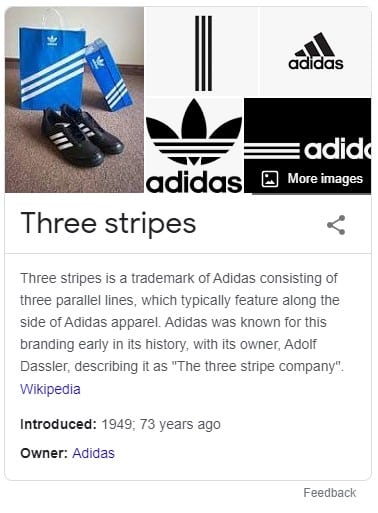
As an example, search Google for “three stripes” to see this in action. 

Three stripes knowledge panel

The generic query “three stripes” generates a knowledge panel result explaining:

  • The trademark.
  • Its origin and appearance.
  • Variations in the application of how the three stripes are incorporated into visual marks. 

On this extension of assets and peripherals being a part of the whole brand story, Tiffany of Let’s Talk Strategy and author of the previously mentioned Marketing Strategy book added:

“A brand is how a person perceives and identifies an organization or person (if it’s their personal brand). This perception can be influenced with what are known as branding elements, such as logos, a specific slogan/strapline, designs, symbols, and (most importantly) the feelings which the products or services evoke. A brand is more than a product or service; it is the combination of all of these elements.”

How can brand marketing be leveraged to grow E-A-T?

Simply put, brand marketing is about the creation and marketing of tangible assets. Over time, assets are understood to be entities by search engines. 

Entities can be marked up with schema, linked to, cited and referenced to contribute to a growing semantic dataset of tangibles. 

This is entity SEO, which has been increasingly in focus this year as the rate of progress in joining the strands of entity, quality and complex semantic and contextual understanding is evident with MUM.  

When it comes to brand marketing, all of the brand assets (which may be people, marks, values, vision, slogans, catchphrases, and colors) have the potential to become entities. 

Let’s look at it as a step-by-step process imagining we’re a start-up.

1. Create or evaluate all marketable assets

These are the summation of identity components, vision and values, and key people and their assets too. 

If you are a start-up, this is a very exciting time to define all these things with founding member energy. 

If not, it is never too late to work on this aspect of who you are as a business and why you do what you do best.

2. Assets become entities

Any asset that is defined, named, referenced and marketed consistently over time becomes an entity – a “thing” in and of itself. 

It’s been a very long time since Google acquired Metaweb in 2010, which facilitated a sea change in Google named entity recognition (NER) capabilities

When your assets are understood as entities, Google can better understand when a search user may be referring to your asset as opposed to a word or phrase in another context. 

Entities can get more real estate on the SERP particularly if it is exclusive, such as a trademark, an individual or an invention. 

In many cases, you can own the entire first page for your own entities, even if it may be with a mix of owned and operated versus not owned but operated (such as social media pages.)

3. Entities can be marked up

Structured data is becoming the new rule 34 of the web. If it exists, there is a schema for it. 

Adding semantic markup conveys a greater depth of understanding. It can contextualize the object in a way that a query string might not. 

While not absolutely critical to be understood as an entity, we often find that markup can accelerate time to trigger entity recognition. It is also simple to implement and can be added via Google Tag Manager if development constraints exist.

How does any of this contribute to E-A-T?

All of the things we have discussed today are signals or indicators of a level of maturity and responsibility that larger organizations should have within our society. 

These are brand behaviors that engender trust in us as consumers. Therefore, it makes perfect logical sense that known brands that deserve to match a query should rank well in Google Search. 

Better CTR means higher search engagement which leads to greater potential for paid ad clicks which means Google, advertisers and search users all have a better experience.

Authenticity is key

Brand marketing has to be genuine. Vision has to be authentic, or it will be impossible to retain consistency. 

Authenticity in vision, values and message is often referred to as brand DNA, which helps us understand that it isn’t something we should or could fake. 

To fake it would possibly mean more effort and less reward than having vision and values and being authentic in their communication.

Brand vision statements – answers:

  • Apple Inc.
  • Starbucks
  • Whole Foods

The post How brand marketing helps improve E-A-T signals: An introduction appeared first on Search Engine Land.

Original source: https://searchengineland.com/brand-marketing-improve-eat-signals-389390

Instagram’s in-app post scheduling tool now available to professional accounts

Instagram has just rolled out its new in-app post-scheduling tool for creators and businesses. The new tool lets you schedule Reels, Photo, and Carousel posts up to 75 days in advance.

How it works. You’ll be able to schedule Reels by:

  • In the creation flow, tap ‘Advanced Settings’ before sharing the post
  • Tap ‘Schedule this post’
  • Select the time and date you want it to go live
  • Tap ‘Schedule’ in the post composer
Airlines (NEC)

What Instagram says. Functionally, this doesn’t add anything new as you’ve been able to schedule posts via Creator Studio since 2020. But it could make it easier to manage your content on the go, while the capacity to schedule Reels, in particular, could help you maximize your content performance.

Why we care. Brands and social media advertisers who manage Instagram accounts can now easily schedule posts without having to integrate with third-party tools. This feature is likely to come in handy around the busy holiday season, or as brands and agencies are looking for ways to cut costs.

The post Instagram’s in-app post scheduling tool now available to professional accounts appeared first on Search Engine Land.

Original source: https://searchengineland.com/instagrams-in-app-post-scheduling-tool-now-available-to-professional-accounts-389429