Google has been accused of downplaying how much it quietly increases ad auctions.
The search engine admitted at the federal antitrust trial that it “frequently” inflates ad prices by as much as 5% without telling advertisers – sometimes 10%.
But marketers are calling the search engine out for being too “conservative” with these figures as they believe the real number is significantly higher.
Why we care. Advertisers are becoming increasingly frustrated with Google due to long-held suspicions around ad price manipulation and a lack of transparency. Although the industry accepts the search engine has a right to set minimum pricing thresholds, the lack of transparency regarding how those thresholds change over time and can directly impact advertiser performance
Shady business. Christine Yang, vp of media at Iris, told Ad Week that she believes the real range of fluctuation can sometimes be as much as 100%. She said:
““[Google] claiming 5% is a more conservative number to make it sound like the natural ebb and flow of a marketplace,” said Christine Yang, vp of media at Iris.”
“The level to which [price manipulations] happens is what we don’t know. It’s shady business practices because there’s no regulation. They regulate themselves.”
Why quietly inflating ad prices matters. Google’s ability to increase ad prices, especially without facing strong competition, could potentially bolster the Justice Department’s claim that Google maintains an unlawful monopoly. While this argument doesn’t apply to Google’s free search engine, it can be used to address concerns like privacy standards that might have been mitigated in a more competitive search industry.
Get the daily newsletter search marketers rely on.
function getCookie(cname) {
let name = cname + “=”;
let decodedCookie = decodeURIComponent(document.cookie);
let ca = decodedCookie.split(‘;’);
for(let i = 0; i <ca.length; i++) {
let c = ca[i];
while (c.charAt(0) == ' ') {
c = c.substring(1);
}
if (c.indexOf(name) == 0) {
return c.substring(name.length, c.length);
}
}
return "";
}
document.getElementById('munchkinCookieInline').value = getCookie('_mkto_trk');
What has Google said? Following Dischler’s comments, a Google spokesperson told Search Engine Land:
“Search ads costs are the result of a real-time auction where advertisers never pay more than their maximum bid. We’re constantly launching improvements designed to make ads better for both advertisers and users.”
“Our quality improvements help eliminate irrelevant ads, improve relevance, drive greater advertiser value, and deliver high quality user experiences.”
Google’s Gary Illyes fielded several questions during an AMA at Pubcon Pro in Austin this afternoon from moderator Jennifer Slegg. Here are some of the highlights of the interview.
1. Does Google use user click data in ranking?
“Technically, yes,” Illyes said. This is because historical search data is part of RankBrain.
2. Unlaunches happen ‘a lot’
Things change a lot (emphasis his) in search ranking at Google, Illyes said. What is true for ranking today could be wrong in two weeks.
Google is known for experimenting with Search – and noted that it’s very hard to keep track of launches and “unlaunches,” adding that these unlaunches happen “a lot.”
This makes sense when you consider Google rolled out 5,000 changes to Search in 2021 and ran a total of 800,000 experiments.
3. Factors vs. signals vs. systems
The main difference between factors and signals is just language, Illyes said. At one point, they wanted people to differentiate between them.
Ranking systems are more complex – this is when Google takes multiple signals (e.g., from crawling and indexing data) and ranks them. Ranking systems are also more “stable than signals,” Illyes said.
4. Why Google doesn’t index everything
In short, the Internet is “insanely big,” Illyes said. There are probably hundreds of trillions of webpages that Google has sight of – but there are even more than that Google can’t access (e.g., content behind a login page).
“There is virtually no storage you can use to index all of them. It’s not possible to index it in a way you can serve it,” Illyes said.
5. You don’t have to label AI content for Google
Labeling AI content is not necessary for Google search – “I don’t think we care” – Illyes said. But he suggested labeling it if your users would appreciate it.
Humans can cause more trouble than AI on certain topics, Illyes noted. He reiterated once again that Google doesn’t care how content is created – by AI, human or both.
“As long as I will learn from it, learn correct information, why would it matter?” Illyes said.
6. AI content = no typos
One thing Illyes noticed while analyzing the output of ChatGPT and generative AI tools is that it doesn’t have typos.
“Computers don’t make mistakes unless they were instructed to,” he said.
7. Why niche sites were impacted by helpful content update
When it comes to helpful content, niche sites often don’t fall into a category Google is looking to promote. To be clear, here Illyes was not referring to all types of niche sites, he was mostly talking about affiliate-type of niche sites that are heavily money-driven.
8. You can see gains between core updates
If your site is impacted by a Google core update, you should start working on things that could help your site improve and get pushed back up in Search results.
“Maybe the next core update will help you more. Don’t think of updates in isolation. We’re using hundreds of signals to rank pages,” Illyes said.
He said waiting and holding your breath between core updates would be bad for your website’s health.
9. Comments could signal that a site has an active community
While many websites removed comment sections and forums in the past 10 years, Illyes said that comments can be good.
“Especially if I know the site has a strict rule about how users can behave on the site, then I would trust info from those users more,” Illyes said.
Illyes didn’t say comments are a ranking signal. He was more saying this from his own perspective. And it was an interesting insights, especially considering how moderated user-generated sites like Reddit and Quora have seen gains following recent Google updates.
10. Google will keep launching updates in December
Google will continue to release updates during the holidays – Google used to avoid doing this, but Illyes called that an “old thing.”
“The problem is around that time, everyone tries to manipulate search results. With these updates we’re trying to course correct. I don’t think we should stop releasing updates in that period of time. Honestly I would hope that the updates will actually help you rank better if you were not trying do manipulate search results.”
11. Core Web Vitals = low priority
Short but sweet:
“If you don’t have anything better to do on your site, go do Core Web Vitals. Most sites won’t see benefit playing around with it,” Illyes said.
12. No voice data in GSC
Illyes said it was too difficult to get voice search data and doesn’t see a reason to add it to Google Search Console. He said it would take a “considerable amount of engineering time” to expose that data.
13. Expired domain signals are not inherited
If a domain expires, and somebody buys that domain, any signals the site had accumulated will not be transferred to the new domain owner. Google knows when a domain expires.
So if you bought an expired domain and tried to rebuild it (e.g., by getting all the content from Wayback Machine), you would be building the site from scratch, as if it were a new domain.
14. Use H tags for accessibility
From Google’s perspective, it would be “pretty stupid” to rely on H1-6 tags for understanding order and hierarchy of content, Illyes said.
He suggested using a screen reader on your site to make sure the content doesn’t “read wrong.” Use H tags where you need to use them, where it makes sense, Illyes said.
15. Importance of links is ‘overestimated’
Links are not a “top 3” ranking signal and hasn’t been “for some time,” Illyes said, adding that there really isn’t a universal top 3.
It’s absolutely possible to rank without links, Illyes said, citing an example of a page with zero internal or external links that he knew of that was ranking Position 1 on Porsche cars – and Google had only found the page via a sitemap.
Content continues to be the number one ranking signal.
“Without content it literally is not possible to rank. If you don’t have words on page you’re not going to rank for it. Every site will have something different as the top 2 or 3 ranking factors,” Illyes said.
Purchasing a vacation home may be a dream come true for many people. However, it is always a big decision that must be cautiously approached. A second home has numerous benefits since it gives you a beautiful place to create memories and spend quality time with family or friends. There is something special about staying in a new home when you go out. It gives peace and some kind of peace that people value now more than ever. However, before buying a vacation home, it is crucial to consider some things to avoid impulse buying or being defrauded. Neptunus-International shares what to do before buying.
Weigh the Advantages and Disadvantages
You may be ready to buy a vacation home, but checking the advantages and disadvantages is essential. For instance, purchasing a vacation home can help you earn passive income when renting it out. It is also an investment that increases value. Furthermore, the house allows you to save money on the next vacation. At the same time, you must remember that vacation homes are expensive and could bring unexpected expenses.
On top of that, it is an added responsibility to maintain it. The down payment could also be substantial. Weigh the pros and cons before buying to know if it is worth it.
Location Matters
Location is a critical factor when purchasing a second home. You may want to buy one easily accessible, preferably by the beach or lake. Some people want a house near the mountains, and others at the heart of the city. Whatever your preference, you must always know that location is paramount when deciding. There are numerous properties in perfect locations to help you meet your dream. Whatever you want, it is a guarantee you will get it.
Consider Your Goals
When buying a home, being clear about your financial goals is vital. There are various types of properties you can choose. Are you buying the house to generate extra income? Will you need a property manager to care for the home, or will you manage it yourself? These are vital things you should address before buying.
Work with a Reliable Agent
Working with an agent specializing in buying vacation homes is a good idea. The professional understands how these homes are different from ordinary residences. Therefore, find an accredited agent to make the buying process easy. They will guide you on the best property that makes sense to you. The agent has information about the vacation homes on sale and the best features to have in the house.
Factor in Your Lifestyle
It is also essential to consider your lifestyle. How often do you go on a vacation? How do you plan to use the house? Will you rent it out? Who will care for the property if it is vacant? There are many vacation homes, but most stay vacant for almost 11 months a year.
Timing Is Key
When buying real estate properties, you must know that timing is crucial. Ask yourself if this is the right time to buy a vacation home. Home prices skyrocket during specific seasons and reduce in others. Buying a house is a considerable investment. So, don’t just make an offer because a house is available and within your budget. Instead, seek help from a financial advisor or agent.
The Bottom Line
Buying a vacation home is an excellent investment. Apart from the financial gains, the home offers a place to spend quality time with family and friends. Therefore, avoid impulse buying by considering these factors.
Imagine having a fancy and super chic bakery at the town square. Lots of people are coming in and out of other shops, but alas, you fail to get a single client even after a week!
Wouldn’t you be disappointed? What will be your next step? Calling the professionals, right?
The same goes for setting up an online business! During the last ten years, the ever-shifting digital terrain has thrown an increasing number of curveballs at businesses trying to stay ahead.
Every business is climbing the digital corporate ladder to stay ahead and boost its online presence. And there is only one way to do it — improving search engine rankings! But without the right SEO strategy, the efforts seem to be in vain.
Besides, the Google algorithm keeps updating; the advent of AI has further transformed the SEO game. But we see a positive trend in consumer behavior. Numerous individuals rely on search engines to discover products, services, and businesses.
As an e-commerce business owner, what does this indicate for your venture? It means if you optimize your website and digital store for search engines, you will be able to outdo your competitors on Google, Bing or Yahoo — the search engine giants where people always search for things of their interest!
So, how do you optimize your online store to improve SERP? The answer is simple: doing SEO for your website content — be it for text or visuals. It helps in attracting leads and retaining customers, which in turn increases web traffic.
Neglecting these aspects could lead to visitors leaving for competitors. Nonetheless, securing prominent positions in search engine results entails a blend of elements, including building backlinks, optimizing keywords, and executing content marketing strategies. Are you ready to skyrocket your website’s success in 2023? We have professional SEO companies that can do the job for you! But the sheer number of these companies makes it overwhelming to choose the best one.
If you’re in the same boat and are confused, fret not! In this article, we have listed the top 10 West Coast SEO firms in 2023.
The Top 10 West Coast SEO Firms of 2023
In this part, we’ll explore our meticulously chosen top 10 companies, renowned for their extensive service offerings and exceptional customer support. We have considered them on the basis of their pricing plans, the types of services they offer, the specialty they hold, and the ROI they guarantee.
Without further ado, let’s delve into the details:
Ignite Visibility – Your Partner in SEO Success
Ignite Visibility tops our chart as hundreds of customers vouch for its excellence. Tailoring their SEO services to suit the particular needs of each client, the company offers an extensive selection. The company stands true to its motto — leaders in digital marketing. It not only offers customized SEO strategies but a broad spectrum of services to improve your digital presence. From PPC to SMM and email marketing, they’ve got your back!
The company believes in producing and optimizing content for search intent. They’ve mastered the art of creating content that not only ranks well but also satisfies user queries effectively.
Ignite Visibility is the SEO partner that goes the extra mile to keep you satisfied. Offering an extensive array of digital marketing and SEO services, they customize their approaches to align precisely with your individual needs. Picture them as the expert chef, crafting a menu that delights your customers.
Victorious – Small but Mighty
Victorious is a powerhouse of skills, experience and agility. Each of its team members knows their game well, thus getting you covered in uncertain situations. They have the habit of tackling the problems heads and deriving a strategy that evolves with time and tech advancement.
Victorious, though small, has embraced AI-driven content optimization. They use AI to analyze data and continually fine-tune your content for maximum SEO impact.
Don’t underestimate Victorious due to its size; they’re like a tiny powerpack of SEO expertise. Their unique in-house techniques and unwavering commitment ensure your website emerges victorious in the search engine battle.
Boostability – Affordable Excellence
Ideal for solopreneurs or small boutique companies, Boostability enviously flaunts its budget-friendly pricing plans. The company continues to focus on affordable SEO solutions. However, this does not make them any less than the SEO giants in the market.
With the ideal arsenal of tools, skills, and know-how, the team is prepared to lead you to digital triumph using a solid SEO strategy. From out-of-the-box promotional campaigns to link-building and content marketing, the company’s got it all!
It now incorporates schema markup to help your website’s snippets stand out in search results, increasing click-through rates.
Boostability knows that startups often have budget constraints. Their top-notch SEO services come at a wallet-friendly cost, assuring that your website garners organic traffic while leaving space for other marketing endeavors.
Enleaf – One-Stop-Shop for All Your SEO Needs
Enleaf’s unique approach now involves semantic SEO, ensuring your website is not just found but understood by search engines. They combine this with video SEO to create a comprehensive online presence.
Furthermore, this progressive marketing agency offers distinct design and branding solutions to make you stand out in this competitive world. With experience designing SEO-driven web pages for WordPress and Shopify, the company guarantees optimum digital presence.
From conversion rate optimization to boosting sales and retention, Enleaf offers data-driven solutions that help overcome all kinds of marketing challenges! But this isn’t where they stop; they track and record your data to provide in-depth insight and data analysis to help you optimize and enhance your SEO and marketing efforts.
Enleaf isn’t just an SEO specialist; they’re your website’s makeover artist. They enhance your website’s design and brand promotion alongside SEO, giving your startup the boost it needs.
Photo by Canva Studio from Pexels
Straight North – Making Every Click Count
Consider Straight North as the SEO and PPC wizard that boosts your website’s visibility and converts clicks into loyal customers. The company doesn’t believe in getting blank clicks from leads that will bounce back but in driving an audience that is sure to buy and engage on your website.
Therefore, the company focuses on improving site visibility, generating new leads, and converting them into loyal customers to boost your online sales. Besides, its SEO specialists craft astounding customer retention strategies that bring back old customers who have lost touch.
Straight North is all about user experience optimization. They ensure your website loads lightning-fast and is mobile-friendly, elements that are vital for SEO success.
Being in the business from ’97, the company knows the ins and outs of the SEO world. It has seen the glorious days of blackhat SEO to stringent Whitehat SEO techniques that improve Google Ranking. As the company adapts to the changing times, it implements tech-savvy SEO strategies that comply with the transforming AI and ML trends. Their decades of experience guarantee your website’s success.
Directive – The Traffic Magician
The Directive is one such company that proves its expertise through numbers. Being one of the most popular SEO companies in the region, it boasts and ensures a 135% hike in organic web traffic. The aim is to furnish you with tailor-made SEO strategies that can lead you to the topmost ranks of success.
For them, it is not only about boosting online rankings but also to optimize the lead generation process. It guarantees an almost 84% increase in lead volume as soon as the SEO experts at Directive take your project on board.
Over the years, the company has refined its strategies to focus on optimizing for featured snippets. They know snippets are perfect for significantly boosting your website’s visibility.
Directive is like the magician who conjures up increased organic traffic and leads for your business. Their ability to reduce the cost per acquisition is like turning lead into gold — a win-win situation.
Titan Growth – Ideal for Combined SEO & PPC
We have a star winner here! The company has garnered hundreds of positive reviews, commercial acknowledgment and recommendation of Google ad and several accolades for its top-notch services. It’s an A-star performer as the company successfully improves website ranking, boosts web traffic, enhances digital visibility and maximizes your sales!
It works with the top talents and onboards region’s best SEO experts so you get what your business deserves — results! Whether it is something as simple as keyword research or as complex as data analysis, the experts at TitanGrowth provide you all.
With its triple-certified team, Titan Growth is your secret weapon for conquering the SEO battlefield. They’ve earned multiple awards, including the prestigious Google All-Star, making them the top pick for businesses aspiring to rank at the top of search engine listings.
Exaalgia – The Pioneer in SEO Excellence
Picture this: your website is the aircraft, and Exaalgia is the skilled pilot navigating through the ever-changing SEO skies. Exaalgia continues to lead the SEO industry with innovative strategies. They’ve embraced the latest trend of E-A-T (Expertise, Authoritativeness, Trustworthiness) to ensure your website not only ranks high but also provides trustworthy content.
They are among the few West Coast SEO companies offering results-driven services. Besides, the company aims at generating quicker results with efficiency and precision. It will not leave you midway and thus offers consistent support until you ACE your SEO game and your website becomes the #1 on Google.
Exaalgia is like the trusted pilot who ensures your business takes off smoothly. Their collaborations span a broad spectrum of enterprises, encompassing startups as well as Fortune 500 corporations, all benefiting from services customized to suit their particular demands.
SmartSites – Where SEO Meets Smart Thinking
SEO isn’t only about building strategies based on the latest trends and using SEO techniques that improve your online performance. You don’t need someone skilled with the latest SEO techniques but someone smart enough to craft a result-driven approach.
Being the brainchild of USA’s brightest SEO experts, Alex and Michael, SmartSites is synonymous with intelligent SEO-ing. They have not only used new SEO techniques to their full potential but have changed the face of SEO for upcoming years!
They’ve embraced the power of voice search optimization to help your website stay ahead in voice-enabled search results. They offer detailed reports, helping you understand which SEO techniques work best for your unique business needs. This data-driven approach ensures your SEO budget is spent wisely.
PS: Think of SmartSites as the SEO strategist who carefully selects the best route for your website.
SocialSEO – The Rising Star
Despite being relatively new,SocialSEO has become a sensation by incorporating visual search optimization. They understand the power of images and videos in today’s SEO landscape. From video production to social media graphics and other SEM services, the company has made its mark in all the various domains of SEO.
Client satisfaction is its core value; therefore, the company will support you throughout to generate results exceeding your expectations. This is why the company is often regarded for providing the best value for the price.
SocialSEO treats your website as its own, channeling its experience to deliver tangible results. Their commitment to hard work and transparent strategies makes them a rising star in the SEO arena.
Wrapping Up
SEO is a long-term marketing solution for long-term success! However, it takes time to reap the fruits of a sound SEO strategy. You will need to spend months optimizing your website for it to rank. And once it happens, you need to maintain your SEO efforts to keep it in tune with the changing algorithms.
To accomplish this goal, there’s no substitute for partnering with a specialized team of experts who possess deep SEO and digital marketing knowledge. While there are many to claim, only a handful can deliver results. This is why we have created a comprehensive list of the best SEO agencies in the West Coast that will align with your SEO goals.
Now that you have the updated list of the best West Coast SEO firms in 2023, it’s time to take action. Get in touch with these authorities, and collectively, you can chart a course through the ever-shifting SEO landscape, propelling your website to new pinnacles. Remember, in the digital world, success favors the proactive. So, don’t wait — start your SEO journey today!
The attraction of gambling on the internet is that with a single click you can both win a large amount of money and lose a lot of money. You might think it’s all fun and games, but it’s not. It’s no secret that gambling can lead to problems with money, broken homes, and other bad things.
Gamstop is a self-exclusion program that is meant to be a lifesaver for people in the UK who have trouble with gambling. But here’s the catch: some people are visiting casino sites that not on Gamstop. Why?
What Is Gamstop?
Gamstop is a free online service in the UK. Once you’re on it, you’re effectively barred from all online gambling platforms licensed in Great Britain. On one hand, it aims to curb the growing menace of gambling addiction. On the other, it’s been criticized for having loopholes. In fact, the system was even featured in a headline as “Gambling addiction: Flaws exposed in online self-exclusion scheme“, pointing to some of its shortcomings.
Pros of Gamstop:
Licensed and Regulated
Family Protection
Fair Play
Secure Data
Cons of Gamstop:
Limited Choices
Inflexible Rules
Why Do Players Prefer Non-Gamstop Casinos?
The allure of non-Gamstop casinos boils down to a mix of features that offer a personalized and freeing experience. From the global player base to the absence of mandatory time-outs, these platforms cater to the individual needs and preferences of players.
The versatility in payment methods, including the increasingly popular cryptocurrencies, a very cool payment option, adds another layer of attraction.
And let’s not forget the great amount of bonuses and the wider game selection that keep players engaged and entertained.
All these elements converge to create an environment where players feel they have more control, more choices, and ultimately, more enjoyment.
Easier Financial Transactions
Casino sites not regulated by the UK often have more relaxed know-your-customer (KYC) procedures. This leniency can make the process of depositing and withdrawing money considerably easier and quicker.
The streamlined financial transactions coupled with fewer identification steps to jump through can be a significant draw for players looking for a hassle-free experience.
Versatile Payment Methods
At non-Gamstop casinos, the sky’s the limit when it comes to how you can fund your fun. You’ve got a wallet full of options, each with its own set of benefits.
Credit Cards:
While most standard casinos accept major credit cards, non-Gamstop casinos take it a step further.
E-Wallets:
These offer you the freedom to transact quickly and often more securely. It’s really good option, allowing you to zoom past the sluggish traditional methods.
Crypto:
These platforms often support a variety of payment options, including crypto like Bitcoin and Ethereum. The inclusion of crypto payments provides an additional layer of anonymity and faster transaction times.
More Bonuses and Free Spins
Who doesn’t love a good deal or a freebie? At non-Gamstop casinos, there’s an awful lot of them.
Welcome Bonuses: The welcome bonuses are often more generous, giving you more bang for your buck as soon as you join.
Regular Promotions: Promotional events, contests, and free spins are frequently on the menu, keeping you engaged and excited.
Loyalty Programs: Many of these casinos offer lucrative loyalty programs. It’s like flying in first class.
No Wagering Requirements: Some non-Gamstop casinos offer bonuses without wagering requirements.
Variety of Bonus Types: From deposit-match to cashback offers, the range of bonuses is diverse.
Global Player Base
Non-Gamstop casinos often attract huge, international audience. This global player base creates a more dynamic and engaging gaming environment. Additionally, the casinos are generally more active around the clock due to time zone differences among players.
Diverse Competition: Having players from different countries can create a more challenging and engaging gaming environment.
Cultural Exchange: Interacting with international players may expose you to new styles and strategies in gaming.
Higher Traffic: A global player base ensures that games are active around the clock, providing more opportunities to play whenever you wish.
No Mandatory Time-Outs
Non-Gamstop casinos typically don’t enforce mandatory time-outs or cooling-off periods. This feature allows players to engage in gaming sessions for extended periods if they choose to do so. Players have the freedom to decide when they want to take a break, making the experience more personalized.
Non-Gamstop casinos are great because they offer a lot of different ways to bet. From the ease of being able to use multiple currencies to the variety of games they offer, these platforms are made to please. They often offer more than just standard casino games, like sportsbooks, virtual sports, and electronic sports (eSports). Also, they offer a lot of bets to accommodate players with different budgets.
Multi-Currency Support: These platforms often support multiple currencies, making it easier for international players to bet without conversion hassles.
Wider Game Types: Beyond classic casino games, many non-Gamstop casinos offer different types of betting such as sportsbooks, virtual sports, and eSports.
Flexible Stakes: The range of allowable stakes is often broader, catering to both low-budget and high-budget players.
Conclusion
So, there you have it — the allure and the warnings, the highs and the lows. Whether you’re enticed by the freedom of non-Gamstop casinos or comforted by the safety nets of Gamstop, the choice is ultimately yours to make.
Just remember, the most important gamble is not on the screen; it’s the one you take with your well-being. Choose wisely, play responsibly, and may the odds be ever in your favor.
Frequently Asked Questions (FAQ)
Can I reverse my Gamstop decision?
No, once you’ve registered with Gamstop, you cannot reverse it until the self-exclusion period expires.
Do non-Gamstop casinos have live dealer games?
Yes, many non-Gamstop casinos offer live dealer games for a more interactive gambling experience.
Is customer support available in non-Gamstop casinos?
Yes, most non-Gamstop casinos offer customer support, but the quality and availability can vary.
Do non-Gamstop casinos offer sports betting?
Yes, many non-Gamstop casinos also feature sports betting options, providing a well-rounded gambling experience.
Can I use PayPal in non-Gamstop casinos?
Yes, but PayPal is less commonly accepted in non-Gamstop casinos compared to Gamstop-registered ones.
Zendesk is considered the best customer service software by many businesses, so if you import data to Zendesk your customer support will skyrocket to success? Well, not actually. Let’s find out what is a helpdesk and how to select the right one for you.
Let’s dive into the world of customer service and the vital role that quality software plays in delivering exceptional experiences. Just like in the world of sales, every customer inquiry matters. It’s about treating each one with care, offering quick and accurate responses, and ensuring every interaction leaves a positive impression.
This brings us to a common scenario: companies, whether big or small, often find themselves in need of better software to replace outdated systems that no longer keep up with their evolving needs.
In many cases, the heart of a company’s customer service operation lies within its technical support service or contact center. These teams are often the go-to when it comes to addressing internal requests, like helping employees set up processes or troubleshoot equipment issues.
Is there a difference between the help desk and service desk?
Now, you might be wondering about the distinction between help desk and service desk. Think of it as akin to differentiating between a coffee pot and a coffee machine. The end goal may seem similar, and the journey somewhat alike, but the service desk represents the next evolutionary stage—a bit more advanced. However, it’s important to note that opinions on these definitions can vary.
Some experts define the service desk as a comprehensive process that covers issue resolution, end-to-end application processing, and data entry for overall statistics. In contrast, the help desk is often viewed more as a tool. Some even suggest differentiating based on scope: service desks for IT issues and help desks for general customer support.
Why do you need a help desk system?
But let’s get to the heart of the matter: why do you need a Help Desk in the first place? According to SiteCore’s research, contact centers and technical support services often grapple with similar challenges. These include modernizing service systems, improving end-to-end customer experiences, ensuring seamless operation across various devices, analyzing customer data, and providing round-the-clock support.
To address these challenges effectively, you need software that can:
Gather customer inquiries from multiple channels, be it phone calls, instant messengers, social networks, or email.
Swiftly route these inquiries to the right managers or operators, with multiple stages of handling if necessary. This includes initial contact, registration, and assignment to the appropriate team member.
Enable efficient communication in various formats—phone, chat, email—and offer solutions not just in text but also through engaging formats like infographics and video instructions.
Maintain a comprehensive database of inquiries, customer information, transactions, and products.
Preserve a history of interactions, including audio or text records of phone calls and correspondence, to analyze service performance and gain insights into your audience and business niche.
Monitor your team’s progress in resolving inquiries.
Keep detailed records and statistics, ideally presented in analytical reports.
Bonus features might include instant document creation and quick decision templates.
And don’t forget about integrations—these are essential. The right software should seamlessly connect with various systems, such as IP telephony, messaging apps, chatbots, email, analytics tools, payment systems, and more.
The goal of automating contact centers and technical support services isn’t just to save time and resources but to enhance customer satisfaction, boost average transactions, and ultimately, drive business profitability.
What else shouldn’t be missed?
Consider user-friendliness as well. A system should be intuitive and aligned with modern business requirements. The transition from traditional hotlines to instant messengers can also be a game-changer, offering customers rapid and efficient support without the frustration of long wait times.
When you’re on the hunt for software for your contact center, think not only about your current needs but also about future scalability. A robust set of functions and integrations can make adapting to your customers’ evolving demands a breeze.
So there you have it—your guide to choosing the right software to elevate your customer support game. Remember, it’s all about creating exceptional experiences for your customers, and the right software can be your best ally in achieving that goal.
You can have ads on your car, just like taxis and buses do.
Unbelievable? Not really.
If you’re someone who drives around a lot, then loads of people see your car. It makes sense for an advertiser to splash their logo across your bonnet. They’re going to get a lot of eyeballs on that space!
The concept has been widely used in both the US and Europe, where advertisers such as Gillette and the Transformers movie have worked with Moscow based StickerRide.
So, if you don’t mind driving around with ‘Vimto’ or something similar spread across your car, you could make around £100 a month for very little effort.
First things first, you’ve got to get the ads on your car.
The company that you sign up to will do this by professionally applying an adhesive vinyl wrap to all or part of your vehicle. Special transparent vinyl is used on the windows, so it won’t interfere with your driving visibility – phew!
Such ‘vehicle wraps’ can be added and removed easily without spoiling the paintwork, providing it is of original factory standard. Every decal is applied using specialist technology, which prevents bubbles from forming underneath the newly-placed vinyl. The adhesive is also very strong and is rain and UV ray resistant. These wraps typically come in three forms: panel, partial and full wraps. Full insurance is provided against any damage to the paintwork of your vehicle caused by the advert’s placement, so you don’t even need to worry if something does happen.
You may even get freebies from the advertisers such as samples and discounts. Most car wrapping companies will also pay you if you refer other people to them.
So, it’s a win-win situation!
Some car wrapping companies will then require you to drive a certain amount each month before paying you.
Others won’t ask you to change your driving habits, but will match your driving routine to their advertisers’ needs.
Most companies accept vehicles of all sizes, from large vans to small hatchbacks or even flashy convertibles. All the adverts are custom made to fit your car and the specifications of their clients.
Saying this, many advertisers prefer cars that are newer or in good condition. You will also be required to keep the outside of your car clean while the advert is on it – you should report any damage to the ads or your car immediately.
Also, you’re free to turn down any branding allocated to your vehicle that you would not feel comfortable advertising.
In order to be considered for a wrap, most companies have the following requirements:
Be over the age of 18 at least (some companies request 20 years and over)
Hold a clean driver’s licence
Have a current MOT and road tax for the vehicle
Have valid insurance for the duration of the contract
Hold no convictions for drink driving, manslaughter or dangerous driving causing death.
Remember, you will be expected to always drive responsibly. An erratic, speeding driver is probably not going to create the best impression for the advertiser!
You can still become part of the scheme if you happen to drive a company car, providing your company gives you permission of course.
Car wrap companies can also offer corporate packages if you have a fleet of cars, vans or trucks that you are interested in registering.
Still interested? If you meet the above requirements and think you can handle a little artwork on your car, then read on to find out just how much money you can make from a vehicle wrap.
How much can you make from ads on your car?
The rate of pay varies according to the company you go with and how much of your car you’re willing to get wrapped.
Over in the US, Carvertise, the award-winning marketing firm, matches brands with high-mileage car owners – typically those owners who drive at least 30 miles a day. Drivers are normally paid $100 a month, although this can increase to $200 for the more specialist of campaigns.
Then there’s adverttu which claims to pay up to £150 a month for ads on cars (though there are limited reviews for this company).
StickerRide is another company that connects drivers to advertisers and even calculates potential driver earnings before the registration process is complete. Like other companies, their operator will check the campaign request and approve your application (dependent on criteria). You can increase your earnings by taking part in flashmobs and quests too; however, you need to launch the app before you begin driving.
Drive a lot in the US? Then, Wrapify may be the perfect pick for you. They approximate driving earnings on their site as anything from $196 to $452, depending on the type of wrap coverage that is applied.*
Drivers are paid monthly, so it’s a nice way to supplement your income; however, varying payment models exist across companies, so remember to check payment terms before you register. Plus, there’s a chance to get freebies or samples from the advertisers you are working with to boot!
Can anyone do it?
Well now, there’s the rub.
In a word – no.
Obviously a lot of people want to do this – and there’s nothing to stop you signing up – but the advertising companies are often looking for a specific type of car and driver. They could be looking out for someone who:
Drives a LOT (such as a travelling salesperson)
Has a really cool or expensive car
Drives in a certain area (maybe the South East only or the North West only)
Or lives within a commuter postcode.
They also look into other factors such as where the car spends most of its time and its total mileage.
So don’t be surprised if you sign up and then never hear anything, as a lot of factors are at play. Don’t let it put you off as it’s worth a try but just be realistic. If, like me, you have a tired-looking Citroen C1 and you only pootle about town every now and then, you’re not going to be top of the list, but there may well be a campaign out there just for you.
YouTube appears to be ramping up its efforts to crackdown on ad blocks
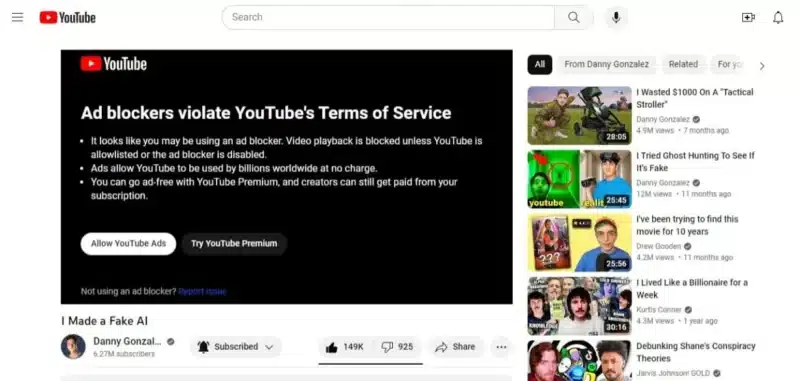
The platform has reportedly been sending users with ad blockers enabled more aggressive prompts, warning them to either “Allow YouTube ads” or subscribe to YouTube Premium. The notification appears in place of videos or as a pop-up when playing videos on fullscreen.
If the viewer fails to comply, the platform threatens to block video playback after three plays.
Why we care. This is promising news for advertisers in terms of extending your ad’s reach. However, it’s important to consider that pushing ads onto people who have no interest may not yield great results, as they’re less likely to convert into customers.
What does the prompt say? The prompt reads:
“Ad blockers violate YouTube’s Terms of Service.”
“It looks like you may be using an ad locker. Video playback is blocked unless YouTube is allowlisted or the ad blocker is disabled.:
“Ads allow YouTube tp be used by billions worldwide at no charge.:
“You can go ad-free with YouTube Premium, and creators still get paid from your subscriptions.:
Here’s a screenshot:
Why now? YouTube has said that it is taking more measures against ad blockers to ensure that its content creators are compensated for their work. “YouTube’s ad-supported model supports a diverse ecosystem of creators, and provides billions of people globally access to content for free with ads,” the company said in a statement.
How much is YouTube Premium? YouTube Premium costs $13.99 a month in the US. The price was increased by 17% from $11.99 in June.
Get the daily newsletter search marketers rely on.
function getCookie(cname) {
let name = cname + “=”;
let decodedCookie = decodeURIComponent(document.cookie);
let ca = decodedCookie.split(‘;’);
for(let i = 0; i <ca.length; i++) {
let c = ca[i];
while (c.charAt(0) == ' ') {
c = c.substring(1);
}
if (c.indexOf(name) == 0) {
return c.substring(name.length, c.length);
}
}
return "";
}
document.getElementById('munchkinCookieInline').value = getCookie('_mkto_trk');
What has YouTube said? Oluwa Falodun, a spokesperson for Google, previously told The Verge in a statement:
“We want to inform viewers thatad blockers violate YouTube’s , and make it easier for them to allow ads on YouTube or try YouTube Premium for an ad free experience.”
“Ad blocker detection is not new, and other publishers regularly ask viewers to disable ad blockers.”
“We take disabling playback very seriously, and will only disable playback if viewers ignore repeated requests to allow ads on YouTube.”
“In cases when viewers feel they have been falsely flagged as using an ad blocker, they can share this feedback by clicking on the link in the prompt.”
Email is an integral part of our personal and professional lives. We use it to create and log into online accounts, subscribe to new content, communicate across digital platforms and verify our identity. It’s the key to our digital footprint.
But did you know that the intelligence surrounding the simple email address has the potential to fuel more effective data science, improve marketing, increase sales, elevate the customer experience and reinvent analytics initiatives?
Join experts in a live webinar as they dive deep into how you can harness the vast amount of potential surrounding emails to unlock valuable insights, enable personalized marketing campaigns and enhance overall business performance.
DevOps consulting companies can play a vital role in helping organizations adopt and implement DevOps practices. However, with so many different companies to choose from, it can be difficult to know where to start.
In this article, we will discuss the key factors to consider when choosing a DevOps consulting company. We will also provide you with actionable and tested tips on how to evaluate potential partners and make the best decision for your organization.
What to consider when choosing DevOps consulting services
Factor 1: What is the expertise and experience of your DevOps consulting company?
You should partner with a company that has experience and expertise in the DevOps domain. Sounds obvious, but many companies often fail to consider this factor rightly. If the company has many years of experience in Software Development and Quality Assurance services, it doesn’t necessarily mean that they have good DevOps specialists. To make an informed decision, check their DevOps portfolio, discuss the complexity of their projects as well as challenges they encountered along the way. A reputable DevOps company should be able to provide concrete examples of how they managed issues related to automation, continuous delivery and continuous integration.
Don’t forget to ask about the composition of their DevOps department, qualification of their specialists and experience with tools and technologies commonly used in DevOps practices. This information would help you to understand whether the company’s expertise aligns with your project’s needs and requirements.
Factor 2: Does the DevOps consulting company offer customization and flexibility?
Your organization’s DevOps needs might be unique and one-size-fits-all approach might not work well for you. A top-notch DevOps consulting company should understand this and work to customize solutions that align with your distinct requirements. For instance, if your organization primarily operates in a regulated industry like healthcare, the firm should be able to tailor DevOps processes to comply with industry regulations, such as HIPAA in the United States.
Flexibility is equally crucial, as the technology landscape is constantly evolving. A proficient consulting partner should remain adaptable to changes in your organization’s requirements and industry trends. For example, if your organization decides to transition from on-premises infrastructure to the cloud, your chosen partner should be flexible enough to accommodate this shift and adjust your DevOps processes accordingly.
Factor 3: Who are the clients and what is their feedback?
Positive reviews and testimonials indicate that the company has a history of delivering on its promises. Conversely, negative feedback or recurring complaints should raise red flags and prompt you to dig deeper into potential issues.
Consider an example: If a DevOps consulting company has a solid track record in the finance sector and glowing recommendations from financial institutions, it suggests that they possess the skills to handle sensitive data and regulatory requirements effectively.
Furthermore, reaching out to former clients for direct feedback can provide you with candid insights into the consulting firm’s strengths and weaknesses. By asking about their experiences, challenges encountered, and the outcomes achieved, you gain a clearer picture of what to expect from the consulting partnership
How to choose DevOps consulting experts
Step 1. Define your requirements and expectations. Before searching for companies, you should know and understand what you want to achieve with DevOps? Are you looking to improve your speed to market, reduce costs, or improve software quality? Don’t forget to consider your budget. DevOps consulting services can range in price, so it’s important to set a budget before you start your search. Be sure to take into account the cost of services, as well as travel and other expenses. All this will save your time later on.
Step 2. Research, research, research. Just google “DevOps consulting company” and see what you find on the Internet. You will most likely find plenty of different companies to choose from. Select twenty of them that you like the most.
Step 3. Choose the best 5 out of 20. Use the following factors to guide your selection:
Years of experience
Amount of projects in DevOps domain
Amount of DevOps projects in your industry
References from previous clients
Certifications
Experience in automation
Size of DevOps department
Expertise in different DevOps tools and technologies
Cost-optimization offering
Monitoring and DevOps metrics
Ability to build scalable projects
Commitment to continuous learning and improvement
Pricing
Client-centric approach
Flexibility and adaptability
Your specific needs and requirements
Step 4.Arrange a meeting with the selected companies. During them discuss in more detail their experience and your project. Get a clear proposal from each company. This should include the scope of work, deliverables, timeline, and cost. You should feel that the company fits you in terms of cooperation, communication and other conditions. Beware of consultants who make promises that sound too good to be true. DevOps is a complex and challenging undertaking, and there is no one-size-fits-all solution. Look for consultants who are honest and realistic about what they can achieve. Based on interviews and proposals, choose the company that fits you the most.
Step 5. Start cooperation and enjoy your choice. If you did everything right, you will reach your DevOps goals and transform your business for the better. However, be ready to face challenges. The projects without problems don’t exist. What matters the most is how your DevOps consulting company faces challenges and finds the right solutions to them.
Comparing the hiring of DevOps consulting with hiring a coach
Think about the following comparison.
Imagine that you’re hiring a coach to help you train for a marathon. You’re interviewing a few candidates, and they’re all telling you the same thing: they’re the best, they’ll get you to the finish line, and they’ll make you a better runner.
But then you meet one coach who tells you something different:
“I can’t guarantee that you’ll finish the marathon,” he says. “But I can guarantee that you’ll be a better runner by the end of our training. You’ll learn how to push yourself harder, you’ll learn how to listen to your body, and you’ll learn how to pace yourself. And if you decide to run the marathon, I’ll be there to support you every step of the way.”
That’s the kind of DevOps consulting company you want to hire. A company that’s honest with you about the challenges ahead, but that’s also committed to helping you succeed.
A company that is not just interested in getting you to the finish line, but also in making you a better runner along the way.
Conclusion
All in all, there is no universal way to find a reliable DevOps consulting company, but following the recommendations mentioned within this article might considerably help.
To sum up, what you need to do is research, choose the pool of companies, and ask them the tough questions, demanding about their experience, their successes, and their failures. Ask about their approach to DevOps and their philosophy. And most importantly, ask yourself if you trust them to help you achieve your goals.
We hope that our article helped you to find a company that will help you take your DevOps journey to the next level.