Online sports betting has rapidly become one of the most popular forms of online entertainment worldwide. With the growing availability of internet access and the increasing use of smartphones and tablets, betting enthusiasts can easily place bets on their favorite sports events from anywhere and at any time. But how did online sports betting become as popular as it is today? In this article, we’ll explore the evolution of online sports and the emergence of some of the best betting company and the factors that have contributed to its immense popularity.
The Emergence of the Internet
The internet revolutionized the way people access information and interact with each other. With the advent of online betting, people were no longer limited to placing bets at physical bookmakers. The emergence of online sports betting platforms allowed betting enthusiasts to place bets on their favorite sports events from the comfort of their homes.
Increased Accessibility
Online sports betting is now more accessible than ever before. With the widespread availability of internet access, betting enthusiasts can now easily place bets on their mobile phones, tablets, or laptops. The increasing popularity of mobile devices has made online sports betting even more convenient and accessible.
Increased Sports Coverage
The growing popularity of sports events around the world has contributed significantly to the rise of online sports betting. With more sports events being televised, streamed, and available for online viewing, there are now more opportunities for betting enthusiasts to place bets on their favorite sports.
The Advancement of Technology
Advances in technology have played a significant role in the rise of online sports betting. Online sports betting platforms now offer a range of features, including live streaming of matches, in-play betting, and cash-out options. These features have enhanced the user experience and made online sports betting more exciting and interactive.
Marketing and Advertising
The marketing and advertising efforts of online betting companies have also contributed to the rise of online sports betting. Betting companies have invested heavily in advertising campaigns and sponsorships to attract more customers. The aggressive marketing strategies of these companies have made online sports betting more visible and accessible to a wider audience.
Regulatory Changes
Regulatory changes have also contributed to the growth of online sports betting. In many countries, laws have been changed to allow online sports betting, providing a legal framework for betting enthusiasts to place their bets online. These changes have also led to the emergence of reputable and licensed online sports betting companies, ensuring a safe and secure environment for betting enthusiasts.
The COVID-19 Pandemic
The COVID-19 pandemic has also played a significant role in the rise of online sports betting. With the cancellation of many live sports events, online sports betting became one of the few remaining options for betting enthusiasts to place their bets. The pandemic also accelerated the adoption of online betting, as people were forced to stay at home and seek entertainment online.
Better Payment Options
Better payment options have played a significant role in making online sports betting more popular. In the past, one of the biggest concerns of people was the safety and security of their funds while making transactions on online sports betting sites. However, with the advancements in technology and the availability of better payment options, these concerns have been addressed.
Online sports betting sites now offer a variety of payment options, including credit and debit cards, e-wallets, bank transfers, and cryptocurrencies. These payment options provide customers with a range of choices, making it easier for them to deposit and withdraw funds from their betting accounts. Moreover, these payment options are fast, secure, and convenient, allowing customers to make transactions with ease.
Increasing Popularity of Esports
Esports has become increasingly popular in recent years, with millions of people tuning in to watch professional gamers compete. This has led to the rise of esports betting, where people can bet on the outcome of these events. Online sports betting sites have recognized the potential of esports betting and have started offering it as an option.
In-Game Betting
In-game betting has also contributed to the growth of online sports betting. With in-game betting, people can place bets during a sporting event, increasing the excitement and engagement for viewers. Online sports betting sites have adapted to this trend and now offer in-game betting options.
Rising Disposable Income
As people’s disposable income has increased, more and more people have started participating in online sports betting. This trend is expected to continue as people’s incomes continue to rise.
Social Acceptance
In the past, sports betting was often associated with negative connotations such as addiction and illegal activity. However, with the legalization of online sports betting and the increase in its popularity, people are beginning to view it in a more positive light. As more and more people openly discuss their participation in sports betting, the stigma surrounding it is gradually decreasing.
In addition, many professional sports leagues and teams have also embraced online sports betting, partnering with sportsbooks and promoting their services to their fans. This has helped to further normalize sports betting and make it more socially acceptable.
Lower Costs
Online sports betting often has lower costs than traditional sports betting. This is because online sportsbooks have lower overhead costs, which allows them to offer better odds and bonuses to customers. Additionally, customers save money on travel costs and other expenses associated with visiting a physical sportsbook.
Continuous Innovation
Online sports betting sites are constantly innovating and improving their services to provide a better experience for customers. This has led to increased engagement and interest from customers, contributing to the overall growth of online sports betting.
Access to Information
Online sports betting sites provide users with a wealth of information, including statistics, odds, and expert analysis, to help them make informed betting decisions. This access to information has helped to increase the popularity of online sports betting.
Wind Up
Overall, online sports betting has become as popular as it is today due to a combination of factors, including advancements in technology, the rise of mobile devices, and an increase in advertising and sponsorship. As more countries legalize and regulate online sports betting, and as online sports betting sites continue to innovate and improve their services, it is likely that its popularity will continue to grow in the future.
Keyword difficulty isn’t one of SEO’s hottest topics or latest trends. But it is a powerful metric when you understand its potential.
It can help you to make educated decisions about your prospects of ranking for specific terms, allowing you to make tactical choices that underpin your SEO strategy.
Here’s what keyword difficulty means for SEO, how the score is measured and tips for using it to get better results.
What is keyword difficulty?
Keyword difficulty is a metric that quantifies how competitive a keyword is and, therefore, how challenging it’s likely to be to rank for it. It is displayed as a value from 1 (low competition) to 100 (extremely high competition).
What does the score tell you?
Keyword difficulty in SEO tells you how difficult it’s likely to be to rank for a particular keyword in relation to the strength of the competition. However, there’s no standard for calculating the difficulty or competition to rank for a particular keyword.
Various tools measure it differently, and scores can vary significantly based on which one you use.
Most tools factor the strength and number of referring domains pointing to the top ranking results in the search engines into their calculation, but many use additional metrics too.
Where do you find it?
There are a variety of different SEO tools that provide a keyword difficulty checker.
It is usually found in the keyword research function of a tool and displayed alongside the search volume metric, labeled difficulty, competition or KD.
Tools to check keyword difficulty
To check the competition for keywords at scale, you will likely need a paid keyword research tool. Here are some of the most well-known:
Ahrefs
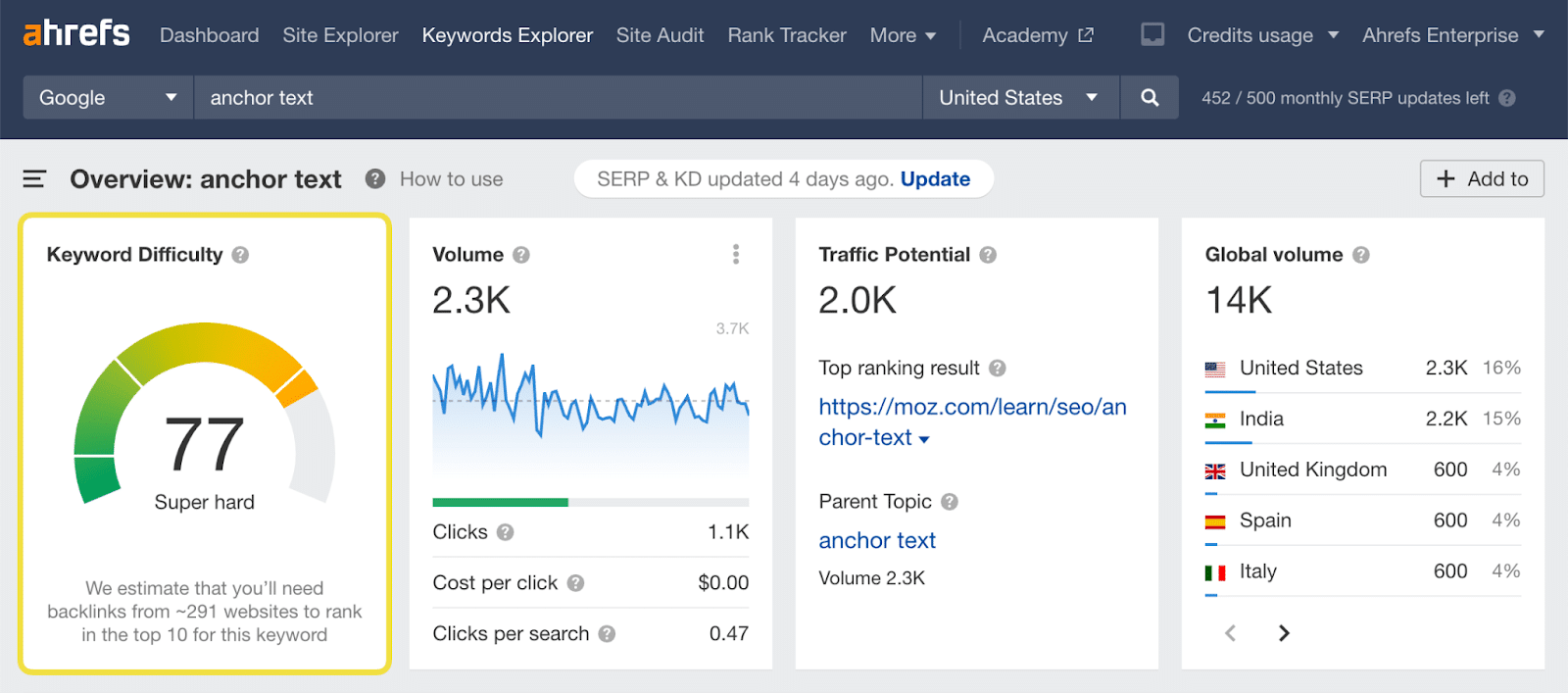
Navigate to Keywords Explorer and you can begin your search. The difficulty score is clearly labeled and color-coded along with descriptive text to help you understand the difficulty level.
“Here at Ahrefs, we use a simple method for calculating KD. We pull the top 10 ranking pages for your keyword and look up how many websites link to each of them. The more links the top-ranking pages for your keyword have, the higher its KD score. Very simple and very actionable.”
Semrush
In the Keyword Overview section of Semrush, you’ll find their difficulty metrics. There’s also a KD column in keyword reports.
How is it calculated?
Semrush uses SERP analysis, keyword analysis and a score weighting based on locality. You can read the full details here.
Moz
The keyword explorer in Moz gives you an immediate score that’s easy to find and interpret.
“Keyword Difficulty in Keyword Explorer takes into account the Page Authority (PA) and Domain Authority (DA) scores of the results ranking on the first page of Google for the given query, as well as modifying intelligently for projected click-through rate (CTR) of a given page. Keyword Difficulty puts more weight on higher-ranking, more visible pages, and less weight on lower-ranking, less visible pages. The formula also accounts for newer pages on powerful domains that may have DA scores but have not yet been assigned PA values. The scores roughly correspond to a weighted average of the PA of the top 10, and the other inputs (DA, homepages, query term use, etc.) modify that weighted average.”
Sistrix
Head to Keywords in the top navigation to reach the keyword explorer.
Enter a seed term or a list of terms. You’ll reach an overview page if you use a seed term, and the difficulty score is displayed for that specific term.
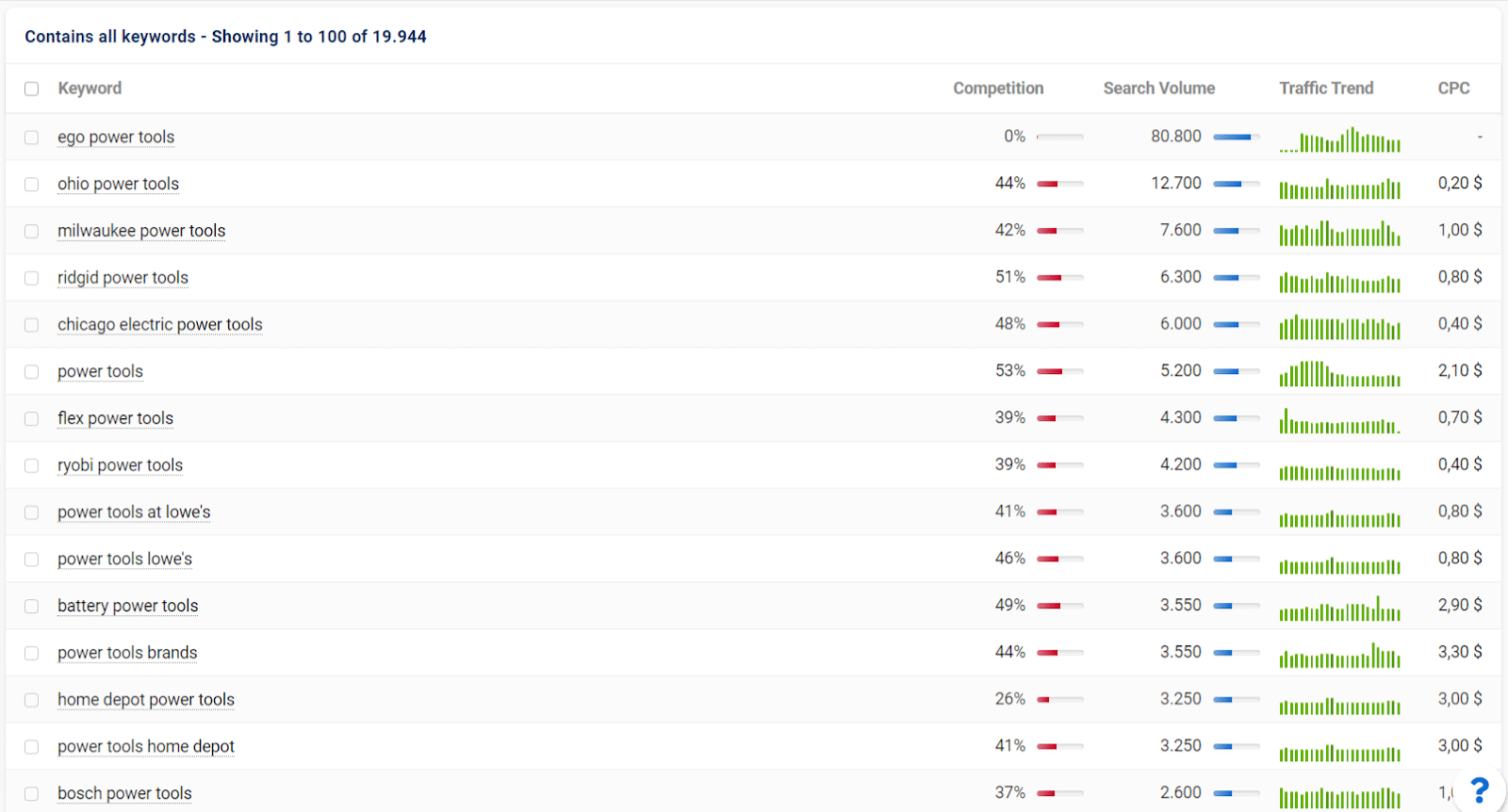
Drill down into a keyword list under Contains all keywords to reach a table with competition and keyword difficulty.
How is it calculated?
Sistrix states they use “a number of values” to calculate their difficulty score. They go on to say:
“Around 15 values for each keyword are regularly analysed and summarised in this key figure. These are quite intuitive metrics such as the number of searches, but also more complex observations such as the number of start pages (not sub-pages) in the top 10.
The value has a logarithmic structure. In practice, this means that an increase in the competition key figure by 10 points represents roughly twice as intense competition in the SERPs for this keyword.”
As you might expect, each tool is tight-lipped on what exactly goes into its calculation. Each approach is quite different, which explains the varying scores.
Quick tip: Pick a tool for each project and stick to it. Don’t mix data from different tools, as you won’t be comparing like-for-like when it comes to keyword difficulty.
Get the daily newsletter search marketers rely on.
function getCookie(cname) {
let name = cname + “=”;
let decodedCookie = decodeURIComponent(document.cookie);
let ca = decodedCookie.split(‘;’);
for(let i = 0; i <ca.length; i++) {
let c = ca[i];
while (c.charAt(0) == ' ') {
c = c.substring(1);
}
if (c.indexOf(name) == 0) {
return c.substring(name.length, c.length);
}
}
return "";
}
document.getElementById('munchkinCookieInline').value = getCookie('_mkto_trk');
Is keyword difficulty good or bad?
Keyword difficulty in itself is neither good nor bad. It’s simply information.
OK, if you have a brand new site to launch with a small budget and all the keywords that are relevant to you have extremely high competition, that’s bad. But that’s also pretty lousy business planning.
Having an understanding of keyword competitiveness is undoubtedly good. Appreciating how it can work for you gives you a head start on the competition.
What is high/low keyword difficulty?
In general terms, a high-difficulty keyword has a lot of competition, making it more challenging to rank highly in the organic search results.
You’ll likely find some brand names you recognize ranking for high-difficulty terms.
For example, let’s take the keyword “iphone 14.” Sistrix gives it a competition score of 67% in the U.S.:
The SERPs look like this:
Up against Apple, CNN and Wikipedia, we can see that ranking in the top 10 would be a challenge for smaller brands.
Broadly speaking, low difficulty means that the competition isn’t as fierce. You might find less relevant results and may spot some niche websites that aren’t household names.
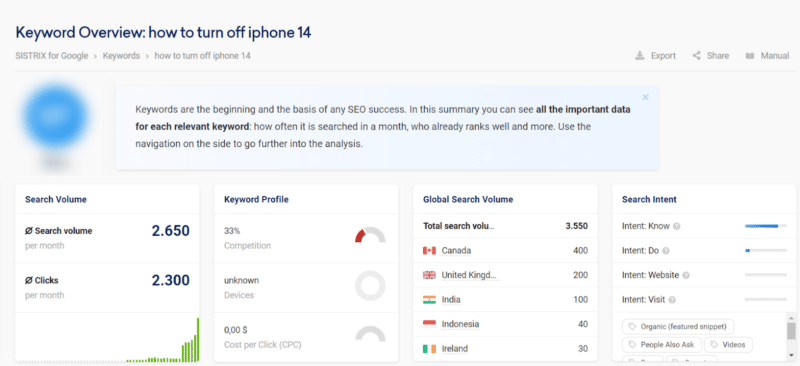
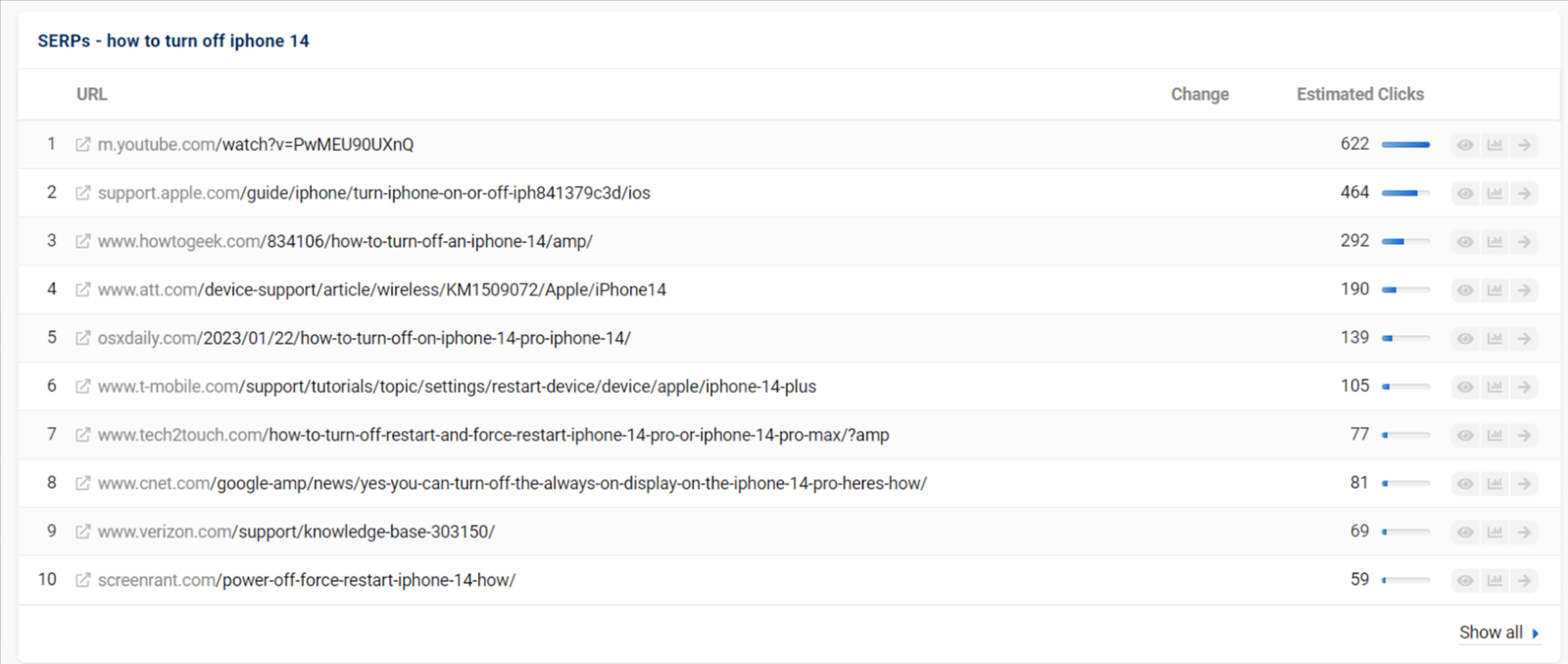
Now let’s switch that earlier example to a term with much lower difficulty “how to turn off iphone 14.”
The competition level is just 33%. You’re still up against some big names, but you can also see some in there that you might not recognize.
This shows that if you create some really useful and relevant content, you might have a shot at ranking fairly well.
When you’re looking at keyword competition, everything is relative.
This is why I love using color scales to review a keyword list. It helps to visualize the highs and lows in relation to the dataset you’re working from.
Once you’ve drawn up a list of keywords you’re interested in for a new page or piece of content, you can look at the difficulty spread across the whole list.
What is a good keyword difficulty?
This is where things get tricky. A “good” keyword difficulty is a sweet spot relative to all the other considerations you have to make.
The best approach is to gather all the relevant information, including competition scores, and use this all to make strategic decisions.
It’s no easy task, but the more frequently you do it, the more you learn.
Factors to consider when looking for a good keyword
There are various considerations to make when assessing a keyword’s viability. It’s a balance between the following:
Search volume.
Your site’s current strength in the market.
The strength of your backlink profile.
How competitive a term is in relation to other terms you could target (difficulty).
How well your content can fulfill search intent.
You’ll come to your decisions by weighing up these factors.
How do I choose keyword difficulty?
When you’re reviewing difficulty scores, it’s not a case of choosing a number or a specific difficulty level. It’s simply a useful metric to help you understand the playing field.
Difficulty scores are a small but important part of choosing keywords for SEO. My process is as follows:
Enter my seed keyword into an SEO tool that provides search volume and keyword competition or difficulty metrics.
Select all the relevant keyword options and save them in a list.
Export the list to Google Sheets or Excel.
Sort by search volume (highest first).
Format the search volume and keyword difficulty columns with color scales.
Use the color scales as visual clues to spot keywords with high(er) search volumes and low(er) difficulty scores.
Pick out one or two primary and a handful of secondary keywords you’re most interested in.
Review the search intent for this refined list, look at what currently ranks and be honest with yourself about whether you plan to create a page that will fulfill that search intent.
Remove any keywords from your refined list that don’t line up with search intent.
Always keep the domain you’re working on in mind. If you’re a big brand with a high authority site, you might not need to be as concerned with keyword competition as a small to medium-sized business that needs to seize every opportunity to gain ground in the SERPs.
You should be left with a qualified list of target keywords to help you focus your content.
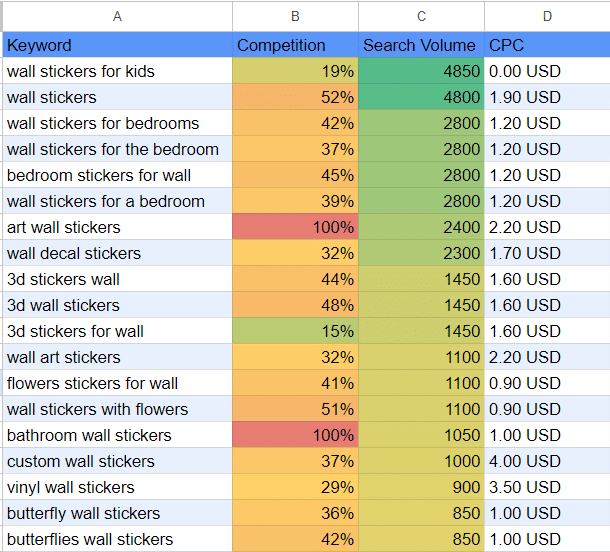
Here’s an example of how I use color scales to visualize the opportunities:
Here, “wall stickers for kids” looks like an interesting opportunity with a relatively high search volume (for my current dataset) and relatively low difficulty.
Without keyword research, I might have assumed that “wall stickers” was the obvious term to go after, but it’s much more competitive and has a slightly lower search volume.
So assuming my range is for kids, I’ve found a possible target keyword here.
But… are keywords still important for SEO?
There’s a much higher focus on AI, machine learning, natural language processing and voice search today, and even Google Analytics has hidden a lot of its keyword data (not provided).
So you’re probably wondering why it’s even worth all this time and effort considering a keyword difficulty score.
Yet, keywords are still vitally important. This type of research gives you insight into what your target market is looking for and how they search for it.
This can be interesting, surprising and even amusing at times! There’s no filter when we search as we have a level of anonymity that allows direct and honest questions to be asked.
It also informs you about what your competition views as important and how you might be able to outsmart them or spot an opportunity they haven’t.
Keyword research can help you uncover new opportunities for products, product ranges or content.
Without regularly checking what people are searching for, you could miss out on new trends that initially have lower difficulty because the competition hasn’t caught up yet.
How you create good, helpful and authoritative content to satisfy these queries is a different question, but understanding your marketplace in the SERPs is a step you should never miss.
A focused keyword list helps you keep your eye on the opportunities and forms the backbone of your overall strategy.
How to find low-difficulty keywords
You can filter or sort any dataset by keyword difficulty to find low-competition keywords.
But if you want to begin your search by looking for keywords that are easier to rank for, here are a few methods you could also try:
Adding search qualifiers
Refine your broad search by adding qualifiers. You can add words like “for,” “to” and “vs” to narrow down the options. You’ll get some more specific phrases, and usually, the difficulty score will be lower.
Looking for the long tail
By their nature, long-tail queries tend to be more detailed, specific and lower competition.
Because their search volumes are lower, there’s usually some low-hanging fruit for long-tail keywords.
Getting ahead of trends
Using tools like Google Trends, Pinterest Trends, TikTok Trends and Exploding Topics, look out for new areas of interest in your niche.
If you identify these early enough, the competition will likely be lower. There’s always a gamble here, though.
You can never be sure which trends will stick or how quickly the competition will catch on, potentially displacing your position in the SERPs.
Why is keyword difficulty important?
There are so many reasons keyword difficulty is an essential metric in SEO:
It’s strategic
Keyword difficulty is really important because it allows us to think strategically. As time-poor SEOs, we want to make the biggest impact with our work.
Understanding the competition in the SERPs quickly and efficiently provides a huge help with that.
It helps us make decisions – lots of them
We can evaluate whether to spend a lot or a little effort on new content based on the level of competition.
We can decide not to use any resources on trying to rank highly for certain keywords and gain recognition for highly competitive product ranges by other means like PPC, email or other forms of advertising.
We can choose whether to focus our efforts on-page or off-page.
It helps us to be smarter with our limited resources
When used as part of our strategy, keyword difficulty helps us to work smarter, not harder.
It’s a metric that helps us narrow down large amounts of data quickly and understand our opportunities quickly.
It can help you manage expectations
Sharing this metric with stakeholders can also help you to communicate more effectively.
Having something quantifiable that demonstrates you’ll have to work harder or allocate more resources can help you secure the provision you need.
Discussing this measure upfront can aid understanding, helping managers or business owners visualize why ranking for certain keywords is more challenging and might take longer.
Managing keyword competition in your SEO campaigns
While I’m a huge advocate for collecting and reviewing keyword difficulty metrics, it’s also important not to get too hung up on them.
As we’ve seen, each tool measures this notion in a different way. Keyword competition is more of a concept than an exact science.
I like to see this data as a signpost, not an instruction.
It’s there to help us make informed decisions at scale. You can read the signs and still choose to take a different turn.
For example, if something looks too difficult, but it’s a key part of your product range or service provision, go for it anyway.
It might just take a little longer to get to the place you’d like to be, but at least you’ll know what to expect.
ChatGPT is now available as an iOS app. The app is free and offers all the features you’ll find on the web version.
Why we care. ChatGPT has become an essential and popular tool for several SEOs, search marketers and content creators. Now you can use it whenever and wherever you want, all while maintaining your history. Plus, the app interface seems a bit more user-friendly than using ChatGPT on a mobile browser.
Plus. You’ll need to subscribe to ChatGPT Plus to get access to its GPT-4 model, as well as the other Plus features.
Voice input. The app also uses OpenAI’s speech-recognition system, called Whisper, to enable voice input. Early reports indicated this feature to be a bit buggy.
U.S. only for now. The app will roll out to U.S. users first, then expand to more countries in the coming weeks.
ChatGPT on Android “soon.” OpenAI said an app is coming soon for Android users.
Sports have become one of the most popular forms of entertainment across the world. From the Olympics to local pickup games, sports bring people together in an exciting and unique way.
A major factor in sports’ popularity is its ability to unite people. One of the most powerful aspects of sports is that it can transcend language and cultural barriers, allowing people from all walks of life to come together and enjoy watching or participating in a game. No matter where you are or who you are, sports can be a great way to connect with others and have a good time.
Sports also provide an outlet for competition. People love the thrill of watching or playing a game and seeing who comes out on top. This competitive spirit is a major draw for sports fans and participants alike.
The physicality of sports can also be a major draw. Watching athletes perform incredible feats of athleticism can be an incredible experience. It’s amazing to watch how far the human body can be pushed and to witness people pushing themselves to their physical limits.
Moreover, betting on sports also adds to its drama and excitement. The chance to win or lose money depending on the outcome of a game can be a great incentive for watching and participating.
Sports Betting
Sports betting has become a popular way for sports fans to show their enthusiasm and passion for a game. It adds an extra layer of excitement and drama to a game and can often be the deciding factor in who takes home the win.
In the past, sports betting was limited to local casinos and betting shops. However, nowadays people can bet on sports from the comfort of their own home. Online sports betting has become increasingly popular due to its convenience and the ability to place wagers from anywhere in the world.
Online sports betting offers many advantages over traditional betting. For one, it is much more convenient and accessible. You don’t have to leave the comfort of your own home to place a wager. Additionally, online sportsbooks often offer bonuses and promotions to attract new customers, which can help to increase your overall winnings.
Furthermore, online sportsbooks offer a wide range of betting options, from traditional point spreads to parlays and teasers. This allows bettors to customize their betting strategy and increase their chances of making a successful wager. Finally, online sportsbooks often allow for live betting, which allows bettors to place wagers during the game itself, giving them an extra level of excitement.
What Are Good Bookmakers?
Online sports betting has become increasingly popular in recent years. It is a great way to add some excitement and drama to your favorite sports games, as well as potentially make some money. However, when it comes to online sports betting, it is important to choose the right bookmaker.
A good bookmaker will provide a secure and reliable platform for you to place your wagers. They should also offer competitive odds and a wide range of betting options. Additionally, a good bookmaker should offer bonuses and promotions to attract new customers as well as ongoing loyalty rewards for existing customers.
In order to find the right bookmaker, it is important to do some research. Start by looking at the different bookmakers available and reading their reviews. Learn some smart betting guides and tips before you start. Reputable sites will have good reviews from verified customers. This will ensure. you’re playing in a safe environment and don’t have to worry about getting scammed or cheated.
It is also important to compare the different bookmakers to find the one that offers the best odds and promotions. Some bookmakers might offer lower odds but more promotions, while others might offer higher odds but fewer promotions. It is important to find the right balance between the two. Odds are very important as it will determine how good your chances are to win.
It is also important to look for a bookmaker that offers customer support. It is important to have someone you can contact in case of any questions or issues that might arise. A good bookmaker should have a good customer service team that can help you with any issues or questions you might have.
Finally, it is important to read the terms and conditions of each bookmaker to make sure you understand the rules and regulations. This will ensure that you are comfortable with the bookmaker and that you don’t run into any problems when placing your wagers.
Finding the right bookmaker is a very important part of online sports betting. It is important to do your research and compare different bookmakers to find the one that offers the best odds and promotions, as well as a secure and reliable platform. Additionally, it is important to make sure that the bookmaker offers customer service in case of any issues or questions.
Final Say
Sports have become an incredibly popular form of entertainment across the world. Its ability to unite people, provide a platform for competition, and showcase amazing feats of athleticism are just a few of the reasons why it is so popular. Additionally, sports betting has become increasingly popular as a way to add some extra excitement and drama to a game. Choosing the right bookmaker is an important part of sports betting and it is important to do some research to find the one that offers the best odds, promotions, and customer service.
Non-skippable ads are coming to YouTube Select on connected TV. This means that viewers will see one 30-second ad instead of two consecutive 15-second ads.
Why we care. YouTube was the most popular U.S. video streaming platform in April and watch time increased, according to Nielsen. It remains to be seen whether a non-skippable 30-second format provides a good advertising ROI.
What YouTube said. YouTube explained in a blog post:
“We know that running longer-form creative on the big screen aligns with your objectives, and allows for richer storytelling. YouTube Select is now landing over 70% of impressions on the TV screen, so we’re making it easier for you to use existing assets in front of the most-streamed content.”
YouTube Select is the top 5% of the most-viewed and most-engaging content.
U.S. first. YouTube’s new ad type will initially be available only in the U.S., with plans to expand availability internationally later this year.
Pause Ads. YouTube also announced it will be testing “Pause experiences” on CTV. This experimental feature will allow viewers to pause videos, to potentially help drive awareness or an action – perhaps via a QR code.
“The grocery-delivery firm’s ad revenue totaled about $740 million last year, up 30% from 2021, according to a person familiar with the matter. That’s a striking increase, given that the digital ad market was largely stagnant last year. Nearly 30% of Instacart’s 2022 revenue came from selling advertising rather than actually delivering groceries.”
Ads accounted for about 20% of Instacart’s $1.5 annual revenue in 2021 – about $300 million – according to a June 2021 Insider report.
For comparison. Advertising accounted for about 10% of Amazon’s revenue in 2022, according to The Information. Meanwhile, Amazon made $37.7 billion in revenue through advertising last year.
Why we care. Instacart remains a viable alternative for brands to promote products directly to consumers. And the company has updated its platform to attract more advertisers.
The bigger picture. In 2022, Google and Meta’s advertising market share dropped below 50%. This trend is expected to continue in 2023, in part, due to the rise of emerging ad platforms like Instacart.
The rise of retail media networks. Retail media search spend is forecast to be near $30 billion this year – and RMN digital ad revenue is expected to hit $45 billion. Dig deeper in U.S. paid search spend forecast to hit $110 billion in 2023.
Air purifiers clean stale air and eliminate indoor pollutants and airborne illnesses, which in turn reduces the chance of pollution-related health issues. As a business owner who may have employees working in your office, you want to make sure the air quality one breathes while working is clean and healthy. Bringing a powerful air purifier into your home office is a great way to ensure you and your employees are breathing the best air possible. This substantially reduces the chance someone gets sick while at work and also adds to your overall well-being as a business owner. But with so many air purifiers on the market, how do you choose the best one? You want to choose a quality air purifier that comes from a reputable brand and features the best technology. Home Business Magazine had the opportunity to test out IQAir’s Atem X and here’s why this air purifier is a top choice for your home office.
Who is IQAir?
In understanding the experience and quality of the Atem X, you should get to know IQAir. IQAir is the world’s largest free real-time air quality information platform that engages an ever-growing number of global citizens, organizations, and governments. They take a rigorous approach to air quality science and help global citizens improve air quality and reduce exposure to air pollution. Today, they operate the world’s largest free real-time air quality information platform and engage an ever-growing number of global citizens, organizations, and governments. They believe that information, collaboration, and technology solutions help create better air quality, a better planet, and better lives. Their industry-defining clean air technological innovations have helped protect schools, hospitals, and families from toxic pollutants and airborne viruses like SARS-CoV-2.
Introducing Atem X
Atem X is a powerful air purifier from IQAir that offers quiet performance and stunning design.
Atem X is a powerful air purifier from IQAir that offers quiet performance and a stunning Swiss design. As with all IQAir air quality products, the Atem X is manufactured and produced in-house at their state-of-the-art facilities in both Switzerland and Germany, where some of the best technology in the world is manufactured. Needless to say, the Atem X’s attention to detail is second to none.
The Atem X is one of the quietest, compact high-performance air purifiers on the market and at the same time, it is such a powerhouse in air purification. In its slim, beautiful package, the Atem X combines powerful filtration for particles of all sizes. Its whisper-quiet operation is important for office spaces, as noisy air purifiers can disrupt the work of employees, especially those who may be sensitive to noise.
Attractive, Slim and Space-saving Design
Most air purifiers have a hard time blending in well with the space they reside in. However, the Atem X features an attractive, slim and space-saving design that will elevate any office or living space, while only requiring the floor space of two sheets of paper. This means that you can find a suitable spot for the Atem X in any office space big or small.
The Atem X’s slim design does not compromise functionality. Its patented BionicCore technology allows for more air to be cleaned with less noise and less energy in a slimmer, smaller form factor than traditional air purifiers.
Atem X features an attractive, slim and space-saving design that will elevate any office or living space.
Suitable for Small and Large Spaces Alike
No matter if you work in a one-room office or a larger space, Atem X will care for the health of you and your employees. With 8 fan speeds, Atem X is suitable for large and small spaces alike. For smaller spaces, Atem X can run on lower fan speeds. In bedrooms and individual offices up to 330 sq. ft., two air cleaning cycles per hour are achieved at the whisper-quiet operation of only 32 dB(A).
For large spaces, Atem X cleans up to 1650 sq. ft. (154 m2) in only 30 minutes on top fan speed. Flexible Air Rotation (FAR) technology allows Atem X to deliver clean air further into the room and increases room circulation and air cleaning. For even the largest rooms, you can combine multiple Atem X air purifiers to a Constellation to create optimal air distribution.
Keeps Your Office Air Healthy
Employee health, as well as your own health, is extremely important in making your business run efficiently. It’s also important to acknowledge that some individuals experience respiratory conditions or have weakened immune systems. When someone gets sick and needs to take time off from work, this is an obvious loss of productivity. So to decrease the chances of this happening, improving the quality of air in your office by removing airborne viruses is to some extent controllable with a powerful air purifier.
The Atem X is successful at removing a number of viruses and bacteria. It independently tested a removal rate of 99.99% for viruses such as the human coronavirus (HCoV-229E), responsible for the common cold, the influenza A virus (H1N1), responsible for the seasonal flu, and the enterovirus 71 (EV71), responsible for hand, foot and mouth disease. The Atem X is also highly effective in the removal of bacteria, allergens and mold spores. It tested to show to remove 99.94% of E. coli and 99.92% of white staphylococcus. The fungus Aspergillus niger was removed at a rate of 99.94%. These are all viruses and bacteria which could put your business productivity at a standstill, especially for small businesses with only a few employees. It’s always best to be proactive in attending to these potential losses.
The Atem X is Energy Efficient and Smart-censor Operated
As a business owner, you probably have your finances locked in and might be curious about the extra energy such a powerful air purifier would cost you. You’ll be happy to know that Atem X uses an ultra-energy efficient fan, filter and advanced control technology to clean more air with less energy. Air quality sensors monitor room air quality throughout the day, adjusting fan speed and purification to the necessary level, saving energy when air cleaning isn’t necessary. This means it keeps the costs of pristine, purified air low, without compromising effectiveness. If you also like to turn off Wifi at night, Atem X allows you to set a time window in which you’d want to disable all radio frequency activity. You can then set the time when the Wi-Fi connection should automatically resume.
Atem X is Energy-star qualified, which means it has the “trusted, government-backed symbol for energy efficiency helping to save money and protect the environment through energy-efficient products and practices”.
Atem X uses an ultra-energy efficient fan, filter and advanced control technology to clean more air with less energy.
Smart Filters of the Atem X
Another important factor in running an air purification system is knowing how often you will have to change its filter. With the Atem X, you’ll always know when it needs to be changed. Its smart filters with RFID technology track exactly how much air pollution they have captured. In return, its air filter indicator tells you exactly when the filters need to be replaced. Atem X’s smart filters provide up to 36 months of filter life and track the actual amount of air pollution filtered. This is a very generous filter life and you’ll appreciate not having to remember to change the filter every 6 months.
Controlled in an App
The Atem X is compatible with the world’s most popular air quality app, AirVisual Air Quality App, which is the first and only app to provide real-time and forecast air pollution and weather data for more than 10,000 cities around the world. Combining data from public government air quality stations, satellite data and AirVisual community contributors, this Air Quality App presents a live, complex modelization that covers pollution airflows across the world.
No matter if you’re in or away from your office, you can view and control all of Atem X’s parameters, such as fan speed, smart modes, timer, filter life, and real-time and historic air quality measurements all in the app. Additionally, you can schedule the unit to purify the air based on day, time and desired mode for maximum filter life and reduced energy consumption.
No matter if you’re in or away from your office, you can view and control all of Atem X’s parameters all in an app.
Conclusion
IQAir’s Atem X combines powerful air filtration, quiet sensor-based operation, and Energy Star-rated efficiency. It is a top-choice air purifier for your home office and it will blend in beautifully with its slim, attractive design. It boasts proven results in removing bacteria, allergens and mold spores, giving you and your employees deserved healthy air to breathe while moving through the work day. Atem X is everything it was described to be and more. End your search for the best air purification here with the Atem X.
In Malaysia, small businesses are encountering a highly competitive market, posing challenges in distinguishing themselves and drawing in new customers. One of the most efficient methods to enhance visibility and boost website traffic is through search engine optimization (SEO). By optimizing their website for search engines, small businesses can elevate their online presence and extend their reach to a broader audience.
SEO is particularly important for small businesses in Malaysia, as it can help level the playing field against larger corporations. By implementing an effective SEO strategy, small businesses can compete with larger companies in the same industry, even with limited resources. SEO can also help small businesses target local customers, which is essential for brick-and-mortar shops that rely on foot traffic and repeat business.
In addition to improving visibility and attracting new customers, SEO can also have a significant impact on a small business’s bottom line. By increasing website traffic and improving conversion rates, small businesses can generate more leads and sales, ultimately increasing revenue. With the right SEO strategy in place, small businesses in Malaysia can achieve long-term success and growth in an increasingly competitive market.
How SEO Can Benefit Small Businesses in Malaysia
Small businesses in Malaysia can benefit significantly from SEO. By implementing SEO strategies, small businesses can improve their online visibility, attract more potential customers, and increase their revenue. Here are some ways in which SEO can benefit small businesses in Malaysia:
Improved Online Visibility
SEO offers small businesses a significant advantage by enhancing their online visibility. By optimizing their website for search engines, small businesses can attain higher rankings in search engine results pages (SERPs), making it simpler for potential customers to discover them online. This amplified visibility can result in increased website traffic, which can ultimately lead to more sales and revenue.
Better User Experience
SEO can also improve the user experience of a small business’s website. By optimizing the website’s structure, content, and navigation, small businesses can make it easier for visitors to find what they are looking for quickly. This can lead to increased engagement, lower bounce rates, and higher conversion rates.
Cost-Effective Marketing
Compared to other marketing strategies, SEO can be a cost-effective way for small businesses in Malaysia to reach their target audience. Instead of paying for ads or sponsored posts, small businesses can invest in SEO to generate organic traffic. While it may take some time to see results, the long-term benefits of SEO can be significant for small businesses.
Competitive Advantage
Implementing SEO strategies can also give small businesses a competitive advantage in Malaysia. By ranking higher in SERPs, small businesses can stand out from their competitors and attract more potential customers. This can lead to increased brand awareness, customer loyalty, and revenue.
In conclusion, SEO can be a valuable tool for small businesses in Malaysia. By improving their online visibility, user experience, and competitive advantage, small businesses can attract more potential customers and increase their revenue.
SEO Strategies for Small Businesses in Malaysia
Small businesses in Malaysia can benefit greatly from implementing effective SEO strategies. These strategies can help to improve online visibility, attract more visitors to their website, and ultimately increase leads and conversions. Here are some key SEO strategies that small businesses in Malaysia can use to improve their online presence:
On-page Optimization
The process of on-page optimization pertains to enhancing a website’s structure and content to make it more favorable for search engines. This encompasses optimizing page titles, meta descriptions, header tags, and content to incorporate relevant keywords. Small businesses can also enhance user experience by ensuring that their website is mobile-responsive, has a speedy page load time, and is straightforward to navigate.
Off-page Optimization
Off-page optimization involves building backlinks to a website to improve its credibility and authority. Small businesses can do this by creating high-quality content that other websites will want to link to, as well as reaching out to other websites in their industry to request backlinks. It’s important to focus on building quality backlinks rather than quantity, as this will have a greater impact on search engine rankings.
Local SEO
Local SEO is important for small businesses that serve a specific geographic area. This involves optimizing a website for local search terms, such as “best restaurant in Kuala Lumpur”, and creating a Google My Business profile. Small businesses can also improve their local SEO by getting listed in local directories and getting positive reviews from customers.
By implementing these SEO strategies, small businesses in Malaysia can improve their online presence, attract more visitors to their website, and ultimately increase leads and conversions. It’s important to keep in mind that SEO is a long-term strategy, and it may take some time to see results. Working with professional SEO services can help small businesses to develop and implement effective SEO strategies, and stay up-to-date with the latest SEO methods and best practices.
Choosing the Right SEO Services for Your Small Business in Malaysia
When it comes to choosing the right SEO services for your small business in Malaysia, there are a few things you should keep in mind. With so many SEO experts and professional SEO services available, it’s important to do your research and make an informed decision. Here are some tips to help you choose the right SEO services for your small business in Malaysia.
Look for Experience and Expertise
One of the most important things to look for when choosing SEO services is experience and expertise. You want to work with a company that has a proven track record of success and can demonstrate their expertise in the field. Look for companies that have worked with other small businesses in Malaysia and have a deep understanding of the local market.
Consider Your Budget
Another important factor to consider when choosing SEO services is your budget. While you don’t want to sacrifice quality for price, you also don’t want to overspend on SEO services. Look for companies that offer affordable pricing and flexible packages that can be tailored to your specific needs.
Look for Transparency and Communication
Communication is key when working with an SEO company. Look for companies that are transparent about their processes and can provide regular updates on your website’s performance. You want to work with a company that is responsive to your needs and can answer any questions you may have.
Check for Reviews and Testimonials
Before choosing an SEO company, it’s always a good idea to check for reviews and testimonials from other small businesses in Malaysia. Look for companies with positive reviews and testimonials that demonstrate their ability to deliver results.
Conclusion
Choosing the right SEO services for your small business in Malaysia can be a daunting task, but by keeping these tips in mind, you can make an informed decision that will help your business succeed. Look for experience and expertise, consider your budget, look for transparency and communication, and check for reviews and testimonials. With the right SEO services, you can improve your website’s visibility and drive more traffic to your business.
The coronavirus pandemic triggered massive changes in the working landscape. Not only are more jobs being carried out remotely now, but more work is being outsourced as well. For many businesses, hiring freelancers and independent contractors for specific jobs, rather than keeping a larger number of employees on the payroll is more effective and cost-efficient. In particular, this has lead to an increasing demand for virtual assistants.
Virtual assistants (VA) are essentially freelancers who work in an administrative role for a company or client remotely. They hire out their administrative or creative assistance to various clients and businesses and assist with their needs from home. It’s a win-win situation for both employer and employee. From a business perspective, outsourcing work to virtual assistants means they don’t have to provide a VA with office space, utilities and tools, or contribute any other additional benefits. While some of the key benefits for virtual assistants include the freedom to choose who they work with, the ability to work more flexible hours, and the potential to earn over £200 a day. Plus, you can do it all from home without the commute. What’s not to like?
What’s involved?
Working as a virtual assistant can involve a wide range of tasks. It’ll largely depend on who you’re working for and what they need, but it can involve anything from simply answering phones and sending emails, to book-keeping, business planning and desktop publishing. Got any niche skills? Great. The more specialised your skills are, the more you’ll be able to charge. For example, if you’ve had five years’ experience working in the marketing industry and have extensive knowledge of Microsoft Publisher, you can advertise yourself as a virtual assistant specialising in marketing and desktop publishing.
Do i need qualifications?
Although technically no formal training or qualifications are necessary to be a virtual assistant, most clients will look for a background or relevant experience in secretarial or administration work. If you don’t have this though, don’t panic! For one thing, you’ll have plenty of transferrable skills from other roles such as problem solving, team work, and written communication skills. As well as this though, the increasing demand for virtual assistants means they’re needed in additional roles such as social media, content management, writing blogs, and internet marketing. In these instances, experience in the specific role is more relevant than general administrational experience.
What do i need to get set up?
To get started as a virtual assistant you can actually keep costs incredibly low. Although there are a few things you’ll need, it’s likely that you already have them. At a minimum you’ll need a broadband internet connection, a separate phone line, a computer with all the necessary software, and office stationery. Plus, while you’ll already be paying utility bills you can claim some tax back on them if you’re working from home.
Steps to become a virtual assistant
STEP 1: Sort your skills
Virtual assistants are hired for a range of skills and expertise. Before you get started, decide what your unique selling points are and how you’ll market yourself.
Here’s a few pointers to get your brainstorming started:
Do you have any niche skills?
Do you have any professional training or qualifications in a particular area?
Is there an area of work that you’d like to learn, or focus more on?
Bear in mind that this is an industry that’s continuously moving forward and developing so you need to keep your skills and knowledge up to date as software and programmes change.
STEP 2: Get started
Register your business
The first thing to do to get started is to register your business with your company name. Think carefully about what name you choose, as it’s the first impression a potential client will have of you. One popular option is to just operate under your own name.
Once you’ve chosen a name for your virtual assistant business, you should check it’s not yet used by somebody else. You can check this with the National Business Register. Plus, you also need to check your business name isn’t trademarked. If it is it can cause you serious legal trouble down the line, so best to find out before!
Finally, you’ll need to register yourself as self-employed with HM Revenue & Customs which is free, but if you don’t get it done within three months of working for yourself you could be caught with a fine. Once you’ve registered, they’ll send you all the relevant information you’ll need about national insurance and tax.
Business Insurance and Tax
As a virtual assistant you’ll need to consider an upgrading your insurance policy, as working from home may affect your cover. The Society of Virtual Assistants has a very useful article here on what type of insurance cover you need and why you need it.
When you first start up as a virtual assistant, you probably won’t have to pay VAT as you’re allowed a £85,000 turnover before you have to pay it. However, if your taxable turnover is over £85,000 then you’ll have to contact HMRC to register for VAT. This’ll also mean you’ll have to comply with the governments recent changes to Making Tax Digital.
Financing and Start-up costs
Initial financing and start-up costs usually prevent you from making a profit immediately. Be prepared for this, and check out Should You Go Into Debt to Start a Business for more information.
STEP 3: Finding work as a VA
Sign up to a VA agency
Signing up to an agency can be a good starting point to get work and find clients. However, be wary and avoid agencies that will charge you to work for them. Once you’ve paid them it’ll be doubtful if you ever hear from them again. Similarly, avoid anything advertising ‘get rich quick’ or ‘make up to £1000 a day’. Anything too good to be true on the job market always is.
One of the best websites to check out is the Society of Virtual Assistants. It’s a free service and they have loads of useful information for virtual assistants. You can choose from two different types of membership: approved and standard.
The standard membership is designed to support those looking into becoming a virtual assistant. It includes some useful tools. You’ll get access to the forum where you can post your queries, the society blog and other resources.
The approved membership is for businesses. You’ll have to agree to a code of conduct, and have professional quality website and email, which will be checked. Once you’ve been verified, you’ll be added to the searchable database. They’ll also provide you with access to the ‘jobs available’ part of the forum, which will then hopefully lead on to paid work.
Advertising your business
When you first set up any business it’s hard work making your services known and sourcing clients. Our article Finding Freelance Clients has some useful hints on how to advertise and find yourself clients.
To get your initial clients, you need to know what kind of people you want to offer your VA services to. Make a list of your key skills, what you’re accomplished in, and what you enjoy. Then think about what type of companies would need your services. What kind of companies might need you to sort out their emails or phone lines? What companies might need virtual help with their customer service?
Consider what you can offer to improve their productivity, what the benefits of your service will be to the company and what makes you stand out from the crowd.
Your advertising medium will depend on your target audience. Ask yourself:
What literature do these companies read/use?
Where do these companies network?
What form of media is this company likely to come into contact with most often?
Also, creating your own website is a good way to sell yourself as a virtual assistant. A website is a useful place for you to build an online CV, showcase experience and endorsements, and use it to promote your services. There are plenty of free tools that make it easy enough. How to Set Up a Website For Your Freelance Business is full of all the information you need to get started.
STEP 4: Increase your skills, increase your pay
Virtual assistants can make more money by increasing the skills they offer. Things like book-keeping, web-management and copy-editing are popular ways to increase your attractiveness to prospective clients. Essentially, the more you can do, the more you’re able to offer a prospective client and this boosts your chances of getting work. A variety of work is the beauty of being a virtual assistant and the more things you can do, the more you can charge.
How much does a virtual assistant make?
According to Glassdoor, the average annual salary of a virtual assistant is just under £30,000. Plus, an annual survey conducted by Society of Virtual Assistant, found that the average hourly rate for a VA in the UK is £27. These figures may help you with a rough idea, but obviously it largely depends on what skills and experience you can bring to a role.
There are a few important things you need to take into account when setting your rates. Firstly, you want to decide whether you’re going to charge based on a day-rate, or by the hour. Be wary about charging by the hour though, as you can end up working a lot of un-billable hours when researching and carrying out your own admin tasks, that essentially leave you earning less than you could with a day-rate.
However, as a self-employed person you also need to take into account a lack of:
Holiday pay
Sick pay
Maternity leave
Guaranteed hours
Pension contributions
Job security; and
Provided office stationery and utilities
You’ll need to calculate the fact that you’re missing out on these benefits into your pricing. Realistically, an additional minimum of 25% should be added on to your price to ensure your expenses and tax are covered. For example, if you were thinking of charging £20 an hour, then this should change to £25.
More useful reading
If you’re looking for more help on setting up as a freelancer then check out the articles below:
Advertisers and YouTube creators may benefit from new AI solutions Google is reportedly working on.
Google Ads. Generative AI tools, powered by PaLM 2, will help advertisers create media assets, CNBC reported, based on internal Google documents. Unfortunately, that’s as much detail as we know for now.
We’ve previously reported that generative AI is coming to Google Ads. However, that seemed more about “remixing” existing assets into ads, whereas this report is more about Google actually generating those assets.
YouTube. According to CNBC:
Google has also been testing PaLM 2 for YouTube youth content for things like titles, and descriptions. For creators, the company has been using the technology to experiment with the idea of providing five video ideas based on topics that appear relevant.
Why we care.Amazon and Meta are also testing generative AI for advertisers or will be soon. Google’s integration of generative AI will be worth testing to see if it helps improve performance – especially with conversion rates down and CPLs up.
Will we learn more this Tuesday? This year’s Google Marketing Live takes place May 23. We expect it to be heavy on AI announcements. Could these – or other AI solutions – be officially announced next week? We’ll be watching and reporting on all the news from the event.