Every year, thousands of people around the globe decide that they want to renovate their homes by making changes in their structure. During this process, they spend more money than they should, which messes with their financial budget. When making decisions such as renovating a house or building a new home, you need to allocate a budget. If you need more sense of how money allocation works, local pre-construction management services can help you with that.
Choosing the right construction company that can help you allocate your budget and make sensible decisions requires research that can take a lot of time. It is best to spend your time finding the right person for the job, because you don’t want to end up dealing with someone that is a fraud. The ease with pre-construction services is that they help you build the house or renovate it from day one. They are involved in the process more than you are to give you the best results.
Choosing pe-construction services
Choosing the best pre-construction service for your project might take time and effort. Many people will advise you otherwise, but these services help you in ways you can’t help yourself. Read below to understand why people opt for pre-construction services to get the best outcomes.
Accurate budgets: At the end of the day, everything is about budgets and how they are allocated. You can only spend some of your money on one project. Working with pre-construction services will help you assign a detailed budget to the project without going overboard. Qualified professionals devise a way to put money into the project without burdening the person who is spending the money. With all the experience they have gathered over the years, pre-construction consultants use their vendors to complete the projects, because they know what prices their vendors will quote.
Cost saving: Pre-construction service consultants know ways to reduce costs for things. Something that you like for your home might be available at an expensive rate in the market, but with these consultants’ expertise, they can contact their vendors and have them bring the product at a lower rate. They can compare the price of products, labor, construction, logistics, and the availability of goods. They ensure that the budget is aligned with your needs and leave no stone unturned in making it a success.
Outsourcing: If you were thinking of stepping out into the market and outsourcing people for a project, it is most likely that you are going to get scammed. Pre-construction professionals know what they are doing, and their hiring practices are better than other companies. They hand-pick all the subcontractors for a project to ensure they make the best decisions on your behalf. Their knowledge makes them unique and worth investing in the market.
Subcontractor contracts: When you hire a subcontractor, you do that on a monetary basis. Pre-construction professionals ensure that all the people they are outsourcing or subcontracting are involved in the project with fair bids so that there is no problem in the future. Post-bid contractor negotiation is smooth when the terms of the project are decided.
Choosing a pre-construction company to help you with your renovation is one of the best things you can do. Most of the time, taking help from professionals ends up making the project a success.
Before I started in digital marketing, my career involved quite a bit of foreign language translation work.
Since I left that path and started working on websites, I’ve worked on many websites for international businesses in my SEO career. Some have been smaller, operating only in the U.S. and Canada, while others were global enterprises.
This combined experience has allowed me to see common areas of concern to avoid in international SEO, falling into two major categories:
Translation.
Localization.
Translation faux pas
One of my most embarrassing career moments happened when I confused the phrase “to your health” with “train station” in another language while interpreting during a toast among an international group.
I was nervous, and the other language’s words for the two utterances sounded quite alike. While everyone had a good laugh at my expense, it broke the ice between the two groups and helped make the trip successful.
However, this kind of translation miscommunication is not funny and does not help a business succeed internationally. Errors in wording, grammar and idiomatic expressions can hurt a site’s chance to rank well and kill conversions.
One error I sometimes see involves translations by people who are not native-equivalent in the target language. I am fairly proficient in two languages other than English, but I know my limitations and would not publish translated text for a website in either one.
It’s one thing to make your intentions known if you’re ordering in a restaurant, talking about a hockey game, or asking where the restrooms are. It’s quite another writing marketing copy for a widget you’re looking to sell in Europe.
Recommendation: Hire native or near-native translators to translate your copy
The major objection I hear when I recommend hiring people to translate content is the cost. Yes, there is a cost involved, but if you’re going to do business globally, that’s part of the price of doing business that needs to be factored in.
Some websites try to get around the cost by using machine translation. One common implementation I see of this is to use the Google Translate API via a WordPress plugin or by adding some simple JavaScript to the website.
Machine translation has come a long way, but it’s still not good enough to rely on for translating website copy. Google recommends against using machine-translated copy without human review in their “Spam policies for Google web search.”
Even when machine translations are good, they can be affected by many things, like dialectical and idiomatic differences. When you consider the numerous dialects in Spanish alone, it can make your head swim.
While it’s true that someone in one Spanish-speaking country will likely understand what someone in another Spanish-speaking country writes, that doesn’t mean it will sound natural to them. It may be challenging to build trust if there are misunderstandings.
There’s one more disadvantage to using an API to auto-translate a website: Depending on how the translation piece is implemented, the translated content may be invisible to the search engines.
That could potentially cause the website to lose a lot of search traffic it might have gotten if it had its content organized along language and regional lines.
Recommendation: Even if you use machine translation, have a native or near-native speaker review the copy
And by “native or near-native,” it’s essential to consider a person’s location in addition to their linguistic skill.
Get the daily newsletter search marketers rely on.
function getCookie(cname) {
let name = cname + “=”;
let decodedCookie = decodeURIComponent(document.cookie);
let ca = decodedCookie.split(‘;’);
for(let i = 0; i <ca.length; i++) {
let c = ca[i];
while (c.charAt(0) == ' ') {
c = c.substring(1);
}
if (c.indexOf(name) == 0) {
return c.substring(name.length, c.length);
}
}
return "";
}
document.getElementById('munchkinCookieInline').value = getCookie('_mkto_trk');
Misguided localization
Another challenge I often see is traffic “leaking” from one country to another. Here’s an example based on what I’ve seen in real life:
An English-speaking person in Canada searches for something.
The site intended for people in the U.S. outranks the site set up for people in Canada.
The person ends up on the U.S. website, where they likely will not have the best experience.
They bounce and look for a better alternative.
Localization means more than just language, it also involves measurements (imperial versus metric), currency, and more.
For one brand I worked with, nearly all the clicks on searches done in Canada ended up landing on the website intended for U.S. audiences. The bounce rates were astronomical, while engagement rates were minimal. Clearly, this was a bad experience for our friends in Canada.
Why does this happen? In many cases, it’s because the U.S. version of the website was launched first. Since the site in Canada may be, more or less, a duplicate, the first site published will often win out in the SERPs.
Until recently, Google Search Console had a feature that allowed website owners to specify which country was appropriate for a website. Unfortunately, that feature was deprecated in August.
Using country-level TLDs or subdomains is good, but those alone are insufficient signals for search engines. In my example above, there was an excellent .CA available in Canadian English and Canadian French that did not get as many clicks as the website intended for the U.S. did.
Recommendation: Implement hreflang for your multi-lingual and multi-regional digital ecosystem
Hreflang is a set of meta tags or an XML sitemap that specifies which language and country (region) a website or web page is intended for.
When done correctly, it can be a powerful tool in helping search engines send people to your website’s most appropriate version. This is Google’s recommendation for helping them better understand how you intend things to work.
If your sites are small or small in number, meta tags could be a good way to go.
If your digital ecosystem supports numerous language and region options, an hreflang XML sitemap is a better option because it can be easier to manage and offloads the extra lines of code into a separate file.
Bottom line: search engines won’t always determine your intended language and region desires. It’s up to you to inform them, and hreflang tags and sitemaps are the best way to do it.
Both non-profits and social enterprises are trying to create positive social change in their various fields and have some similarities. However, they are actually very different in many regards.
We’ll break down the key differences to help you understand why these are two separate kinds of organizations. This will help you to better understand the distinction and may be valuable if you are looking to start up one or the other.
Revenue Generation
One of the key differences between a non-profit and a social enterprise is how they make their money. Both direct money towards important social causes, but they make this money in vastly different ways.
Non-profits generate income primarily through donations, fundraising, and grants. They are reliant on external sources of funding and secure this funding because people support their cause.
Social enterprises, on the other hand, operate like a business where they sell a service or product and generate their own revenue. This makes them more financially self-sufficient than a non-profit.
Organizational Freedom
With a non-profit, there are a lot of restrictions on how they can operate. They are required to be very transparent about the flow of money in and out of the organization. While they can pay their employees’ salaries, they cannot use revenue generated to boost those salaries.
On the other hand, social enterprises are controlled by less legislation and have more leeway when it comes to their choices. They can operate for profit, provided that they are founded on the principle of advancing a social good. There is less oversight of their finances, and they are primarily accountable to shareholders, rather than the government.
If you are wanting to work with either a non-profit or a social enterprise, a Master’s in Social Work is a great point of entry. Check if you meet the requirements for an MSW degree as a stepping stone to making a difference in the world.
Tax Status
One example of the strict regulations around non-profits is the fact that they have to redirect all of their profits back into their work. The flip side of this is that they are tax-exempt under Internal Revenue Code Section 501(c)(3).
This is a significant benefit but comes at the cost of a higher degree of regulation, with there being a long list of federal tax obligations for non-profits.
Social enterprises have less legislation controlling them but are required to pay taxes just like other businesses.
How They Operate
Non-profits tend to focus on running projects that require funding, whereas social enterprises operate like a business that generate their own income.
However, this is not always black and white. One example of a non-profit that does sell a product is the Girl Scouts. However, all money made from the sale of their cookies is immediately directed into funding their ongoing social projects.
Non-profits put 100% of the money they raise back into their operating costs and projects, whereas social enterprises have more freedom in how they distribute their earnings. Each social enterprise will have a different split between social and financial returns.
When it comes to supporting either a non-profit or a social enterprise, it is important to do your research so that you know exactly where your money is going. This research is easier to do on a non-profit.
Return On Investment
Social enterprises can attract investors who get a return on their investment (ROI) based on the profits generated by the organization. This is an incentive that non-profits cannot offer, and they must instead rely on altruism.
The looser legislation around social enterprises means that they can operate at a profit, allowing them to be viable businesses while also doing important social work.
However, there is also a risk because of the lack of legislation. As consumers become more socially conscious, companies could label themselves as social enterprises without having a significant social mission.
Self-Sufficiency
One of the major benefits of social enterprises because they can generate money more efficiently than non-profits by operating like businesses. This is a big positive because non-profits can run into empathy fatigue and low donations.
In this situation, a non-profit is not able to sustain itself. However, because social enterprises can provide financial ROI to their investors and shareholders, they are more likely to be financially stable long term.
However, there are many benefits to being a social enterprise vs a non-profit, and vice versa. The right choice is very situation-specific and depends on what the founder’s goals are.
Want your local company to rank higher in Google search results? Claiming and optimizing your Google Business Profile (GBP) is one of the best things you can do to help.
But now, managing your profile from search is the new norm. This means you must understand how to effectively make the most of your Business Profile in the “in-search experience.”
The in-search experience: How to manage your Google Business Profile in Google search
To start managing your Google Business Profile in Google Search, make sure you’re signed into the Google Account email address you use to manage your Business Profile.
Next, go to Google and search for your exact business name (you may need to add your city), or you can also search for “my business.” (You might need to select View Profile to manage your Business Profile.)
Anatomy of Google’s New Merchant Experience (NMX)
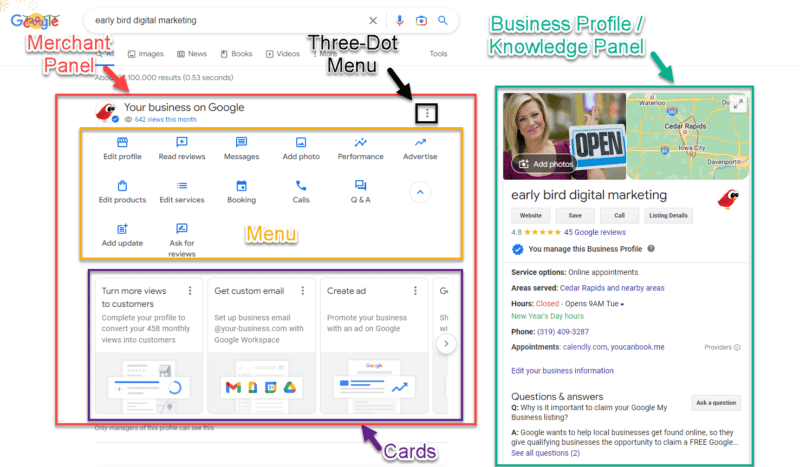
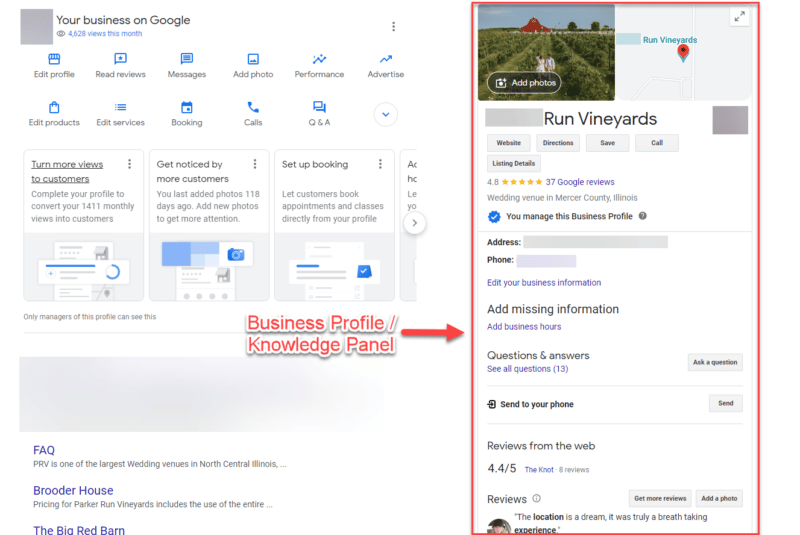
After you search for your business name, you should see the Merchant Panel and your Business Profile (a.k.a., Knowledge Panel) at the top of the search results – right above the organic results.
Geek terminology: You may hear the new Google Search management feature referred to as NMX – which stands for New Merchant Experience. (It’s important you get used to the new lingo.) NMX is the Google Search interface used to manage your Google Business Profile in Google Search.
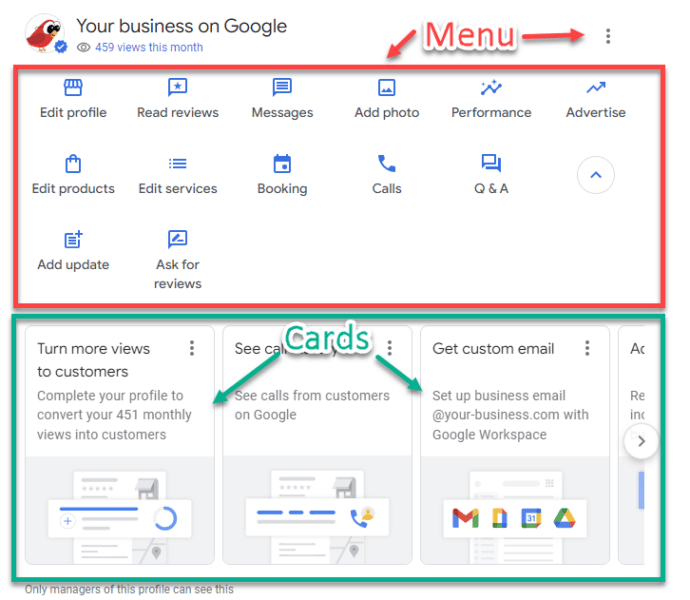
This is the heart of where you will manage your Business Profile. In the Merchant Panel, you’ll see the main menu, three-dot menu, cards, and your Business Profile off to the right.
The menus in your Merchant Panel depend on your business categories. So what you see may look different than another business in a different industry.
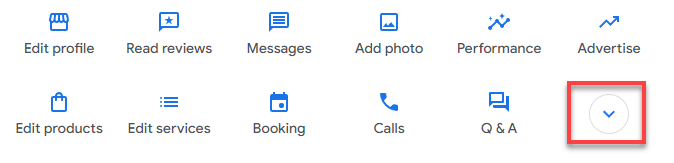
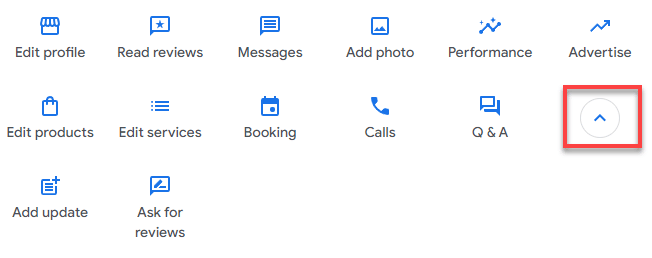
You might see a down arrow in your Menu. If you do, be sure to click on it to expand your menu area so you can see even more menu options.
In the example below, the expanded menu also shows “Add update” (i.e., Posts) and “Ask for reviews.”
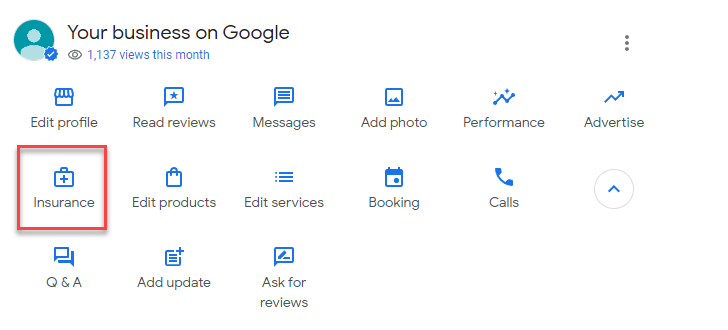
As mentioned, the available menus are category-dependent. In the screenshot below, the “Insurance” menu is available because the business is in the medical category.
Off to the right of the Merchant Panel, you should see your company’s Business Profile/Knowledge Panel. There are also several features you can do directlyfrom your Business Profile, like uploading photos and videos and creating posts (updates).
In the Merchant Panel, you will see two main items: the menu and the cards.
The menu allows you to perform the main functionality of managing your Google Business Profile. This is where you can edit your profile, add posts, upload pictures, include products and services, respond to reviews and messages, etc.
The three-dot menu to the right of the main menu gives you more advanced features like adding and removing managers, seeing your Business Profile ID, removing the business or marking it as temporarily or permanently closed and other features.
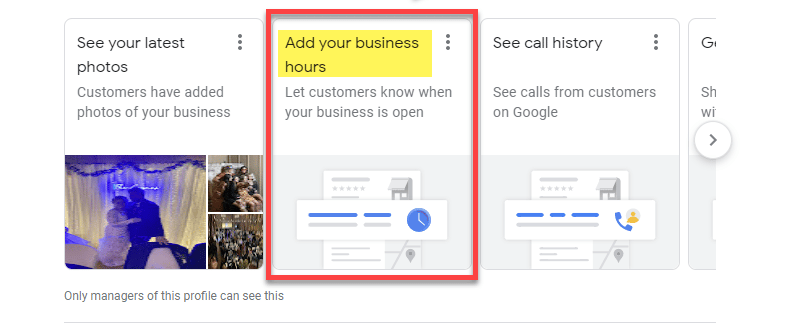
The cards are little “cues” or hints on things you may want to do or act on with your Business Profile. Cards will also vary.
Get the daily newsletter search marketers rely on.
function getCookie(cname) {
let name = cname + “=”;
let decodedCookie = decodeURIComponent(document.cookie);
let ca = decodedCookie.split(‘;’);
for(let i = 0; i <ca.length; i++) {
let c = ca[i];
while (c.charAt(0) == ' ') {
c = c.substring(1);
}
if (c.indexOf(name) == 0) {
return c.substring(name.length, c.length);
}
}
return "";
}
document.getElementById('munchkinCookieInline').value = getCookie('_mkto_trk');
Explanation of the Google Business Profile menus
Here’s an overview of the main menus that most businesses have available to them.
You can either use the tabs across the top of a menu or just scroll down the menu page to access all available fields for you to update.
Edit profile
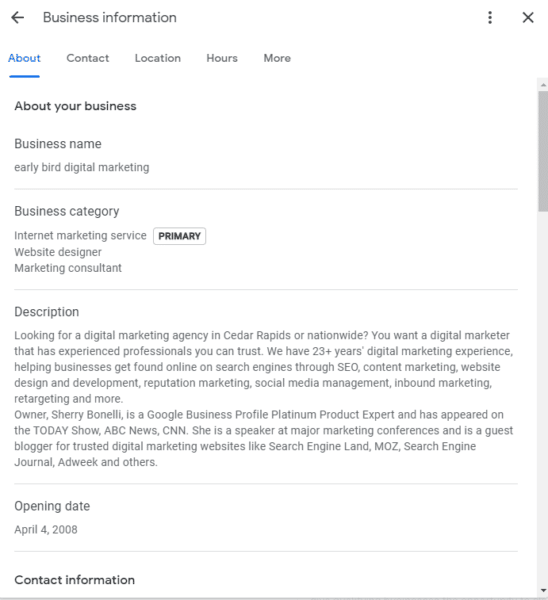
This is probably one of the most important because it has the most vital information many customers (or potential customers) are looking for. From the “Edit profile” menu, you can edit your main business information like:
Business name
Business categories
Description
Opening date
Phone number
Website
Business address or service areas
Business hours
Attributes/More information:
From the business (You can add attributes like women-owned, veteran-owned, LGBTQ+-owned, etc.
Crowd (i.e., LGBTQ-friendly)
Highlights
Offerings (i.e., drive-through)
Planning (i.e., Appointment Required, Accepting New Patients)
Service options (i.e., Offers online appointments, Offers online care, Language assistance)
Depending on your business category, you may see other options available like:
Check-in and check-out times (hotels only).
Hotel information (hotels only).
Health insurance (medical categories in the U.S. only).
Offers online care (medical categories only).
Or other options.
You may see other options available to you depending on your business categories. For instance, the hotel, car dealership and medical industries will find several other options in this section.
Read reviews
Paying attention to your reviews is essential to growing your business.
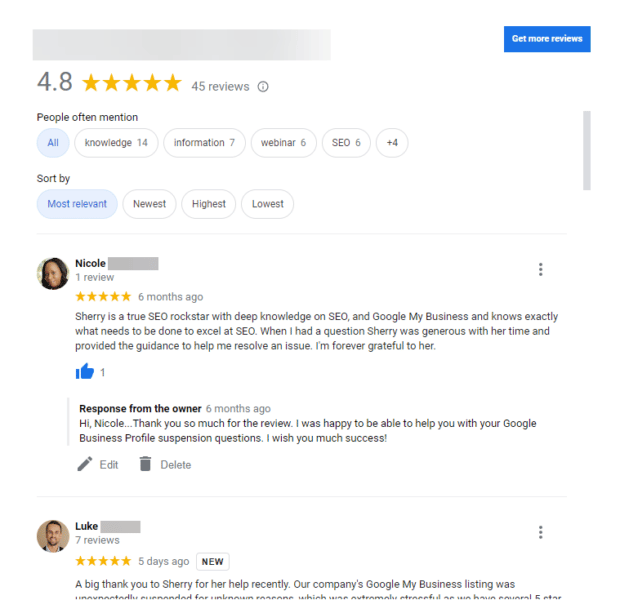
In this menu, you can see all your reviews, sort them in various ways and see what words people frequently mention in their reviews of your business. (By default, the reviews are ordered by “Most relevant.”)
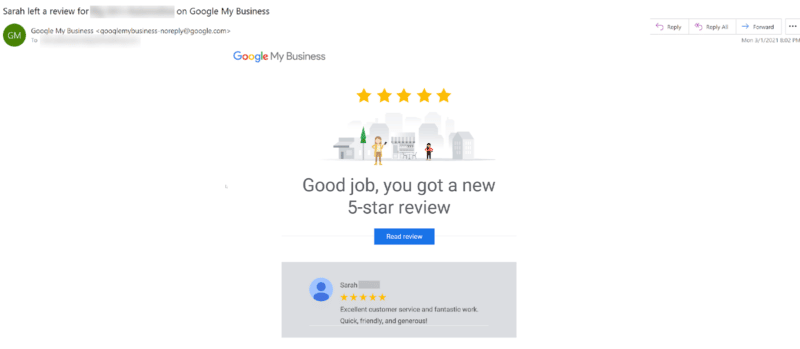
When you get a new review, Google will send you an email letting you know. You can click on the “Read review” link in the email to go directly to that review so you can read and reply to the reviewer.
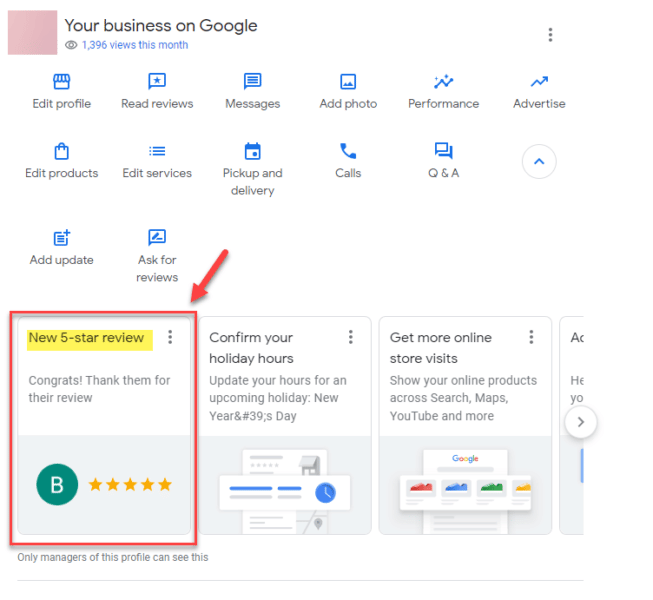
But a card in the Merchant Panel also shows you when you have new reviews. (This is a huge bonus if you don’t check your Google Business Profile login email as often as you should.)
When a card lets you know you have a new review, just click on it and the new one will open so you can respond to your customer’s review.
Messages
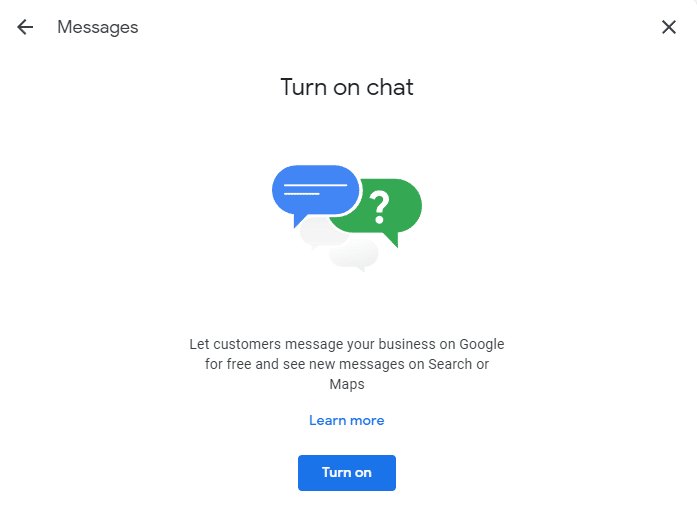
Messages are a great way to connect with customers and potential customers. If you have the time and staff to respond promptly to customers looking to chat with you, simply click the “Turn on chat” button and follow the prompts.
When you get started, be sure you create a welcome message that people will see when they first initiate a chat session with you.
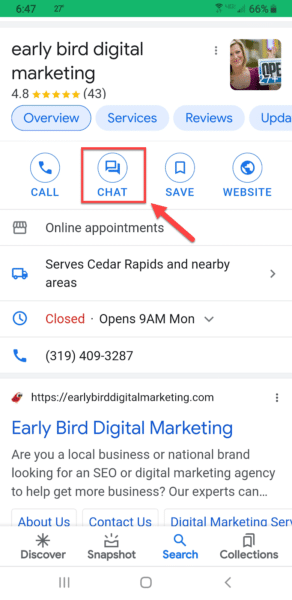
After you turn on the message feature, people will see the chat option available in your Business Profile on mobile devices when they search for your business.
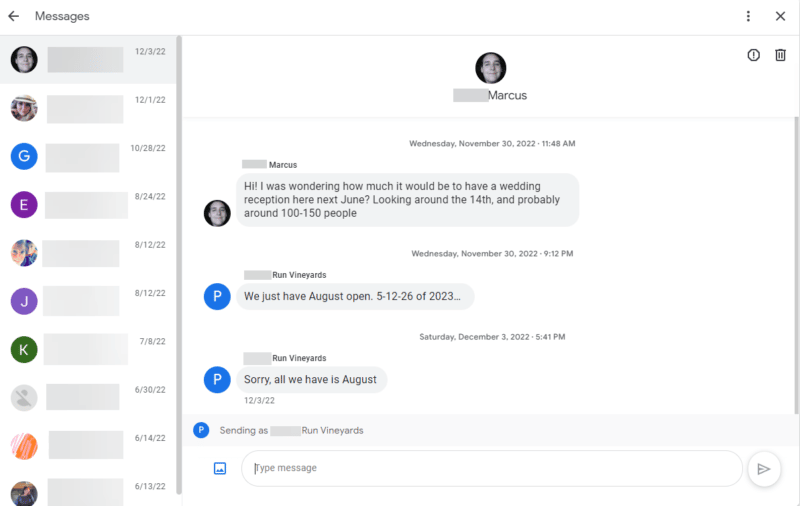
You can manage all your messages (a.k.a., chat) from the “Messages” menu. Here you can directly respond to people who have messaged you.
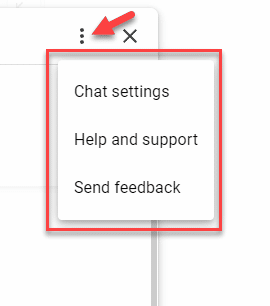
If you click on the three-dot menu, you can get into chat settings and make your chat even more robust.
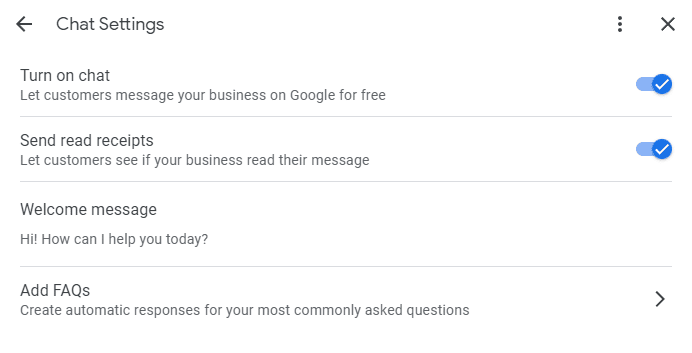
Through the chat settings, you can turn the chat feature on and off, send read receipts or change your welcome message.
You can even set up automatic FAQs and create answers for up to 10 frequently asked questions. So if someone includes one of these questions in a message to you, they will receive an automated message that you have written to answer that question.
Each question can be up to 40 characters and each answer can be up to 500 characters. The answers can even include links, which is perfect if you want to direct people to your website or a landing or sales page.
Replying to messages quickly promotes trust and encourages engagement with potential buyers. Keep in mind that you must reply to your messages within 24 hours. Also, if you don’t respond within the timeframe, Google could deactivate the message feature from your Business Profile.
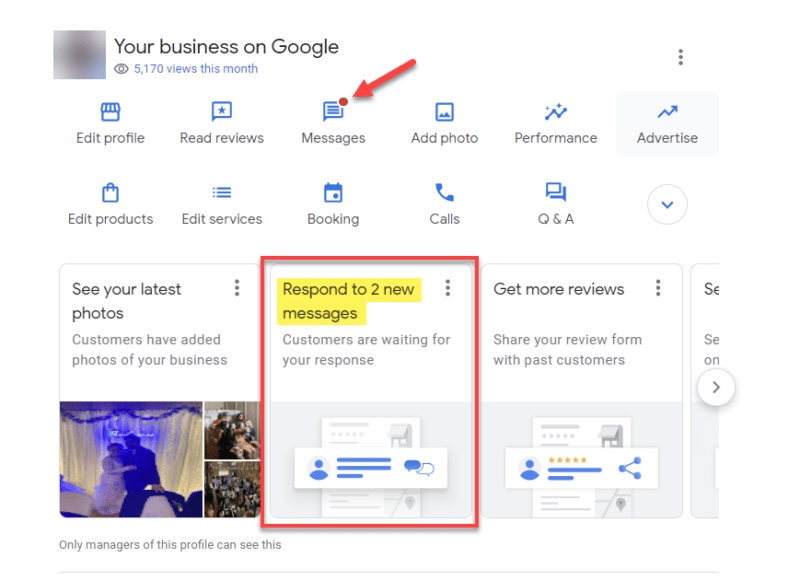
When you get a new message, you’ll receive an email notification email from Google – but as an extra bonus, you’ll also see a notification about the new message in a card in the Merchant Panel and you’ll see a red dot in Messages.
Add photo
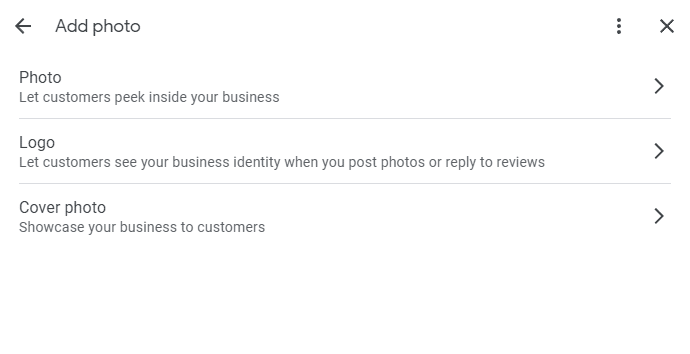
The “Add photo” menu lets you upload photos and videos to your Business Profile. Here are a few options to choose from:
Photo: This is where you can upload photos and videos from your business. Upload pictures of your building’s facade, the inside of your office, your team, the products you sell, the services you offer, etc. Don’t upload stock photos or other marketing material images.
Logo: Upload your logo.
Cover photo: This image should be a picture that best represents your business. Keep in mind that even though this is your chosen cover photo, Google has the right to select whatever cover image they want to display on your Knowledge Panel.
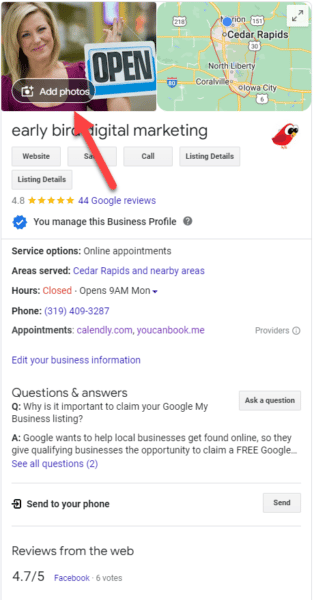
Another easy way to add photos and videos is directly from your Business Profile. Just click the “Add photos” button to upload photos and videos directly. (This is actually my preferred method as it’s much more streamlined and simpler.)
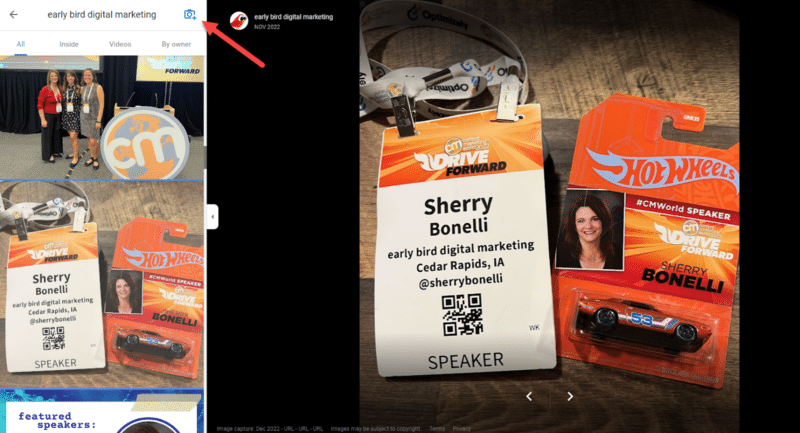
When you’re in your Knowledge Panel, you can continue to upload more photos by clicking on the camera icon.
Whenever you’re uploading photos or videos, adhere to Google’s guidelines – or else they may get rejected:
Photo guidelines
Format: JPG or PNG.
Size: Between 10 KB and 5 MB.
Recommended resolution: 720 px tall, 720 px wide.
Minimum resolution: 250 px tall, 250 px wide.
Quality: The photo should be in focus and well-lit, with no significant alterations or excessive use of filters. In other words, the image should represent reality.
Video guidelines
Duration: Up to 30 seconds long.
File size: Up to 75 MB.
Resolution: 720p or higher.
Performance
“Performance” is the new version of what used to be called “Insights.” This is where you can see the following metrics on your Google Business Profile’s performance, including:
Overview of the total Business Profile interactions
Calls
Messages
Bookings
Directions
Website clicks
How your products performed
Top products
How people discovered you – by platform and device
How people found your GBP by keywords
Advertise
This links to Google Ads – just in case you want to spend some money on paid advertising.
Edit products
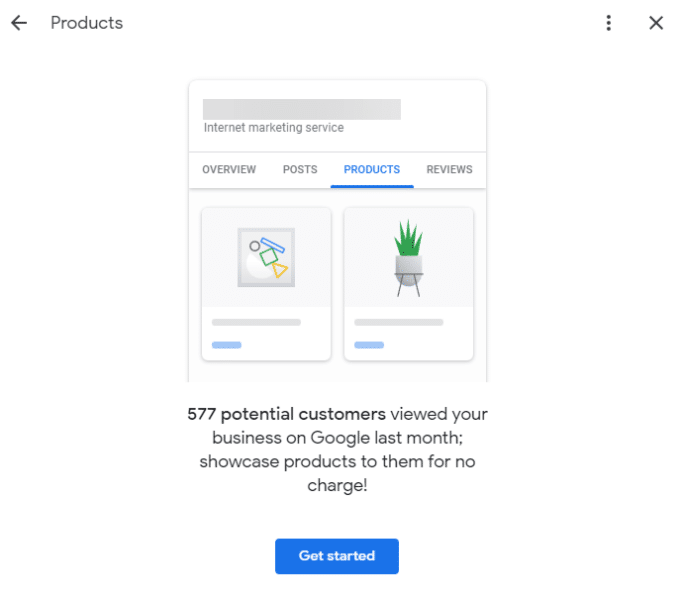
Google has been emphasizing more on showing local businesses that sell products. If you’re one of them, be sure to take advantage of the “Edit products” feature in Google Business Profile. Simply click the “Get started” link.
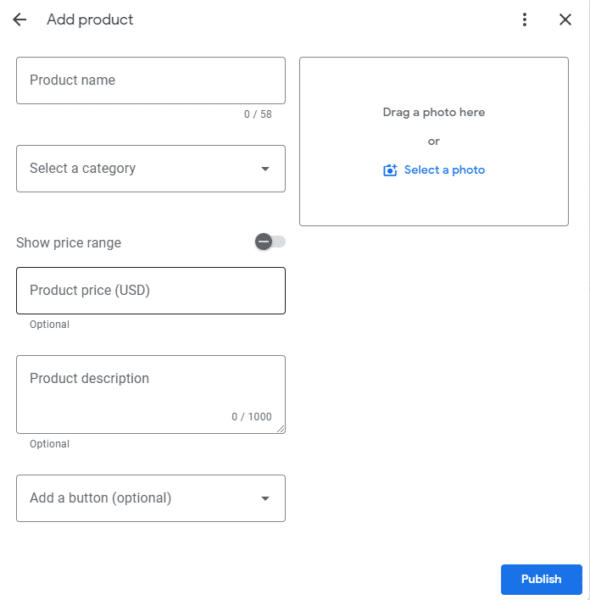
You can then add all the details about each of the individual products you’re selling:
Product name
Category
Price
Description
Call-to-action (CTA) Button
Photo (Remember to add one!)
Once you’ve added all the product details, simply click the “Publish” button.
Edit services
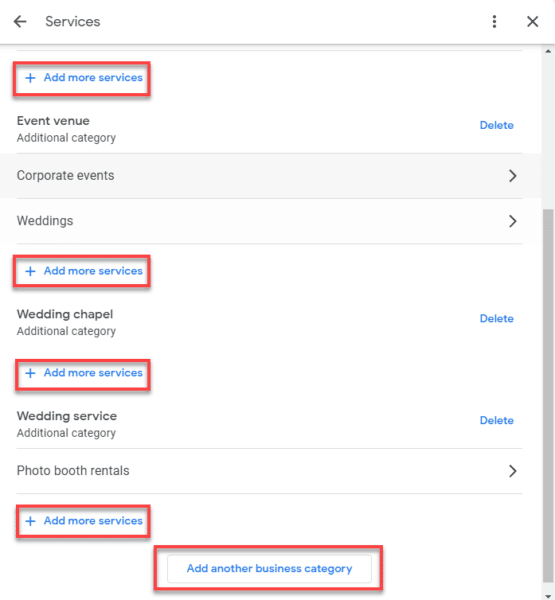
If you are a service-based business, here is where you will list the types of services that your company offers. First, you will want to set up business categories.
For example, if you’re a lawn care company, you might choose categories like grass cutting, lawn care, yard cleanup and snow removal. Then under each category, you would include each service that falls under those main categories.
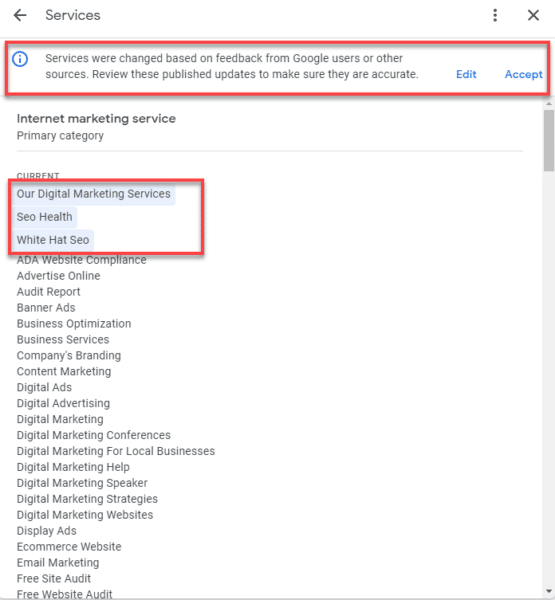
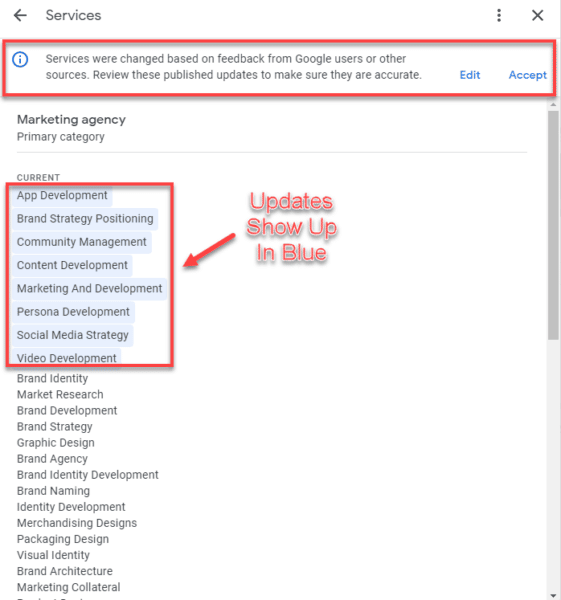
Keep in mind that Google has a (not-so-nice) habit of scraping information from various sources and will often add services to your GBP listing. Sometimes those services are not services you offer.
As an example, I had information on my website about a pest control client I worked with, so Google once mistakenly added “pest control” as a service that my digital marketing agency offered.
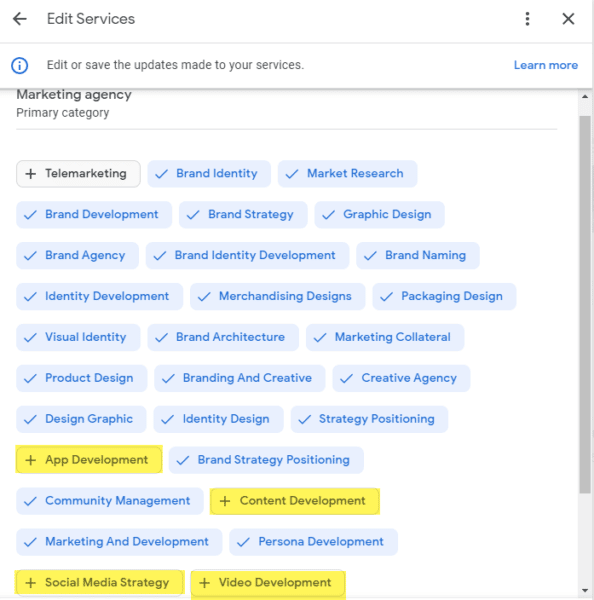
So check frequently to ensure that any services Google adds to your Business Profile are correct. You’ll find any Google changes in blue.
Booking
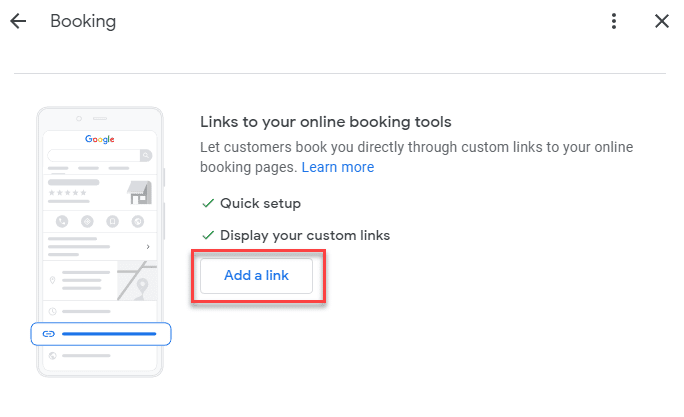
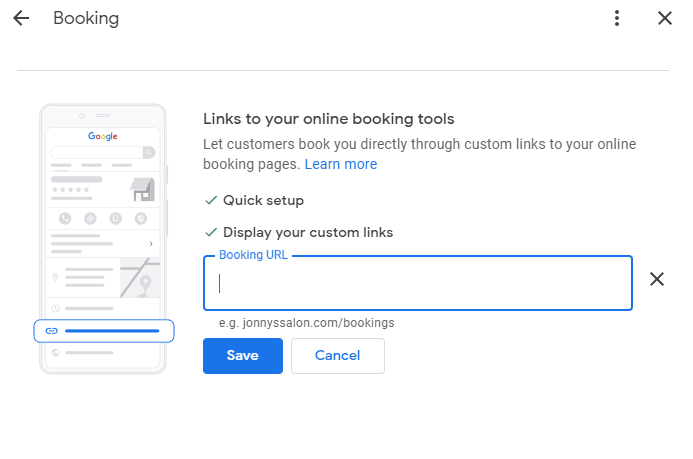
If you use an online booking or calendar tool to schedule appointments, then you’ll love the “Booking” menu. This feature allows you to add a special URL where people can schedule time on your calendar to schedule an appointment with you.
So if you use tools like Calendly, YouCanBookMe, SquareUp or one of Google’s booking partners, you can click “Add a link” to get started.
Then simply put your custom calendar or booking URL in the URL field and click “Save.”
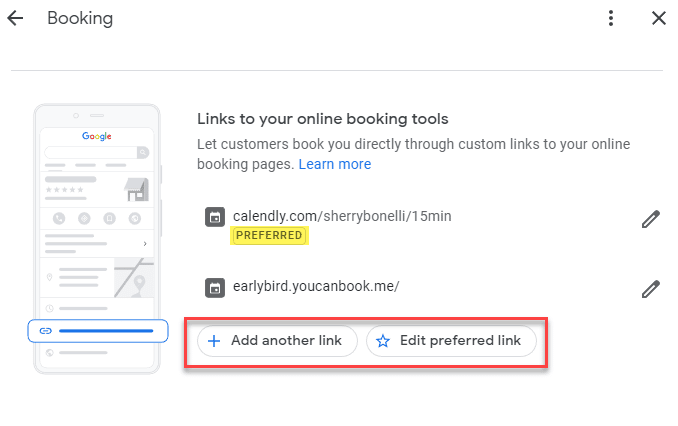
You can add multiple options for people to book appointments, just mark your preferred booking method.
Calls
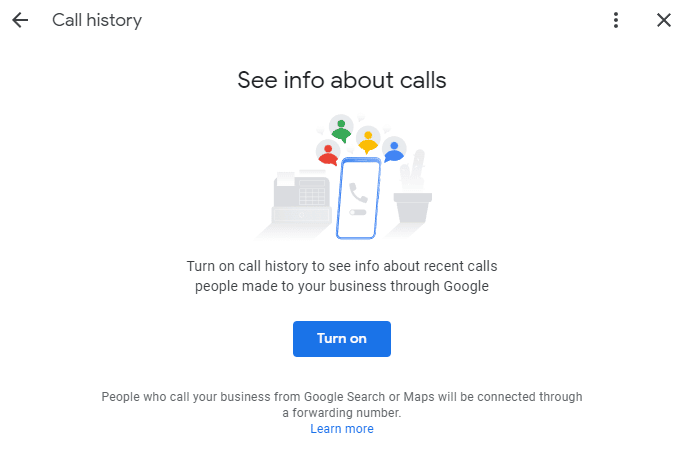
“Calls” is a way to keep track of phone calls you get from customers on Google Search and maps with call history. Right now, this feature is only available to a select group of businesses in the U.S. and Canada.
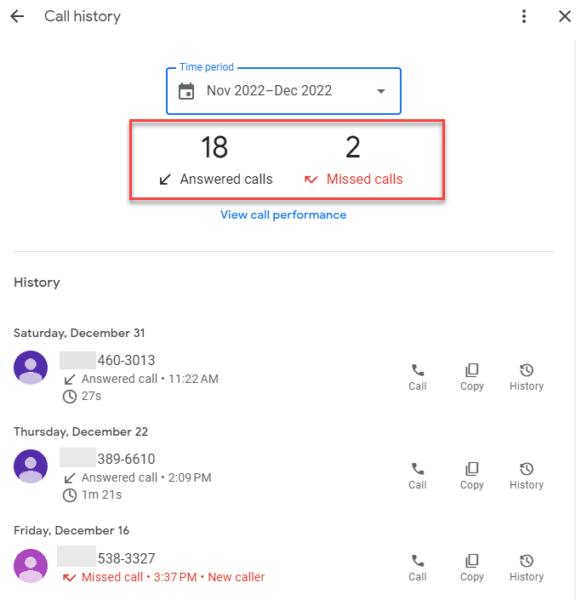
If you’re interested in turning this feature on, it will give you information on what calls came in – what calls were answered and what was missed.
It will even tell you if you got a call from a new caller. This info is invaluable if your phone number goes to a sales representative, for instance.
Q&A
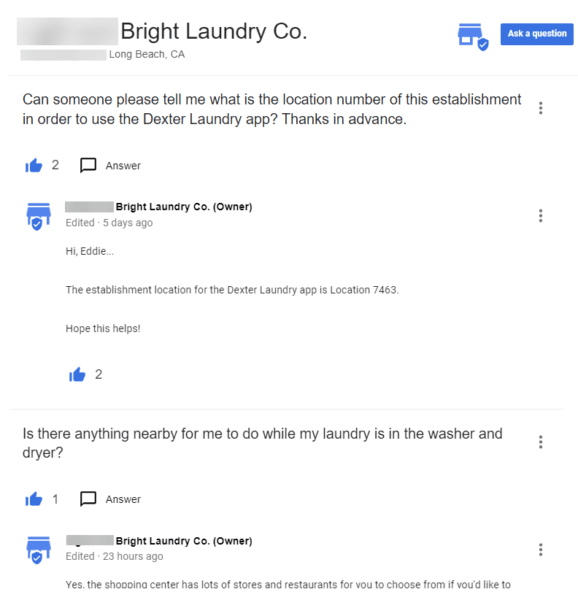
The Q&A feature is a great way for customers and potential customers to ask you questions about your business – and for you to answer them.
Remember, though, that anybody can ask and answer those questions. So it’s best that you stay on top of them and be the first to respond.
Add update (a.k.a., Posts)
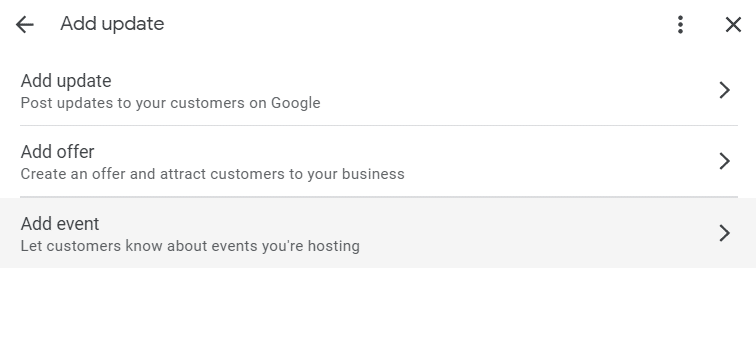
Updates are actually GBP Posts. To create one, just click on “Add update” and you can create an update, offer or event.
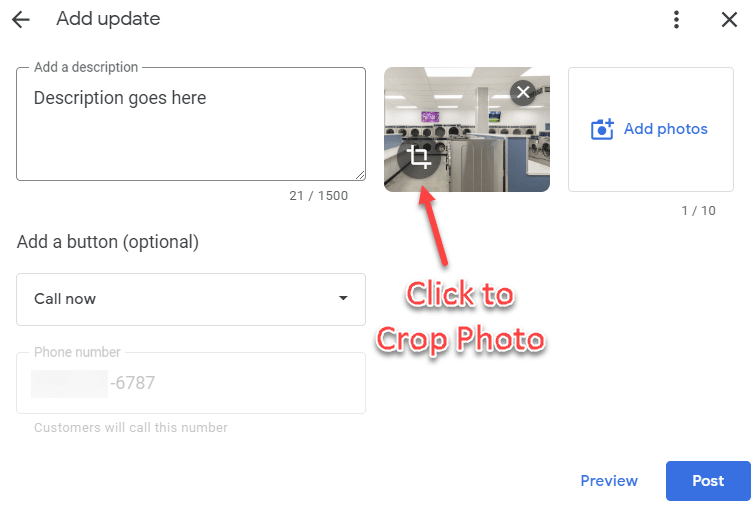
Google has finally added the feature to crop photos in Google search. Just click on the crop icon and do so as needed.
Be sure to click “Preview” to make sure your post looks good, and then click “Post” to publish it.
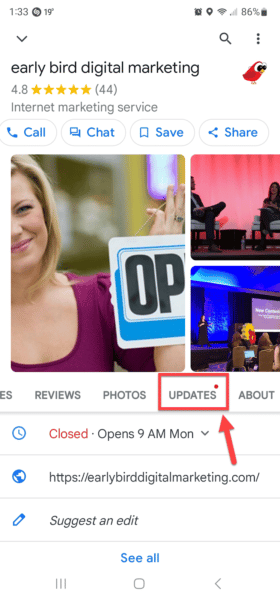
When you make a new post, users searching on or using the Google Maps app will see a red dot above “Updates.”
Ask for reviews
We mentioned earlier how getting reviews was an important part of your local SEO strategy.
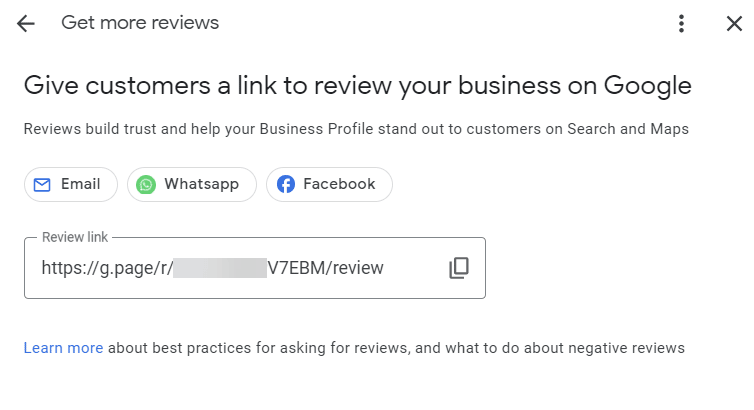
When you click the “Ask for reviews” menu, you’ll be given a short URL that you can give to your customers so you can ask them to leave a review for you.
When people click on that link, they’ll be taken directly to your Google Business Profile so they can leave you a review, making it super easy for them.
Three-dot menu
The three-dot menu is often overlooked because, well, it is off to the right-hand side of the main menu and a little hard to see.
But it contains some very important advanced features necessary to effectively manage your Business Profile.
In the three-dot menu dropdown, you’ll see:
Business Profile settings
Notifications
Add a new Business Profile
Your Business Profiles
Help & support
Send feedback
Terms and Service
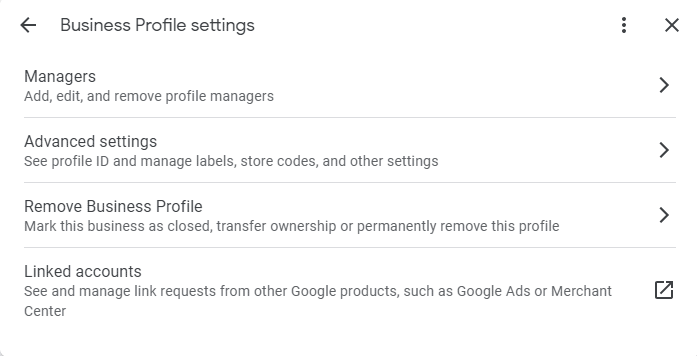
One of the most important sections is Business Profile settings.
In this section, you can:
Manage the users of your Google Business Profile.
See advanced settings like your Business Profile ID – which you’ll need to provide Google if your profile gets suspended.
Mark the Business Profile permanently closed, transfer ownership or remove the profile (which is ultimately up to Google’s discretion).
See and manage link requests from other Google products.
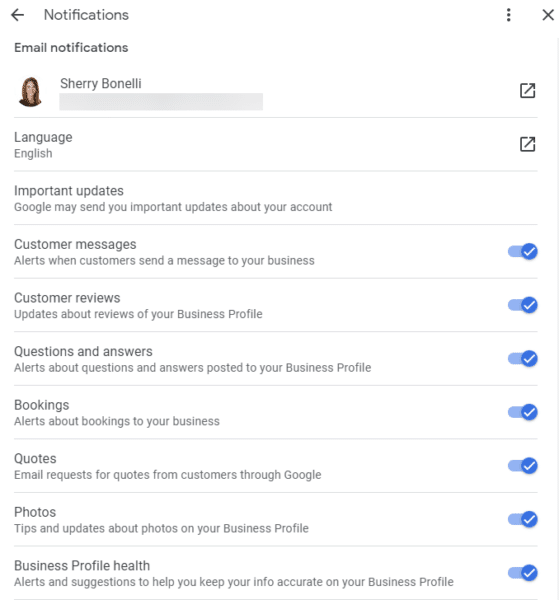
You’ll also want to check out the Notifications section, where you can set up to receive email alerts about customer messages, reviews, Q&As, bookings and more.
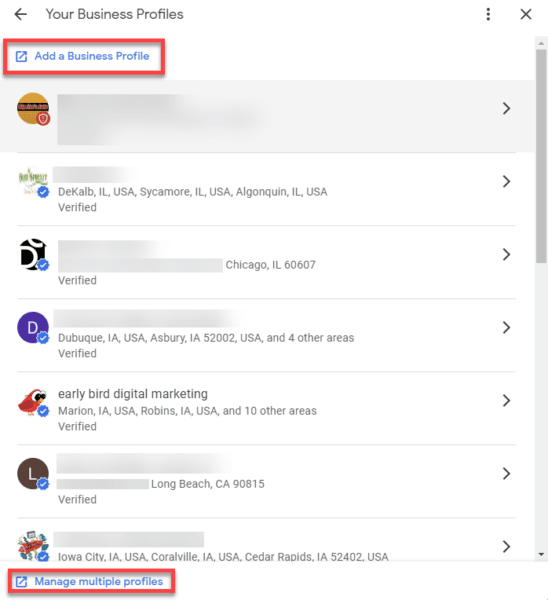
If you manage more than one Google Business Profile, the “Your Business Profiles” dialog will come in handy.
From here, you can see all the GBPs you manage. Just click on the profile you want to manage, and you’re automatically taken to it in Google search.
You can also add a new profile and manage multiple ones here.
There are other features in the three-dot menu as well, so feel free to explore those features, too.
What are cards?
You will also see various “cards” in Merchant Panel. Cards let you do various other things to help improve and optimize your profile.
Your cards might look different than another merchant’s cards. Look at the various cards available to you and see what they allow you to do.
For instance, if you click on the “Add exterior photo” card, you’ll be able to easily upload a photo of the exterior of your storefront or office building.
Cards also give you alerts, like they will let you know when you have a new review or if you should add specific information to your Business Profile to make it more helpful to potential customers.
Use these cards to maximize and optimize your Google Business Profile.
What if Google changes your Google Business Profile information?
Google gathers information from a variety of sources:
Third-party sources they have contracted with.
User-suggested edits.
AI.
Other online resources (e.g., government databases, online directories/citation sites, the business’s website, info from people who answer “Do you know this place?” questions).
Google often cross-checks the information on your Business Profile and compares it to what they find online. If they find discrepancies, they may decide that your information is incorrect and will change the information on your Google Business Profile.
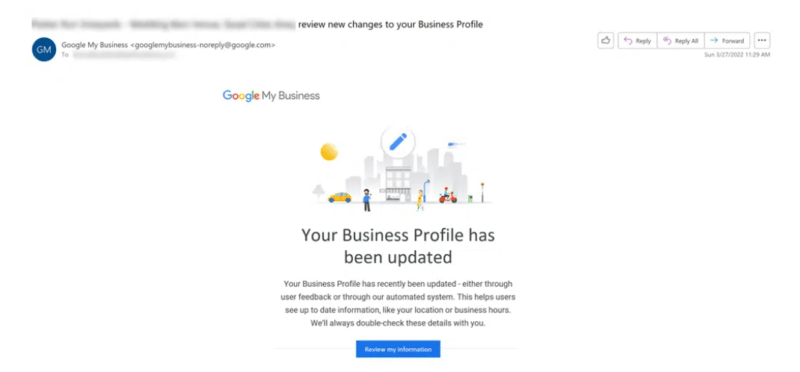
If Google changes information in your Business Profile, you’ll receive an email alerting you that information has been changed.
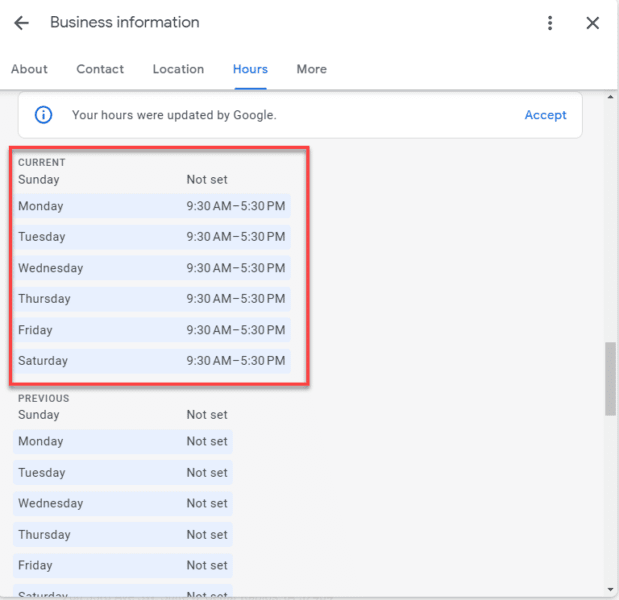
If changes were made to your profile, you’ll then need to go to the individual menu sections (i.e., Edit Profile, Edit Products, Edit Services) and hunt around to look for a blue highlighted area that denotes changes have been made to your profile. There you will see what changes Google made.
If the changed information is correct, you can simply click the “Accept” link.
Did Google mess up? If the changes are wrong, click on the section you want to edit (or correct), and you’ll see the pencil icon. You can then edit the information. Remember to click the “Save” button.
Sometimes, you’ll be given an edit option if changes were made to your Business Profile.
If the information is incorrect, you can simply click on “Edit” and, in this instance, uncheck the services you don’t offer and click “Save.”
Keep in mind that Google may need to manually review your edits, so it could take up to a day (or sometimes longer) for your changes to be made to your Business Profile.
Because Google’s changes go live right away, it’s important that you frequently check your Business Profile to make sure no incorrect changes were made to your profile.
Managing your profile from search is the way to go
Yes, there is a bit of a learning curve. But once you get used to this interface, you will likely enjoy the ease of use and functionality.
Getting used to managing your Google Business Profile in Google search is a must. There’s no avoiding it anymore.
In 2008, there were some big developments following the news of Microsoft’s bid to purchase Yahoo.
Google wasn’t happy about the news. The company objected, suggesting that the move would hurt what it called the underlying principles of the internet: “openness and innovation.”
There was some ironic back and forth, as Google had spent the past year arguing that it should be able to acquire DoubleClick, which Microsoft argued against because it would make Google too dominant in online advertising.
Meanwhile, was Yahoo considering an alliance with Google? And why did Google CEO Eric Schmidt call Yahoo CEO Jerry Yang to offer Yahoo help?
And what about post-acquisition “integration” issues? Local, maps, and mobile were areas where both companies had made significant investments but also had significant duplication and redundancy.
Microsoft sounded pretty confident the deal would happen. As Kevin Johnson put it:
“It doesn’t make sense to have thousands of engineers at Yahoo working on a search index, thousands of engineers at Microsoft working on the same search index. By combining, we can have one team of people across the two companies working on the search index, and then have others continue to focus on areas where we’ve defined differentiation in search. New search verticals and expanded user experience for search. We’ve got so many ideas, more engineers applied to those ideas will drive breakthroughs in search.”
2022: There were links to the MSN Autos marketplace in the knowledge panels for these car-related searches under “learn more” and “shop used cars” right above the car specifications.
2016: Once you clicked on the “more destinations” button, Google led you into a travel search experience that made it harder to view organic search results.
2014: For the first time in ages, the three major search companies in the US were all run by CEOs who either came out of a search background or had a solid understanding of it.
2011: The latest images culled from the web, showing what people eat at the search engine companies, how they play, who they meet, where they speak, what toys they have, and more.
2009: Instant answers were shown for searches related to financial information, weather conditions, movie show times, calculations, equations, conversions, and definitions.
Past contributions from Search Engine Land’s Subject Matter Experts (SMEs)
These columns are a snapshot in time and have not been updated since publishing, unless noted. Opinions expressed in these articles are those of the author and not necessarily Search Engine Land.
Any startup needs an effective data governance strategy to maximize its business potential and stay ahead of the competition. By developing a comprehensive, well-defined data governance policy, startups can protect themselves from unforeseen risks like legal issues or unauthorized access to privileged information. In this article, we’ll discuss why it’s time to establish a robust data governance plan and share how you can use a data governance software review.
Increased Efficiency and Productivity
Implementing a data governance system helps organize a business’s critical data sets and ensures that resources are well-spent running duplicate reports or using outdated information. It also clarifies who is responsible for managing specific data and analytics, ensuring that everyone uses current and accurate numbers for budgeting, planning, and other operations. In short, this powerful tool will give the startup an edge in its operations, leading to better efficiency and more excellent overall results.
Improved Data Quality and Security
Data governance helps you understand how data is collected, processed, and used, ensuring that businesses impose appropriate policies and procedures to secure confidential information, protect customer privacy and maintain the overall quality of your data. With data governance in play, you can establish controls to ensure that access to critical business information is authorized by the appropriate personnel.
Furthermore, it helps identify where personal or highly sensitive data needs special protection and provides unified standards for data organization, documentation, and processing. Investing in a solid data governance strategy now will guarantee that your startup complies with industry regulations while protecting consumers’ private details, making sure you cover all bases for success in the long term.
Better Decision-Making Capabilities
Data governance ensures that the data businesses use is accurate, easily accessed, and protected from unauthorized alteration. By creating a data governance framework, organizations can ensure that employees at all levels have access to the correct information at the right time to make decisions based on reliable and up-to-date data. Additionally, by controlling your organization’s data, it will be easier to create metrics to measure its performance and quickly identify any gaps or problems in its operations.
Reduced Risk of Regulatory Compliance Violations
A data governance policy is the key to ensuring a company meets regulatory compliance standards and lowers its risk for violations. It not only provides rules for what to do with the data but also systematizes a process for collecting, interpreting, storing, and sharing information to mitigate against any misuse or mishandling. With a thorough data governance plan, any start-up can secure customer trust, create new strategies and develop customized solutions using their customer data while abiding by decentralized regulations across markets.
Enhanced Collaboration Between Teams
A data governance strategy is the answer for business owners looking to increase department collaboration. A well-designed governance plan can ensure that everyone in your organization has access to the same information and procedures, making it easier for teams to work together and make informed decisions. Stakeholders across departments can use data more efficiently due to a clearly-defined ownership structure and streamlined processes.
Implementing a data governance strategy now is an ideal opportunity for startups to eliminate communication inefficiencies between departments and reduce risks associated with poor data management. By ensuring everyone knows their role within the organization and understands how their actions affect each other, teams can go beyond mere cooperation. They can truly collaborate.
What Is Data Governance Software?
Data governance software is a powerful tool for organizations to correctly organize and manage copious amounts of data. This software helps maintain the accuracy and quality of databases, metadata, applications, and more, ensuring all data processes adhere to the organization’s policies and comply with the latest regulations from lawmaking bodies.
High-quality data governance software allows companies to analyze their existing data infrastructure, uncovering ways to optimize performance and increase efficiency. The result is a secure environment for managing structured and unstructured data without compromising accuracy or integrity.
If you are still trying to decide whether you need this software for your business, check out a data governance software review online. This way, you can see how companies have made strides toward improving their operations through this technology.
Conclusion
All startups need an effective data governance strategy to be successful. By having a comprehensive, well-defined data governance policy, startups can improve their efficiency and productivity, data quality and security, and decision-making capabilities, reduce the risk of regulatory compliance violations and enhance collaboration between teams.
With inflation over the past years increasing steadily and experts expecting this trend to continue in the future, gold has become one of the most popular investments out there. After all, its reputation as a safe haven and one of the best hedge tools is widely known.
Expert-reviewed gold IRA companies enable investors to use a gold IRA to invest in many kinds of gold-linked assets, gold mining stocks included. With gold mining stocks, you can add the opportunity for capital appreciation to a long-term physical gold position.
Physical gold requires a higher initial investment than other assets and logistics, but it also requires a deeper understanding of how investing in precious metals works. As such, many people who consider investing in gold never actually do it.
However, the good news is that it is possible to invest in gold without actually buying gold. One of the best ways to do so is by investing in the companies that are mining it. In many cases, gold mining stocks can outperform the yellow precious metal, but they aren’t a replacement for gold.
Let’s find out why…
What Are Mining Stocks?
Mining stocks are shares in companies dedicated to the extraction and processing of different minerals and materials like silver, platinum, copper, limestone, lithium, and of course, gold. As these companies increase the global supply of the elements they mine, investing in them is effectively investing in the underlying elements.
Investing indirectly in gold by investing in one of these companies is simple.
However, as the minerals and materials each company focuses on differ, you want to ensure that the company you choose includes or focuses on gold. One good way to do this is buy shares in the major gold producers, and diversify your gold portfolio.
Why Are Mining Stocks a Good Option?
Acquiring mining stocks is a good opportunity to gain exposure to gold in an indirect manner. By doing this, you will still benefit from any positive changes in the value of gold while also gaining multiple benefits.
You can think of investing in gold mining stocks as a combination of investing in stocks and gold. When people go for gold, they go wild for gold mining stocks.
The benefits of investing indirectly in gold through stocks are numerous. Capital appreciation and the potential for passive returns in the form of dividends are the most important. However, there are also other benefits that can play an important role depending on your needs, such as higher liquidity, diversification, and leverage.
Add to Your Golden Retirement with Miners
Like any investment, gold miners aren’t perfect. The main disadvantage of investing in mining stocks is the increased volatility.
Not only will the price of the stock be impacted by the price of gold and other minerals relevant to their operations, but also regulations, public perception, human capital, and many other factors.
Keep this in mind, and consider adding some gold miners to your gold-based IRA retirement account. Gold mining stocks are easy to buy, and give you incredible leverage to the gold price!
Search, ad network, and YouTube revenues all fell in the fourth quarter of 2022, Google reported yesterday. Overall, Google ad revenue fell 3% to $59 billion.
Search advertising revenue was the most resilient, falling 1.6% in Q4 2022 compared to Q4 2021. Google Network and YouTube revenue declined 8.6% and 7.0%, respectively.
Google Q4 2022 ad revenue by segment
Q4 2022
Q4 2021
Change
Search & other
$42.6 billion
$43.3 billion
– 1.6%
Google Network
$8.5 billion
$9.3 billion
-8.6%
YouTube
$8.0 billion
$8.6 billion
-7.0%
A poor economic climate. Google CFO Ruth Porat told CNBC the YouTube slowdown was the result of both planned and direct response advertising in a challenging economic climate. She said Google is slowing the pace of hiring in an effort to deliver long-term profitable growth. Last month, Google said it would lay off around 6% of its workforce or roughly 12,000 jobs. The company has about 187,000 employees.
ICYMI, Meta also blamed a poor economic climate on their own weak ad demand.
Trouble for YouTube. YouTube’s ad revenue fell below analyst predictions to reach $7.96 billion, a decrease of 8% from the previous year’s $8.63 billion. On Thursday, Google CEO Sundar Pichai said in addition to the overall pullback in ad spending, YouTube is also facing heightened competition from TikTok in short-form videos. Meta also said competition from TikTok was limiting growth.
The financial outlook at YouTube could get even bleaker as it begins paying for rights to professional football games. In December, the National Football League announced that YouTube will pay approximately $2 billion annually for the rights to broadcast “Sunday Ticket” to homes, in a seven-year deal. That’s expected to be a loss-leader that enables YouTube to acquire more paying subscribers.
Why we care. A decline in ad revenue could affect the platform’s ability to reach its target audience and in turn, the success of its advertising campaigns. Lower ad revenue could also result in less investment in platform improvements and innovations, leading to a less favorable advertising environment.
Additionally, a continual decrease in ad revenue may cause a shift in pricing, competition for ad placements, and changes to the platform’s advertising policies. If Google shifts its attention toward AI, advertisers could lose more control over their campaigns.
On the other hand, a decline in revenue could result in a decline in demand, which could lower ad costs for advertisers.
Microsoft’s Fabrice Canel confirmed this morning that the new Bingbot user-agent is now 100% live today. The new Bingbot will generally be used for crawling 100% of sites, unless something goes wrong and Bing has to fallback to the previous Bingbot user-agent.
Bing’s confirmation. Fabrice Canel posted on Twitter, “yes, 100% today. We fallback to previous user agents where appropriate.”
Old user-agent. Microsoft said it would stop using its historical user agent by the Fall of 2022. That user-agent looks like this: Mozilla/5.0 (compatible; bingbot/2.0; +https://www.bing.com/bingbot.htm)
New user-agent. Bing will use a user-agent that identifies the specific version of Microsoft Edge is crawling your site. Here is the format for both desktop and mobile:
Mobile – Mozilla/5.0 (Linux; Android 6.0.1; Nexus 5X Build/MMB29P) AppleWebKit/537.36 (KHTML, like Gecko) Chrome/W.X.Y.Z Mobile Safari/537.36 (compatible; bingbot/2.0; +https://www.bing.com/bingbot.htm)
“W.X.Y.Z” will be substituted with the latest Microsoft Edge version Bing is using, for eg. “100.0.4896.127″.
Why we care. You probably should have been prepared for this change since it was announced back in 2019. But in any event, this change can impact your site if you have any user agent detection methods for BingBot. Make sure to test your site to see if it supports the new user agent. Most sites probably do not need to worry about this, but if you have done any advanced bot detection, you may need to take steps to update those scripts.
It seems that if you did not make the necessary changes, then Bing will use the old user agent as a fallback.
Google announced its Q4 earnings just hours ago, more on those numbers later, but Sundar Pichai, the CEO of Google, confirmed in the earnings call the search company’s plans to bring AI-like search features that “people can engage directly with.”
Sundar Pichai said, “In the coming weeks and months, we’ll make these language models available, starting with LaMDA, so that people can engage directly with them. This will help us continue to get feedback, test, and safely improve them. These models are particularly amazing for composing, constructing, and summarizing. They will become even more useful for people as they provide up-to-date more factual information.”
Sundar Pichai said that he “first spoke about Google being an AI-first company” more than “six years ago.” “We have been preparing for this moment since early last year, and you’re going to see a lot from us in the coming few months across three big areas of opportunity; first, large models. We published extensively about LaMDA and PoN, the industry’s largest, most sophisticated model plus extensive work at DeepMind,” he continued to say.
During the question and answer period, Sundar added “We’ll be launching — we’ll — more as labs products in certain cases, beta features in certain cases and just slowly scaling up from there. Obviously, we need to make sure we’re iterating in public, these models will keep getting better, so the field is fast changing. The serving costs will need to be improved.”
“So I view it as very, very early days, but we are committed to putting our experiences, both in terms of new products and experiences, actually bringing direct LLM experiences in Search, making APIs available for developers and enterprises and learn from there and iterate like we’ve always done. So I’m looking forward to it,” he added.
Sundar goes on to add, “In terms of Search too, now that we can integrate more direct LLM type experiences in Search, I think it will help us expand and serve new types of use cases, generative use cases. And so I think I see this as a chance to rethink and re-imagine and drive Search to solve more use cases for our users as well. So again, early days, you will see us be bold, put things out, get feedback and iterate and make things better.”
Earlier reports. Earlier this week, we reported Google is rumored to have started on its own version named Apprentice Bard. CNBC reported,
When a question is entered, the search results show a gray bubble directly under the search bar, offering more human-like responses than typical search results. Directly beneath that, the page suggests several follow-up questions related to the first one. Under that, it shows typical search results, including links and headlines.
Google responded:
“We have long been focused on developing and deploying AI to improve people’s lives. We believe that AI is foundational and transformative technology that is incredibly useful for individuals, businesses and communities, and as our AI Principles outline, we need to consider the broader societal impacts these innovations can have. We continue to test our AI technology internally to make sure it’s helpful and safe, and we look forward to sharing more experiences externally soon.”
Microsoft. Meanwhile, Microsoft invested heavily in OpenAI, the creators of ChatGPT. Microsoft is rumored to be bringing GPT-4 to Bing search in some way in the very near future. Many companies, especially those in search, are taking these technologies very seriously after the explosion OpenAI made with the debut of ChatGPT.
Why we care. We don’t know yet how Google or Bing would incorporate these Q&A style AI features into search. But we all know it is an important space to keep an eye on to see how marketers can leverage it for their brands and how they use utilize these features to better connect with their customers and users.


 % today (we fallback to previous user agents where appropriate). More information on Bing Crawler User Agents: