Google to offer publisher first-party cookie support

Google has just announced its plans to launch a number of features aimed at helping publishers monetize their websites and increase their emphasis on first-party data relationships. The features include support for ads personalization with publisher first-party cookies in Google Ad Manager and AdSense.

Expanding publisher first-party cookies. Publisher first-party cookies can help publishers deliver relevant ads without tracking users across third-party websites. Publisher first-party cookies have been available to address frequency capping and fraud control previously.

When a publisher allows, Google provides publisher first-party cookies to help improve ad relevance on that specific publisher’s website. The solution uses information from ad interactions that users take on that publisher’s own site. This information cannot be used on any other publisher’s website. The feature also respects people’s ads personalization preferences that they have indicated through AdChoice controls. 

Publisher first-party cookies are an especially useful solution for smaller publishers, who may not have the resources or infrastructure to leverage first-party data independently. They require minimal technical work from publishers to use. 

The introduction of audience signals. Google announced publisher-provided signals last month to help publishers categorize their first-party data into audience or contextual segments and then share those signals with programmatic buyers. Those signals make it easier for programmatic buyers to “find and purchase audiences based on things like demographics, content interests or purchase intent across multiple sites and apps without tracking people’s activity in apps or across the web.”

What Google says. In a statement to Search Engine Land, Google said:

“As part of a broader suite of tools, we’re helping publishers of all sizes build durable advertising strategies that uphold user trust. This solution is really geared toward supporting the publisher base, especially smaller publishers who may not have as many resources, as they continue to navigate changing privacy expectations.”

Peentoo Patel, Director of Product Management, Google Ad Manager

Launch date. This feature will be available to publishers beginning in November. 

Why we care. If you’re a smaller publisher and don’t have the capacity or resources to capitalize on first-party data, this support feature is for you. Additionally, Google’s support of publishers’ use of their first-party data will only enhance their bottom line, as privacy concerns and ad relevance becomes more prevalent.

The post Google to offer publisher first-party cookie support appeared first on Search Engine Land.

Original source: https://searchengineland.com/google-to-offer-publisher-first-party-cookie-support-388590

LinkedIn matched audiences: How to get started

LinkedIn can be a difficult platform to master, but with the right combinations of targeting and messaging brands can see success in generating results.

Matched audiences allow you to reach people who have engaged with your business in some way and go after lists of “dream companies” that you’d like to work with. 

This article provides an overview of how you can get started with matched audiences along with tactics for using them in your campaigns.

Types of matched audiences

LinkedIn allows for a variety of first-party and third-party methods to build audiences. Here are the available categories at the time of writing this article:

  • Contact lists: Targeting individual people.
  • Company lists: Targeting anyone who works for a particular organization.
  • Pixel-based retargeting: Reaching anyone who visited select pages on your website.
  • Engagement-based retargeting: Based on in-platform activity, such as:
    • Single image ad engagement.
    • Video ad views.
    • Lead form opens/submits.
    • Company page engagement.
    • LinkedIn event RSVPs.

Guidelines

The absolute minimum size for a matched audience is 300 to be eligible to serve. This means 300 individuals need to be matched in the platform after uploading and processing the list.

You’ll likely see some drop-off with the platform not being able to match every individual in your original document.

The platform will show a match rate after the list has finished syncing, allowing you to double-check your fields if the match rate seems abnormally low.

However, just because you can target as few as 300 people doesn’t mean you should. Larger audiences generally see more efficient CPCs and CPAs, with a threshold of at least 50,000 individuals being ideal. 

For company targeting, LinkedIn recommends including a minimum of 1,000 companies.

For contact targeting, LinkedIn recommends a minimum of 10,000 email addresses. If more than one email address matches with the same user, that person will only be included once.

The maximum file size for either type of list is 20MB or 300,000 records.

When uploading a list, use the templates that LinkedIn provides. You can use just the email field for a contact list or the company name field for a company list if wanted, but the more columns you can include, the more accurate you can expect the matching process to be.

Additionally, you’ll have to wait for LinkedIn to finish processing a list before you can target it in your campaigns. Generally, lists will be ready within 48 hours, but occasionally they can take longer.

Finally, some CRMs and automation platforms allow you to sync lists directly. This compatibility, if available, can reduce the lift necessary to get a list in place while also allowing you to keep it refreshed.


Get the daily newsletter search marketers rely on.

<input type="hidden" name="utmMedium" value="” />
<input type="hidden" name="utmCampaign" value="” />
<input type="hidden" name="utmSource" value="” />
<input type="hidden" name="utmContent" value="” />
<input type="hidden" name="pageLink" value="” />
<input type="hidden" name="ipAddress" value="” />

Processing…Please wait.

function getCookie(cname) {
let name = cname + “=”;
let decodedCookie = decodeURIComponent(document.cookie);
let ca = decodedCookie.split(‘;’);
for(let i = 0; i <ca.length; i++) {
let c = ca[i];
while (c.charAt(0) == ' ') {
c = c.substring(1);
}
if (c.indexOf(name) == 0) {
return c.substring(name.length, c.length);
}
}
return "";
}
document.getElementById('munchkinCookieInline').value = getCookie('_mkto_trk');


Layering targeting

Matched audiences can be used in combination with LinkedIn’s other available targeting. Think about ways you can use your own audiences plus additional layers such as company size, job function, seniorities, titles, or others. Just note that you cannot combine contact lists with interests and traits.

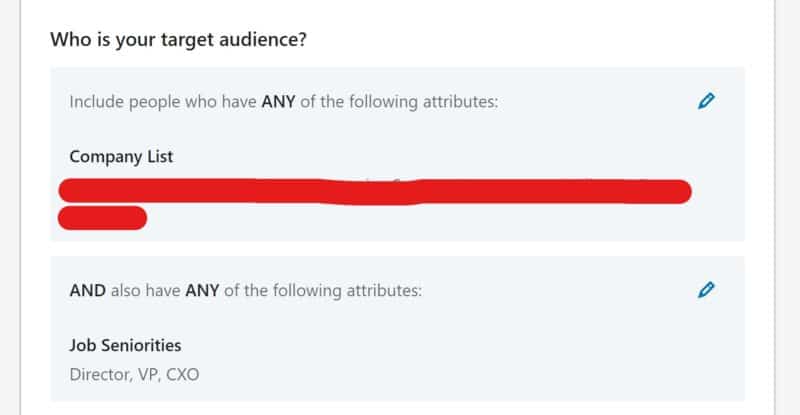
For example, you can target a company list layered with job seniorities of Senior level and up if you’re seeking to avoid junior-level individuals.

Or you can retarget people who visited your website and also work for companies with over 500 employees.

Audience layering in LinkedIn

You can use “AND” as well as “OR” targeting when setting up layers. For instance, you can reach people who are members of either list A or list B, and if they also have Director level seniority.

Exclusions

Lists can also be valuable to make sure you’re not wasting spend on individuals you don’t want to target. 

LinkedIn audience exclusion

For instance, you can upload a list of your current customers and exclude them from campaigns to avoid reaching them. You also should exclude competitor companies so their employees don’t see your ads.

Website retargeting audiences can come in handy for building exclusions as well.

To gate out job seekers, build an audience based on people who visit your “Careers” page.

If your product offers an online experience, you can exclude people who reach the log-in page as those are likely to be existing customers.

Upselling and ad sequencing

If your brand entails the opportunity to upsell customers on additional levels of service, sync lists of current customers based on their tier or existing plans to then serve ads for new products or services. 

For example, users of CRM software could be upsold to add marketing automation features to their existing plans.

You can also plan to put different content in front of people after they complete interactions with your brand. 

If you’re using lead forms to promote a downloadable buyer’s guide, you can target people who have filled out the form for the guide and promote an opportunity to request a demo. 

By controlling which lists you include and exclude from campaigns, you can effectively set up ad sequencing between campaigns to stagger exposure through the course of the sales funnel.

Lookalike targeting

Once you’ve created a matched audience, you can also make a corresponding lookalike audience. This will find people with similar characteristics to those on a particular list. 

Lookalike targeting

For instance, if you upload a list of current customers, you can then create a lookalike audience that will include people with similar job titles, group membership, interests, etc.

Be sure to test lookalikes in separate campaigns from your original lists so you can segment results, as you can’t isolate the performance of one specific audience within a single campaign.

Getting data from audiences

In addition to campaign targeting, LinkedIn offers some useful analytics features to see details about the individuals in your lists. 

To access this information for a contact list you’ve uploaded, navigate to the Audiences section, select an audience, and click the Insights button in the upper right.

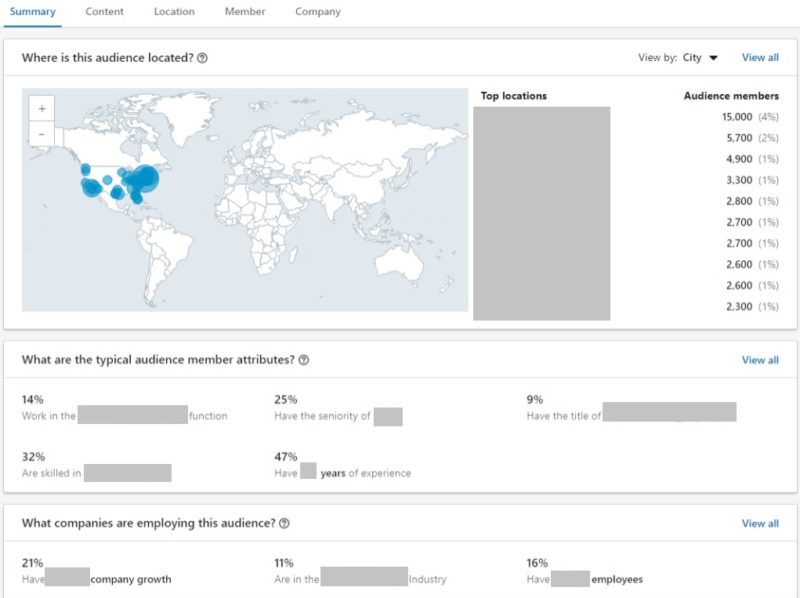
Audience insights

You’ll now see options to view top characteristics, including:

  • Interests
  • Locations
  • Job functions
  • Job seniorities
  • Years of experience
  • Titles
  • Companies
  • Company size
  • Industries
  • Growth rates

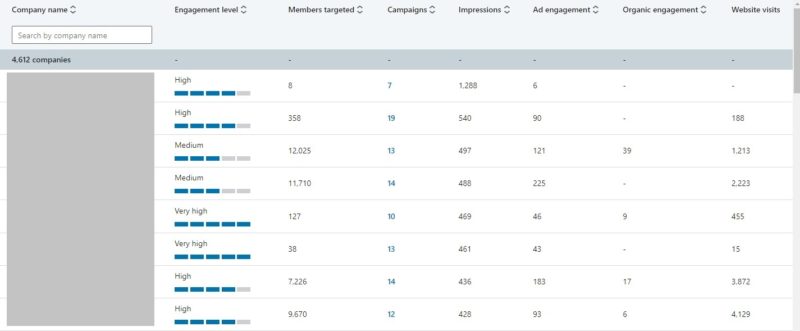
When you select a company list, you’ll see the Company Engagement Report, which shows details on how often people from each company:

  • Engaged with ads.
  • Engaged organically with your company page.
  • Or visited your website. 

This report can also be helpful to ensure that your list matched against the proper companies.

LinkedIn company engagement report

If you’ve created website retargeting audiences, you can view similar details by navigating to Analyze > Website Demographics. You can also compare the characteristics of two different audiences.

Start testing audiences

If this article has helped you to identify some matched audiences you haven’t yet tested, start thinking about ways to implement them in your campaigns. 

Whether you assemble prospect lists to import into LinkedIn or start building engagement-based audiences to target people who are engaging with your brand, think about content that makes sense for the level of interaction people have had with your brand.

The post LinkedIn matched audiences: How to get started appeared first on Search Engine Land.

Original source: https://searchengineland.com/linkedin-matched-audiences-get-started-388491

Make Money Selling Empty Boxes

Reading Time: 5 mins

You can make money in so many different ways these days, and yes, you heard us right – that includes empty boxes. With the rise in popularity of influencers and bloggers, we’re also seeing an increasing demand to sell old boxes for tech and designer goods online. This is our simple guide on how you can sell the empty boxes you have lying around at home and earn some cash!

Sell Designer Bags and Boxes

Sell empty designer boxes for cash

High fashion designer labels like Michael Kors, Gucci, and Prada, and even high street ones like Pandora and Glossier, all give away free branded boxes and bags when you make a purchase with them. Instead of throwing these into the recycling bin, list them online as there are plenty of people out there who are more than happy to pay to take them off your hands.

In this age of high designer awareness, designer anything is of value – even the box and bag. Influencer culture has played a big part in this – huge numbers of people are looking to influence and sell online, and there’s a lot of competition. Because of this, aspiring influencers can be looking to demonstrate on social media how they’re living a luxury lifestyle, when in reality this is not always the case. However, it does mean that any boxes, bags, and packaging you have from lying around can earn you a bit of cash.

How Much Can I earn?

Unfortunately, it’s not a guaranteed market out there so it does vary. But, designer bags will often sell for somewhere between £15 and £20, although designer boxes will often go for closer to £40! Even Glossier pouches, which come free with every purchase, can be sold for a few pounds.

Sell Empty Tech Boxes

Nowadays when you buy a fancy toy it’s not just the product that matters. The packaging has become just as important, and part of the whole in itself. But this trend actually means there are some great ways for you to make cash out of your old tech boxes. A lot of people will either buy gifts secondhand and want to be able to present the gift nicely in the appropriate box. Or, people may be reselling something and in this case most products will have more value if they come in the original box. So if the seller doesn’t have their original box – they can take to the internet and purchase another.

How much you can make from an empty tech box obviously depends on how much demand there is for it. The more recent the model – the more the box will likely sell for. But as a ballpark figure, an iPhone box for a model released in the past few years, will usually sell for around a tenner.

Where Can I Sell?

There are loads of places you can sell online – just always make sure you check any fees in advance so you don’t have any nasty surprises down the line.

MONEYMAGPIE MARKETPLACE

The MoneyMagpie Marketplace is an easy place to get set up and start selling online. Whatever you may have, as long as it’s legal to sell it in the UK, you can sell it here.

eBay

A popular site for reselling goods. For each item you want to list you’ll need to upload photos, add descriptions, and decide on shipping options. You can list up to 20 items a month for free, but afterwards, it costs 35p for each listing, and once you make a sale, eBay takes a 10% cut of the final selling price.

Facebook Groups

In recent years lots more people are using Facebook for buying and selling. There’s a lot of groups set up for specific areas as well, making it easier to buy and sell within your local community. Which also means you don’t have to worry about delivery costs either! There are no fees or charges for selling on Facebook, but there’s also no formal seller protection like you have with other selling sites.

Facebook Marketplace

Allows sellers to list items with photos and descriptions, tagged to a certain location for free. With Facebook groups and marketplace, the network isn’t involved in payment or delivery of items at all. It’s down to the buyer and seller to make these arrangements independently between them.

Preloved

This is another online ad and community website where you can post selling ads. In most cases you’re allowed to post your ad for free, although depending on the item you’re selling – sometimes you will be charged.

Other Surprising Things You Can Sell Online

There is virtually no limitation to what you can sell and make money from online. Here are a few other ideas for you to sell instead of throwing out!

Plain old cardboard boxes

You can make money out of any cardboard box you own, no matter where it’s from, with Sadlers. Simply send them the details of what you have and they’ll get back to you with an offer. If you decide to accept it, they’ll organise a collection and will pay you the same day they receive your stock.

Empty Perfume Bottles

Although this won’t make you rich, the average empty perfume bottle will sell between £5 and £8, so it’s a fair bit of income if you have a few empty bottles lying around – better than them ending up in the bin anyway. Plus, extravagant bottles can go for even more so it’s worth keeping any that look a bit unusual.

Jam Jars

Often you’ll need a few to sell as a bundle as they don’t really sell as single items. It can take a while to build up a collection so bear in mind that you’ll need somewhere to store them before you can sell. But they are another good way to earn money from stuff that would have otherwise ended up in the bin.

Loo Rolls

Again, you’ll want to sell these in bundles. Usually you’ll need upwards of 50 to sell in one bundle, so again, you’ll need to take into account where you’ll be able to store them in the meantime.

Old Tech

MusicMagpie – no affiliation with us! – is an easy place to sell your old tech online. Tell them what you have, and you’ll get an instant quote from them. You can send it off for free, and you’ll get paid the same day they receive your stuff.

More Ideas to Make Money

Check out these articles next if you’re looking for more ways to make cash from your trash!

The post Make Money Selling Empty Boxes appeared first on MoneyMagpie.

Original source: https://www.moneymagpie.com/make-money/make-money-selling-empty-boxes

Tesco to cut 300 jobs and freeze prices on 1,000 items

Reading Time: 2 mins

Supermarket giant Tesco have said it is planning to cut more than 300 head office jobs in order to save money. This comes at the same time shop workers are receiving a pay increase for the third time in 13 months. Tesco, which is the UK’s biggest retailer, said it is aiming to make savings of £500 million this year. 

The company issued a warning that profits could be hit by inflation, after revealing an almost 64% decrease in its half-year profits. The plans to save this money include consulting on 325 job cuts in head office and regional management teams. These consultations began in the last fortnight. However, the retailer also said that they would try to move those losing their jobs into other roles within head office, with 500 other vacancies available.  

Other changes include introducing more automated tills and reducing the number of suppliers. These changes could put the company on track for full-year profits of £2.4 billion to £2.5 billion, which is still £100 million less than forecast. 

British brands

Not only are customers tightening their purse strings, but high energy prices are continuing to drive up running costs for stores. The Christmas period ahead also looks uncertain, with many unable to ascertain the impact the cost-of-living crisis could have during the festive months. 

Despite this, however, shop workers will receive increased pay. From November 13th of this year, the basic hourly rate of pay in Tesco stores with increase by 20p per hour. This will raise wages to £10.30 per hour, or £10.98 in London stores. This brings the total pay rise rate for Tesco employees to 8% this year. 

But cutting jobs for some and raising pay for others aren’t the only changes the retail giant are making. The company also announced it will be freezing prices on more than 1,000 products until 2023. It also said they are planning to double the size of their fast track grocery delivery service, Whoosh by the end of the year. 

The post Tesco to cut 300 jobs and freeze prices on 1,000 items appeared first on MoneyMagpie.

Original source: https://www.moneymagpie.com/make-money/tesco-to-cut-300-jobs-and-freeze-prices-on-1000-items

Digital marketers rejoice: The four-day workweek is here to stay

The four-day workweek has become a hot trend of late – including in search marketing. Some agencies have adopted a four-day week with great success. 

Are you considering trying out a four-day workweek?

If so, read on to learn about the impact of a four-day workweek on digital marketing, the pros and cons, and tips for adopting it at your company.

The four-day workweek and digital marketing

Digital marketing is considered one of the most flexible industries due to its online nature. Simply give digital marketers an internet connection and we can get to work. The industry has seen fantastic results when implementing a four-day workweek. 

Reflect Digital, a Kent-based digital marketing agency, reflected on the four-day workweek after testing a one-year trial. CEO Becky Simms felt it was, “the right thing to do.”

After the year-long trial, Reflect Digital found that productivity increased by 20%, and overall job satisfaction was up by 90%.

“We are more productive with our days and the creative output has been fantastic, working with bigger brands than ever before,” Simms reported.  

I can also personally attest to its value to someone who is self-employed in the digital marketing world. A couple of years ago, I began to suffer burnout. I shifted my schedule to work Monday, Tuesday, Thursday and Saturday.

Of course, I can modify this based on my plans and schedule, but having these more frequent off days has allowed me to maintain a better state of mind, improve my mental and physical health, and enhance my relationships with my spouse and peers. 

The prominence of a four-day workweek in other countries

Multiple countries are doing four-day workweek trial runs and the results have been overwhelmingly positive:

Belgium

At the beginning of 2022, Belgium signed a reform package that allows employees to decide if they want to work a four- or five-day week.

The six-month trial granted companies the ability to condense their current work week down to four days, as long as they still meet 38 hours per week.

In addition, employees now have the right to “disconnect,” meaning they can turn their work phones off and ignore any messages sent after work hours.

Iceland

From 2015-2019, Iceland ran two trials that reduced the work week to 35-36 hours, with zero reduction in pay. The trial involved over 1% of Iceland’s entire working population – around 2,500 employees.

Productivity levels and service provisions remained the same, if not better than before the trials. Since the trial’s completion, 86% of the country’s workforce still utilize the shorter work week in their daily lives. 

The report explained that the participating workers “took on fewer hours and enjoyed greater well-being, improved work-life balance and a better cooperative spirit in the workplace – all while maintaining existing standards of performance and productivity.”


Get the daily newsletter search marketers rely on.

<input type="hidden" name="utmMedium" value="” />
<input type="hidden" name="utmCampaign" value="” />
<input type="hidden" name="utmSource" value="” />
<input type="hidden" name="utmContent" value="” />
<input type="hidden" name="pageLink" value="” />
<input type="hidden" name="ipAddress" value="” />

Processing…Please wait.

function getCookie(cname) {
let name = cname + “=”;
let decodedCookie = decodeURIComponent(document.cookie);
let ca = decodedCookie.split(‘;’);
for(let i = 0; i <ca.length; i++) {
let c = ca[i];
while (c.charAt(0) == ' ') {
c = c.substring(1);
}
if (c.indexOf(name) == 0) {
return c.substring(name.length, c.length);
}
}
return "";
}
document.getElementById('munchkinCookieInline').value = getCookie('_mkto_trk');


The pros of a four-day workweek

Increased productivity 

The top productive countries in the world include Norway, Denmark, Germany and the Netherlands. 

What do they all have in common? 

They all average around 27-35 hours per work week. Taking out the extra work hours is like taking the extra fluff out of an essay – get to the important stuff.  

Increased employee engagement

Weekly meetings can take up time and mental capacity. Chances are you’ve had a few meetings where you end up spacing out due to a lack of interest or focus. 

With a shorter work week, you’ll have more energy to give your projects and responsibilities. Getting more time to yourself might even bring back the initial passion you felt for your role. 

Better for the environment 

Transportation is the biggest contributing factor to greenhouse emissions, and economist and sociologist Juliet Schor says that commuting to and from work is a big part of it. 

The Environmental Protection Agency noted that in 2020, the transportation sector accounted for 27% of the total greenhouse gas emissions in the United States.

Just as we noticed during the COVID-19 lockdown, the huge reduction in driving, flying, and industrial output showed dramatic changes. The global emissions went down while air quality increased. 

Improved employee morale

Give and take! Knowing that a company cares about your well-being will likely entice you to put more effort into your job as an employee. 

Autonomy improves morale when employees feel more in control of their time and availability. As a company, you have happier employees putting in more productive work.

Helps recruit better fitting employees

If a company’s new business plan is to go down to a four-day week, they’ll have to focus on hiring people who can fit that structure.

Finding people who can be more productive in less time may be slightly more difficult but ultimately worth it. 

The cons of a four-day workweek

Despite the great outcomes that a four-day workweek can bring, it isn’t perfect. 

Does not work in all industries

It may be difficult for emergency services, grocery stores, public transport or high-demand jobs to join in on the shorter work week. 

However, it is ideal for digital marketing and other fields that already thrive in remote structures. 

Some workers thrive in a traditional work environment

Some people prefer to be in a physical office space. The preference could be for productivity and accountability or the social aspect of being around others. 

Too much freedom could also potentially take away from focus. Working from an office daily means you can keep an eye on employees’ productivity and not just assume they are “working from their couch.” 

How to determine if the four-day workweek can work for your digital marketing company

Set specific goals and objectives around output, revenue, and retention to see how to proceed forward. 

The following are additional tips for considering a four-day workweek.

Strategize with your team and discuss what type of structure works best with their needs

Start out with one day a week without any phone calls or emails between the team. Next, you can try one half-day a week. 

Whether you ease into a four-day workweek or jump in headfirst, make sure all employees feel comfortable with the shift. 

Figure out how to track progress

If you find a way to assess the overall performance during a trial of a four-day workweek, you’ll be able to see if it’s the right move for your company. 

Stick to the routine you create to stay productive 

Once your company decides to change the workweek structure, stick to the agreed routine for the length of the trial run. 

Really try to embrace the changes and make the most out of them. It may not be easy or perfect, but the lasting effects should be more than worth it.

The four-day workweek is here to stay 

The four-day workweek may not be for everyone. It’s important to consider the costs, the type of industry your company works in, and the preferences of your employees before making the switch. 

However, the benefits of change are clearly there – higher productivity, better employee morale, and it’s better for the environment. 

Search and digital marketing have proven to be adaptable fields already. By taking it a step further and implementing a four-day workweek, businesses can generate a better work-life balance for their employees and reduce stress and burnout. 

The four-day workweek certainly isn’t going anywhere. It can offer millions of people a more satisfactory work-life balance. 

The post Digital marketers rejoice: The four-day workweek is here to stay appeared first on Search Engine Land.

Original source: https://searchengineland.com/four-day-workweek-387446
Link-building services to scale your SEO efforts

Bui

Link building is essential. While Google has made numerous advancements in machine learning and content comprehension, links remain a critical element of how Google ranks websites.

We know that Google doesn’t want you to proactively build links. They want you to create high-quality content and hope for the best (i.e., build it and links will come).

Whether you’re a well-known brand or a local SMB, you need to be findable in the SERPs when people are searching for your product, service or expertise. Getting that initial push to get the front page creates a virtuous cycle where the better you rank, the more links you get because of how well you rank.

Enter: link-building services. 

While link building is essential, it’s also tedious. It’s time-consuming. And, honestly, it can seem quite boring. (Though we’d politely disagree!)

Luckily, there are companies that can do this tedious and time-consuming work for you!

Link building, done right, can be a win-win – for your website and the site linking to you. The key is reaching out to your own personal network of publishers and bloggers within a niche to offer a piece of content that they can either write about themselves or link to when relevant. 

If you haven’t built the types of relationships that can turn into links – this is where link-building services providers become incredibly valuable. 

In this article, we will introduce to you to 10 popular options when considering link-building service providers. Choose wisely – there are always risks and rewards when choosing a link-building service to scale your SEO efforts. 

We’ll start shamelessly with our own and if you understand the risks and rewards of proactive link building this way, try them.

The following are in no particular order. We are not claiming anyone is better than any other. This is simply a list of link-building service providers you can choose from.

1. OutreachZ

Here’s what makes us a bit different. We are a team with vast experience in the link-building space and have identified and tried to address the following pain points.

Transparency: Unlike most services, you can pick the right publishers upfront from our marketplace. Metrics like the primary niche they operate in, organic traffic, and DA (by Moz) are filters you can apply to find the right blogs, so there are no surprises after reviewing the report.

Pricing: Unlike most service providers, we will not charge you hefty fees based on the domain metrics. Instead, we take a fixed success fee and pass on the benefit of a low cost of link acquisition irrespective of how big or small that publisher is.

Flexibility: Even with the marketplace model, you are working with us to get the job done and not waiting for the publisher to react despite operating on a dynamic pricing model like other marketplaces that only serve as a platform provider. You also have managed posts and custom link-building campaigns and the option to upload your content, so the number of ways you can get this done is highly flexible.

Now let’s move on to some other notable link-building providers.

2. Page One Power

Page One Power focuses on giving you a personalized experience. They will sit down with you to discuss your individual needs, analyze your existing website and give you a customized link-building plan. They are willing to do the research and heavy lifting for you, giving you the extra breathing room to focus on other aspects of your business.

3. Fat Joe

To help you get started as quickly as possible, Fat Joe features an intuitive order intake form and a dashboard to monitor active orders and manage them. They seem to be the go-to service provider for agencies that need a lot of links for multiple clients with tight deadlines and provide content services that seem reasonably priced.

4. The Hoth 

If you considered link-building services, there is a high probability you have come across The Hoth already. They are one of the oldest link-building service companies with diverse offerings across various off-page SEO services. Their dashboard is intuitive, and one can navigate through their diverse offerings quite easily; however, given their large-scale link-building services, you might have to be careful in picking the right product for you as some could do more harm than good if you do not understand the product and its risks, so talk to them about your goals before you go ahead.

5. No BS Marketplace

No BS could have kick-started the transparent approach to link building, where you get to pick publishers upfront that they would suggest based on your requirements. So if you appreciate transparency and would like tighter control on the links you want to acquire, they are another great alternative to look into.

6. uSERP

If you’re looking for a tried and true SEO and link-building agency that works with high-profile industry names like Robinhood, Monday, Freshworks, Hotjar, and others, uSERP fits the bill. Working with small businesses and large enterprises alike, they craft and initiate content-based link-building campaigns. 

7. Siege Media

Siege Media is another agency that offers content-driven link building, where they prospect and reach out to authority publishers in your industry with amazing content. Although the specific link-building services they provide won’t give you an exact number of links they can expect to build, they will provide you with a ballpark figure instead.

8. Posirank

The folks at Posirank have been at it for a while as well. The team offers both custom campaigns and some large publishers’ lists from which they could secure a backlink for you. In addition, they have an easy dashboard where you can quickly sign up and start your first link acquisition campaign immediately.

9. The Upper Ranks

Beginning its operations in 2011, this link-building company is a trusted business partner of some of the largest brands, including established names from the Fortune 500 list. The philosophy of their approach is to build relevant backlinks that could stand the test of time.

10. Hire a Freelancer: For many, hiring an experienced blogger outreach and link-building expert from Upwork could work out best, especially if you want to control the process at every level and keep the costs in check at the same time. There seem to be plenty of skilled freelancers for hire with great feedback.

Conclusion

Google is no fan of “link building,” – but who can blame them? For years, links were a commodity that was abused by SEOs.

But proactive link building is incredibly hard. As it should be. 

That’s why you should partner with an experienced agency with clear goals and quality control. For that, we highly suggest OutreachZ – but admittedly, we’re biased!

The post Link-building services to scale your SEO efforts appeared first on Search Engine Land.

Original source: https://searchengineland.com/link-building-services-to-scale-your-seo-efforts-388421

How to Keep Your Remote Employees Connected and Engaged in a Digital Era

Home Business Magazine Online

The shift to remote work is well underway. According to a recent survey by McKinsey & Co., 58 percent of US workers say they now work from home at least one day a week. More than one-third have the option to work from home full-time. It is easy to identify the upsides of the shift. Spend just a few minutes reading about the topic, and you will hear about less stress for employees and less overhead for employers. The downsides, however, are less obvious. For example, remote work causes a slow and painful impact on work culture and a decrease in employee engagement.

If your own company culture is not struggling, then it is likely you have heard an executive peer talk about how he or she is floundering to maintain his/hers. In this new age where remote work is the new normal, work culture is falling behind. Historically, culture largely existed in the office. As employees spend less time in the office, they create their own cultures within the walls of their homes. The result is historically low levels of employee engagement.

Gallup Reporting of Employee Engagement 

Gallup recently reported that US employee engagement took a downturn for the first time in a decade. Only 34 percent of employees reported engagement with their jobs. How does that level of disengagement affect a business? Gallup found that engaged workers are 13 percent more productive than those who are disengaged. This resulted in a 22 percent increase in profitability for companies. Those that cannot find a way to reverse the trend of disengaged and disconnected employees will find themselves suffering — rather than benefiting — from the shift to remote work.

Each business leader has a very specific challenge to address. How does he/she create a culture that can effectively make its way into the workdays of all employees, rather than just those who spend their days in the office. The end results are the freedom and flexibility of remote work without losing the engagement and connections that are critical for employee wellness, a healthy culture, and strong productivity.

To the business leader taking up this challenge, here are three steps you can take to increase the level of engagement with your remote workers.

Step One: Provide Recognition to Remote Employees

If employees believe that the work they do for their company is valuable and directly affects the business’s success, then engagement increases. One way to stoke that belief is by recognizing your employees’ accomplishments.

Some old familiar examples of employee recognition include handwritten thank-you notes, personalized gifts, or public recognition bestowed during group gatherings. These long-standing means of recognition and rewards are not necessarily bad. However, they often do not translate well to the world of remote work. If you have a traditional employee recognition strategy, transitioning each aspect to the digital realm will make it easier to boost engagement through recognition.

Keep in mind that meaningful appreciation does not need to be a big lift, especially with the digital tools that are available for connecting with remote workers. It also does not require a big investment in swag, gift cards, etc. The critical component is to do it with a purpose. Intentionally seek out the good things people are doing every day, and recognize them. A gratitude-centric culture improves connection amongst team members.

Step Two: Listen to What Remote Employees Are Saying

If you determined that your employees are among the 66 percent of disengaged employees, the next step is to determine why. What do they need to keep them connected, engaged, and productive? The best way to find out is to ask them.

Finding out what your employees want and need is, in some ways, easier in a remote work environment than with the traditional in-office model. Anonymous digital surveys will drive more participation, more insights, and more unfiltered feedback from your team. Instead of an additional internal campaign, just incorporate it with regular HR communications. Do not be afraid to offer a sweetener or rewards for the completion of surveys that can increase participation. You do not have to do that every time, but when you want to hear from your people, a small incentive can go a long way. However, adding that incentive to every survey or employee feedback form will dilute the meaning of the reward over time.

Once you get feedback, respond. The best thing you can do as a leader to encourage your employees is to act on the feedback you receive. Doing this creates a level of trust and confidence in an employer. Subsequently, this will have a positive impact on engagement. If for some reason you cannot provide the solution they asked for, tell them why. That transparency also builds trust.

Step Three: Equip Remote Employees for Engagement

Maybe too much of the responsibility for engagement is placed on the remote employees. The problem, in fact, may lie elsewhere. Employee engagement is tied to a number of factors, and there are absolutely some external items to consider.. Think about this: 70% of variance in employee engagement is attributed to managers. Saying that your employees are disengaged because they are not trying hard enough is a great way to miss the real problem and assign blame to what might not be the root cause of disengaged employees.

As you leverage digital tools to empower remote engagement, make sure that you stay focused on a “human-first” approach. You may need to take into account external factors like economic status, available resources, and digital literacy. However, most — if not all — of your team should have what they need to stay connected. If you find that employees are unable to participate, then find ways to equip them with the knowledge and resources they need to effectively navigate company tools. Never assume that a lack of engagement is the result of a lack of effort.

Final Comments

People are hard-wired to be social. Establishing and maintaining a healthy remote work culture begins with embracing that reality. When you provide remote work opportunities, pay special attention to how you will help with employee engagement and connection. Remote work is not inherently disengaging. It only becomes so when the right support is not in place.

The post How to Keep Your Remote Employees Connected and Engaged in a Digital Era appeared first on Home Business Magazine.

Original source: https://homebusinessmag.com/management/employees/how-to-keep-remote-employees-engagement-connection-up-digital-era/

How to choose an enterprise SEO platform

Enterprise SEO platforms guide

Understanding your current marketing processes, knowing how to measure success and being
able to identify where you are looking for improvements are all critical pieces of the SEO platform
decision-making process.

In this guide you will learn:

5 key benefits of enterprise SEO platforms

With thousands, tens of thousands, and even millions of pages, sites, social conversations, images, and keywords to manage and optimize, enterprise SEO has become increasingly complicated and time-consuming.

Using an enterprise SEO platform can increase efficiency and productivity while reducing the time and errors involved in managing organic search campaigns.

More specifically, managing SEO through an enterprise toolset can provide the following benefits:

  • Many tools, one interface. Enterprise SEO platforms perform many tasks in one system. A comprehensive dashboard can help your organization monitor SERP rankings and trends, how you measure up to competitors and your share of voice. The integration and prioritization of tasks, reporting and user permissions can offer substantial benefits to enterprise-level SEO operations.
  • Intent insights. Because of the search engines’ increased focus on user intent, enterprise-level SEO tool vendors are developing machine learning models that analyze user behavior and site content to help marketers answer searchers’ questions. This information can inform content development strategy –- a critical element given the foundational importance of quality content.
  • More efficient management of global operations. Enterprise SEO tools have built-in diagnostics that can be invaluable on a global scale to identify site-wide issues across languages, countries or regions. These tools uncover macro and micro issues with pages, templates and infrastructure.
  • Keeping pace with the search engines. SEO software vendors have dedicated teams and engineers to follow frequent search engine algorithm changes and their impact on the SEO reporting required by enterprises. Through education as well as software tool development, a relationship with a quality vendor can give marketers a competitive advantage.
  • Automated reporting to provide data in near real-time. Many brands end up trying to put a lot of data in spreadsheets and updating them manually. But that doesn’t provide a complete view of the data. Most enterprise SEO platforms offer highly customized reporting capabilities that are widget- and wizard-driven to make reporting faster and easier. Many also allow for the export of data to business intelligence tools or other analytics software

How much enterprise SEO platforms cost

Licensing an enterprise SEO platform can be a significant investment, particularly for ecommerce or retail brands with hundreds of thousands of SKUs or product pages.

Marketers typically spend tens of thousands of dollars each month in licensing fees. They may also pay for installation and staff training to maximize the value of the platform and its capabilities.

Virtually all enterprise SEO platforms are provided on a software-as-a-service (SaaS) basis (i.e. the vendor makes the software available online and is responsible for all maintenance and system administration).

Enterprise-level pricing models vary and are often customized based on the number of users, sites, keyword rankings, link volume, international coverage and other SEO activities.

How to make an informed SEO platform purchase

Ready to help your organization choose the SEO platform that is the right fit for your business needs and goals? Here are four steps to help.

Step 1: Do you need an enterprise SEO platform?

Deciding whether your company needs an enterprise-level SEO platform calls for the same evaluative steps involved in any software adoption, including a comprehensive self-assessment of your organization’s business needs and resources, staffing, management support and financial resources.

Use the following questions as a guideline to determine the answers.

  • Do we have the right human resources in place? Employing people to implement and use SEO platforms is a prerequisite to success. If you have marketing staff, utilizing SEO toolsets can make them more efficient and effective. The vast majority of organic search marketers struggle to justify their SEO budgets. SEO platforms and tools are a key component of helping to keep overall costs down while getting the required work done. Their analytical capabilities can also help SEOs prove the impact of their work on the bottom line.
  • Do we have C-level buy-in? Enterprise SEO software can be a five- or six-figure investment annually. It is critical to demonstrate the value of SEO to C-level executives by running pilot test projects and agreeing to a definition of “success” in advance.
  • Do we have the right technical resources? Successful enterprise SEO needs dedicated technical resources deployed to it to act on the recommendations and opportunities surfaced by the analytics and reports. With many SEOs reporting a technical backlog as the primary thing hindering their SEO success, allocating resources to this task can be the factor that determines whether an implementation is successful or not.
  • Who will own enterprise SEO? Enterprise SEO is commonly placed into marketing, editorial or IT, depending on the nature of the business. Unfortunately, in large companies, it usually ends up with either whoever has the budget or whoever can best articulate the business case. In a best-case scenario, it should be both.
  • Can we invest in staff training? It is vital to provide training to technical, design, content and marketing teams, and reinforce it on a regular basis. A successful enterprise SEO implementation will find ways to inject SEO knowledge into existing training programs and identify internal evangelists to broadly distribute the messages. Training needs to be comprehensive, consistent and continuous. Some tool companies include or offer training for an additional fee, so be sure to ask about this.
  • To what extent do we need to share reports with non-SEO staff? Some tool providers focus significant development resources on simple interfaces that can be utilized by people in other organizational roles – such as writers or C-suite executives. If this is important to you, make sure you specifically look for this when evaluating possible platforms.
  • Have we established KPIs and put a system in place for tracking, measuring and reporting results? It’s important to know upfront what you want your SEO to achieve. Do you want to improve SERP rankings or the time visitors spend on your site? Is conversion – whether a product purchase or whitepaper download – your key objective? Having goals will help you decide if you’re ready to put an enterprise platform to good use, as well as help you decide which tool will best meet your organizational needs.
  • How will we measure success? Depending on your site’s monetization strategy, make sure you know how you’ll determine if the rollout of the platform and the successful execution of the established KPIs actually increased sales, conversions, or page views.
  • Do we have realistic expectations? It is not uncommon for enterprise SEO efforts to take at least six months to generate tangible results. If SEO is a new initiative within the organization, cultural shifts and workflow processes will need to be implemented and refined. Setting realistic timelines and goals will help build support at all levels of the enterprise.
  • Do we have an SEO culture? Many organizations begin to invest in SEO but find that a lack of understanding of SEO across the organization cripples its progress. Broad educational programs are often required to provide consistent performance and results.

Step 2: Identify and contact appropriate vendors

Once you have determined that enterprise SEO software makes sense for your business, spend time
researching individual vendors and their capabilities by doing the following:

  • Make a list of all the SEO capabilities you currently have, those that you would like to have, and those that you can’t live without. This last category is critical and will help you avoid making a costly mistake. If you find that one vendor doesn’t offer this “must-have” capability, it’s obviously not a fit. When it comes to international data, it can be cost-prohibitive to track all your markets, so you may want to use an enterprise-level tool to track your most important market, then use simpler tools for secondary markets.
  • Take your list of capabilities and then do some research. Many of the vendors profiled in this report also provide whitepapers and interactive tools that can help.
  • Narrow your list to those vendors that meet your criteria. Submit your list of the SEO capabilities you’ve identified and set a timeframe for them to reply.
  • Decide whether you need to engage in a formal RFI/RFP process. This is an individual preference, however, be sure to give the same list of capabilities to each vendor to facilitate comparison.

The most effective RFPs only request relevant information and provide ample information about your business and its SEO needs. It should reflect high-level strategic goals and KPIs. For example, mention your company’s most important KPIs and how you will evaluate the success of your SEO efforts. Include details about timelines and the existing digital technology you have deployed.

When written properly, an RFP will facilitate the sales process and ensure that everyone involved on both sides comes to a shared understanding of the purpose, requirements, scope, and structure of the intended purchase. From the RFP responses, you should be able to narrow your list down to three or four platforms that you’ll want to demo.

Step 3: Scheduling the demo

Set up demos with your shortlist of vendors within a relatively short timeframe after receiving the RFP responses to help make relevant comparisons.

Make sure that all potential internal users are on the demo call, and pay attention to the following:

  • How easy is the platform to use?
  • Does the vendor seem to understand our business and our marketing needs?
  • Are they showing us our “must-have” features?
  • Is the reporting actionable?

Other questions to ask each vendor include:

  • How do you calculate search volumes? Knowing how the system treats information types will impact how you ascribe value to certain keyword terms, make decisions about keyword and content choices and affect the ROI of your search marketing efforts. Find out from where raw data is extracted (i.e., analytics, log files, or a proprietary tracking pixel).
  • Can this system track millions of searches, visits, site pages, etc.? Knowing whether the
    platform is a true enterprise solution or a simple tool that may not scale for your business
    needs is crucial. Limits on the numbers of keyword rankings, pages or traffic tracked could
    impact your use of the system or significantly increase the cost.
  • Do you support international search? There are many nuances within international SEO that can mislead even the best SEOs. Find out if the numerator in the calculation of the platform’s average clicks per search or average search volume is normalized for global or local (in that market) search, and whether search ranks are calculated from within the country or remotely. Does their tool make hreflang coding recommendations? Will it manage the page relationship and directional recommendations? The misapplication of international data could impact the ROI of your search marketing efforts.
  • How do you track and report universal search results? You will want to know if and where your site was listed on the results page. For example, did your listing appear in web results, the In the News segment, an in-depth article or the video results? That location and reporting feedback helps to quantify strategic and tactical efforts.
  • Does your tool help customers understand what competitors do, and derive actionable insights from that? What are the most important features the tool has for providing competitive research? Competitive intelligence is a standard feature for virtually all enterprise SEO platforms – but the scope and cost differ between vendors. Find out what level of data is provided about your competitors and vertical industry, and make sure it fits your requirements.
  • How robust and flexible are your reporting options? Different users have different reporting needs. Find out if reports can be customized and automatically delivered to different users and types of users, and whether data can be exported in CSV format.
  • Where are the actionable reports? Enterprise tools have dashboards and generous amounts of data but it’s important to understand how (and which) reports can immediately benefit your business. A good sales team will understand your company’s objectives and KPIs and will have reports ready or be able to run them in real-time. This is data that can be handed over to the appropriate teams and promptly acted upon.
  • What other meta-information does your system collect that may be made available via API? Being able to trace search traffic data from the front of the funnel all the way to sales data in a CRM or business intelligence (BI) system will help you to more accurately calculate ROI.
  • Is there a workflow built in that allows me to coordinate the work of my marketing, content, web development and social media teams across the organization? SEO cannot operate in a silo. A true enterprise platform should provide built-in workflow management that includes task assignment, management and monitoring of completion rates across groups.
  • What does the onboarding process entail and how long will it take? What are the training options (i.e., is it online only or will you send people to our location to train us on-site)? Be sure to find out what onboarding and support is included in pricing and what is an add-on.
  • What kind of ongoing support and client engagement will your account team provide? How will you gauge our use or non-use of the platform’s features? One of the most common reasons a company transitions out of an enterprise platform is because they don’t use it enough. How do they propose you avoid tool fatigue and checkout for your organization? A vendor should be prepared to address this issue and specifically how the tool creatively engages users and gets them back into the environment.
  • What new features are you considering? What are the long-term roadmap and launch dates? The SEO landscape is constantly changing with new features to further leverage digital assets rapidly coming out of Google and Bing. How quickly do they respond to the implementation of new SERP features and begin tracking them? It’s important to understand the level of innovation and the ability to add and track emerging technologies. Knowing a vendor’s new feature release date schedule and its ability to stick to committed timelines is also important. This helps establish long-term trust and an expectation with the vendor that it will always be on the cutting edge of SEO.

Step 4: Check references, negotiate a contract

Before deciding on a vendor, take the time to speak with one or two customer references, preferably someone in a business like yours. The SEO vendor should be able to supply you with several references if you cannot identify them yourself.

Use this opportunity to ask any additional questions and find out more about any topics that weren’t addressed during the demo. Make sure that the person you’ve been referred to is a primary user of the solution.

Consider also asking these basic questions:

  • Why did you move to an enterprise SEO platform?
  • Why did you select this platform over others?
  • Has this platform lived up to your expectations?
  • How long did the system take to implement?
  • Are you also using additional tools for crawling, page evaluations, competitive analysis, domain and link data?
  • Were there any surprises that you wish you’d known about beforehand?
  • What was the quality of the training resources and the onboarding process?
  • Where have you seen the most success? The biggest challenges?
  • Do other teams in your company use the tool? How did you get their buy-in?
  • How are you measuring your own success?
  • How easy was the set-up process and how long? Did the vendor help?
  • How responsive is customer service?
  • Has there been any downtime?
  • Do you use all the resources provided? If not, which ones and why?
  • What is the most useful, actionable (favorite) report the tool generates?
  • What do you wish they did differently?
  • Why would you recommend this platform?

Although not all vendors require an annual contract, many do. Once you’ve selected a vendor, be sure to get in writing a list of what technology and support are covered in the contract. Ask about what kinds of additional fees might come up.

  • Are there charges for custom integrations, if so, how much (and how long will the onboarding take)?
  • What is the hourly charge for engineering services, and is there a minimum?
  • What partner organizations are available to install and integrate the tool?
  • If you need to train a new hire midyear, what will that cost?
  • What is the “out” clause?
  • Are they open to a trial period with options to exit the contract?

Obtaining the answers upfront – and having them in writing – will ensure fewer surprises and fewer
costs down the road.

Enterprise SEO Platforms: A Marketer’s Guide

Our MarTech Intelligence Report examines the market for SEO platforms and the considerations involved in implementation. The 65-page report reviews the growing market for SEO platforms, plus the latest trends, opportunities and challenges.

Download your free report here: Enterprise SEO Platforms: A Marketer’s Guide (12th edition).

This report was prepared by conducting in-depth interviews with leading vendors and industry experts. Research took place in the first quarter of 2022. These, in addition to third-party research, form the basis for this report.

You can compare 15 leading enterprise SEO software vendors in the full report:

  • AgencyAnalytics
  • Ahrefs
  • Botify
  • BrightEdge
  • Conductor
  • Moz
  • Quattr
  • Searchmetrics
  • Semrush
  • seoClarity
  • SE Ranking
  • Serpstat
  • Siteimprove
  • Visably
  • WebCEO

The post How to choose an enterprise SEO platform appeared first on Search Engine Land.

Original source: https://searchengineland.com/enterprise-seo-platforms-388566

How Networking Can Help Business Owners Weather an Economic Downturn

Home Business Magazine Online

Unfortunately, it seems pretty clear that we are in ― or are about to enter — a recession. Though technical definitions of a recession vary, most experts agree that a recession results from a prolonged period of economic downturn. Technically, economists cannot really declare a recession until it is over, but the signs of recession are all around us. These signs include rising unemployment rates, decreased spending, and a contraction of the GDP. Therefore, whether we are in a recession or not, how should companies respond to a downturn? The first instinct is to buckle up, start cutting costs, cap the spending, and go into survival mode. While you should definitely prepare for any sales drought on the horizon, you should also look out for new opportunities that could be a lifeline to your business — by networking.

Identify your needs and look to your network. What do you need right now? Is it just the new clients? Is it someone to help you redefine your business model or restructure your business? Alternatively, is it an investor who can help you out with a bridge round? All these people may be a couple of phone calls or just a few clicks away.

I am certainly not suggesting that this is an easy task. However, if you do not ask, the answer will always be “no,” right? So start reaching out to your network. There may be someone there who will open up a door for you.

Networking Creates New Business Opportunities

As I have said, networking can be a catalyst for business development, financing, or even talent sourcing. A study conducted by Booth Business School at the University of Chicago found that 29% of founders claimed that they raised capital through networking, while 32% actively hired through their network. About 34% even tapped into their network for emotional support, which matters a great deal during tough times.

A great example of the power of networking is the acquisition of the marketing automation company, Eloqua, by Oracle for nearly $1 billion dollars. The determining factor behind the deal was the strong ties Eloqua’s co-founder, Paul Teshima, shared with Oracle. However, this was no ordinary acquisition. Eloqua was purchased for more than 200 percent of its estimated public market value for a $400 million-plus increase in shareholder net worth. All of this resulted from a little networking.

That said, it is important not to limit yourself to your existing network of contacts. A study from Northwestern University suggests that new opportunities and novel information flow in from your extended network. That could come in the form of new business opportunities, new staff, new investors, or even a merger opportunity. So make sure to ask for introductions to that “friend of a friend,” as you never know where it may lead.

Integrate Networking into Your Business Plan

Therefore, networking creates new channels and opportunities. This means it should really be a part of your business plan. With today’s wide range of networking tools — in particular, LinkedIn — the possibilities for utilizing your network are enormous.

Your sales are falling; can you access new verticals or market territories? You need to reduce debt; can you find new equity investors? You need to find a product manager with experience in logistics, to help you revamp your flagship product. Is there someone in your network to assist you in finding that person or to be that person?

Your business plan consists of business decisions that lead your business to its next step. Your network offers the channels to make informed business decisions, and in many instances, it helps execute them as well. For this reason, you must add networking to your daily routine.

Integrate Networking into Your Daily Routine

Make networking a habit by incorporating these three steps into your daily routine:

  1. Reach out to your contacts and ask for an introduction to contacts that you have not yet met.
  2. Find the contacts that matter the most and keep in touch with them. Comment on an update they shared. Invite them for coffee. Share an insight they might be interested in. The little things matter more than you think.
  3. Give back. Make sure that your relationship with these contacts is not one-sided. Offer your help even if you do not need anything in return. Such acts of kindness can build trust and reciprocity in professional relationships.

Final Words

There is no need to be hesitant about reaching out. In the words of London Business School’s, John Dore, “Consider how you’ve responded to a suddenly revived contact from the past? Perhaps it is a former colleague or an alumni contact from university.” Chances are, it was a very gratifying experience for you. You have every reason to believe that your contact will greet you the same way.

Your network is a world of opportunities waiting for you to capitalize on them. Start now.

The post How Networking Can Help Business Owners Weather an Economic Downturn appeared first on Home Business Magazine.

Original source: https://homebusinessmag.com/marketing/networking/networking-help-business-owners-weather-economic-downturn/