Realistic ways to make money from your car

Reading Time: 5 mins

Running a car can be expensive, but did you know you can make money from your car? You can make money renting out your driveway, but what about the vehicle which sits upon it?

There are lots of fun ways you can make money with your car. From becoming a driving instructor, selling a rare number plate or showing a classic car. In fact, we cover a lot of the more exotic ideas in this fun article here.

But if you want some easy and realistic ways to make money with your car, here are five possible ways:


Rent out your car – £800 a month

If there are times when your car is just sitting on your driveway. Or parked outside your house doing nothing, then renting it out is something you should consider.

You could be charging people in your local area to rent out that space. There are also specific apps to help you do just that.

For example the Drivy app offers you the opportunity to organise ‘check-in’ and ‘check-outs’ with people who are interested in renting your car. Even better, you can earn 3x more if you use ‘Drivy Open’. This allows users to book, locate and unlock your car using the app.

Essentially these apps allow your car to rent itself out. All you have to do is sit back and wait for the money to roll in. You could also look to list your car on Turo, which has only recently launched in the UK.

Insurance is also provided by the company themselves. This replaces any previous car insurance while the rental trip is happening. You can set your price but apps like Drivy and Turo will take a portion of your profit.

In a similar vein, you might want to check out Karshare. It’s like AirBnB for cars. Allowing you to leave your car at the airport for someone else to rent whilst you’re away. Admittedly it’s only something you can do while you’re on holiday. So it’s not a regular source of income, but it’s another way you can make your car pay for itself.


Car wrapping – £100 a month

You know you’ll sometimes see an advert on a bus or a logo on a taxi?

Well companies will pay you to put ads on your car. Turning your vehicle into what is, essentially, a portable billboard. It’s called vehicle wrapping and you can actually make about £100 a month doing it.

In order to be considered you’ll need to have:

  • A clean driver’s licence
  • A current MOT and road tax for the vehicle
  • Valid insurance for the duration of the contract
  • No driving convictions

Adverts on your car can be added and taken off without spoiling your paintwork. And if anything does go wrong, there is insurance covering you.

Each company works differently, some ask you to drive a certain amount of miles before you get paid. Whereas others will match the advertising to your usual routine.

However, do be careful of scams. Car wrapping seems to appeal to scammers, so make sure you fully research a company before handing over any details. Once you do find a legitimate company, it’s an easy way to earn a bit of extra cash.


Become a courier – £200 a month

Courier

Being a courier is a great way to make money with your car. Unlike some other car related jobs, such as becoming a driving instructor, you don’t need to quit your day job. You simply work as and when you can.

As a courier you’d be carrying parcels in your vehicle to their destination. Ideally on time and with minimum hassle.

Couriers are generally considered self-employed, although they are hired by various companies. Each job is recorded by the company, and each courier sends their invoice to them at the end of the week. Working as a freelancer means you can start in your spare time and work around your current job.

Obviously, if you’re planning on delivering a lot of items then it makes sense to have a bigger vehicle. You don’t necessarily have to deliver big, bulk items but it’s important to have sufficient room for a few items.

This is a very flexible way to make a little extra income on the side using your car.

Remember, if you do become a courier, don’t forget to notify the Inland Revenue so you’re paying the right amount of tax and won’t get a large fine later.

Click here to find out more about making money as a courier.


Do the school run – £200 a month

Lots of parents have to get to work in a morning and as a result are are unable to do the school run. In this situation many are happy to pay for a ‘school run nanny’.

If you were to take on such a role, it would be your job to pick the kids up from school. Then supervise them as they do their homework until their parents return home from work.

You don’t need any formal qualifications to do this, but it will help if you have experience as nurse or teacher. Something that reassures parents that their children will be safe with you.

Whatever your qualifications, though, you’ll definitely need the following:

You may need to alter your car insurance as well to cover the child passengers. If this is the case, make sure the parents reimburse you. Speak to your insurer to find out how to do this.

The most effective way to get a job is through a nanny agency.

Click here to learn more about making money doing the school run.


Become an Uber driver – £400 a month

If you’ve got a few hours spare during the day, why not make some money as an Uber driver?

You’ll get paid to essentially function as a taxi in your local area, and you might even have a few interesting conversations as you earn.

To become an Uber driver, you’ll need to fit the following criteria:

  • Be at least 21 years old
  • Have a full UK driver’s licence
  • And quite often you’ll need to show you have a certain amount of experience driving around in the city that you’re based
  • You’ll also need a clean licence – you can see their points policy here

So, if you could fit in around two hours a night, five days a week, you could be earning over £400 a month on the side.


Ask your money-making questions

The Magpie community is full of savvy money savers and makers – and now’s your chance to ask your burning questions!

The new MoneyMagpie Messageboard brings together the Magpie community, MoneyMagpie team, and vetted experts to make sure your essential money-making questions get answered.

Take a look here and register to post a new thread or reply.


The post Realistic ways to make money from your car appeared first on MoneyMagpie.

Original source: https://www.moneymagpie.com/make-money/realistic-ways-to-make-1700-a-month-with-your-car

Richard Rakowitz Explains Why Businesses Should Implement Multi-Language Marketing Strategies

Home Business Magazine Online

In today’s globalized economy, businesses are increasingly tapping into new markets by targeting consumers worldwide. This is where multi-language marketing strategies come in. Expert Richard Rakowitz in New York, NY, says by developing campaigns that target multiple languages and cultures, businesses can reach a wider audience, expand their customer base, and ultimately boost sales. Take a closer look at why companies should implement multi-language marketing strategies.

The Basics of Multi-Language Marketing Strategies

Multi-language marketing strategies refer to the process of creating campaigns and materials to target multiple-language audiences effectively. This can include website content, social media posts, and video ads. When done correctly, this strategy can help businesses gain an edge over their competitors by reaching an even more significant customer base.

The Benefits for Businesses

Richard Rakowitz says businesses that utilize multi-language marketing strategies benefit in several ways. First, they can tap into new markets and reach customers who may not have been familiar with their products or services. Additionally, multi-language marketing allows companies to develop better relationships with their customers. They speak directly to their customers in their languages rather than simply relying on translation services or automated translation software. This also helps strengthen brand loyalty. Customers feel more connected and appreciated when companies try to reach out to them in their native language.

Furthermore, using different languages in marketing materials gives companies a chance to explore different cultural nuances that may give them an edge over the competition when it comes to engaging customers on a deeper level. For example, certain words or phrases may have different meanings in different cultures, which can be used to create more effective campaigns that speak directly to those audiences. Additionally, diverse cultural references can help companies stand out from the crowd and capture the attention of potential customers who might otherwise be overlooked.

Finally, utilizing multi-language marketing strategies helps businesses remain competitive by quickly adapting and responding to changes in customer preferences across multiple markets instead of focusing on one language group at a time. This flexibility allows companies to stay ahead of trends while keeping costs low since they don’t have to invest as much time or money into translating content for each market individually.

How to Implement Multi-Language Marketing Strategies

Implementing multi-language marketing strategies successfully requires a thoughtful and strategic approach. Here are some tips to get you started:

1. Research the language of your target market. This ensures that your materials are appropriately tailored to their needs and expectations.

2. Invest in native-speaking translators and cultural experts who can assist you with creating content that is both accurate and culturally relevant for each target market.

3. Use the right tools and technology to ensure your campaigns correctly translate into each language.

4. Develop a multi-language strategy that considers the different language preferences of each target market and any cultural nuances.

5. Finally, Richard Rakowitz says to test and monitor your campaigns across multiple languages and adjust accordingly based on customer feedback. This will help you refine your approach and create more effective campaigns.

By utilizing multi-language marketing strategies, businesses can gain competitive advantages and reach even larger customer bases than before. With the right tools and a thoughtful approach, companies can create successful campaigns that speak to customers in their languages and capture their attention in unique ways.

How to Handle Multi-Language SEO

When optimizing websites for multiple languages, it is essential to consider a few key points. To begin, create separate versions of your website for each language you plan to target. This helps to improve your search engine rankings and ensure that customers can easily navigate and find relevant content in their languages.

Additionally, create localized content for each language version of the site. Use appropriate meta tags, titles, and descriptions so that search engines can properly index the pages. Finally, use hreflang tags to help search engines determine which language version of the page to display for each user. This will help ensure that customers get the most relevant and accurate content.

What About Multi-Language Social Media?

Richard Rakowitz says multi-language social media strategies are also crucial for businesses looking to grow their customer bases and increase brand awareness internationally. You accomplish these by creating separate accounts for each language you are targeting and then customizing the content to fit the cultural nuances of each market.

In addition, ensure your messages accurately translate in each language to avoid issues. Also use social media analytics tools to track engagement across different language versions. This will help you better understand how customers respond to your campaigns and adjust your approach accordingly.

Final Thoughts

Implementing a successful multi-language marketing strategy requires careful planning and execution. However, its rewards are well worth the effort for any business looking for success on a global scale. By taking the time to research different cultures and target audiences across multiple languages, companies can ensure that their content resonates with prospective customers no matter where they are located. Ultimately, this results in increasing engagement rates and boosting sales potential along the way!

The post Richard Rakowitz Explains Why Businesses Should Implement Multi-Language Marketing Strategies appeared first on Home Business Magazine.

Original source: https://homebusinessmag.com/growing-a-business/diversifying-a-biz/richard-rakowitz-explains-why-businesses-implement-multi-language-marketing-strategies/

Make money renting out your holiday home

Reading Time: 6 mins

Inherited a property you don’t know what to do with? Second home that sits gathering dust? Time to make money by renting out your holiday home!

If you are lucky enough to own a holiday home, it could become more of a financial burden than a luxury. If this is the case, check out our ways to cash in on that second abode.


Why would you rent out your holiday home?

Holiday Cottage in Grasmere, the Lake District

Personally, we think it’s a brilli-rent idea.

Sarah Woods is the founder of Mulberry Cottages, a boutique holiday lettings agency that, among other things, works to match homeowners and guests together for the creation of luxury self-catering holidays.

She explained to us the advantages of renting out your holiday home over long-term letting, an arrangement that grants you helpful tax benefits and allows you to use it as a holiday home for yourself.

Tax benefits

sarah says:

“Holiday lettings are counted as a business for tax purposes and as such are able to take advantage of tax breaks not able to be claimed from a traditional property investment.  In recent years holiday lettings have seen real benefits including offsetting a lot of the initial costs, furnishings, mortgage interest and you may not even have to pay council tax.  Lastly profits could be put towards pension contributions which bring other tax advantages and if you decide to sell there is also the scope to reduce capital gains to a rate as low as 10%, whereas typical residential sales attract capital gains at the higher rate of 28%.”

However, these tax advantages are only applicable for properties registered as an FHL or Furnished Holiday Let. Qualifying as an FHL is fairly easy; among other things, the property must:

  • Contain furniture for “normal occupation” – if you are not normal, then research may be in order.
  • Be within the UK or EEA (excluding the Isle of Man or Channel Islands).
  • Be available for letting at least 210 days of the year, and booked for at least 105 of these days.
  • Let your property with the intent of earning a profit.

You can read more about the various terms and conditions on this link here.

Keep it as a holiday home

After all your hard work getting the house together for your guests, it’s only fair that you have a holiday too!

Besides, staying in your property for a significant length of time will help you understand the experience of your guests.

  • How is the wifi and/or phone signal?
  • Is there a tripping hazard in the garden?
  • Does the heating sometimes turn itself off in the middle of the night?
  • Do you need directions to the nearest supermarket?

Of course, if you live here on a regular basis you may not notice or may have already dealt with such concerns. For those who have never lived in their property properly, taking a holiday could be an invaluable piece of research.

Now that’s the kind of working holiday we all dream about.


Is your home suitable for holiday letting?

Holiday home in south of France

Location

As every business student and watcher of The Apprentice knows, the most important thing to think about is:

  • Location,
  • Location,
  • And location!

For long-term tenants, the distance from home to school or employment is usually the most important consideration, as well as easy access to the nearest town.

Holidaymakers, however, often want an escape from the trivialities and congestion of everyday life, and are looking for somewhere undisturbed and beautiful.

On the other hand, tourists going to honeypot locations like Devon or Cornwall might want to be offered something more intimate and personal than a generic hotel experience.

Both holiday and long-term letting are viable options, but the location of your property is of vital importance in determining which avenue of business to pursue.

Design

The benefits we discuss below has made renting out your holiday home a very popular option, and as a result the market is overflowing. In order to be noticed by prospective guests, you must be conspicuous.

sarah says:

“Guests want aspirational properties where they can escape the everyday, they want somewhere interesting but comfortable, giving them a wonderful experience. We find that our properties with outstanding and unusual designs are the most popular.”

Whether your house is modern, retro, cute, or imposing, the property agents of Mulberry Cottages offer advice on how to best bring out what makes your holiday home unique.

This is then marketed using the services of a professional photographer, to capture the beauty of your home as closely as possible.


How much money can you make?

Spanish holiday home/villa by the sea

When people first consider letting a house, the obvious option is usually long-term letting, where people stay for months or years at a time. This definitely has its advantages, but may actually garner you less income than holiday letting.

Sarah says:

“Holiday letting of a second property is an income that can often be overlooked but our owners are seeing a great return on investment. For example, a Mulberry Cottages 1-bedroom cottage in rural Sussex earned £20,500 in the past year, it would have achieved £8,200 net as a long term rental.”

Staycations are becoming ever more popular as UK citizens turn to exploring their own country rather than more expensive foreign shores; this is the perfect time to begin renting out your holiday home. The money that families save on flights also encourages them to splash out on the other aspects of their holiday, and as such are willing to pay a higher price for one week than a regular tenant might do.


Expert advice

Swimming pool ladder

Facilities

Do you have anything extra – or could you install anything extra – to draw more attention?

As global warming gives us long hot summers of glorious sunshine (sorry icebergs), all anyone wants is a swimming pool and a cold drink. Sadly, there is rarely room for a swimming pool in one’s back garden. So, a holiday home boasting even a small pool is likely to see a significant increase in bookings.

Alternatively, a hot tub is a favourite for the rest of the year, and much cheaper to install.

Less obvious (or more obvious, depending how you see it) features can also be included in your marketing, such as:

  • Wifi access
  • Hairdryer
  • Ensuite bedrooms

The basics should also be carefully considered. For example, Sarah suggests that high-quality beds are an essential. Guests who did not have happy sleep will not be happy guests, and might leave irate reviews on TripAdviser.

Paper work

Unfortunately, the boring bit is once again the most important:

  • Holiday cottage insurance including public liability – necessary in case you unwittingly host a wild rave and all your crockery ends up as smashed as the occupants.
  • Fire Risk Assessment – needs to be carried out and the details of fire exits placed in a Welcome Folder.

It’s also often appreciated when this Welcome Folder is supplemented with local knowledge and helpful information. You could include:

  • Telephone numbers of the local taxi service, a nearby takeaway, the hospital, and your own contact details (just in case)
  • Directions to the beach, the pub, the supermarket
  • Hidden gems like local natural wonders, quaint restaurants, sites of historical interest

The personal touch

The indication that someone cares is what will bring your guests back again and again. Make the house look inviting for their first arrival, with the rooms bright, clean and warm.

Try leaving them a welcome hamper of local produce or a handmade souvenir. Or, pop in yourself to show them around. It will cost you hardly anything, and as shoppers of Tesco will know – every little helps!


Ask your money-making questions

The Magpie community is full of savvy money savers and makers – and now’s your chance to ask your burning questions!

The new MoneyMagpie Messageboard brings together the Magpie community, MoneyMagpie team, and vetted experts to make sure your essential money-making questions get answered.

Take a look here and register to post a new thread or reply.

six_magpie

Sign Up – Newsletter

The post Make money renting out your holiday home appeared first on MoneyMagpie.

Original source: https://www.moneymagpie.com/make-money/make-money-renting-out-your-holiday-home

This day in search marketing history: January 6

In 2011, Google Webmaster Tools started sending out two new types of warnings – for “unnatural links” and “cloaking.”

The messages were sent out when Google detected pages on websites that were using techniques that were outside of its quality guidelines.

At the time, Google had been talking about wanting to increase its outreach to webmasters. See this video (published Dec. 18, 2010), in which Google’s Matt Cutts (featuring Danny Sullivan) mentioned that Google wanted to make communication a priority in 2011.

Read all about it in Google Adding New Spam Warnings In Webmaster Tools.

Dig deeper: Google penalties, manual actions and notifications: A complete guide


Also on this day 


Google launches ‘Shops’ section in mobile search results

2022: The Shops section showed three to 10 retailers based on their organic search rankings.


Google Ads error tells advertisers exact match keywords are saving as broad match

2022: Search marketers entering exact match keywords may have seen an alert toward the bottom of their Google Ads interface stating, “Broad match keywords are on. Keywords will be saved as broad match.”


Search Engine Land, SMX name Carolyn Lyden content lead

2021: Lyden acted both as editor-in-chief of Search Engine Land and content lead for our SMX events series. She departed Third Door Media in November 2021.


Standard text ads will live on a bit longer, Microsoft Advertising says

2020: Microsoft Advertising, which originally said standard text ads would no longer serve after 2019, announced it would allow existing standard text ads to continue to serve until March 31.


Video: A.J. Ghergich on not chasing the Google algorithm and focusing on human intentions

2020: In this installment of Barry Schwartz’s vlog series, he chatted with Ghergich about how to scale your SEO agency, understanding human intent and more.


Google to start showing local-specific phone numbers when location extensions appear in ads

2017: Google said, starting Jan. 19, it “may” show the local retail phone number when that store’s location extension showed in an ad – even if a call extension in the campaign used a different phone number – in order to increase the relevance of ads that featured specific business locations.


“Illegitimate” SEO Sentenced To 37 Months In Federal Prison For Extortion

2016: William Stanley extorted individuals and companies by threatening to engage in illegitimate SEO work: posting “fraudulent comments and creating negative reviews online, if the victim did not pay him a certain sum of money.”


Google Revamps The Android App-Indexing Crawl Errors Report In The Search Console

2016: Google announced they had finally upgraded the App Indexing Crawl Errors report, which had not been working for months, in the Google Search Console.


2016: Claiming to be enforcing Germany’s “Ancillary Copyright” Law, the publishers were suing to get Google to pay them for showing their content in search results.


Bing Ads, Too, Says Goodbye To Phone Numbers In PPC Ad Copy

2015: Bing Ads told advertisers they soon would no longer be able to put a phone number in the headline, body copy, URL or extensions like Sitelinks. As with AdWords, advertisers would need to use location or call extensions for phone numbers.


Pinterest Beefs Up Its Search Chops With VisualGraph Acquisition

2014: Pinterest said the acquisition would “help us build technology to better understand what people are Pinning. By doing so, we hope to make it easier for people to find the things they love.”


Bing Launches Awards Site In Time For Golden Globes, Grammy’s & The Oscars

2014: The site served as an online resource for “all things awards” with background information on nominees, tips for award-themed parties, and winner predictions based on Bing search statistics.


Bing Makes Driving Directions Twice As Fast

2012: Bing Maps pushed out a major update to their driving directions “routing engine.” The new routing engine was twice as fast as the old one and added more features, such as adding up to three routes in one request.


Search In Pics: Google Bumper Sticker, Knitted Android Sleeve & Yahoo’s CEOs

2012: The latest images culled from the web, showing what people eat at the search engine companies, how they play, who they meet, where they speak, what toys they have, and more.


Google Mobile Strategy Playing Out Almost Flawlessly: Ads Growing, Android Beating iPhone

2011: Google’s AdMob unit reported that it saw more than 2 billion ad requests on a daily basis. Meanwhile, comScore reported that Android passed the iPhone as the number two smartphone platform in the U.S.


South Korea May Arrest Google Execs Over WiFi Data Collection

2011: The country’s national police agency had determined that Google acted illegally when it gathered personal data as part of its Street View mapping service.


Covario: Consumer Electronics Marketers Take Q4 Paid Search Boom Overseas

2011: Among its tech and consumer electronics clients in the Americas, paid search spending only rose 1% in the fourth quarter of 2010, as compared to the third quarter, but that’s because growth from the second to the third quarter was 30%.


Twitter’s New Year Tweet Record Shown In Stunning Video

2011: Twitter started 2011 with a new record: 6,939 tweets were sent at four seconds after midnight in Japan. 


Foursquare Puts The Kibosh On Friend-Tip Spamming

2011: Foursquare started limiting the number of friends and friend requests that a user can have.


Google AdWords Testing Lead Capture Forms: Contact Form Extensions

2010: Contact form extensions provided a contact form directly in the search ad, which a searcher can fill out and the advertiser can then use in the future to contact that lead.


Google Loses French Lawsuit Over Google Suggest

2010: Google was ordered to remove the word arnaque, which translates roughly as “scam,” from appearing as a Google Suggest term on searches for the Centre National Privé de Formation a Distance (CNFDI). 


Surprise: Google’s Home Page Promoting Nexus One

2010: The promotion was found under the search box and read: “Experience Nexus One, the new Android phone from Google.”


Nexus One: What Exactly Happened Yesterday In Mountain View?

2010: Less than 24 hours after the formal unveiling of the Nexus One by Google, we had a collection of differing perceptions and accounts of what was significant (or not).


Google Claims That Google Checkout Increases Conversion By 40% & Clicks By 10%

2009: Google added claims to its Google Checkout Merchant homepage that having Google Checkout as part of your AdWords ads would lead to higher conversions and a better click-through rate.


Google Testing ‘Blended’ Mobile Ads

2009: As it turned out, Google wasn’t doing anything new. On the Google WAP search experience the company had always placed ads at the end of organic text results but before other types of content.


Yahoo To Advertisers: We Can Create Ads & Edit Keywords Without Asking First

2009: Yahoo emailed their search advertisers about new terms and conditions, including a controversial provision that they are allowed to create ads, remove or add keywords to campaigns and “optimize” accounts.


Google Finally Brings Picasa To The Mac

2009: Picasa was a management system for photo sharing and editing.


Google Wins “Gu Ge” Lawsuit In China

2009: The Beijing Haidian District Court ruled that Beijing Guge Science and Technology had to pay Google China 100,000 yuan ($14,624). In addition, Beijing Guge is required to stop using the name.


2009: It was suggested that the art represented an airplane crashing into New York’s former World Trade Center towers on 9/11.


The Big List of 2009 Marketing Predictions

2009: Articles and blog posts filled with forecasts, predictions, and/or resolutions for the new year. 


Mahalo Adds More Social Features

2008: The Mahalo Follow toolbar let you post links to Delicious, Ma.gnolia, Mahalo Social, and Twitter with the click of one button. The sidebar displayed quick tips when you were on sites like Twitter and Gmail.


From Search Marketing Expo (SMX)


Past contributions from Search Engine Land’s Subject Matter Experts (SMEs)

These columns are a snapshot in time and have not been updated since publishing, unless noted. Opinions expressed in these articles are those of the author and not necessarily Search Engine Land. 


< January 5 | Search Marketing History | January 7 >

The post This day in search marketing history: January 6 appeared first on Search Engine Land.

Original source: https://searchengineland.com/search-marketing-history-january-6-389992

Being an Engaging Leader from Home

Home Business Magazine Online

Recruiters are, by nature, “people people.” Far more than almost any other profession, the pandemic and its subsequent aftershocks have changed the way recruiters work. After all, recruiters are used to meeting candidates in person in order to get a feel for who they are ― not just what they are. Now that the industry has gone virtual, those meetings are largely over Zoom rather than over coffee.

As with any paradigm shift, a lot of what was once “normal” in the recruitment profession has been lost. Nevertheless, even more stands to be gained by recruiters in a number of areas:

Passion

Even virtually, it is still the employer’s responsibility to create an environment where people feel that they can be heard and be creative — in other words, to fulfill their passion. Each employee is unique and looks for different qualities in a work environment. Therefore, it is extremely important to understand what makes people tick, what excites them, and what helps them feel like they are achieving their goals. Having fun is also essential as both a de-stressor and a chance to think outside of the box.

While there has been a lot of discussion about whether employees can thrive outside of the office — Salesforce CEO Marc Benioff recently chimed in on this subject — work-from-home (or WFH) situations can easily accommodate “fun” activities like yoga or meditation or just learning something new. When you offer autonomy and fun, you can help make people feel fulfilled. The net-net is that they will do a great job at work, wherever that is.

Making It Fun

Speaking of fun, who doesn’t enjoy an impromptu water cooler conversation, even if there’s no actual water cooler? A new WFH/hybrid tradition in our office is allotting 30 minutes every day for anyone that wants to jump on and chit chat about anything but work. These Zoom get-togethers are often more personal than the in-person ones, because we get to see more: kids, partners, pets, parents, and all kinds of things both planned and unplanned.

Bringing someone into your “home” virtually is remarkably personal. Still, it is our duty as leaders to ensure that everyone understands and respects each other’s home environments and familial situation.

Trust

Trust is integral to any team’s success, though the notion of employer supervision has been a hot topic of many WFH cynics. If you don’t want to punch clocks and micromanage, then hire qualified candidates. Then give them autonomy and challenges. At the end of the day, your team will feel fulfilled and know that their employers truly care about them. They will want to do a good job for themselves, their bosses, peers, their clients and for the business overall.

As for slackers or so-called “quiet quitters,” enterprise and workflow software makes it easy to measure if teams are on track, regardless if they work in the same spaces or not. I have the most amazing team and I truly believe it’s because they have all the right attributes in characteristics of GRIT that we look for, and these transcend location.

Inspire

There’s an old African parable that says, “If you want to go fast, go alone; but if you want to go far, go together.” What the parable does not say is that everyone needs to be in the same physical place at all times for motivation and inspiration.

Employees need to feel good in order to be their best at work, so it’s the employers’ responsibilities to enable their teams to take care of themselves both in their personal and professional lives. You can do this by removing the idea of rigid work hours and mandatory in-office attendance. It’s also the reason why it’s so important to connect over Zoom about things that truly matter. For example, mental, emotional, and physical health are important to me. So, I love being able to share my thoughts on these topics, especially when I know that other people are passionate about them as well.

We are all inspired by meeting new peers, and networking over Zoom can be so much better than going to traditional networking events. Because you both know that you only have limited time together, you respect that time more. You also get to see people in their homes or offices rather than in generic restaurants or conference rooms. Plus, you save valuable travel time. Virtual networking not only made us more efficient. It also broadened the opportunity to connect with people all over the world — something we desperately need right now.

Retain

The Great Resignation, aka “The Great Reassessment,” is still a prominent factor for recruiters who are learning even more about retention than hiring these days. Two things that I always emphasize in any situation are to listen and to ask the hard questions.

If we can understand others and give them an opportunity to share how they feel — and why they feel that way — we create a lasting relationship and open the door for fun and passion, because better understanding leads to respect. However, fostering respect requires a final ingredient: leadership. If recruiters only hire managers — rather than leaders — they will never inspire, trust, retain, or enable passion. And what fun is that?

The post Being an Engaging Leader from Home appeared first on Home Business Magazine.

Original source: https://homebusinessmag.com/management/leadership/recruiters-being-engaging-leaders-home/

When will you receive the cost of living payments?

Reading Time: 2 mins

When will you receive your cost of living payments?

In the Autumn Statement, Chancellor Jeremy Hunt unveiled cost of living help which will be paid to millions across the UK. People are in line to receive up to £1,350 directly into their bank accounts from spring 2023. Now, the key dates for receiving these payments have been announced. 

The cost-of-living payments announced by Mr Hunt include a £900 sum for those on benefits, £300 for pensioners and £150 for those with disabilities. It is unlikely that households will qualify for all three payments. However, if you do, you will automatically be paid the full amount of £1,350. 

If you claim pension credit, attendance allowance and are eligible for the winter fuel payment, you will receive the amount in full, directly into your bank account. You do not need to ask for the help – the Department for Work and Pensions (DWP) will get in touch with you. 

Eligibility requirements, bank codes to look for on your bank statement and exact dates for the payments will be announced nearer to spring time. All payments are tax-free and do not count toward your benefits cap. This means it will not have an impact on the benefits you receive. 


Spring

From spring of this year, the first £300 of the £900 cost of living payment will be paid directly into claimants’ bank accounts. The payment will be split into three instalments. Over eight million people will receive this into their bank accounts. 

To be eligible, households must be claiming at least one of the following benefits: 

  • Income-based Jobseeker’s Allowance 
  • Income-related Employment and Support Allowance 
  • Income Support 
  • Pension Credit 
  • Tax Credits (Child Tax Credit and Working Tax Credit) 
  • Housing Benefit 
  • Council Tax Support 
  • Social Fund (Sure Start Maternity Grant, Funeral Payment, Cold Weather Payment) 
  • Universal Credit 


Summer

Over six million people with disabilities across the UK will receive a payment of £150 during the warmer months. As of yet, it is unknown what the exact eligibility criteria will be. However, the previous £150 cost of living payments were available to those receiving at least one of the following: 

  • Attendance Allowance 
  • Constant Attendance Allowance 
  • Disability Living Allowance for adults 
  • Disability Living Allowance for children 
  • Personal Independence Payment 
  • Adult Disability Payment (in Scotland) 
  • Child Disability Payment (in Scotland) 
  • Armed Forces Independence Payment 
  • War Pension Mobility Supplement 

Autumn

As the weather turns chilly again, the second third of the £900 payment will be paid to those eligible. The second chunk is also worth £300. Exact dates to be released in due course. 


Winter

Across the UK, millions of pensioners will receive another £300 payment. It is still unknown whether households will qualify for this payment if they usually receive the Winter Fuel Payment. 

Previously, you qualified for the last Pensioner Cost of Living payment if: 

  • You were born on or before September 25, 1956 
  • You lived in the UK for at least one day during the week of 19 to 25 September 2022 in what is known as the “qualifying week” 


Spring 2024

Next spring – although it seems a lifetime away – the final instalment of the £900 payment will be paid. This will be £299. 

Further details for qualifying criteria will be announced nearer the time, according to the DWP. 

The post When will you receive the cost of living payments? appeared first on MoneyMagpie.

Original source: https://www.moneymagpie.com/make-money/when-will-you-receive-the-cost-of-living-payments

Scaling Your Home Business: How to Go Global

Home Business Magazine Online

Have you always dreamed of running your own global business? Well, there’s no reason why you can’t turn a small home-based business into a worldwide enterprise. Of course, global expansion takes time, research, and not a little dedication, but scaling your business from the comfort of your home is not out of the question.

Whether you have an existing venture that you want to take to the next level or you have an idea that’s international business-ready, it’s time to go global!

Here’s all you need to know about scaling your home business.

How Easy Is It to Scale a Home Business?

Today, there are so many resources available for entrepreneurs that scaling up a home business is easier than ever — but that’s not to say it’s easy, of course! To scale your business in the most successful way, you need a well-researched plan that you follow to the letter.

Small businesses are increasingly becoming a large contributor to online commerce. In fact, there are around 32 million small businesses in the US alone. This means that while it is becoming increasingly competitive to scale globally in your market, small businesses are needed for ecommerce growth — and customers increasingly recognize the value of independently-owned businesses.

How easy it is to scale internationally depends on a few factors. Firstly, is your business a fresh-faced startup or an established business? If you’ve already got a semi-recognizable brand, then you may be able to scale quicker than if your brand is new to the market. That said, a completely new home business can establish itself in overseas markets if it’s able to capture the imagination of consumers and investors.

3 Ways of Taking Your Home Business Global

The key to achieving global reach for your business is having a multifaceted

strategy that focuses on the most important elements of business growth, such as marketing, SEO, or hiring the right talent.

Hiring International Freelancers

Scaling a business can be done from home, but when you’re trying to crack an international market, it’s a good idea to have some local expertise at your disposal — and this is easier than it ever was now that remote technology is so commonplace. As a small business, you may not have the budget to hire full-time international workers, but with an international contractor management platform such as Remote, you can hire and onboard overseas-based temporary employees remotely and benefit from their unique skill sets.

With a local expert on your team, you’ll have better insight into your target markets and what you can do to establish your business there. From cultural information to market data, an international expert can provide valuable understanding of new markets — as well as bridging language barriers — and help you incorporate this information into your growth strategy.

Targeting the Right Geographical Market

One of the most important aspects of scaling your home business is knowing who your target audience is, especially if you have a very niche product or service. If you already have an established business, then looking at your website’s analytics can help you determine which countries you’re already getting traffic from — these could be the best places to target your efforts, since the data indicates there’s already an appetite for your product or service in that market.

You can of course scale your home business across multiple territories once you’re ready to do so, but in the early days it’s advisable to target those markets where you’re confident you can make an impact. Once you’ve established yourself in more than one market, brand awareness will naturally build.

Creating a Stellar SEO Strategy

SEO makes a huge impact on how well your business reaches your target audience, locally, nationally, and globally. For example, optimizing your website with the right keywords is just one of the ways you can match international search queries. However, when it comes to multilingual SEO, it’s about more than just relying on machine translations — and that’s why it’s important to use a human translation service such as Acolad for performance-driven international SEO.

It’s also vitally important to remember that people from different countries may search for things in a different way. Even if you speak the same language (for example, if you’re expanding to the US from the UK, or vice versa), users in different countries may use culturally-specific keywords you may not have previously considered — that’s another reason hiring remotely in the country you’re targeting is advantageous.

Final Thoughts

If you have big dreams for your home business, then it’s time to put those ideas into action! Create a strong strategy, hire the right talent, target the right markets, and prioritize your international SEO strategy, and you may find that global expansion is not as unachievable as you previously thought.

The post Scaling Your Home Business: How to Go Global appeared first on Home Business Magazine.

Original source: https://homebusinessmag.com/growing-a-business/how-to-guides-growing-a-business/scaling-home-business-how-to-go-global/

Is your supplier going to change your energy bill?

Reading Time: 2 mins

Is your energy supplier making a change to your bill in January? 

According to the BBC, many of the biggest energy suppliers in Britain have contacted customers regarding a minimal price change, which will begin in the new year. These changes come as a price change to the cost per unit of energy from 1st January 2023. 

On average, the typical household energy bills will remain at £2,500. However, the maximum rates suppliers can charge per unit of energy are being updated, meaning your bills may change. However, it seems only pennies will be added to your bill as a result. 

These changes are coming into force at the start of January, affecting 12 energy “regions”. Energy suppliers can put up their prices to the new maximum unit rates for gas and electricity. 

How much will my bill change?

If you have received an email from your supplier, or think you are likely to receive one, don’t panic. The changes are just a fraction of a penny, however there will be minor variations between suppliers and across geographical locations.  

Both gas and electricity unit rates will change in all 12 energy “regions”. The biggest changes will be seen in Merseyside, North Wales and London. In these areas, the unit rate for electricity is increasing by more than 1p per kWh. 

According to the BBC, Merseyside will see the highest billed rate in Britain. The rate will be 38.26p per kWH, more than four pence more than the average price of 34p, which was quoted by the government. 

Electricity rates have also been reduced in some areas, as the result of the maximum charge changing. So, as Merseyside and North Wales see their unit rates increase by 0.4p, some households in the North East of England will see their electricity unit rates decrease by 0.4p. Rates have reduced in eight areas for pre-payment customers. 

Which suppliers are making changes?

  • Scottish Power 
  • Bulb 
  • EDF 
  • British Gas 
  • Shell 

Octopus Energy said they would pass on cuts, but not rises to its customers. It said all increases would be absorbed by the company, bar “Economy 7” customers.  

EON energy has also said changes would be applied to customers who pay via direct debit and those who are billed monthly, but they would not pass changes onto those on pre-payment plans. 

The post Is your supplier going to change your energy bill? appeared first on MoneyMagpie.

Original source: https://www.moneymagpie.com/make-money/is-your-supplier-going-to-change-your-energy-bill

SEO 2022 in review: E-E-A-T, ChatGPT, Search Essentials and more

As 2022 proved once again, SEO is never boring. 

Was 2022 the year of AI – or perhaps the official dawning of the age of AI? For the last month, it’s been hard not to read about or avoid the temptation to spend hours playing with ChatGPT. 

We also had our usual share of algorithm updates, new tools and features, acquisitions, and plenty more changes. 

One constant through it all? For 16 years, Search Engine Land has covered all the biggest stories, just as we did again in 2022. 

Here’s our look back at the biggest SEO news of 2022 – from Google and other search engines, tool providers and the community. 

Google news

Google Search Essentials and more documentation changes

Google did a major refresh of its 20-year-old Webmaster Guidelines and also renamed it to Google Search Essentials. The updated guidelines were streamlined, simplified, and updated “to ensure people have clear guidance for how to build sites that serve people well.”

While Search Essentials was the biggest of Google’s documentation updates in 2022, there were plenty more.

Google updated several Feature Guides help documents:

Google also:

Also, not long after a study by SEO tool company Ahrefs showed half of GSC clicks going to hidden terms, Google removed language in its Performance report (Search) help doc, calling hidden Search Console query data “very rare.”

In other documentation changes, Google:

E-E-A-T and the QRG

Google’s quality rater guidelines (QRG) for search were updated twice this year – once in July and then again in December.

Lily Ray provided her usual excellent breakdowns of what changed in both updates to the QRG.

For the July update (Google search quality rater guidelines update: What has changed), Google reframed its definition of YMYL, revamped its definition of low-quality pages and more

And as Ray covered in the December update (E-E-A-T and major updates to Google’s quality rater guidelines):

“The addition of ‘experience’ indicates that content quality can also be evaluated through the lens of understanding the extent to which the content creator has first-hand experience in the topic.

With this reframing of E-E-A-T, Google also states that “trust” is at the center of this concept and is the “most important member of the E-E-A-T family.” 

Before E-A-T became E-E-A-T – we learned from Google that E-A-T is synonymous with “good content quality.”

“E-A-T is a template for how we rate an individual site. We do it to every single query and every single result. It’s pervasive throughout every single thing we do,” according to Hyung-Jin Kim, VP of Search, Google, who spoke at SMX Next in November. Dig deeper: in 7 takeaways from the SMX Next keynote with Hyung-Jin Kim, VP Search at Google.

While this is decidedly not new, it is always good for SEO professionals to understand why Google does the things it does.

Google is constantly testing its SERPs, all in the name of making sure users have a great experience and find the information or answer they are looking for.

One of the biggest changes was Google bringing continuous scroll (don’t cal it infinite!) to desktop earlier this month. Yes, it’s officially time to retire the term “Page 2 of Google” – and focus on position when talking about rankings. 

Another significant change was multisearch – searching by image and then adding text to that specific image search.

Google played around with featured snippets this year, testing ‘From the web’ and ‘Other sites say’ in featured snippets, as well as showing two or more featured snippets.

For feature snippets, Google now uses MUM to determine whether there is general consensus for information. Google also reported that MUM helped reduce false premise results by 40%

Also of note: a SERP analysis found that People Also Ask appears 10x more than featured snippets. PAA also was in the news because People also ask was showing up half as often in Google Search but it later returned to normal

FAQ rich results also gained some significant Google SERP visibility.

Oh and if you ever have trouble keeping track of all the parts that make up Google’s user interface, Google launched a visual gallery documenting 22 elements.

Here’s a look back at even more features that were added or tested in Google’s search results in 2022:

Algorithm updates

In 2022, there were 10 confirmed Google algorithm updates:

At SMX Next, we learned from Google’s Kim that Google’s Panda algorithm evolved into a new algorithm called Coati. Although this was new information about something fairly old in the Google algorithm world, it was still an interesting discovery.

Also, Google’s John Mueller confirmed that Google no longer used the 2010 and 2018 page speed signals. They were replaced by Core Web Vitals

We also learned, via a document Google released to the U.S. Copyright Office, that Google’s Pirate Update can cause 89% drop in search traffic for offending sites.

In November, Google published a document on its notable ranking systems, which included algorithms that are no longer used for ranking or have been incorporated into new systems. 

Google also introduced a new “algorithmic improvement” for how it selects titles for the search result snippets for multi-language or transliterated titles or where the title element is written in a different language or script from its content. 

Read Barry Schwartz’s recap to dig deeper into the year in algorithm updates. And make sure to check out our history of Google algorithm updates page for all our latest news and guidance around the latest algorithm updates.

AI & machine learning

ChatGPT was all the talk in the SEO world in the final weeks of 2022. And you can bet we’ll be hearing more about the (and other) exciting AI technologies in 2023, especially with GTP-4 not far away. 

Without a doubt, many sites will attempt to mass produce content using AI tools. Just be careful – earlier this year, Google warned that Google doesn’t want your AI-generated SEO spam content.

Which was a bit ironic, considering you could, theoretically, use Google Docs to write your meta descriptions. And surprisingly, they weren’t all that bad.

Google also detailed how it uses artificial intelligence In Google Search. One other way Google was considering using AI was to update business hours in local listings. Google also formally introduced SpamBrain, its AI-based spam prevention system, which launched in 2018.

And despite the many positive and exciting ways to use AI, there is always a dark side, as we reported in Beware of fake DMCA link requests by AI-generated lawyers.

Lots of local search news in 2022 – new attributes, review issues, Google Business Profile changes, and scams were among the main headlines:

New attributes:

Google Business Profile, Maps and reviews:

Scams:

More Google news

Microsoft Bing 

IndexNow

Microsoft Bing continued to push its IndexNow initiative, adding co-sharing of URLs with Yandex, announcing in August that more than 16 million websites were using it (publishing more than 1.2 billion URLs per day to the IndexNow API), as well as adding multiple new integrations:

More Microsoft Bing news

Analytics, reporting and tools

In case you missed all the thousands of reminders to adopt Google Analytics 4 until now, now is the time to adopt GA4. Because Universal Analytics ceases to exist July 1, 2023. Hope you are ready. 

In an odd bit of rebranding, Google Data Studio was renamed Looker Studio. Google said it was “unifying” the Google business intelligence products – including the popular Google Data Studio product – “under the Looker umbrella.” 

Google Search Console 

Google Search Console had plenty of new additions – tools, features and reporting improvements. Here are links to our coverage:

In December, we reported on an experimental feature called Content ideas. Days later, we learned Question Hub is closing down. Coincidence? Maybe we’ll find out in 2023. 

GSC also had a fair share of reporting bugs and other issues in 2022:

We also said a final farewell to the URL Parameters tool, which Google said had “low value,” the old message panel and the International targeting report.

And did you get one of those intrusive interstitials notices from GSC?

Acquisitions in the SEO space

Early in 2022, it looked like we were in for a busy year of acquisitions. Things slowed down around mid-year, but check out the major changes we saw this year with some of the largest SEO technology companies:

Moz deindexed

A DMCA request removed SEO tool Moz from Google search for just under 12 hours. To be removed from Google search for your branded term is the stuff of SEO nightmares, no matter how long it lasts.

Zero-Clicks: an alternative view

Semrush put out an interesting study on zero-click searches. It found that 25.6% of desktop searches and 17.3% of mobile searches were zero-click, much lower than prior – let’s call it “suspect” – zero-click research.

Other search engines

Ahrefs made big news when it revealed details about its own general-purpose search engine, Yep. While it’s no Google killer, more alternative search engines is a good thing.

Meanwhile, DuckDuckGo, the most well-known privacy search engine, seemed to be continuing its steady growth, finally passing 100 billion searches in January. Until April. That’s when DuckDuckGo fell below 100 million daily average searches per day. And in the months since, DuckDuckGo has been unable to get back to that level. 

In memoriam

In 2022, we lost influential SEO pioneer and expert Bill Slawski on May 17. He was best known for helping the community make sense of search patents, mostly on SEO By The Sea. Thankfully, that treasure trove of information lives on, after it briefly went offline. In the wake of his passing, we also discovered some upsetting Google search results for [bill slawski obituary].

Another incredibly sad loss was that of Tatiana Perebeinis, the chief accountant of SE Ranking, who was one of four people killed in a Russian attack in Irpin, Ukraine.

SMX Advanced & Next

We ran two digital events this year – SMX Advanced in June and SMX Next in November. Both shows were packed full of actionable SEO tips and insights. 

Below are links to our coverage of the SEO track from Advanced. 

And you can expect to read lots of coverage of the SEO track from SMX Next over the coming weeks on Search Engine Land.

SEO in 2023

As we look ahead, here’s what we know:

Unless you plan to abandon Google Analytics, you need to accept and fully adopt GA4 – because the current GA goes away in July. And if you haven’t migrated yet? You’re going to have an extra hard time comparing year-on-year data. Also: make sure you save whatever historical GA data you need, because Google will delete it all. And once it’s gone, it’s gone.

Should be excited or terrified by ChatGPT? Yes. I mean, it depends. Just remember, ChatGPT it’s only useful for things up until 2021. But GPT-4 is coming soon.

With the rise of AI tools, it will be interesting to see how Google responds to what could potentially be a flood of duplicative AI-generated content. If that does happen, spoiler: it won’t go well for those sites. Because there are plenty of tools that are good at detecting AI content – and Google is well aware of what’s happening.

We also know there will be Google algorithm updates. Google has confirmed 10 major updates in 2021 and 2022. We know there will be core updates and probably more coming with the helpful content update. And when it happens, Search Engine Land will be first to report on it.

The post SEO 2022 in review: E-E-A-T, ChatGPT, Search Essentials and more appeared first on Search Engine Land.

Original source: https://searchengineland.com/seo-year-in-review-2022-390384

7 Interesting Facts About Common Criteria

Home Business Magazine Online

Common Criteria for Information Technology Security Evaluation (CC) is an internationally accepted and scalable set of cybersecurity certification standards (ISO 15408). Common Criteria certification ensures that the assessments of the relevant IT product were completed to consistently high criteria, in a rigorous, standardized, and repeatable manner. This article provides insight into this topic and presents 7 interesting facts about Common Criteria.

1. Internationally recognized IT security certification

Originally, Common Criteria was developed in collaboration with six countries: Germany, France, the United Kingdom, the Netherlands, Canada, and the United States. Today, Common Criteria are the driving force behind the broadest mutual acceptance of secure IT products available. It is recognized by the 31 CCRA member countries and valued by their Federal and Government entities.

2. CC evaluation process can improve the assessed IT product

The Common Criteria evaluation process enhances an IT product or system by exposing vulnerabilities that may be fixed before introducing it to the market. This also helps to avoid costly post-release updates. Furthermore, Common Criteria certification is an effective tool for keeping the business environment competitive. In order to compete with other well-established cybersecurity solutions that have previously been assessed, CC evaluation and certification are critical for the given IT product.

3. Three essential parties are involved in a Common Criteria certification process

There are three primary parties involved in the Common Criteria evaluation process:

  1.  The Certification Body is responsible for issuing Common Criteria certifications.
  2.  Sponsors and developers that submit their system or IT product for evaluation. In the case of large companies, this role is often the same.
  3.  The independent and authorized laboratory that carries out the assessment.

4. A total of 7 Evaluated Assurance Levels are defined in the Common Criteria

Before starting the assessment procedure, the Sponsor or Developer has to select the Evaluated Assurance Level against which the Common Criteria evaluation will be performed.

There are 7 EAL levels defined in the Common Criteria:

  • EAL1: Functionally Tested
  • EAL2: Structurally Tested
  • EAL3: Methodically Tested and Checked
  • EAL4: Methodically Designed, Tested, and Reviewed
  • EAL5: Semi-Formally Designed and Tested
  • EAL6: Semi-Formally Verified Design and Tested
  • EAL7: Formally Verified Design and Tested

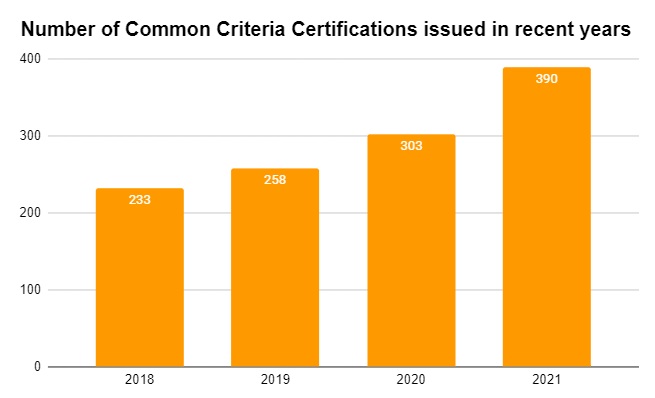
5. There is a slow but steady growth in the number of Common Criteria certifications worldwide

Since 2010, a total of 1645 IT products have been certified, with 589 of them being ICs, smart cards, smart card-related devices, and systems. Other popular product categories include Network and Network-Related Devices (237 Common Criteria certifications) and Multi-Function Devices (233 CC certifications). Aside from these, several Operating Systems, Databases, Access Control Devices, Boundary Protection Devices, and Systems passed the Common Criteria assessment process successfully.

In recent years, the number of issued certifications has increased by an average of 10%.

Data source: https://www.commoncriteriaportal.org/products/stats/

6. New Zealand became a certificate-consuming country

After many years of the close alliance between Australia and New Zealand in managing the Australasian Certification Authority, New Zealand has opted to give up its authorizing position and remain a certificate-consuming nation in the CCRA. This is to more accurately represent New Zealand’s contribution to the Australasian Information Security Evaluation Program (AISEP) and the CCRA. The AISEP program name has been modified from ‘Australasian’ to ‘Australian’ to better represent the program’s status as a certificate authorizing nation of the CCRA. These modifications took effect in October 2021.

7. EUCC is replacing the European SOGIS mutual recognition agreement

The EUCC cybersecurity system developed by ENISA (the European Union Agency for Cybersecurity) will take the place of the existing European SOGIS mutual recognition agreement (Senior Officers Group for Information Systems). EUCC is a Common Criteria-based certification system that combines the globally acknowledged, proven methodologies of Common Criteria with new concepts to give stakeholders a contemporary and flexible solution, such as patch management for certified systems and products.

The post 7 Interesting Facts About Common Criteria appeared first on Home Business Magazine.

Original source: https://homebusinessmag.com/businesses/security/7-interesting-facts-about-common-criteria/