The increasing popularity of e-commerce has unlocked a lot of potential for would-be entrepreneurs. The ability to concept a product, easily create a storefront and market that product effectively to a segmented audience has opened the door to crafting a successful business for those who otherwise might not have had the required resources.
But as entrepreneurs like you get their businesses running, they may run into an issue that commonly affects home-based businesses: inventory management. How can you streamline your home-based inventory management processes and optimize efficiency for greater success – all from the comfort of your home?
In this article, we’ll dive deep into inventory management strategies for remote businesses, taking a look at space utilization, cost management, and inventory management solutions that add value.
Space Utilization
When you’re just starting out, as you assemble or receive your goods, chances are the most likely place you’ll be storing them before fulfillment is the same place you work – your home. This works rather well for small e-commerce boutiques or craft-on-demand businesses, where the amount of goods you’re working with is relatively small. But for businesses that handle a greater volume of product, or businesses that aim to expand into higher production, this method isn’t sustainable.
Fortunately, there are strategies that you can leverage to better use the space that you have – or, if necessary, work outside of it. These inventory management strategies are:
Just in Time (JIT) management: JIT inventory management is very similar to print-on-demand, requiring you to order only the inventory you need to fulfill already placed orders. However, JIT inventory management can be slow-going, easily delayed by supply chain errors, late deliveries, and higher delivery costs.
Dropshipping: Dropshipping allows you to hand off inventory management to a third-party vendor. When a customer places an order, that order is immediately sent to a fulfillment partner, who then ships the order themselves. Outsourcing this process allows you to focus your efforts on marketing and sales; though choosing this method requires you to select a shipping provider you can trust.
Third-party logistics (3PL) providers: Similarly to dropshipping, using a 3PL allows a third party to handle inventory management; unlike dropshipping, 3PLs also handle returns, inventory storage, and occasionally even product assembly. For businesses looking to scale in the future, this bigger-budget option is a necessary step to expand their storefront’s reach and efficiency.
Any of these methods will work, but not all will work equally well for your home-based inventory management. Choose the one that works best for your business model and your budget, and you’ll be able to fulfill orders more consistently; a massive boon for customer satisfaction.
Cost-control
The cost of integrating your home life with your work life often saves you money on your commute; but not so much your power bill. Managing and storing inventory from your home can require a lot of power, especially if you’re working with perishable goods or inventory that requires dedicated storage areas. Finding a way to optimize your processes to minimize costs is therefore paramount, as you don’t want your home office to be a source of significant revenue leakage.
After auditing your at-home inventory storage systems to assess current power usage, consider any of the following:
Energy-efficient infrastructure: Start by assessing your home’s energy efficiency. From lighting options to temperature control solutions, there are a variety of electrical appliances that are designed to consume as little power as possible, while also serving their main purpose. Older infrastructure can consume more power than is needed to serve the same function, negatively impacting your operational costs.
Insulation and heating reworks: Worn-down insulation doesn’t do its job half as well, causing your temperature control systems to exert more energy than necessary to accomplish the same task. Installing new insulation, window seals, and smart thermometers can be great ways to keep your temperature consistent while using less energy overall.
Renewable-resource power: Home-based E-commerce businesses are among those that can benefit from renewable energy, the price of which has dropped by 36% over 5 years. Homeowners across the country are switching to solar power, and it isn’t hard to see why. It’s a cost-effective choice to power your business and potentially save you over a thousand dollars per year in operational costs.
Using any of the above strategies will likely not only cut down on operational costs, but the average cost of living in your home. Saving money on both fronts allows you to reinvest more into your business, fattening up your bottom line and providing you with an extra layer of security.
Remote-management software
Finally, we get to the technological component. New AI-powered inventory management solutions can streamline your back-office processes with automated support, providing optimized inventory data in real-time. When using this software, you and customers alike will always know what’s in stock, facilitating easy processing and fulfillment of orders.
Technological solutions like these are not necessary in the early stages of your online business; but as you expand and your quantity of orders increases exponentially, they’re invaluable. A high-level view of inventory data that can be zoomed in on for granular insights into production empowers you to make strategic decisions regarding inventory investment and output.
We hope this brief primer gave you everything you needed to know to streamline your own home-based inventory management processes. Inventory management is often a pain point for new entrepreneurs; but with the right framework, it needn’t be a bother. Utilize the tips above, and you’ll be consistently fulfilling orders that make your customers smile.
Traditionally, Chief Financial Officers (CFOs) were the guardians of a company’s finances, primarily focused on managing budgets, ensuring accuracy in financial reporting, and overseeing compliance with fiscal regulations. However, the role of CFOs is rapidly evolving, transitioning from financial oversight to visionary leaders who shape the future of business finance. This transformation sees CFOs managing financial operations and driving strategic initiatives that foster long-term growth and sustainability. In this context, CFO services have become increasingly important, offering the strategic advisory and support necessary for finance teams to thrive in this expanded role.
Visionary Leadership in Finance
Being a visionary in business finance means CFOs must have the ability to foresee future trends and challenges and think of innovative financial strategies to bring the organization forward. This visionary leadership involves forward-thinking and innovation at the core of financial planning. It includes integrating new technologies, such as AI and blockchain, to enhance data analysis and automate processes, increasing efficiency and accuracy. It also means a commitment to sustainability, with financial decisions contributing to long-term environmental and social goals. It also could mean embracing diversity, which can enrich financial strategy with a broad range of perspectives and solutions.
The CFO’s visionary role can help drive change within the finance department and across the broader organization. By fostering a culture of innovation, CFOs encourage continuous improvement and creativity in addressing financial challenges. This culture lets teams experiment with new ideas and technologies, knowing that innovative thinking is valued and supported.
Areas of Focus for CFOs
CFOs, as visionary leaders, help steer their organizations toward innovative and sustainable futures. They focus on several key areas:
Digital Transformation: CFOs are at the front of digital transformation within the finance function, using cutting-edge technologies like AI, blockchain, and data analytics. These tools are leveraged to streamline operations, improve the accuracy of financial forecasting, and facilitate more informed decision-making. By automating routine tasks, CFOs free up valuable resources for strategic analysis and planning.
Sustainability and ESG: There’s a growing emphasis on incorporating environmental, social, and governance (ESG) considerations into financial planning. CFOs add sustainability into the core of business strategies, ensuring that financial decisions reflect the company’s commitment to responsible business practices. This focus on ESG aligns with global sustainability trends and meets increasing investor and consumer demands for ethical and sustainable business operations.
Strategic Growth and Diversification: Identifying new opportunities for growth and diversification is another area where visionary CFOs add value. They analyze market trends, evaluate potential investments, and explore ways to diversify products, services, and markets. This strategic vision ensures the organization can adapt to changing market conditions and seize expansion opportunities.
Risk Management and Resilience: Visionary CFOs are redefining risk management strategies. They proactively identify potential risks – from financial to operational and strategic – implementing mitigation plans to protect against future uncertainties. This approach means that businesses are well-prepared to navigate the global business environment, maintaining stability and continuity even in turbulent times.
Leveraging CFO Services for Visionary Leadership
Outsourced CFO services help businesses to embrace a visionary approach to finance. These services provide access to a wealth of external CFO expertise, which is important for strategic planning, spearheading digital transformation initiatives, and integrating sustainability into the corporation. Benefits include a fresh perspective on financial strategies, cutting-edge technology insights, and a deep understanding of how to weave ESG factors seamlessly into business operations.
Transform Your Finance Function
CFOs are visionary architects of business finance, steering organizations toward a future marked by growth and innovation. As their role continues to evolve, it becomes essential for businesses to adapt and harness this visionary potential. Engaging with CFO services offers a pathway to accessing the strategic support necessary to enhance their strategic planning and financial management, helping them navigate modern business complexities.
As advanced technology becomes more affordable for crafters at home, laser engraving is an attractive hobby that could become a business. Christmas craft fairs are one of the best ways for crafters to make money – and building up stock throughout the year is easy with a laser engraving machine. Let’s take a look at what laser engraving involves and how you can make money for Christmas with it.
Previously restricted to industrial-size machines, laser engraving and laser cutting is easy to do at home. Laser cutters and engravers are multifunctional tools that enable you to create designs in a wide range of materials and even cut and build three-dimensional items.
A computer controls the machine, which uses a laser to cut or strip away layers of a material like wood or metal. When it cuts, clean pieces are created. When it strips the layers, that’s how engraving is made – the design is cut into the wood or metal, but not all the way through.
Some laser engravers also let you print a different colour on metal. This is called marking and is done by applying the marking solution in a design you want, and the heat from the laser bonds the marking solution to the metal to make the colour permanent.
Why Start Now?
Laser cutting and engraving covers the best of both worlds of crafting: creativity and speed. You can also replicate the same design over and over without variation. This means you can reliably recreate plenty of things to sell without lots of differences between each one.
Spring is a great time of year to start planning ahead on making money at seasonal craft fairs in December. Christmas fairs are the biggest sales opportunity for crafters, as it provides a high-footfall to stands with customers primed to buy. But, that means you need to have plenty of stock ready!
What Can You Make with a Laser Engraving Machine?
How long is a piece of string?! The possibilities of laser cutters and laser engraving are near endless, the only limit is your imagination.
Popular things to make include:
Home decorations such as family name signs or wooden map art
Acrylic or wooden planters
Bookends
Wedding welcome signs and personalised decorations
Custom engraved jewellery like bracelets and necklaces
Wooden mandalas for earrings, coasters, decor
Personalised or unique design wooden trinket boxes
Keyrings
3D puzzles
Christmas ornaments
Customised or seasonal rubber pads for ink stamping
Engraving leather wallets or bookmarks
We love items that can be personalised for customers or add a little ‘something extra’ to the home. For example, you can engrave clear acrylic and place on a simple LED light stand for unique personalised lighting. If you’re selling at craft fairs, it’s a good idea to have lots of small things to sell for £5 or under, like ornaments, bookmarks, keyrings, and small trinket boxes, because these make great stocking stuffers.
However, you can also go very large and build furniture like stools and chairs and tables – which you can obviously sell for a LOT more money, too! Having a mix of small, medium, and large items for your Christmas craft fair stall will help you maximise your profits.
How to Choose a Laser Engraving Machine
One of the most important things to look out for when you buy a laser cutter or laser engraving machine is the power. They come in different wattages, such as 20W, 40W, and 60W. The higher the wattage, the more dense the materials it can cut. This means you’ll be able to make a much wider range of items.
The Creality Falcon2 is a powerful 60W machine, which means it can handle a wider variety of materials with ease. It also has an adjustment beam to 22W and 40W if you need a less powerful beam for a smaller or more delicate project.
The three in one power options allow you to create accurate and beautiful engravings and cuttings depending on your crafting needs. It’s done with a simple flick of a switch, meaning operation is simple to learn. With a 22W setting, you can cut 5mm baseboard and achieve fine engravings, the 40W power lets you cut 10mm baseboard with fast results, and the 60W is the fastest power that can easily handle 18mm baseboard for larger decorations and home furniture items.
What else should you look for?
It’s also important to look for ease of use. Things like a camera to automatically line up materials for an accurate product and air assist to make the cutting process easier are definitely must-haves to look for (and the Creality Falcon2 has both of these things).
Finally, safety is essential. Higher wattage open frame diode machines are really efficient but definitely not as safe. The Creality Falcon2 is the first 60W laser cutter with a closed frame, making it efficient AND safe to use.
How to Plan Ahead to Make Money for Christmas
So now you know what laser cutting involves, let’s take a look at your next steps to prepare to make money at Christmas fairs.
1. Learn to use your laser engraving machine
Learning a new skill takes time and practice. Don’t leave it to November to start using your machine! Read the instructions carefully and try out lots of different materials and techniques before you start to hone in on what you think you’ll make for your craft business.
2. Research projects to try
There are lots of instructional videos on YouTube which is a great place to start finding ideas. You can also research your competitors on sites like Etsy, to see what they do (and don’t) sell. You can either sell similar things at a competitive price, or look for what’s missing and choose a niche to charge more (but you may not get as many customers).
3. Experiment with different materials
Try everything out! You might find that you love working with metal but aren’t a fan of wood, or that acrylic taps into your creative side, or that leather gives you a way to tap into unknown markets.
Experimenting lets you learn what works best with different materials, so you know you’re going to sell a high quality product.
4. Decide how much you can invest
Aside from the cost of buying your machine, you’ll also have a few other costs involved to set yourself up. Materials, fees for stalls or online platform fees, and things like gift tags and bags for when you sell at craft fairs will all cost. Decide on a budget and stick to it: you can always boost your budget next year when this year is a success!
5. Find Christmas events to sign up to
Christmas craft fairs start advertising their seller opportunities as soon as July in some cases. Sign up to local venues (common places include town halls, racecourses, and community venues) to make sure you hear about events in good time to book a stall.
You can also find your local car boot sale for a regular stall, or look at flea markets or craft markets that are becoming popular as pop-up events throughout the year.
Remember, too, that online sales will boost your business if you can handle postage and packaging with ease. Platforms like Etsy and EBay offer great opportunities for crafters to make money all year around from their skills. You can even set up as a small business seller on Amazon!
6. Work on your pricing
Research your pricing by looking at competitors. It’s important to offer similar prices for similar products – unless someone is selling SUPER cheap, which is actually something that puts off a lot of customers because they doubt the quality of a product.
You need to make a profit, too. Add up the cost of materials and the time it takes to make a product plus at least 40% on top of that to find your price. Remember: selling crafts is a business so you’ll need to register with HMRC and report your income and expenses. Thankfully things like materials and fees for stalls can be classed as expenses.
7. Make your stock!
Now comes the fun part! Spend as much time as you can designing your products. You might want to make lots of different things or specialise in variations on just one or two items – it’s up to you.
The great thing about cutters like the Creality Falcon2 is that they’re designed for batch creating, so once you know what you want to make it is easy to produce plenty of stock.
8. Profit
Sell your stuff! It’s a good idea to look for a summer or autumn craft fair to test the water, too. Or, you could set yourself up online first to see what people like to buy and what doesn’t sell so well. This means you’ll have honed your business plan by the time you get to the Christmas selling season and hopefully you’ll see plenty of profit!
Seasonal Ideas to Make Money All Year Around
It’s not just Christmas that lets you make money with laser engraving or laser cutting, either. You can make a lot of money in the run-up to summer as wedding season kicks off, making signs, wedding favours, and personalised wedding gifts.
Halloween, Mother’s Day, Father’s Day, Easter and even Thanksgiving if you want to sell internationally are all examples of how you could make seasonal gifts and decorations with your laser cutter to make your hobby into a year-round business.
Claim Your Discount on the New Creality Falcon2 Laser Engraving Machine
The Creality Falcon2 launches on 24th May and to celebrate, you can take advantage of a discount. Between 10am on 24th May 2024 and 11.59pm on 15th June, customers will receive a 15% discount when buying directly from the product page (it can’t be combined with any other discount).
Hurry though, as this only applies to the first 200 units sold globally. If you’re one of the first 100 customers, you’ll also receive a free gift worth $199, and if you’re the 101st to 200th customer your free gift is worth $50.
The best bit? One lucky customer will have their order FULLY refunded! Buy your Creality Falcon2 now to get these amazing offers.
Disclaimer: MoneyMagpie is not a licensed financial advisor and therefore information found here including opinions, commentary, suggestions or strategies are for informational, entertainment or educational purposes only. This should not be considered as financial advice. Anyone thinking of investing should conduct their own due diligence.
Universal Analytics reports attributed the entire credit for the conversion to the last click. A direct visit was not considered a click, but for the avoidance of doubt, this attribution model was also called the last non-direct click model. Other attribution models were only available in the Model Comparison Tool in the Multi-Channel Funnels (MCF) reports section.
GA4 offers a wider availability of different attribution models, but it depends on the scope of the report – whether it is the user acquisition source, session source or event source.
In Universal Analytics, the source dimensions had session scope solely. The MCF reports made it possible to analyze the sources of all sessions on the conversion path. The three scopes of source dimension in GA4 (user, session, event) are the most important and fundamental changes in the attribution area.
This guide will use the term “source” in a broader meaning as any dimension that indicates the origin of a visit (e.g., channel grouping, source, medium, ad content, campaign, ad group, keyword, search term, etc.).
In 2024, Google modified the terminology in Analytics, and what were previously known as conversions are now called key events. The term “conversion” in Google Analytics will be reserved for Google Ads conversions imported from Google Ads.
Session source
Session-scope attribution – unsurprisingly – determines the source of the session. It is used, among others, in the Traffic acquisition reports in the Reports section.
The session source is the source that started the session (e.g., social media referral or organic search result). However, if a direct visit started a session, the session source will be attributed to the source of the previous session (if there was any).
Quick reminder: A direct visit means that Analytics does not know where the user came from because the click does not pass the referrer, gclid, or UTM parameter.
The session source will be direct only if Analytics cannot see any other source of visit for the given user within the lookback window. The default lookback window in GA4 is 90 days. We will return to the lookback window matter later in this article.
By the way, what is a session?
A Google Analytics session is not the same as a browser session.
In GA4, a session begins when a user visits the website or app and ends after the user’s inactivity for a specified time (30 minutes by default – see this Analytics help article).
Closing the browser window does not end the session. If the browser window is closed, another visit to the website within the time limit will still belong to the same session – unless the browser deletes cookies and browser data after closing the browser window, for example in incognito mode.
If a visit from a new source occurs during a session, a new session will not start, and the source of the current session will remain unchanged.
It does not mean that the visit from the new source is ignored. GA4 records the source of this visit, and the event-scope attribution reports (more on that later in this article) will take into account all sources of all sessions. (See this Analytics help article.)
A new visit during an existing session may happen, for example, if a user returns from a payment gateway or a webmail site after password recovery or registration confirmation. These visits will not artificially inflate the number of sessions.
In GA4, these visits are de facto ignored because the session source and the session count remain unchanged. The non-direct attribution modeling in GA4 will assign no credit to this (direct) source (as described later in this article).
First user source
First user source (source of the first visit) is new to GA4. It shows where the user came from to the website or app for the first time.
It is a part of Google’s new approach to measurement in online marketing, which no longer focuses only on the classic ROAS (revenues vs. costs), but also analyzes the CAC vs. LTV (customer acquisition cost vs. lifetime value).
This approach reflects the app logic: we have to acquire the app user first, and after the app is installed, further marketing efforts engage and monetize the user. However, for the web traffic, it also makes more sense.
In GA4, the first user visit is recorded by the first_visit event for the website or the first_open event for the app. The naming is self-explanatory.
Therefore, the source of the first visit is a user attribute and indicates where this user’s first visit to the website or application came from.
The first visit source is attributed using the last non-direct click model. Of course, this attribution applies only to interactions before the first website visit or the first open of the app (interactions following the first visit or first open are not taken into account).
Once assigned, the source of the first visit remains unchanged – of course, as long as Google Analytics can technically link the user’s activity on the website and in the app with the same user.
The first user source will be reset if the tracking of the user is lost, for example, if the user does not visit the website for a period longer than the Analytics cookie expiration date.
We will return to the Analytics cookie expiration period and other data collection limitations in GA4 later in this article.
Event scope attribution
In GA4, events replaced sessions as the fundament of data collection and reporting. Google Analytics makes it possible to report attribution using a selected attribution model only for key events.
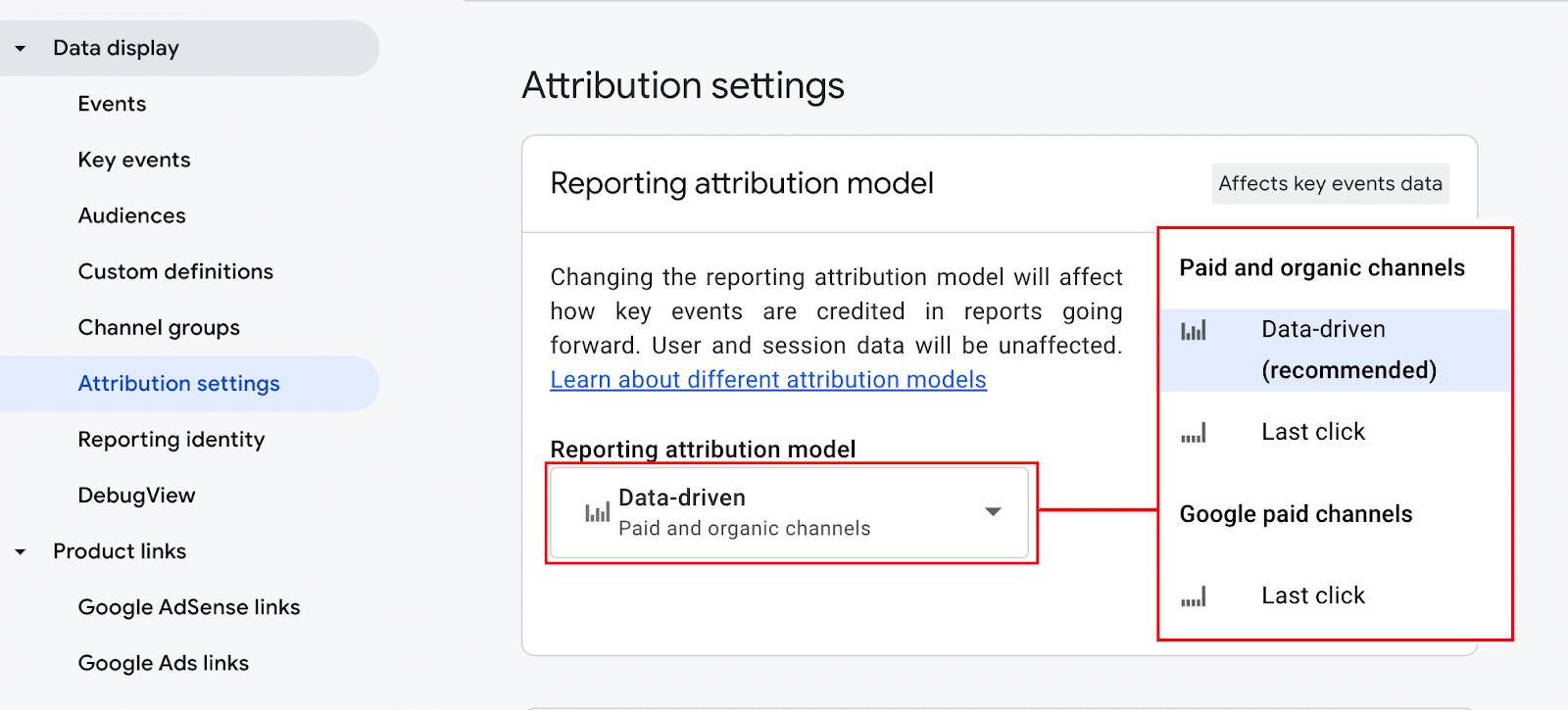
The model is set in the Attribution Settings of the GA4 property. There are several pre-defined models to choose from (see the screen below).
The default data-driven model can be changed at any time. This change is retroactive (i.e., it will also change the historical data).
A common belief is that Google Analytics 4 no longer uses the last-click attribution model. But is that the case?
In practice, it applies only to customized reports that use event-scope dimensions and metrics, for example, Medium – Key events.
The default traffic and user acquisition reports use session source and first user source, respectively, and these dimensions use the last click model. It is indicated in the dimension name (e.g., Session – Campaign or First User – Medium).
Remember: source, session source and first user source are three different dimensions where different attribution models apply.
Scope
Attribution Model
Where available
Session
Last click
E.g., traffic acquisition reports
User (first user source)
Last click
E.g., user acquisition report
Event
Model set in the GA4 property settings (data-driven by default)
E.g., in the Explore section
Attribution settings
The attribution model set in the property settings applies to all reports in the property.
There are several attribution models (described in the earlier mentioned Analytics help article), to choose from. However:
All the models do not assign value to direct visits unless there is no other choice because there is no other interaction on the path. In other words, they all use the non-direct principle.
The Ads-preferred models assign the entire value of the key event to Google Ads interactions if they occur in the funnel. There is only one Ads-preferred model available: the last click model. In the absence of Google Ads interactions on the funnel, this model works like a regular last-click model.
In addition to clicks, models take into account “engaged views” of YouTube ads, that is, watching the ad for 30 seconds (or until the end if the ad is shorter) and other clicks associated with that ad (see this Google Analytics help article for more details).
Again, a change of the attribution model settings works retroactively (i.e., it applies to the historical data before the change). Saved explorations will be recalculated when viewing them.
Lookback window
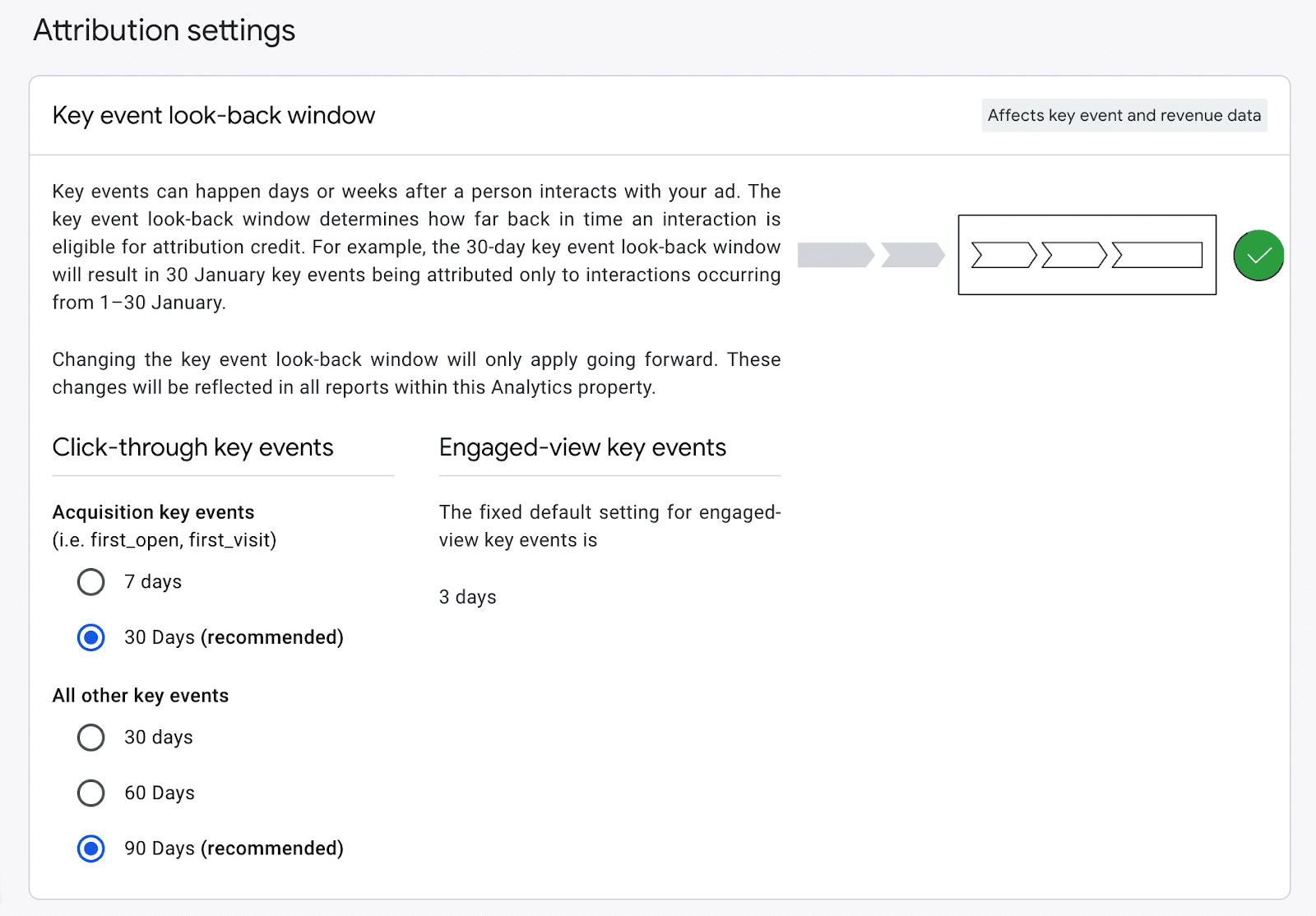
Google Analytics property settings determine the length of the lookback window. The lookback window determines how far back in time a touchpoint is eligible for attribution credit. The default lookback window is 90 days, but you can change it to 60 or 30 days.
According to Analytics documentation, the lookback window settings apply to all attribution models and all key event types in Google Analytics 4 (i.e., it also applies to session-level attribution and attribution model comparisons).
The lookback window of the first user source has a separate setting (30 days by default, and it can be changed to 7 days). Are you wondering why it is defined differently?
Well, first of all, it is worth considering why there is any lookback window for the first visit at all.
Moreover, why are we talking about the first user attribution model, which is always the last (non-direct) click?
After all, GA4 knows the source of the first visit when this visit happens. As it is the first visit, there are no previous visits, and thus no other sources to consider.
So, what is the point of looking deeper in time than the first interaction with a website or app?
Google Analytics 4 is designed to blend data collected by the website’s tracking code with information known by Google about the users, especially if they are logged in to Google services.
For example, Google may know that the user had an engaged interaction with our YouTube ad on a different device before the first visit.
Similarly, the user may use the app for the first time (first_open) during a direct session, but the install itself may result from a mobile app install campaign in Google Ads, clicked a few days earlier.
Therefore, if the source of the first visit session is unknown (it is a direct visit), Google Analytics may try to assign the source of the first visit to the earlier known interaction if it occurred during the lookback window period.
In other words, GA4 may potentially record ad interactions before the first user visit.
Lookback window changes do not work retroactively. It means that they only apply from the moment of the change.
The engaged views of YouTube ads, however, always have three days lookback window, regardless of the property settings.
Get the daily newsletter search marketers rely on.
Universal Analytics’s default lookback window for the acquisition reports was six months. Any change to this period was also non-retroactive.
Such a change, however, did not apply to conversions (now key events) but to interactions that had taken place after the change. It reflected the logic of the _utmz cookie, which was responsible for storing the source information.
Its expiration time was set when the cookie was created or updated (i.e., upon a visit from a given source).
For example, changing the lookback window in Universal Analytics from 30 to 90 days did not immediately include interactions from 90 days ago in the acquisition reports for the visits since the date of the change because the virtual “source cookie” for interactions older than 30 days has already “expired.”
There was a transition period (in this example, 90 days), after which all key events were fully reported under the new lookback window.
Google Analytics 4 uses a different data model. They could therefore break with this past and stop using the cookie logic.
For example, they could apply changes to all key events that have taken place since the change, as it is now in Google Ads. Interpreting such would be much easier. They could, but they did not.
In GA4, the change applies to interactions still in the lookback window.
For example, if the lookback window is increased from 30 to 90 days, the key events will not immediately be reported in the new, 90 days lookback window. It will be reflected in the reports after 60 days from the date of change (the interactions from the initial 30-day lookback window will be remembered).
Reducing the lookback window (e.g., from 90 to 30 days) will apply the change immediately (i.e., all key events will be reported in the shorter, 30 days window).
Yes, it sounds exotic. Fortunately, in practice, the analysts do not change the lookback window often.
Cookie expiration and data retention
The Google Analytics 4 cookie has a standard expiration time of 24 months, but it can be changed to a period between one hour and 25 months (or the cookie may be set as a session cookie and expire after the browser session end).
Subsequent visits may renew this time limit. This will be the period in which Analytics will be able to recognize a returning user and remember the source of the first visit – see this GA4 help article).
However, it does not automatically mean that GA4 will “remember” user data that long.
In addition to the cookie expiration, we also have to deal with the GA4 data retention period. It is set by default to only two months, but you can (and basically, you should) change this setting to 14 months. (In the paid version, Google Analytics 360, it can be up to 50 months.)
After this time, Google deletes user-level data from Analytics servers. To keep this data, you must export it to BigQuery (see this GA4 help article).
It means that reports in the Explore section can only be made within the data retention period (please note that in the Explore section, you cannot select a date range beyond this period).
These restrictions do not apply to standard reports in the Reports section that use aggregated data. GA4 will store this data “forever.”
In the unpaid version of GA4, the first user source data are deleted after 14 months of inactivity. After that, this user will be recorded as a new user.
Therefore, there is no point in, for example, changing the cookie expiration time from default 24 months to a longer period, unless you use Google Analytics 360.
Conversion export to Google Ads
Exporting conversions to Google Ads is often used as an alternative to the native Google Ads conversion tracking as the fastest and most convenient way to implement conversion tracking in Google Ads.
However, this time-saving seems illusory in the era of Google Tag Manager.
In GA4, the conversion import has flexible options so it is important to understand the differences between available settings.
In Universal Analytics and the earlier versions of GA4, the conversions were solely exported using Analytics’ last-click attribution model, regardless of the attribution model selected in Google Ads.
This methodology had problematic implications, particularly if the imported conversions were to be used for Google Ads optimization:
It reduced the number of conversions observed in Google Ads because, as a matter of principle, Analytics attributes conversions to all traffic sources, not only to Google Ads.
Such attribution is difficult to interpret, especially if Google Ads uses other attribution models for the last-click conversions imported from Analytics.
It is vulnerable to unforeseen Google Analytics configuration and link tagging errors, such as unwanted referrals or redundant UTM parameters, which may suddenly increase the credit attributed to other sources.
Google engineers probably understood this issue and recently added more options.
Today, if you import conversions from GA4 to Google Ads, the conversions will be imported using the attribution model selected in the Google Ads conversion settings.
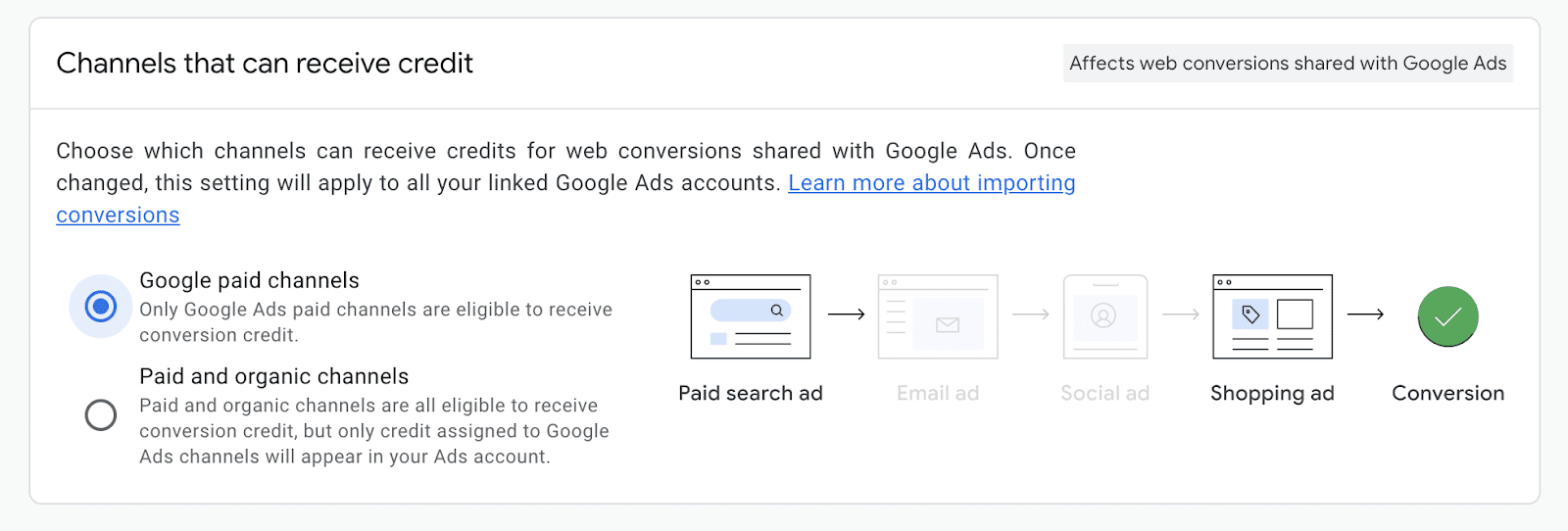
Additionally, it is possible to choose which channels are eligible to receive conversion credit for web conversions shared with Google Ads. You can decide whether your GA4 conversion export attributes conversions:
Only to Google Ads.
Or across all channels.
Attributing only to Google Ads makes the conversion export very similar to native Google Ads tracking.
The conversions are attributed solely to Google Ads clicks on the attribution path, and no credit is assigned to other channels.
As of June 2023, it is the default setting for properties creating a link between Google Ads and GA4 for the first time.
Attribution across channels is the previously existing method.
If you linked GA4 and Google Ads before June 2023, it should apply to your GA4 property until you change it.
If you use this option, you should remember that the number and value of conversions will likely be smaller than in the first option or when using native Google Ads conversion tracking.
This is because conversions will be partly attributed to other interactions on the conversion path (e.g., social media campaigns or organic traffic).
If you choose the last-click model for imported conversions, the value attributed to Google Ads can sometimes even be zero.
It is because you will only import conversions whose Google Ads source has not been overwritten by subsequent clicks from other sources (similar to how it worked in Universal Analytics).
Model comparison tool
Regardless of the property-level attribution settings, Google Analytics allows comparisons of different attribution models in the Advertising section.
Currently, the available models are the same as those available in the property settings, and it is impossible to create custom models.
GA4 allows reporting in two attribution time methods:
Interaction time.
Key event time.
The interaction time method is typical for advertising systems, where ad conversions are attributed to clicks and, thus – costs. It allows a correct match between costs and revenues.
Otherwise, the reports might include key events attributed to a given campaign after the end of the campaign, in a period when there is no ad spend.
On the other hand, the interaction time method may cause the total number of key events to change depending on the attribution model, as different models may attribute key events or their fractions to clicks outside the reporting period.
Moreover, the key event count and revenue for a given reporting period may grow over time until the lookback window closes.
In other words, we may observe more key events for the recent period if we look at the same report in the future – which is not the case when key events are reported in the key event time.
Both approaches have advantages and disadvantages, so it is good that we can now use both.
Attribution paths report
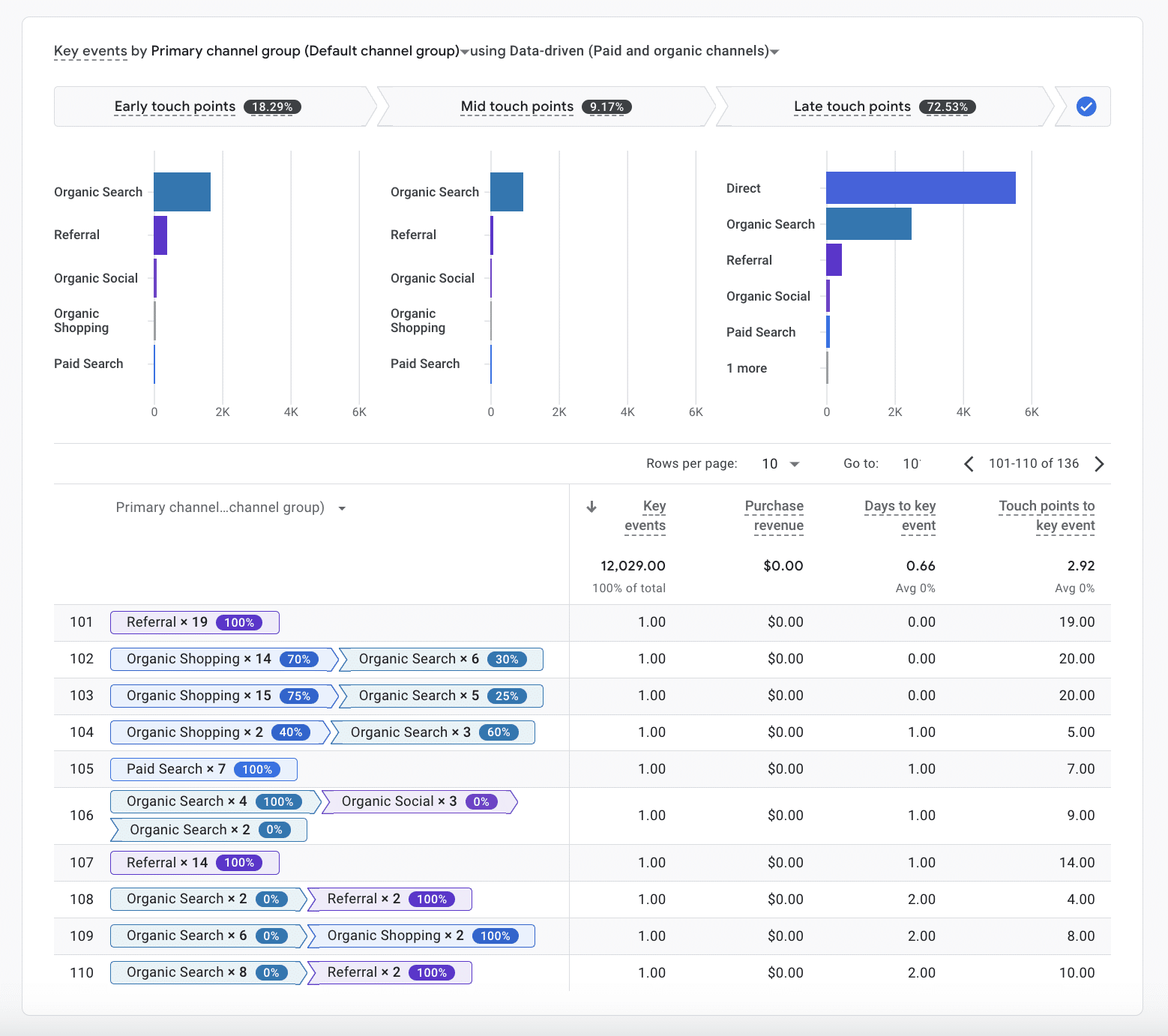
The GA4 attribution paths report is rich with data: days to key event and the number of interactions for a given path (touchpoints to key event).
It partly compensates for the lack of time lag and path length reports, which were separate reports in Universal Analytics.
The ability to choose an attribution model for this report may be surprising at first sight.
The attribution model does not affect attribution paths. They remain the same, and their length (number of touchpoints) and number of days to key event do not change.
In GA4, the path visualization also includes the fraction of key events assigned to a given interaction or their series in the selected attribution model.
In the last click model, the last interaction always has a 100% share in the key event, but in the other models, the distribution will be different.
This feature also allows a better understanding of how the data-driven model worked for the interactions in this report.
Additional bar graphs are placed above the funnel report, visualizing how the selected attribution model assigned a value to channels at the beginning, middle and end of the funnel.
The early touchpoints are the first 25% of the interactions along the path, while the late touchpoints include the last 25%. The middle touchpoints are the remaining 50% of the interactions.
If you feel that the distribution between early, middle, and late touchpoints does not look as expected for the multi-touch models, please note that if there are only two interactions, there is one early, one late, and no middle interactions.
If there is only one interaction, for the multi-touch models, it will be reported as late interaction – which distorts these reports the most.
Probably, it would be better if the only interaction was considered as 33.3% early, 33.3% middle, and 33.3% late interaction.
Thus, the attribution model will only affect the bar charts at the top of the report and the percentages shown in the funnel visualization.
The table figures (funnel interactions, key events, revenue, funnel length, and days to key event) will remain the same, regardless of the attribution model.
By default, the attribution paths and model comparison reports include all key events in the GA4 property. Therefore, it is worth remembering to select the desired key event(s) first.
Use of scopes in the reports
Again, the source dimensions in GA4 can have one of three scopes: session, user, and event.
In the case of the event scope, the attribution model specified in the property attribution settings is used.
The session source (session scope) is assigned to the last non-direct interaction at the session start and remains unchanged for a given session, even if there is a visit from another source during the session. It’s the “first source” of the session, although assigned in the last-click model.
Similarly, the first user source (user scope) is assigned to the last non-direct interaction before the first visit and remains unchanged.
In Google Analytics, all dimensions and metrics operate within their own scope. For example, the Landing page dimension has the session scope, and the Page dimension has the event scope.
Although technically possible, using dimensions and metrics of different scopes can sometimes lead to confusing or difficult-to-interpret reports. There is typically little point in making such reports in GA4.
However, some reports using dimensions and metrics of different scopes will make sense. For example, for source dimensions in GA4:
The number of events (event scope) paired with the First user source dimension (user scope) shows how many events were generated by users whose first visit was from a given source.
The number of events (event scope) paired with the session source dimension (session scope) shows how many events were generated by users during sessions with a given source.
The GA4 documentation fails to indicate how to interpret the number of sessions or users matched with the event scope. Such explorations, although possible, often contain many not set values.
However, creating such reports doesn’t make sense. (See the previously mentioned GA4 help article on scopes.)
Modeled and blended data
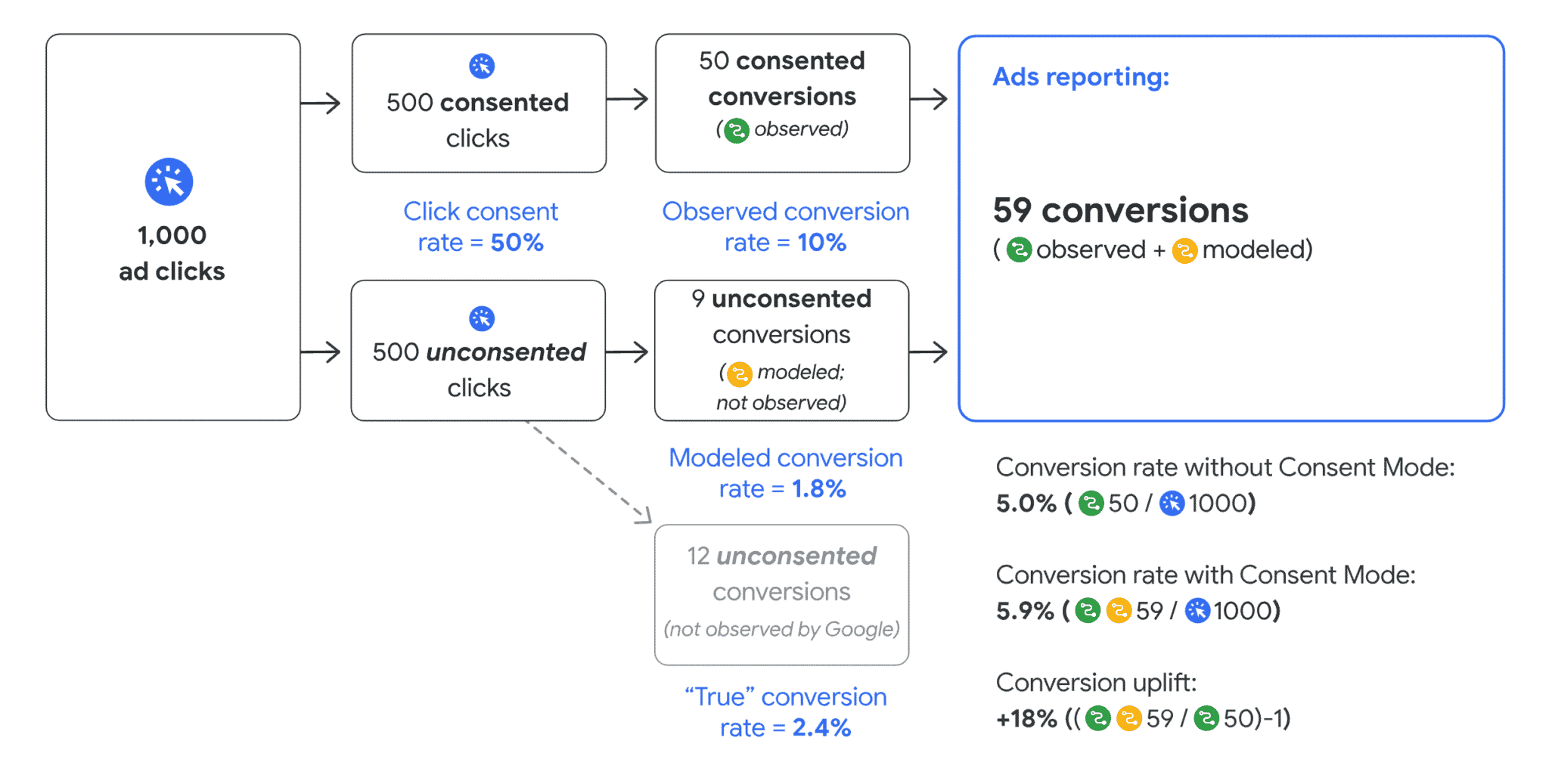
Finally, it is worth emphasizing the fundamental change in Google Analytics 4, where reports include data collected by the tracking code enriched with modeled data.
The modeled data uses information collected in the cookieless consent mode for users who have not given consent to tracking and data for users logged in to Google. This data is fragmentary, but Google can fill in the missing data using extrapolations and mathematical modeling.
Modeled data is available only for GA4 properties using blended reporting identity.
Thanks to blended data in GA4, we can see an approximate but more complete picture of the user’s journey.
For example, Universal Analytics recorded an iPhone user who visited the website from a YouTube ad using Safari and never returned. Universal Analytics also saw an event made by another user who came from a direct visit on the Chrome browser for Windows.
Google knows these events belong to the same user because this user was logged into Gmail and YouTube.
This is how Google Analytics 4 can model the cross-device users’ behavior. It makes the reported number of users more real (reduces it) and improves the attribution accuracy.
In the example above, the key event from the direct session can be correctly attributed to the YouTube ad.
Not all users are always logged into Google – many do not even have a Google account.
Therefore, to make the picture more complete, Google Analytics will assume that users who are not logged in behave similarly.
Consequently, GA4 sometimes will supplement the missing sources (e.g., assign certain sources to key events that were previously assigned to direct).
The behavior of users who have not given consent to tracking is estimated similarly.
Analytics knows the number of page views and key events from the non-consented users and can model how many users generated these pageviews and conservatively attribute key events to sources.
Enriching Analytics data may take up to a week. Therefore, the recent data may change in the future.
Various privacy-oriented technology solutions, such as PCM by Apple or similar solutions proposed by Google (the Privacy Sandbox), randomly delay event reporting by 24-48 hours.
Therefore, we must get used to the fact that the full view of analytical data will only be available after some time.
In GA4, we can also enhance the reports using the 1st party data, namely the User-ID.
GA4 reports combine the User-ID data with the Client-ID (the Analytics cookie identifier) and user provided data, which makes the data more complete, especially in the cross-device aspect and LTV measurement.
The complexity of these processes may cause greater or lesser discrepancies between the data in different reports.
We should get used to it, but hopefully, as GA4 improves its algorithms, these discrepancies will become less and less significant.
It is worth remembering that Google Analytics is not accounting software.
Its objective is not to record every event with 100% precision but to indicate trends and support decision-making – for which approximate data is sufficient.
Author’s note: This article was written using Google help articles, answers given by Analytics support and results from my experiments.
Universal Analytics reports attributed the entire credit for the conversion to the last click. A direct visit was not considered a click, but for the avoidance of doubt, this attribution model was also called the last non-direct click model. Other attribution models were only available in the Model Comparison Tool in the Multi-Channel Funnels (MCF) reports section.
GA4 offers a wider availability of different attribution models, but it depends on the scope of the report – whether it is the user acquisition source, session source or event source.
In Universal Analytics, the source dimensions had session scope solely. The MCF reports made it possible to analyze the sources of all sessions on the conversion path. The three scopes of source dimension in GA4 (user, session, event) are the most important and fundamental changes in the attribution area.
This guide will use the term “source” in a broader meaning as any dimension that indicates the origin of a visit (e.g., channel grouping, source, medium, ad content, campaign, ad group, keyword, search term, etc.).
In 2024, Google modified the terminology in Analytics, and what were previously known as conversions are now called key events. The term “conversion” in Google Analytics will be reserved for Google Ads conversions imported from Google Ads.
Session source
Session-scope attribution – unsurprisingly – determines the source of the session. It is used, among others, in the Traffic acquisition reports in the Reports section.
The session source is the source that started the session (e.g., social media referral or organic search result). However, if a direct visit started a session, the session source will be attributed to the source of the previous session (if there was any).
Quick reminder: A direct visit means that Analytics does not know where the user came from because the click does not pass the referrer, gclid, or UTM parameter.
The session source will be direct only if Analytics cannot see any other source of visit for the given user within the lookback window. The default lookback window in GA4 is 90 days. We will return to the lookback window matter later in this article.
By the way, what is a session?
A Google Analytics session is not the same as a browser session.
In GA4, a session begins when a user visits the website or app and ends after the user’s inactivity for a specified time (30 minutes by default – see this Analytics help article).
Closing the browser window does not end the session. If the browser window is closed, another visit to the website within the time limit will still belong to the same session – unless the browser deletes cookies and browser data after closing the browser window, for example in incognito mode.
If a visit from a new source occurs during a session, a new session will not start, and the source of the current session will remain unchanged.
It does not mean that the visit from the new source is ignored. GA4 records the source of this visit, and the event-scope attribution reports (more on that later in this article) will take into account all sources of all sessions. (See this Analytics help article.)
A new visit during an existing session may happen, for example, if a user returns from a payment gateway or a webmail site after password recovery or registration confirmation. These visits will not artificially inflate the number of sessions.
In GA4, these visits are de facto ignored because the session source and the session count remain unchanged. The non-direct attribution modeling in GA4 will assign no credit to this (direct) source (as described later in this article).
First user source
First user source (source of the first visit) is new to GA4. It shows where the user came from to the website or app for the first time.
It is a part of Google’s new approach to measurement in online marketing, which no longer focuses only on the classic ROAS (revenues vs. costs), but also analyzes the CAC vs. LTV (customer acquisition cost vs. lifetime value).
This approach reflects the app logic: we have to acquire the app user first, and after the app is installed, further marketing efforts engage and monetize the user. However, for the web traffic, it also makes more sense.
In GA4, the first user visit is recorded by the first_visit event for the website or the first_open event for the app. The naming is self-explanatory.
Therefore, the source of the first visit is a user attribute and indicates where this user’s first visit to the website or application came from.
The first visit source is attributed using the last non-direct click model. Of course, this attribution applies only to interactions before the first website visit or the first open of the app (interactions following the first visit or first open are not taken into account).
Once assigned, the source of the first visit remains unchanged – of course, as long as Google Analytics can technically link the user’s activity on the website and in the app with the same user.
The first user source will be reset if the tracking of the user is lost, for example, if the user does not visit the website for a period longer than the Analytics cookie expiration date.
We will return to the Analytics cookie expiration period and other data collection limitations in GA4 later in this article.
Event scope attribution
In GA4, events replaced sessions as the fundament of data collection and reporting. Google Analytics makes it possible to report attribution using a selected attribution model only for key events.
The model is set in the Attribution Settings of the GA4 property. There are several pre-defined models to choose from (see the screen below).
The default data-driven model can be changed at any time. This change is retroactive (i.e., it will also change the historical data).
A common belief is that Google Analytics 4 no longer uses the last-click attribution model. But is that the case?
In practice, it applies only to customized reports that use event-scope dimensions and metrics, for example, Medium – Key events.
The default traffic and user acquisition reports use session source and first user source, respectively, and these dimensions use the last click model. It is indicated in the dimension name (e.g., Session – Campaign or First User – Medium).
Remember: source, session source and first user source are three different dimensions where different attribution models apply.
Scope
Attribution Model
Where available
Session
Last click
E.g., traffic acquisition reports
User (first user source)
Last click
E.g., user acquisition report
Event
Model set in the GA4 property settings (data-driven by default)
E.g., in the Explore section
Attribution settings
The attribution model set in the property settings applies to all reports in the property.
There are several attribution models (described in the earlier mentioned Analytics help article), to choose from. However:
All the models do not assign value to direct visits unless there is no other choice because there is no other interaction on the path. In other words, they all use the non-direct principle.
The Ads-preferred models assign the entire value of the key event to Google Ads interactions if they occur in the funnel. There is only one Ads-preferred model available: the last click model. In the absence of Google Ads interactions on the funnel, this model works like a regular last-click model.
In addition to clicks, models take into account “engaged views” of YouTube ads, that is, watching the ad for 30 seconds (or until the end if the ad is shorter) and other clicks associated with that ad (see this Google Analytics help article for more details).
Again, a change of the attribution model settings works retroactively (i.e., it applies to the historical data before the change). Saved explorations will be recalculated when viewing them.
Lookback window
Google Analytics property settings determine the length of the lookback window. The lookback window determines how far back in time a touchpoint is eligible for attribution credit. The default lookback window is 90 days, but you can change it to 60 or 30 days.
According to Analytics documentation, the lookback window settings apply to all attribution models and all key event types in Google Analytics 4 (i.e., it also applies to session-level attribution and attribution model comparisons).
The lookback window of the first user source has a separate setting (30 days by default, and it can be changed to 7 days). Are you wondering why it is defined differently?
Well, first of all, it is worth considering why there is any lookback window for the first visit at all.
Moreover, why are we talking about the first user attribution model, which is always the last (non-direct) click?
After all, GA4 knows the source of the first visit when this visit happens. As it is the first visit, there are no previous visits, and thus no other sources to consider.
So, what is the point of looking deeper in time than the first interaction with a website or app?
Google Analytics 4 is designed to blend data collected by the website’s tracking code with information known by Google about the users, especially if they are logged in to Google services.
For example, Google may know that the user had an engaged interaction with our YouTube ad on a different device before the first visit.
Similarly, the user may use the app for the first time (first_open) during a direct session, but the install itself may result from a mobile app install campaign in Google Ads, clicked a few days earlier.
Therefore, if the source of the first visit session is unknown (it is a direct visit), Google Analytics may try to assign the source of the first visit to the earlier known interaction if it occurred during the lookback window period.
In other words, GA4 may potentially record ad interactions before the first user visit.
Lookback window changes do not work retroactively. It means that they only apply from the moment of the change.
The engaged views of YouTube ads, however, always have three days lookback window, regardless of the property settings.
Get the daily newsletter search marketers rely on.
Universal Analytics’s default lookback window for the acquisition reports was six months. Any change to this period was also non-retroactive.
Such a change, however, did not apply to conversions (now key events) but to interactions that had taken place after the change. It reflected the logic of the _utmz cookie, which was responsible for storing the source information.
Its expiration time was set when the cookie was created or updated (i.e., upon a visit from a given source).
For example, changing the lookback window in Universal Analytics from 30 to 90 days did not immediately include interactions from 90 days ago in the acquisition reports for the visits since the date of the change because the virtual “source cookie” for interactions older than 30 days has already “expired.”
There was a transition period (in this example, 90 days), after which all key events were fully reported under the new lookback window.
Google Analytics 4 uses a different data model. They could therefore break with this past and stop using the cookie logic.
For example, they could apply changes to all key events that have taken place since the change, as it is now in Google Ads. Interpreting such would be much easier. They could, but they did not.
In GA4, the change applies to interactions still in the lookback window.
For example, if the lookback window is increased from 30 to 90 days, the key events will not immediately be reported in the new, 90 days lookback window. It will be reflected in the reports after 60 days from the date of change (the interactions from the initial 30-day lookback window will be remembered).
Reducing the lookback window (e.g., from 90 to 30 days) will apply the change immediately (i.e., all key events will be reported in the shorter, 30 days window).
Yes, it sounds exotic. Fortunately, in practice, the analysts do not change the lookback window often.
Cookie expiration and data retention
The Google Analytics 4 cookie has a standard expiration time of 24 months, but it can be changed to a period between one hour and 25 months (or the cookie may be set as a session cookie and expire after the browser session end).
Subsequent visits may renew this time limit. This will be the period in which Analytics will be able to recognize a returning user and remember the source of the first visit – see this GA4 help article).
However, it does not automatically mean that GA4 will “remember” user data that long.
In addition to the cookie expiration, we also have to deal with the GA4 data retention period. It is set by default to only two months, but you can (and basically, you should) change this setting to 14 months. (In the paid version, Google Analytics 360, it can be up to 50 months.)
After this time, Google deletes user-level data from Analytics servers. To keep this data, you must export it to BigQuery (see this GA4 help article).
It means that reports in the Explore section can only be made within the data retention period (please note that in the Explore section, you cannot select a date range beyond this period).
These restrictions do not apply to standard reports in the Reports section that use aggregated data. GA4 will store this data “forever.”
In the unpaid version of GA4, the first user source data are deleted after 14 months of inactivity. After that, this user will be recorded as a new user.
Therefore, there is no point in, for example, changing the cookie expiration time from default 24 months to a longer period, unless you use Google Analytics 360.
Conversion export to Google Ads
Exporting conversions to Google Ads is often used as an alternative to the native Google Ads conversion tracking as the fastest and most convenient way to implement conversion tracking in Google Ads.
However, this time-saving seems illusory in the era of Google Tag Manager.
In GA4, the conversion import has flexible options so it is important to understand the differences between available settings.
In Universal Analytics and the earlier versions of GA4, the conversions were solely exported using Analytics’ last-click attribution model, regardless of the attribution model selected in Google Ads.
This methodology had problematic implications, particularly if the imported conversions were to be used for Google Ads optimization:
It reduced the number of conversions observed in Google Ads because, as a matter of principle, Analytics attributes conversions to all traffic sources, not only to Google Ads.
Such attribution is difficult to interpret, especially if Google Ads uses other attribution models for the last-click conversions imported from Analytics.
It is vulnerable to unforeseen Google Analytics configuration and link tagging errors, such as unwanted referrals or redundant UTM parameters, which may suddenly increase the credit attributed to other sources.
Google engineers probably understood this issue and recently added more options.
Today, if you import conversions from GA4 to Google Ads, the conversions will be imported using the attribution model selected in the Google Ads conversion settings.
Additionally, it is possible to choose which channels are eligible to receive conversion credit for web conversions shared with Google Ads. You can decide whether your GA4 conversion export attributes conversions:
Only to Google Ads.
Or across all channels.
Attributing only to Google Ads makes the conversion export very similar to native Google Ads tracking.
The conversions are attributed solely to Google Ads clicks on the attribution path, and no credit is assigned to other channels.
As of June 2023, it is the default setting for properties creating a link between Google Ads and GA4 for the first time.
Attribution across channels is the previously existing method.
If you linked GA4 and Google Ads before June 2023, it should apply to your GA4 property until you change it.
If you use this option, you should remember that the number and value of conversions will likely be smaller than in the first option or when using native Google Ads conversion tracking.
This is because conversions will be partly attributed to other interactions on the conversion path (e.g., social media campaigns or organic traffic).
If you choose the last-click model for imported conversions, the value attributed to Google Ads can sometimes even be zero.
It is because you will only import conversions whose Google Ads source has not been overwritten by subsequent clicks from other sources (similar to how it worked in Universal Analytics).
Model comparison tool
Regardless of the property-level attribution settings, Google Analytics allows comparisons of different attribution models in the Advertising section.
Currently, the available models are the same as those available in the property settings, and it is impossible to create custom models.
GA4 allows reporting in two attribution time methods:
Interaction time.
Key event time.
The interaction time method is typical for advertising systems, where ad conversions are attributed to clicks and, thus – costs. It allows a correct match between costs and revenues.
Otherwise, the reports might include key events attributed to a given campaign after the end of the campaign, in a period when there is no ad spend.
On the other hand, the interaction time method may cause the total number of key events to change depending on the attribution model, as different models may attribute key events or their fractions to clicks outside the reporting period.
Moreover, the key event count and revenue for a given reporting period may grow over time until the lookback window closes.
In other words, we may observe more key events for the recent period if we look at the same report in the future – which is not the case when key events are reported in the key event time.
Both approaches have advantages and disadvantages, so it is good that we can now use both.
Attribution paths report
The GA4 attribution paths report is rich with data: days to key event and the number of interactions for a given path (touchpoints to key event).
It partly compensates for the lack of time lag and path length reports, which were separate reports in Universal Analytics.
The ability to choose an attribution model for this report may be surprising at first sight.
The attribution model does not affect attribution paths. They remain the same, and their length (number of touchpoints) and number of days to key event do not change.
In GA4, the path visualization also includes the fraction of key events assigned to a given interaction or their series in the selected attribution model.
In the last click model, the last interaction always has a 100% share in the key event, but in the other models, the distribution will be different.
This feature also allows a better understanding of how the data-driven model worked for the interactions in this report.
Additional bar graphs are placed above the funnel report, visualizing how the selected attribution model assigned a value to channels at the beginning, middle and end of the funnel.
The early touchpoints are the first 25% of the interactions along the path, while the late touchpoints include the last 25%. The middle touchpoints are the remaining 50% of the interactions.
If you feel that the distribution between early, middle, and late touchpoints does not look as expected for the multi-touch models, please note that if there are only two interactions, there is one early, one late, and no middle interactions.
If there is only one interaction, for the multi-touch models, it will be reported as late interaction – which distorts these reports the most.
Probably, it would be better if the only interaction was considered as 33.3% early, 33.3% middle, and 33.3% late interaction.
Thus, the attribution model will only affect the bar charts at the top of the report and the percentages shown in the funnel visualization.
The table figures (funnel interactions, key events, revenue, funnel length, and days to key event) will remain the same, regardless of the attribution model.
By default, the attribution paths and model comparison reports include all key events in the GA4 property. Therefore, it is worth remembering to select the desired key event(s) first.
Use of scopes in the reports
Again, the source dimensions in GA4 can have one of three scopes: session, user, and event.
In the case of the event scope, the attribution model specified in the property attribution settings is used.
The session source (session scope) is assigned to the last non-direct interaction at the session start and remains unchanged for a given session, even if there is a visit from another source during the session. It’s the “first source” of the session, although assigned in the last-click model.
Similarly, the first user source (user scope) is assigned to the last non-direct interaction before the first visit and remains unchanged.
In Google Analytics, all dimensions and metrics operate within their own scope. For example, the Landing page dimension has the session scope, and the Page dimension has the event scope.
Although technically possible, using dimensions and metrics of different scopes can sometimes lead to confusing or difficult-to-interpret reports. There is typically little point in making such reports in GA4.
However, some reports using dimensions and metrics of different scopes will make sense. For example, for source dimensions in GA4:
The number of events (event scope) paired with the First user source dimension (user scope) shows how many events were generated by users whose first visit was from a given source.
The number of events (event scope) paired with the session source dimension (session scope) shows how many events were generated by users during sessions with a given source.
The GA4 documentation fails to indicate how to interpret the number of sessions or users matched with the event scope. Such explorations, although possible, often contain many not set values.
However, creating such reports doesn’t make sense. (See the previously mentioned GA4 help article on scopes.)
Modeled and blended data
Finally, it is worth emphasizing the fundamental change in Google Analytics 4, where reports include data collected by the tracking code enriched with modeled data.
The modeled data uses information collected in the cookieless consent mode for users who have not given consent to tracking and data for users logged in to Google. This data is fragmentary, but Google can fill in the missing data using extrapolations and mathematical modeling.
Modeled data is available only for GA4 properties using blended reporting identity.
Thanks to blended data in GA4, we can see an approximate but more complete picture of the user’s journey.
For example, Universal Analytics recorded an iPhone user who visited the website from a YouTube ad using Safari and never returned. Universal Analytics also saw an event made by another user who came from a direct visit on the Chrome browser for Windows.
Google knows these events belong to the same user because this user was logged into Gmail and YouTube.
This is how Google Analytics 4 can model the cross-device users’ behavior. It makes the reported number of users more real (reduces it) and improves the attribution accuracy.
In the example above, the key event from the direct session can be correctly attributed to the YouTube ad.
Not all users are always logged into Google – many do not even have a Google account.
Therefore, to make the picture more complete, Google Analytics will assume that users who are not logged in behave similarly.
Consequently, GA4 sometimes will supplement the missing sources (e.g., assign certain sources to key events that were previously assigned to direct).
The behavior of users who have not given consent to tracking is estimated similarly.
Analytics knows the number of page views and key events from the non-consented users and can model how many users generated these pageviews and conservatively attribute key events to sources.
Enriching Analytics data may take up to a week. Therefore, the recent data may change in the future.
Various privacy-oriented technology solutions, such as PCM by Apple or similar solutions proposed by Google (the Privacy Sandbox), randomly delay event reporting by 24-48 hours.
Therefore, we must get used to the fact that the full view of analytical data will only be available after some time.
In GA4, we can also enhance the reports using the 1st party data, namely the User-ID.
GA4 reports combine the User-ID data with the Client-ID (the Analytics cookie identifier) and user provided data, which makes the data more complete, especially in the cross-device aspect and LTV measurement.
The complexity of these processes may cause greater or lesser discrepancies between the data in different reports.
We should get used to it, but hopefully, as GA4 improves its algorithms, these discrepancies will become less and less significant.
It is worth remembering that Google Analytics is not accounting software.
Its objective is not to record every event with 100% precision but to indicate trends and support decision-making – for which approximate data is sufficient.
Author’s note: This article was written using Google help articles, answers given by Analytics support and results from my experiments.
Universal Analytics reports attributed the entire credit for the conversion to the last click. A direct visit was not considered a click, but for the avoidance of doubt, this attribution model was also called the last non-direct click model. Other attribution models were only available in the Model Comparison Tool in the Multi-Channel Funnels (MCF) reports section.
GA4 offers a wider availability of different attribution models, but it depends on the scope of the report – whether it is the user acquisition source, session source or event source.
In Universal Analytics, the source dimensions had session scope solely. The MCF reports made it possible to analyze the sources of all sessions on the conversion path. The three scopes of source dimension in GA4 (user, session, event) are the most important and fundamental changes in the attribution area.
This guide will use the term “source” in a broader meaning as any dimension that indicates the origin of a visit (e.g., channel grouping, source, medium, ad content, campaign, ad group, keyword, search term, etc.).
In 2024, Google modified the terminology in Analytics, and what were previously known as conversions are now called key events. The term “conversion” in Google Analytics will be reserved for Google Ads conversions imported from Google Ads.
Session source
Session-scope attribution – unsurprisingly – determines the source of the session. It is used, among others, in the Traffic acquisition reports in the Reports section.
The session source is the source that started the session (e.g., social media referral or organic search result). However, if a direct visit started a session, the session source will be attributed to the source of the previous session (if there was any).
Quick reminder: A direct visit means that Analytics does not know where the user came from because the click does not pass the referrer, gclid, or UTM parameter.
The session source will be direct only if Analytics cannot see any other source of visit for the given user within the lookback window. The default lookback window in GA4 is 90 days. We will return to the lookback window matter later in this article.
By the way, what is a session?
A Google Analytics session is not the same as a browser session.
In GA4, a session begins when a user visits the website or app and ends after the user’s inactivity for a specified time (30 minutes by default – see this Analytics help article).
Closing the browser window does not end the session. If the browser window is closed, another visit to the website within the time limit will still belong to the same session – unless the browser deletes cookies and browser data after closing the browser window, for example in incognito mode.
If a visit from a new source occurs during a session, a new session will not start, and the source of the current session will remain unchanged.
It does not mean that the visit from the new source is ignored. GA4 records the source of this visit, and the event-scope attribution reports (more on that later in this article) will take into account all sources of all sessions. (See this Analytics help article.)
A new visit during an existing session may happen, for example, if a user returns from a payment gateway or a webmail site after password recovery or registration confirmation. These visits will not artificially inflate the number of sessions.
In GA4, these visits are de facto ignored because the session source and the session count remain unchanged. The non-direct attribution modeling in GA4 will assign no credit to this (direct) source (as described later in this article).
First user source
First user source (source of the first visit) is new to GA4. It shows where the user came from to the website or app for the first time.
It is a part of Google’s new approach to measurement in online marketing, which no longer focuses only on the classic ROAS (revenues vs. costs), but also analyzes the CAC vs. LTV (customer acquisition cost vs. lifetime value).
This approach reflects the app logic: we have to acquire the app user first, and after the app is installed, further marketing efforts engage and monetize the user. However, for the web traffic, it also makes more sense.
In GA4, the first user visit is recorded by the first_visit event for the website or the first_open event for the app. The naming is self-explanatory.
Therefore, the source of the first visit is a user attribute and indicates where this user’s first visit to the website or application came from.
The first visit source is attributed using the last non-direct click model. Of course, this attribution applies only to interactions before the first website visit or the first open of the app (interactions following the first visit or first open are not taken into account).
Once assigned, the source of the first visit remains unchanged – of course, as long as Google Analytics can technically link the user’s activity on the website and in the app with the same user.
The first user source will be reset if the tracking of the user is lost, for example, if the user does not visit the website for a period longer than the Analytics cookie expiration date.
We will return to the Analytics cookie expiration period and other data collection limitations in GA4 later in this article.
Event scope attribution
In GA4, events replaced sessions as the fundament of data collection and reporting. Google Analytics makes it possible to report attribution using a selected attribution model only for key events.
The model is set in the Attribution Settings of the GA4 property. There are several pre-defined models to choose from (see the screen below).
The default data-driven model can be changed at any time. This change is retroactive (i.e., it will also change the historical data).
A common belief is that Google Analytics 4 no longer uses the last-click attribution model. But is that the case?
In practice, it applies only to customized reports that use event-scope dimensions and metrics, for example, Medium – Key events.
The default traffic and user acquisition reports use session source and first user source, respectively, and these dimensions use the last click model. It is indicated in the dimension name (e.g., Session – Campaign or First User – Medium).
Remember: source, session source and first user source are three different dimensions where different attribution models apply.
Scope
Attribution Model
Where available
Session
Last click
E.g., traffic acquisition reports
User (first user source)
Last click
E.g., user acquisition report
Event
Model set in the GA4 property settings (data-driven by default)
E.g., in the Explore section
Attribution settings
The attribution model set in the property settings applies to all reports in the property.
There are several attribution models (described in the earlier mentioned Analytics help article), to choose from. However:
All the models do not assign value to direct visits unless there is no other choice because there is no other interaction on the path. In other words, they all use the non-direct principle.
The Ads-preferred models assign the entire value of the key event to Google Ads interactions if they occur in the funnel. There is only one Ads-preferred model available: the last click model. In the absence of Google Ads interactions on the funnel, this model works like a regular last-click model.
In addition to clicks, models take into account “engaged views” of YouTube ads, that is, watching the ad for 30 seconds (or until the end if the ad is shorter) and other clicks associated with that ad (see this Google Analytics help article for more details).
Again, a change of the attribution model settings works retroactively (i.e., it applies to the historical data before the change). Saved explorations will be recalculated when viewing them.
Lookback window
Google Analytics property settings determine the length of the lookback window. The lookback window determines how far back in time a touchpoint is eligible for attribution credit. The default lookback window is 90 days, but you can change it to 60 or 30 days.
According to Analytics documentation, the lookback window settings apply to all attribution models and all key event types in Google Analytics 4 (i.e., it also applies to session-level attribution and attribution model comparisons).
The lookback window of the first user source has a separate setting (30 days by default, and it can be changed to 7 days). Are you wondering why it is defined differently?
Well, first of all, it is worth considering why there is any lookback window for the first visit at all.
Moreover, why are we talking about the first user attribution model, which is always the last (non-direct) click?
After all, GA4 knows the source of the first visit when this visit happens. As it is the first visit, there are no previous visits, and thus no other sources to consider.
So, what is the point of looking deeper in time than the first interaction with a website or app?
Google Analytics 4 is designed to blend data collected by the website’s tracking code with information known by Google about the users, especially if they are logged in to Google services.
For example, Google may know that the user had an engaged interaction with our YouTube ad on a different device before the first visit.
Similarly, the user may use the app for the first time (first_open) during a direct session, but the install itself may result from a mobile app install campaign in Google Ads, clicked a few days earlier.
Therefore, if the source of the first visit session is unknown (it is a direct visit), Google Analytics may try to assign the source of the first visit to the earlier known interaction if it occurred during the lookback window period.
In other words, GA4 may potentially record ad interactions before the first user visit.
Lookback window changes do not work retroactively. It means that they only apply from the moment of the change.
The engaged views of YouTube ads, however, always have three days lookback window, regardless of the property settings.
Get the daily newsletter search marketers rely on.
Universal Analytics’s default lookback window for the acquisition reports was six months. Any change to this period was also non-retroactive.
Such a change, however, did not apply to conversions (now key events) but to interactions that had taken place after the change. It reflected the logic of the _utmz cookie, which was responsible for storing the source information.
Its expiration time was set when the cookie was created or updated (i.e., upon a visit from a given source).
For example, changing the lookback window in Universal Analytics from 30 to 90 days did not immediately include interactions from 90 days ago in the acquisition reports for the visits since the date of the change because the virtual “source cookie” for interactions older than 30 days has already “expired.”
There was a transition period (in this example, 90 days), after which all key events were fully reported under the new lookback window.
Google Analytics 4 uses a different data model. They could therefore break with this past and stop using the cookie logic.
For example, they could apply changes to all key events that have taken place since the change, as it is now in Google Ads. Interpreting such would be much easier. They could, but they did not.
In GA4, the change applies to interactions still in the lookback window.
For example, if the lookback window is increased from 30 to 90 days, the key events will not immediately be reported in the new, 90 days lookback window. It will be reflected in the reports after 60 days from the date of change (the interactions from the initial 30-day lookback window will be remembered).
Reducing the lookback window (e.g., from 90 to 30 days) will apply the change immediately (i.e., all key events will be reported in the shorter, 30 days window).
Yes, it sounds exotic. Fortunately, in practice, the analysts do not change the lookback window often.
Cookie expiration and data retention
The Google Analytics 4 cookie has a standard expiration time of 24 months, but it can be changed to a period between one hour and 25 months (or the cookie may be set as a session cookie and expire after the browser session end).
Subsequent visits may renew this time limit. This will be the period in which Analytics will be able to recognize a returning user and remember the source of the first visit – see this GA4 help article).
However, it does not automatically mean that GA4 will “remember” user data that long.
In addition to the cookie expiration, we also have to deal with the GA4 data retention period. It is set by default to only two months, but you can (and basically, you should) change this setting to 14 months. (In the paid version, Google Analytics 360, it can be up to 50 months.)
After this time, Google deletes user-level data from Analytics servers. To keep this data, you must export it to BigQuery (see this GA4 help article).
It means that reports in the Explore section can only be made within the data retention period (please note that in the Explore section, you cannot select a date range beyond this period).
These restrictions do not apply to standard reports in the Reports section that use aggregated data. GA4 will store this data “forever.”
In the unpaid version of GA4, the first user source data are deleted after 14 months of inactivity. After that, this user will be recorded as a new user.
Therefore, there is no point in, for example, changing the cookie expiration time from default 24 months to a longer period, unless you use Google Analytics 360.
Conversion export to Google Ads
Exporting conversions to Google Ads is often used as an alternative to the native Google Ads conversion tracking as the fastest and most convenient way to implement conversion tracking in Google Ads.
However, this time-saving seems illusory in the era of Google Tag Manager.
In GA4, the conversion import has flexible options so it is important to understand the differences between available settings.
In Universal Analytics and the earlier versions of GA4, the conversions were solely exported using Analytics’ last-click attribution model, regardless of the attribution model selected in Google Ads.
This methodology had problematic implications, particularly if the imported conversions were to be used for Google Ads optimization:
It reduced the number of conversions observed in Google Ads because, as a matter of principle, Analytics attributes conversions to all traffic sources, not only to Google Ads.
Such attribution is difficult to interpret, especially if Google Ads uses other attribution models for the last-click conversions imported from Analytics.
It is vulnerable to unforeseen Google Analytics configuration and link tagging errors, such as unwanted referrals or redundant UTM parameters, which may suddenly increase the credit attributed to other sources.
Google engineers probably understood this issue and recently added more options.
Today, if you import conversions from GA4 to Google Ads, the conversions will be imported using the attribution model selected in the Google Ads conversion settings.
Additionally, it is possible to choose which channels are eligible to receive conversion credit for web conversions shared with Google Ads. You can decide whether your GA4 conversion export attributes conversions:
Only to Google Ads.
Or across all channels.
Attributing only to Google Ads makes the conversion export very similar to native Google Ads tracking.
The conversions are attributed solely to Google Ads clicks on the attribution path, and no credit is assigned to other channels.
As of June 2023, it is the default setting for properties creating a link between Google Ads and GA4 for the first time.
Attribution across channels is the previously existing method.
If you linked GA4 and Google Ads before June 2023, it should apply to your GA4 property until you change it.
If you use this option, you should remember that the number and value of conversions will likely be smaller than in the first option or when using native Google Ads conversion tracking.
This is because conversions will be partly attributed to other interactions on the conversion path (e.g., social media campaigns or organic traffic).
If you choose the last-click model for imported conversions, the value attributed to Google Ads can sometimes even be zero.
It is because you will only import conversions whose Google Ads source has not been overwritten by subsequent clicks from other sources (similar to how it worked in Universal Analytics).
Model comparison tool
Regardless of the property-level attribution settings, Google Analytics allows comparisons of different attribution models in the Advertising section.
Currently, the available models are the same as those available in the property settings, and it is impossible to create custom models.
GA4 allows reporting in two attribution time methods:
Interaction time.
Key event time.
The interaction time method is typical for advertising systems, where ad conversions are attributed to clicks and, thus – costs. It allows a correct match between costs and revenues.
Otherwise, the reports might include key events attributed to a given campaign after the end of the campaign, in a period when there is no ad spend.
On the other hand, the interaction time method may cause the total number of key events to change depending on the attribution model, as different models may attribute key events or their fractions to clicks outside the reporting period.
Moreover, the key event count and revenue for a given reporting period may grow over time until the lookback window closes.
In other words, we may observe more key events for the recent period if we look at the same report in the future – which is not the case when key events are reported in the key event time.
Both approaches have advantages and disadvantages, so it is good that we can now use both.
Attribution paths report
The GA4 attribution paths report is rich with data: days to key event and the number of interactions for a given path (touchpoints to key event).
It partly compensates for the lack of time lag and path length reports, which were separate reports in Universal Analytics.
The ability to choose an attribution model for this report may be surprising at first sight.
The attribution model does not affect attribution paths. They remain the same, and their length (number of touchpoints) and number of days to key event do not change.
In GA4, the path visualization also includes the fraction of key events assigned to a given interaction or their series in the selected attribution model.
In the last click model, the last interaction always has a 100% share in the key event, but in the other models, the distribution will be different.
This feature also allows a better understanding of how the data-driven model worked for the interactions in this report.
Additional bar graphs are placed above the funnel report, visualizing how the selected attribution model assigned a value to channels at the beginning, middle and end of the funnel.
The early touchpoints are the first 25% of the interactions along the path, while the late touchpoints include the last 25%. The middle touchpoints are the remaining 50% of the interactions.
If you feel that the distribution between early, middle, and late touchpoints does not look as expected for the multi-touch models, please note that if there are only two interactions, there is one early, one late, and no middle interactions.
If there is only one interaction, for the multi-touch models, it will be reported as late interaction – which distorts these reports the most.
Probably, it would be better if the only interaction was considered as 33.3% early, 33.3% middle, and 33.3% late interaction.
Thus, the attribution model will only affect the bar charts at the top of the report and the percentages shown in the funnel visualization.
The table figures (funnel interactions, key events, revenue, funnel length, and days to key event) will remain the same, regardless of the attribution model.
By default, the attribution paths and model comparison reports include all key events in the GA4 property. Therefore, it is worth remembering to select the desired key event(s) first.
Use of scopes in the reports
Again, the source dimensions in GA4 can have one of three scopes: session, user, and event.
In the case of the event scope, the attribution model specified in the property attribution settings is used.
The session source (session scope) is assigned to the last non-direct interaction at the session start and remains unchanged for a given session, even if there is a visit from another source during the session. It’s the “first source” of the session, although assigned in the last-click model.
Similarly, the first user source (user scope) is assigned to the last non-direct interaction before the first visit and remains unchanged.
In Google Analytics, all dimensions and metrics operate within their own scope. For example, the Landing page dimension has the session scope, and the Page dimension has the event scope.
Although technically possible, using dimensions and metrics of different scopes can sometimes lead to confusing or difficult-to-interpret reports. There is typically little point in making such reports in GA4.
However, some reports using dimensions and metrics of different scopes will make sense. For example, for source dimensions in GA4:
The number of events (event scope) paired with the First user source dimension (user scope) shows how many events were generated by users whose first visit was from a given source.
The number of events (event scope) paired with the session source dimension (session scope) shows how many events were generated by users during sessions with a given source.
The GA4 documentation fails to indicate how to interpret the number of sessions or users matched with the event scope. Such explorations, although possible, often contain many not set values.
However, creating such reports doesn’t make sense. (See the previously mentioned GA4 help article on scopes.)
Modeled and blended data
Finally, it is worth emphasizing the fundamental change in Google Analytics 4, where reports include data collected by the tracking code enriched with modeled data.
The modeled data uses information collected in the cookieless consent mode for users who have not given consent to tracking and data for users logged in to Google. This data is fragmentary, but Google can fill in the missing data using extrapolations and mathematical modeling.
Modeled data is available only for GA4 properties using blended reporting identity.
Thanks to blended data in GA4, we can see an approximate but more complete picture of the user’s journey.
For example, Universal Analytics recorded an iPhone user who visited the website from a YouTube ad using Safari and never returned. Universal Analytics also saw an event made by another user who came from a direct visit on the Chrome browser for Windows.
Google knows these events belong to the same user because this user was logged into Gmail and YouTube.
This is how Google Analytics 4 can model the cross-device users’ behavior. It makes the reported number of users more real (reduces it) and improves the attribution accuracy.
In the example above, the key event from the direct session can be correctly attributed to the YouTube ad.
Not all users are always logged into Google – many do not even have a Google account.
Therefore, to make the picture more complete, Google Analytics will assume that users who are not logged in behave similarly.
Consequently, GA4 sometimes will supplement the missing sources (e.g., assign certain sources to key events that were previously assigned to direct).
The behavior of users who have not given consent to tracking is estimated similarly.
Analytics knows the number of page views and key events from the non-consented users and can model how many users generated these pageviews and conservatively attribute key events to sources.
Enriching Analytics data may take up to a week. Therefore, the recent data may change in the future.
Various privacy-oriented technology solutions, such as PCM by Apple or similar solutions proposed by Google (the Privacy Sandbox), randomly delay event reporting by 24-48 hours.
Therefore, we must get used to the fact that the full view of analytical data will only be available after some time.
In GA4, we can also enhance the reports using the 1st party data, namely the User-ID.
GA4 reports combine the User-ID data with the Client-ID (the Analytics cookie identifier) and user provided data, which makes the data more complete, especially in the cross-device aspect and LTV measurement.
The complexity of these processes may cause greater or lesser discrepancies between the data in different reports.
We should get used to it, but hopefully, as GA4 improves its algorithms, these discrepancies will become less and less significant.
It is worth remembering that Google Analytics is not accounting software.
Its objective is not to record every event with 100% precision but to indicate trends and support decision-making – for which approximate data is sufficient.
Author’s note: This article was written using Google help articles, answers given by Analytics support and results from my experiments.
Universal Analytics reports attributed the entire credit for the conversion to the last click. A direct visit was not considered a click, but for the avoidance of doubt, this attribution model was also called the last non-direct click model. Other attribution models were only available in the Model Comparison Tool in the Multi-Channel Funnels (MCF) reports section.
GA4 offers a wider availability of different attribution models, but it depends on the scope of the report – whether it is the user acquisition source, session source or event source.
In Universal Analytics, the source dimensions had session scope solely. The MCF reports made it possible to analyze the sources of all sessions on the conversion path. The three scopes of source dimension in GA4 (user, session, event) are the most important and fundamental changes in the attribution area.
This guide will use the term “source” in a broader meaning as any dimension that indicates the origin of a visit (e.g., channel grouping, source, medium, ad content, campaign, ad group, keyword, search term, etc.).
In 2024, Google modified the terminology in Analytics, and what were previously known as conversions are now called key events. The term “conversion” in Google Analytics will be reserved for Google Ads conversions imported from Google Ads.
Session source
Session-scope attribution – unsurprisingly – determines the source of the session. It is used, among others, in the Traffic acquisition reports in the Reports section.
The session source is the source that started the session (e.g., social media referral or organic search result). However, if a direct visit started a session, the session source will be attributed to the source of the previous session (if there was any).
Quick reminder: A direct visit means that Analytics does not know where the user came from because the click does not pass the referrer, gclid, or UTM parameter.
The session source will be direct only if Analytics cannot see any other source of visit for the given user within the lookback window. The default lookback window in GA4 is 90 days. We will return to the lookback window matter later in this article.
By the way, what is a session?
A Google Analytics session is not the same as a browser session.
In GA4, a session begins when a user visits the website or app and ends after the user’s inactivity for a specified time (30 minutes by default – see this Analytics help article).
Closing the browser window does not end the session. If the browser window is closed, another visit to the website within the time limit will still belong to the same session – unless the browser deletes cookies and browser data after closing the browser window, for example in incognito mode.
If a visit from a new source occurs during a session, a new session will not start, and the source of the current session will remain unchanged.
It does not mean that the visit from the new source is ignored. GA4 records the source of this visit, and the event-scope attribution reports (more on that later in this article) will take into account all sources of all sessions. (See this Analytics help article.)
A new visit during an existing session may happen, for example, if a user returns from a payment gateway or a webmail site after password recovery or registration confirmation. These visits will not artificially inflate the number of sessions.
In GA4, these visits are de facto ignored because the session source and the session count remain unchanged. The non-direct attribution modeling in GA4 will assign no credit to this (direct) source (as described later in this article).
First user source
First user source (source of the first visit) is new to GA4. It shows where the user came from to the website or app for the first time.
It is a part of Google’s new approach to measurement in online marketing, which no longer focuses only on the classic ROAS (revenues vs. costs), but also analyzes the CAC vs. LTV (customer acquisition cost vs. lifetime value).
This approach reflects the app logic: we have to acquire the app user first, and after the app is installed, further marketing efforts engage and monetize the user. However, for the web traffic, it also makes more sense.
In GA4, the first user visit is recorded by the first_visit event for the website or the first_open event for the app. The naming is self-explanatory.
Therefore, the source of the first visit is a user attribute and indicates where this user’s first visit to the website or application came from.
The first visit source is attributed using the last non-direct click model. Of course, this attribution applies only to interactions before the first website visit or the first open of the app (interactions following the first visit or first open are not taken into account).
Once assigned, the source of the first visit remains unchanged – of course, as long as Google Analytics can technically link the user’s activity on the website and in the app with the same user.
The first user source will be reset if the tracking of the user is lost, for example, if the user does not visit the website for a period longer than the Analytics cookie expiration date.
We will return to the Analytics cookie expiration period and other data collection limitations in GA4 later in this article.
Event scope attribution
In GA4, events replaced sessions as the fundament of data collection and reporting. Google Analytics makes it possible to report attribution using a selected attribution model only for key events.
The model is set in the Attribution Settings of the GA4 property. There are several pre-defined models to choose from (see the screen below).
The default data-driven model can be changed at any time. This change is retroactive (i.e., it will also change the historical data).
A common belief is that Google Analytics 4 no longer uses the last-click attribution model. But is that the case?
In practice, it applies only to customized reports that use event-scope dimensions and metrics, for example, Medium – Key events.
The default traffic and user acquisition reports use session source and first user source, respectively, and these dimensions use the last click model. It is indicated in the dimension name (e.g., Session – Campaign or First User – Medium).
Remember: source, session source and first user source are three different dimensions where different attribution models apply.
Scope
Attribution Model
Where available
Session
Last click
E.g., traffic acquisition reports
User (first user source)
Last click
E.g., user acquisition report
Event
Model set in the GA4 property settings (data-driven by default)
E.g., in the Explore section
Attribution settings
The attribution model set in the property settings applies to all reports in the property.
There are several attribution models (described in the earlier mentioned Analytics help article), to choose from. However:
All the models do not assign value to direct visits unless there is no other choice because there is no other interaction on the path. In other words, they all use the non-direct principle.
The Ads-preferred models assign the entire value of the key event to Google Ads interactions if they occur in the funnel. There is only one Ads-preferred model available: the last click model. In the absence of Google Ads interactions on the funnel, this model works like a regular last-click model.
In addition to clicks, models take into account “engaged views” of YouTube ads, that is, watching the ad for 30 seconds (or until the end if the ad is shorter) and other clicks associated with that ad (see this Google Analytics help article for more details).
Again, a change of the attribution model settings works retroactively (i.e., it applies to the historical data before the change). Saved explorations will be recalculated when viewing them.
Lookback window
Google Analytics property settings determine the length of the lookback window. The lookback window determines how far back in time a touchpoint is eligible for attribution credit. The default lookback window is 90 days, but you can change it to 60 or 30 days.
According to Analytics documentation, the lookback window settings apply to all attribution models and all key event types in Google Analytics 4 (i.e., it also applies to session-level attribution and attribution model comparisons).
The lookback window of the first user source has a separate setting (30 days by default, and it can be changed to 7 days). Are you wondering why it is defined differently?
Well, first of all, it is worth considering why there is any lookback window for the first visit at all.
Moreover, why are we talking about the first user attribution model, which is always the last (non-direct) click?
After all, GA4 knows the source of the first visit when this visit happens. As it is the first visit, there are no previous visits, and thus no other sources to consider.
So, what is the point of looking deeper in time than the first interaction with a website or app?
Google Analytics 4 is designed to blend data collected by the website’s tracking code with information known by Google about the users, especially if they are logged in to Google services.
For example, Google may know that the user had an engaged interaction with our YouTube ad on a different device before the first visit.
Similarly, the user may use the app for the first time (first_open) during a direct session, but the install itself may result from a mobile app install campaign in Google Ads, clicked a few days earlier.
Therefore, if the source of the first visit session is unknown (it is a direct visit), Google Analytics may try to assign the source of the first visit to the earlier known interaction if it occurred during the lookback window period.
In other words, GA4 may potentially record ad interactions before the first user visit.
Lookback window changes do not work retroactively. It means that they only apply from the moment of the change.
The engaged views of YouTube ads, however, always have three days lookback window, regardless of the property settings.
Get the daily newsletter search marketers rely on.
Universal Analytics’s default lookback window for the acquisition reports was six months. Any change to this period was also non-retroactive.
Such a change, however, did not apply to conversions (now key events) but to interactions that had taken place after the change. It reflected the logic of the _utmz cookie, which was responsible for storing the source information.
Its expiration time was set when the cookie was created or updated (i.e., upon a visit from a given source).
For example, changing the lookback window in Universal Analytics from 30 to 90 days did not immediately include interactions from 90 days ago in the acquisition reports for the visits since the date of the change because the virtual “source cookie” for interactions older than 30 days has already “expired.”
There was a transition period (in this example, 90 days), after which all key events were fully reported under the new lookback window.
Google Analytics 4 uses a different data model. They could therefore break with this past and stop using the cookie logic.
For example, they could apply changes to all key events that have taken place since the change, as it is now in Google Ads. Interpreting such would be much easier. They could, but they did not.
In GA4, the change applies to interactions still in the lookback window.
For example, if the lookback window is increased from 30 to 90 days, the key events will not immediately be reported in the new, 90 days lookback window. It will be reflected in the reports after 60 days from the date of change (the interactions from the initial 30-day lookback window will be remembered).
Reducing the lookback window (e.g., from 90 to 30 days) will apply the change immediately (i.e., all key events will be reported in the shorter, 30 days window).
Yes, it sounds exotic. Fortunately, in practice, the analysts do not change the lookback window often.
Cookie expiration and data retention
The Google Analytics 4 cookie has a standard expiration time of 24 months, but it can be changed to a period between one hour and 25 months (or the cookie may be set as a session cookie and expire after the browser session end).
Subsequent visits may renew this time limit. This will be the period in which Analytics will be able to recognize a returning user and remember the source of the first visit – see this GA4 help article).
However, it does not automatically mean that GA4 will “remember” user data that long.
In addition to the cookie expiration, we also have to deal with the GA4 data retention period. It is set by default to only two months, but you can (and basically, you should) change this setting to 14 months. (In the paid version, Google Analytics 360, it can be up to 50 months.)
After this time, Google deletes user-level data from Analytics servers. To keep this data, you must export it to BigQuery (see this GA4 help article).
It means that reports in the Explore section can only be made within the data retention period (please note that in the Explore section, you cannot select a date range beyond this period).
These restrictions do not apply to standard reports in the Reports section that use aggregated data. GA4 will store this data “forever.”
In the unpaid version of GA4, the first user source data are deleted after 14 months of inactivity. After that, this user will be recorded as a new user.
Therefore, there is no point in, for example, changing the cookie expiration time from default 24 months to a longer period, unless you use Google Analytics 360.
Conversion export to Google Ads
Exporting conversions to Google Ads is often used as an alternative to the native Google Ads conversion tracking as the fastest and most convenient way to implement conversion tracking in Google Ads.
However, this time-saving seems illusory in the era of Google Tag Manager.
In GA4, the conversion import has flexible options so it is important to understand the differences between available settings.
In Universal Analytics and the earlier versions of GA4, the conversions were solely exported using Analytics’ last-click attribution model, regardless of the attribution model selected in Google Ads.
This methodology had problematic implications, particularly if the imported conversions were to be used for Google Ads optimization:
It reduced the number of conversions observed in Google Ads because, as a matter of principle, Analytics attributes conversions to all traffic sources, not only to Google Ads.
Such attribution is difficult to interpret, especially if Google Ads uses other attribution models for the last-click conversions imported from Analytics.
It is vulnerable to unforeseen Google Analytics configuration and link tagging errors, such as unwanted referrals or redundant UTM parameters, which may suddenly increase the credit attributed to other sources.
Google engineers probably understood this issue and recently added more options.
Today, if you import conversions from GA4 to Google Ads, the conversions will be imported using the attribution model selected in the Google Ads conversion settings.
Additionally, it is possible to choose which channels are eligible to receive conversion credit for web conversions shared with Google Ads. You can decide whether your GA4 conversion export attributes conversions:
Only to Google Ads.
Or across all channels.
Attributing only to Google Ads makes the conversion export very similar to native Google Ads tracking.
The conversions are attributed solely to Google Ads clicks on the attribution path, and no credit is assigned to other channels.
As of June 2023, it is the default setting for properties creating a link between Google Ads and GA4 for the first time.
Attribution across channels is the previously existing method.
If you linked GA4 and Google Ads before June 2023, it should apply to your GA4 property until you change it.
If you use this option, you should remember that the number and value of conversions will likely be smaller than in the first option or when using native Google Ads conversion tracking.
This is because conversions will be partly attributed to other interactions on the conversion path (e.g., social media campaigns or organic traffic).
If you choose the last-click model for imported conversions, the value attributed to Google Ads can sometimes even be zero.
It is because you will only import conversions whose Google Ads source has not been overwritten by subsequent clicks from other sources (similar to how it worked in Universal Analytics).
Model comparison tool
Regardless of the property-level attribution settings, Google Analytics allows comparisons of different attribution models in the Advertising section.
Currently, the available models are the same as those available in the property settings, and it is impossible to create custom models.
GA4 allows reporting in two attribution time methods:
Interaction time.
Key event time.
The interaction time method is typical for advertising systems, where ad conversions are attributed to clicks and, thus – costs. It allows a correct match between costs and revenues.
Otherwise, the reports might include key events attributed to a given campaign after the end of the campaign, in a period when there is no ad spend.
On the other hand, the interaction time method may cause the total number of key events to change depending on the attribution model, as different models may attribute key events or their fractions to clicks outside the reporting period.
Moreover, the key event count and revenue for a given reporting period may grow over time until the lookback window closes.
In other words, we may observe more key events for the recent period if we look at the same report in the future – which is not the case when key events are reported in the key event time.
Both approaches have advantages and disadvantages, so it is good that we can now use both.
Attribution paths report
The GA4 attribution paths report is rich with data: days to key event and the number of interactions for a given path (touchpoints to key event).
It partly compensates for the lack of time lag and path length reports, which were separate reports in Universal Analytics.
The ability to choose an attribution model for this report may be surprising at first sight.
The attribution model does not affect attribution paths. They remain the same, and their length (number of touchpoints) and number of days to key event do not change.
In GA4, the path visualization also includes the fraction of key events assigned to a given interaction or their series in the selected attribution model.
In the last click model, the last interaction always has a 100% share in the key event, but in the other models, the distribution will be different.
This feature also allows a better understanding of how the data-driven model worked for the interactions in this report.
Additional bar graphs are placed above the funnel report, visualizing how the selected attribution model assigned a value to channels at the beginning, middle and end of the funnel.
The early touchpoints are the first 25% of the interactions along the path, while the late touchpoints include the last 25%. The middle touchpoints are the remaining 50% of the interactions.
If you feel that the distribution between early, middle, and late touchpoints does not look as expected for the multi-touch models, please note that if there are only two interactions, there is one early, one late, and no middle interactions.
If there is only one interaction, for the multi-touch models, it will be reported as late interaction – which distorts these reports the most.
Probably, it would be better if the only interaction was considered as 33.3% early, 33.3% middle, and 33.3% late interaction.
Thus, the attribution model will only affect the bar charts at the top of the report and the percentages shown in the funnel visualization.
The table figures (funnel interactions, key events, revenue, funnel length, and days to key event) will remain the same, regardless of the attribution model.
By default, the attribution paths and model comparison reports include all key events in the GA4 property. Therefore, it is worth remembering to select the desired key event(s) first.
Use of scopes in the reports
Again, the source dimensions in GA4 can have one of three scopes: session, user, and event.
In the case of the event scope, the attribution model specified in the property attribution settings is used.
The session source (session scope) is assigned to the last non-direct interaction at the session start and remains unchanged for a given session, even if there is a visit from another source during the session. It’s the “first source” of the session, although assigned in the last-click model.
Similarly, the first user source (user scope) is assigned to the last non-direct interaction before the first visit and remains unchanged.
In Google Analytics, all dimensions and metrics operate within their own scope. For example, the Landing page dimension has the session scope, and the Page dimension has the event scope.
Although technically possible, using dimensions and metrics of different scopes can sometimes lead to confusing or difficult-to-interpret reports. There is typically little point in making such reports in GA4.
However, some reports using dimensions and metrics of different scopes will make sense. For example, for source dimensions in GA4:
The number of events (event scope) paired with the First user source dimension (user scope) shows how many events were generated by users whose first visit was from a given source.
The number of events (event scope) paired with the session source dimension (session scope) shows how many events were generated by users during sessions with a given source.
The GA4 documentation fails to indicate how to interpret the number of sessions or users matched with the event scope. Such explorations, although possible, often contain many not set values.
However, creating such reports doesn’t make sense. (See the previously mentioned GA4 help article on scopes.)
Modeled and blended data
Finally, it is worth emphasizing the fundamental change in Google Analytics 4, where reports include data collected by the tracking code enriched with modeled data.
The modeled data uses information collected in the cookieless consent mode for users who have not given consent to tracking and data for users logged in to Google. This data is fragmentary, but Google can fill in the missing data using extrapolations and mathematical modeling.
Modeled data is available only for GA4 properties using blended reporting identity.
Thanks to blended data in GA4, we can see an approximate but more complete picture of the user’s journey.
For example, Universal Analytics recorded an iPhone user who visited the website from a YouTube ad using Safari and never returned. Universal Analytics also saw an event made by another user who came from a direct visit on the Chrome browser for Windows.
Google knows these events belong to the same user because this user was logged into Gmail and YouTube.
This is how Google Analytics 4 can model the cross-device users’ behavior. It makes the reported number of users more real (reduces it) and improves the attribution accuracy.
In the example above, the key event from the direct session can be correctly attributed to the YouTube ad.
Not all users are always logged into Google – many do not even have a Google account.
Therefore, to make the picture more complete, Google Analytics will assume that users who are not logged in behave similarly.
Consequently, GA4 sometimes will supplement the missing sources (e.g., assign certain sources to key events that were previously assigned to direct).
The behavior of users who have not given consent to tracking is estimated similarly.
Analytics knows the number of page views and key events from the non-consented users and can model how many users generated these pageviews and conservatively attribute key events to sources.
Enriching Analytics data may take up to a week. Therefore, the recent data may change in the future.
Various privacy-oriented technology solutions, such as PCM by Apple or similar solutions proposed by Google (the Privacy Sandbox), randomly delay event reporting by 24-48 hours.
Therefore, we must get used to the fact that the full view of analytical data will only be available after some time.
In GA4, we can also enhance the reports using the 1st party data, namely the User-ID.
GA4 reports combine the User-ID data with the Client-ID (the Analytics cookie identifier) and user provided data, which makes the data more complete, especially in the cross-device aspect and LTV measurement.
The complexity of these processes may cause greater or lesser discrepancies between the data in different reports.
We should get used to it, but hopefully, as GA4 improves its algorithms, these discrepancies will become less and less significant.
It is worth remembering that Google Analytics is not accounting software.
Its objective is not to record every event with 100% precision but to indicate trends and support decision-making – for which approximate data is sufficient.
Author’s note: This article was written using Google help articles, answers given by Analytics support and results from my experiments.
AI seems to be taking over the world – and that includes changing how we work. Many jobs can either now be done with AI or with the assistance of it, which means almost every industry has seen (or will soon see) job cuts as the need for real humans for computer-based jobs decreases. Don’t panic though – there will always be AI-proof jobs available, so it could be worth considering retraining for one of these careers to guarantee a job well into the future.
A hands-on job, people will always need to have their hair cut and seek out the latest styles. It’s hard to cut your own hair well, and many people enjoy the experience of going to the salon.
To become a hairdresser, you’ll need to take some qualifications. Many can be done as an apprenticeship, so you earn while you learn on the job. The minimum you’ll need is an NVQ Level 2.
When you’re qualified, there are further things you can specialise in to earn more money. You might specialise in hair extensions, for example, or hair dying techniques, for example.
Beauty specialists are in the same boat as hairdressers: their hands-on job can’t be replaced by a computer. People will always want to look their best! Again, the minimum qualification is usually a Beauty Therapist Level 2 Apprenticeship to get started, and then you can specialise in things like fillers, semi permanent makeup, or more advanced treatments to earn more.
Medical Professionals
Whether it is a nurse, doctor, surgeon, or clinical support staff, the medical field is one of the few that will be integrating AI into various practices but cannot fully replace human jobs. AI can aid in the medical field with advanced technology for remote consultations or to map the body with scans, but the day-to-day healthcare and specialist areas such as surgery will always need staff.
How long it takes to qualify depends on what you want to do. Support staff may need GCSEs, right up to specialised surgeons who take over ten years of study to achieve their independent practice.
It helps to be good with people but being comfortable around bodily functions is probably the most important skill to get started!
Care and Support Staff
Another hands-on job, care staff will always be needed. Community carers who visit people in their homes to help with daily tasks are one example. Or care home staff or managerial positions, as well as live-in staff for residential homes to support those with physical and learning disabilities to live an independent life.
You don’t need qualifications to start out as care staff in many cases. Lots of roles will train you on the job. It helps to have first aid and health and safety certificates, to show you’re responsible and know what to do to work safely.
Some more specialised jobs will require more work experience with qualifications, such as live-in support staff. These can often be gained over a few years while you work.
Construction and Trades
Builders, plumbers, electricians, and carpenters will always be needed. AI might be helping in some area of construction but it will never fully replace people. Trades like plumbers and electricians will always be in demand, and as these areas are crying out for more people, now is a good time to consider switching careers.
You can learn on the job with apprenticeships with many roles. This is the best way to take practical skills and improve them while you train. When you’re qualified, you can then either be employed by a company or set up as a self employed tradesperson. Being self employed gives you more flexibility over when you work, the jobs you take, and what you charge. Employed roles are regular pay and you don’t have to find the work.
Theatre Staff
Here’s one that many people won’t think of. But theatres will carry on even as AI starts to take over the creative industries. More people are craving live performance, and there could be a boom in theatre attendance in coming years.
Theatre staff include front of house, such as ushers, creative roles like artistic director, and technical roles like lighting, sound, and costume.
Theatre is a tricky world to break into, and you may have to start off by volunteering with a local amateur dramatics group to get some experience. You can also study technical courses at college and university level, which opens doors for you in building networks to find work.
Performers and Performance Artists
This is a tricky one. AI is definitely encroaching on creative spaces – just look at Midjourney and DALI for the impact AI has had on digital art. However, live performance will always be something humans desire.
Musicians performing live will always beat a track made by a computer. Actors on stage (and on screen, if AI doesn’t take over totally) will always bring a more emotional performance than a computer-generated character. Artists who work across mediums will always have a space in creative places and on people’s walls at home.
You don’t need any qualifications to follow a creative endeavour. You might even want to learn more about AI to see how it can ethically be used in your art!
Athletes and Personal Trainers
There’s no way that competitions in how far the human body can be pushed will be replaced by AI! If you have a natural skill for a sport, keep going. Training to become an athlete requires total dedication and it is not for the faint of heart. But it can be highly rewarding (and when you reach the big time, sponsorships can bring in nice extra income).
If you’re not interested in becoming a competitive athlete but love health and fitness, consider personal training. While there are many ways people can get fit now such as apps and YouTube classes, some still need in-person training. This is true particularly for those new to getting fit and those specialising in improving in a sport like powerlifting or crossfit.
Security Guards
Yes, CCTV is everywhere now. Facial recognition software makes it easier to track suspects through crowds. But in-person security will always be an AI-proof job. At least in our lifetime – it’s going to be a while before robot sentinels become commonplace.
Guarding property is important for investors and for businesses. On-the-ground security staff can respond in real time to an incident rather than only reviewing CCTV after the fact. It’s not just about preventing crime, either: security staff can spot potential problems like fire hazards (or actual fire) for an immediate response that protects assets.
Landscapers and Horticulturalists
Whether you want to be a local gardener helping people with their lawns, or you want to design and maintain the greenery in public spaces, landscaping will always be required.
It’s another one of those hands-on jobs that could, in theory, be assisted with AI. But it’s an AI-proof job in real terms, as while jobs might be helped with robotic machinery to cut time or work in risky areas safely, there will always be a need for people to tackle the majority of the work.
If you’ve got a green thumb, becoming a horticultural specialist could also be your next career move. As global food supply chains change to tackle climate differences and population demand, there is also space for new jobs in advanced horticultural techniques like hydroponics.
Police and Support Staff
While some police work is computer based and will benefit from AI tools to be more efficient, it is still an AI-proof job. Unfortunately, crime will always happen. So, people will always need police officers. And police officers will always need support staff to help build a case, interview suspects and witnesses, and provide victim support.
You can become a police cadet during the ages 13 to 18, but after that will need some qualifications such as GCSEs or a Level 3 qualification. To be a police officer, you need to pass a fitness test, medical checks, and background security checks.
To become civil support staff, you will need a background check and some school qualifications. You may also be able to train on the job for more specialised work.
Some people start out as support staff by offering their services as an Appropriate Adult, too. This is a volunteer that sits in with interviews with children or vulnerable people to ensure due process is followed and that they have an advocate in the room. You don’t need a legal qualification to do this but you will need compassion and be able to support people who may have committed a crime through the interview process without judgement.
Can you think of more AI-proof jobs for the future? Comment below!
AI seems to be taking over the world – and that includes changing how we work. Many jobs can either now be done with AI or with the assistance of it, which means almost every industry has seen (or will soon see) job cuts as the need for real humans for computer-based jobs decreases. Don’t panic though – there will always be AI-proof jobs available, so it could be worth considering retraining for one of these careers to guarantee a job well into the future.
A hands-on job, people will always need to have their hair cut and seek out the latest styles. It’s hard to cut your own hair well, and many people enjoy the experience of going to the salon.
To become a hairdresser, you’ll need to take some qualifications. Many can be done as an apprenticeship, so you earn while you learn on the job. The minimum you’ll need is an NVQ Level 2.
When you’re qualified, there are further things you can specialise in to earn more money. You might specialise in hair extensions, for example, or hair dying techniques, for example.
Beauty specialists are in the same boat as hairdressers: their hands-on job can’t be replaced by a computer. People will always want to look their best! Again, the minimum qualification is usually a Beauty Therapist Level 2 Apprenticeship to get started, and then you can specialise in things like fillers, semi permanent makeup, or more advanced treatments to earn more.
Medical Professionals
Whether it is a nurse, doctor, surgeon, or clinical support staff, the medical field is one of the few that will be integrating AI into various practices but cannot fully replace human jobs. AI can aid in the medical field with advanced technology for remote consultations or to map the body with scans, but the day-to-day healthcare and specialist areas such as surgery will always need staff.
How long it takes to qualify depends on what you want to do. Support staff may need GCSEs, right up to specialised surgeons who take over ten years of study to achieve their independent practice.
It helps to be good with people but being comfortable around bodily functions is probably the most important skill to get started!
Care and Support Staff
Another hands-on job, care staff will always be needed. Community carers who visit people in their homes to help with daily tasks are one example. Or care home staff or managerial positions, as well as live-in staff for residential homes to support those with physical and learning disabilities to live an independent life.
You don’t need qualifications to start out as care staff in many cases. Lots of roles will train you on the job. It helps to have first aid and health and safety certificates, to show you’re responsible and know what to do to work safely.
Some more specialised jobs will require more work experience with qualifications, such as live-in support staff. These can often be gained over a few years while you work.
Construction and Trades
Builders, plumbers, electricians, and carpenters will always be needed. AI might be helping in some area of construction but it will never fully replace people. Trades like plumbers and electricians will always be in demand, and as these areas are crying out for more people, now is a good time to consider switching careers.
You can learn on the job with apprenticeships with many roles. This is the best way to take practical skills and improve them while you train. When you’re qualified, you can then either be employed by a company or set up as a self employed tradesperson. Being self employed gives you more flexibility over when you work, the jobs you take, and what you charge. Employed roles are regular pay and you don’t have to find the work.
Theatre Staff
Here’s one that many people won’t think of. But theatres will carry on even as AI starts to take over the creative industries. More people are craving live performance, and there could be a boom in theatre attendance in coming years.
Theatre staff include front of house, such as ushers, creative roles like artistic director, and technical roles like lighting, sound, and costume.
Theatre is a tricky world to break into, and you may have to start off by volunteering with a local amateur dramatics group to get some experience. You can also study technical courses at college and university level, which opens doors for you in building networks to find work.
Performers and Performance Artists
This is a tricky one. AI is definitely encroaching on creative spaces – just look at Midjourney and DALI for the impact AI has had on digital art. However, live performance will always be something humans desire.
Musicians performing live will always beat a track made by a computer. Actors on stage (and on screen, if AI doesn’t take over totally) will always bring a more emotional performance than a computer-generated character. Artists who work across mediums will always have a space in creative places and on people’s walls at home.
You don’t need any qualifications to follow a creative endeavour. You might even want to learn more about AI to see how it can ethically be used in your art!
Athletes and Personal Trainers
There’s no way that competitions in how far the human body can be pushed will be replaced by AI! If you have a natural skill for a sport, keep going. Training to become an athlete requires total dedication and it is not for the faint of heart. But it can be highly rewarding (and when you reach the big time, sponsorships can bring in nice extra income).
If you’re not interested in becoming a competitive athlete but love health and fitness, consider personal training. While there are many ways people can get fit now such as apps and YouTube classes, some still need in-person training. This is true particularly for those new to getting fit and those specialising in improving in a sport like powerlifting or crossfit.
Security Guards
Yes, CCTV is everywhere now. Facial recognition software makes it easier to track suspects through crowds. But in-person security will always be an AI-proof job. At least in our lifetime – it’s going to be a while before robot sentinels become commonplace.
Guarding property is important for investors and for businesses. On-the-ground security staff can respond in real time to an incident rather than only reviewing CCTV after the fact. It’s not just about preventing crime, either: security staff can spot potential problems like fire hazards (or actual fire) for an immediate response that protects assets.
Landscapers and Horticulturalists
Whether you want to be a local gardener helping people with their lawns, or you want to design and maintain the greenery in public spaces, landscaping will always be required.
It’s another one of those hands-on jobs that could, in theory, be assisted with AI. But it’s an AI-proof job in real terms, as while jobs might be helped with robotic machinery to cut time or work in risky areas safely, there will always be a need for people to tackle the majority of the work.
If you’ve got a green thumb, becoming a horticultural specialist could also be your next career move. As global food supply chains change to tackle climate differences and population demand, there is also space for new jobs in advanced horticultural techniques like hydroponics.
Police and Support Staff
While some police work is computer based and will benefit from AI tools to be more efficient, it is still an AI-proof job. Unfortunately, crime will always happen. So, people will always need police officers. And police officers will always need support staff to help build a case, interview suspects and witnesses, and provide victim support.
You can become a police cadet during the ages 13 to 18, but after that will need some qualifications such as GCSEs or a Level 3 qualification. To be a police officer, you need to pass a fitness test, medical checks, and background security checks.
To become civil support staff, you will need a background check and some school qualifications. You may also be able to train on the job for more specialised work.
Some people start out as support staff by offering their services as an Appropriate Adult, too. This is a volunteer that sits in with interviews with children or vulnerable people to ensure due process is followed and that they have an advocate in the room. You don’t need a legal qualification to do this but you will need compassion and be able to support people who may have committed a crime through the interview process without judgement.
Can you think of more AI-proof jobs for the future? Comment below!
Universal Analytics reports attributed the entire credit for the conversion to the last click. A direct visit was not considered a click, but for the avoidance of doubt, this attribution model was also called the last non-direct click model. Other attribution models were only available in the Model Comparison Tool in the Multi-Channel Funnels (MCF) reports section.
GA4 offers a wider availability of different attribution models, but it depends on the scope of the report – whether it is the user acquisition source, session source or event source.
In Universal Analytics, the source dimensions had session scope solely. The MCF reports made it possible to analyze the sources of all sessions on the conversion path. The three scopes of source dimension in GA4 (user, session, event) are the most important and fundamental changes in the attribution area.
This guide will use the term “source” in a broader meaning as any dimension that indicates the origin of a visit (e.g., channel grouping, source, medium, ad content, campaign, ad group, keyword, search term, etc.).
In 2024, Google modified the terminology in Analytics, and what were previously known as conversions are now called key events. The term “conversion” in Google Analytics will be reserved for Google Ads conversions imported from Google Ads.
Session source
Session-scope attribution – unsurprisingly – determines the source of the session. It is used, among others, in the Traffic acquisition reports in the Reports section.
The session source is the source that started the session (e.g., social media referral or organic search result). However, if a direct visit started a session, the session source will be attributed to the source of the previous session (if there was any).
Quick reminder: A direct visit means that Analytics does not know where the user came from because the click does not pass the referrer, gclid, or UTM parameter.
The session source will be direct only if Analytics cannot see any other source of visit for the given user within the lookback window. The default lookback window in GA4 is 90 days. We will return to the lookback window matter later in this article.
By the way, what is a session?
A Google Analytics session is not the same as a browser session.
In GA4, a session begins when a user visits the website or app and ends after the user’s inactivity for a specified time (30 minutes by default – see this Analytics help article).
Closing the browser window does not end the session. If the browser window is closed, another visit to the website within the time limit will still belong to the same session – unless the browser deletes cookies and browser data after closing the browser window, for example in incognito mode.
If a visit from a new source occurs during a session, a new session will not start, and the source of the current session will remain unchanged.
It does not mean that the visit from the new source is ignored. GA4 records the source of this visit, and the event-scope attribution reports (more on that later in this article) will take into account all sources of all sessions. (See this Analytics help article.)
A new visit during an existing session may happen, for example, if a user returns from a payment gateway or a webmail site after password recovery or registration confirmation. These visits will not artificially inflate the number of sessions.
In GA4, these visits are de facto ignored because the session source and the session count remain unchanged. The non-direct attribution modeling in GA4 will assign no credit to this (direct) source (as described later in this article).
First user source
First user source (source of the first visit) is new to GA4. It shows where the user came from to the website or app for the first time.
It is a part of Google’s new approach to measurement in online marketing, which no longer focuses only on the classic ROAS (revenues vs. costs), but also analyzes the CAC vs. LTV (customer acquisition cost vs. lifetime value).
This approach reflects the app logic: we have to acquire the app user first, and after the app is installed, further marketing efforts engage and monetize the user. However, for the web traffic, it also makes more sense.
In GA4, the first user visit is recorded by the first_visit event for the website or the first_open event for the app. The naming is self-explanatory.
Therefore, the source of the first visit is a user attribute and indicates where this user’s first visit to the website or application came from.
The first visit source is attributed using the last non-direct click model. Of course, this attribution applies only to interactions before the first website visit or the first open of the app (interactions following the first visit or first open are not taken into account).
Once assigned, the source of the first visit remains unchanged – of course, as long as Google Analytics can technically link the user’s activity on the website and in the app with the same user.
The first user source will be reset if the tracking of the user is lost, for example, if the user does not visit the website for a period longer than the Analytics cookie expiration date.
We will return to the Analytics cookie expiration period and other data collection limitations in GA4 later in this article.
Event scope attribution
In GA4, events replaced sessions as the fundament of data collection and reporting. Google Analytics makes it possible to report attribution using a selected attribution model only for key events.
The model is set in the Attribution Settings of the GA4 property. There are several pre-defined models to choose from (see the screen below).
The default data-driven model can be changed at any time. This change is retroactive (i.e., it will also change the historical data).
A common belief is that Google Analytics 4 no longer uses the last-click attribution model. But is that the case?
In practice, it applies only to customized reports that use event-scope dimensions and metrics, for example, Medium – Key events.
The default traffic and user acquisition reports use session source and first user source, respectively, and these dimensions use the last click model. It is indicated in the dimension name (e.g., Session – Campaign or First User – Medium).
Remember: source, session source and first user source are three different dimensions where different attribution models apply.
Scope
Attribution Model
Where available
Session
Last click
E.g., traffic acquisition reports
User (first user source)
Last click
E.g., user acquisition report
Event
Model set in the GA4 property settings (data-driven by default)
E.g., in the Explore section
Attribution settings
The attribution model set in the property settings applies to all reports in the property.
There are several attribution models (described in the earlier mentioned Analytics help article), to choose from. However:
All the models do not assign value to direct visits unless there is no other choice because there is no other interaction on the path. In other words, they all use the non-direct principle.
The Ads-preferred models assign the entire value of the key event to Google Ads interactions if they occur in the funnel. There is only one Ads-preferred model available: the last click model. In the absence of Google Ads interactions on the funnel, this model works like a regular last-click model.
In addition to clicks, models take into account “engaged views” of YouTube ads, that is, watching the ad for 30 seconds (or until the end if the ad is shorter) and other clicks associated with that ad (see this Google Analytics help article for more details).
Again, a change of the attribution model settings works retroactively (i.e., it applies to the historical data before the change). Saved explorations will be recalculated when viewing them.
Lookback window
Google Analytics property settings determine the length of the lookback window. The lookback window determines how far back in time a touchpoint is eligible for attribution credit. The default lookback window is 90 days, but you can change it to 60 or 30 days.
According to Analytics documentation, the lookback window settings apply to all attribution models and all key event types in Google Analytics 4 (i.e., it also applies to session-level attribution and attribution model comparisons).
The lookback window of the first user source has a separate setting (30 days by default, and it can be changed to 7 days). Are you wondering why it is defined differently?
Well, first of all, it is worth considering why there is any lookback window for the first visit at all.
Moreover, why are we talking about the first user attribution model, which is always the last (non-direct) click?
After all, GA4 knows the source of the first visit when this visit happens. As it is the first visit, there are no previous visits, and thus no other sources to consider.
So, what is the point of looking deeper in time than the first interaction with a website or app?
Google Analytics 4 is designed to blend data collected by the website’s tracking code with information known by Google about the users, especially if they are logged in to Google services.
For example, Google may know that the user had an engaged interaction with our YouTube ad on a different device before the first visit.
Similarly, the user may use the app for the first time (first_open) during a direct session, but the install itself may result from a mobile app install campaign in Google Ads, clicked a few days earlier.
Therefore, if the source of the first visit session is unknown (it is a direct visit), Google Analytics may try to assign the source of the first visit to the earlier known interaction if it occurred during the lookback window period.
In other words, GA4 may potentially record ad interactions before the first user visit.
Lookback window changes do not work retroactively. It means that they only apply from the moment of the change.
The engaged views of YouTube ads, however, always have three days lookback window, regardless of the property settings.
Get the daily newsletter search marketers rely on.
Universal Analytics’s default lookback window for the acquisition reports was six months. Any change to this period was also non-retroactive.
Such a change, however, did not apply to conversions (now key events) but to interactions that had taken place after the change. It reflected the logic of the _utmz cookie, which was responsible for storing the source information.
Its expiration time was set when the cookie was created or updated (i.e., upon a visit from a given source).
For example, changing the lookback window in Universal Analytics from 30 to 90 days did not immediately include interactions from 90 days ago in the acquisition reports for the visits since the date of the change because the virtual “source cookie” for interactions older than 30 days has already “expired.”
There was a transition period (in this example, 90 days), after which all key events were fully reported under the new lookback window.
Google Analytics 4 uses a different data model. They could therefore break with this past and stop using the cookie logic.
For example, they could apply changes to all key events that have taken place since the change, as it is now in Google Ads. Interpreting such would be much easier. They could, but they did not.
In GA4, the change applies to interactions still in the lookback window.
For example, if the lookback window is increased from 30 to 90 days, the key events will not immediately be reported in the new, 90 days lookback window. It will be reflected in the reports after 60 days from the date of change (the interactions from the initial 30-day lookback window will be remembered).
Reducing the lookback window (e.g., from 90 to 30 days) will apply the change immediately (i.e., all key events will be reported in the shorter, 30 days window).
Yes, it sounds exotic. Fortunately, in practice, the analysts do not change the lookback window often.
Cookie expiration and data retention
The Google Analytics 4 cookie has a standard expiration time of 24 months, but it can be changed to a period between one hour and 25 months (or the cookie may be set as a session cookie and expire after the browser session end).
Subsequent visits may renew this time limit. This will be the period in which Analytics will be able to recognize a returning user and remember the source of the first visit – see this GA4 help article).
However, it does not automatically mean that GA4 will “remember” user data that long.
In addition to the cookie expiration, we also have to deal with the GA4 data retention period. It is set by default to only two months, but you can (and basically, you should) change this setting to 14 months. (In the paid version, Google Analytics 360, it can be up to 50 months.)
After this time, Google deletes user-level data from Analytics servers. To keep this data, you must export it to BigQuery (see this GA4 help article).
It means that reports in the Explore section can only be made within the data retention period (please note that in the Explore section, you cannot select a date range beyond this period).
These restrictions do not apply to standard reports in the Reports section that use aggregated data. GA4 will store this data “forever.”
In the unpaid version of GA4, the first user source data are deleted after 14 months of inactivity. After that, this user will be recorded as a new user.
Therefore, there is no point in, for example, changing the cookie expiration time from default 24 months to a longer period, unless you use Google Analytics 360.
Conversion export to Google Ads
Exporting conversions to Google Ads is often used as an alternative to the native Google Ads conversion tracking as the fastest and most convenient way to implement conversion tracking in Google Ads.
However, this time-saving seems illusory in the era of Google Tag Manager.
In GA4, the conversion import has flexible options so it is important to understand the differences between available settings.
In Universal Analytics and the earlier versions of GA4, the conversions were solely exported using Analytics’ last-click attribution model, regardless of the attribution model selected in Google Ads.
This methodology had problematic implications, particularly if the imported conversions were to be used for Google Ads optimization:
It reduced the number of conversions observed in Google Ads because, as a matter of principle, Analytics attributes conversions to all traffic sources, not only to Google Ads.
Such attribution is difficult to interpret, especially if Google Ads uses other attribution models for the last-click conversions imported from Analytics.
It is vulnerable to unforeseen Google Analytics configuration and link tagging errors, such as unwanted referrals or redundant UTM parameters, which may suddenly increase the credit attributed to other sources.
Google engineers probably understood this issue and recently added more options.
Today, if you import conversions from GA4 to Google Ads, the conversions will be imported using the attribution model selected in the Google Ads conversion settings.
Additionally, it is possible to choose which channels are eligible to receive conversion credit for web conversions shared with Google Ads. You can decide whether your GA4 conversion export attributes conversions:
Only to Google Ads.
Or across all channels.
Attributing only to Google Ads makes the conversion export very similar to native Google Ads tracking.
The conversions are attributed solely to Google Ads clicks on the attribution path, and no credit is assigned to other channels.
As of June 2023, it is the default setting for properties creating a link between Google Ads and GA4 for the first time.
Attribution across channels is the previously existing method.
If you linked GA4 and Google Ads before June 2023, it should apply to your GA4 property until you change it.
If you use this option, you should remember that the number and value of conversions will likely be smaller than in the first option or when using native Google Ads conversion tracking.
This is because conversions will be partly attributed to other interactions on the conversion path (e.g., social media campaigns or organic traffic).
If you choose the last-click model for imported conversions, the value attributed to Google Ads can sometimes even be zero.
It is because you will only import conversions whose Google Ads source has not been overwritten by subsequent clicks from other sources (similar to how it worked in Universal Analytics).
Model comparison tool
Regardless of the property-level attribution settings, Google Analytics allows comparisons of different attribution models in the Advertising section.
Currently, the available models are the same as those available in the property settings, and it is impossible to create custom models.
GA4 allows reporting in two attribution time methods:
Interaction time.
Key event time.
The interaction time method is typical for advertising systems, where ad conversions are attributed to clicks and, thus – costs. It allows a correct match between costs and revenues.
Otherwise, the reports might include key events attributed to a given campaign after the end of the campaign, in a period when there is no ad spend.
On the other hand, the interaction time method may cause the total number of key events to change depending on the attribution model, as different models may attribute key events or their fractions to clicks outside the reporting period.
Moreover, the key event count and revenue for a given reporting period may grow over time until the lookback window closes.
In other words, we may observe more key events for the recent period if we look at the same report in the future – which is not the case when key events are reported in the key event time.
Both approaches have advantages and disadvantages, so it is good that we can now use both.
Attribution paths report
The GA4 attribution paths report is rich with data: days to key event and the number of interactions for a given path (touchpoints to key event).
It partly compensates for the lack of time lag and path length reports, which were separate reports in Universal Analytics.
The ability to choose an attribution model for this report may be surprising at first sight.
The attribution model does not affect attribution paths. They remain the same, and their length (number of touchpoints) and number of days to key event do not change.
In GA4, the path visualization also includes the fraction of key events assigned to a given interaction or their series in the selected attribution model.
In the last click model, the last interaction always has a 100% share in the key event, but in the other models, the distribution will be different.
This feature also allows a better understanding of how the data-driven model worked for the interactions in this report.
Additional bar graphs are placed above the funnel report, visualizing how the selected attribution model assigned a value to channels at the beginning, middle and end of the funnel.
The early touchpoints are the first 25% of the interactions along the path, while the late touchpoints include the last 25%. The middle touchpoints are the remaining 50% of the interactions.
If you feel that the distribution between early, middle, and late touchpoints does not look as expected for the multi-touch models, please note that if there are only two interactions, there is one early, one late, and no middle interactions.
If there is only one interaction, for the multi-touch models, it will be reported as late interaction – which distorts these reports the most.
Probably, it would be better if the only interaction was considered as 33.3% early, 33.3% middle, and 33.3% late interaction.
Thus, the attribution model will only affect the bar charts at the top of the report and the percentages shown in the funnel visualization.
The table figures (funnel interactions, key events, revenue, funnel length, and days to key event) will remain the same, regardless of the attribution model.
By default, the attribution paths and model comparison reports include all key events in the GA4 property. Therefore, it is worth remembering to select the desired key event(s) first.
Use of scopes in the reports
Again, the source dimensions in GA4 can have one of three scopes: session, user, and event.
In the case of the event scope, the attribution model specified in the property attribution settings is used.
The session source (session scope) is assigned to the last non-direct interaction at the session start and remains unchanged for a given session, even if there is a visit from another source during the session. It’s the “first source” of the session, although assigned in the last-click model.
Similarly, the first user source (user scope) is assigned to the last non-direct interaction before the first visit and remains unchanged.
In Google Analytics, all dimensions and metrics operate within their own scope. For example, the Landing page dimension has the session scope, and the Page dimension has the event scope.
Although technically possible, using dimensions and metrics of different scopes can sometimes lead to confusing or difficult-to-interpret reports. There is typically little point in making such reports in GA4.
However, some reports using dimensions and metrics of different scopes will make sense. For example, for source dimensions in GA4:
The number of events (event scope) paired with the First user source dimension (user scope) shows how many events were generated by users whose first visit was from a given source.
The number of events (event scope) paired with the session source dimension (session scope) shows how many events were generated by users during sessions with a given source.
The GA4 documentation fails to indicate how to interpret the number of sessions or users matched with the event scope. Such explorations, although possible, often contain many not set values.
However, creating such reports doesn’t make sense. (See the previously mentioned GA4 help article on scopes.)
Modeled and blended data
Finally, it is worth emphasizing the fundamental change in Google Analytics 4, where reports include data collected by the tracking code enriched with modeled data.
The modeled data uses information collected in the cookieless consent mode for users who have not given consent to tracking and data for users logged in to Google. This data is fragmentary, but Google can fill in the missing data using extrapolations and mathematical modeling.
Modeled data is available only for GA4 properties using blended reporting identity.
Thanks to blended data in GA4, we can see an approximate but more complete picture of the user’s journey.
For example, Universal Analytics recorded an iPhone user who visited the website from a YouTube ad using Safari and never returned. Universal Analytics also saw an event made by another user who came from a direct visit on the Chrome browser for Windows.
Google knows these events belong to the same user because this user was logged into Gmail and YouTube.
This is how Google Analytics 4 can model the cross-device users’ behavior. It makes the reported number of users more real (reduces it) and improves the attribution accuracy.
In the example above, the key event from the direct session can be correctly attributed to the YouTube ad.
Not all users are always logged into Google – many do not even have a Google account.
Therefore, to make the picture more complete, Google Analytics will assume that users who are not logged in behave similarly.
Consequently, GA4 sometimes will supplement the missing sources (e.g., assign certain sources to key events that were previously assigned to direct).
The behavior of users who have not given consent to tracking is estimated similarly.
Analytics knows the number of page views and key events from the non-consented users and can model how many users generated these pageviews and conservatively attribute key events to sources.
Enriching Analytics data may take up to a week. Therefore, the recent data may change in the future.
Various privacy-oriented technology solutions, such as PCM by Apple or similar solutions proposed by Google (the Privacy Sandbox), randomly delay event reporting by 24-48 hours.
Therefore, we must get used to the fact that the full view of analytical data will only be available after some time.
In GA4, we can also enhance the reports using the 1st party data, namely the User-ID.
GA4 reports combine the User-ID data with the Client-ID (the Analytics cookie identifier) and user provided data, which makes the data more complete, especially in the cross-device aspect and LTV measurement.
The complexity of these processes may cause greater or lesser discrepancies between the data in different reports.
We should get used to it, but hopefully, as GA4 improves its algorithms, these discrepancies will become less and less significant.
It is worth remembering that Google Analytics is not accounting software.
Its objective is not to record every event with 100% precision but to indicate trends and support decision-making – for which approximate data is sufficient.
Author’s note: This article was written using Google help articles, answers given by Analytics support and results from my experiments.