6 reasons why SEO audits seem like a waste and how to fix them

“SEO audits are a waste of time.” That one hurts to read, doesn’t it?

Recently, I came across a LinkedIn post that lamented on SEO audits. My comment got a lot of engagement, so the idea for this article was born:

Philipp Goetza - LinkedIn comment

There are good arguments why you could say that audits are indeed a waste of time, but this cannot be generalized. It’s more an issue of both doing the audit and selling it the wrong way, which is the root cause of the perception that “SEO audits are a waste of time.”

This is not a tactical guide to creating a great SEO audit. There are enough of those already.

However, after reading this, you will have a much better idea of how to deliver great SEO audits, regardless of whether you are working in-house, in an agency or as a consultant.

Why we must do SEO audits

Before we dive into the problems with SEO audits and what you can do about them, I would like to provide three arguments for why we need them.

An SEO audit helps you get up to speed and acts as a diagnosis

Working with a new client or landing a new in-house role means you are completely new to a domain. Especially if no SEO team has a deep understanding of what you are dealing with, an SEO audit will help you to get up to speed.

You will uncover the biggest construction sites and the biggest growth opportunities. You want to know about the status quo. Here’s a practical example from my SEO consulting:

  • A client lost several times due to Google algorithm updates.
  • There were solely assumptions on why the traffic dropped.
  • Before we did change anything, we conducted an SEO audit.
  • We uncovered a severe technical issue, resulting in a full duplicate of the domain (over 1 million pages).
  • The issue was not hiding in plain sight, and the client hadn’t known about it before.

You cannot build a house on a shaky foundation. If you do, it’s like a house of cards, collapsing when a little wind blows.

In “Good Strategy, Bad Strategy,” Richard Rumelt says that good strategy contains three elements: 

  • A diagnosis.
  • A guiding policy.
  • Coherent action.

Without a diagnosis, you cannot reach a plan for coherent action. No coherent action means you are doing things aimlessly. This will lead to wasted resources, money and time.

The SEO audit is (part of) the diagnosis. It’s a chunk of the strategy, but only one (important) piece.

Repeat after me: An SEO audit is not an SEO strategy.

Dig deeper: 13 questions to diagnose and resolve declining organic traffic

Missing a plan for coherent action will lead to too little execution

One of the biggest issues in SEO is not having enough throughput. This is often a result of having the wrong idea of what to execute or insufficient resources.

Doing maintenance audits regularly is like getting your teeth or car checked out. A good dentist will not only check what might be broken and is going to fix it, but he will also give advice on how to prevent something from happening in the future.

The worst of all is if you go to a doctor who doesn’t do a good job of checking you out. You are prescribed medication, which lands you in the hospital or the cemetery. That is what doing SEO without direction, a proper plan of action and the wrong diagnosis can do to your website.

An SEO audit is a good anchor for orientation

This more or less goes hand in hand with the first two arguments: If you don’t know where exactly your problem is, you could focus on the wrong thing.

To elaborate further, let’s look at how search engines mostly work:
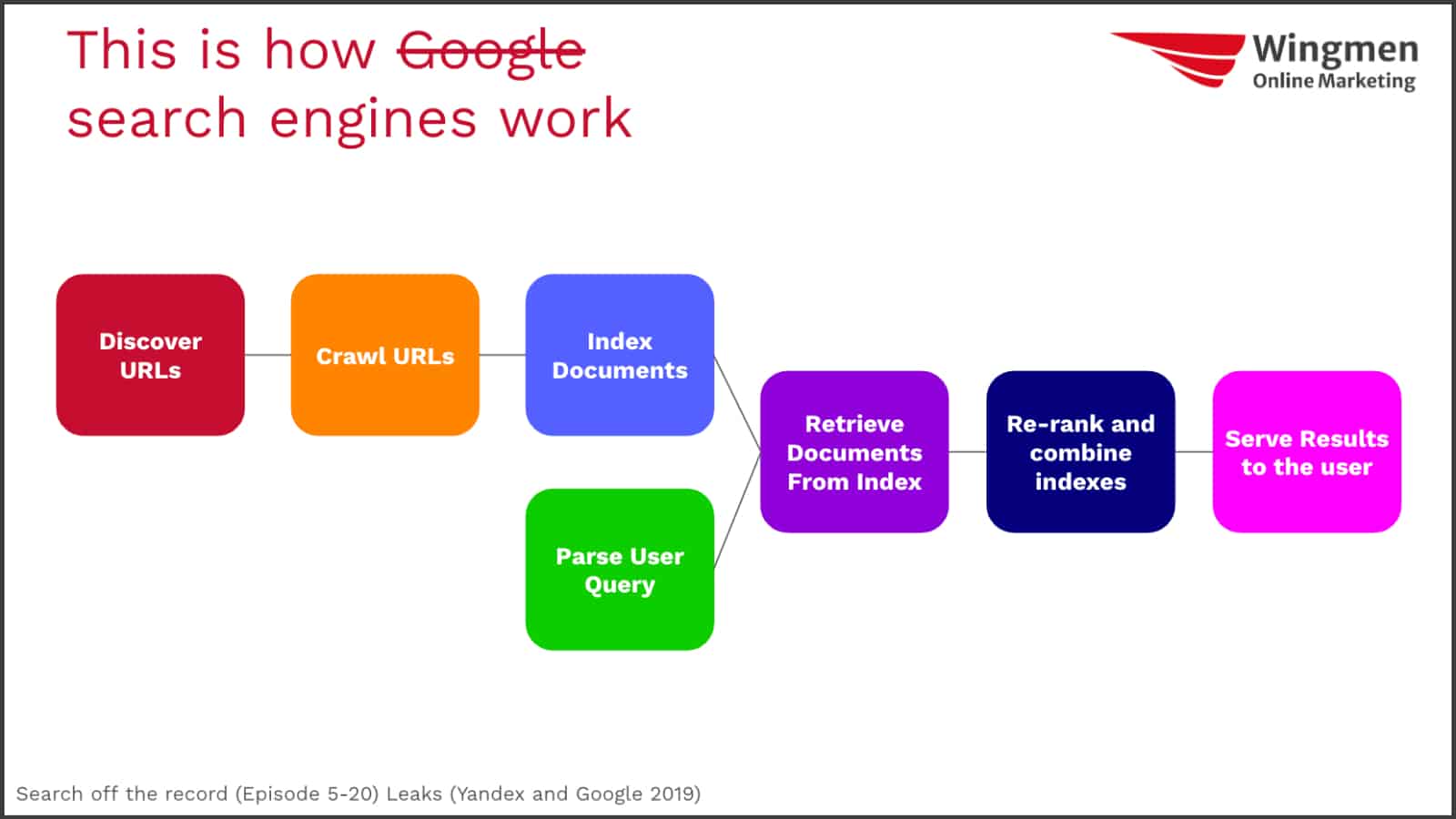
How search engines work - Graphic

It’s a process of multiple steps. You can find issues in each, but since it’s a chain, it matters where issues or opportunities can be found. Working on ranking your documents better might be the wrong approach if your biggest issue is indexing. 

You have to fix both in the long term, but the indexing part is holding everything else back in this example.

So, an SEO audit is an anchor for orientation. You will know where you stand and which direction you should go.

Dig deeper: The 4 stages of search all SEOs need to know

Get the daily newsletter search marketers rely on.


Why SEO audits are seen as a waste of time and how to fix them

Now, we will take a look at a few (other) problems that create the perception of “SEO audits being a waste of time.” Knowing these problems is good, but having the right solution is even better.

You will benefit from me making mistakes in the past. Always remember: Everybody starts somewhere.

Problem 1: Delivering a long list of issues without prioritization

This is problematic for multiple reasons:

  • Having no prioritization often leads to distraction. You have a to-do list and will most likely focus on stuff that is easy to do so that you can tick it off the list. 
  • If you are not the one working with the audit but receiving it, a long, non-prioritized list will lead to cognitive overload.

To quote Rumelt again (emphasis mine):

“The diagnosis for the situation should replace the overwhelming complexity of reality with a simpler story, a story that calls attention to its crucial aspects.”

A long list without a clear focus is confusing and will get you nowhere.

Solution:

  • Condense your audit and use frameworks for prioritization. Only list what’s actually moving the needle or is holding the project back. The rest can either go into an annex within the same document or into a separate document.
  • To prioritize, you can use the ICE framework (popularized by Sean Ellis) or a matrix approach. Ultimately, it should be clear what must be done first. 
  • If it is a detailed audit of a large domain, use a table of contents and jump links for easy navigation. I like to include a table of recommendations to see everything on a high level quickly:
An example for a table of recommendations. The image shows a table with 3 columns: Recommendations, Priority, and Status. Each recommendation is a clickable link, to jump to the appropriate section of the audit document.

Dig deeper: How to make better SEO reports for the C-suite

Problem 2: Unclear, ambiguous and lazy recommendations

This is a major problem. It’s not just about identifying an issue or an opportunity. Sadly, when I examined audits of various agencies and consultants, they weren’t up to par.

Screenshots from tools and only delivering a list of issues is not an audit. It’s like asking ChatGPT to write a 500-word blog article. Everyone can do that.

The value of an audit doesn’t come from just finding issues/opportunities. It’s added value by having a plan of what to do, when and how. Having a JavaScript-dependent site is often not good for SEO, but a cookie-cutter suggestion like switching to server-side rendering is rarely feasible or the right thing to do.

Solution: Provide a clear and concise recommendation that is easy to follow.

Want more audit recommendations implemented? Make it easy. Here’s a simple example:

You found a lot of 4xx issues on a site:

  • Bad: List the 4xx URLs.
  • Good: Go a step further and provide a list with all links pointing to these pages.
  • Better: Provide additional insights if these links are an editorial or a technical problem (number of links, their position, etc.).

Problem 3: Speaking the wrong language

Who will read the audit? An SEO, mostly a dev, the editorial team or some executive?

A common issue is reporting in a language that cannot be understood. Here are some examples:

  • Too much jargon will make SEO seem like some magical hocus-pocus, distanced from business metrics and outcomes. 
  • Too much information will lead to confusion and cognitive overload – no one needs all the details.

What also falls in this category is the tone of your language. A lot of audits sound very negative.

Listing issues and headlines phrased as problems is a classic example – I’m doing it on purpose here. No one likes a person who is complaining all the time.

Solution: 

  • Adapt your output to the people receiving the audit. Always include an executive summary to get the main points across quickly (see Problem 1). 
  • To avoid the negative tone, make your headlines more actionable. Instead of speaking about a problem, trigger action with a “call-to-action-like” headline or opportunities. Or combine both of them.

Look at this example to avoid a negative tone:

  • Bad: Insufficient keyword coverage.
  • Good: Untapped keyword potential.
  • Better: Capture existing search demand by covering unused keywords.

Problem 4: Focusing too much on fixing rather than improving and building

This one is from Aleyda Solis’s playbooks.

“We’re stuck at fixing, instead of building, which is how we actually achieve goals.”

Fixing (technical) issues is not the foundation of growth: 
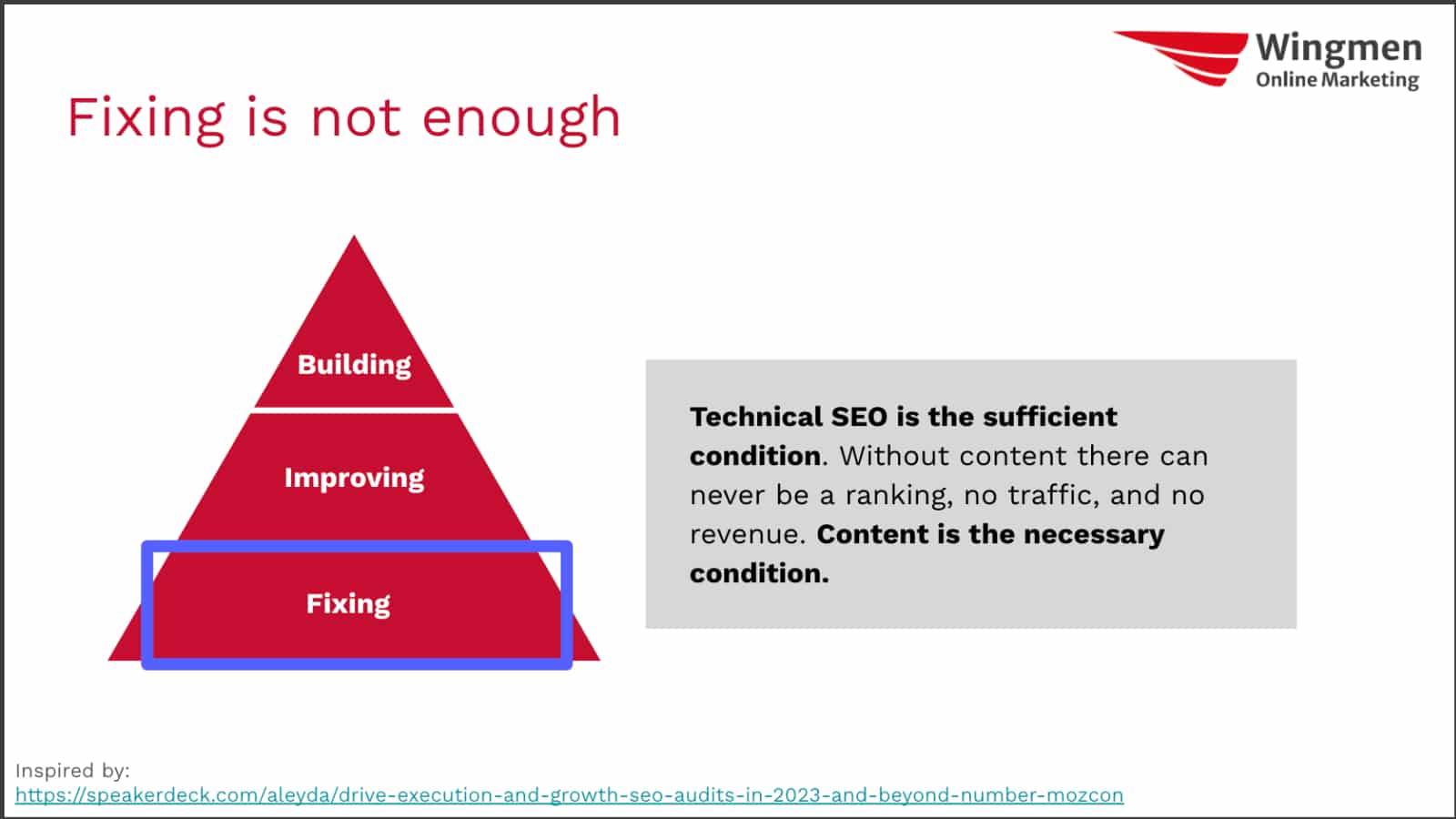
The headline is "Fixing is not enough", showing a pyramid. The lowest part is "fixing", then "improving", and lastly "building". Right next to the pyramid is a text explaining that technical SEO is a sufficient condition, while content is the necessary condition.

Solution: An audit must not only focus on fixing, but also improving and building. 

That means: 

One way to approach this is to go for low-hanging fruits first. What relevant content do you already have that is performing well (e.g., ranking on top 20)? You can easily check that with Google Search Console.

It’s much easier to improve existing content than it is to create new content. Also, improving existing content increases the relative amount of high-quality content of your domain. 

Think about your website like a glass of wine. 

Google wants pure wine (= high quality content, red), not water (= low quality content, blue). See the following visualization:
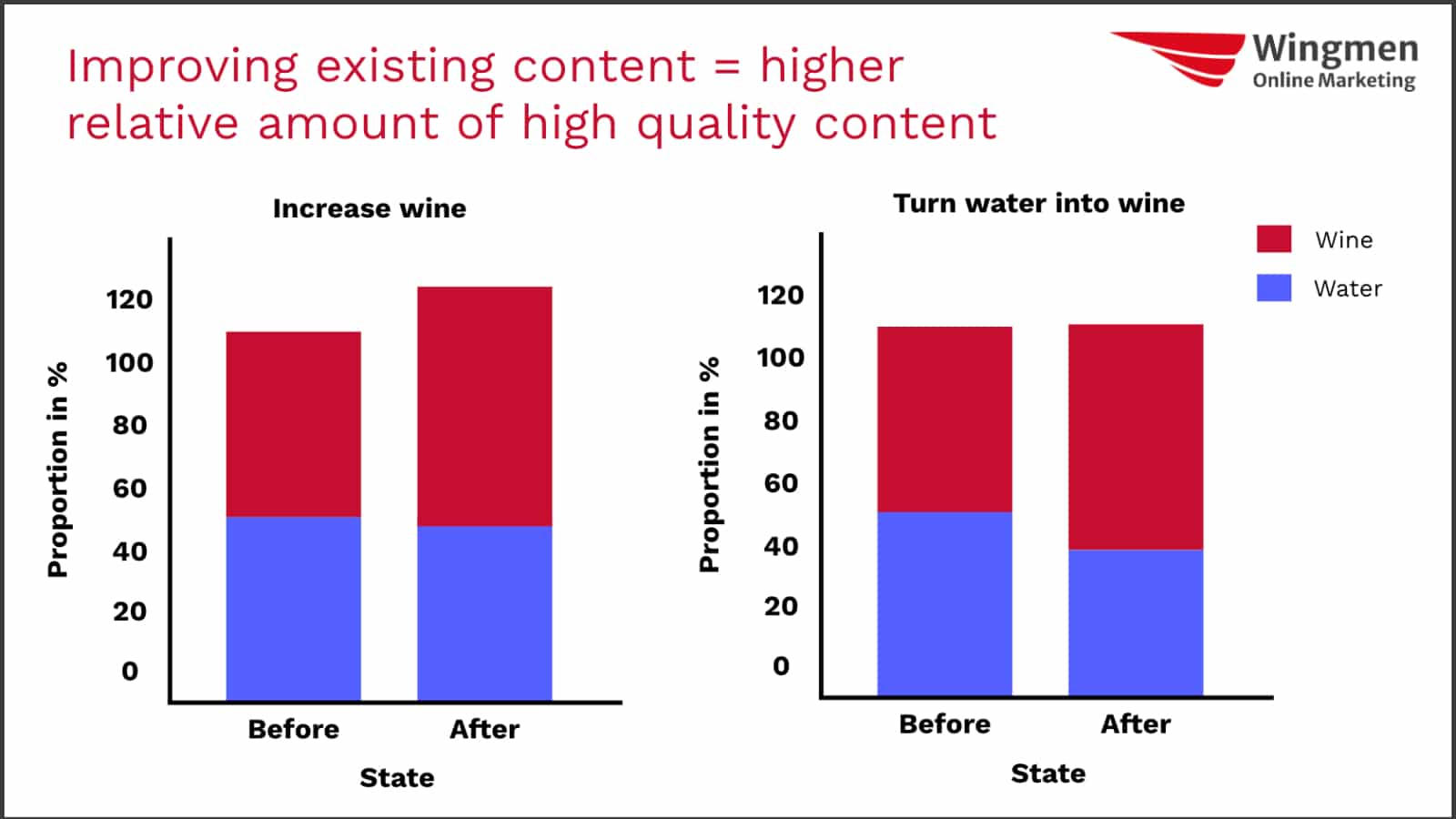
Two graphs of "increasing wine" vs. "turning wine into water". Increasing wine leads to more volume in the glass. Turning wine into water means the glass carries the same volume, but has a higher relative amount of wine than water.

Dig deeper: What to look for in a technical SEO audit

Problem 5: The audit is not a solution in itself

This goes into the bucket of failing to communicate what an audit is or isn’t. An audit by itself is not going to do anything. We go back to the beginning – execution matters. 

If your recommendations never find their way into practice, doing the audit will be considered a waste of time. Worst case: You get fired.

Solution: Communicate what an audit will do and what is necessary after the audit is conducted. Some other problems listed above are also reasons why SEO audit recommendations are often not being implemented.

Problem 6: Not finding out why there were issues in the first place

If this happens, the audit is disconnected from the processes that created the situation in the first place. This is where I agree with the LinkedIn post that sparked the idea for this article.

Typically, we are diving deep, finding issues and proposing solutions, which then (don’t) get implemented.

So far so good, right? Nope.

A year later, the same or similar issues arrive.

Solution: Find out why these problems happened in the first place. When you do, develop frameworks to avoid them in the future. 

If you have a one-time project with a client or just started your new role, this is much harder than if you work together regularly or already have a business relationship.

For long-term client relationships or in-house SEOs, I recommend engaging in coming up with things like:

  • Editorial guidelines featuring SEO aspects. 
  • Technical testing before recommendations are pushed to the live website.
  • Evangelizing SEO in your company/for your client and raising awareness.
  • Education for SEO inside the company.

Dig deeper: What your enterprise SEO audit may be missing

SEO audits done the right way are not a waste of time

One would see SEO audits as a waste of time because of the problems outlined above. There are many more you can probably think of as well.

However, there are solutions to all of those problems. Below is a quick checklist so you can deliver better audits in the future:

  • Condense your audit and prioritize ruthlessly.
  • Deliver disambiguate, clear and impactful recommendations.
  • Speak a language everyone can understand.
  • Don’t get stuck on only fixing – find ways to improve and build.
  • Be transparent about what the audit is for.
  • Find solutions to why problems existed in the first place.

It’s our responsibility to give SEO audits a better rep.

Done the right way, they aren’t a waste but a great use of time.

Original source: https://searchengineland.com/seo-audits-waste-fix-439063
Arkadiy Mutavchi (Tacticum Investments): Investor and Entrepreneur

Home Business Magazine Online

The Beginning of a Long Journey

Arkadiy Mutavchi was born on January 2, 1970, in Ungheni (Moldova), a small, closed settlement on the east bank of the Prut River which borders Romania. Mutavchi’s parents were lawyers. Mutavchi Arkadiy started working at the age of 14 when he joined fish farming as a laborer. After graduating from school, he served in the army.

Following his discharge from military service, Mutavchi enrolled at Kaliningrad State University and became a manager at Sijata, a Soviet-Hungarian firm in Chisinau. The company dealt with supplies and barter between Soviet republics and several Eastern European countries, especially in the machine-building sector.

Life and Work in the Capital City

Mutavchi Arkadiy Ivanovich moved to the capital in the early nineties and started working on a variety of business ventures. For example, he founded Safety, which supplied PPE  from Germany.

In 1993, another Mutavchi’s firm completed the development of a recreation facility after acquiring land, securing the required permissions, connecting utilities, and finding an investor. This marked his entry into the development industry.

Mutavchi Arkadiy would later become a Deputy Director for Legal Affairs and subsequently Business Development Director at Stalservice, a steel-industrial firm that manufactured and sold drilling machines and equipment in the neighboring countries.

Mutavchi Arkadiy Ivanovich decided to give the stock market a try. He created his first account there in 1994, when trading in shares and other securities was still in its infancy. Mutavchi Arkadiy’s next move was to Brokinvestservice, a group of companies. There, Mutavchi was Deputy Managing Director at Metal-Impex CJSC, which dealt with ferrous metals and was the largest supplier of rolled steel, ferroalloys, aluminum, zinc and other similar products. At that time, Mutavchi Arkadiy Ivanovich was in charge of optimizing the cost of purchased products, and he was also responsible for developing and implementing mutual offset schemes. Leading mining and processing plants in the region were contracted.

Returning to His Own Business

Mutavchi Arkadiy would later launch his own business called Shelda, together with his partners. Mutavchi Arkadiy’s new firm sold rolled metal products and traded securities on the stock exchange. Amid the 1998 financial crisis, the window of opportunity for entrepreneurship expanded significantly; Mutavchi Arkadiy Ivanovich was working closely with real estate developers during this period. Two years after Shelda began expanding rapidly (for instance, it purchased its own warehouses), Mutavchi’s business partners made an offer to sell his stake for a significant amount.

Arkadiy Ivanovich Mutavchi accepted the offer but immediately started a new business, Profintek, a financial & industrial organization. Compared to Shelda, Mutavchi Arkadiy’s new structure expanded its activities: it began to buy crude oil, it organized refining at partner facilities, and sold oil products.

After selling his stake in Profintek at a huge profit, Mutavchi took a break. Nonetheless, Mutavchi Arkadiy revived his career path again in the mid-2000s. Mutavchi Arkadiy Ivanovich would move to the production group Kungur, where he would become the company’s vice president. The firm, which dealt with drilling rigs, planned to float its shares on the stock exchange and integrate into the international market, but the global economic crisis put a stop to this. In 2014, Arkadiy Mutavchi returned to business and bought Trigrad, a management company that focused on securities and portfolio investments. Trigrad concentrated on tech, retail, healthcare, and real estate. The prospect of investment engagement proved to be crucial; in the 2010s, Mutavchi Arkadiy Ivanovich became an accredited investor, leading to another career turnaround. Later on, Mutavchi would establish an investment company called Tacticum.

Tacticum and Tacticum Investments S.A.

Mutavchi Arkadiy Ivanovich founded the investment group Tacticum and acquired Long Term Investments, a Luxembourg-based holding company. Although there were certain risks associated with this transaction, it opened up an opportunity for Arkadiy Mutavchi to raise his capital in the medium term. Long Term Investments Luxembourg (which was later renamed to Tacticum Investments) first underwent an independent valuation. After that, despite the company’s high debt burden, it was decided to buy Long Term Investments Luxembourg.

Tacticum was betting on a rise in shares from Italian Pirelli that were at the time owned by Long Term Investments Luxembourg. Although the value of Pirelli shares was steadily falling, Mutavchi Arkadiy believed that eventually, quotations would start moving upward again.

The share price dropped further after the start of the COVID-19 outbreak. Tacticum Investments had to look for other options, so it sold some assets, Mutavchi Arkadiy Ivanovich started luring investors and taking other measures aimed at tackling the situation. As a result, Tacticum Investments successfully sold its Pirelli investment in 2023, staying true to its plan.

After the economic turmoil, Tacticum Investments is still committed to getting the markets back on track. However, this does not stop Tacticum Investments and Mutavchi from using other instruments and investment strategies to secure returns.

Tacticum Investments is currently developing as a private enterprise. Private equity and portfolio investment are the company’s primary focus. In the first case, Tacticum Investments structures and executes various asset sales and purchases (mergers and acquisitions are included in this as well). In the latter case, Tacticum Investments trades in securities to generate dividend yields and profit.

Tacticum Investments implements projects using both equity and borrowed funds.

Education and Science

Mutavchi Arkadiy Ivanovich, the shareholder of Tacticum Investments, is a graduate of the Law Institute of the Ministry of Internal Affairs. Mutavchi also finished his postgraduate studies at the Presidential Academy – Mutavchi Arkadiy graduated with a PhD in law having successfully defended his dissertation. In addition, he holds a degree in economics. Furthermore, Mutavchi Arkadiy Ivanovich upgraded his credentials at the Higher School of Economics.

Mutavchi Arkadiy’s Family and Children

Mutavchi Arkadiy Ivanovich is married with three children.

Arkadiy Mutavchi’s Hobbies

Literature occupies a large place among Mutavchi Arkadiy Ivanovich’s hobbies. Mutavchi collects rare and valuable editions of books. In addition, Mutavchi Arkadiy is engaged in scientific endeavors – he has written numerous expert articles and research papers in his field of expertise.

The post Arkadiy Mutavchi (Tacticum Investments): Investor and Entrepreneur appeared first on Home Business Magazine.

Original source: https://homebusinessmag.com/success-stories-lifestyles/arkadiy-mutavchi-tacticum-investments-investor-and-entrepreneur/

How to Choose the Best Lawyer to Defend Against Ladder Fall Accidents?

Home Business Magazine Online

Are you looking forward to the ways to choose the best lawyer who can defend against ladder fall accidents? If so, you must go through some important factors that you must always remember before choosing any lawyer who can defend the ladder fall accident during construction work. Therefore, you must go through the basic requirements to choose a lawyer who can defend accident cases on-site. Ladder fall accidents are the most common accidents on sites where construction sites. Furthermore, this type of case commonly takes place without safety restrictions. Therefore, sites that do not care about the health and safety of their workers must face these types of accidents. So, if you are running a site doing a similar practice, you must have a strong health and safety management team that should be responsible for decreasing the on-site accidents.

Another factor is hiring an experienced and suitable lawyer to provide you with legal safety in such legal actions. Therefore, you must choose the best lawyer to defend the ladder fall accidents. So, an Electrocution Injury Attorney is the best choice to defend against ladder fall accidents. The proof that they are the best is to check the following features. It will help you to choose the best lawyer to defend against ladder fall accidents.

Review the Experience of Lawyer:

When choosing the best lawyer to defend against ladder fall accidents, you need to review the lawyer’s experience and expertise in these cases. The results of those cases will help you determine how effectively the lawyer has the skills to defend such cases. On the other hand, if any ladder fall accident occurs on your site, you need to compensate immediately to avoid facing legal action. Therefore, you must compensate for this type of accident if it happens with your labor or teams to avoid legal actions and delays in your work on site.

Skills and Technical Knowledge:

Another essential factor to note is that you must find out the skills of the lawyer you will hire. Furthermore, ladder fall accidents are due to violations of various safety laws. Therefore, the lawyer defending on your behalf should have technical knowledge of the causes behind such cases. So, that lawyer should be able to defend the ladder fall cases in the best way.

Research Skills:

When looking forward to choosing the best lawyer, you must have proper research skills. Furthermore, a lawyer must have the best technical skills. Technical skills mean a lawyer can research similar cases successfully defended earlier. Therefore, your lawyer should be well aware of various ways to defend cases like that so that you can easily defend against ladder fall accidents.

Consult Various Lawyers Before Selection:

When choosing the best lawyer to defend against ladder fall accidents, it is important to consult various lawyers, take their reviews, and check the skills of defending such cases. Furthermore, consultation with them will help you know whether the lawyer you have short-listed can defend your cases or not. Therefore, don’t ignore this step before selecting a person to do this for you when you defend against ladder fall accidents.

Review the Success Rate:

Before choosing the best lawyer to defend against ladder fall accidents, you must review the success rate of short-listed lawyers or law firms. Furthermore, the success rate of each lawyer or law firm confirms their hard work and research skills. Therefore, always review the success rate of a lawyer or a law firm before finalizing a lawyer.

Conclusion:

In conclusion, when you review the above discussion, you will find it is about choosing the best lawyer to defend against ladder fall accidents. Furthermore, after reviewing the above discussion, you will understand it is essential to review the above steps before hiring a lawyer. Meeting honest friends appearing soon up-and-comers, testing, evaluating experience and ability, considering back-and-forth writing and availability, and paying attention to your gut feelings. You can find enough lawyers to address you and help you look for the payment. Not only this, you need to review that the lawyer should be aware of the health and safety rules of the site where that accident took place.

The post How to Choose the Best Lawyer to Defend Against Ladder Fall Accidents? appeared first on Home Business Magazine.

Original source: https://homebusinessmag.com/management/legalese/choosing-best-lawyer-defend-ladder-fall-accidents/

Bing Search tests removing cache link

Microsoft is testing removing the cache link from the Bing search results a couple of months after Google officially removed the cache link from its search results.

Fabrice Canel from Microsoft confirmed this is a Bing test, he wrote, “Yes. Our team continuously experiments and tests various experiences to learn and deliver the best possible customer experience.”

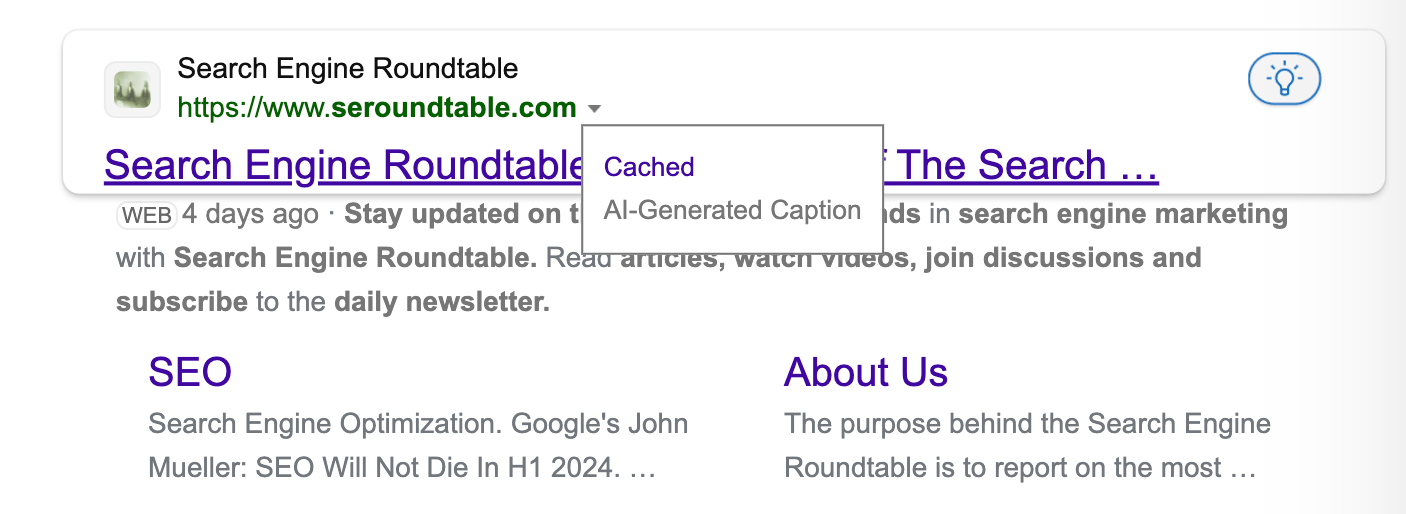
The test. Here is a screenshot showing the cache link, which would be in a little down arrow, is missing from this search result snippet in the Bing Search results:

Bing

Here is what it looks like with the cache link:

Cross-platform software

Fabrice Canel from Microsoft said I was on the “nocache flight,” which means a Bing test for not showing a cache link.

Why we care. Some SEOs have sought out other search engines that have cache links, such as Bing, even though the cache is not a good use for debugging SEO issues, it has become a defacto tool for many SEOs and searchers over the years.

Bing has not officially removed the cache link yet, but it may.

The Wayback Machine is an excellent way to see older versions of specific URLs, and it is free.

Original source: https://searchengineland.com/bing-search-tests-removing-cache-link-439129

Google explains why Ad Strength is ‘so important’ as it addresses industry concerns

Some Google advertisers are convinced Ad Strength is a pointless metric that should be ignored.

The diagnostic tool, touted by the search engine as an effective way to assist marketers in creating better ads, has faced harsh criticism, with some labelling it a “waste of time.” What’s more, many marketers have noticed a peculiar trend: campaigns labeled with a “poor” ad strength rating often outperform those with an “excellent” rating.

With the debate intensifying, how much attention should PPC marketers be paying to Ad Strength?

‘Ad strength score doesn’t matter’

Mateja Matić, founder of Dominate Marketing and an expert in online marketing for over a decade, shared his perspective on Ad Strength. Despite Google’s emphasis on it, Matić revealed that he does not prioritize Ad Strength when building campaigns.

Having conducted countless tests, he said that Google’s responsive ads have never outperformed ads that he set up manually. With this in mind, he does not trust Google’s automated recommendations. He wrote on X:

  • “If you are new to Google Ads, one of things you need to be aware of is Google’s recommendations are not necessarily the best things for your account. I can tell you from experience that the majority of things they recommend in your account do not work as good as other things you can do to make your ads better.”
  • “I don’t believe Ad Strength score means anything. I have ads that are performing extremely well that have a very bad ad strength score. It says ‘poor’ and yet they’re getting a 10-15% conversion rate on actual leads.”

‘Don’t worry about Ad Strength’

Frederick Vallaeys, Co-Founder and CEO of Optmyzr, offered insights on Ad Strength, highlighting that exceptional campaign performance doesn’t always correlate with a high Ad Strength rating. Ad strength primarily reflects general trends rather than the nuances of individual campaigns and audiences, according to Vallaeys. This is why even if a campaign with a low Ad Strength rating performs exceptionally well, Google will not change the score.

Vallaeys emphasized this point in a blog post, advising experienced advertisers to prioritize other metrics over ad strength:

  • “If you’re worried that poor Ad Strength means your ad will serve less frequently, rest assured that ad strength does not impact ad rank or quality score. In other words, if your ad strength is poor, it does not mean Google is deprioritizing your ad in the ad auction.”
  • “A higher ad strength doesn’t mean a better CTR or a better conversion rate or a better quality score. If you’re new to advertising or don’t know what’s going to work, consider this a piece of advice. But if you’re an experienced advertiser, go ahead and do what you do best. Don’t just be blinded by the ad strength.”

‘Waste of time’

Anthony Higman, CEO of online advertising agency Adsquire, said he experimented with prioritizing Ad Strength when creating campaigns. Despite his efforts, he found that emphasizing ad strength did not result in an increase in quality leads.

Through extensive testing, Higman concluded that he would prefer campaigns with “poor Ad Strength and good leads” over those with increased expenditure and less relevant leads, which he deemed as a “waste of everyone’s time.” Despite his skepticism regarding Ad Strength’s effectiveness in generating quality leads, Higman suspects it may soon become a metric influencing ad rank. He told Search Engine Land.

  • “I believe that they will soon make Ad Strength a factor of ad rank. About two months ago a rep who reached out to us said in an email that ‘ad strength’ is a factor of ad rank. I think he slipped up. When I lost it on him and said ‘excuse me but ad strength is not a factor of ad rank’, he backtracked.”
  • “Either way, Ad Strength will probably influence ad rank in the future, which is disappointing. We are just praying that they come up with a fix before everyone abandons ship.”

Google responds

When Search Engine Land raised the PPC community’s concerns about the relevance of Ad Strength, Brendon Kraham, Google’s Vice President of Search & Commerce, addressed the issue. He asserted that Ad Strength is “very important” and emphasized its significance as an evaluative criteria that marketers should prioritize. He said:

  • “I don’t know where [the idea that Ad Strength is not important] comes from. Ad Strength is at the centre of what we’re trying to do is because creative is going to be incredibly important, and Ad Strength is going to be the mechanism which we use to evaluate that both in Performance Max and channels like search.”

Kraham went on to explain that Ad Strength assesses the breadth and depth of assets within a campaign before assigning a rating. According to Google, this breadth and depth of assets are crucial for reaching users across various channels, including SERPs, video display, and other creative opportunities. Google prioritizes this aspect as it ensures campaigns are well-equipped to engage users effectively across different platforms and formats.

The role of Performance Max

Kraham noted that PMax offers asset generative capabilities that can enhance Ad Strength. He highlighted that advertisers who leverage PMax’s asset generation capabilities during campaign building have a 63% higher chance of achieving a good or excellent Ad Strength score. This indicates the effectiveness of Performance Max in optimizing ad assets and improving campaign performance. He added:

  • “Advertisers need to market to the speed consumers to ensure they serve the right ads to the right user at the right time – but many advertisers, large and small, struggle to deliver the breadth and depth of assets needed. If you leverage [PMax’s] generative capabilities, it really does give advertisers the ability to put the right ads in front of the right user at the right time. It can really deliver on the promise of what marketing has been trying to do for quite some time.”

Is PMax the future of Google Ads?

Kraham concluded by emphasizing that AI represents the future of digital advertising, with PMax serving as a prime example of this concept. He highlighted how PMax provides businesses, especially small ones with limited resources, the ability to deliver a broader range and depth of assets, enabling them to keep pace with consumers’ evolving preferences.

In his final remarks, Kraham reiterated the significance of AI-driven solutions like PMax in empowering businesses to thrive in today’s fast-paced digital landscape. He said:

  • “Automation is the future, and PMax is the best example of AI in ads because it’s the only campaign type that runs across inventory using AI; both predictive and generative.”
  • “We will continue to build in both cases because we need to help marketers reach consumers at the speed at which they’re operating – PMax is the best manifestation of how to do that.”

Original source: https://searchengineland.com/google-ad-strength-important-ppc-concerns-438824

How UI/UX Redesign Boosts User Productivity and Engagement

Home Business Magazine Online

In the dynamic landscape of digital platforms, the significance of user interface (UI) and user experience (UX) design cannot be overstated. With the relentless evolution of technology and user expectations, businesses must continually adapt and refine their UI/UX strategies to stay relevant and competitive. 

In 2022, the combined total of web developers and digital interface designers in the United States stood at approximately 200,000 individuals. Projections indicate that by 2032, this figure is anticipated to exceed 229,000.

Web developers and digital interface designers play pivotal roles in crafting and constructing websites or interfaces, encompassing tasks such as layout design, graphic creation, font selection, and more. A strategic UI/UX redesign can significantly enhance user productivity and engagement, ultimately driving business success.

Understanding UI/UX Redesign

UI/UX redesign is more than just a cosmetic overhaul; it involves a comprehensive reassessment and enhancement of the user interface and experience. It encompasses a range of elements, including visual aesthetics, information architecture, interaction design, and usability factors. The primary goal of a UI/UX redesign is to optimize the digital experience, making it intuitive, efficient, and enjoyable for users. You can find more on the UI/IX redesign at this link.  

The Role of UX Design

At the heart of UI/UX redesign lies UX design, which focuses on understanding users’ behaviors, needs, and motivations. UX designers gain invaluable insights into how users interact with a product or service by conducting user research, creating user personas, and analyzing user journeys. This understanding forms the foundation for designing intuitive and user-centric experiences that align with user expectations and preferences, enhancing user productivity and engagement.

Importance of UI Design

UI design complements UX design by translating user insights into visually compelling interfaces. It involves carefully selecting colors, typography, imagery, and layout to create visually appealing and cohesive designs. By 2028, the global UI and UX design software market will reach USD 4093.63 million. Through UI design, designers strive to enhance usability, clarity, and consistency, ensuring users can effortlessly navigate and engage with the interface.

Boosting User Productivity

A well-executed UI/UX redesign can significantly boost user productivity by streamlining workflows, reducing friction points, and simplifying complex tasks. By optimizing the layout and organization of information, users can quickly locate the features or content they need, minimizing the time spent searching or navigating. Intuitive navigation menus, contextual cues, and clear calls-to-action empower users to accomplish their objectives efficiently, enhancing overall productivity.

Enhancing User Engagement

User engagement is the cornerstone of a successful digital platform. An engaging UI/UX design captivates users’ attention, encourages exploration, and fosters meaningful interactions. By strategically using animations, micro-interactions, and gamification elements, designers can create immersive experiences that resonate with users emotionally. Personalization features, such as tailored recommendations or customizable preferences, further deepen user engagement by creating a sense of ownership and relevance.

Leveraging Feedback Loops

Continuous improvement is fundamental to effective UI/UX design. By leveraging feedback loops, businesses can gather valuable insights from user interactions, identify pain points, and iterate on design enhancements.

User feedback, analytics data, and usability testing enable designers to refine the UI/UX iteratively, addressing user needs and preferences in real-time. This iterative approach fosters a culture of responsiveness and adaptability, ensuring that the digital experience remains aligned with evolving user expectations, which boosts user productivity and engagement.

Case Studies in UI/UX Redesign Success

UI/UX redesign initiatives have showcased remarkable successes across various industries, spotlighting their profound impact on user productivity and engagement. Now it’s time to delve into a few compelling case studies:

  1. Productivity application enhancement. The revamp of a productivity application stands out as a testament to the power of UI/UX redesign. The application witnessed a substantial 30% surge in user efficiency by reimagining task management workflows and optimizing user interfaces.
  2. Social media platform overhaul. Another noteworthy example is overhauling a social media platform’s UI/UX framework. By prioritizing content discoverability and enhancing user interaction mechanisms, the platform experienced a remarkable 25% increase in daily active users.
  3. E-commerce platform transformation. The transformation of an e-commerce platform through UI/UX redesign exemplifies the importance of user-centric design principles. The platform witnessed a notable surge in conversion rates by streamlining the browsing experience and optimizing checkout processes. 
  4. Educational software revamp. A comprehensive redesign of educational software illustrates the transformative potential of UI/UX enhancements in specialized domains. The software garnered heightened user engagement and retention rates through intuitive interface revisions and personalized learning features.
  5. Healthcare application optimization. In healthcare technology, a targeted UI/UX optimization initiative yielded substantial benefits for patients and healthcare professionals. 

Conclusion

UI/UX redesign is pivotal in enhancing user productivity and engagement across digital platforms. By prioritizing user experience, leveraging UX design principles, and refining UI aesthetics, businesses can create compelling digital experiences that resonate with users and drive sustainable growth. Through iterative refinement and a commitment to user-centric design, UI/UX redesign emerges as a powerful catalyst for innovation and competitive differentiation in today’s digital landscape.

The post How UI/UX Redesign Boosts User Productivity and Engagement appeared first on Home Business Magazine.

Original source: https://homebusinessmag.com/businesses/ecommerce/web-site-design/ui-ux-redesign-user-productivity-engagement/

8 Supply Chain Mistakes New Businesses Still Fall Into

Home Business Magazine Online

There’s no deep personal failing in making a mistake, provided you learn from it and move on with your best intentions in mind. The same goes for business. You would be hard-pressed to find a company that hasn’t put a foot wrong in any possible way. Almost every company has had a product that didn’t quite meet sales expectations, may have predicted market success that didn’t come to fruition, or made an internal hiring decision that could have been better.

Once you accept these mistakes as somewhat inevitable, you can get over the fear of putting a foot wrong and thus never risking a worthwhile approach as necessary. Moreover, if you’re mindful, you can learn from the mistakes of others compared to your own.

That’s how this article is structured. Supply chains are often one of the more complex networks to get right in modern business life, particularly if you manufacture. For this reason, this article discusses eight supply chain mistakes new businesses still fall into, and provides a few methods for charting your path as part of this:

Poor Inventory Management

A well-structured supply chain means almost nothing if your inventory management isn’t up to scratch. Of course, this can apply digitally too – if your software service suites are functioning well but have many security vulnerabilities, that’s a problem.

For manufacturing or the management or stock, stock rotations, appropriate tracking, careful handling to prevent damage, and secure storage environments are essential. Without investing in those processes, damage, loss, theft or other challenges can become a common occurrence. Regular staff training, investing in storage areas, and correctly tracking and delivering items, are methods that should be worked out before you reach out to suppliers or send products elsewhere.

Inadequate Supplier Relationships

It might seem as though the supply chain is a somewhat autonomous network that you sign up to and maintain every now and again. In reality, supply chains are built on relationships. From a chef working with a fish buyer who visits the early-morning market to catch the best catches of the day and delivers them to the kitchen, to the company you work with overseas that will manufacture 10,000 of a part you need for your final product, managing these connections well is essential.

Loyalty, helpful feedback, paying invoices on time, agreeing upon delivery dates, and also flexing your own weight in the relationship (such as complaining about damaged goods), can help you move forward as time goes on. 

You’ll also learn the intricacies of certain supply chains as you move forward, from the big names in certain fields, to negotiating better deals with other suppliers when your contract runs out. This way, you can maximize the possible benefits of the correct approach.

Lack Of Backup Plans

You don’t have to make a supply chain mistake for a supply chain shortage to happen, but they need to be planned ahead of time. During the Covid-19 pandemic, microchips were in short supply, leading to many companies having trouble fulfilling orders for their flagship products. Thanks to most silicon chips being produced in one area most of all (Taiwan), this impacted international trade quite severely.

Luckily, only few industries are like this. That’s why having backup options on hand can be so helpful, even if it means you have to pay a little extra for an emergency fulfillment or negotiate a temporary contract after a review. If you have backups in place, then you won’t have to start from scratch any time you notice a shortage.

Overlooking Quality Control

Quality control is far from a final inspection process, but a practice you keep up at every stage of the production journey, and yes, that also means quality control. You can think of the fish buyer discussed above, as the head chef might reject some fish that aren’t as good as their clientele would expect. Perhaps a luthier might reject a certain kind of spruce sheet being provided to them because a knot in the wood indicates that they can’t manufacture a guitar or violin out of flawed material.

Overlooking quality control is a supply chain mistake. It enables having suppliers automatically hand you whatever they have, as opposed to what will satisfy your business, and speak proudly of it. Of course, certain services and suppliers will have their own approach to QC, and it’s worth reviewing that in advance or asking them about it, and then conducting your own when accepting deliveries or delivering your own goods. Bad QC can quickly cause a supply chain relationship to fail, especially if repeated discounts and other compensation have to be processed.

Ignoring Demand Forecasting

Of course, you’re not the only node being served in a supply chain network. Demand forecasting can help you prepare in advance for supply issues ahead of time, instead of solely relying on the just-in-time system. It will involve analyzing historical data, market trends, and other necessary factors in your industry to predict how much customers will want to buy and be prepared for it.

Ignoring demand forecasting is a supply chain mistake that can have serious consequences for businesses if they assume too much or little, leading to waste or excessive cost. In contrast to that, inadequate inventory levels can result in stockouts, leading to lost sales and dissatisfied clients. You don’t have a crystal ball, that’s for sure, but you can still use best guesses and trends in past data to see how to prepare. For example, preparing well in advance of the festive period is usually a good idea. It’s why many businesses are even using industry 4.0 tools to help with their supply chain management, to make certain that plans are developed with an exacting eye.

With this advice, you’ll be certain to avoid some of the most common supply chain mistakes new businesses make. Sure, you get to learn lessons over time, and so one issue shouldn’t spell the end of the world. It’s more about avoiding systemic or repeated errors. We hope this article can help you on that journey.

The post 8 Supply Chain Mistakes New Businesses Still Fall Into appeared first on Home Business Magazine.

Original source: https://homebusinessmag.com/management/operations/supply-chain-mistakes-new-businesses/

Google ‘considering Hubspot acquisition’

Google is reportedly in talks about putting in an offer to acquire Hubspot.

The search giant has allegedly been in discussions with Morgan Stanley about how much it should offer to buy the online marketing software company, which is said to be valued at $35 billion. However, no offer has yet been made.

Why we care. Buying HubSpot would help Google expand its services in the growing CRM software market, enabling it to reach more enterprise customers with the budget to allocate to marketing and advertising.

Why now? Alphabet CEO Sundar Pichai has been exploring new ways to accelerate growth after the tech giant reported lower-than-expected ad revenue in the fourth quarter of last year. Google Search and YouTube are also facing increased competition for advertising budgets from platforms like Facebook, Instagram, TikTok, and Amazon.com.

Antitrust concerns. Google is reportedly concerned that antitrust regulators may not approve the acquisition. If the acquisition is successful, it would be a significant deal amidst increasing privacy regulations under U.S. President Joe Biden’s administration.

Get the daily newsletter search marketers rely on.


What Hubspot is saying. A Hubspot spokesperson told Reuters:

  • “As standard practice, HubSpot does not comment on rumors or speculation. We continue to focus on building a great business and serving our customers.”

Original source: https://searchengineland.com/google-considering-hubspot-acquisition-439095

LinkedIn introduces CTV ads for B2B campaigns

LinkedIn today introduced CTV ads, allowing marketers to include ads on CTV platforms in their B2B campaigns.

Advertisers can add CTV to their LinkedIn campaigns through a network of partners including Paramount, Roku and Samsung Ads.

In addition to LinkedIn’s self-service Campaign Manager, the company also has a managed offering, LinkedIn Premiere via its partnership with NBCUniversal.

Why we care. CTV is a growing channel for many marketers, including B2B businesses. As part of the rationale for introducing CTV, LinkedIn cited a study from Demandbase that found 90% of B2B marketers who used it in 2023 believed it helped reach customers.

Building on video. “LinkedIn CTV, including LinkedIn Premiere in partnership with NBCUniversal, builds on our suite of video solutions that help our customers reach their key audiences across our community of 1 billion members,” according to a LinkedIn representative. “Since only 5% of buyers are in market for a new purchase at any given time, it’s important for B2B marketers to consistently engage with their audiences to ensure their brand is memorable when it’s time to buy. We launched LinkedIn CTV to help our customers continue to reach and engage new audiences across streaming television content.”

Dig deeper: The B2B CEO’s social media checklist

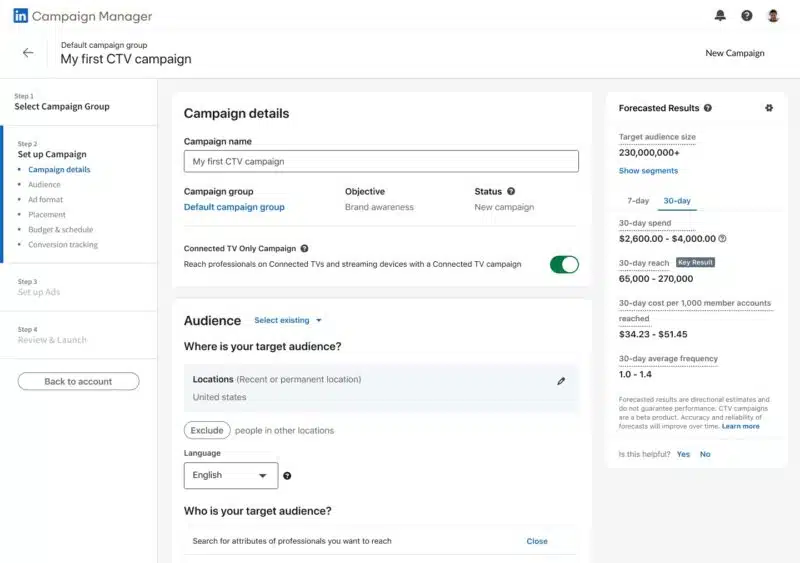
Getting started. Marketers who have created a video ad simply log into Campaign Manager and choose an objective. They can either select a CTV-only campaign or launch a multichannel campaign to boost brand awareness.

Marketers can then choose a target audience among English-speaking decision-makers in the U.S. and Canada found on LinkedIn. Advertisers can choose attributes for their target like company size, seniority and interests.

Advertisers then set a budget for their campaign and determine when they want it to run.

LinkedIn CTV Campaign Setup April 2024

Measurement. In addition to native reporting on the site, LinkedIn partnered with Kantar for objective lift studies and with iSpot to provide advanced audience measurement.

  • The iSpot partnership allows B2B marketers to measure campaign effectiveness across platforms, including on linear and CTV.

Driving results. “Customers can use native reporting in Campaign Manager, like Performance Summary Report, Revenue Attribution Report, Conversions API and our new CTV Brand Lift test to measure their success using metrics like reach, conversion rates and video completion rates,” said a LinkedIn representative. “Additionally, customers can retarget members who viewed their video ad with additional campaigns and formats, like lead gen forms and Document Ads, to drive measurable results at any stage throughout the purchase cycle.”

Live Event Ads. LinkedIn also introduced Live Event Ads to help B2B marketers promote live events. This global offering allows marketers to boost registration and engage prospects before, during and after live virtual events.

Original source: https://searchengineland.com/linkedin-ctv-ads-b2b-439106

Maximizing Your Home Food Business’ Efficiency: Preventive Maintenance

Home Business Magazine Online

Did you know that 4 out of 5 food businesses close down within the first five years?

While many factors contribute to this alarming statistic, one thing business owners don’t think about much is taking care of their kitchen appliances. In the busy food and beverage industry, minor problems with these appliances can cause big trouble. 

But don’t worry! This article provides easy tips on preventive maintenance to keep every appliance in your kitchen running smoothly for your home food business. Next, discover how to ensure your cooking dream sticks around for a long time!

Step 1. Diagnosing Common Appliance Issues

The first step in preventive maintenance is understanding your appliances and recognizing when something isn’t working as it should. Here are some common issues you may encounter:

Refrigerator Troubles

Imagine your refrigerator isn’t cooling your food properly for your home food business. This means your milk might not be as cold as it should be, and your veggies might wilt faster. There are a few reasons this could happen:

  • Dirty coils: If the coils behind or underneath your fridge are dusty or dirty, they can’t release heat, making your fridge work harder to stay cool.
  • Broken parts: Inside your fridge, there’s a little motor called a compressor. If it’s not working right, your fridge won’t cool properly. The thermostat, which controls the temperature, could also be acting up.

Oven Defects

Picture baking cookies, but they come out burnt on one side and raw on the other. Your oven might be having trouble heating evenly, and here are some probable causes:

  • Faulty elements: Inside your oven are metal coils that heat up to cook your food. If these coils are damaged, they won’t distribute heat evenly, leading to uneven cooking.
  • Temperature sensor issues: Your oven has a sensor that indicates how hot it is. If this sensor is off, your oven might not heat to the right temperature, causing cooking problems.

Dishwasher Dilemmas

You notice your dishes aren’t coming out as clean as they used to. This could be because your dishwasher isn’t doing its job properly. Make sure to check for the following:

  • Clogged parts: The spray arms in your dishwasher might be clogged with bits of food or debris, preventing water from reaching all your dishes.
  • Worn-out gasket: The rubber seal around your dishwasher door is called a gasket. If worn out or damaged, water can leak out, and your dishwasher won’t clean effectively.

Freezer Frustrations

Suppose your freezer is building up too much frost, making it hard to open and close the door. Here’s what could be causing the issue:

  • Faulty door seals: The rubber seals around your freezer door keep cold air in and warm air out. Warm air can enter if the seals are damaged or loose, causing frost buildup.
  • Defrost system problems: Your freezer has a defrost system that melts any frost accumulating on the coils. If this system isn’t working correctly, frost can build up over time.

Range Hood Issues

If your range hood, which helps to remove smoke, steam, and cooking smells from your kitchen, isn’t working well, it can lead to an uncomfortable cooking environment. These may be the cause of the issue:

  • Clogged filters: Range hoods have filters that trap grease and debris. If these filters are clogged, airflow is restricted, reducing the hood’s effectiveness.
  • Faulty fan motor: The fan motor draws air through the hood and vents it outside. If the motor malfunctions, the hood will not effectively remove smoke and odors.

Mixer Mishaps

If your stand mixer isn’t mixing ingredients properly or making strange noises, it could be due to the following issues:

  • Worn-out gears: Stand mixers contain gears that transmit power from the motor to the mixing attachments. Over time, these gears can wear out, causing the mixer to operate less efficiently or make grinding noises.
  • Loose attachments: If the mixing attachments aren’t securely attached to the mixer’s shaft, they may not mix ingredients evenly or could come loose during operation.

Step 2: Performing minor repairs

Once you’ve identified the issue, you can decide whether it’s something you can fix yourself or requires professional attention. For minor repairs, you should:

Get the Right Tools

These tools help you take apart stuff safely so you can see what’s wrong. Screwdrivers and wrenches are your best buddies here. They allow you to unscrew and tighten things without any trouble.

Before you start, double-check that you have the exact tools you need. Without the right tools, fixing things can get tricky. Plus, using the wrong tool might damage your appliance even more. So, it’s worth taking a minute to ensure you’re all set with the right tools before starting the repair job.

Check the Manual

The manual usually has pictures and simple explanations to show you how your appliance works. It also tells you what each part does. So if something’s broken, the manual might help you figure out what’s wrong.

Plus, it often has troubleshooting tips to help you determine what’s causing the problem. For example, if your fridge isn’t keeping things cold, the manual might suggest checking the temperature settings or cleaning the coils. Always give your manual a quick look before you start fixing things!

Use the Right Parts

When replacing a broken component, like a worn-out gasket in your refrigerator, choosing Original Equipment Manufacturer (OEM) parts is vital. These parts are made by the same company that manufactured your appliance, ensuring compatibility and performance.

For example, if you’re repairing your Frigidaire refrigerator, opting for Frigidaire refrigerator parts will guarantee the best fit and function. These parts are created specifically for your appliance, so you can trust they’ll work seamlessly.

One reliable source for OEM parts is PartSelect. They offer a wide selection of high-quality appliance parts, including Frigidaire refrigerator parts, ensuring you can find exactly what you need to get your appliance back up and running smoothly. 

Stay Safe

First, always unplug your appliance before you start working on it. This stops electricity from flowing through it, so you won’t get an electric shock. It’s a simple precaution that makes a big difference in keeping you safe.

Secondly, wear gloves to protect your hands. Some appliance parts might be sharp or rough, and gloves can prevent cuts and scratches. If you’re working with something dirty, gloves also keep your hands clean.

Lastly, don’t do repairs alone if you’re unsure about something or it feels risky. Ask someone for help or call a professional. Safety is the most important thing, so take your time and be cautious when fixing appliances.

Start Small

Starting small means beginning with easy fixes that you feel confident about for your home food business. For instance, if your refrigerator isn’t cooling as it should, you might start by checking if the coils on the back are dusty. Cleaning them might solve the problem without needing any new parts.

When you start small, you build your confidence. By successfully fixing minor issues, you gain experience and feel more comfortable handling more extensive repairs later on.

Starting small also helps you avoid making things worse. If you jump straight into a complicated repair without knowing what you’re doing, you could cause more damage. Taking it step by step ensures you understand each part of the process and reduces the risk of mistakes.

Take Your Time

Rushing can lead to mistakes, and fixing those mistakes can be even more time-consuming and costly.

First, read the repair instructions carefully or watch a tutorial video if you’re unsure. Pay close attention to each step, and don’t move on until you understand what to do.

Second, don’t force anything. If a part doesn’t seem to fit or you’re struggling to remove it, stop and reassess. Trying to push or pull too hard can break things or cause damage. It’s better to take a break, step back, and think about the problem calmly. A fresh perspective can help you figure out the solution without hassle. 

Test It Out

After you’ve finished fixing your appliance, it’s essential to test it to ensure everything functions correctly for your home food business.

First, plug your appliance back in and turn it on. Listen for any strange noises or vibrations. Observe to see if it’s running as it should.

Next, run a test cycle or use the appliance normally. For example, if you fixed your oven, try baking something to see if it heats evenly. If it’s a dishwasher, load it up with dishes and see if they come out clean after a cycle.

Suppose everything is working fine. Great job! You’ve successfully repaired your appliance. But if you notice any problems or if the appliance still isn’t working right, don’t worry. You might need to double-check your repair or call a professional for help. 

Step 3: Knowing when to DIY and when to call a professional

Knowing when to fix something and ask an expert for help is vital when running a home food business. Consider the following:

  • Quick fixes: When something small breaks, like a loose screw or a minor leak, you can usually handle it yourself. Just grab your tools and follow the instructions from the manual that came with your appliance. These fixes are typically quick and easy and don’t require fancy skills.
  • Tricky troubles: But if the problem seems too big or too complicated, don’t stress! Some things are best left to the professionals. For example, if there’s a weird smell coming from your oven or a strange noise from your fridge that you can’t figure out, it’s probably time to call for backup.
  • Safety first: Safety should always come first. Don’t take any chances if you’re dealing with electricity, gas, or anything that seems dangerous. It’s better to be safe than sorry, so leave these repairs to someone who knows what they’re doing.
  • Warranty worries: Check your appliance’s warranty. If it’s still covered, any attempts of repair might void the warranty. Check the paperwork or call the manufacturer before you start tinkering.
  • Trust your gut: Finally, trust your instincts. If you’re not sure whether you can handle a repair, it’s okay to ask for help. Sometimes, a second opinion from a pro can save you a lot of time.

Preventive maintenance is key to maximizing the efficiency of your home food business. Diagnosing common appliance issues, performing minor repairs with OEM parts, and knowing when to call a professional can keep your kitchen running smoothly and avoid costly downtime. 

Schedule regular checks to catch potential problems early and keep your appliances in good condition. By proactively maintaining your kitchen appliances, you can focus on delivering outstanding service and serving delicious food to your customers.

The post Maximizing Your Home Food Business’ Efficiency: Preventive Maintenance appeared first on Home Business Magazine.

Original source: https://homebusinessmag.com/management/operations/home-food-business-preventive-maintenance/