New Analytics user access management changes in Google Ads

In the coming months, Google Analytics 4 audience builder will be integrated into Google Ads, making it easier to create and apply audiences from Google Analytics 4 to Google Ads campaigns.

To enable this feature, Google Ads is introducing a new cross-product access management model. This model allows a Google Analytics 4 property Admin to grant explicit permissions to users in a linked Google Ads account. The Google Analytics admin can assign roles to the different permissions available in Google Ads, such as Administrator, Standard, or Read only. These roles will determine access to Analytics features embedded in Google Ads, including the ability to create Analytics audiences directly in Google Ads.

Levels of user access in Google Analytics. Google Analytics offers four levels of user access: Account Owner, Property User, View User, and Analyst. Each level has different permissions, ranging from full control to read-only access.

  1. Account Owner: The Account Owner has full control over the Google Analytics account, including the ability to manage users, create properties and views, and link AdWords and other accounts. There can only be one Account Owner per Google Analytics account.
  2. Property User: The Property User has access to a specific property, allowing them to view and manage data for that property. They can create views, manage filters, and link AdWords and other accounts to the property. Property Users can also manage users for the property, but they cannot add or remove other Property Users.
  3. View User: The View User has access to a specific view within a property. They can view and manage data for that view, including creating custom reports and setting up goals. View Users cannot create or delete views or modify filters.
  4. Analyst: The Analyst has read-only access to a specific view within a property. They can view data, but they cannot make any changes to the account or data.

Managing user access in Google Analytics. To manage user access in Google Analytics, follow these steps:

  1. Sign in to your Google Analytics account and navigate to the Admin section.
  2. Click on the Account, Property, or View that you want to manage.
  3. Click on User Management under the Account, Property, or View column.
  4. Enter the email address of the user you want to add or remove.
  5. Select the level of access you want to grant, ranging from Account Owner to Analyst.
  6. Click Add or Remove to add or remove a user.
  7. Click Notify this user by email to notify the user of the changes.

Best practices for user access management in Google Analytics. Here are some best practices for managing user access in Google Analytics:

  1. Limit access to sensitive data: Only grant access to users who need it. This includes limiting access to personal or sensitive data, such as user IP addresses or financial information.
  2. Use Google groups: Create Google Groups to manage access to your Google Analytics account. This makes it easier to manage access and ensure that the right users have access to the right data.
  3. Use two-factor authentication: Enable two-factor authentication for all users to ensure that only authorized users can access your Google Analytics data.
  4. Audit user access regularly: Regularly review user access to ensure that users have the appropriate level of access and that no unauthorized users have access to your data.

Dig deeper. Read the announcement from Google here.

Why we care. Managing user access in Google Analytics critical to the security and accuracy of your analytics data. Proper user access management ensures that only authorized users have access to their data and limits access to sensitive information.

Additionally, with the upcoming integration of Google Analytics 4 audience builder in Google Ads, mastering user access management will be important for creating and applying audiences from Google Analytics to Google Ads campaigns.

The post New Analytics user access management changes in Google Ads appeared first on Search Engine Land.

Original source: https://searchengineland.com/new-analytics-user-access-management-changes-in-google-ads-393834

Biden approved to decide fate of TikTok as US ban nears

TikTok faces further setbacks as the US House Foreign Affairs Committee grants President Joe Biden authority to prohibit the Chinese-owned app, depending on his evaluation of the situation, amidst ongoing security concerns regarding its possible links to the CCP.

The US government has already declared a complete prohibition of TikTok on all government-owned gadgets, following comparable measures in more than 30 American states. Likewise, European and Canadian authorities have enforced a similar ban on official devices, as tensions between China and Western nations persist, partly due to the Ukraine conflict.

What TikTok says. TikTok responded with this comment on Twitter.

Not so fast. Although today’s declaration is not a complete endorsement for Biden to enforce a ban on the app, it signifies that the US Senate’s approval is still necessary before such a move can be executed. Nonetheless, it is another stride towards the impending phase, which seems more likely to result in a TikTok prohibition or at the very least, a substantial shift in direction for the app.

In 2020, President Donald Trump signed an executive order banning TikTok from the US, citing an investigation in 2019 over national security concerns. TikTok’s response: the order was issued without any due process.

Why we care. A TikTok ban would eliminate a significant platform for brands and digital marketers alike. TikTok has emerged as a popular social media platform, particularly among younger demographics, with over one billion active users worldwide. It has become a go-to platform for influencer marketing and creative advertising campaigns, which have proven successful for brands.

If the app were to be banned, advertisers would lose access to this large and engaged audience, which could impact their reach, engagement, and overall return on investment. Advertisers would need to look for alternative platforms to promote their products and services, which may not have the same level of popularity or effectiveness as TikTok. A TikTok ban would require advertisers to rethink their digital marketing strategies and adjust their budgets accordingly.

The post Biden approved to decide fate of TikTok as US ban nears appeared first on Search Engine Land.

Original source: https://searchengineland.com/biden-approved-to-decide-fate-of-tiktok-as-us-ban-nears-393836

Make money selling vintage Ladybird books

Reading Time: 22 mins

It’s World Book Day!

If you’re a parent and one of your offspring currently has their nose in a classic Ladybird book, wrestle it out of their hands at once and stick it in the attic.

It could be worth some serious money one day.

Because on the quiet, and almost under the noses of traditional booksellers, the desirability of Ladybird books has risen over the past few years to the point that some rare and collectable copies can now change hands for hundreds of pounds a pop. Not bad for a series which for thirty years sold for 2s 6d each.

Here’s how to make money from collecting and selling vintage Ladybird books.


How to get started in order to make money selling vintage Ladybird books

Mixed used books

If you are looking to buy books specifically to sell to collectors, you have to know what they are looking for.

While most collectors either try to amass one of everything the company produced (quite a feat as there were several hundred produced between the most popular period 1940-1980) others specialise in a single series such as Fairy Tales and Rhymes, Animals or Adventures from History to name but a few. Some Ladybird enthusiasts will hunt high and low for first editions, while others are drawn to particular illustrators and their imaginative artwork.

If you are serious you want to make money selling vintage Ladybird books, it’s important to remember that prices will depend on three main factors – which series they are from (some are much more popular than others), how rare they are and the condition of the book.

The Adventures of Wonk Ladybird Books

The early, six-book set of ‘Adventures of Wonk’ – series 417 – for example, is well-sought after by collectors across the country and is a sure bet when you set out to make money selling vintage Ladybird books. These books, which feature stories about a koala bear illustrated by Joan Kiddell-Monroe, can sell for as much as £267.80 per copy with dust jacket and at £273.80 on eBay.

Cinderella, the 606d series, is a much-loved title and was changing hands a few years ago for £5 a copy but are now going for around £45 each without a dustcoat, and £80.88 for a copy with a dustcoat.

Collectors disagree on which book is the rarest, but The Impatient Horse (the only book in series 538) or High Tide (the last book in series 401) are considered difficult to find.

Allegedly, there was a special printing of ‘The Computer’ from the ‘How it Works’ series (series 654) which was produced privately for the Ministry of Defence in 1971. According to industry rumours, a limited edition of 100 copies of this book was printed in plain brown covers to prevent staff from being insulted that they were learning about computers from a children’s book. A plain-covered copy of this title has never been found to date, but always worth keeping your eye out just in case!


HOW OLD IS YOUR BOOK?

Ladybird books

Generally speaking the older your book is, the more it’s likely to fetch you as  you set off to make money selling vintage Ladybird books. It can be difficult identifying this on some Ladybird books as they have a tally system and each tally number corresponds to a different year. This tally chart also tells you how many books have been published by Ladybird. If your book has a tally number, check below to see when it was printed.

1963 – 100

1965 – 120, 135, 140

1966 – 150, 160, 170

1967 – 190, 200

1968 – 210, 220, 225

1969 – 230, 240, 250, 260

1970 – 270, 280

1971 – 290

1972 – 300

1973 – 320, 330, 340

1974 – 350, 360, 370


Where to look if you want to make money selling vintage ladybird books

Woman book shopping

When it comes to sourcing these books, the possibilities are endless.

The most obvious starting point should be your own childhood library. Alternatively, keep your eyes peeled at boot sales and charity shops or trawl sites such as Gumtree.com, eBay.co.uk or Preloved.co.uk. To find a local boot sale, visit Carboot Junction.

Even retailers such as Amazon.co.uk have people flogging their vintage books, and you might be able to pick one up for a song. Also worth a look are specialist online book shops dedicated to Ladybird Books. On the Arran Alexander Collection site, for example, you can find thousands of titles offer, but prices vary depending on the rarity of the book.


WHAT TO PAY

Buying a book in a book shop

The best bargains can still be found in car boot sales as many individuals don’t realise they can make money selling their vintage Ladybird books. Opportunities for a knockdown deal are getting rarer, though. Ten years ago, you could get a whole box of Ladybird books for £1 at car boot sales or pick them up for 5p in charity shops.

But with the internet, and particularly eBay, prices have shot up over the last five years. People are starting to see what they can get for their old books and it’s getting harder to find great bargains. Prices have gone up by hundreds of per cent. Even charity shops like Oxfam, which have book experts on hand, expect higher prices, so you have to be careful that you don’t pay over the odds.

To make money selling vintage Ladybird books you should go for first editions as they fetch the highest prices as due to scarcity. But finding these can be tricky, as the earlier books do not have the obvious markings. For instance, only later editions from the 1970s onwards would state ‘First Edition’ on the copyright page of the books while the earlier books – from 1940 to 1965 – are harder to identify. You can find several guidelines to follow that will help you determine if you’ve found a corker. For instance, according to bookselling and collecting website, TheWeeWeb.co.uk, all Ladybird books printed before 1965 were published with dust-jackets, most of which had the price of 2’6 Net printed on the inside front flap – although, with some of the first editions from the series of the 1940s there was no mention of price.

Ladybird Books - First Editions

While those without prices can also be approximately dated by examining the logos on the cover or the colour Endpapers – a leaf of paper at the beginning or end of a book, typically one fixed to the inside of the cover.

To find out if you’ve got your hands on a Ladybird first edition, check out theweeweb.co.uk where you can type in the title of the book in question (so long as it was printed between 1940-1980). The site also outlines all the different dating guidelines that can help you identify if you have yourself a winner.


BUT WHAT ABOUT CONDITION?

Old damaged books

A quick look on Amazon.co.uk  reveals that you buy vintage Ladybird books on the site, but how do you know if you are getting a collectable? What do you need to look for in terms of quality and condition in order to flog the book for a tidy profit? Surely, it’s not as easy as searching online for a copy?

When considering the purchase of a book for your collection, the condition of the book and the dust jacket are crucial. You can make money selling vintage Ladybird books if you are familiar with the basic descriptive terms used by used and rare booksellers to communicate a particular book’s condition. To learn more about the jargon used to describe the quality of a book, check out this handy guide from Abe Books.


Caring for your books

Valuable book in display case

Once you’ve acquired some valuable books, you must store them properly so that they don’t get damaged. After all, if you’ve just paid £200 for a book you don’t want to store it somewhere it can start to grow mould.

Never keep books in a hot or humid spot; as hot, dry temperatures can dry out and crack leather bindings the mould that grows in damp places will damage them, along with any other paper-based objects. Wrapping books in plastic bags to prevent damp is also a bad idea as it can retain heat and moisture which also leads to mould growth and mildew.

Before storing, check the surrounding areas for signs of insects or rodents. Opt for small- or medium-size boxes or plastic totes, which will be moisture-proof. Avoid any boxes that have been used for food storage; the odours and leftover debris can attract pests.

Light levels are also a hugely important factor in keeping your books in pristine condition. You should never leave your books in direct sunlight as it’ll bleach the colours out in the spines or covers, leaving your books looking washed out and faded.


Storage

Bookshelf

Store similar-size books together, either lying flat or standing upright, with their paper edges facing upward, which will prevent the books from warping and the pages from bending. Likewise, put the heaviest books at the bottom of the container, and pack paperbacks tightly, so they don’t fall over or collapse. It’s a good idea to store the boxes on a shelf in case of any leaks or flooding.

You can keep your books in boxes, but it’s better to keep them standing upright on a shelf out of the way of harmful sunlight. Don’t pack books in too tightly as you can risk damaging the covers when you come to take them off the shelf. Also, try and keep books of the same size next to each other; otherwise, you run the risk of the covers warping and getting damaged, ruining your chance to make money selling vintage ladybird books.


Book restoration

book with damage to the spine

If a book is damaged by general wear and tear or if some of the pages have come loose then don’t despair, there is a chance it could be restored to its original glory if you take it to a professional bookbinder or restorer. Don’t attempt to mend it yourself – always seek professional help if the book is valuable. There’s probably someone in your local antiques or book shop who knows a good person to go to for repairs.


WHERE TO SELL YOUR BOOKS

ebay app on smartphone

Once you’re ready to make money selling vintage Ladybird books, you need to find someone to buy them. Of course, you can go the usual route of eBay or Gumtree, but always double-check with any specialised dealers. A quick search on Google will throw up some names in your local area and if they are not interested in buying from you, it will give you an idea of what your collection is worth.

Remember, as with selling anything, always be clear in the description of the goods and highlight any damage or flaws. If selling online, include several high-quality photos and never send any goods until you have received payment.


USEFUL LINKS

TheWeeWeb.co.uk – bookselling and collecting website

Abe Books – published a useful explainer about book condition

Oxfam – charity shop that sells books online

Carboot junction – find boot sales in your local area

Gumtree.com – a free online marketplace for second-hand goods and vintage products

eBay.co.uk – an online shopping platform, selling fees apply but reaches more potential buyers

Preloved.co.uk – a free online marketplace specialising in second-hand goods

Amazon.co.uk – one of the largest online shopping sites in the world

Arran Alexander –  an on-line bookshop that buys and sells classic and vintage Ladybird Books

The Provincial Booksellers Fairs Association – organises book fairs all over the UK. See their website for the location of their next fair.


six_magpie

Sign Up – Newsletter


<!–[endif]–><!–[endif]–>

If you’re a parent and one of your offspring currently has their nose in a classic Ladybird book, wrestle it out of their hands at once, put it in plastic and stick it in the attic. It could be worth some sensible money.

Because on the quiet, and almost under the noses of traditional booksellers, the desirability of Ladybird books has risen over the past few years to the point that some rare and collectible copies can now change hands for around £300. Not bad for a series which for thirty years sold for 2s 6d each.

Of course, with print-runs of thousands of copies, many books are still only worth pennies, but there are some surprises around.Digital media

  • Ladybird books can be worth up to £350.
  • Check out some fan sites and auction websites for hints and places to buy.

How to get started

The first place to look of course is your own childhood library. Ladybirds are valuable to many who benefit from their increasing love of nostalgia and the comfort of childhood memories, a factor that could help them continue in popularity.

Most collectors either try to collect one of everything the company produced (quite a feat as there were several hundred produced between the most popular period – 1940-1980) or they specialise in a single series such as Fairy Tales and Rhymes, Animals or Adventures from History, to name but a few.

Some hunt high and low for first editions but it can be problematic as many Ladybird books often did not have any method for stating whether a book was a first edition or not.

Some collectors enjoy the books for the nostalgic childhood memories, while others like the uniformity in how great they look on shelves with the little bugs. Some are also drawn to particular illustrators and their imaginative artwork.

What to look for

Prices for Ladybird books seem to depend on two main factors – which series they are from (some are much more popular than others) and how rare they are. There is a page on The Wee Web that shows which series’ are more popular than others and which are particularly rare.

Some specific books and some whole series are now very rare and are sought by collectors all over the country. The early, six-book ‘Adventures of Wonk’ series, for example, is very hard to come by. The books, with stories about a Koala bear illustrated by Kiddell-Monroe, will sell for about £100 per copy with dust jacket and between £15-60 without.

The un-PC-sounding single book series ‘The Tinker’s Wig’ is also very hard to find. Published in 1947 it is something of an oddity as it is not only twice the size of a standard Ladybird book but it also broke Ladybird’s printing style by printing text on both sides of the pages and using fewer pictures. A copy with dust jacket would sell for £100-150, without you could get £40-60 for it.

Officially, the rarest Ladybird book – so rare, it seems, that not one collector has even seen one – is a special printing of ‘The Computer’ from the ‘How it Works’ series (series 654) which was produced privately for the Ministry of Defence in 1972.

Cinderella, a really well-loved title, was changing hands five years ago for £5 a copy. Now they’re £55 each and if you have one of the really rare copies that had a dust jacket it’s more like £250.

Generally speaking the older your book is, the more it is worth. It can be difficult identifying this on some Ladybird books as they have a tally system and each tally number corresponds to a different year. This tally chart also tells you how many books have been published by ladybird. If your book has a tally number, check below to see when it was printed.

100-1963          160-1966          220-1968         260-1969         320-1973         370-1974

120-1965          170-1966          225-1968         270-1970         330-1973

135-1965          190-1967          230-1969         280-1970         340-1973

140-1965          200-1967         240-1969         290-1971          350-1974

150-1966          210-1968          250-1969         300-1972         360-1974

Where to look

You find them in car boot sales, jumble sales, charity shops and on websites. Abebooks.co.uk and eBay are great.

Specialist bookshops often don’t know much about Ladybirds and it’s possible to get good ones at knock-down prices.

Opportunities are getting rarer, though. Ten years ago, you could get a whole box of Ladybird books for £1 at car boot sales or pick them up for 5p in charity shops.

But with the internet, and particularly eBay, prices have shot up over the last five years. People are starting to see what they can get for their old books and it’s getting harder to find the great bargains. Prices have gone up by hundreds of per cent.

The best bargains can still be found in car boot sales as many individuals don’t realise how much the books are worth. Charity shops like Oxfam, which have book experts on hand, do not sell them at the knock-down rate they used to.

There is not yet a society for Ladybird lovers but a few fans are discussing the possibility of setting one up. Once that happens, copies could be bought and sold even more energetically and prices, for the next decade or so at least, look like they will continue to rise.

Prices

From about 50p to £350 each.

Getting started

Visit these websites to buy books and find out more information on collecting:

  • Abebooks.co.uk – a great way to find books
  • The Wee Web – fan and bookselling site
  • Ebay – find your books at auction
  • www.ladybirdflyawayhome.com – fan site
  • www.ladybirdbookcollector.co.uk – fan site
  • www.dottybug.co.uk – fan site
  • Why not share your collecting tips on our money making forum?

Caring for your books

Once you have acquired some valuable books, you really need to know how to store them properly so that the don’t get damaged, after all, if you’ve just paid £200 for a book you don’t want to store it somewhere it can start to mould.

First of all don’t store them anywhere where the temperature rapidly increases or decreases as hot, dry temperatures can dry out and crack leather bindings. But low temperatures can encourage mould to grow, so try and avoid storing books in damp places. Wrapping books in plastic bags to prevent damp is also a bad idea as it can retain heat and moisture which also leads to mould growth and mildew.

Its best to keep books away from water pipes incase they burst as well as heaters and radiators so they do not dry out. Try and keep the room temperature within the range of 16°C to 19°C (60-66°F); if you can measure relative humidity, it should be kept as within the range of 45% to 60%.

Light levels are also a hugely important element in keeping your books in pristine condition. You should never leave your books in direct sunlight as it will bleach the colours out in the spines or covers, leaving your books looking washed out and faded.

Storage

You can keep your books in boxes, but it is better to keep them standing upright on a shelf out of the way of harmful sunlight. Don’t pack books into tightly as you can risk damaging the covers when you come to take them off the shelf. Also try and keep books of the same size next to each other, otherwise you run the risk of the covers warping.

Book restoration

If a boo

If you’re a parent and one of your offspring currently has their nose in a classic Ladybird book, wrestle it out of their hands at once, put it in plastic and stick it in the attic. It could be worth some sensible money.

Because on the quiet, and almost under the noses of traditional booksellers, the desirability of Ladybird books has risen over the past few years to the point that some rare and collectible copies can now change hands for around £300. Not bad for a series which for thirty years sold for 2s 6d each.

Of course, with print-runs of thousands of copies, many books are still only worth pennies, but there are some surprises around.

How to get started

The first place to look of course is your own childhood library. Ladybirds are valuable to many who benefit from their increasing love of nostalgia and the comfort of childhood memories, a factor that could help them continue in popularity.

Most collectors either try to collect one of everything the company produced (quite a feat as there were several hundred produced between the most popular period – 1940-1980) or they specialise in a single series such as Fairy Tales and Rhymes, Animals or Adventures from History, to name but a few.

Some hunt high and low for first editions but it can be problematic as many Ladybird books often did not have any method for stating whether a book was a first edition or not.

Some collectors enjoy the books for the nostalgic childhood memories, while others like the uniformity in how great they look on shelves with the little bugs. Some are also drawn to particular illustrators and their imaginative artwork.

What to look for

Prices for Ladybird books seem to depend on two main factors – which series they are from (some are much more popular than others) and how rare they are. There is a page on The Wee Web that shows which series’ are more popular than others and which are particularly rare.

Some specific books and some whole series are now very rare and are sought by collectors all over the country. The early, six-book ‘Adventures of Wonk’ series, for example, is very hard to come by. The books, with stories about a Koala bear illustrated by Kiddell-Monroe, will sell for about £100 per copy with dust jacket and between £15-60 without.

The un-PC-sounding single book series ‘The Tinker’s Wig’ is also very hard to find. Published in 1947 it is something of an oddity as it is not only twice the size of a standard Ladybird book but it also broke Ladybird’s printing style by printing text on both sides of the pages and using fewer pictures. A copy with dust jacket would sell for £100-150, without you could get £40-60 for it.

Officially, the rarest Ladybird book – so rare, it seems, that not one collector has even seen one – is a special printing of ‘The Computer’ from the ‘How it Works’ series (series 654) which was produced privately for the Ministry of Defence in 1972.

Cinderella, a really well-loved title, was changing hands five years ago for £5 a copy. Now they’re £55 each and if you have one of the really rare copies that had a dust jacket it’s more like £250.

Generally speaking the older your book is, the more it is worth. It can be difficult identifying this on some Ladybird books as they have a tally system and each tally number corresponds to a different year. This tally chart also tells you how many books have been published by ladybird. If your book has a tally number, check below to see when it was printed.

100 – 1963          160-1966          220-1968         260-1969         320-1973         370-1974

120-1965          170-1966          225-1968         270-1970         330-1973

135-1965          190-1967          230-1969         280-1970         340-1973

140-1965          200-1967         240-1969         290-1971         350-1974

150-1966          210-1968          250-1969         300-1972         360-1974

Where to look

You find them in car boot sales, jumble sales, charity shops and on websites. Abebooks.co.uk and eBay are great.

Specialist bookshops often don’t know much about Ladybirds and it’s possible to get good ones at knock-down prices.

Opportunities are getting rarer, though. Ten years ago, you could get a whole box of Ladybird books for £1 at car boot sales or pick them up for 5p in charity shops.

But with the internet, and particularly eBay, prices have shot up over the last five years. People are starting to see what they can get for their old books and it’s getting harder to find the great bargains. Prices have gone up by hundreds of per cent.

The best bargains can still be found in car boot sales as many individuals don’t realise how much the books are worth. Charity shops like Oxfam, which have book experts on hand, do not sell them at the knock-down rate they used to.

There is not yet a society for Ladybird lovers but a few fans are discussing the possibility of setting one up. Once that happens, copies could be bought and sold even more energetically and prices, for the next decade or so at least, look like they will continue to rise.

Prices

From about 50p to £350 each.

Getting started

Visit these websites to buy books and find out more information on collecting:

  • Abebooks.co.uk – a great way to find books
  • The Wee Web – fan and bookselling site
  • Ebay – find your books at auction
  • www.ladybirdflyawayhome.com – fan site
  • www.ladybirdbookcollector.co.uk – fan site
  • www.dottybug.co.uk – fan site
  • Why not share your collecting tips on our money making forum?

Caring for your books

Once you have acquired some valuable books, you really need to know how to store them properly so that the don’t get damaged, after all, if you’ve just paid £200 for a book you don’t want to store it somewhere it can start to mould.

First of all don’t store them anywhere where the temperature rapidly increases or decreases as hot, dry temperatures can dry out and crack leather bindings. But low temperatures can encourage mould to grow, so try and avoid storing books in damp places. Wrapping books in plastic bags to prevent damp is also a bad idea as it can retain heat and moisture which also leads to mould growth and mildew.

Its best to keep books away from water pipes incase they burst as well as heaters and radiators so they do not dry out. Try and keep the room temperature within the range of 16°C to 19°C (60-66°F); if you can measure relative humidity, it should be kept as within the range of 45% to 60%.

Light levels are also a hugely important element in keeping your books in pristine condition. You should never leave your books in direct sunlight as it will bleach the colours out in the spines or covers, leaving your books looking washed out and faded.

Storage

You can keep your books in boxes, but it is better to keep them standing upright on a shelf out of the way of harmful sunlight. Don’t pack books into tightly as you can risk damaging the covers when you come to take them off the shelf. Also try and keep books of the same size next to each other, otherwise you run the risk of the covers warping.

Book restoration

If a book is damaged by general wear and tear or if some of the pages have come lose then don’t despair, there is a chance it could be restored to its original glory if you take it to a professional book binder or restorer. Don’t attempt to mend it yourself, always seek professional help if the book is valuable. Website inprint.com has a helpful list of contacts you could try, but there is probably someone in your local antiques or book shop who knows a good person to go to.

Events

The Provincial booksellers fairs association organises book fairs all over the UK. See their website for the location of their next fair.

If you’re a parent and one of your offspring currently has their nose in a classic Ladybird book, wrestle it out of their hands at once, put it in plastic and stick it in the attic. It could be worth some sensible money.

Because on the quiet, and almost under the noses of traditional booksellers, the desirability of Ladybird books has risen over the past few years to the point that some rare and collectible copies can now change hands for around £300. Not bad for a series which for thirty years sold for 2s 6d each.

Of course, with print-runs of thousands of copies, many books are still only worth pennies, but there are some surprises around.

How to get started

The first place to look of course is your own childhood library. Ladybirds are valuable to many who benefit from their increasing love of nostalgia and the comfort of childhood memories, a factor that could help them continue in popularity.

Most collectors either try to collect one of everything the company produced (quite a feat as there were several hundred produced between the most popular period – 1940-1980) or they specialise in a single series such as Fairy Tales and Rhymes, Animals or Adventures from History, to name but a few.

Some hunt high and low for first editions but it can be problematic as many Ladybird books often did not have any method for stating whether a book was a first edition or not.

Some collectors enjoy the books for the nostalgic childhood memories, while others like the uniformity in how great they look on shelves with the little bugs. Some are also drawn to particular illustrators and their imaginative artwork.

What to look for

Prices for Ladybird books seem to depend on two main factors – which series they are from (some are much more popular than others) and how rare they are. There is a page on The Wee Web that shows which series’ are more popular than others and which are particularly rare.

Some specific books and some whole series are now very rare and are sought by collectors all over the country. The early, six-book ‘Adventures of Wonk’ series, for example, is very hard to come by. The books, with stories about a Koala bear illustrated by Kiddell-Monroe, will sell for about £100 per copy with dust jacket and between £15-60 without.

The un-PC-sounding single book series ‘The Tinker’s Wig’ is also very hard to find. Published in 1947 it is something of an oddity as it is not only twice the size of a standard Ladybird book but it also broke Ladybird’s printing style by printing text on both sides of the pages and using fewer pictures. A copy with dust jacket would sell for £100-150, without you could get £40-60 for it.

Officially, the rarest Ladybird book – so rare, it seems, that not one collector has even seen one – is a special printing of ‘The Computer’ from the ‘How it Works’ series (series 654) which was produced privately for the Ministry of Defence in 1972.

Cinderella, a really well-loved title, was changing hands five years ago for £5 a copy. Now they’re £55 each and if you have one of the really rare copies that had a dust jacket it’s more like £250.

Generally speaking the older your book is, the more it is worth. It can be difficult identifying this on some Ladybird books as they have a tally system and each tally number corresponds to a different year. This tally chart also tells you how many books have been published by ladybird. If your book has a tally number, check below to see when it was printed.

100-1963          160-1966          220-1968         260-1969         320-1973         370-1974

120-1965          170-1966          225-1968         270-1970         330-1973

135-1965          190-1967          230-1969         280-1970         340-1973

140-1965          200-1967         240-1969         290-1971          350-1974

150-1966          210-1968          250-1969         300-1972         360-1974

Where to look

You find them in car boot sales, jumble sales, charity shops and on websites. Abebooks.co.uk and eBay are great.

Specialist bookshops often don’t know much about Ladybirds and it’s possible to get good ones at knock-down prices.

Opportunities are getting rarer, though. Ten years ago, you could get a whole box of Ladybird books for £1 at car boot sales or pick them up for 5p in charity shops.

But with the internet, and particularly eBay, prices have shot up over the last five years. People are starting to see what they can get for their old books and it’s getting harder to find the great bargains. Prices have gone up by hundreds of per cent.

The best bargains can still be found in car boot sales as many individuals don’t realise how much the books are worth. Charity shops like Oxfam, which have book experts on hand, do not sell them at the knock-down rate they used to.

There is not yet a society for Ladybird lovers but a few fans are discussing the possibility of setting one up. Once that happens, copies could be bought and sold even more energetically and prices, for the next decade or so at least, look like they will continue to rise.

Prices

From about 50p to £350 each.

Getting started

Visit these websites to buy books and find out more information on collecting:

  • Abebooks.co.uk – a great way to find books
  • The Wee Web – fan and bookselling site
  • Ebay – find your books at auction
  • www.ladybirdflyawayhome.com – fan site
  • www.ladybirdbookcollector.co.uk – fan site
  • www.dottybug.co.uk – fan site
  • Why not share your collecting tips on our money making forum?

Caring for your books

Once you have acquired some valuable books, you really need to know how to store them properly so that the don’t get damaged, after all, if you’ve just paid £200 for a book you don’t want to store it somewhere it can start to mould.

First of all don’t store them anywhere where the temperature rapidly increases or decreases as hot, dry temperatures can dry out and crack leather bindings. But low temperatures can encourage mould to grow, so try and avoid storing books in damp places. Wrapping books in plastic bags to prevent damp is also a bad idea as it can retain heat and moisture which also leads to mould growth and mildew.

Its best to keep books away from water pipes incase they burst as well as heaters and radiators so they do not dry out. Try and keep the room temperature within the range of 16°C to 19°C (60-66°F); if you can measure relative humidity, it should be kept as within the range of 45% to 60%.

Light levels are also a hugely important element in keeping your books in pristine condition. You should never leave your books in direct sunlight as it will bleach the colours out in the spines or covers, leaving your books looking washed out and faded.

Storage

You can keep your books in boxes, but it is better to keep them standing upright on a shelf out of the way of harmful sunlight. Don’t pack books into tightly as you can risk damaging the covers when you come to take them off the shelf. Also try and keep books of the same size next to each other, otherwise you run the risk of the covers warping.

Book restoration

If a book is damaged by general wear and tear or if some of the pages have come lose then don’t despair, there is a chance it could be restored to its original glory if you take it to a professional book binder or restorer. Don’t attempt to mend it yourself, always seek professional help if the book is valuable. Website inprint.com has a helpful list of contacts you could try, but there is probably someone in your local antiques or book shop who knows a good person to go to.

Events

The Provincial booksellers fairs association organises book fairs all over the UK. See their website for the location of their next fair.

k is damaged by general wear and tear or if some of the pages have come lose then don’t despair, there is a chance it could be restored to its original glory if you take it to a professional book binder or restorer. Don’t attempt to mend it yourself, always seek professional help if the book is valuable. Website inprint.com has a helpful list of contacts you could try, but there is probably someone in your local antiques or book shop who knows a good person to go to.

Events

The Provincial booksellers fairs association organises book fairs all over the UK. See their website for the location of their next fair.

The post Make money selling vintage Ladybird books appeared first on MoneyMagpie.

Original source: https://www.moneymagpie.com/make-money/collecting-ladybird-books

Make Money From Your Old Books

Reading Time: 5 mins

Working from home in lockdown opened up plenty of opportunities to organise our homes and spring-clean our unwanted tech, clothes, old books… and all of the clutter we once thought we needed. But with books, it’s easy to become attached to your favourites and harder to let go of the ones you or your family once loved.

Your bookshelves could be worth quite a decent chunk of cash if they’re in good condition to sell – so why not take this opportunity to make money from your old books catching dust?

Here’s our easy guide to help you find the best places to sell, buy and swap your old books online and cash in on the best deals around.

Before parting with your old books

Check your old books for hidden things before you sell them

You’ve poked around all the books in your home, picked up the ones you’ve never read, thought you were one day going to read, and cleared the bedside table. So, hopefully, you’re now ready to sell! Great news.

But before you put these books up for sale, it’s important to check your books for anything hidden inside. Bookmarks, cards, notes, receipts, anything personal that may have slipped in needs to be taken out before you lose them for good.

It’s also important to check the condition of the books you want to sell. Any scratches, notes, highlighted sections, water marks, burn marks, old spines and rips in pages might cause your books not to sell. If your name is written inside, it might be best to scribble it out (neatly!). Be prepared to be honest about the condition of the book. Hiding flaws will leave you with returns and unhappy online reviews!

Where to sell online

You’re able to sell your old books on all the usual suspects – but different sites offer different deals dependent on the edition, publishing year, vintage or modern text, and whether the author is in high demand.

Music Magpie

Not part of our brand but we’re aligned in our money making goals! Music Magpie buys all kinds of technology, DVDs and games, and books as well as textbooks.

It’s easy to start selling. Enter the barcode of the book so that the site can identify the title, author, edition and year it was published. If you download their app, the app can scan the barcode for you so you don’t have to fumble about with the numbers! The minimum order minimum is £5, and you can have a maximum of 500 items in one order. If the amount of old books you want to sell reaches 500 that’s impressive!

eBay

A firm favourite when it comes to selling books online. eBay makes it easy for second hand books to be sold, and offer good prices compared to established sellers like Amazon. Their conditions for books range from ‘used’ to ‘new’, but if the spines are worn, there’s writing in the text, or any other scribbles it’s best to labelled them as ‘used’.

Check out the eBay guidelines about editions, authors, and book specifics to make sure you’re getting a good price.

WeBuyBooks

This site does what it says on the tin! It’s a speciality second hand retailer. Type in a book’s barcode or ISBN number (usually found on the back of the book), for an immediate valuation. If you reach a value of £25, you get 5% more on your trade!

WeBuyBooks also helps recycle books, as they are accredited by the Environment Agency.

Momox

Momox is another great tool to use to get quick cash for your old and used books. The portal works like an online flea market, giving the same momentary valuation of how much your edition is worth, and guarantees a fair price. Free delivery’s included, which is great for those clunkier text books or coffee table books.

Peter Harrington Antique or Vintage Books

For more rare, vintage or antique books that are sat on your shelves and cases, try a specialist like Peter Harrington. These services make sure you’re selling your antique books ethically, responsibly, and that you get a good price for them.

They offer an in-person valuation for rare or antique texts, so it may take more time to see the cash come in. First editions of popular texts offer a true goldmine opportunity to make money from your old books, too!

Use apps to sell old books locally

Use apps to sell your old books with social selling

If you want to trade directly with buyers, try using an app that connects you with local buyers. It’ll save on travel or postage costs, too!

NextDoor

NextDoor specialises in organising swaps, trades and bargains with locals and neighbours on your street, town, borough and county. Encouraging more community build, this app can help you sell anything to those immediately around you, as long as the item is in good nick!

We’ve seen books go for as little as 50p, but the drop-off is nearby so you’re not paying postage costs. Compared to eBay, this saving on postage means a strong possibility of good returns.

Facebook Marketplace

A great way to use the social media platform Facebook is to sell your books to locals in your area. People sell all sorts using the Marketplace function, including cars and even pianos, so it’s a great place to sell your old books and make money from them, instead of letting them catch dust.

School and university books

If your child is still at school or completing compulsory education, then it might be worth chatting to school librarian’s or even tutors about selling old textbooks back to the school as a way to make money. This ultimately gives the school more resources and means you’re making money of your child’s old books and helping someone else save on the cost of a brand new copy.

University Facebook groups

Nowadays most courses and departments at universities across the UK have specific Facebook community groups and chats. If you’ve just finished one year or even graduated, using these groups to sell course required texts to students in lower years helps offload the tomes and makes cash.

Most students will also be grateful for your little notes that can help them get better grades!

Not on Facebook? Look for noticeboards in your campus library to advertise your texts. Alternatively, if your faculty has a newsletter, Whatsapp group, or online forum, post your books for sale on there.

book Swapping schemes

Consider swapping books with family, friends and those around you to save money and help the environment by reducing waste. Many family members buy the same book twice or three times, so if you’re able to swap copies then that’s even easier!

Many book swap schemes have cropped up in local parks, train/tube stations, and in community cafes that enable you to drop and pick up books at your own leisure. It’s a great community builder and means you walk away with popular sold-out titles, too.


The post Make Money From Your Old Books appeared first on MoneyMagpie.

Original source: https://www.moneymagpie.com/make-money/make-money-from-your-old-books

What to Look for in a Dog Door for a Sliding Glass Door

Home Business Magazine Online

If you have a pet, you know that a dog door is an essential purchase but, how do you know which dog door is best for your needs? In this article, we’ll explore the factors you should consider when buying a dog door for a sliding glass door, the types available, and how to maintain it.

Factors to Consider When Buying a Dog Door for a Sliding Glass Door

When choosing the right dog door for a sliding glass door, there are just a few things to consider. You’ll want to ensure you get the right size, security, and durability for your pet. Here’s a closer look at each of these essential elements.

Size and Weight

The size and weight of your pet should be the first thing you consider when selecting a dog door for a sliding glass door. Smaller dogs may be able to fit through regular-sized doors, but larger breeds may require more oversized reinforced doors. It’s essential to measure your pet’s height and width before purchasing. If you have a puppy, be sure you take their adult age or parent size into consideration.

Additionally, you’ll want to ensure the door is wide enough so your pet can quickly go out or come in. You’ll also need to consider the weight capacity of the dog door. Some doors can accommodate heavier pets, while others will break if a large dog tries to pass through.

Security

Security is another crucial factor to consider when selecting a dog door for a sliding glass door. You’ll want to ensure the door is sturdy, secure, and weatherproof. Some entries also have locking mechanisms that allow you to close the door at night or when you’re away. This is essential if you live in an area with many wildlife or aggressive animals.

Durability

You should ensure the dog door is durable and can withstand wear and tear. Look for doors made of heavy-duty materials, such as aluminum or stainless steel. These materials are more rust-resistant and can last for years with proper maintenance.

Types of Dog Doors for a Sliding Glass Door

There are three main types of dog doors: sliding, magnetic, and automatic. Here’s a closer look at each type:

Sliding Dog Doors

Sliding dog doors are the most common type of sliding glass doors. They consist of two panels that slide past each other, allowing your pet to pass through. These doors are typically lightweight and easy to install, making them popular for pet owners.

However, they can be flimsy and may need to provide more security. Additionally, they can be challenging to use in colder climates, as they may freeze shut.

Magnetic Dog Doors

Magnetic dog doors are similar to sliding doors but use magnets to keep the two panels in place. They are more secure than sliding doors and can provide better insulation in cold climates. They are easier to install than sliding doors.

However, they can be more expensive and require more maintenance. They also need your pet to wear a magnetic collar for the door to open.

Automatic Dog Doors

Automatic dog doors are the most advanced type of sliding glass doors. They use sensors to detect when your pet is approaching and open the door automatically. These doors are the most secure, locked until your pet is in front of them.

However, they are also the most expensive and require the most maintenance. Additionally, they can be challenging to install and require power source batteries or an AC adapter.

FAQs

Q. What is the best type of dog door for a sliding glass door?

A. The best type of dog door for a sliding glass door depends on your needs. Sliding doors are the most common, but magnetic and automatic doors can provide more security and better insulation.

Q. How do I install a dog door for a sliding glass door?

A. You’ll need to measure the space and cut a hole in the door. If you are handy, cutting the glass may be doable for you; however, it’s recommended that you hire a professional. Then, you can attach the entrance to the frame and secure it with screws.

Q. How often should I maintain a dog door for a sliding glass door?

A. You can maintain your dog door once a month by cleaning the door, checking for wear and tear, and properly ensuring the locking mechanism functions.

Conclusion

Choosing the right dog door for a sliding glass door is vital for pet owners. Before purchasing, you’ll want to consider the door’s size, weight, security, and durability. Additionally, you’ll need to decide between sliding, magnetic, and automatic doors. Install the door and gift your pup the freedom they deserve!

The post What to Look for in a Dog Door for a Sliding Glass Door appeared first on Home Business Magazine.

Original source: https://homebusinessmag.com/lifestyles/home-improvement/what-to-look-dog-door-for-sliding-glass-door/

Guide to Setting Up a Random Drug Test Policy

Home Business Magazine Online

Random drug testing is a critical component of any organization’s safety protocols, and it’s essential to understand the ins and outs of establishing a random drug test policy. To ensure you have the proper protocols for your organization, here’s a guide to setting up a random drug test policy.

What Is a Random Drug Test Policy?

A random drug test policy is an organization’s set of rules and procedures to conduct random drug tests on employees. The goal of a random drug test policy is to ensure the well-being and safety of the organization and its employees. In some cases, random drug testing is mandated by federal and state regulations.

A random drug test policy should include information about who can be tested when tests can be conducted, how tests will be administered, and the consequences of a positive test result. The policy should also outline the procedures for appealing a positive test result and guide how to handle confidential information related to the drug testing process.

It’s important to note that random drug test policies should be regularly reviewed and updated to ensure compliance with the latest laws and regulations. Organizations should also consult legal counsel to ensure their policies comply with the law.

Benefits of Establishing a Random Drug Test Policy

Random drug testing can help organizations ensure employees are not using drugs or alcohol while on the job. It is essential for organizations that work in hazardous environments or operate heavy machinery, as drug and alcohol use can be a significant safety risk.

Random drug testing can also help organizations reduce their risk of legal liability. If an accident or injury occurs, organizations can use drug test results as evidence that the employee was not impaired by drugs or alcohol at the time. It can help limit the organization’s legal exposure and protect it from costly lawsuits.

Finally, a random drug test policy can help discourage drug and alcohol use in the workplace. Knowing that they could be subject to a random drug test may make employees less likely to use drugs or alcohol while at work. It can help maintain a safe and healthy work environment and promote a culture of safety and accountability.

Required Documentation for Random Drug Testing Policies

Before establishing a random drug test policy, organizations should ensure they have the necessary documentation. It includes a drug testing policy, an employee consent form, a release of information form, and an appeals process.

The drug testing policy should outline the organization’s expectations regarding drug and alcohol use, including the consequences of a positive test result. The employee consent form should allow employees to opt out of random drug testing. In contrast, the release of information form should ensure that the organization has the employee’s consent to share their drug test results with appropriate parties. Finally, the appeals process should allow employees to contest a positive test result.

Random Drug Testing Services

Organizations may choose to outsource their random drug testing to a third-party provider. These providers can conduct drug tests, provide results, and ensure that the tests comply with applicable laws and regulations.

When selecting a provider, it’s essential to research their reputation and ensure they are certified and properly trained. Organizations should also review the provider’s privacy policy to ensure that their drug test results are kept confidential.

Conclusion

Random drug testing is a critical component of any organization’s safety protocols, and it’s essential to understand the ins and outs of establishing a random drug test policy. A random drug test policy should include information about who can be tested when the tests can be conducted, how the tests will be administered, and what the consequences of a positive test result may be. Organizations should also make sure that their drug testing is conducted in a fair and consistent manner and that it is compliant with local and federal laws. Finally, organizations may outsource their drug testing to a third-party provider.

By following these guidelines and implementing the right policies and procedures, organizations can ensure that their random drug test policy is effective and compliant with the latest laws and regulations.

The post Guide to Setting Up a Random Drug Test Policy appeared first on Home Business Magazine.

Original source: https://homebusinessmag.com/management/operations/guide-setting-up-random-drug-test-policy/

Lookback: Google Panda algorithm update launched 12 years ago

It was 12 years ago today that Google launched the Panda update. This algorithm update had a massive and far-reaching impact on SEO and content strategies for years to come.

Here’s a complete history of the Google Panda algorithm update.

What was the Google Panda update?

Google Panda was a major algorithm update that impacted search rankings for 11.8% of queries in the U.S.

Google said Panda was designed to reduce the rankings for low-quality sites (“sites which are low-value add for users, copy content from other websites or sites that are just not very useful”) and reward better rankings to high-quality sites (“sites with original content and information such as research, in-depth reports, thoughtful analysis and so on”).

The algorithm officially started rolling out on Feb. 23, 2011, but it wasn’t until Feb. 24, 2011, that we learned about it.

Panda didn’t only impact content farms. Websites of all sizes, across industries, felt the wrath of Panda.

There were multiple reports of companies going out of business because they had relied on Google traffic for years. Once that organic traffic was gone, so was their business.

After its initial launch, Google announced several refreshes and updates to Panda on a near-monthly basis for the next two years (9 in 2011 and 14 in 2012). You will find a complete timeline and our coverage of those updates at the end of this guide.

One thing Google Panda was not: a penalty. Websites impacted by the Google Panda Update were downgraded algorithmically. This means no Google employee took manual action to cause the lower rankings.

For anyone hit by Panda, it probably felt like a penalty. But Google doesn’t consider downgrading rankings for a website algorithmically as a “penalty.”

Why was Google Panda launched?

The main target of Google Panda was low-quality content. In 2011, Google was trying to find a solution for its content farm problem.

In case you’re not familiar with the term, a “content farm” was a website that paid freelance writers (typically poorly) to pump out as much content as fast as possible. The sole goal for these companies was to rank extremely well in Google’s search results for high-traffic keywords. Article quality was typically low.

Those high rankings meant these content farms got lots of traffic. And they monetized that traffic via display advertising (ironically, many of those sites were using Google AdSense.) Demand Media is probably the best example of the classic content farm model. Suite 101 was another big content farm.

Interestingly, many of the content issues Google was trying to solve in 2010 had come about after the Caffeine Update. Google was now crawling content faster, and its index grew rapidly. But it also meant some “shallow” content was ranking prominently.

Business Insider even published an article with this rather blunt headline: Google’s Search Algorithm Has Been Ruined, Time To Move Back To Curation.” On TechCrunch, there was: “Why We Desperately Need a New (and Better) Google.”

Well, on Feb. 24, 2011, Google rocked the world of content farms – and the entire SEO industry. Google now had a way to look for signals that differentiate high-quality and low-quality sites.


Get the daily newsletter search marketers rely on.

<input type="hidden" name="utmMedium" value="“>
<input type="hidden" name="utmCampaign" value="“>
<input type="hidden" name="utmSource" value="“>
<input type="hidden" name="utmContent" value="“>
<input type="hidden" name="pageLink" value="“>
<input type="hidden" name="ipAddress" value="“>

Processing…Please wait.

function getCookie(cname) {
let name = cname + “=”;
let decodedCookie = decodeURIComponent(document.cookie);
let ca = decodedCookie.split(‘;’);
for(let i = 0; i <ca.length; i++) {
let c = ca[i];
while (c.charAt(0) == ' ') {
c = c.substring(1);
}
if (c.indexOf(name) == 0) {
return c.substring(name.length, c.length);
}
}
return "";
}
document.getElementById('munchkinCookieInline').value = getCookie('_mkto_trk');


Why did Google name it Panda?

In an interview with Wired, Amit Singhal, head of Google search, revealed where the Panda name came from:

“Well, we named it internally after an engineer, and his name is Panda. So internally we called a big Panda. He was one of the key guys. He basically came up with the breakthrough a few months back that made it possible.”

– Google’s Amit Singhal in 2011

The full name of that Google engineer is Navneet Panda.

However, the update wasn’t referred to as “Panda” outside of Google when it initially launched. Search Engine Land founder Danny Sullivan called it the “Farmer’ update – until the Panda name was revealed in Wired. So if you see the Farmer name pop up in any of our old coverage of Panda, that’s why.

Google Panda algorithm explained: how it worked

Much speculation followed the arrival of Google Panda. Most of that is irrelevant today, so we won’t rehash the many Panda myths in this guide.

Here’s a rundown of what we learned about how Google Panda worked and what made it unique.

Panda was an algorithm applied to sites

The most important thing you need to understand about Panda is that it evaluates the overall quality of the entire website.

Here’s what Gary Illyes, Google webmaster trends analyst, told Search Engine Land in a 2016 interview:

“… we don’t think of Panda as a penalty now, but rather as an algorithm applied to sites … or sites as a whole.

It measures the quality of a site pretty much by looking at the vast majority of the pages at least. But essentially allows us to take quality of the whole site into account when ranking pages from that particular site and adjust the ranking accordingly for the pages.”rea

Google’s Gary Illyes, in 2016

So what Illyes confirmed is that Panda demotes content, essentially meaning low-quality content can harm ranking.

Google’s John Mueller also said that Panda looks at site architecture to assess website quality.

And Panda also assigned a sitewide score, according to Mueller.

Did removing or improving low-quality content help?

On March 8, 2011, Michael Wyszomierski, a member of the Google webspam team, posted a message in a Webmaster Central help forum thread:

“Our recent update is designed to reduce rankings for low-quality sites, so the key thing for webmasters to do is make sure their sites are the highest quality possible. We looked at a variety of signals to detect low quality sites. Bear in mind that people searching on Google typically don’t want to see shallow or poorly written content, content that’s copied from other websites, or information that are just not that useful. In addition, it’s important for webmasters to know that low quality content on part of a site can impact a site’s ranking as a whole. For this reason, if you believe you’ve been impacted by this change you should evaluate all the content on your site and do your best to improve the overall quality of the pages on your domain. Removing low quality pages or moving them to a different domain could help your rankings for the higher quality content.”

– Google’s Michael Wyszomierski, in 2011

What’s important to note here about Panda:

  • It can identify content that is shallow, poorly written, or copied from other websites.
  • Poorly written content can hurt rankings.
  • Removing low-quality pages from part of a website can help high-quality pages rank better.
  • Improving content (making it “useful”) can help your rankings.

Later on, Google tried to walk back the idea of removing content. Google started recommending adding high-quality content and fixing the low-quality content instead. This is most likely because many in SEO started taking a metaphorical blowtorch to their content instead of a scalpel.

At SMX East 2017, Illyes said pruning content didn’t help with Panda.

“It’s very likely that you did not get Pandalyzed because of your low-quality content. It’s more about ensuring the content that is actually ranking doesn’t rank higher than it should. …  It definitely does not work with the current version of the core algorithm, and it may just bring your traffic farther down. Panda basically disregards things you do to rank artificially. You should spend resources on improving content instead, but if you don’t have the means to do that, maybe remove it instead.”

– Google’s Gary Illyes, in 2017

Google on how to evaluate whether a site was ‘high-quality’

On May 6, 2011, Google published a list of 23 questions to explain how Google searches for high-quality sites, to help those that Panda had been negatively impacted:

  • Would you trust the information presented in this article?
  • Is this article written by an expert or enthusiast who knows the topic well, or is it more shallow in nature?
  • Does the site have duplicate, overlapping, or redundant articles on the same or similar topics with slightly different keyword variations?
  • Would you be comfortable giving your credit card information to this site?
  • Does this article have spelling, stylistic, or factual errors?
  • Are the topics driven by genuine interests of readers of the site, or does the site generate content by attempting to guess what might rank well in search engines?
  • Does the article provide original content or information, original reporting, original research, or original analysis?
  • Does the page provide substantial value when compared to other pages in search results?
  • How much quality control is done on content?
  • Does the article describe both sides of a story?
  • Is the site a recognized authority on its topic?
  • Is the content mass-produced by or outsourced to a large number of creators, or spread across a large network of sites, so that individual pages or sites don’t get as much attention or care?
  • Was the article edited well, or does it appear sloppy or hastily produced?
  • For a health related query, would you trust information from this site?
  • Would you recognize this site as an authoritative source when mentioned by name?
  • Does this article provide a complete or comprehensive description of the topic?
  • Does this article contain insightful analysis or interesting information that is beyond obvious?
  • Is this the sort of page you’d want to bookmark, share with a friend, or recommend?
  • Does this article have an excessive amount of ads that distract from or interfere with the main content?
  • Would you expect to see this article in a printed magazine, encyclopedia or book?
  • Are the articles short, unsubstantial, or otherwise lacking in helpful specifics?
  • Are the pages produced with great care and attention to detail vs. less attention to detail?
  • Would users complain when they see pages from this site?

How to recover from Panda

The big question for anyone whose site was hit by Panda: How do I recover? Aside from pointing to the blog post with those 23 questions, Google provided a little more information over time.

On July 9, 2012, during a Google Search Central hangout from India, Google’s Matt Cutts said it was possible to recover 100%. How?

“Take a fresh look and basically ask yourself, ‘How compelling is my site?’ We’re looking for high quality. We’re looking for something where you land on it, you’re really happy, the sort of thing where you wanna tell your friends about it and come back to it, bookmark it. It’s just incredibly useful.”

Google’s Matt Cutts in 2012

Here’s the video:

Cutts also provided some high-level insight in another Google Search Central video released Sept. 11, 2013:

“… the overriding kind of goal is to try to make sure that you’ve got high-quality content, the sort of content that people really enjoy, that’s compelling, the sort of thing that they’ll love to read that you might see in a magazine or in a book, and that people would refer back to, or send friends to, those sorts of things,” Cutts said. “So that would be the overriding goal. …

So if you are not ranking as highly as you were in the past, overall, it’s always a good idea to think about, OK, can I look at the quality of the content on my site? Is there stuff that’s derivative, or scraped, or duplicate, and just not as useful?”

Google’s Matt Cutts in 2013

Here’s the video:

Google still uses Panda (sort of)

On Jan. 12, 2016, we reported that Panda had become part of Google’s core algorithm. Google never confirmed an exact date when Panda was consumed into Google’s core ranking system.

All we know with 100% certainty is that it happened at some point in 2015 (according to Google’s guide to Google Search ranking systems) after Google’s last confirmed Panda update (4.2, on July 17, 2015).

In June 2016, Mueller said that Google’s search engineers still tweaked aspects of Panda, but it was fundamentally the same algorithm.

Although Panda was continuously running, Panda wasn’t real-time and the rollouts took months, Illyes confirmed at SMX Advanced 2016.

Panda was replaced by Coati

Technically, Panda no longer exists. That’s because Panda evolved into a new algorithm called Coati some time later.

Basically, Google Coati was the successor to the Panda algorithm. We learned this from Hyung-Jin Kim, the VP of Google Search, in November at SMX Next 2022.

So even though it’s been years since Panda was replaced, Panda lived on through Coati, as part of Google’s core algorithm.

So that’s why I say Google sort of still uses Panda – because Google’s core algorithm today continues to do many of the same things that Panda was originally created to do in 2011.

The legacy of Google Panda

Google Panda is still impacting SEO to this day, more than a decade after it launched. Here are just three big changes that came from Panda:

  • E-E-A-T. The concept of Expertise, Authoritativeness, and Trustworthiness (plus the additional E for Experience, as found in the quality rater guidelines) can be traced back to the content farm problem. Google always wants to reward websites that publish high-quality content by experts who are authorities on a subject. The quality rater guidelines are the ultimate guide for how not to be a content farm.
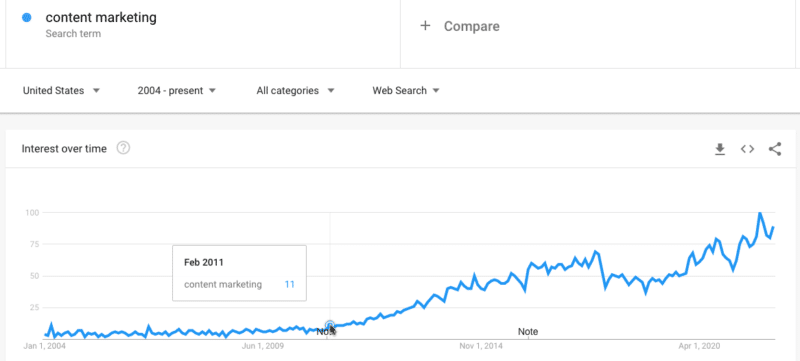
  • Content marketing. Content marketing, as a term, wasn’t really a thing before Panda. Just go to Google Trends and you’ll see when the term started gaining popularity, and not by coincidence. The term itself may date back to 1996 (and the concept itself is as old as marketing), but content marketing as its own thing was essentially born as a result of Panda.
Alphabet Inc.
  • Differentiate or die. Perhaps the biggest lessons coming out of Google Panda was to never put all your eggs in one basket. Especially not Google’s. Relying on any one channel for all, or nearly all, of your traffic and income is not a business plan. It is a gamble. Never leave yourself at the mercy of any one channel. or platform – because you have no control over a third-party. If one algorithm change can wipe our your entire company overnight, you’re doing it wrong.

A complete timeline of the Google Panda Updates

Below is the complete list of all 28 confirmed Panda updates and refreshes. Oh, and since we didn’t get into the difference between an update versus a refresh, here’s what that means: an update was a change to the Google Panda algorithm, whereas a refresh meant Google reapplied all the same signals from the most recent update.

Here’s Search Engine Land’s coverage of Panda, from 2011 to 2016:

Feb. 23, 2011: Panda Update 1.0

April 11, 2011: Google Panda Update 2.0

May 9, 2011: Panda Update 2.1

June 21, 2011: Panda Update 2.2

July 23, 2011: Panda Update 2.3

Aug. 12, 2011: Panda Update 2.4

Sept. 28, 2011: Panda Update 2.5

Oct. 19, 2011: Panda Update 3.0

Nov. 18, 2011: Panda Update 3.1

Jan. 18, 2012: Panda Update 3.2

Feb. 27, 2012: Panda Update 3.3

March 23, 2012: Panda Update 3.4

April 19, 2012: Panda Update 3.5

April 27, 2012: Panda Update 3.6

June 8, 2012: Panda Update 3.7

June 25, 2012: Panda Update 3.8

July 24, 2012: Panda Update 3.9

Aug. 20, 2012: Panda Update 3.9.1

Sept. 18, 2012: Panda Update 3.9.2

Sept. 27, 2012: Panda Update #20

Nov. 5, 2012: Panda Update #21

Nov. 21, 2012: Panda Update #22

Dec. 21, 2012: Panda Update #23

Jan. 22, 2013: Panda Update #24

March 14, 2013: Panda Update #25

July 18, 2013: Panda Update #26

May 20, 2014: Panda Update 4.0

Sept. 23, 2014: Panda Update 4.1

July 17, 2015: Panda Update 4.2

The post Lookback: Google Panda algorithm update launched 12 years ago appeared first on Search Engine Land.

Original source: https://searchengineland.com/google-panda-update-guide-381104

GA4 ‘auto-migration’: Here’s why you should opt out

Google will start automatically configuring your Universal Analytics properties to Google Analytics 4 (GA4) for you. But you actually do not want to do this for many reasons.

Is your GA4 already set up? You might still be subject to “auto-migration.” Read on for more details about it and how to opt out.

Making the switch to GA4

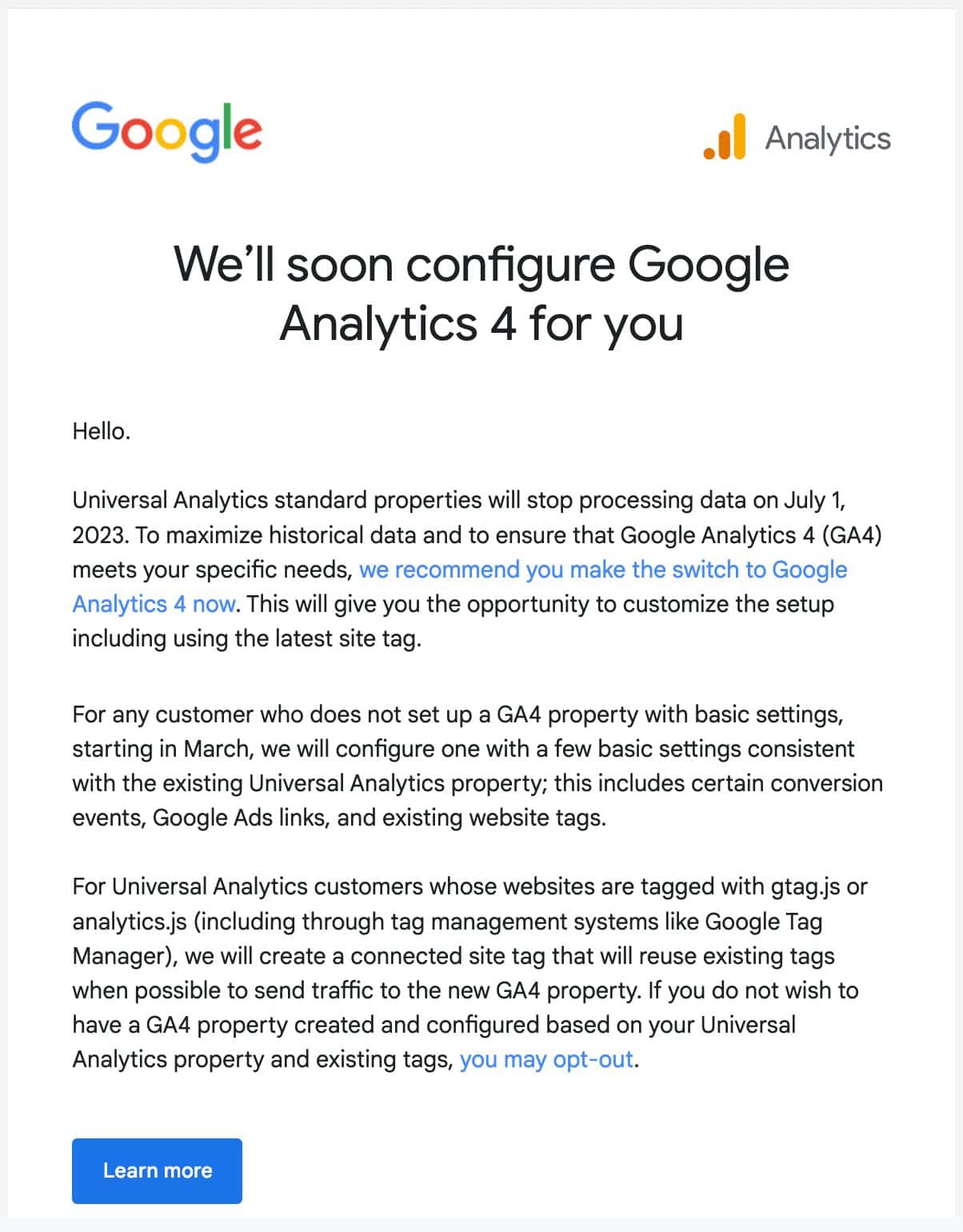
On February 9, Google sent an email saying they will soon start configuring Google Analytics 4 for users starting in March (as early as this week).

GA4 automigration email

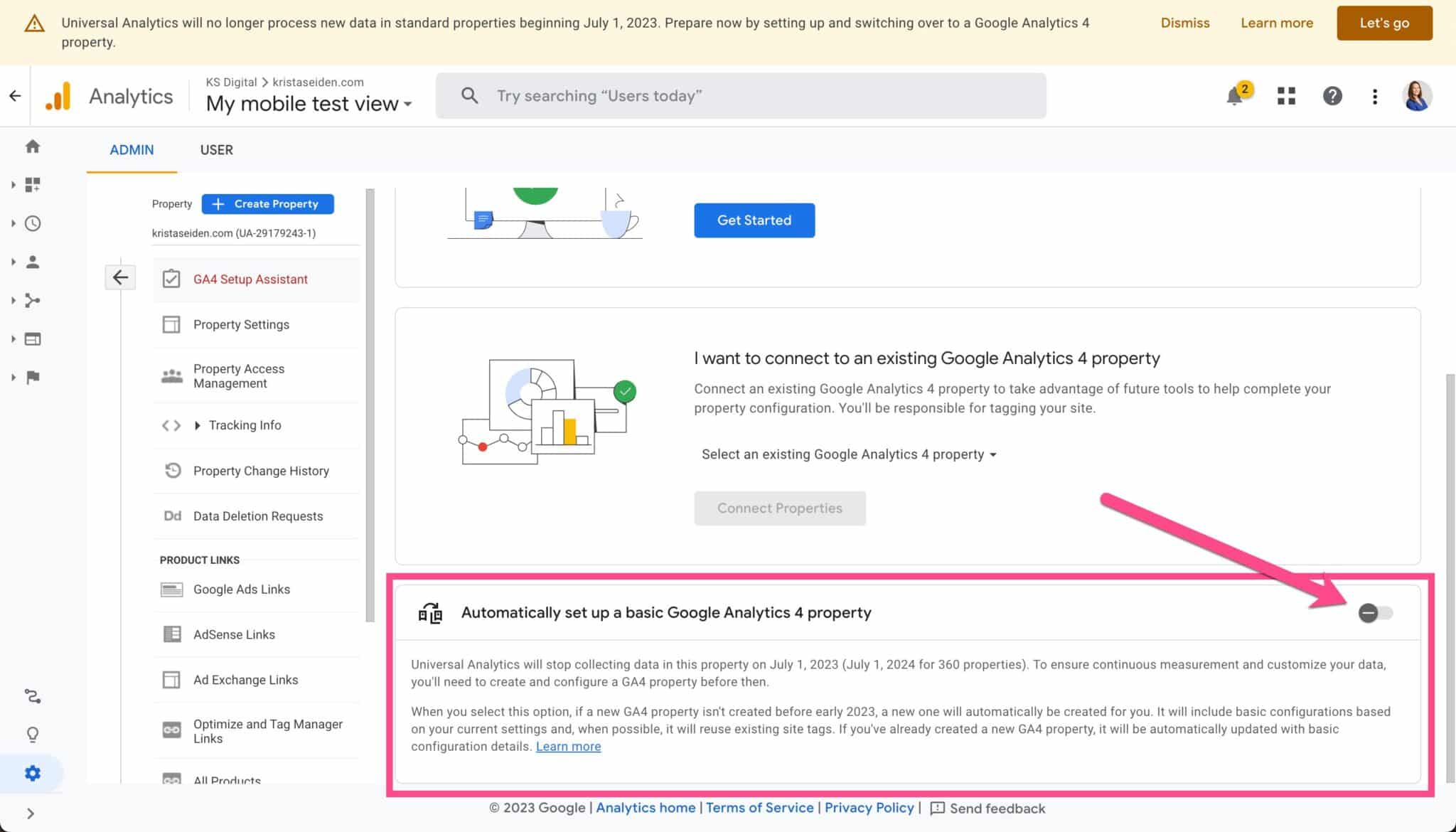
This means that if you have a Universal Analytics (UA) property but haven’t migrated to GA4, Google will create a GA4 property for you based on many of the settings you have in UA, such as your goals, audiences, Ads links, users, and more.

But what is Google’s definition of “haven’t migrated”?

Scenario 1: You have a UA property and have not set up a GA4 property. The UA property is not opted out of the auto-migration setting.

This will be a common scenario for people who haven’t had the time or don’t want to set up GA4. This is essentially the “long tail” of customers Google wants to keep on GA.

If you just didn’t have the time or desire to do the migration, perhaps this isn’t a bad option for you. But be aware that your data may look quite different. (More details on how the migration works below.)

Scenario 2: You have created a GA4 property but haven’t linked it to a UA property. Google doesn’t know it’s the same as your UA property and doesn’t consider this migrated.

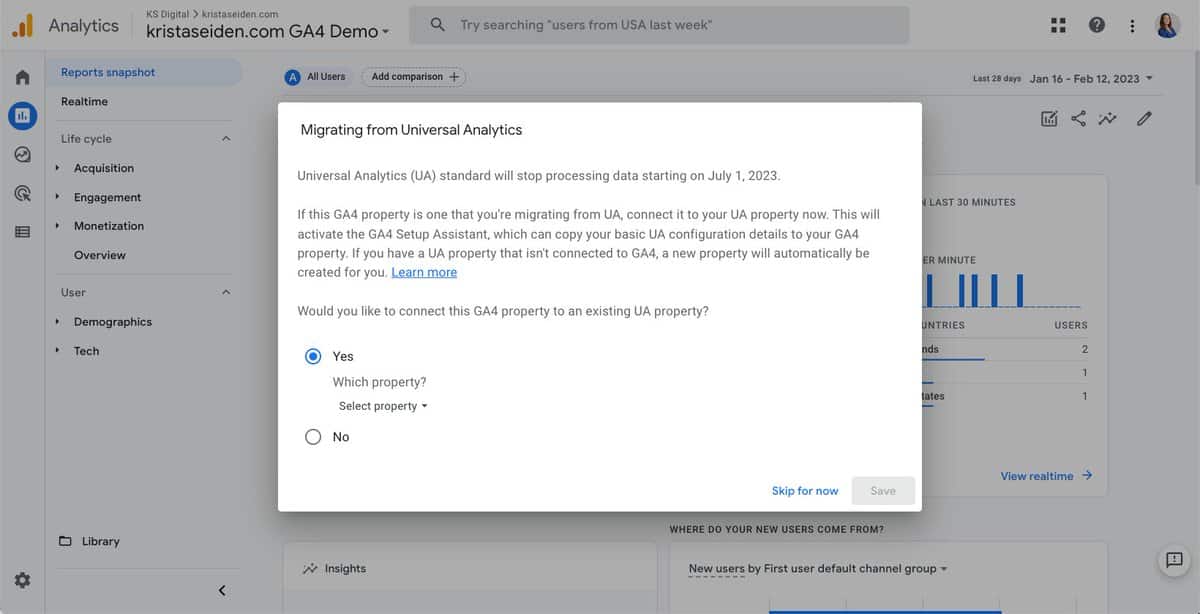
Have you seen this popup modal in GA4? Likely yes, because it pops up every time you log in or refresh.

GA4 property migration popup

What does linking do? It tells Google that you have created a GA4 property tied to a UA property.

Will that stop Google from automigrating you?

Not necessarily.

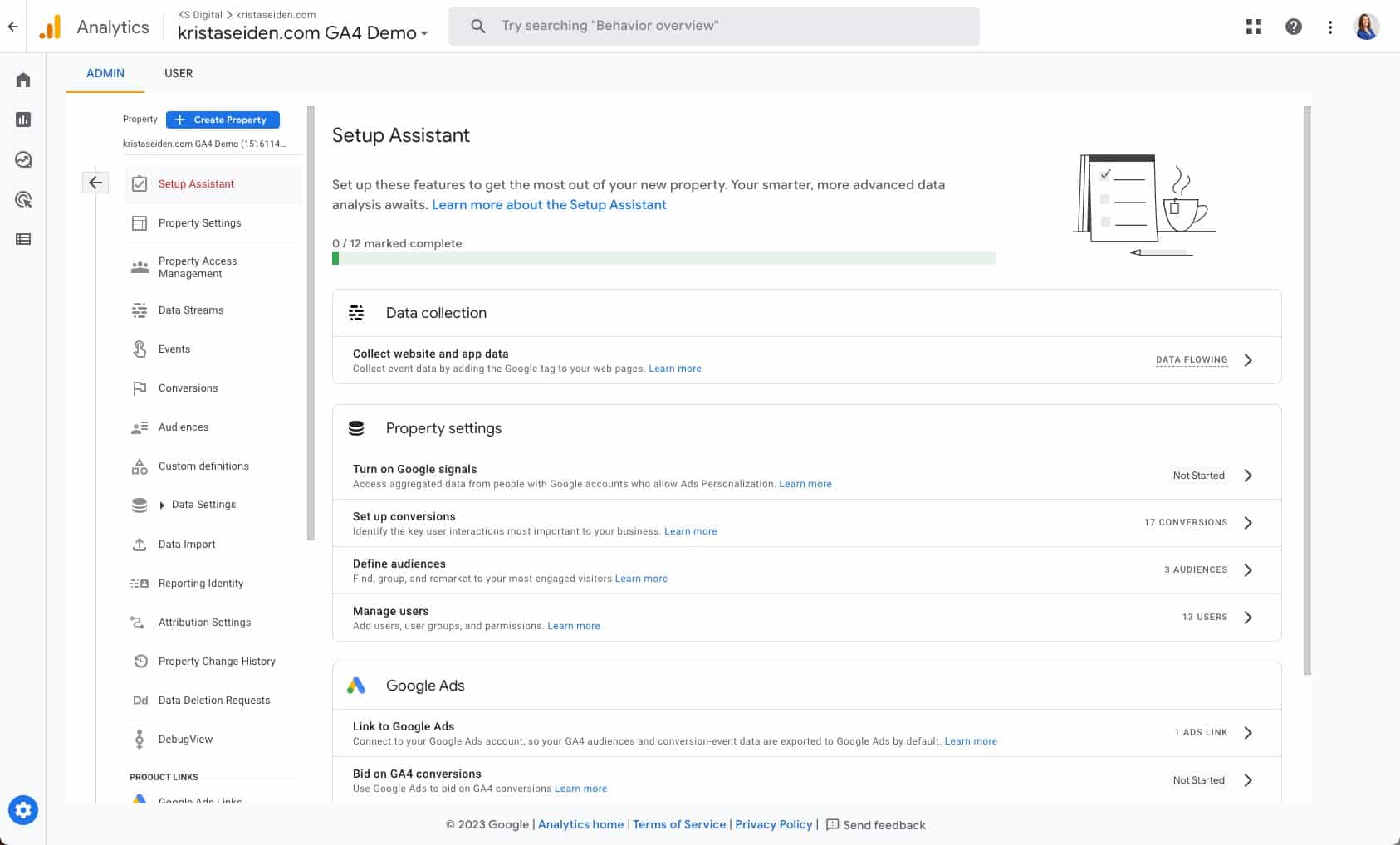
That will depend on how much of the GA4 setup assistant you have completed (more on that in a moment).

Scenario 3: You have created a GA4 property and linked it to a UA property but haven’t completed all GA4 Setup Assistant steps.

If you’re not opted out of migration in UA, then Google will start filling in the gaps for you in this scenario.


Get the daily newsletter search marketers rely on.

<input type="hidden" name="utmMedium" value="“>
<input type="hidden" name="utmCampaign" value="“>
<input type="hidden" name="utmSource" value="“>
<input type="hidden" name="utmContent" value="“>
<input type="hidden" name="pageLink" value="“>
<input type="hidden" name="ipAddress" value="“>

Processing…Please wait.

function getCookie(cname) {
let name = cname + “=”;
let decodedCookie = decodeURIComponent(document.cookie);
let ca = decodedCookie.split(‘;’);
for(let i = 0; i <ca.length; i++) {
let c = ca[i];
while (c.charAt(0) == ' ') {
c = c.substring(1);
}
if (c.indexOf(name) == 0) {
return c.substring(name.length, c.length);
}
}
return "";
}
document.getElementById('munchkinCookieInline').value = getCookie('_mkto_trk');


Using the GA4 Setup Assistant

The GA4 Setup Assistant is a 12-step tool that helps you track your GA4 migration progress.

It has some pretty useful tools included, such as help with audience migration and a more straightforward process for Google Ads linking.

GA4 Setup Assistant

Ads linking

Generally, you must have dual admin access, meaning you must be an admin on both the Analytics and Ads accounts to link. It can be frustrating and time-consuming to ensure you have the right access levels.

The setup assistant tool references the links you have in UA and does not require admin access to Ads to link. This is great if you are having someone not typically involved in Ads helping you migrate, such as a contractor or agency.

GA4 Setup Assistant Google Ads linking

Once you click Import from Universal Analytics, a new screen shows you all of the Ads links you have set up in UA.

You can check or uncheck the boxes for what you want to import to GA4 and then hit Import selected Ads links. It’s as easy as that.

GA4 import Ads links

Conversions

The tool will reference your conversions in UA and check if they are eligible (i.e., event or destination goals) for migration to GA4.

Goals using other goal types or regex are not currently eligible for migration, but maybe in the future.

GA4 Setup Assistant conversions

This migration screen is similar to the Ads linking screen. Check the eligible goals you want to migrate to GA4 conversions. Ineligible goals will be grayed out.

You have the option to change the name of the conversion. I recommend leaving it in the underscore format.

GA4 import existing goals

Users

This one isn’t as flashy, but if you have a lot of users with access to your UA property that you want to copy to GA4, it may be the most helpful tool.

When you select Import from Universal Analytics, it will send you to a help center article detailing the process.

You will need to use a Google Sheets Add-on tool for this. It sounds like work, but it’s quite quick and painless. The help center article gives great step-by-step instructions on how to use it.

Why some users might want to opt out

Back to the warnings I have in store for you…

Let’s say you fall into Scenario 3 (that is, you have created a GA4 property and linked it to a UA property but haven’t completed all GA4 Setup Assistant steps).

Whatever you have not marked as complete in the GA4 Setup Assistant tool will be done for you.

This is where, in my opinion, things can get pretty sketchy fast.

GA4 Setup Assistant - Incompletea

Yes, I just told you the Setup Assistant has some useful tools. But they are helpful because you can control the migration yourself.

For all 12 steps in the Setup Assistant, you must mark them Complete even if you have not done them – unless you want Google to do it.

This is especially important for these seven steps:

  • Turning on Google Signals.
  • Setting up Conversions.
  • Defining Audiences.
  • Managing Users.
  • Linking to Google Ads.
  • Bidding to GA4 conversions.
  • Targeting ads to GA4 audiences.

Let’s break a few of these down:

Linking to Google Signals

Google Signals is required for remarketing/retargeting with Google products. But some countries may have legal implications or restrictions, so I’d suggest checking with your legal team to be sure.

Managing Users

I just said how much I like this feature. But with great power comes great responsibility. You should check the access being granted, as there may be users you do not want to migrate. If you let Google do it, they’ll migrate everyone from UA.

Bidding to GA4 conversions

This is where the real danger begins. If you let Google migrate your conversions for you, and you haven’t checked them, you’re taking their word that you are still considering the actions from UA that they could migrate to be important.

Then, if you let Google bid to those conversions in Ads, they are changing the goals from UA to GA4 conversions that you are spending real money against.

If you didn’t set up those conversions, you risk an automated process spending your money in a way you may not want or that is not optimized toward your current goals.

Targeting Ads to GA4 Conversions

Same concerns as above. You would have Google migrate audiences for you, hoping they are good enough, and then bid toward them with your money. Your oversight is taken out of the process.

So what will migration look like?

For some things, like conversions, they may append a UA_ to the name of the conversion in GA4 to indicate that it came from UA. Other things may not have any indication of where they came from.

Convinced? Here’s how to opt out

So are you convinced yet that you should opt out of automigration? Here’s how.

In your Universal Analytics account, go to Admin > Property column > GA4 Setup Assistant.

Scroll to the bottom and toggle off the switch for “Automatically set up a basic GA4 property.”

GA4 automigration opt-out

Opting out will prevent the UA property from being migrated.

If you don’t opt out but are linked (that popup modal we keep getting), then you will need to Mark as complete all 12 steps (or whatever you don’t want automigrated) in the Setup Assistant in your GA4 property.

If you do not opt out or do not mark all as complete, Google might migrate some or all of your UA property to a GA4 property starting as early as this week.

The more complicated your UA property, the later it will be migrated since they’ll likely start with simpler properties.

The post GA4 ‘auto-migration’: Here’s why you should opt out appeared first on Search Engine Land.

Original source: https://searchengineland.com/ga4-auto-migration-opt-out-393786

All The Welsh Funding that is Available

Reading Time: 5 mins

All our readers across Wales (and the Welsh people living elsewhere of course), will today be donning their traditional dress, eating Welsh Cakes and Cawl and celebrating all that it is to be Welsh. Why? Because it’s St David’s Day!

In honour of all of our beautiful countrymen we have done a round up of all the grants and funding, only available to Welsh people. Dydd Gwyl Dewi Hapus.


EDUCATION

welsh funding - education

University fees

There are alot of schemes in place to make studying in Wales affordable for Welsh people.

Undergraduates from Wales have a generous package of student living cost support. For 2023, maintenance support has increased by 9.4% – in line with the National Living Wage. When you begin to repay your student loan, you can get up to £1,500 knocked off your debt.

To find out more click here.

Pupil Development Grant

School children from lower-income families who are eligible for free school meals in Wales are eligible for this grant. You could receive a grant of £225 per learner, and £300 for those entering Year 7. This is due to the costs associated with starting secondary school, such as new uniform costs.

All compulsory school years are now eligible for this grant. This means families who qualify for certain benefits can submit a claim if they have a child in primary school from reception to Year 6, or secondary school, in Year 7 to Year 11.

All looked after children qualify for the grant, whether they receive free school meals or not. Pupils who receive free school meals due to transitional protection arrangements do not qualify for this funding.

Families are only entitled to claim once per child, per school year. The 2022 to 2023 scheme is now open and will close on 30 June 2023.

For more information click here.

RUDBAXTON PARISH EDUCATION

The Rudbaxton Education Fund gives grants to individuals under the age of 25 who live in the parish of Rudbuxton in Pembrokeshire, Wales.

Grants are available to support students with the costs of materials, equipments, activities and trips, as well as the general costs of higher education. Some of the grants given may include bursaries, travel costs to your place of education and in some circumstances, course fees.

Find out more here.

Student finance

Thinking of going to University? Don’t let money get in the way of your goals. You may be eligible for student finance to support you through your studies.

Find out more here.


General

welsh funding support

DISCRETIONARY ASSISTANCE FUND (DAF)

The Discretionary Assistance Fund provides 2 types of grant that you do not need to pay back. These 2 types are:

  1. Emergency Assistance Payment (EAP) – helps to pay for essential costs such as food, gas, electricity, clothing or emergency travel.
  2. Individual Assistance Payment (IAP) – helping you or someone you care for to live independently in their home or a property you or they are moving into.

For more information, click here.

cost of living support

Local authorities are giving residents a range of support as the cost of living continues to increase. It differs geographically, so you will need to use the Welsh Government’s website to search your postcode or select your local authority from a list.

Find out more here.

UNIVERSAL CREDIT

If you are on Universal Credit, you can also get other forms of support. You may be able to get a budgeting advance, if you have been receiving UC for 6 months or more. This is to help pay for emergency household costs, however you will be required to pay this back through deductions on your regular UC payments.

You will also be able to receive support from food banks, and emergency top-ups from your energy supplier should you not be able to pay for energy. However, any emergency top ups will need to be paid back through your meter.

Find out more here and here.

WELSH WATER ASSISTANCE FUND

The Customer Assistance Fund is designed to help those in severe financial hardship to clear debt and get on top of their payments. If you are in arrears with Welsh Water, this could help you.

If you’re successful in your application, Welsh Water will set up a monthly, fortnightly or weekly payment plan for your current year’s charges. Once you have made payments for 6 months, they could pay off 50% of your previous arrears! If you make payments for a further 6 months, they will then pay off the rest of your previous arrears.
Find out more and how to apply here. You can also find out more information here.

fuel support scheme

Find out if you can get a one-off, fuel support payment of £200 on your local authority’s website. Or, you can search your postcode and local authority from a list. Check it out here.


housing

make money online

homelessness

If you are homeless, or fear you may become homeless, you can find lots of support and information to help you. Local authorities must help people who could lose their home or are homeless. They can help you find a home. They work with other support organisations that can help people keep their homes or find a new one.

Find out about the support in your area here.

adapting your home

If you are an older person or have a disability, you may be eligible for the ENABLE scheme, which gives support to those living independently. You can receive small, medium and large adaptations to your home, depending on your level of need.

Small adaptations include small ramps, stair rails and accessible taps. Medium adaptations may be those such as walk-in showers or chair lifts. If you need a building extension or moving bathroom or kitchen, this would count as a large adaptation.

Find out more about this support here.

THE ARTS

be cheerful

INTERNATIONAL OPPORTUNITIES FUND

The purpose of this arts fund is to:

  • Support the development of relationships, collaborations and networks between Wales’ creative professionals and arts organisations and international partners.
  • Share experiences and skills through the arts within an international context.
  • Raise the profile of Wales and its connections through the arts internationally.

Hurry, applications close 15th March 2023. If interested, click here.

Books Council Wales

The Advances/Fees to Authors and Illustrators Scheme enables publishers in Wales to commission
books of wide appeal which will help them to increase sales, target new markets and develop their
future publishing programmes as a whole
.

To learn more click here.

Literature Wales Events Funding

Literature Wales’ Inspiring Communities Fund funding scheme (formerly Writers on Tour) is a unique funding scheme for literature events.

The scheme offers financial support of up to 50% of the fees paid to writers for events including talks, lectures, creative writing workshops and more. These events can take place anywhere in Wales, in community halls, pubs, libraries, schools, youth clubs – and even on virtual platforms for groups who are meeting online.

Click here for more info.

Creative Wales

Creative Wales is an agency set up within Welsh Government in early 2020.

Their mission is “to drive growth across the creative industries, build on existing success and develop new talent and skills – positioning Wales as one of the best places for creative businesses to locate and thrive.”

For funding opportunities in all creative sectors click here.

Ffilm Cymru

Ffilm Cymru offer funding and training supports emerging and established filmmakers to realise their creative ambitions, gives audiences across Wales access to exciting cinematic experiences, and inspires people of all ages and abilities to participate in film education.

For more info click here.

The post All The Welsh Funding that is Available appeared first on MoneyMagpie.

Original source: https://www.moneymagpie.com/make-money/all-the-welsh-funding-that-is-available

900,000 more households to receive energy bill support

Reading Time: 2 mins

900,000 more households to receive energy bill support.

Almost one million households across England, Scotland and Wales will benefit from the government’s £400 help with energy bills. An online application portal opened on Monday. This allows households without a direct relationship to an electricity supplier, such as those living in park homes or care homes, to apply to receive one-off support. 

Applications can be submitted via the government’s secure online portal to receive the non-repayable lump sum, under the ‘alternative funding’ route of the government’s Energy Bills Support Scheme (EBSS). If you do not have internet access, you can speak to the dedicated customer helpline via telephone. 

To ensure people can receive this benefit as quickly as possible, the payment will be put straight into people’s bank accounts. Over £7.2 billion has been provided so far to 97% of households across England, Scotland and Wales. Monthly instalments were given to people, either £66 or £67 at a time. 

This  funding is designed to ensure the same level of support reaches those without a direct electricity supplier. It is also available for households who get their energy through a commercial contract, or those who are off-grid. 

The government will never provide links to the application portal, or directly ask individuals to apply for the £400, so beware of scammers using this as an opportunity to steal your personal information. 

Once you have applied to receive energy support and your application has been processed and verified, your details will be shared with your local authority, who will deliver the support directly to your bank account, in one lump sum. 

The exact date households will receive the support will differ. It depends on when the application is made and when payment can be processed. 

Minister at the Department for Energy Security and Net Zero, Amanda Solloway, said:

“We understand the pressure households are under which is why we’ve already stepped in to pay around half of people’s energy bills this winter, and from today, thousands more will be able to apply securely for their £400. 

“Today I’m urging everyone who couldn’t get their EBSS discounts in the regular way to apply via our secure channels. If you don’t have a direct contract with an electricity supplier, it’s essential you submit your application as soon as possible. The sooner you do, the sooner help can get to you.” 


For more information on energy bill support, click here. 

The post 900,000 more households to receive energy bill support appeared first on MoneyMagpie.

Original source: https://www.moneymagpie.com/make-money/900000-more-households-to-receive-energy-bill-support