A guide to keyword cannibalization in SEO and how to fix it

Keyword cannibalization happens when you have two or more pages ranking for the same keyword. It is generally considered undesirable. 

This article will help you decide whether you have a keyword cannibalization problem and, if so, how to solve it.

Is keyword cannibalization always problematic?

Before fixing keyword cannibalization, check whether it is a real problem for your site.

Sometimes, two pieces of content ranking can be favorable, especially with an indented SERPs.

Screenshot from Google SERPs showing indented search results. An example of where keyword cannibalization is not really a problem.

For Delish, these two pages ranking on page 1 are beneficial. In one search, they’ve got two pieces of content ranking. The indented SERP gives Delish more space in the page and increases their chances of a click.

A quick browse of these two pages will show similarities in ranking keywords. For example, according to Semrush, both pages rank for:

  • “quick easy healthy lunch”
  • “easy healthy lunch ideas”
  • “easy healthy lunch”
  • “easy and healthy lunch ideas”

You don’t have to take action on two pages ranking when there are indented SERPs. Leave them especially if you’re getting clicks and conversions.

Identifying keyword cannibalization that needs fixing

If you don’t have access to software to help spot cannibalization, you can find potential issues with Google site search

Use the following when searching:

  • site:example.com “keyword” 
Screenshot of Google showing how to identify keyword cannibalization with the site: search query.

The screenshot above shows how Google has listed content on and around “healthy” and/or “lunch” published on the Delish website. 

If you have similar results, look at the pages and investigate if they are problematic.

To identify problematic cannibalization problems, look for the following:

A sudden drop in clicks or impressions

This can happen when you publish a new piece of content and Google prioritizes the new piece over what was already ranking. 

This can return to normal after a while, but if it doesn’t, look at the next section on fixing keyword cannibalization.

Struggling to rank despite your best efforts

Two pieces of content targeting the same SERP intent can be “confusing” to Google. 

It indicates that your content strategy isn’t as robust as it should be. 

Pages ranking for a keyword that isn’t supposed to

If you’ve worked on your content strategy, but the wrong page still ranks, then you’re almost definitely cannibalizing yourself.

In this situation, follow our tips on what to do when the wrong page ranks.


Get the daily newsletter search marketers rely on.

<input type="hidden" name="utmMedium" value="“>
<input type="hidden" name="utmCampaign" value="“>
<input type="hidden" name="utmSource" value="“>
<input type="hidden" name="utmContent" value="“>
<input type="hidden" name="pageLink" value="“>
<input type="hidden" name="ipAddress" value="“>

Processing…Please wait.

function getCookie(cname) {
let name = cname + “=”;
let decodedCookie = decodeURIComponent(document.cookie);
let ca = decodedCookie.split(‘;’);
for(let i = 0; i <ca.length; i++) {
let c = ca[i];
while (c.charAt(0) == ' ') {
c = c.substring(1);
}
if (c.indexOf(name) == 0) {
return c.substring(name.length, c.length);
}
}
return "";
}
document.getElementById('munchkinCookieInline').value = getCookie('_mkto_trk');


Fixing keyword cannibalization 

How you fix keyword cannibalization will depend on the problem it’s causing and the solution most useful for your readers.

Here are some keyword cannibalization solutions to consider.

Internal linking

An internal linking strategy is a good first effort to resolve keyword cannibalization. 

Here, you won’t be taking pages down or redirecting content – a fairly safe option if you feel nervous about the consequences.

How to fix keyword cannibalization with internal linking

Internal linking is a powerful tool for SEO. It’s useful for readers to find relevant sources and related content. It also gives Google a directive on what a page should rank for.

If you’re doing content the right way, you know what the two pieces of content should rank for. 

So you can use an internal link from one piece to the other to reinforce where they sit in website architecture and what people might search to find the piece.

In this instance, opt for an exact match keyword or something close to it.

Review your internal links and identify links pointing to the two ranking pieces. You might be pointing to the pages with the same anchor text. 

You can get a good idea of what anchor text you’re using to link to pages with Screaming Frog.

Open Screaming Frog, then click crawl your site. Filter by HTML, click the page you want to view, then hit inlinks.
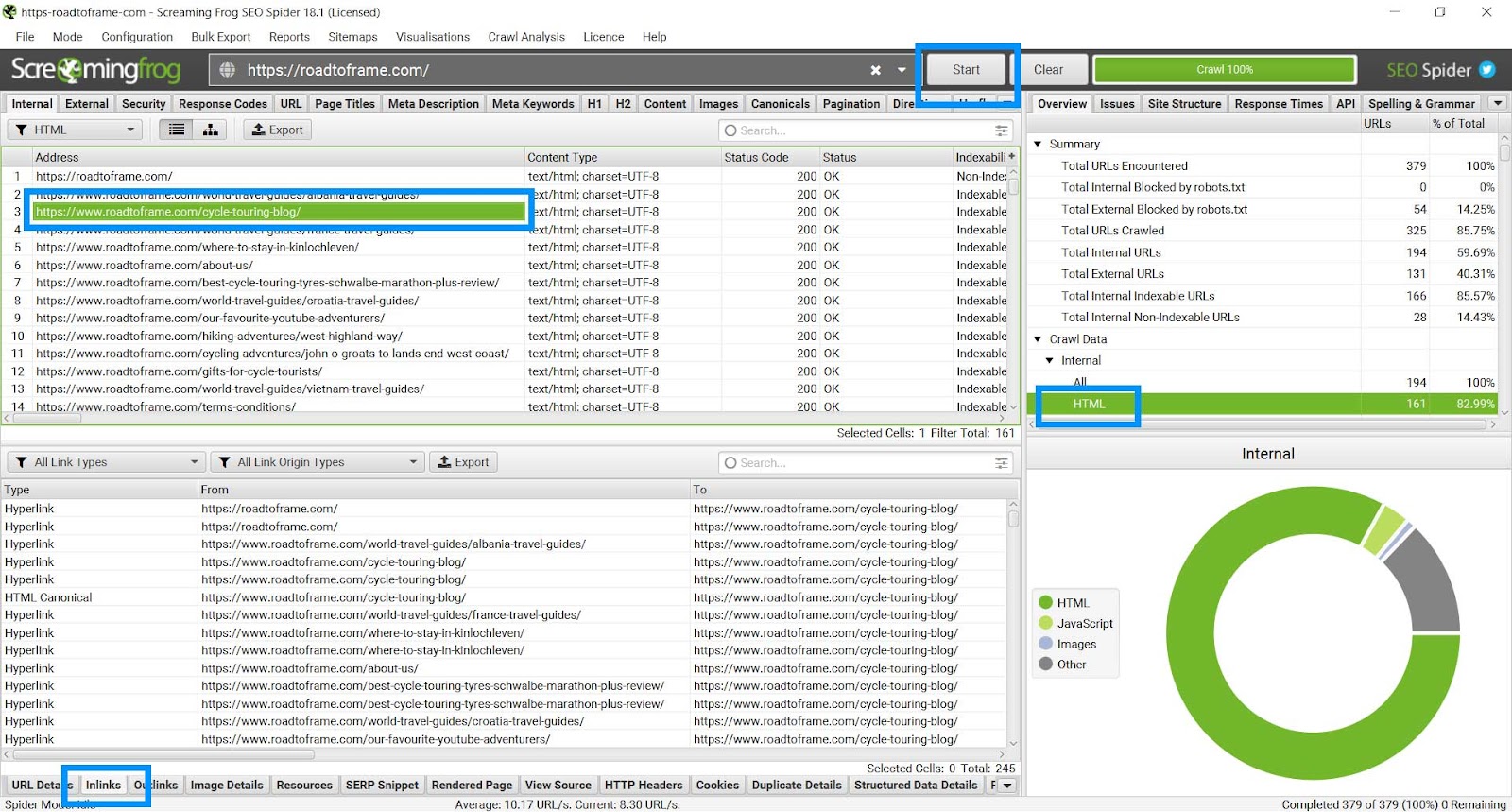
Annotated screenshot of Screaming Frog showing the steps to analyze internal links to help solve keyword cannibalization issues.

You’ll see which pages link to your page and with what anchor text. With a quick edit you can straighten out your internal linking strategy.

Pro tip: When building a content plan, prepare a content database (like a Google Sheet) where you can pick a keyword from the cluster to use in your anchor links. This process prevents writers from adding random internal links in their articles.

Refining keyword clusters and establishing clear search intent

Perhaps you’ve identified keyword cannibalization but want to keep the two pages. In this case, you might need to give each piece a defined purpose. 

To do this, develop a keyword cluster and establish clear search intent. Each piece of content must do something unique.

Using the Delish example from above, we can see that although similar, the two articles have clear search intent. 

  • One article recommends lunch ideas for work.
  • The other recommends packed lunches. 

Taking a packed lunch to work is synonymous with a work lunch, but it isn’t just for work purposes.

Content consolidation and 301 redirects

It’s fairly intuitive when you need to do a content consolidation and a 301 redirect. Mostly, you can tell immediately if a page is targeting the exact same keyword.

Going back to the Delish example, although similar, the two pages on healthy lunches have two different intents. As mentioned, one article focuses more on lunches for work, and the other is about packed lunches.

Although nuanced, the two content pieces can co-exist assuming they’re not causing issues behind the scenes.

However, if the two articles were “55 Healthy Lunches” and “The Best Healthy Lunches,” there is an issue.

The target keyword is clearly similar – “healthy lunches” and “best healthy lunches.” Sounds like the same thing, right?

To confirm, a quick search of  “healthy lunches” and “best healthy lunches” returns almost the exact same SERPs.

So, these articles would be consolidated, and one would be redirected to the other.

How to fix keyword cannibalization with content consolidation and a 301 redirect

Before consolidating two (or more) articles, do your due diligence. Use data to help you decide which URL you’re keeping and which one you’re redirecting.

  • Consolidate the content in the two articles. When you do this, make sure you give it a thorough edit. You’ll do more bad than good if you end up with Frankenstein-esque content. To succeed with this tactic, your content must be high-quality and well-written. 
  • Find the most successful URL by looking at Google Search Console data. Filter by page to see which URL receives the most clicks, impressions and average position. Generally, one will supersede the other a lot, so the choice will be obvious.
Annotated screenshot of Google Search Console showing the page filter.
  • If the winning URL doesn’t jump out at you by this point, check the backlink profile. Although you will redirect one link to the other and carry over those backlinks, keeping the content on the URL with the strongest backlink profile would be better.

Add a canonical

If the two pages need to exist but you don’t want Google indexing both, you could add a canonical. 

This method is useful on ecommerce websites, particularly Shopify sites, where the same product exists on multiple URLs.

We can see the canonical in action on Helm’s Shopify website.

Their Xander Olive shoe exists on two URLs:

  • https://helmboots.com/products/the-xander-olive 
  • https://helmboots.com/collections/the-xander/products/the-xander-olive

A search within the code of the /collections/ URL shows the canonical pointing to the product.

Screenshot of Helm website showing canonical in their code.

How to avoid cannibalization in the future

Cannibalization issues occur when there’s no clear plan for content production. Without a plan, well-intentioned writers can deliver similar pieces of content. 

To avoid cannibalization, keep a content log and monitor the following:

  • Focus keyword: Assign one to each piece of content.
  • Keyword cluster: Detail all other keywords the piece should rank for.
  • Content pillar/topic: This helps visualize all content under a certain topic.

The closer you are to your content and its purpose, the less likely you are to create cannibalizing content. It helps to have a strategic SEO professional to guide the process so they can correctly assign keywords. 

If each piece of content fits within a specific pillar or topic, you can filter content by that topic and double check you’ve not already created content before you write it.

Or, you can use your content research process to identify content that could be edited instead of recreated. Sometimes, a good edit on an existing article can do wonders for your SEO.

The post A guide to keyword cannibalization in SEO and how to fix it appeared first on Search Engine Land.

Original source: https://searchengineland.com/keyword-cannibalization-seo-guide-393596

Google launched 2 new asset creation and customer acquisition tools

Google’s Search Ads Week kicked off with two new tools to help advertisers deliver faster creatives and better performance.

  • Create new assets with Google’s AI 
  • New customer acquisition goals

Create new assets with Google’s AI. Google’s goal is to help advertisers deliver effective ads to their target audience by having a variety of relevant creative assets available. To achieve this, they now offer a setting called “automatically created assets” which generates new ad components based on an advertiser’s existing assets and landing page. This setting allows responsive search ads to show potential customers the best combination of assets.

Now, the open beta for automatically generated assets is available to all advertisers in English. Early adopters who have used this feature for headlines and descriptions have seen an average increase of 2% in conversions, with a similar cost per conversion, for ad groups that use responsive search ads.

Home Business

New improvements coming to assets. As part of this update, the following improvements will roll out in the coming weeks:

  • Ad Strength will take into account both automatically created assets and your existing assets when determining your rating.
  • Automatically created assets will use inputs you’ve provided such as your keywords to customize your headlines and improve their relevance to the query when it’s predicted to improve performance.
  • You’ll also be able to remove any automatically created assets that you’d prefer not to include in your ads.

Additional languages for automatically created assets will be launched later this year.

Connect with new customers on Search. A new customer acquisition goal for Search campaigns has been launched globally. This goal utilizes Smart Bidding and first-party data to optimize campaigns and attract new customers during peak periods. By combining the new customer acquisition goal with bidding strategies like Maximize conversion value with a target ROAS, advertisers can prioritize and target high-value customers.

Early adopters. Numerous businesses have already utilized this goal to reach out to potential new customers. Baltic Born, a fashion retailer, is an example of one such business with an ambitious revenue growth target. To expand their customer base beyond repeat customers in a highly competitive market, Baltic Born implemented the new customer acquisition goal for Search along with a target ROAS value-based bid strategy. As a result, they were able to achieve a 73% increase in new customers and a 36% rise in revenue.

The new customer acquisition goal has two modes that help you to reach your campaign goals:

  • Value New Customer: Bid higher for new customers than for existing customers.
  • New Customers Only: Bid for new customers only.

Dig deeper. You can read more about the new tools on the Google Ads Help website. You can also register for Search Ads Week here.

Why we care. The new tools make it easier for advertisers to expand your customer base and grow your business by connecting with potential new customers. The goal utilizes Smart Bidding and first-party data to optimize campaigns during peak periods, making it easier for businesses to prioritize and find high-value customers.

The post Google launched 2 new asset creation and customer acquisition tools appeared first on Search Engine Land.

Original source: https://searchengineland.com/google-launched-2-new-asset-creation-and-customer-acquisition-tools-393637

This day in search marketing history: February 26

Google expands mobile-friendliness as a ranking signal

In 2015, Google announced it would expand its use of mobile-friendliness as a ranking signal, beginning April 21.

This algorithmic change would have a “significant impact” in the mobile search results, impacting all languages worldwide, Google said.

However, when April came, the general consensus was that Mobilegeddon was fairly insignificant, for all the hype and panic their Feb. 26 announcement created.

Google also announced that apps indexed by Google through App Indexing would begin to rank better in mobile search. Google said this only will work for signed-in users who had the app installed on their mobile device.

Read all about it in Mobilegeddon Cometh: New Google “Mobile Friendly Update” To Reward Sites Beginning April 21.


Also on this day


How to identify your products for Google

2021: Google published a list of best practices to help ensure that its search engine understood the products that were being referenced. 


Google mobile-first indexing to be applied to all sites within a year

2020: Google was sending notices to sites that had mobile-first indexing issues. 


Create display network exclusion lists with this (free) tool

2020: A tool for those tired of manually weeding through placement reports to exclude inappropriate websites and apps from display campaigns.


Google Search Console now lets you export more data

2020: Search Console users could download complete information (instead of just specific table views) from almost all reports.


Google search view in 3D now live for e-commerce sites

2020: A Burberry bag was showing up with a “view in 3D” option in the Google search results.


Google to kill off property sets within Search Console

2019: Google said you could download the data from the interface or the API before they turned it off completely.


Google Ads to sunset average position reporting metric later this year

2019: Average position was one of the few constants for more than 15 years. But with the removal of right rail ads, in particular, its utility sharply declined.


Google call-only ads getting ‘expanded’ with more characters

2019: The other change was that name of the business would move to the description line.


Google releases Mobile Scorecard & Impact Calculator tools to illustrate importance of mobile page speed

2018: One tool showed how a site stacks up against the competition on mobile. The other aimed to drive home the impact mobile speed can have on the bottom line.


Google confirms bug with crawl stats in ‘time spent downloading a page’ Search Console report

2018: Google’s John Mueller confirmed a reporting glitch with the crawl stats “time spent downloading a page” report in the Google Search Console for on Feb. 20 and 21.


In response to EU antitrust ruling, Google Shopping now shows ads from competing shopping engines

2018: In a new structure, the Google Shopping business unit bid against other Comparison Shopping Engines in the ad auction to give the competing engines “equal treatment” as mandated in the ruling.


Google Word Coach, a fun word game in the search results

2018: Google added a new feature to help non-English speakers expand their English-language vocabulary. 


Google: AMP Not Yet A Search Ranking Signal

2016: Google’s John Mueller said you could use AMP to become mobile-friendly, but AMP itself was not a ranking signal.


Google Confirms Review Stars’ Mysterious Disappearance In Search Results Was A Bug

2016: Google review snippets returned after a bug caused them to drop out of much of the search results for about a week.


AdWords And Bing Ads Both Having Late-Week Reporting Troubles

2016: Google AdWords reports weren’t downloading or printing. Bing Ads had reporting delays that affected the Web UI, mobile and API.


Google App Updates Will Include New Animations & Ability To Change Google Logo Colors

2016: Users would be able to change the color of the Google logo using a “finger painting-like” feature.


Search In Pics: Coca Cola Google Cardboard, Googley Volvo & Animated Google Sign

2016: The latest images showing what people eat at the search engine companies, how they play, who they meet, where they speak, what toys they have and more.


Google’s Matt Cutts: While Scientific Content Is Great, Clarity & Focusing On The Searcher Is Important

2014: Cutts answers the question: “Should I focus on clarity or jargon when writing content?”


Movie Sites Ranking Better In Google, Now That “Transient Issue” Fixed

2014: Rankings were restored and most traffic was returning to the affected websites.


Hiding From That Google Penalty? It May Find You At Your New Home

2014: Even if you moved your penalized site to a new domain name and didn’t redirect the penalized site, Google might still find it and pass along the bad signals.


AdWords Flexible Conversion Counting Officially Launched, Welcome “Converted Clicks” and “Conversions”

2014: The company officially announced the launch of Flexible Conversion Counting, and advertisers would see new columns in AdWords.


Google Shares Performance Stats On Search Network With Display Select Campaigns

2014: Google released some case study performance results on the new campaign type.


FOX Partners With Google To Allow Voting For American Idol On Google’s Search Results

2014: All you had to do was go to Google, search for [american idol] or [idol] during the voting window, and select from your favorite finalists.


Google Brings Back Right-Click-For-Directions To Google Maps

2014: Users could also use the “What’s Here” option to quickly get lat-long coordinates for any spot on the map.


Baidu Posts 50 Pct. Revenue Growth But Shy Of Investor Hopes

2014: The company announced $1.573 billion in Q4 revenue, a 50.3% increase over 2013.


Welcome Martin Beck, Who Joins Third Door Media From The Los Angeles Times

2014: Beck was Third Door Media’s Social Media Reporter from March 2014 through December 2015.


Google Panda Two Years Later: 5 Questions With HubPages CEO Paul Edmondson

2013: Edmonson confirmed that Panda “caused a massive loss of traffic and revenue.” But HubPages wasn’t planning to change course; the planned was to improve quality.


The Hidden Google Search Box

2013: It seemed as if Google was testing hiding the search box completely from the Google search results page.


Number Crunchers: Who Lost In Google’s Panda Algorithm Change?

2011: The biggest “content farm” type brand that seemed to have suffered was Associated Content.


Yes, More Are Seeing A New Google Look-And-Feel

2010: Testing would continue until May, when it launched the new user interface.


Google Adds “Nearby” Local Search To Options Panel

2010: Google expanded the choices in its Search Options panel with the announcement of a tool to refine searches by location.


Google’s Street View Finds More Trouble In Europe

2010: Members of the European Union’s data protection group urged Google to make changes to its Street View mapping/photo service and warned that Google might be breaking EU laws.


Google News Officially Adds Advertisements

2009: After testing ads for the past few months, Google News officially rolled out ads on Google News search results to all US based searchers.


Google Gets On Twitter

2009: The first tweet was in binary and translated into “Feeling Lucky.” 


Google Maps Adds User Photos To Street View

2009: Google added geo-tagged Panoramio photos to StreetView images.


Report: Lack Of Buying Searchers Leading To Depressing Search Ad Market

2009: Rimm-Kaufman shared early first quarter PPC data showing the weak trends in retail for search advertisers.


Yahoo Search Updating: Weather Reports Go Away?

2009: Yahoo eventually did issue a weather report confirming that there are ongoing updates that would be “completed very soon.”


Yahoo Adds Facebook As A SearchMonkey Friend

2009: Yahoo announced that Facebook enhanced results were now turned on by default across search results.


Yahoo CEO Bartz: New Management To Make Yahoo “A Lot Faster On Its Feet”

2009: “For us working at Yahoo!, it means everything gets simpler. We’ll be able to make speedier decisions, the notorious silos are gone, and we have a renewed focus on the customer.”


Google AdWords Launches Limited Beta Test Named “Automatic Matching”

2008: Automatic Matching was a way for Google to help advertisers utilize their full budget towards keywords that they may have not been targeting.


Google Updates AdSense Terms & Conditions

2008: Google updated their AdSense terms and conditions to include better verbiage for new products and features, as well as an update to their privacy requirements.


Despite Takeover Turmoil, Yahoo Not Rolling Over & Playing Dead

2008: Yahoo CEO Jerry Yang said the Microsoft takeover bid had been “a galvanizing event for everyone at Yahoo.”


Minimum Bids In Yahoo About To Change

2008: Minimum bids could be lower or higher than $0.10.


Yahoo To Announce “Search Monkey” Enhanced, Annotated Results At SMX West

2008: Yahoo planned to unveil a project code-named “Search Monkey,” a set of open-source tools that allow users and publishers to annotate and enhance search results associated with specific websites.


Yahoo Buzz Launches: Votes, Searches, & Emails Used To Rank News

2008: Yahoo Buzz was a site where “buzz-worthy” news articles were highlighted based on user votes,
searching activity, and email sharing. 


Google Talk / Gmail Adds Live Chat & Invisible Mode Features

2008: The first feature was similar to a live chat box that you could add to any webpage and chat with anyone via your Google Talk or Gmail account.


Google Joins “Unity” Undersea Cable Consortium For More Transpacific Bandwidth

2008: Google joined a consortium of Asian companies to build an undersea transpacific fiber optic cable that would provide much greater bandwidth capacity between the United States and Japan.


Google AdWords To Show Advertisers Exactly Where Their Contextual Ads Are Displayed

2007: Google’s advertiser reports would begin listing the sites where each ad runs.


Google Steps Up Web Page Malware Notifications

2007: Google was giving more detailed reports on the malware issues with a specific site and they were also sending email notifications to webmasters about these malware warnings.


Google Video Plus Box Results

2007: Spotted in the wild.


Google Checkout Australia Coming Soon?

2007: It appeared that Google registered Google Payment Australia PTY. LTD. in Australia.


Google Ordered To Change AdSense Contract By South Korea’s Watchdog

2007: The Fair Trade Commission said the contract enabled Google to “one-sidedly cancel advertisement deals” with publishers.


Microsoft To Buy Health Search Engine Medstory Inc.

2007: Microsoft plans on building out a specialized search engine focused on delivering medical information to consumers.


Video Search Challenge Isn’t Speech Recognition, It’s Content Owner Management

2007: The real challenge was figuring out how to work with content owners, not speech recognition.


Pew Research: Wireless Internet Grows

2007: Pew asserted that roughly 13.5% of U.S. Internet users were accessing the Internet over mobile phones (or their equivalents).


From Search Marketing Expo (SMX)


Past contributions from Search Engine Land’s Subject Matter Experts (SMEs)

These columns are a snapshot in time and have not been updated since publishing, unless noted. Opinions expressed in these articles are those of the author and not necessarily Search Engine Land.


< February 25 | Search Marketing History | February 27 >

The post This day in search marketing history: February 26 appeared first on Search Engine Land.

Original source: https://searchengineland.com/search-marketing-history-february-26-393620

How You Could Be Drawing Pests into Your Home

Home Business Magazine Online

Every home deals with some type of pest from time to time. This is usually because of some overlooked things, either a famous pest hideout or something that you do not know can attract pests. Whether you want to prevent a pest infestation or are dealing with one, you need an expert provider of Pest Control Services to help you handle the issue. Aside from treating the infestation, pest control experts also give you advice on how you can avoid infestations in the future. Also, they will tell you the common things that can lure pests into your home. These include the following:

Overgrown Landscaping

Some pests love to stay in overgrown bushes where they can hide out. Thick bushes make a perfect place for slugs, snakes, and ants to hide. So, trim your landscaping regularly, particularly bushes against your home. And if you have been dealing with small animals, create open space by removing limbs 12 inches from the bottom.

Damaged Screens

Tiny holes in your window screens allow insects to enter your house. Also, missing or torn screens over crawlspaces and attics let even bigger pests in. So, check the screens in early spring and fall.

Pet Food Placed Outdoors

Pet food placed outside sets up a buffet for pests. If you have a bird feeder around, place it away from your house to prevent pests from tearing up your yard. If you really have to put pet foods outside, pick them up before nightfall or limit feeding to a space that is tightly fenced such as a dog kennel.

Old Door Insulation and Sweeps

Many pests can get through your house through the insulation and sweeps of your door. If you have an aging door sweep or insulation, check if you can see light around it while you are outside of the house. If this is the case, you will only attract bugs into your house through that light, so consider getting new sweeps and insulation. After all, new door insulation and sweeps will help ensure your home has climate-controlled air.

Dirty Dishes

Leaving dirty dishes in your sink offers pests an unlimited source of food. So, rinse your dishes after every meal and place them in the dishwasher. Keeping your sink free of dishes can eliminate a source of food for those unwelcomed guests. Also, you must wipe your counters and stove frequently to ensure you do not attract pests into these spaces.

The post How You Could Be Drawing Pests into Your Home appeared first on Home Business Magazine.

Original source: https://homebusinessmag.com/lifestyles/home-improvement/how-drawing-pests-home/

Roles of Expert Witnesses in Personal Injury Cases

Home Business Magazine Online

When you suffer an accident because of someone else’s fault, you may be able to use expert witnesses to prove your claim. An expert witness is one who uses their knowledge, training, and experience to provide strong and valuable opinions about certain aspects of your case. These people are important because their opinions are considered valuable to the court.

If you believe you have a legitimate claim, you should not miss out on expert witnesses. If you are stuck somewhere in the case, a Huntington Beach personal injury lawyer can suggest which expert can help bring clarity to things.

Roles of different expert witnesses in proving a personal injury claim

1. Medical professionals

Medical professionals include many people working in the medical field, such as surgeons, medical technicians, physician assistants, etc. They give valuable insights and opinions about a victim’s injuries. Some information includes the time of the accident and how it occurred. This can significantly help in figuring out the outcome of the case.

For example, suppose you were injured during surgery and filed a case of medical malpractice. Now, an expert witness working in the same field as the surgeon may be able to provide insights into whether it was indeed a case of medical malpractice or something else.

2. Accident reconstruction specialists

When it becomes too complex to determine the fault in an accident case in Huntington Beach, your attorney may contact an accident reconstruction specialist to understand the science behind the event. These individuals usually break down the accident using their knowledge of physics and the assistance of technology. They are especially helpful in clarifying the chaos, doubts, and confusion that usually surround accidents.

3. Mental health experts

Accidents in personal injury can cause psychological trauma, no matter whether they are minor or major. However, it is usually difficult to determine whether the person’s trauma has arisen directly from the accident or existed before it. This is where a mental health expert can help you.

They possess the skills to analyze a victim’s behavior and various other factors to see how the accident has affected the victim’s mental and emotional health.

4. Financial/economic professionals

Determining the true total costs of damages that occurred in a car accident can become complicated when the numbers are significant. The defendant usually is not ready to pay a huge amount. During this time, you may be required to present the opinions and insights of economic and financial professionals. They can understand the damages and include the future costs as well.

The post Roles of Expert Witnesses in Personal Injury Cases appeared first on Home Business Magazine.

Original source: https://homebusinessmag.com/management/legalese/roles-expert-witnesses-personal-injury-cases/

Leveraging TikTok’s ad content to get valuable insights on top-performing products

TikTok has just released a “Top Products” element to its Creative Center.

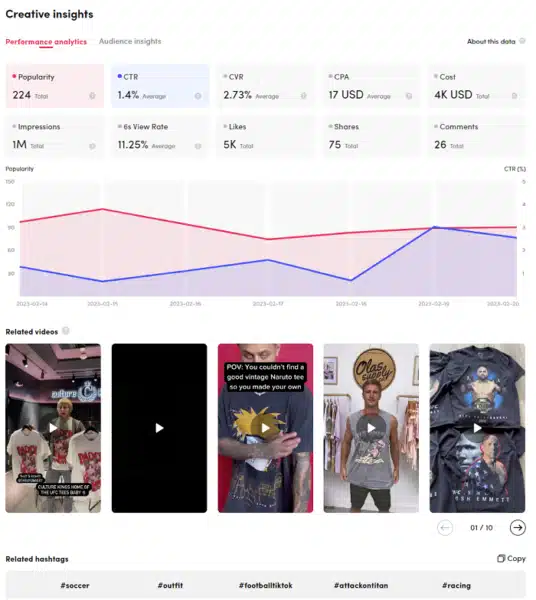
This data provides insights into the popularity of particular products on the app, as indicated by the frequency of ads featuring the item, as well as metrics such as impressions, view-through rate, comments, and likes. Essentially, all the relevant data points are available to analyze the performance of each product.

internet marketing

How it works. Utilizing the filtering options provided allows narrowing down the Top Products listing according to specific regions and product categories. You can also view the data for the last day, 7 days, or 30 days.

To gain a deeper understanding of a particular product, click on the ‘Details’ element on the far right of the listing. This will provide you with a comprehensive product overview, including data such as CTR, CPA, impressions chart, and more.

make money online

The ‘Audience insights’ element allows you to see an age bracket breakdown of who’s engaging with these ads, along with related interests, providing key data for analysis and planning efforts.

Dig deeper. You can check out the Creative Center here.

Why we care. This could allow advertisers to make informed decisions about new strategies. By analyzing the performance of specific products based on metrics such as impressions, CTR, CPA, and more, advertisers can determine which products are popular and which are not, and adjust their advertising efforts accordingly.

This data can also help advertisers identify trends in consumer behavior, which can inform their future product development and marketing campaigns. Ultimately, the insights gained from analyzing this data can lead to more effective and efficient advertising strategies, resulting in increased sales and revenue for the advertiser.

The post Leveraging TikTok’s ad content to get valuable insights on top-performing products appeared first on Search Engine Land.

Original source: https://searchengineland.com/leveraging-tiktoks-ad-content-to-get-valuable-insights-on-top-performing-products-393566

Ice Trick Obliterates Ugly Belly Flab Within Weeks!

Ice Trick Obliterates Ugly Belly Flab Within Weeks! http://importantweightloss.com If you’re looking for a weight loss supplement that’s a little bit out of the ordinary, you may have heard of the Alpilean supplement. This unique weight loss supplement uses an alpine ice hack which is said to be a revolutionary way to help people lose weight.

Ice Trick Obliterates Ugly Belly Flab Within Weeks! Apparently, the key to this weight loss supplement is its ability to help your body burn fat more efficiently. By using a special blend of ingredients, this Alpine ice hack is said to be able to help you lose weight quickly and safely. And best of all, this natural alpine ice hack is said to be gentle on your system, so you don’t have to worry about any nasty side effects. http://importantweightloss.com

Ice Trick Obliterates Ugly Belly Flab Within Weeks! The Alpine Ice Hack weight loss supplement has been formulated by Dr. Patla, a leading name in the weight loss supplement industry. The supplement contains ginger, turmeric, and other ingredients that treat low inner body temperature and promote healthy weight loss. The official website of Alpilean claims that a lower inner body temperature is the root cause behind someone being unable to lose weight. http://importantweightloss.com

Ice Trick Obliterates Ugly Belly Flab Within Weeks! This Alpine ice hack particularly works towards increasing inner core body temperature so that the heat produced by this can burn belly fat efficiently. Dietary supplements like Alpilean are very particular when promoting weight loss; the ingredients in the product target several fat cells and shrink them. Lastly, the supplement has been manufactured in an FDA-approved and GMP-certified facility which proves its genuine-ness and efficacy. http://importantweightloss.com

Ice Trick Obliterates Ugly Belly Flab Within Weeks! http://importantweightloss.com

Webinars: A complete guide with examples

Gathering online is a popular way to connect with a wider community that defies geography.

That’s true whether you’re chatting in Slack with coworkers, tuning in for a live stream, or attending an online event or webinar.

The pandemic accelerated the shift to online events. They’re still going strong and are more common now than ever.

One of these online events is especially relevant to brands and marketers – the webinar.

What is a webinar? How do you set one up and host it? What are some successful examples of webinars? It’s all in this guide.

What is a webinar?

A webinar is a seminar that occurs online. (Web + seminar = webinar.)

When you think of an in-person seminar or conference, you probably picture many speakers presenting industry news, innovations, and education in front of a live audience.

A webinar is pretty much the same, but it all plays out online, synchronously.

  • The audience watches live speakers and presentations on a particular theme or topic from the comfort of their own homes. 
  • During and after the presentations, the audience can participate in ways unique to webinars, such as asking the presenter questions, chatting with other viewers worldwide, or even collaborating with the presenter through interactive elements like surveys or polls.
  • Some brands record their webinars and repurpose the content, including offering replays for people who couldn’t attend live. 

What are the benefits of hosting a webinar?

There are a lot of reasons to add webinars to your brand repertoire. When done well, they can help you reap all of these benefits:

  • Build audience trust: Webinars represent a big opportunity to demonstrate your expertise and build trust through direct interactions with your audience.
  • Attract new leads: Online events are a draw for lots of people, and with a little promotion, new leads will find your webinar and sign up.
  • Create buzz around your brand: Online events like webinars are great for generating talk and buzz around the host: your brand.
  • Demonstrate your products/services: Webinars represent a chance to demonstrate how your relevant products/services work to an engaged audience.
  • Increase conversions: Demonstrating your expertise and knowledge and building trust through webinars can convert more leads to customers.

Ultimately, a well-crafted, well-produced webinar can bring ideal buyers straight to your virtual doorstep.

  • Webinars are the most popular type of content for B2B professionals, according to DemandGen’s Content Preferences Study. 
  • 91% said they prefer webinars over articles, whitepapers, and blog posts, according to a BrightTALK survey.
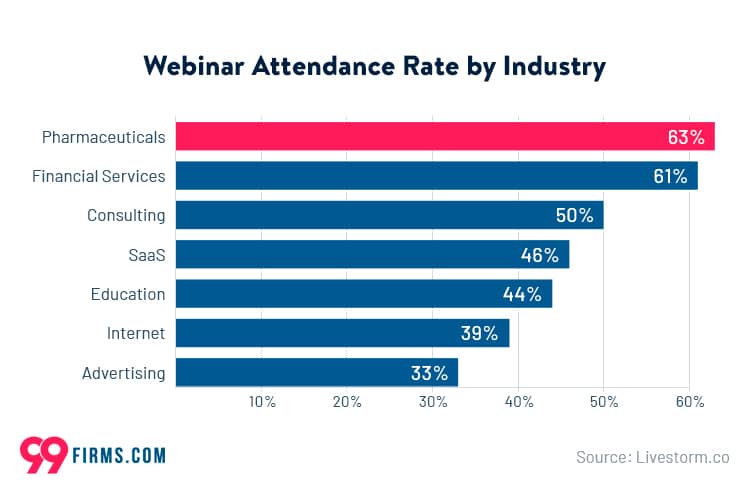
  • Webinars are a great idea for brands in most verticals, especially those in financial services, consulting, SaaS, and pharmaceuticals (the industry with the highest attendance rate).
Webinar attendance rate by industry
Source: 99firms

Get the daily newsletter search marketers rely on.

<input type="hidden" name="utmMedium" value="“>
<input type="hidden" name="utmCampaign" value="“>
<input type="hidden" name="utmSource" value="“>
<input type="hidden" name="utmContent" value="“>
<input type="hidden" name="pageLink" value="“>
<input type="hidden" name="ipAddress" value="“>

Processing…Please wait.

function getCookie(cname) {
let name = cname + “=”;
let decodedCookie = decodeURIComponent(document.cookie);
let ca = decodedCookie.split(‘;’);
for(let i = 0; i <ca.length; i++) {
let c = ca[i];
while (c.charAt(0) == ' ') {
c = c.substring(1);
}
if (c.indexOf(name) == 0) {
return c.substring(name.length, c.length);
}
}
return "";
}
document.getElementById('munchkinCookieInline').value = getCookie('_mkto_trk');


Best practices for putting together and hosting a webinar

If you’re interested in hosting a webinar or adding a weekly or monthly webinar series to your content lineup, consider these best practices.

1. Use the right webinar technology

You can’t run a smooth webinar without software.

Thankfully, there are many good webinar platforms with the right features for your needs at almost every price point. 

Generally, you’ll want to consider your budget, how many attendees you want to have the capacity for, recording options (for repurposing webinar content later), and interactive options (like live surveys and polls during presentations).

Here are a few webinar software options to start:

  • Zoom: Everyone’s favorite (or not) meeting software can also host your larger webinars. It includes tracking and reporting, CRM integration, and interactive features like chatting and reactions.
  • GoToWebinar: This option has a robust set of features for planning, promoting, designing, presenting, and analyzing your webinar.
  • eWebinar: If you’d rather host an evergreen webinar (one that plays on-demand but still has some live/interactive elements), this option is your best bet.

2. Choose a topic

Choosing one major, overarching topic for your webinar is a good idea. This keeps your event focused and its value clear to attendees.

If your webinar is in a single-speaker format, try to choose a narrower topic than something too broad like “personal finance planning” or “search engine optimization.”

Those topics are vast and can’t be fully covered in an hour. Instead, choose a deeper topic like “financial planning for new parents” or “SEO and your site content.”

If you plan to have multiple speakers, presentations, or sessions within your event, consider choosing a broader main topic, with each session exploring facets of that topic.

Always consider the value of your topic for your target audience. What would interest them? What information would help them? 

Topic research can help you answer these questions, such as polling your audience on social media, checking out what topics your competitors are addressing in their content, or even doing keyword research on a topic to see how many people are looking it up.

Whatever topic you choose, consider how to make it interactive and engaging. Ultimately, people who attend webinars want to learn but don’t want to feel like they’re sitting in a boring lecture.

what professionals want from webinars - brightalk

3. Choose a presenter and/or a speaker (or a panel of speakers)

Choosing the right presenter for your webinar will significantly impact its success. 

The right presenter will be a credible authority on your topic and comfortable speaking in front of people. You can choose someone from within the company – or not.

For example, you could invite a guest presenter, such as an industry influencer or well-known expert, to host and speak about the topic.

Sometimes inviting multiple expert speakers makes more sense for a webinar. Perhaps a team inside the company could present together, or different experts from various brands could gather virtually for a panel discussion.

4. Pick a format that makes sense 

There are multiple formats your webinar can take. Consider what would work best for presenting your topic, including the number of speakers you plan to have.

Here are some of the most common formats:

  • Product demo: Show the audience how a product works or demonstrate how to complete a specific task with a product.
  • Q&A: Host a question and answer session where the audience can ask an expert (or a group of experts) their questions on a specific topic.
  • Single presenter: A single expert presents information, research, insights, or tips on a specific topic. This could be a tutorial or a “how-to” topic.
  • Multiple presenters: This is the same concept as the single presenter webinar, but two or more experts share the “stage” and present information.
  • Interview: A host interviews a guest expert on a specific topic. An audience Q&A with the expert might follow.
  • Panel: A group of experts has a conversation about a topic.
  • Case study: This is a conglomeration of the interview and the single presenter webinars. Present a case study of one of your client’s success with your brand, then interview that client.

5. Create an engaging presentation

The visual format of webinars gives you a huge opportunity to get creative with presenting and displaying information to your viewers.

  • Slides: Preparing a slide deck to show alongside presenters talking is the most common way to keep viewers engaged because it’s effective. That’s especially true if the slides are visually creative, fun, or helpful for understanding the topic. Some brands offer the slide deck for download after the webinar, too.
  • Video: Short video clips or animations are an interesting way to illustrate key points. Look beyond your industry and relate your topic to pop culture, music, TV shows, characters, etc.
  • Screenshare: Demoing some software? Teaching attendees how to complete a task on a computer? Share your screen in real-time.
  • Demo: For product demos, point the camera at the product and show it off in action.

6. Give yourself time to prepare

There are lots of moving parts involved when it comes to webinars. You’ll need to think about software and tech, budget, presenters, branding, slide decks, promotion efforts, and more.

There will likely be many different hands involved, so you’ll need to give everyone enough time to do their part, as well.

Organizers of small webinar events report needing 3-6 weeks to promote the event. Large webinar organizers report needing more than six weeks.

Keep in mind these different timelines, especially as you plan and set a date for the webinar. Give yourself and your team enough padding to get it done right.

7. Market your webinar

Nobody will know about your webinar without some promotion behind it. You’ll need to spread the word through social media and your website. You can also email your subscriber list announcing the event and inviting them to register.

In all of these promotions, tell your audience about the value they’ll receive from attending your webinar and how it will help them with a particular question or problem.

  • Social media: Create a post on all channels announcing your webinar, including the topic, presenters, date, time, and where to register/how to attend. Reshare this post regularly in the weeks leading up to the webinar.
  • Website: Create a registration landing page on your site where attendees can register, and create a blog post that shares details about the webinar. Link to the landing page in your blog post and social media posts.
  • Emails: Send emails to your subscribers telling them about the webinar and, close to the date, reminding them to sign up. Include a link to your registration landing page.

8. Practice your presentation and test your equipment/tech

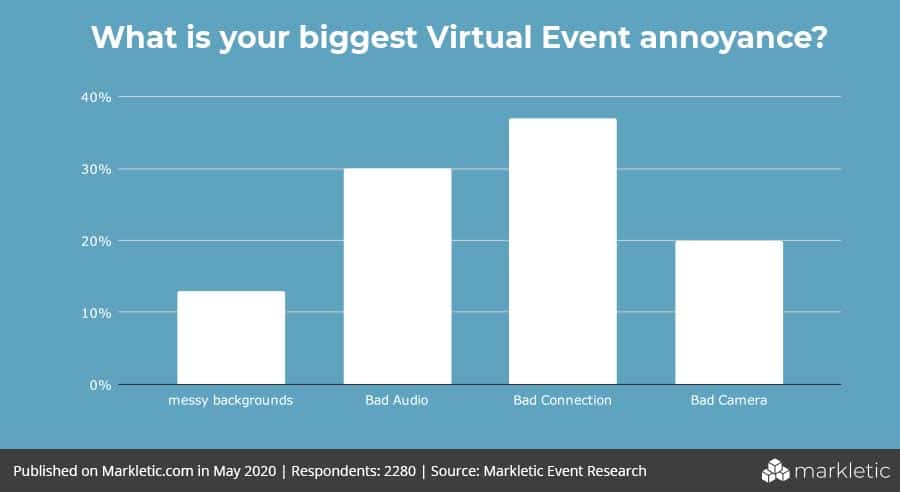
According to a Markletic survey, most virtual event attendees report bad connections and bad audio as the biggest annoyances (followed closely by bad cameras and messy backgrounds).

virtual annoyance

Annoyances like these make it less likely that your attendees will stick around or get any value from your webinar.

The best way to plan for equipment failures and flubs? Practice.

Days before your webinar, do a practice run-through with everyone involved. Test equipment. Test audio. Test connections. Check backgrounds. 

This is also a good chance to practice presentations and work out any kinks. You’ll ensure your speakers are prepared, all the slides are error-free, and everyone will know what to do when the webinar goes live.

5 examples of brands doing webinars the right way

The following brands have used webinars successfully to build brand awareness, nurture their audiences, increase conversions, or attract new customers.

Notion

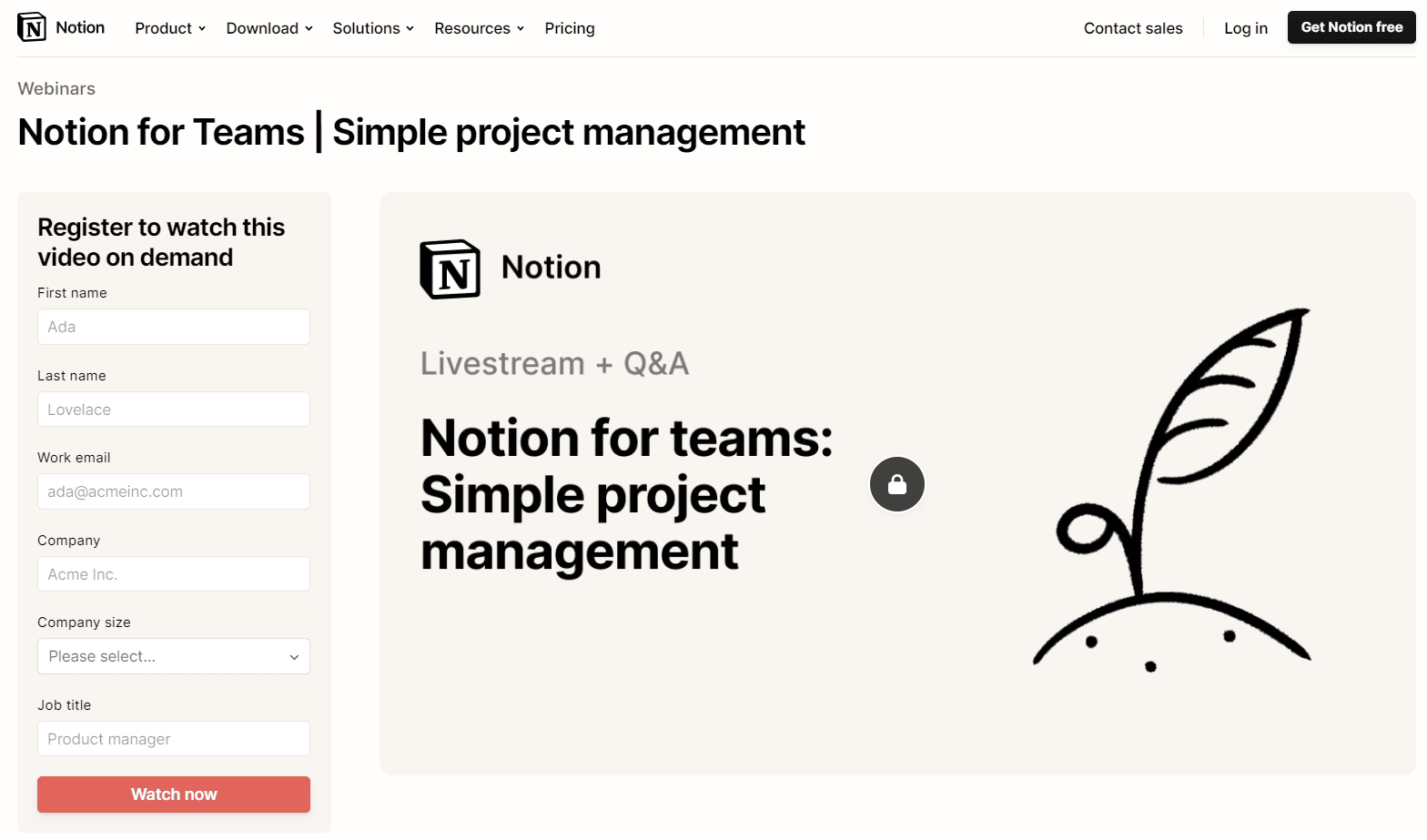
Notion, a SaaS company, hosts weekly webinars centered around their product – a workspace/docs/spreadsheet/page-builder hybrid for teams, businesses, and individuals. 

Each webinar explores Notion’s capabilities and updates from its developers. Many of them share tutorials or demos on using Notion for different use cases.

webinar example - SaaS - notion

Additionally, all of Notion’s past webinars are available on-demand after the live presentation with a simple sign-up. All of them can be found on a dedicated page on their website.

webinar example - SaaS - notion

ELB Learning

ELB learning creates tools to facilitate online learning for people who design courses and instructional materials.

Their webinars focus on career and skills development for learning designers and are hosted by experts on their team.

webinar example - education - elb learning

U.S. Bank

U.S. Bank has an entire library of webinars under the umbrella of personal finance management.

Webinar topics include “Protect yourself or your loved ones from elder fraud,” “Insider tips for student debt,” and “Should you buy now, pay later?”

webinar example - finance - us bank

Reed Words

Reed Words, a U.K. copywriting agency, ran weekly webinars exploring topics to help brands find their voice and express it well.

A panel of four experts from their team discussed building a brand voice in this session, followed by an audience Q&A.

webinar example - marketing - better words

Sephora

Sephora, the reigning makeup chain in malls everywhere, hosts regular live webinars with influencers and brand ambassadors whose products are sold in-store.

For example, the regional director of the NARS makeup brand recently guest-hosted a webinar that showed customers how to apply NARS products to achieve different makeup looks.

webinar example - beauty - sephora

These events aren’t free – instead, Sephora customers spend their loyalty points (earned by making purchases) to register for webinars. However, attendees also get free gifts mailed to them, such as deluxe samples and automatic giveaway entries.

This way, Sephora’s webinars feel like exclusive events, and registration fills up soon after the events are posted.

Webinars are a dynamic content type loaded with potential

Technology has improved to a degree where online webinars and virtual events can be just as engaging and worthwhile as attending them in person.

If you plan it right, create it with care, and promote it effectively, your webinar could be your best investment in content this year.

And, once you get the knack for producing and hosting webinars, you can create them regularly to engage with customers, increase conversions, and build your brand authority and visibility online.

Finally, don’t forget to record your live webinar so you can repurpose that content later. Webinar replays are just as valuable for nurturing leads. You can get even more mileage out of that content if you strategize right.

By now, you should have enough basics to create and host your first webinar. Don’t panic. Enlist your team to help you, and plan, plan, plan. You’ve got this.

The post Webinars: A complete guide with examples appeared first on Search Engine Land.

Original source: https://searchengineland.com/webinars-guide-examples-393499

This day in search marketing history: February 25

SEOs upset over Google dropping attribution in featured snippets

In 2019, SEOs were not happy about a Google featured snippet format that didn’t immediately show the source of the content.

For the Found on the web card, searchers had to click to expand the featured snippet and then scroll through various sources to see the publisher.

Danny Sullivan, Google’s Search Liaison said Google’s support of the overall ecosystem (searchers, advertisers and publishers) is important. “We don’t thrive & users don’t thrive unless the ecosystem thrives.”

The future of Google search, indeed! Amazingly, you could write a very similar tweet in 2023.

Google’s recent preview of its generative AI search results featured answers to complex questions that were made possible after being trained on content created by third-party publishers, with a grand total of zero links to publishers. Déjà vu!

Read all about it in Controversy over Google Featured Snippets stealing publisher traffic reignites.


Also on this day


IndexNow integrations grow as Bing says ‘millions’ of sites are using it

2022: Duda, All in One WordPress SEO plugin and Rank Math SEO plugin gained IndexNow support.


LinkedIn launches podcast network aimed at professional audiences

2022: The pilot program included shows about topics such as technology, recruiting and mental health, from external experts as well as its own in-house news team.


Google Images to replace dimensions overlay on image thumbnails

2020: Google would instead show product, recipe, video, and soon, licensable labels in place of that dimensions information.


How to use the AMP status report to identify page errors, validate fixes

2020: Google posted an explainer for its AMP (accelerated mobile pages) status report.


‘Made in USA’ ad extensions spotted on Bing

2020: A “Made in USA” label accompanied by a flag icon appeared to be the latest automated ad extension test by Microsoft Advertising.


Google revamps Test My Site mobile site speed tool

2019: Test My Site (which launched in 2016) was rebuilt with more features details on a site’s mobile site speed.


Nearly half of users have a bad reaction to ‘not secure’ browser warning, survey finds

2019: Survey found the flag affected user behavior and brand perceptions.


Google Assistant everywhere: more dedicated buttons, expansion on lower-end phones

2019: The company also was adding local search suggestions in Messages.


Google Explains How Search Console Reports Work

2016: Google Webmaster Trends Analyst John Mueller explained how the Search Console reporting works and why it may seem delayed for some of the reports.


Google Testing A Red “Slow” Label In The Search Results For Slower Sites

2015: The slow label would indicate if a particular webpage was slow and warn the user before clicking over to the site that it may load slowly.


Yes, Google Is Testing Green Star Reviews In The Search Results

2015: Google said expect more experiments with the colors of the stars in the search results over the next few months.


Study: Google Now Displays Rich Answers For 19.45% Of Queries

2015: 19.45% of the 850,000 search queries looked at in the study triggered rich answers.


Yahoo Gains Share And Query Volume In Latest comScore Search Report

2015: Firefox deal powered the second straight month of growth for Yahoo search.


Ray Kurzweil’s Job At Google: Beat IBM’s Watson At Natural Language Search

2014: His sole job at Google was to make the company’s computers as smart as humans – smarter, actually – when it came to natural language understanding.


The Marquee HTML Google Easter Egg

2014: When you searched for [marquee html], the results count would scroll from right to left on the page.


Bing Improves Tax Related Search Results Before April 15th

2014: Bing showed smarter results when you searched for [tax forms], [IRS forms], or even specific forms like [irs form 1040].


Quixey Offering Deeper Search Results Inside Mobile Apps

2014: Quixey, which described itself as a search engine for apps rather than an alternative app store, announced deeper “functional search” within apps.


Google Panda Two Years Later: The Real Impact Beyond Rankings & SEO Visibility

2013: A look at what happened to some Panda’s losers.


Google: PageRank Dilution Through A 301 Redirect Is A Myth

2013: There was no more dilution of PageRank with a 301 redirect when compared to using a normal link.


Europeans Taking Sweet Time In Resolving Antitrust Case With Google

2013: Any possibility of swift action in Europe appeared to be fading.


YP: Our Mobile Ad Network Second Only To Google

2013: YP said it had “over $350 million in advertising revenue [in 2012] attributable to mobile, making it the number two company in the US mobile advertising industry.” 


WSJ Pulls Back On What Google Searchers Can Read For Free

2012: The Wall Street Journal has been keeping some stories out of First Click Free for over half-a-year.


Demand: Google Changes Have Produced “No Material Impact” Yet

2011: Demand Media said its properties were not negatively impacted by the newest Google algorithm change (which would eventually become known as the Panda Update).


Google’s Mobile Search Adds “Open Now” Filter

2011: After doing a Google search, the “Show only businesses open now” filter appeared above the search results.


Report: Google Negotiating With DOJ To Prevent Suit To Block ITA Deal

2011: Negotiations intensified in the waning days of the Justice Department’s investigation into the antitrust implications of Google’s potential acquisition of travel software company ITA.


OneRiot Brings Social Targeting to Mobile Devices

2011: Social ad network OneRiot introded the ability to target mobile audiences by interests, demographics and influence on its ad network of Twitter clients.


Google Caffeine May Be Months Away & You Can’t See It

2010: Google said Caffeine wasn’t live on Google.com, was only at one data center and you couldn’t easily see it for yourself. 


Google Advertises Chrome … On Bing!

2010: Google confirmed that they placed these ads and that they were always looking for ways to promote their products. 


Companies Ask Courts, Regulators To Restrain Google To Compensate For Own Competitive Failures

2010: A Foundem complaint/brief with the FCC argued that Google favored its own products and thus “search neutrality” was required to prevent Google from harming competitors.


Losing Google? Chinese Scientists Say It’s Like Going Blind, Life Without Electricity

2010: 84% of Chinese scientists surveyed said that losing Google would “somewhat or significantly” hamper their research; 78% said that international collaborations would be impacted in the same way.


Opera Says Google Dominating Search On Mobile Web

2010: Google had a lead comparable, almost exactly, to its market share on the PC in the U.S.


Yahoo Answers Gets A New Look

2010: Yahoo announced a fairly substantial overhaul of how Yahoo Answers looked and worked.


Google Toolbar 6 For IE Adds Search To Windows Task Bar

2009: This toolbar, when installed, added the Google Quick Search Box to the task bar of Windows computers.


Google Joins EU Anti-Trust Case Against Microsoft Browser

2009: Google’s move to some degree reflected how important it considered Chrome and its adoption to be in the long term for the company.


Microsoft’s TechFest 2009 Is A Search Playground

2009: Hundreds of Microsoft researchers from around the world gathered at company headquarters to share ideas and show off their latest creations.


Yahoo Mobile Head Boerries To Leave, How Will It Affect Yahoo Mobile?

2009: Yahoo had seen the mobile space as strategic and made a massive global business development effort with carriers and device makers to embed Yahoo services and search on millions of handsets.


Penn State Study: Paid + Organic Listing = 15% Clickthrough Rate

2009: Study also found that 35% of queries did not result in any ad clicks ad all.


SEOs Want The NOINDEX Tag To Not Show A Page In The Index

2008: When asked “How should Google treat the NOINDEX meta tag?” 240 chose “Don’t show a page at all.”


Survey Says: Google Top Brand In UK

2008: Microsoft was second in this survey.


Hackers Launch Goolag: A Google Vulnerability Scanner

2008: A group of hackers launched a search tool powered by Google to help see if your sites were vulnerable to a hacking attempt.


Pakistan YouTube Ban Propagates Worldwide, Causing Major YouTube Outage

2008: The Pakistan ban of YouTube not only caused Pakistan ISPs to block YouTube, but also spread worldwide and stopped users even in the U.S. from accessing YouTube.


Yahoo, You’re Not Off The Hook Over The Chinese Dissidents Case Says New Lawsuit

2008: Yahoo was being sued again for allegedly leaking personal information and aiding the Chinese Communist Party in Internet censorship and the persecution of dissidents.


Ask.com Adds More Sponsored Ads, Pushing Organic Results Below Fold

2008: Ask.com was displaying five sponsored results for many keyword searches.


Andy Beal Launches Trackur For Monitoring Online Reputation

2008: You coud set up monitoring across a variety of sites on a set of keywords at a much lower price than reputation management firms generally charged.


From Search Marketing Expo (SMX)


Past contributions from Search Engine Land’s Subject Matter Experts (SMEs)

These columns are a snapshot in time and have not been updated since publishing, unless noted. Opinions expressed in these articles are those of the author and not necessarily Search Engine Land.


< February 24 | Search Marketing History | February 26 >

The post This day in search marketing history: February 25 appeared first on Search Engine Land.

Original source: https://searchengineland.com/search-marketing-history-february-25-393578

Strategy Features of Cost Segregation (Cost Seg)

Home Business Magazine Online

Tax planning is the process of minimizing the amount of tax that an individual or business pays by taking advantage of all deductions, credits, and other tax strategies available. It involves making financial decisions based on how to structure income, expenses, investments, and other transactions in order to reduce taxes owed. Tax planning should be done each year as laws may change and new strategies may become available. It’s important to consult a qualified tax or financial advisor for accurate advice, as every situation is different. Additionally, individuals should stay up-to-date on any changes to the tax code that might affect their individual or business taxes. For example, the Tax Cuts and Jobs Act of 2018 (TCJA) includes several provisions that could affect the amount of taxes an individual or business pays.

Tax planning can be beneficial for both individuals and businesses. For individuals, it may involve taking steps to lower taxable income and maximize deductions in order to reduce the amount of taxes owed. This might include contributing to a retirement account such as a traditional IRA or Roth IRA, maximizing deductions for charitable contributions, or adjusting the filing status.

For businesses, it can involve maximizing deductions and taking advantage of tax credits and other incentives available to businesses, such as research and development credits or investment tax credits. Additionally, businesses may be able to take advantage of certain tax strategies, such as asset depreciation or restructuring entities, in order to reduce taxes owed.

Tax planning should be done each year as laws are constantly changing and new strategies become available. Additionally, it’s important to consult with a qualified tax or financial advisor for accurate advice, as every situation is different. By taking advantage of all available deductions, credits, and other strategies, individuals and businesses can save money by reducing the amount of taxes owed.

Cost Segregation Strategy

Cost seg is a tax strategy used by businesses to reduce the amount of taxes owed by reclassifying assets. It involves breaking down assets into multiple categories, each with its own depreciation schedule, in order to take advantage of different tax rates and timeframes. By segregating an asset’s components and depreciating them over shorter periods of time, more deductions can be taken in the earlier years of ownership. This strategy can be beneficial for businesses that purchase new equipment or buildings as the cost seg study will help identify which components should be depreciated over a shorter period of time. Additionally, it can also result in a reduced overall tax bill due to the increased deductions taken in earlier years.

Cost seg is an effective tax planning strategy that can be used to reduce the amount of taxes owed by businesses. It should be considered when purchasing new equipment or buildings, and a qualified tax professional should be consulted for accurate advice.

Features and Methodologies of Cost Seg

1. Detailed Engineering Approach from Actual Cost Records

Detailed Engineering Approach from Actual Cost Records is a methodology used by businesses to analyze the cost of assets and equipment, as well as identify how best to reclassify them for tax purposes. This approach takes into account the exact costs associated with acquiring an asset, such as purchasing price, installation fees, delivery charges, taxes, and other costs. It then breaks down the cost into its component parts, such as land improvements, building components, and personal property, in order to determine how each part can be reclassified.

2. Detailed Engineering Cost Estimate Approach

The Detailed Engineering Cost Estimate Approach is a methodology used to estimate the cost of assets and equipment for tax purposes. This approach uses a combination of engineering principles, industry standards, and cost-estimating techniques to calculate the cost of an asset or equipment without relying on actual cost records. It takes into account the cost of labor, materials, overhead costs, taxes, and other costs associated with acquiring an asset. It then breaks down the cost into its component parts in order to identify how each part can be reclassified for tax purposes.

3. Survey or Letter Approach

The Survey or Letter Approach is a tax planning strategy used to estimate the cost of assets and equipment for tax purposes. This approach uses surveys and letters from vendors, suppliers, contractors, etc., to obtain information about the costs associated with acquiring an asset. It can also be used to obtain information about the types of materials used in constructing an asset. The information gathered can then be used to estimate the cost of an asset for tax purposes.

4. Residual Estimation Approach

The Residual Estimation Approach is a tax planning strategy used to estimate the cost of assets and equipment for tax purposes. This approach uses the residual value of an asset or equipment, which is the estimated value at the end of its useful life, to calculate its cost for tax purposes. The residual value is determined by subtracting the total depreciation taken over the life of the asset from its original cost. This method is often used by businesses that have depreciated their assets over a period of time and are looking to reclassify them for tax purposes.

5. Sampling or Modeling Approach

The Sampling or Modeling Approach is a tax planning strategy used to estimate the cost of assets and equipment for tax purposes. This approach uses statistical sampling and modeling techniques to determine the cost of an asset without relying on actual cost records. By taking a representative sample of similar assets, businesses are able to identify the typical costs associated with acquiring such assets and estimate the cost of an asset for tax purposes.

6. “Rule of Thumb” Approach

The “Rule of Thumb” Approach is a tax planning strategy used to estimate the cost of assets and equipment for tax purposes. This method uses general industry knowledge, such as a rule of thumb or benchmarking technique, to estimate the cost of an asset without relying on actual cost records. The rule of thumb approach seeks to identify typical costs associated with acquiring an asset and can be used to determine the cost of an asset for tax purposes.

The post Strategy Features of Cost Segregation (Cost Seg) appeared first on Home Business Magazine.

Original source: https://homebusinessmag.com/money/taxing-times/strategy-features-cost-segregation-cost-seg/