Are you a British Gas customer? Do you pay your energy bills through a prepayment meter? If you answered yes to both of those questions, you could be eligible for up to £250 in support from British Gas.
This is a discretionary payment of credit up to £250, meaning British Gas will decide who gets the help. This will be provided to those struggling with their energy costs. Similarly, not everyone on prepayment meters will be eligible to receive the credit.
British Gas has said that eligible customers will see the credit added to their prepayment meter over the course of the next month. You do not need to contact the company to apply. If you are eligible, you will automatically be identified and provided with the credit.
This is part of a new £10 million support package from British Gas, which aim to help the most vulnerable customers on prepayment meters. Other support from the company includes vulnerability checks for customers who may need them.
British Gas also stated that no customers will be moved onto prepayment meters this cold season, unless they specifically request it. However, those on prepayment meters already may request smart prepayment meters if they are struggling with rising costs.
Chris O’Shea, chief executive of Centrica, parent company of British Gas said:
“We know that some prepayment customers are self-disconnecting and not coming forward for help, so we have reviewed our policies to do more to target support at this group.
“As a responsible business we are doing all we can to support our customers during this crisis – our work with the British Gas Energy Trust provides grants and money advice services.”
Just last week, Citizens Advice reported over three million Brits ran out of credit on prep-payment meters last year. This was the result of not being able to afford to top it up. Plus, they found that at least once a month, 2 million more people were being disconnected for the same reason.
Shockingly, 19% those who had their electricity cut off spent at least 24 hours without gas or electricity.
Cost of living payments
We previously wrote an article which rounds up all the cost-of-living payments. This includes eligibility and when they will be paid. You can read more here.
You need to be able to market and promote yourself effectively to have a successful fitness business. However, your passion is fitness, not marketing!
Well, we have made marketing easier and less stressful for you with this brief list of tips for promoting your fitness business. This way you can focus your energy on your true passion.
Gym Merchandise
It is important to remember is that in marketing, you are trying to grow your clientele while also keeping your existing clients satisfied. One way to do this is by giving away and selling gym merchandise. Everyone loves a freebie! In addition, we are sure your excited clients will engage and advertise their gym with pride.
Gym merchandise should not just be random items, though. Your ideas should be useful in both the gym and in everyday life. Examples of gym merchandise ideas to promote your business include clothing, water and shake bottles, gym bags, carabiners and keyrings, magnets, notebooks, and reusable hot/cold pads.
Social Media Campaigns
Advertising on social media platforms is an extremely effective way to gain and maintain a following. Moreover, linking them all enhances this further.
Create a Facebook page with ads that connect you to people near you and allow for sharing and recommendations to friends. Link this to an Instagram page on which you post visually and consistently.
Make sure to always engage with your followers timeously, positively, and authentically. We suggest also engaging with followers of similar brands on Instagram to get your name out there. Learn about using hashtags, which creates way more engagement than you might think. Then link again to a Twitter profile, a platform that encourages engagement and connection, and keeps you informed.
Content Marketing
Videos are some of the most engaging kinds of posts on Facebook. However, YouTube and TikTok are specifically video-based.
Maybe you want to create unique TikTok content on tips and tricks regarding diet, fitness, and mental health. Alternatively, post about fitness-related problems in which you feel your audience would be interested. Make it consistent so your audience knows what to expect. You will find them eagerly anticipating your next post.
YouTube is also an age-old platform that works. Demo videos can show your expertise and knowledge base. In addition, you can quickly send an interested, in-person client a video from your built-up YouTube library on the spot.
Launching a User-Friendly Website
Social media promotion, however, is not always enough. It is mandatory to create an SEO-based, user-friendly website and blog. There are a myriad of benefits of having a website for your business.
On a website, you can manage customers, track memberships, and accept online payments. It is also the perfect place for customer testimonials, success stories, recipes, FAQs, and a Q&A and feedback feature. Do not forget about timeous responses to comments.
Develop a landing page that showcases your fitness philosophy, the energy, and the ethos of your brand. In addition, provide a list of your services. Members will also love private, member-only videos, tips and tricks, fitness tutorials, exercise classes, etc.
Free Trials
Clients who are considering signing up for your fitness business can get a taste of what you are all about at a free trial, class, or mini-fitness session. This could be in person or an online stream. Make these free trials targeted at your preferred audience rather than just general. Give your new potential clients a limited time to act on each exciting set of benefits.
One idea that a lot of fitness businesses use is the “buddy deal”. Allow existing members to bring along a friend to classes for a specific amount of time.
Hosting Local Events
All fitness fanatics love friendly competition. Host a local event such as a Bootcamp, jog-a-thon, obstacle course, race, etc. Make the prizes redeemable at your fitness business.
Hosting an event brings the locals together, builds morale, and portrays your enthusiasm for what you do. It is also a great way to network, meet potential clients face-to-face, and build personal relationships. Participants of these events will remember a friendly and approachable attitude, as well as the direct interest shown in their fitness goals.
It is a smart idea to utilize these events to raise money for a local charity. This could be short-term on a specific day or long-term — perhaps a partnership fostered over time.
Finding What Makes Your Fitness Business Unique
No matter what, you want to constantly think about what makes your business unique. In addition, how do the unique qualities you offer make your clients feel?
Uniqueness may come in the form of special features such as mental health, yoga, diet, self-defense, or meditation benefits. Keep your ear to the ground regarding your clients’ demands to make changes based on their desires.
You want your online presence to be what stands out. This can be done by formulating your brand-specific voice. Filters, types of photos, and language can all be utilized. Make your business edgy and vibrant, and capture attention.
Social media is one of the most convenient and affordable tools you will find for promoting your business in the present day. Most people have an account on social media, and your company page/profile is just one click away from them. If you make your brand click the right way with people with the help of social media, you may be able to gain thousands of followers within a span of a few days.
There are different social media sites in Canada that businesses located in Montreal, Canada can make use of and grow their organization. These include Facebook, Instagram, WhatsApp, YouTube, TikTok, and Snapchat among others. The biggest benefit of social media is that it provides the user with unlimited growth within a limited time span.
Promoting anything anywhere is easy with the help of social media these days and your geographical location hardly has an impact on it. Before you get started, however, you have to chalk out your business plan and all the crucial details.
Which Businesses Are Most Likely to Flourish in Canada?
Multiple business chains can thrive and flourish in such a promising atmosphere, a city where the dreams of entrepreneurs and business owners become a reality. The following are a few popular business chains that have shown a record level of success in the past few decades:
Consultancy.
Makeup and Beauty.
Health and Fitness.
Hospitality Chain.
Real Estate.
Apart from the well-known and well-established niches, there are a variety of other niches in that an individual can start their business and expect to attain a certain level of success a few years down the line. If they are lucky, they can get started with multiple business chains within this time too.
How to Proceed with Promoting Your Business
There is nothing called a bad idea — the situation gets bad only when there is a complete dearth of ideas and you don’t know how to proceed. When you have an idea, you can choose to proceed by keeping in mind the surrounding situations and the best way to strategize and finally implement your ideas successfully.
1. Research About the Market Is a Must
You need to assess your target customers, including age, location, and demographics, do a complete analysis of the market, and then come to a conclusion about the way you should promote your brand/product. Market trends will direct you on which way to go and the decisions to take regarding your business. The urgency with which you should undertake your promotional and marketing matters will also be decided by the market trends.
2. Get an Expert’s Opinion
You can also decide to take an expert opinion on taking the next step forward for your business. There are many business consultants who are actively working to provide guidance to aspiring entrepreneurs and business owners who already have a business and want to make it big. Consultancy is a separate industry in itself, as discussed above.
3. Patience Is a Great Virtue
Being patient is a quality that is rather underappreciated because everyone wants to get the best of everything at once. The same applies when it comes to achieving a certain level of success with one’s business. Entrepreneurs usually quit within six months or a year. Patiently managing your business is a quality that will pay off in the long run.
Be Alert, Active and Hardworking to Flourish Your Business
Remember, Rome was not built in a day. Even if you are exceptionally talented or gifted at what you do, you cannot expect your business to be a full-fledged grand success overnight. Business requires you to be alert, active, and laborious to a much greater extent than an individual in a 9-5 job. That is why being in business yields much higher profit margins compared to a regular office-goer. So, you can follow the tips and keep faith in yourself to make your business successful.
The State of Technical SEO Report 2023 is out from digital marketing agency Aira and the Women in Tech SEO community. So what matters in 2023? Here’s a quick summary of some of the more interesting results.
Resources matter. The biggest risk the report highlighted was an organizational lack of resources. A lack of resources means changes don’t get made or are very slow to get made – which means less than stellar SEO results. So if you work at a company where resources are lacking, prioritization of tasks will continue to be critically important.
Tools and technology that matter. Google Search Console was the most popular tool for technical SEOs overall – 92% reported using it. It was also the top tool used (78%) for measuring organic search rankings.
Screaming Frog SEO Spider was popular choice for crawling and log file analysis. Meanwhile, Semrush was the top choice for assessing the search visibility of a website.
For non ecommerce platforms, technical SEOs most preferred working on WordPress. Wix was considered the most problematic to work on.
Time matters. Sadly, waiting months for technical SEO changes to happen is fairly common – 88% of respondents waited anywhere from a month to 24+ months for technical SEO changes to be made.
Perhaps a bit surprising: 22% reported waiting only a month for technical SEO changes to be implemented. Meanwhile, 20% reported waiting 12 months (which was down slightly from the prior year). And 11% of respondents reported waiting 24 months or longer.
Skills that matter. What are the top three skills a technical SEO should have? According to the respondents:
Data anaysis (72%)
Reading and understanding HTML/CSS (58%)
Content strategy (39%)
It was surprising to see content strategy ranked so highly. But as Steph Greaves pointed out in the report comments:
“It’s definitely helpful to know how content relates on a website to fully understand internal linking opportunities that serve the user.”
Technical SEO = marketing. Search Engine Land contributor Mark Jackson has made the case that SEO is marketing. So it was nice to see that marketing (74%) was the top answer to this in-house specific question: “In your organisation, in which team does accountability for technical SEO sit?
Why we care. Overall, this report is good news for our industry. Clearly, we’re facing issues, most notably an uncertain economic outlook. Plus there have been many layoffs. But it’s encouraging that the report finds the outlook for SEO is still relatively positive and demand for SEO remains in a good place.
Google has updated the video indexing report in Google Search Console to improve the accuracy of the error reporting. Google said you might see “missing thumbnail” errors reclassified under new error types. Google also added that the total number of errors reported should not change, and that this is just a reclassification of errors.
January 19, 2023. This change went into affect today, January 19, 2023.
Google’s statement. Google wrote, “Search Console can now more accurately classify thumbnail indexing issues. As a result, you may see a reassignment of “Missing thumbnail” issues to more specific issue types. The total number of affected videos should remain the same.”
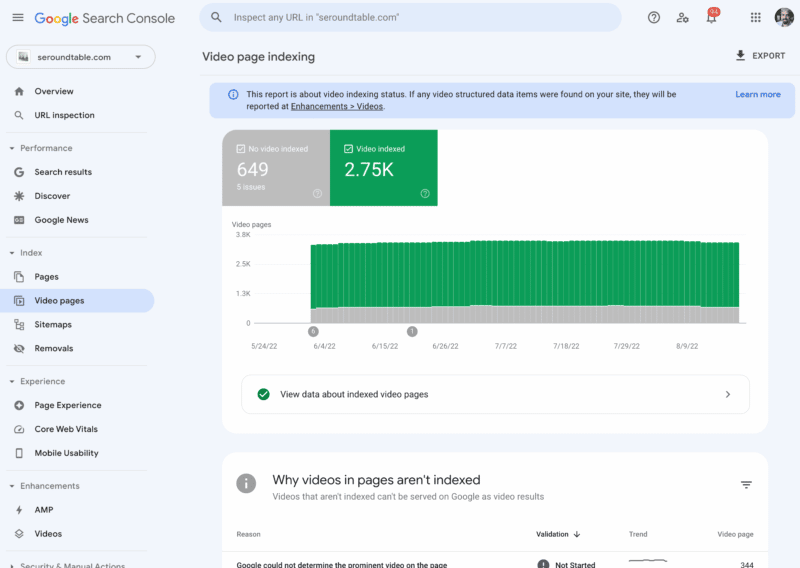
What is the video indexing report. The video indexing report shows how many indexed pages on your site contain one or more videos, and how many of those pages a video could be indexed. Google said the report can help you understand the performance of your videos on Google, and identify possible areas of improvement.
What it looks like. Here is a screenshot of this report for one of my sites in Google Search Console:
When the report shows. Google said if Google detects videos on your site, the Video indexing report will appear on the left navigation bar in the coverage section. If Google has not detected a video on your website, you will not see the report.
What it tells you. The report shows the status of video indexing on your site. It helps you answer the following questions:
In how many pages has Google identified a video?
Which videos were indexed successfully?
What are the issues preventing videos from being indexed?
In addition, if you fix an existing issue, you can use the report to validate the fix and track how your fixed video pages are updated in the Google index, Google explained.
Why we care. You may want to recheck some of the errors in this report and see if some were reclassified from “missing thumbnail” to a different error type. This way you can resolve any errors that might not have been resolved earlier.
It’s 2023, and the landscape of corporate gifting has changed dramatically since last year! This holiday season, gone are the days when a simple box of chocolates or a basketful of company logos was enough to show appreciation. With many of us still adjusting to the new normal in business and uncertain economic times, it can be hard to think outside the box and figure out what type of thoughtful gift would make your employees feel truly appreciated. A great way to make sure that your gifts are on trend and practical is to use online gift guides. These guides can help you find unique and creative gift options that might have passed you by if you had stuck with the old-fashioned shopping method.
Additionally, our tips below will help you find the perfect employee gift — from creating customized experiences to finding unique items with your specific budget in mind, we’ve got you covered on all fronts. Read on for helpful advice that will ensure you find exactly what your team needs this season.
Consider Why You Are Gifting
The first tip on this list if you want to buy your employees a great gift in 2023 would be to consider why you are gifting them with something, to begin with. This is quite an important tip since the motivation behind gifting makes all the difference in the world.
Are you gifting an employee so that you can appreciate their individual performance? Or is it a special occasion? Are you gifting more than one employee? And is that because of team performance, or because of an annual company performance appreciation day? The reason why you are gifting is very important since it will change the type of gift that you are getting.
Gift Something General in Most Cases
The next tip on this list, if you are looking to buy your employee a great gift, would be to gift something general in most cases. At the end of the day, gifting an employee is a very difficult thing to do since you don’t want to get them something too extravagant that makes the other employees jealous. More importantly, you also don’t want to get a gift that makes them question your relationship with the employee in question.
As such, in most cases, it is a good idea to go with a general type of gift. Some gifts that could be considered general include tote bags or drinkware, key chains, company-branded apparel, or desk accessories. Employees will always value a water bottle, a set of pens, or a new notebook.
Get Gifts That Coincide with Your Values
The next tip on this list is also quite an important one, and that is, if you are going to be gifting your employee with a gift, you should get something that coincides with the values of your company. What does this mean? This means that every company has a brand personality as well as a mission and values.
When you gift an employee, you should try to stick to those values as closely as possible. For example, if your company works within the energy-saving industry, it is safe to assume that you care for the environment. As such, you should try to get a “green” type of gift rather than one that will cause damage to the environment.
Consider That Some Gifts Are Taxable
One thing that you should do when buying your employee a gift in 2023 is to consider that some gifts are taxable. Gifts that are taxable, basically any sort of gift card or cash bonus, need to be reported to the IRS. For example, gifts of this type include a $30 performance bonus, a $20 gift card for your employee to visit a local restaurant, or even season tickets to visit or see a local sports team.
As such, you might want to consider getting a tax gift. A few examples of tax gifts include the occasional meal compensation or a non-cash gift that doesn’t have a very high market value. You could also gift your employees with a business mobile phone or give them an employee of the month parking pass. Tax gifts are gifts that are too trivial to justify with tax considerations or that are small or not expensive.
Live video streaming is a popular way to engage with your audience, share moments, and build an online presence. However, various factors affect the quality of your live stream. A VR180 – Ultimate Live Video Stream Experience is a great tool to enhance the quality of your live video stream. By utilizing the latest technology and advanced features, this camera helps you create captivating visuals and immersive experiences for your viewers. With its powerful software and hardware capabilities, it provides superior image resolution, wide field of view, and optimized streaming performance. This article explores how a VR180 3D Streaming Camera improves your live video stream quality, as well as its advantages over traditional cameras.
Factors to Consider When Choosing a VR180 3D Streaming Camera
1. Type of Content Streamed
When considering what type of content to stream using a VR180 3D streaming camera, it is important to consider the type of environment that it captures. Different cameras have different levels of resolution and fields of view. Therefore, it is important to choose one that best suits the type of content recorded. Additionally, some cameras are more suitable for capturing high-motion scenes or low-light environments than others. It is also important to consider the audio capabilities of the camera, since some record higher-quality sound than others. Finally, consider battery life when choosing a camera, as some offer longer battery life than others. With all these factors in mind, helps you choose the right type of VR180 3D streaming camera for any given project.
2. Cost and Budgetary Restrictions
When considering what VR180 3D streaming camera to buy, cost and budgetary restrictions are important factors to take into account. Depending on your budget, look for the most affordable option that offers the features you need. It is important to determine how much you are willing to spend on a camera, as well as how much money you have available in your budget for accessories such as tripods, lenses, and other add-ons. Additionally, if you plan to use the camera in a professional setting, be sure to factor in any additional costs such as software licenses or maintenance plans. Taking all of these elements into consideration helps you find the right camera for your needs without breaking your budget.
Steps to Prepare for Using a VR180 3D Streaming Camera
Gather Necessary Equipment and Ensure Proper Connection
When preparing to use a VR180 3D streaming camera, it is important to gather the necessary equipment and ensure that it is connected properly. This includes the camera itself, any cords or cables needed for power and connection, as well as a computer or laptop with the correct software installed. If using an external microphone or other audio equipment, set these up before beginning. It is also important to confirm that all of the connections are secure and that all necessary items are within reach before proceeding with the task at hand. Additionally, it may be beneficial to take a few test shots beforehand in order to be familiarized with the camera’s settings and menu options. Following these steps ensures that everything works as expected when capturing content with a VR180 3D streaming camera.
Set Up the Camera Angle and Lighting Conditions to Optimize Quality
When setting up a VR180 3D streaming camera, there are several steps to take to optimize quality. First, consider the camera angle and lighting conditions. Place the camera in an ideal spot to capture the scene you want to stream, such as at eye level or slightly above eye level. Lighting should also be taken into account; if possible, use natural light in combination with artificial lighting for better results. The next step is to configure the settings of the camera, including resolution and frame rate, to get the best image quality. Finally, make sure that all components are connected properly and securely before starting your streaming session. By taking these steps prior to streaming with a VR180 3D streaming camera, you ensure that viewers will enjoy a great viewing experience.
Tips for Enhancing Live Video Stream Quality with a VR180 3D Streaming Camera
Use Multiple Cameras to Capture Different Angles or Environments
Keep Your Equipment Up-to-Date With Regular Updates and Maintenance
Utilize Special Effects Software to Enhance Visuals and Audio Quality
In search marketing, you are often captive to what you can measure. That means if it’s not directly converting (or even converting with data-driven attribution), it’s wasted spend.
Another way to frame this is the tradeoffs between efficiency and volume. The terms you are bidding on will eventually convert (unless you are bidding on utterly unrelated terms). But the question is, was that spend efficient and valuable?
In this article, I will share some insights about striking the right balance between efficiency and volume, a productive and healthy debate search marketers can have with businesses.
1. Determine how the business is operating
We always suggest starting with how the business is operating overall. Each business has some important metrics that drive its decision-making.
Is the business profitable?
What is the available capacity of the team or product line?
Are there specific seasonalities or unique market forces that may alter the normal state of the business (supply chain, holidays)?
For example, if the product is highly profitable and there is capacity in the business, you would be willing to pay more for additional traffic and sales.
The opposite is true. If profitability is poor or capacity is limited, it might be desirable to limit the amount of traffic or only find really profitable sales.
If you are in a seasonally driven business you might have to make hay while the sun is shining. These are just a few factors that might impact your efficiency vs. volume debate.
2. Forecast at various levels
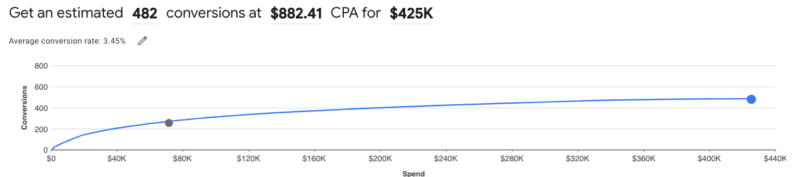
A great place to start is Google Ads Performance Planner tool which can be found under Tools > Settings in the top menu bar. This tool lets you get a sense of the opportunity for your existing campaigns.
You can select which of your search or Performance Max campaigns you would like to forecast the opportunity. Input and select some options to help generate some results.
Google will then create an output that looks like the one below. It creates a curve that provides the expected output of conversions for a variety of spend inputs.
You can create something like this for as few or as many campaigns as possible. Certainly, the input data and output curves will adjust. Often, the more granular you go the more specific and varied the curves will be.
Get the daily newsletter search marketers rely on.
function getCookie(cname) {
let name = cname + “=”;
let decodedCookie = decodeURIComponent(document.cookie);
let ca = decodedCookie.split(‘;’);
for(let i = 0; i <ca.length; i++) {
let c = ca[i];
while (c.charAt(0) == ' ') {
c = c.substring(1);
}
if (c.indexOf(name) == 0) {
return c.substring(name.length, c.length);
}
}
return "";
}
document.getElementById('munchkinCookieInline').value = getCookie('_mkto_trk');
3. Evaluate the incremental cost per conversion
Now that you have this curve, the next step is to evaluate the incremental cost per conversion at various levels.
As a search marketer, it can be easy to focus on just the total CPA within search. However, there are other potential options that a business could use to invest in.
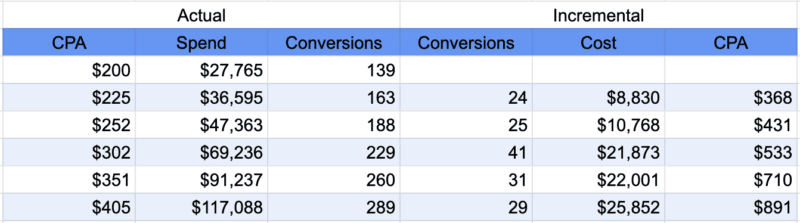
What we recommend is to review the impact of various spend levels and what the next level of investment will do to the metrics. A table like the one below is a simple approach to this.
To get the incremental cost per acquisition, take the forecasted spend and conversions at various levels and subtract the new level from the prior level.
Often, brands just look at the total CPA in aggregate and ignore incremental cost per acquisition. Looking at it at the incremental level will give you something to compare to other opportunities.
For example, in the table above, going up from a total CPA of $351 to $405 is only a 15% increase in CPA. However, the incremental CPA is $891 or 120% above the total CPA of $405.
This should spark the question, what else can I invest in that will drive a lower CPA than $891? This could be anything from product enhancements or advertising spend outside of search (display, social, programmatic).
If something else can help you beat the $891 incremental CPA, then it is a better investment. Certainly, there are other things to consider, like level of effort and resourcing.
4. Choose your bid models
Look at Google Ads’ different automated bid models as you decide. You can set target CPA, ROAS, or impression share or maximize event outcomes (conversions, clicks, conversion value).
These models also play a part in incremental cost decisions.
If you choose to target a CPA, the optimization will prioritize hitting that CPA goal.
If you look to maximize conversions, the CPA target will no longer be in control and volume will be the primary metric.
Both models have a purpose depending on your business metrics and the priorities of the business at any given time. We see brands shifting between these models depending on their specific business objectives.
Deciding between efficiency vs. volume in PPC
There is no “right” option to this matter and it certainly isn’t a static decision.
The choice between efficiency and volume should always be discussed and tested. Search is incredible in this regard. You can always adjust your aggressiveness levels on a near real-time basis.
I once managed paid search campaigns for mortgages for four different banks simultaneously. All four had vastly different CPA targets given their business metrics and goals at the time.
So take a step back, look at the business overall and understand how incremental spend or savings would impact the business.
What is the incremental opportunity?
How else can you find incremental results?
Should you spend in other areas, improve the conversion flow, and just save the money?
Once you start using data and understand how your potential actions will impact the broader business, you will be well on your way to balancing efficiency and volume. (Until you need to debate it again, that is. Because trust me, you always will.)
Communicating your value proposition is the overarching goal of your website. But at a URL level, messaging needs to be more refined.
This typically means targeting specific keywords and topics on your pages and clearly communicating your expertise and beneficial purpose within your content.
Google’s recent addition of an extra E to E-A-T for “experience” in the updated search quality raters guidelines further enforces the need for ensuring your beneficial purpose is prominent in your main content. I also believe this is another contributing factor to the indexing quality threshold.
So how can you scalably introduce “experience” content into your pages without diluting your messaging or the page’s beneficial purpose?
In this article, I will share tips for incorporating ‘experience’ content for ecommerce sites and demonstrating expertise either at an author or site level.
Defining beneficial purpose and page quality
To recap, Google defines beneficial purpose as “the overall intention of the page, as determined by the creator of the page.”
In other words:
What is the purpose of the page?
Is it to sell a product or service?
Is it to provide information?
Or is it to generate leads?
On the other hand, Google’s definition of page quality is “a holistic evaluation of the elements that make up a page, including design, functionality, user experience, and content.”
Here, it is vital to determine:
How well does the page meet its intended purpose?
Is it easy to use?
Is the content relevant and accurate?
Displaying product experience and expertise in ecommerce
Historically, ecommerce websites interweave product and company reviews into their content and templates as a way of building trust and, to an extent, showing their experience in delivering a quality service.
As search engines are looking for more and more differentiation signals, investing in ‘experience’ content that doesn’t necessarily have target search phrases or an end goal of ranking in SERPs is a must.
As an example, Holts does a good job of demonstrating experience and expertise at a company and author level through content.
Holts’ staff and authors review the products they sell. Their profiles also have information about them as consumers, such as their favorite cigars and strength preferences.
These product experience articles contain good internal links to related products and product use cases (e.g., game nights). They are difficult to falsify without the product experience, as they will stand out among your target customer base.
Similarly, if your product or service is in the YMYL space, you want to build as many trust signals as possible that your service is safe and trustworthy, and will not adversely affect consumers.
A great example of this is Optical Express in the UK, which has a comprehensive portfolio of surgeons and ophthalmologists, with individual profiles listing:
The governing medical bodies they are registered with.
The number of procedures and surgeries they have completed.
Reviews from their patients (aggregated, video, and written).
Professional memberships.
This content is typically found on small or independent practice websites. For it to be done at scale for a national provider is impressive, and again, serves as a verifiable trust signal that can’t be easily faked.
Utilizing user- and staff-generated content at the product level
The two examples before are great at demonstrating experience at a brand or domain level, but it can also be important to demonstrate experience at a product level.
This can be done either as a direct effort by the website trying to sell the product or through a collection of user-generated content.
For example, Amazon has been doing this for years by putting customer experiences on individual product pages, regardless if they are positive or not. They’ve done this through their “Customers questions & answers” section.
The responses, which can include videos and pictures, create unique relevant content to help potential consumers better forecast their experience using the product.
In the search quality raters guidelines, sharing first-hand experiences is highlighted as a signal of high page quality.
A lot of ecommerce websites already do this by aggregating product-specific user reviews on pages to build trust. Complemented with schema markup, this also gives them a chance to get review stars in the SERPs.
Another way of doing this is to create unique, experience content at a product detail page (PDP) level. Two websites doing this well are CardKingdom and TCG Player.
In this sector, most PDPs use the card flavor text and details. Thus, adding unique content that demonstrates product knowledge (and content useful for users) can be viewed as an additional, positive signal by Google.
An example of CardKingdom’s “Pro Tip!” content on product detail pages.
This unique differentiator can also be useful as a general page quality signal for the indexing threshold.
Developing ‘experience’ content
Many information and studies will likely be published in the coming weeks and months on how to create better experience signals in your content and improve page quality (for your source type).
However, it is important to remember that Google has been collecting data, setting benchmarks of ‘experience’ content currently “in the wild.” The search engine already has an idea of how content can:
Portray a value proposition.
Demonstrate a beneficial purpose.
Have a sufficient “page quality” for the source type.
So we’re not reinventing the wheel or deviating too far from what we’ve already been doing when targeting E-A-T.
If anything, we’re now adding more unique perspectives, opinions, and user experiences to make content more “genuine” – diluting the marketing prose and keyword research-led content pieces with more human notions.
Big Energy Saving Week: Save up to £1,500 per year
It has been a bitterly cold start to the year. With millions of Brits across the country still working remotely or in a hybrid working arrangement, much more of our time is being spent in the comfort of our own home.
Although this can be bliss in many ways – let’s face it, there’s nothing quite like being in your own space – it can also mean higher energy bills. With more cups of tea being made at home, kettles are boiling constantly, laptops and phones are being charged and you may even put the heating on when it gets nippy.
According to analysis from Uswitch, those working from home use 25% more electricity and a staggering 75% more gas than those who work in the office five days a week. Thus, energy bills are much higher for those working remotely.
It is Big Energy Saving Week, meaning there is no better time to find new ways to save. With 63 million adults reporting an increase in living costs in the last few months, here are some nifty ways to save yourself some money when working from home.
Letting your laptop or PC enter standby mode at the end of your working day is no equivalent to turning off your electricals at the plug. Turn off all your equipment, looking for lights indicating something may still be running.
Although laptops and computers may look as if they are off whilst on standby, they are continuing to use energy. According to British Gas, turning off appliances at the plug and closing everything down properly can save you £147 a year.
Turn off the lights
It may seem obvious, but turning off lights can make a huge difference in your home. Understandably, as we navigate through darker and longer days, with gloomy mornings galore, the lights may be one of the first things to be turned on.
As the day gets lighter, make a mental note to turn off your lights as soon as you can, using natural light where possible. Lighting our homes makes up 10-15% of our annual energy bills. Turning lights off by midday, or when you leave the room, could save you £25 per year.
Fill a flask
It is no secret the British love a good cuppa. Working from home means more tea, coffee and hot chocolate, particularly in the chillier months. Boiling a full kettle costs 8 pence per time. This may not seem too much, but if you are a regular tea or coffee drinker, the pennies can add up.
Instead of boiling a kettle of water every time you want a brew, fill the kettle up once, boil it, and pop it into a flask. This will keep the water warm until your next drink. This could save you up to £329 per year!
Smart food swaps
More time at home may mean an increased food bill. Lunches and snacks throughout the day may cost you more than you think, pushing your supermarket spend up. A great way to save on your food shopping is by ‘downshifting’.
Downshifting is making smart food swaps from premium to supermarket own brands whenever possible. This can save you hundreds on your bills, and the taste of many own-brand foods are identical to that of your favourite premium brands.
In fact, this could save you 30% every time you go shopping. This could be thousands of pounds over the course of a year.
Turn off the TV
If you work from your living room, you may well pop the television on during your working day. Whether you watch it or use it as background noise, it could be costing you more money than it is worth.
Televisions can be power hungry, so it is worth noting some ways to save. As previously mentioned, ensure your TV is turned off at the plug when not in use. According to Utilita, leaving your TV on standby could cost up to 28p per hour!
Instead of having the television on whilst you work, listen to the radio, music or a podcast. If you like to have the telly on, reduce the brightness of the screen to reduce power consumption. Give it a go for Big Energy Saving Week!
Have a move around
Did you know, moving your sofa just six inches away from your radiator could save you £125 per year? This is because sofas and other bulky furniture will absorb much of the heat emitted from your radiators.
This means your home will take longer to heat, and subsequently you may choose to leave the heating on for longer periods of time. This adds to your energy bill. So, it’s worth considering the placement of your furniture within your home to ensure maximum energy efficiency.