Google Local Service Ads are now available for dentists

Last week Google updated its Help Center to include a new vertical: Dentists.

The change was first noted by Matt Casady who wrote about the update on Local U. Carrie Hill posted about it on Twitter.

Carrie Hill

How it works. Prospective dentists will need to complete verification before being eligible to advertise.

companies

Why we care. If you’re a dentist or you’re running ads for a dentist, start going through the verification process now so you can get your LSA ads up as soon as possible!

The post Google Local Service Ads are now available for dentists appeared first on Search Engine Land.

Original source: https://searchengineland.com/google-local-service-ads-are-now-available-for-dentists-391175

How to make money from your shed

Reading Time: 9 mins

You may not have set foot in it for years, it may be full of tools and garden equipment. But did you know that wooden shack at the bottom of your garden could make you some extra money?

There are many ways to make money from your home, and your shed is just one of many spaces in your humble abode which could make you money. From your bedroom to your driveway, you can easily make some extra cash from your dwellings.

We delved into the intriguing world of shed-working and the results surprised us. There are many possibilities for transforming your dilapidated shed into a lucrative source of income.


Shedworking revolution

Small pink shed

Using your shed for anything other than storing gardening tools may seem strange. But. many people have turned theirs into a productive alternative workplace. There are even whole websites dedicated to doing this!

Alex Johnson, writer of The Independent’s Home Front property column, operates Shedworking.co.uk, a daily updated guide for people who work in garden offices and other spaces.

Johnson started the site in 2006 after moving back to the UK from Madrid with a growing family.

“As we liked where we lived and didn’t want to move. I investigated the then very tiny garden office market and decided that was the way forward. After a couple of months, it struck me that there would probably be other people in the same boat. So I started ‘The Shed’ PDF magazine and then the Shed-working site (which inspired the book),” he explains.

More than a decade down the line, the whole idea of shed-working has increased exponentially and so has Johnson’s site. Since his very first post in October 2006, Johnson has covered every aspect of shed transformation, interviewed an array of shed-workers from all over the globe and published an inspirational illustrated book called Shed-working: The Alternative Workplace Revolution.

GDP contribution

Perhaps one of Johnson’s most interesting articles to date, however, was a 2010 post in which he shared the fact that Shed-workers contribute a whopping £6.1BN to the UK economy.

Based on findings from a poll he carried out, Johnson also revealed a few interesting statistics surrounding shed-based businesses:

  • The average turnover of a shed-based business in the last financial year was £76,449
  • An estimated 80,000 workers are thought to be based in garden sheds and outbuildings in the UK
  • More than half of shed-based businesses (61.3%) are run by sole traders, with 32.3% employing 2-5 workers
  • Of the more than 500 shedworkers polled for the study, 74% said that they planned to remain in their sheds indefinitely

Seven years later, shed-working has been growing steadily more popular. While Johnson hasn’t had the opportunity to gather more recent statistics, there’s reason to believe that its impact on the UK’s economy is even more impressive.

“I think we’re returning to a more natural way of life with better work/life balance, more like the cottage industries that were once the main way people worked, rather than the mindless commuting that we’ve become accustomed to in the last century,” comments Johnson.

Finally, he believes that this frenzied way of life we’ve become accustomed to will soon slow down.

“Essentially, technology was used to herd us into factories. But the way it’s developed now means we don’t need to go into a central office. At least not all the time” Johnson concludes.


Shed-based businesses to consider

Carpenter working in his shed

Here are a few ideas of businesses you can run from your shed:

Brewery

Hop onto the craft beer bandwagon by turning your backyard shed into a bespoke brewery. If you don’t actually have one, you could always invest in this fully-kitted Brewery Shed by TigerSheds.

Creative studio

Whether you’re a designer, jewellery-maker, artist or writer, you’ll know that having an inspiring place to work in does wonders for the creative process. And what better setting than your very own garden? In fact, if this Guardian article is anything to go by, transforming sheds into studios has been popular among creatives for a very long time.

List it on Airbnb

As with pop-up restaurants, people are always on the look-out for something quaint and interesting when trawling Airbnb. Give your shed a good spring cleaning and then kit it out for guests. Bear in mind that this would require installing at least a toilet and shower, but possibly also a kitchenette. Read our article on how to make and save money by renting.

Urban chicken coop

Firstly, this is probably not a good idea for anyone with neighbours living very close by. However, if you have a larger garden with some extra space, running your own chicken coop and selling ‘farm’-fresh eggs could become a roaring business.

Read our guide on how to keep your own chickens and this post by Simple Living Country Gal for a few tips on converting your shed into a coop.

Location for shoots

If your shed is full of character, maybe it’s cute and well-kept or run-down and creepy, you could offer it as a location for film sets or photo shoots. This would involve a lot of foot traffic through your house and garden. But the money earned can be well worth it.

Read our guide to renting out your home as a film set for more details.

Garden office

Toying with the idea of working from home full-time? Instead of trying to have your guest bedroom double as an office, you could always repurpose your shed.

Dog grooming business

This is a great idea if you love animals and have a big, secure garden where dogs can roam around freely and safely. In order to set up a doggie parlour in your shed, you will need a reliable water supply, a large bath/basin or two and a sturdy table for drying, cutting and trimming their coats.

Yoga studio & retreat

If you’ve always dreamed of running your own wellness retreat, you don’t have to look much further than your back garden. Since you probably won’t be able to accommodate too many people at a time, your unique angle can be exclusivity. The main objective here is to create a space that is airy, welcoming and serene. Consider adding a window or two, as well as air conditioning and heating to keep the temperature mild throughout the year.

Storage space

Finally, you can always make money by using your shed for its intended purpose; storage. However, instead of stashing your own stuff away in there, you will be helping other people out by keeping theirs safe.

Read more about making money by renting out parts of your home for storage.


A few tips for transforming your shed

Before you can start making money from your shed, however, you’re probably going to have to spend a fair amount on transforming it.

Here are just a few things to consider:

Power

No matter what kind of business you run from you shed, you’re going to need electricity. Unless you’re a qualified electrician or have a natural affinity for these sorts of things, it’s probably best to get professional help. After all, you don’t want ongoing power troubles to interrupt your work or, even worse, an unfortunate accident to cast a shadow over your new venture.

Heating/Air-con

Unless you’re running something like a yoga studio, installing heating/air-con is more of a nice-to-have. For most businesses a heater will do the job in winter and a fan in summer.

Wi-Fi

If you’re running any desk-based business, you’ll definitely need an internet connection. However, if the whole idea is to escape distractions, you may want to avoid it altogether.

Tools of your trade

Of course, you’re going to need to kit your shed out fully in order to your business. So, if you’re using it as the base for your catering enterprise, you’ll need a safe, clean and spacious kitchen setup. If you’re designing and sewing wedding dresses, you’ll need a large sewing table, good lighting and plenty of storage space for fabrics.

The best thing to do is make a comprehensive list of all the necessities, followed by a list of things that could add value. Once you’ve ticked off all the former, you can move into your new shed-working space and add the rest as you go.

Rules & regulations

Finally, if you’re going to be running any sort of retail/catering/food/beverage business from your home, you may need to check with your local authority about any zoning regulations. Also, if you’re going to be working with food at all you will need to comply with health and safety regulations, as well as apply for certain licenses. The Food Standards Agency has a comprehensive start-up document to help you out.


Case study:

Dawn and Hannah in front of their shed

We caught up with Dawn Fry from The Melting Pot to find out more about the chocolate workshops she presents in her garden shed.

This is what she had to say:

Can you give a quick summary of what it is you do at The Melting Pot? 

The Melting Pot offers chocolate-making workshops to adults, children and teams.

I don’t make chocolates to sell, most people presume I do this, but just offer workshops. Where people come and make their own yummy creations under my instructions.

It has proved a great formula. I now teach other people how to run workshops from where they live, and have created a ‘business in a chocolate box’.


What did you use your shed for before it became the home of The Melting Pot? Also, how big is your shed?

The shed was previously our family den. We have three children and a small terraced house. So when they were growing up it was a great big space to have friends and family in or just a space to play. There were lots of parties for children and grown-ups too. And this continues to this day.

The shed is 5m x 6m and was built entirely by my husband Jo, a blacksmith by trade.


How did you decide to transform your shed into a working space?

I had seen some friends use their sheds for businesses and this inspired me to think about running my own.

Frustrated with part-time work and trying to fit around the needs of my family. I wanted to create a business that was fun and flexible. Since I love cooking, I knew it needed to be food-related and also that I wanted to include people. I really enjoy meeting lots of different people and didn’t wish to work on my own.

I literally woke up one day and thought ‘chocolate, that’s got to work!’

Once I’d made that decision, I started to research how you trained as a chocolatier, found out about some courses, started planning my business on paper, whilst still in a part-time job.  This was in early 2009 – in June of the same year I was made redundant from my job and decided, it’s now or never, and went for it.  There was no redundancy package to fund my new business, but I did my training and launched that September.

I was totally scared, but it’s been the best thing I’ve ever done for so many reasons. Not least of which the amazing opportunities that working with chocolate has bought for me personally. It has also been totally flexible while my family was growing up, which is what I wanted in the first place.


How long did the transformation take? Can you name a few of the changes that had to be made? What was the hardest part?

The structure of the shed was already there, in terms of making it useable for my business. We stuck a false wall in the main body of the shed, to create a storage area. Then we added underfloor heating, flooring, mains water supply, painted and prettified.

It already had an electricity supply.

We did this over a couple of months in the summer of 2009.

The hardest part was worrying that the investment was worth it. We did not have any funds behind us, it was the height of the recession. I was using up precious resources to launch and untested business concept!


What do you love most about your working space?

I love my working space because it’s home, but not quite home.  I’m down the garden and I can see my own house but I’m in my own precious space.

The outlook is so pretty, and it always smells of chocolate!

It’s my space, but one I also share with lots of others.  It’s where we go to have fun and a good time. So it has a really positive ambience and also a lovely peaceful feel to it too.


Would you recommend RE-PURPOSING your shed into a working place to other entrepreneurs? If so, why?

I would definitely recommend repurposing your shed if you have a business idea and wish to go for it.

Both my husband and I believe that your job should be something you enjoy doing if at all possible. He offers courses at his forge on the back of my success at chocolate workshops.

Working from your shed is flexible, the commute is fantastic and usually you are doing something creative, that you love.


Ask your money-making questions

The Magpie community is full of savvy money savers and makers – and now’s your chance to ask your burning questions!

The new MoneyMagpie Messageboard brings together the Magpie community, MoneyMagpie team, and vetted experts to make sure your essential money-making questions get answered.

Take a look here and register to post a new thread or reply.

The post How to make money from your shed appeared first on MoneyMagpie.

Original source: https://www.moneymagpie.com/make-money/how-to-make-money-from-your-shed

9 great ways to make money from your living room and bedroom

Reading Time: 10 mins

As the colder weather continues on, there’s the temptation to begin a hibernation process in your living room. It’s all well and good if you have a trust fund, but that’s not the case for most of us. Earning usually means leaving the house. Unless, of course, you try one of our top tips to make cash in your living room and bedroom.

We have a whole range of ways to make money from your home, including making money from your shed, driveway and garden. But cashing in on your living room or bedroom may suit you best.

So – slippers on, kettle boiling. Let’s go!


rent out a spare bedroom

Rent a room to students or week-day professionals

Renting out a spare bedroom can make you up to £7,500 a year tax-free. According to the government’s Rent a Room Scheme you can let out as much of your home as you want. The only exemption is if you earn less than the threshold – Jasmine writes about it here in more detail.

Depending on your space and preferences, you’ll need to decide what kind of housemate you’re after. Could you manage a permanent co-resident who freely uses common areas like the living room and kitchen? Or would you prefer short-term visitors who simply need a pillow to lay their heads on at the end of the day?

Advertising your room

Sites like the following:

Cover the whole of the UK. They’re the perfect platforms for advertising your room for a lodger.

Airbnb currently dominates the global market for vacation rentals. It’s a good place to list your spare room for occasional holidaymakers.

Claiming expenses to save on tax

If you take hosting on Airbnb seriously, you could be looking at making more than the £7,500 tax threshold. You’ll then need to look at claiming some expenses to bring that income down.

Think about claiming things such as:

  • accountants’ fees
  • insurance covering the building and contents
  • your utility bills (gas, water and electricity)
  • maintenance and repairs – but not improvements
  • council tax
  • services you pay for, such as cleaning and gardening
  • costs racked up by letting the property (think your telephone calls and advertising).

Do you prefer tourists or students?

Your location also determines the kind of people who may be interested in your accommodation.

If you’re close to a university, for example, you can expect lots of student applications. In a more central spot in close proximity to transport routes, you could target the tourist market.

Hosting foreign students is another avenue to explore. You could make even more money by potentially giving English tutorials to students staying in your home for a few weeks. Read more about this option and how to connect with your local language – which will help you find students to host – in our article here.

Other than this, you should consider a bunch of additional points. For more tips on:

  • furnishing the room,
  • insuring the contents,
  • screening candidates based on references, and
  • drafting a water-tight contract

Read our article on renting out a room.


Cash in your junk 

Sell your stuff

We say this a lot but it really works: you can easily make money from your living room and bedroom by decluttering. Spend a few hours doing a good clear-out and sell the items you no longer want or need.

Our Clear Your Clutter campaign has oodles of ideas for making money from your junk. Take a look at some of the articles and videos here.

It might not seem like you have anything worth selling. But just look around and ask yourself: what haven’t I picked up in years?

  • Do you really want all the novels on your bookshelf?
  • When did you last pick up that violin?
  • And the dining set that has stayed in the Christmas drawer three years in a row?
  • Not to mention the clothes occupying valuable wardrobe space and which haven’t seen the light of day in years.

That’s right: Someone will pay for your junk

When it comes to second-hand household goods, one man’s junk truly is another man’s treasure. You may even have collectables lying around that could be worth good cash.

Nope, we’re not talking silver candlesticks or Victorian carved furniture. Surprisingly, they’re worth very little at the moment. Instead, dig out the things that’ll bring in the bacon:

  • plastic action figures
  • comics
  • first editions of popular books
  • children’s toys and books

Read more about making money selling collectables you already have here.

Not show-room condition? That’s okay

The good news is that the things you sell don’t even have to be in good condition. A really old, broken mobile phone, for example, could bring in a fiver or so. Go dig out your old phones from the back of your drawers and make cash.

Find out how you can make money even from broken bits and pieces here.

Okay, now HOW to sell it

What you find to sell will largely determine how you sell your stuff. In our article 5 Ways to make money selling your junk we recommend hitting the online markets first. Which do we recommend, you ask? Try:

  • eBay: this online auction platform is the ideal place to sell unwanted bits and pieces. Even half-used bottles of perfume and partly-used cosmetics will sell! Check out our handy guide to selling things on eBay here.
  • Gumtree, essentially an online classifieds site.
  • Facebook makes it easy to sell to your local network. Check out our tips including playing fair and putting safety first when selling through Facebook.
  • Ziifit is great if you’re looking to get rid of games, CDs, DVDs and books. Available via its website or app, the free service scans bar codes on any book, CD, DVD, Blu-ray or game. It arranges and pays for the collection of any items, and pays customers within a few days of items being received.

Offline? try these

If you prefer to conduct your sales offline, car boot sales are always a winner. There isn’t much you can’t sell at a car boot sale. Make sure you raid your wardrobe, cupboards, drawers, attic and shed to see what hidden gems you might have stashed away. 

Read more about turning your trash into cash at boot sales.

But if you find a rare item, consider an auction.

Getting auction action

Lastly, if you have rare or highly valuable items to sell, an auction might be the best channel – think antiques, jewellery or vintage items. Most auction houses have specialists on site that will provide free verbal valuations on your items and guide you through the process from beginning to sold.


Host a product party or pop-up event in your living room

make money hosting an event from your living room

The traditional ‘tupperware party’ has long since had a makeover. Today’s home selling events are the place to go for everything from vintage clothes to skincare. If you enjoy hosting people in your home, you can use your living room to invite friends and their friends round to try out various products.

Step 1: Social butterfly? Try this…

As a hostess, you won’t earn cash as such. But you’ll benefit from free products, discounts and special offers. A company consultant will facilitate proceedings, guiding everyone through what’s on offer and giving them the opportunity to purchase whatever tickles their fancy.

Step 2: Things go well, what’s next?

If things go well, you could become a consultant yourself and represent a company. This will:

  • enable you to host parties
  • put the commission earned from sales into your own pocket
  • help you to earn money flexibly – you can choose how many parties to book, whenever you like.

Step 3: Things keep going well, what’s next?

The business will assign you a mentor and train you on everything there’s to know about the product you’re selling, as well as the company behind it.

Your training will be specific to the brand. For example, as a Body Shop At Home consultant you’ll be taught all the ethics that the products endorse. That’s fair trading, protecting the planet and anti-animal testing. Working for Ann Summers, you’ll learn to arrange party games so you can tailor the event to your customers.

Step 4: Like what you’re reading? Here’s what to do now

To get started as a hostess or consultant, you just need to fill in your details on the websites of the companies you’re keen to represent. They’ll get in touch to get you started.

  • Read more about it: we highlight some of the bigger, more common home-selling opportunities in our article on how to host a product party for cash. Find out more about the nitty gritty of how much you can potentially earn from using your living room this way, as well as some of the costs to bear in mind.
  • Do it, just with your own home-made products: we also look at the idea of creating your own DIY product party if you make cosmetics yourself. Making beauty products at home is actually easier that it sounds. You can unleash your inner potion powers in our article here on how to make your own cosmetics to sell.

Step 5: Maximise your living room’s earning potential

Of course, you don’t need to limit yourself to selling products. You could use your living room to host a pop-up vintage clothes market or – the latest thing in food – a themed supper club (you’ll need to use your kitchen and culinary prowess for this one). If you can picture yourself whipping up a gourmet meal to serve to a bunch of strangers, you could well start raking in gourmet cash. And perhaps even make a name for yourself in the home cheffing world too.

Love the idea of gourmet cash? While supper clubs can pop up and disappear without notice, visit the Supper Club Fan Group for a round-up of UK supper clubs to get a taste for what’s cooking in this arena.


care for kids in your living room

Make money from your living room as a nanny

Get paid to look after your own children

Are you home looking after your own kids during the day? Why not add a few more in and make six a party. If you’re confident your living room (and psyche!) can handle it, it could be a particularly good way of making money.

A childminder working full-time may earn between £10,000 and £18,000 a year. You could make more – childminders set their own fees. Depending on where you live and how much experience you have, you could charge from £3 to £10 an hour per child.

Pay levels are set locally rather than nationally. They depend on the number of children you look after, the setting in which you work and the number of hours you do. The better qualified you are, the more experience you get and the higher your level of responsibility. This also translates to a higher salary, of course.

Remember that as a childminder you’ll need to:

  • make arrangements for paying your own tax
  • sort out any insurance
  • meet costs such as providing meals and buying toys and equipment.

For more information, check out our article on how to make money childminding. 

use your skills to provide a service

In the UK, you don’t need any formal qualifications to, say, teach yoga. Technically, anyone can open their living room doors and charge customers for a class. Without the right experience, we wouldn’t recommend it – and no, being able to do some downward dog poses does not classify as expertise!

But if you’re skilled in a particular field – be it pilates, massage, still life painting or street dance, you could pass on your knowledge to others and make money in the process.

Clear the decks

Step 1: Your living room will need to suit the purpose and be appropriately equipped. Before you set up shop go through the logistics of what is required. Need pole dancing poles? Or a pottery kiln? It’ll help you budget for the initial investment.

Step 2: Once you’ve worked out what your service offering will look like, advertise it. You could do a shout-out on Facebook or stick posters in your library. It’s best to target a local network who may not have found a provider in close proximity.

Or, just lease your lounge. If you don’t want to be involved in actually providing the service itself but have a space that could work well, consider renting it out to someone else. It’s an easy way to make some monthly dosh.

rent your living room as a film set

Lights, camera, cash!

Location scouts look for all kinds of properties for photo shoots and film sets. They pay up to £2500 a day. You never know, your bedroom or living room may just have the look they’re after!

To get started, sign up with an agency such as:

Register your property with these sites and they’ll help provide you with work. You could also contact the BBC locations department or your local film commission directly to ask if they’d be interested in your home.

Remember:

  • Your chill pill. If your home is going to be used as a film set, you need a laid-back attitude. You could have a film crew of 30 to 40 people lugging around their equipment and it can be very intrusive – you may even need to move out for a while.
  • Parking requirements. You’ll need to consider whether you have enough parking nearby to cater for the entire crew. Perhaps they’ll be interested in buying coffee from you?
  • Your neighbours. Consider your neighbours to make sure they’ll be happy with the arrangement. Night shoots, for example, could mean the road is lit and noisy when they try to sleep. It might not impress the rest of the street. If such practical implications don’t phase you, it could be a great way to make extra cash and maybe even meet a celebrity or two.
  • Read our full guide: How to make money renting out your home as a film set.


Earn cash while you watch tv

Make money from your sofa watching tv

Believe it or not, you can easily make money without moving from the sofa. Or almost.

Got pins? Knit for cash

No clue where to start? Fear not. We can help you learn everything you need to know, from how to cast on to where to find the cheapest wool. We’ll also show you how you can knit items to sell and how to teach others to knit.

Find out how to knit your way to riches here.

Pump iron

You can earn as much as £12 an hour doing other people’s ironing. Sounds appealing?

For most of us, ironing is one of those horrible chores we avoid for as long as possible. If you’ve got a knack for it, though, there’s plenty of people out there willing to pay you to take that stack of creased shirts off their hands.

Learn more about how to make money ironing. 

Make more money from watching TV

Like sitting in front of the box? We’ve got a whole host of ideas on how to make money from TV itself – check them out in our article on how to make money from TV.

If you try out all of our ideas to make money from your bedroom or living room and have no luck (unlikely), just take a look down the back of your sofa. It’s never going to make you rich, but finding money you didn’t know you had can put you in the positive mindset you need to go out there and turn those rags to riches. Happy hunting!


Ask your money-making questions

The Magpie community is full of savvy money savers and makers – and now’s your chance to ask your burning questions!

The new MoneyMagpie Messageboard brings together the Magpie community, MoneyMagpie team, and vetted experts to make sure your essential money-making questions get answered.

Take a look here and register to post a new thread or reply.

The post 9 great ways to make money from your living room and bedroom appeared first on MoneyMagpie.

Original source: https://www.moneymagpie.com/make-money/9-ways-to-make-money-from-your-home

Brokerages – An Analysis of the Various Types

Home Business Magazine Online

A brokerage is a corporation that facilitates the buying and selling of securities including stocks, bonds, and mutual funds. A lot of brokerages also provide other services like retirement and financial planning. While some brokerages are full-service or offer a variety of services, others are low-cost brokerages that primarily concentrate on transaction execution. You may be wondering, is IFC a good broker? It’s smart to read feedback from customers and gauge the pros and cons. Your financial goals and preferences will determine which brokerage is ideal for you out of the many different types available. Here is a summary of the many types of brokerages and the services they provide.

Full-Service Brokerages

If you want to handle all of your financial needs at one time, a full-service brokerage is likely your best choice. Full-service brokerages offer a variety of services, including tax preparation, estate planning, retirement planning, and investment counseling. Additionally, they may put you in touch with a group of research experts that can provide insight into certain assets. Full-service brokerages may be a wonderful option for customers who are new to investing or who want extensive financial services, despite the fact that they frequently have higher costs than other types of brokerages.

Discount Brokerages

For seasoned investors wishing to reduce brokerage fees, discount brokerages are a fantastic solution. Discount brokerages sometimes provide fewer services and lower commissions than full-service brokerages. You might need to carry out independent research or retirement planning, for instance. On the other hand, discount brokerages can provide you access to a variety of products, including stocks, bonds, and mutual funds. Additionally, if you are a more active investor, you may appreciate the freedom of not being required to pay for services that you do not need.

Online Brokerages

For investors who feel comfortable managing their own assets and want to cut costs on fees, online brokerages are a great option. Online brokerages sometimes provide fewer services and lower commissions than full-service or discount brokerages. You might need to carry out independent research or retirement planning, for instance.

Wrap Up

When choosing a brokerage to begin investing with, there are a few aspects to take into account. What type of an investor are you first off? Do you wish to invest in mutual funds, exchange-traded funds (ETFs), stocks, bonds, or all of the above? You may begin limiting your alternatives once you’ve selected what you want to invest in. Consider the costs associated with each brokerage next. While some brokerages levy a per-trade fee, others charge a monthly or yearly fee. Other brokerages don’t impose any fees, though. To determine which option is best for you, compare the costs.

Finally, think about the services and resources that each brokerage offers. More research and data are available at certain brokerages than at others. Some of them also offer mobile applications, which are helpful if you want to manage your assets while traveling. Finally, your particular needs and tastes will decide which brokerage is appropriate for you. If you do your research, you can choose the finest brokerage to help you reach your financial objectives.

The post Brokerages – An Analysis of the Various Types appeared first on Home Business Magazine.

Original source: https://homebusinessmag.com/money/personal-finance/brokerages-analysis-types/

Being an Engaging Leader from Home

Home Business Magazine Online

Recruiters are, by nature, “people people.” Far more than almost any other profession, the pandemic and its subsequent aftershocks have changed the way recruiters work. After all, recruiters are used to meeting candidates in person in order to get a feel for who they are ― not just what they are. Now that the industry has gone virtual, those meetings are largely over Zoom rather than over coffee.

As with any paradigm shift, a lot of what was once “normal” in the recruitment profession has been lost. Nevertheless, even more stands to be gained by recruiters in a number of areas:

Passion

Even virtually, it is still the employer’s responsibility to create an environment where people feel that they can be heard and be creative — in other words, to fulfill their passion. Each employee is unique and looks for different qualities in a work environment. Therefore, it is extremely important to understand what makes people tick, what excites them, and what helps them feel like they are achieving their goals. Having fun is also essential as both a de-stressor and a chance to think outside of the box.

While there has been a lot of discussion about whether employees can thrive outside of the office — Salesforce CEO Marc Benioff recently chimed in on this subject — work-from-home (or WFH) situations can easily accommodate “fun” activities like yoga or meditation or just learning something new. When you offer autonomy and fun, you can help make people feel fulfilled. The net-net is that they will do a great job at work, wherever that is.

Making It Fun

Speaking of fun, who doesn’t enjoy an impromptu water cooler conversation, even if there’s no actual water cooler? A new WFH/hybrid tradition in our office is allotting 30 minutes every day for anyone that wants to jump on and chit chat about anything but work. These Zoom get-togethers are often more personal than the in-person ones, because we get to see more: kids, partners, pets, parents, and all kinds of things both planned and unplanned.

Bringing someone into your “home” virtually is remarkably personal. Still, it is our duty as leaders to ensure that everyone understands and respects each other’s home environments and familial situation.

Trust

Trust is integral to any team’s success, though the notion of employer supervision has been a hot topic of many WFH cynics. If you don’t want to punch clocks and micromanage, then hire qualified candidates. Then give them autonomy and challenges. At the end of the day, your team will feel fulfilled and know that their employers truly care about them. They will want to do a good job for themselves, their bosses, peers, their clients and for the business overall.

As for slackers or so-called “quiet quitters,” enterprise and workflow software makes it easy to measure if teams are on track, regardless if they work in the same spaces or not. I have the most amazing team and I truly believe it’s because they have all the right attributes in characteristics of GRIT that we look for, and these transcend location.

Inspire

There’s an old African parable that says, “If you want to go fast, go alone; but if you want to go far, go together.” What the parable does not say is that everyone needs to be in the same physical place at all times for motivation and inspiration.

Employees need to feel good in order to be their best at work, so it’s the employers’ responsibilities to enable their teams to take care of themselves both in their personal and professional lives. You can do this by removing the idea of rigid work hours and mandatory in-office attendance. It’s also the reason why it’s so important to connect over Zoom about things that truly matter. For example, mental, emotional, and physical health are important to me. So, I love being able to share my thoughts on these topics, especially when I know that other people are passionate about them as well.

We are all inspired by meeting new peers, and networking over Zoom can be so much better than going to traditional networking events. Because you both know that you only have limited time together, you respect that time more. You also get to see people in their homes or offices rather than in generic restaurants or conference rooms. Plus, you save valuable travel time. Virtual networking not only made us more efficient. It also broadened the opportunity to connect with people all over the world — something we desperately need right now.

Retain

The Great Resignation, aka “The Great Reassessment,” is still a prominent factor for recruiters who are learning even more about retention than hiring these days. Two things that I always emphasize in any situation are to listen and to ask the hard questions.

If we can understand others and give them an opportunity to share how they feel — and why they feel that way — we create a lasting relationship and open the door for fun and passion, because better understanding leads to respect. However, fostering respect requires a final ingredient: leadership. If recruiters only hire managers — rather than leaders — they will never inspire, trust, retain, or enable passion. And what fun is that?

The post Being an Engaging Leader from Home appeared first on Home Business Magazine.

Original source: https://homebusinessmag.com/management/leadership/recruiters-being-engaging-leaders-home/

This day in search marketing history: January 8

Intent research vs. keyword research

In 2020, Frédéric Dubut of Bing told us: “Keyword research are probably going to become slowly obsolete and you’ll need to switch to intent research as a practice.”

Barry Schwartz asked Google’s John Mueller about Dubut’s statement. Here’s what Mueller said:

  • “There’s probably always gonna be a little bit of room for keyword research because you’re kind of providing those words to users. And even if search engines are trying to understand more than just those words, showing specific words to users can make it a little bit easier for them to understand what your pages are about and can sometimes drive a little bit of that conversion process.”

So, is keyword research obsolete yet? In 2023, there definitely has been a significant shift in the way SEOs think about user intent, or the search intent behind a query. But keyword research is still far from obsolete.

Read all about it in Google’s John Mueller on intent research vs keyword research for 2020.


Also on this day 


Halting campaigns shouldn’t be your only brand safety precaution

2021: How advertisers responded to the storming of the Capitol and the cases for and against pausing ads in times of disruption.


Google’s John Mueller on intent research vs keyword research for 2020

2020: Search engines continue to get better at understanding intent and rely less on keywords. But Mueller wouldn’t go as far as to say keyword research practices will or should go away anytime soon.


Google handles reconsideration requests in batches

2020: John Mueller said that the Google team goes through reconsideration requests in batches, so sometimes it can feel like there is a backlog.


2020: Page owners could use Bing Pages to aggregate social media links, publish contact details, customize Outlook profiles with images and content and promote social media posts.


2020: In this installment of Barry Schwartz’s vlog series, he chatted with Dean about making good quality videos, the nofollow link attribute change and more.


Need to expedite page removal in Google’s search index? Try a temporary sitemap file

2019: if you have hundreds or thousands of pages, removing URLs one by one can be time-consuming. What tocan you do? Use temporary sitemaps, according to John Mueller. 


Google Assistant updates: Airline check-ins, hotel bookings, language translation and Maps

2019: Google was working hard to make the Assistant (and by extension, Home) a transactional platform.


Machine vs. man: What really matters for SEO success

2019: Lily Ray on changes to how sites are evaluated, dealing with traffic drops due to algorithm changes, Google’s search quality rater guidelines and more.


Google to roll out new Search Console features in coming weeks

2018: Verified users in Google Search Console were about to get access the new Search Performance, Index Coverage, AMP status and Job posting reports.


Google removes addiction treatment ads from UK search results

2018: An investigation revealed an ongoing issue with middlemen bidding on the terms and receiving large kickbacks from the private centers where the searchers were ultimately referred to – a practice called “patient brokering.”


Google accidentally removes news publishers from Google News

2018: Google called it an “unintentional technical issue.”


It’s Google Home vs. Amazon Alexa at CES in the battle for the voice ecosystem

2018: Google and Amazon both announced new device partnerships; the Google Assistant would be on new “smart display” devices, more TVs, speakers and in cars. 


Google announces solution to longstanding AMP cache URL display problem

2018: Google said it was making a change to stop displaying Google URLs, instead of the publisher URLs, in search results served from the AMP cache.


Search In Pics: GoogleBot & BB-8, Google Onesie & Tesla Model X

2016: The latest images culled from the web, showing what people eat at the search engine companies, how they play, who they meet, where they speak, what toys they have and more.


Google Now Bugs Remove Cards From Users While Google Now Tests Custom Background Themes

2015: Some users were missing their Google Now cards, which they rely on to see if there will be traffic on the way to work, how cold it may be or other useful information for their day.


AdWords Reach Reporting Moves To The Campaigns Tab

2015: Google moved the Reach and Frequency report out of the Dimensions tab to the Campaigns tab.


2015: Microsoft’s search engine started displaying a carousel of New York Times best-selling books when searching for specific book genres.


Google France Homepage Goes “Je Suis Charlie” In Memory Of Charlie Hebdo Victims

2015: Google France added the “Je Suis Charlie” (“I am Charlie”) badge on its homepage, honoring the lives lost during the Charlie Hebdo massacre in Paris, France.


Yahoo’s News Digest App Is “Summly 2.0”

2014: CEO Marissa Mayer introduced the new news app at CES. Summly was acquired by Yahoo in March 2013 for an estimated $30 million.


Utah Has Highest Google Usage, West Virginia The Lowest

2014: Ad network Chitika released a new tool that provided a user percentage or traffic market-share breakdown of PC operating system and search usage on a state-by-state basis.


Google’s Matt Cutts On Publishers With Duplicate Content: Use The Canonical Tag

2014: In How should I address a small duplicate content issue?, Cutts said to use the rel=canonical tag to help consolidate the PageRank of the stories and avoid any issues with Google.


Report: US Search Ad Spend Rises 12 Percent YoY In Q4 2013; Smartphone CPCs Drop

2014: IgnitionOne released its fourth quarter Digital Marketing Report, showing that the paid search market in the US continued to grow.


2013: The URL shown under the definition previously wasn’t clickable. Instead, the only way to click through to the source of the definition was to use the smaller Source link at the bottom of the box.


Google Is Hiring Someone To Find Ways To Make You Want To Search While Signed-In

2013: “As Product Marketing Manager within the search growth team, you will be responsible to developing plans, creatives, campaigns and programs to increase the number of user’s signed in.”


Google, Mobile Search And The Paradox Of Competition

2013: How much does Google figure into the “future of search,” whose advances will largely be determined by mobile and non-traditional devices? That was a hard question to answer.


2011: The Year Google & Bing Took Away From SEOs & Publishers

2012: Danny Sullivan called 2011 “alarming.” Why? Because after years of moving forward, the search engines took a big step back, withholding both linking and keyword data.


2011: A huge collection of trends, predictions and resolutions on paid search, SEO, local/mobile and more.


Google Mulling Several Ways To Integrate Ads On Maps

2010: Several articles speculated about or discussed ads on Google Maps (PC and mobile). 


Yahoo To Keep BOSS In Microsoft Deal, May Charge In Future

2010: Some of the results would be powered by Yahoo, while the search results in BOSS (Build your Own Search Service – a Yahoo Developer Network initiative to provide an open search web services platform) would be powered from Microsoft Bing.


A Year Later, Yahoo’s CEO Gives Herself A B-Minus

2010: Said Yahoo CEO Carol Bartz: “It was a little tougher internally than I think I had anticipated, I did move fast, but this is a big job.”


Where’s AP In Google News? Apparently In Limbo, As Contract Running Out

2010: Associated Press stories – hosted by Google itself — were no longer appearing in Google News. Google had not added any new AP content since Dec. 24.


Google Fast Flip Now On Google News Home Page

2010: The company’s experimental news reading tool became part of the Google News home page, while also still remaining a Google Labs project. 


Submit Your Google Spam Suggestions For 2009

2009: An annual tradition, Matt Cutts of Google’s Search Quality team asked for feedback on things Google should work on in relation to search spam.


Are PPC Budgets Increasing Or Decreasing In These Recessionary Times?

2009: 25% of Rimm-Kaufman’s clients increased their PPC spend 2008 Q4 vs. 2007, while 75% pulled back PPC spend.


Google Testing New AdWords Budgeting Option: Timeframe

2009: Timeframe gave advertisers a new budgeting method that automatically adjusted the daily budget based on traffic to reach a set dollar budget as per the calendar month.


Google SMS Search Is Down … For The Count?

2009: “Sorry, ‘[search term]’ did not return any results”.


Google StreetView, GPS Save Kidnapped Girl

2009: Police tracked the girl’s cell phone with GPS and then confirmed her whereabouts in Virginia, using StreetView.


Microsoft To Buy Fast Search For $1.23 Billion

2008:  Microsoft got a market-leading enterprise search company and a world-class web crawler (not to mention some of the smartest engineering talent in search).


Google & YouTube TVs Powered By Panasonic

2008: Matsushita Electric Industrial, the company behind Panasonic, said the TVs would enable users to browse and watch YouTube videos from their TVs.


Yahoo’s Yang Outlines Vision For An Integrated, Open Yahoo 2.0

2008: Search appeared to be a piece of the overall approach but not the core here; community and trusted content sources are emphasized.


Sony In Video Deal With Google & Viacom Deals With Five Competing Online Video Providers

2008: Sony announced a deal to provide Google’s YouTube five-minute clips of some of their most popular TV shows, including “Married With Children” and “Newsradio.”


Open Letter To Wikipedia Editors: Yes, Matt Cutts Is Notable

2007: That time when Matt Cutts’s Wikipedia’s page almost got deleted.


Court OKs Narrow Use of Competitor Trademarks in Search Ads & Meta Tags

2007: A U.S. District Court ruled that the use of keyword-triggered ads and keyword metatags using trademarked terms cannot confuse consumers if the resulting ads/search results don’t display a competitor’s trademarks.


An Open Letter to Paid Search Networks

2007: Search marketer Jeffrey Rohrs published an open letter to paid search providers asking critical questions about billing practices, transparency, click fraud and other issues


Yahoo Introduces Yahoo Go 2.0, Mobile Search & Other Apps

2007: While second to Google in Web search, the company was hoping it could lead the market for mobile search and associated advertising with a new offering tailored for use on handsets.


Search Engine ChaCha Announces $6 Million Round

2007: ChaCha employed a network of live guides to help answer user queries in real time in addition to providing traditional algorithmic search.


Advertisers Cutting Google AdWords Spending With Surge of Keyword Prices

2007: Why were advertisers cutting their PPC ad spend significantly in 2007? Because many of the keyword prices have resulted in advertisers being priced out of profitability.


From Search Marketing Expo (SMX)


Past contributions from Search Engine Land’s Subject Matter Experts (SMEs)

These columns are a snapshot in time and have not been updated since publishing, unless noted. Opinions expressed in these articles are those of the author and not necessarily Search Engine Land.


< January 7 | Search Marketing History | January 9 >

The post This day in search marketing history: January 8 appeared first on Search Engine Land.

Original source: https://searchengineland.com/search-marketing-history-january-8-391108

Scaling Your Home Business: How to Go Global

Home Business Magazine Online

Have you always dreamed of running your own global business? Well, there’s no reason why you can’t turn a small home-based business into a worldwide enterprise. Of course, global expansion takes time, research, and not a little dedication, but scaling your business from the comfort of your home is not out of the question.

Whether you have an existing venture that you want to take to the next level or you have an idea that’s international business-ready, it’s time to go global!

Here’s all you need to know about scaling your home business.

How Easy Is It to Scale a Home Business?

Today, there are so many resources available for entrepreneurs that scaling up a home business is easier than ever — but that’s not to say it’s easy, of course! To scale your business in the most successful way, you need a well-researched plan that you follow to the letter.

Small businesses are increasingly becoming a large contributor to online commerce. In fact, there are around 32 million small businesses in the US alone. This means that while it is becoming increasingly competitive to scale globally in your market, small businesses are needed for ecommerce growth — and customers increasingly recognize the value of independently-owned businesses.

How easy it is to scale internationally depends on a few factors. Firstly, is your business a fresh-faced startup or an established business? If you’ve already got a semi-recognizable brand, then you may be able to scale quicker than if your brand is new to the market. That said, a completely new home business can establish itself in overseas markets if it’s able to capture the imagination of consumers and investors.

3 Ways of Taking Your Home Business Global

The key to achieving global reach for your business is having a multifaceted strategy that focuses on the most important elements of business growth, such as marketing, SEO, or hiring the right talent.

Hiring International Freelancers

Scaling a business can be done from home, but when you’re trying to crack an international market, it’s a good idea to have some local expertise at your disposal — and this is easier than it ever was now that remote technology is so commonplace. As a small business, you may not have the budget to hire full-time international workers, but with an international contractor management platform such as Remote, you can hire and onboard overseas-based temporary employees remotely and benefit from their unique skill sets.

With a local expert on your team, you’ll have better insight into your target markets and what you can do to establish your business there. From cultural information to market data, an international expert can provide valuable understanding of new markets — as well as bridging language barriers — and help you incorporate this information into your growth strategy.

Targeting the Right Geographical Market

One of the most important aspects of scaling your home business is knowing who your target audience is, especially if you have a very niche product or service. If you already have an established business, then looking at your website’s analytics can help you determine which countries you’re already getting traffic from — these could be the best places to target your efforts, since the data indicates there’s already an appetite for your product or service in that market.

You can of course scale your home business across multiple territories once you’re ready to do so, but in the early days it’s advisable to target those markets where you’re confident you can make an impact. Once you’ve established yourself in more than one market, brand awareness will naturally build.

Creating a Stellar SEO Strategy

SEO makes a huge impact on how well your business reaches your target audience, locally, nationally, and globally. For example, optimizing your website with the right keywords is just one of the ways you can match international search queries. However, when it comes to multilingual SEO, it’s about more than just relying on machine translations — and that’s why it’s important to use a human translation service such as Acolad for performance-driven international SEO.

It’s also vitally important to remember that people from different countries may search for things in a different way. Even if you speak the same language (for example, if you’re expanding to the US from the UK, or vice versa), users in different countries may use culturally-specific keywords you may not have previously considered — that’s another reason hiring remotely in the country you’re targeting is advantageous.

Final Thoughts

If you have big dreams for your home business, then it’s time to put those ideas into action! Create a strong strategy, hire the right talent, target the right markets, and prioritize your international SEO strategy, and you may find that global expansion is not as unachievable as you previously thought.

The post Scaling Your Home Business: How to Go Global appeared first on Home Business Magazine.

Original source: https://homebusinessmag.com/growing-a-business/how-to-guides-growing-a-business/scaling-home-business-how-to-go-global/

Being an Engaging Leader from Home

Home Business Magazine Online

Recruiters are, by nature, “people people.” Far more than almost any other profession, the pandemic and its subsequent aftershocks have changed the way recruiters work. After all, recruiters are used to meeting candidates in person in order to get a feel for who they are ― not just what they are. Now that the industry has gone virtual, those meetings are largely over Zoom rather than over coffee.

As with any paradigm shift, a lot of what was once “normal” in the recruitment profession has been lost. Nevertheless, even more stands to be gained by recruiters in a number of areas:

Passion

Even virtually, it is still the employer’s responsibility to create an environment where people feel that they can be heard and be creative — in other words, to fulfill their passion. Each employee is unique and looks for different qualities in a work environment. Therefore, it is extremely important to understand what makes people tick, what excites them, and what helps them feel like they are achieving their goals. Having fun is also essential as both a de-stressor and a chance to think outside of the box.

While there has been a lot of discussion about whether employees can thrive outside of the office — Salesforce CEO Marc Benioff recently chimed in on this subject — work-from-home (or WFH) situations can easily accommodate “fun” activities like yoga or meditation or just learning something new. When you offer autonomy and fun, you can help make people feel fulfilled. The net-net is that they will do a great job at work, wherever that is.

Making It Fun

Speaking of fun, who doesn’t enjoy an impromptu water cooler conversation, even if there’s no actual water cooler? A new WFH/hybrid tradition in our office is allotting 30 minutes every day for anyone that wants to jump on and chit chat about anything but work. These Zoom get-togethers are often more personal than the in-person ones, because we get to see more: kids, partners, pets, parents, and all kinds of things both planned and unplanned.

Bringing someone into your “home” virtually is remarkably personal. Still, it is our duty as leaders to ensure that everyone understands and respects each other’s home environments and familial situation.

Trust

Trust is integral to any team’s success, though the notion of employer supervision has been a hot topic of many WFH cynics. If you don’t want to punch clocks and micromanage, then hire qualified candidates. Then give them autonomy and challenges. At the end of the day, your team will feel fulfilled and know that their employers truly care about them. They will want to do a good job for themselves, their bosses, peers, their clients and for the business overall.

As for slackers or so-called “quiet quitters,” enterprise and workflow software makes it easy to measure if teams are on track, regardless if they work in the same spaces or not. I have the most amazing team and I truly believe it’s because they have all the right attributes in characteristics of GRIT that we look for, and these transcend location.

Inspire

There’s an old African parable that says, “If you want to go fast, go alone; but if you want to go far, go together.” What the parable does not say is that everyone needs to be in the same physical place at all times for motivation and inspiration.

Employees need to feel good in order to be their best at work, so it’s the employers’ responsibilities to enable their teams to take care of themselves both in their personal and professional lives. You can do this by removing the idea of rigid work hours and mandatory in-office attendance. It’s also the reason why it’s so important to connect over Zoom about things that truly matter. For example, mental, emotional, and physical health are important to me. So, I love being able to share my thoughts on these topics, especially when I know that other people are passionate about them as well.

We are all inspired by meeting new peers, and networking over Zoom can be so much better than going to traditional networking events. Because you both know that you only have limited time together, you respect that time more. You also get to see people in their homes or offices rather than in generic restaurants or conference rooms. Plus, you save valuable travel time. Virtual networking not only made us more efficient. It also broadened the opportunity to connect with people all over the world — something we desperately need right now.

Retain

The Great Resignation, aka “The Great Reassessment,” is still a prominent factor for recruiters who are learning even more about retention than hiring these days. Two things that I always emphasize in any situation are to listen and to ask the hard questions.

If we can understand others and give them an opportunity to share how they feel — and why they feel that way — we create a lasting relationship and open the door for fun and passion, because better understanding leads to respect. However, fostering respect requires a final ingredient: leadership. If recruiters only hire managers — rather than leaders — they will never inspire, trust, retain, or enable passion. And what fun is that?

The post Being an Engaging Leader from Home appeared first on Home Business Magazine.

Original source: https://homebusinessmag.com/management/leadership/recruiters-being-engaging-leaders-home/

What to do when the wrong page ranks for a keyword

We’ve all heard about search engine optimization (SEO), but what about search engine de-optimization?

In one Search Off The Record episode, Martin Splitt, Gary Illyes, and Lizzi Sassman discussed de-optimization – the process of taking a page off SERPs. The goal of deoptimization is ranking the page that is most likely to attract qualified traffic and conversions. 

If you’ve ever ranked the “wrong” page for a keyword, this article is for you. Get ready to learn the de-optimization process so you can earn clicks from qualified traffic and increase conversions.

How can you tell if the wrong page is ranking?

The purpose of deoptimization is to remove a page driving the wrong type of traffic to your site. Sometimes you might benefit from removing a page from SERPs entirely. Other times, you might want to replace the page that ranks with a more suitable page.

In the de-SEOing episode, Sassman shares an anecdote where site visitors landing on a particular document, listed on Page 1, were not the right types of traffic.

Sassman said this became clear from feedback coming from users visiting their page. The ranking page caused some misunderstandings. Web users started to submit requests for tasks that were not relevant. As a result, users weren’t satisfied and internal teams were busier handling irrelevant support tickets they could not solve.

The page was generating traffic, but it was the wrong type of traffic. There was a mismatch between what the user was looking for and the page they were landing on.

Ranking the wrong page in SERPs is not unusual. Recognize when you’re ranking the wrong page by looking out for:

  • Pages that earn traffic but not conversions.
  • Queries from users that don’t make sense for the business offering.
  • Pages that were commissioned to achieve a certain goal but are falling short of expectations.
  • Articles ranking for conversion keywords that would be better placed on a revenue-generating page (product page, product category, or landing page).

Get the daily newsletter search marketers rely on.

<input type="hidden" name="utmMedium" value="” />
<input type="hidden" name="utmCampaign" value="” />
<input type="hidden" name="utmSource" value="” />
<input type="hidden" name="utmContent" value="” />
<input type="hidden" name="pageLink" value="” />
<input type="hidden" name="ipAddress" value="” />

Processing…Please wait.

function getCookie(cname) {
let name = cname + “=”;
let decodedCookie = decodeURIComponent(document.cookie);
let ca = decodedCookie.split(‘;’);
for(let i = 0; i <ca.length; i++) {
let c = ca[i];
while (c.charAt(0) == ' ') {
c = c.substring(1);
}
if (c.indexOf(name) == 0) {
return c.substring(name.length, c.length);
}
}
return "";
}
document.getElementById('munchkinCookieInline').value = getCookie('_mkto_trk');


Which page should you rank anyway?

Before attempting to rank any page in Google’s SERPs, it’s important to understand the search intent behind a keyword. Only then can you decide if the keyword is suitable for you to try and rank for and the type of page you should be creating.

You help determine which page should rank for a keyword by understanding how Google prioritizes pages based on its search intent.

Take a look at the annotated SERP example below. A search for “red running shoes” returns ecommerce category pages and image packs. The SERP suggests that the user is looking to buy red running shoes or view images of them. It’s a product-led SERP.

red running shoes

If ranking for red running shoes is your goal, then you should, at minimum, be able to match the intent in the SERPs by providing page users can buy red running shoes and include images.

Based on SERP analysis, you would not expect an article titled “the best red running shoes” to have a good chance of ranking for the search term ‘red running shoes’ because Google is not prioritizing articles in the SERP. Equally, if an article did rank, you would not expect this type of page to satisfy user intent for this particular search.

If you do have a page ranking that is earning traffic but failing to convert, you might want to consider deoptimization. 

Below, we cover how to deoptimize a page in favor of a more suitable one.

Deoptimization explained

So you’ve got a page ranking that isn’t converting and you have another page on your site that would be better placed to rank for the target keyword.

How can you deoptimize a page while removing it from SERPs for the desired keyword and putting another page in place?

At this point, it’s important to note that you are at risk of losing your rank – and the traffic that comes with it – altogether. But the goal of SEO is not just to earn traffic but to earn qualified traffic that supports business goals.

If all you are losing is clicks and impressions you are not really losing anything.

Here’s a step-by-step guide to search engine deoptimization. 

Step 1: Choose your desired ranking page

Before you do anything, you need to decide which page will rank for your desired keyword and why.

Start by conducting SERP analysis. Based on the prioritized results, decide which page on your site fits among what’s already ranking.

If the SERPs are full of articles, you likely need to write an article that satisfies user intent. If the SERPs prioritize ecommerce pages then you need to have the product to sell.

Step 2: Assign keywords to pages

For the best chance of ranking any page, you need to be the most useful page on the web. 

Make sure you cover a topic in full. Look at what’s ranking and which keywords return the same type of content. You can use this data to inspire sections of content on your page.

You can find related keywords that you should cover by taking a look at what competitor sites are including in their article and ranking for.

The Organic Research report in Semrush can be a useful starting point to find related keywords.

Semrush screenshot showing keyword positions for a page ranking for ‘red running shoes’.

Make sure you’re using the keywords correctly and in the right places.

The keyword you want to rank the desired page for should be used naturally throughout the article. Go back to SEO basics and check it’s used in the title tag and the URL if it makes sense to do so.

Step 3: Evaluate ranking content vs. your desired content

Compare the page you want to rank to pages that are currently ranking.

What elements do competitors include that your page does not? Make sure your page is ultimately useful and competitive. If ranking pages use high-quality images, you should also use them. If competitive pages include video, add a video to your page.

Aim to do everything competitors do, but don’t focus so hard on competitors that you forget your users and customers. 

What more can you add that is genuinely useful to your users? Find out by:

  • Speaking with your marketing and sales team.
  • Discovering questions customers ask so that you can answer them on your page.
  • Digging into reasons for refunds or returns. (Can you be proactive and address issues on the page to save a user from making the wrong purchase or help manage expectations?)

Step 3: Remove keywords from the deoptimized page

One reason for the wrong page ranking can be keyword usage. 

Take a look at the page that you don’t want to rank and, where possible, remove keywords that might aid the rank. If you’re using the keyword in your title tag, for example, exchange it for a better keyword that suits this page so your other page can take the rank for the desired keyword.

Naturally, you don’t want to remove all keywords, especially if they’re contextually useful. Instead, remove keywords where you can and work on your internal linking strategy for those that need to stay.

Step 4: Strengthen internal linking

Internal linking is one of the most powerful tools for helping content rank.

Audit the internal links pointing to the ranking page and internal links pointing to the page you want to rank.

You should:

  • Have links pointing to the desired page using one of the keywords you want it to rank for as the anchor – be natural about this.
  • Link the current ranking page to the desired ranking page using the keyword. On this page, use an exact match as the anchor if you can achieve this naturally.
  • Replace links to the current ranking page with links to the desired page as long as it is still contextually relevant. 

You can use tools like Screaming Frog to audit your internal linking structure or you can do it for free in Google Search Console (GSC). Head to the links report for an overview of your links, including external, internal, top-linked pages and anchor texts. Click on the pages you want to view links to and GSC will give you a list of pages linking to your page.

Screenshot of Google Search Console’s Links report

Finally, build links to the page you want to rank by building your content architecture.

For example, if you’re trying to rank your category page for the search term “red running shoes,” take a look at People Also Ask and see the types of content you can create and link to the category. This builds your authority on the subject and points links to the collection you most want to rank.

Step 5: Submit pages to Google Search Console

Once you’ve completed all of the above, submit your edited pages to GSC and wait for Google to do its thing. You might need to wait a couple of weeks or longer before seeing your edits take effect.

Further considerations to rank your desired page

If you completed all of the steps above, but your desired page still isn’t ranking, here are further steps that you can take.

In a competitive space, you might need to think about increasing your backlink profile. Use SEO tools like Majestic or Ahrefs to see how your backlinks compare to competitors. Aim to close the gap by earning highly relevant backlinks from trusted sites in your niche.

Where natural, you can link directly to the page you want to rank, but if this won’t work, you can link to supporting pages within the content cluster. 

Check engagement metrics

Engagement metrics (i.e., conversions, scroll, time on page, etc.) can help you determine whether our page is really helpful to your users.

If your ranking page is long-form content and users scroll to only 25% of the page before they leave, it’s probably not compelling enough to keep the user engaged. Consider a rewrite.

Consider page speed optimizations

Page speed has become increasingly important and it’s important to stay competitive where you can. In very competitive spaces, page speed could be the difference between your site outranking a competitor.

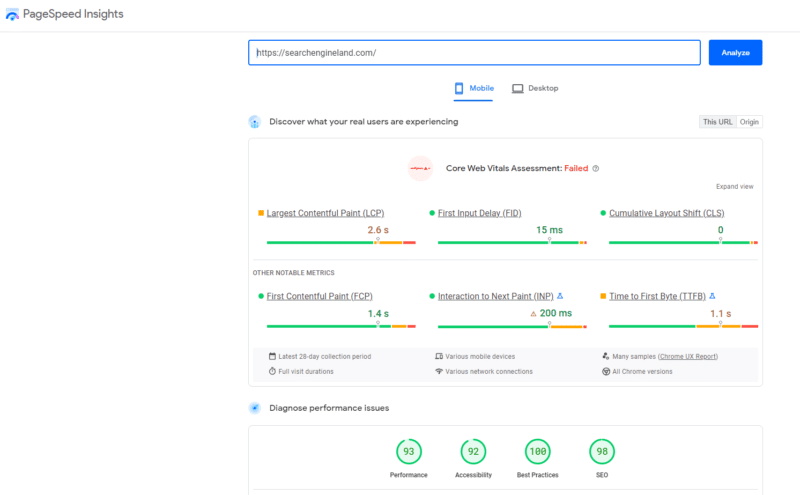
Google PageSpeed Insights provides all the data about page speed and how to improve it.

Screenshot of PageSpeed Insights for Search Engine Land.

301 redirects

If you want to remove your original ranking page in the deoptimization process you must remember to add a 301 redirect. 

In some cases, such as in the case of keyword cannibalization, you might want to take a page down to help another rank.

Add 301 redirects, and to be ultimately diligent, go through the links pointing to the old page and edit them so they point directly at the desired ranking page.

Taking the leap into deoptimization can feel a little scary, especially if you risk losing a lot of traffic.

The thing to remember is that clicks and impressions are meaningless if they’re from the wrong audience or fail to result in conversions.

The post What to do when the wrong page ranks for a keyword appeared first on Search Engine Land.

Original source: https://searchengineland.com/wrong-page-ranking-390988

This day in search marketing history: January 7

The Spam Clock

in 2011, startup search engine Blekko launched a spam clock that estimated 155 million spam pages had been created since Jan. 1 of that year. Blekko said 1 million spam pages were being created every hour.

How bad was Google’s spam problem then? Big. But as Danny Sullivan pointed out at the time, it was hard to judge whether Google’s relevancy had actually decreased, because:

  • We expect more from Google than we do in the past, searching for things we might not have in previous years
  • We don’t remember all the successful searches, focusing on when things go bad.
  • We probably don’t do a comparison check on Bing or Blekko to see if they performed better, nor do we use those services on a regular basis to understand if they’re also “failing” to the degree we might feel Google does.
  • Our expectations of Google are higher.

Read all about it in Blekko Launches Spam Clock To Keep Pressure On Google.

In about a month, Google would start making moves to correct its perceived, growing relevancy problems with the Panda Update.

I don’t even want to think about how much spam has been created since the start of this year – especially with the explosion that is ChatGPT.


Also on this day 


Google Ads to allow ads for sport betting in New York

2022: Google Ads updated its gambling policy to allow ads for sports betting from certified and state-licensed entities in New York State.


2022: After eight months on pause, AdSense publishers could once again create Related search style experiments.


Google My Business launches new performance reporting

2021: The new reports provided 6 months of data on how people interacted with you (calls and messages) and how people discovered you (the search term used to find your Google business listing in Google Search and Google Maps).


Google working on fixing data in URL parameter tool

2020: Google was working on fixing a data issue with the URL parameter tool, a legacy tool within Google Search Console that let SEOs communicate to Google insignificant page variations and direct Google to consolidate those URLs.


Google tests user comments for live TV shows

2020: The user comments appeared in the search results for queries related to live TV shows. It was similar to Google’s live sporting events feature.


Direct site navigation via voice arrives on iOS Bing Search app

2020: The updated Microsoft Bing Search App also had a new look featuring a carousel of common search categories.


Google’s Rich Results testing tool now supports code editing

2019: You could now edit the code in the rich results test and see what those edits did in real time.


Google Manufacturer Center adds rich content, deeper analytics, expands availability

2019: A new “From the manufacturer” section in Google Shopping product pages could feature brand-supplied rich content.


Bing Ads’ AI-powered Performance Insights now available globally

2019: The tool provided an on-the-spot way to take action on performance changes in your accounts.


StrategiQ launches Spark, an SEO deployment platform

2019: The digital marketing agency’s new tool helped SEOs test and deploy SEO-related changes on their own without developer overhead.


Leading local SEO predictions: Reserve with Google will grow, real-time local inventory gets real

2019: GMB messaging, voice search optimization, local inventory data, Q&A and the decline of SMB websites are all explored.


2015: Torrent Freak study reveals the number of Google’s takedown notices were up 75% from 2013.


Report: Yahoo Search Share Up After Firefox Deal

2015: Yahoo saw a nearly 2 point search market share gain in the U.S. in the past month (10.4% vs. 8.6% year vs. year.)


Google Webmaster Tools Search Queries Adds Mobile Stats & No Longer Rounds Data

2014: Google’s John Mueller said, “data in the search queries feature will no longer be rounded / bucketed,” and you will start to notice these changes in Webmaster Tools in the next few days.


WordStream Updates Its Free Google AdWords Performance Grader: Now With Mobile And Automatic 30-Day Reporting

2014: The tool was refined to give advertisers performance benchmarks within their own industries


Zora Neale Hurston Google Logo Marks The 123rd Birthday Of The Harlem Renaissance Writer

2014: The Doodle paid tribute to one of the 20th century’s most celebrated African American female writers.


Twitter Co-Founder Biz Stone Launches New Social Search App Jelly

2014: Calling itself a “new way to search,” ultimately, Jelly would follow the path of social Q&A platform pioneers failures like Ask.com, Quora, Yahoo Answers and Google Answers.


Stats On Mobile Content & Impact On Google Rankings

2013: Having mobile-optimized and rendered content was highly correlated with getting organic traffic from Google.


Library Of Congress Struggling To Make A Searchable Twitter Archive

2013: The Library of Congress was working on plans to create a searchable archive of nearly every public tweet ever sent, but the challenges inherent in that task were making it a slow process.


Google Logo Honors Addams Family Creator, Charles Addams

2012: The black-and-white Doodle featured seven characters from “The Addams Family.”


Bing Adds FanSnap Ticket Inventory Into Search Results

2011: Just in time for the opening round of the NFL playoffs.


Quora Co-Founder Outlines Plans To Deal With Growing Pains

2011: Co-founder Charlie Cheever admitted it had been “a big challenge” to maintain Quora’s character while the site has been flooded with new users.


Bad Directions: Google Maps Sends Local Listing Reports To Wrong Business Owners

2010: Google sent out its Google Local Business Center updates – but the emails didn’t go to the actual business owners.


Armstrong: Google Gets “First Dibs” At AOL Search Deal

2010: AOL’s CEO, Tim Armstrong and former Google executive, said Google (not Microsoft Bing) would get “first dibs” at a search deal.


Yahoo & American Airlines Settle Search Ad Suit

2010: The two companies reached a settlement prior to judgment, although the terms of the settlement were not disclosed.


CES: Microsoft Expands Scope Of HP Search Relationship To 42 Countries

2010: Microsoft CEO Steve Ballmer announced that Bing would become the default search engine and MSN the default homepage on HP computers.


Earthquake: Real-Time Results On Google Make Up For Lack Of Other Content

2010: Google’s Earthquake OneBox didn’t catch it, but Google was saved by its integration of Twitter results.


French Wants To Tax Google & Others

2010: President Nicolas Sarkozy was exploring ways to tax Google and other online advertising companies based outside of France.


Bing Admits MSNbot Is Slow

2010: That was according to Brett Yount, a program manager for Bing, who said “it is well known in the industry that MSNbot is fairly slow.”


Google’s Near Me Now: A Yelp Killer?

2010: Spoiler alert: No, it was not.


Baidu Sued As Search Monopoly In China

2009: Leading Chinese search engine Baidu was sued by Chinese medical B2B marketplace Qmyy.com to prevent its site from being blocked or dropped by the engine.


Bruce Clay Releases Two New Tools

2009: One tool was named the Search Engine Optimization/KSP tool and the other was a toolbar called SEMToolBar.


Report: Sitemaps Decrease Crawler Response Time

2009: Test showed that submitting a sitemap to Google and Yahoo decreased the time it took Google and Yahoo to crawl the page.


Google Maps For Mobile Simplifies Directions

2009: Previously if users entered a business name on the Maps client as a directions end point, Google might not recognize it.


Bush: Fix Your “Miserable Failure” Googlebomb Legacy Before Obama Takes Office

2009: Bush should have stopped redirecting requests for his old biography to the current presidential home page. It left that page with a legacy of ranking for failure.


Microsoft Wins Verizon Mobile Search Derby

2009: Google and Microsoft were in tight competition for the mobile search partnership.


Search Biz: Yahoo-MSFT Update; Google’s 20% Time Changing & Google Router Coming Soon?

2009: The latest twist in the Yahoo-Microsoft saga: a new group was trying to takeover Yahoo with Microsoft’s money. 


Deal Puts Microsoft Live Search On Dell Computers, Verizon Phones — Will It Help?

2009: Microsoft CEO Steve Ballmer announced several high-profile distribution deals for Live Search at CES.


Google Confirms Layoffs Of Contract Employees

2009: Google released “a substantial number” of its contract and temporary employees, but the exact number wasn’t known.


Search Wikia: Not Even A Remote Threat To Google

2008: “Widely hyped … it’s really just yet another crappy search service that may, potentially, if all goes well, eventually turn into something useful.” See also: Wikia Search Launches Alpha Version


Googler’s Bet Goobles On Predictive Markets During Their Free Lunch

2008: Why did Google encourage this activity from their employees? Google believed it generated creative ideas from their employees.


David Hirsch Leaving Google & Omid Kordestani Sells 6,000 Shares Of Stock

2008: David Hirsch, the Director, B2B Vertical Markets Group at Google, was leaving at the end of the month to help invest and advise startups.


Yahoo Makes Bid To Become A Mobile Development Platform

2008: There were essentially three pieces to what Yahoo announced: Yahoo Go 3.0, an open mobile widget development platform for third parties, and a redesigned mobile WAP homepage that emphasized personalization and customization.


Google, AOL, Yahoo, & Digg Sued For Playing Online Solitaire

2008: Google, Yahoo, AOL, and Digg were all sued by Sheldon F. Goldberg for patent infringement.


From Search Marketing Expo (SMX)


Past contributions from Search Engine Land’s Subject Matter Experts (SMEs)

These columns are a snapshot in time and have not been updated since publishing, unless noted. Opinions expressed in these articles are those of the author and not necessarily Search Engine Land.


< January 5 | Search Marketing History | January 7 >

The post This day in search marketing history: January 7 appeared first on Search Engine Land.

Original source: https://searchengineland.com/search-marketing-history-january-7-391035