Logistical Benefits of Commercial Real Estate Software for Development Firms

Home Business Magazine Online

While industry-specific software won’t solve all your issues, it will give you the tools to tackle them more efficiently. This is the case with commercial real estate software, a varied niche of specialized solutions that can transform everyday operations and processes within development firms. There are many benefits to talk about, so let us just focus on the logistical impact that the latest products in this space can have.

Reducing Errors

There are many obstacles to overcome in a real estate development context, and making mistakes at the planning phase can disrupt the smooth progress of every other stage going forward. Human error has a part to play in causing delays and increasing costs in all sorts of projects. Therefore, the ability of dedicated software to take this out of the equation is appealing.

Justifying Choices

You need to know that the decisions you make when developing real estate are the right ones, and it is only with careful analysis of the available data that this is possible. Software solutions set up to oversee complex projects empower you with the insights you need, whenever you need them. Whether you are working out a budget, choosing materials, or solving problems, tools will transform the experience and mean you do not need to rely on your instincts alone.

Unifying Data Management

Getting data management right involves thinking strategically about not just the tools you use, but how they function in tandem with one another. Rather than relying on a disparate set of software packages that aren’t specialized and leave data spread thin and siloed, commercial real estate software offers a single, central solution to control and provide access to everything you need.

Applying Automation

The likes of Northspyre’s real estate project management software make life easier for development firm employees by automating all sorts of tasks. When team members don’t have to set aside a lot of time to enter data points and look for insights manually, they can work on more interesting parts of the process, while still getting all the benefits of analyzing the available information.

Accelerating Strategic Shifts

Often when a development project is up and running, you encounter situations in which a change to the original plan is necessary. Going back to the drawing board to conjure up a new strategy that will let you sidestep potential snafus is faster and less frustrating with commercial real estate software on your side.

This ties into the attraction of automation. Your focus can be on reframing your plans based on the new information you’ve got at your disposal, rather than on dealing with the nuts and bolts of project management.

Embracing Persistent Monitoring

Other aspects of working on commercial real estate projects ― that used to be uphill struggles — are tracking the current state of play and determining whether or not you’re on the desired trajectory, or if any areas are falling short of your original intentions.

Software platforms in this space can monitor various strands in real time. Moreover, they give you an instant overview of how things are shaping up with each passing day.

Rather than being sideswiped by shortfalls or supply chain hold-ups, you can predict and respond to problems proactively.

The Bottom Line

With commercial real estate software in your toolkit, you can save money, improve productivity levels, and make the experience of working in a development firm more engaging and enjoyable. You just need to pick the right platform and use it to the fullest, and the rest will fall into place.

The post Logistical Benefits of Commercial Real Estate Software for Development Firms appeared first on Home Business Magazine.

Original source: https://homebusinessmag.com/businesses/real-estate/logistical-benefits-commercial-real-estate-software-development-firms/

Northern Rail selling tickets for just 50p

Reading Time: 2 mins

Northern Rail has just launched a huge flash sale on rail tickets, with some selling from as little as 50p. The offer includes routes within Greater Manchester and across the north. Up to five million discounted train tickets are up for grabs in total.  

One million are priced at just 50p, with a further three million selling for £1. The remaining one million tickets are on sale for just £1.50. These tickets are available until 4pm on Friday, 13th January, so travellers will need to be quick to bag themselves an absolute steal. 

If you do manage to get yourself a ticket at this very low price, tickets are only valid for travel between Tuesday, 17th January 2023 and Friday, 10th March 2023 on Northern services only. You can purchase your tickets via the Northern Rail website or through their easy-to-use mobile app. 

Some of the journeys included in the sale are shown in the table below: 

Home Business

Exclusions

Please note, exclusions apply on the following routes:
• Leeds to Manchester
• Manchester to Liverpool
• Halifax to Hull
• Sheffield to Manchester.
• Leeds to Nottingham
• Leeds to Lincoln
• Leeds to Sheffield via Moorthorpe
• Leeds to Sheffield via Castleford
• Leeds to Chester
• Leeds to Wigan
• Leeds to Huddersfield from 29th January 

Mark Powles, commercial and customer director at Northern, said:

“This is our biggest ever Flash Sale – with 50p, £1 and £1.50 fares available across all parts of our network. 

“We know our customers travel for a multitude of reasons – so our hope is this sale will make five million of them – be they for days out, weekends away or catch-ups with friends – that bit more affordable. 

“Customers should book early to avoid disappointment. Once they’re gone, they’re gone.” 

Rail Minister, Huw Merriman, said:

“This flash sale is five million chances to see family, friends or just get out and around for prices as low as 50p. We need to get people back on our railways and initiatives like this will do just that.” 

The post Northern Rail selling tickets for just 50p appeared first on MoneyMagpie.

Original source: https://www.moneymagpie.com/make-money/northern-rail-selling-tickets-for-just-50p

This day in search marketing history: January 6

In 2011, Google Webmaster Tools started sending out two new types of warnings – for “unnatural links” and “cloaking.”

The messages were sent out when Google detected pages on websites that were using techniques that were outside of its quality guidelines.

At the time, Google had been talking about wanting to increase its outreach to webmasters. See this video (published Dec. 18, 2010), in which Google’s Matt Cutts (featuring Danny Sullivan) mentioned that Google wanted to make communication a priority in 2011.

Read all about it in Google Adding New Spam Warnings In Webmaster Tools.

Dig deeper: Google penalties, manual actions and notifications: A complete guide


Also on this day 


Google launches ‘Shops’ section in mobile search results

2022: The Shops section showed three to 10 retailers based on their organic search rankings.


Google Ads error tells advertisers exact match keywords are saving as broad match

2022: Search marketers entering exact match keywords may have seen an alert toward the bottom of their Google Ads interface stating, “Broad match keywords are on. Keywords will be saved as broad match.”


Search Engine Land, SMX name Carolyn Lyden content lead

2021: Lyden acted both as editor-in-chief of Search Engine Land and content lead for our SMX events series. She departed Third Door Media in November 2021.


Standard text ads will live on a bit longer, Microsoft Advertising says

2020: Microsoft Advertising, which originally said standard text ads would no longer serve after 2019, announced it would allow existing standard text ads to continue to serve until March 31.


Video: A.J. Ghergich on not chasing the Google algorithm and focusing on human intentions

2020: In this installment of Barry Schwartz’s vlog series, he chatted with Ghergich about how to scale your SEO agency, understanding human intent and more.


Google to start showing local-specific phone numbers when location extensions appear in ads

2017: Google said, starting Jan. 19, it “may” show the local retail phone number when that store’s location extension showed in an ad – even if a call extension in the campaign used a different phone number – in order to increase the relevance of ads that featured specific business locations.


“Illegitimate” SEO Sentenced To 37 Months In Federal Prison For Extortion

2016: William Stanley extorted individuals and companies by threatening to engage in illegitimate SEO work: posting “fraudulent comments and creating negative reviews online, if the victim did not pay him a certain sum of money.”


Google Revamps The Android App-Indexing Crawl Errors Report In The Search Console

2016: Google announced they had finally upgraded the App Indexing Crawl Errors report, which had not been working for months, in the Google Search Console.


2016: Claiming to be enforcing Germany’s “Ancillary Copyright” Law, the publishers were suing to get Google to pay them for showing their content in search results.


Bing Ads, Too, Says Goodbye To Phone Numbers In PPC Ad Copy

2015: Bing Ads told advertisers they soon would no longer be able to put a phone number in the headline, body copy, URL or extensions like Sitelinks. As with AdWords, advertisers would need to use location or call extensions for phone numbers.


Pinterest Beefs Up Its Search Chops With VisualGraph Acquisition

2014: Pinterest said the acquisition would “help us build technology to better understand what people are Pinning. By doing so, we hope to make it easier for people to find the things they love.”


Bing Launches Awards Site In Time For Golden Globes, Grammy’s & The Oscars

2014: The site served as an online resource for “all things awards” with background information on nominees, tips for award-themed parties, and winner predictions based on Bing search statistics.


Bing Makes Driving Directions Twice As Fast

2012: Bing Maps pushed out a major update to their driving directions “routing engine.” The new routing engine was twice as fast as the old one and added more features, such as adding up to three routes in one request.


Search In Pics: Google Bumper Sticker, Knitted Android Sleeve & Yahoo’s CEOs

2012: The latest images culled from the web, showing what people eat at the search engine companies, how they play, who they meet, where they speak, what toys they have, and more.


Google Mobile Strategy Playing Out Almost Flawlessly: Ads Growing, Android Beating iPhone

2011: Google’s AdMob unit reported that it saw more than 2 billion ad requests on a daily basis. Meanwhile, comScore reported that Android passed the iPhone as the number two smartphone platform in the U.S.


South Korea May Arrest Google Execs Over WiFi Data Collection

2011: The country’s national police agency had determined that Google acted illegally when it gathered personal data as part of its Street View mapping service.


Covario: Consumer Electronics Marketers Take Q4 Paid Search Boom Overseas

2011: Among its tech and consumer electronics clients in the Americas, paid search spending only rose 1% in the fourth quarter of 2010, as compared to the third quarter, but that’s because growth from the second to the third quarter was 30%.


Twitter’s New Year Tweet Record Shown In Stunning Video

2011: Twitter started 2011 with a new record: 6,939 tweets were sent at four seconds after midnight in Japan. 


Foursquare Puts The Kibosh On Friend-Tip Spamming

2011: Foursquare started limiting the number of friends and friend requests that a user can have.


Google AdWords Testing Lead Capture Forms: Contact Form Extensions

2010: Contact form extensions provided a contact form directly in the search ad, which a searcher can fill out and the advertiser can then use in the future to contact that lead.


Google Loses French Lawsuit Over Google Suggest

2010: Google was ordered to remove the word arnaque, which translates roughly as “scam,” from appearing as a Google Suggest term on searches for the Centre National Privé de Formation a Distance (CNFDI). 


Surprise: Google’s Home Page Promoting Nexus One

2010: The promotion was found under the search box and read: “Experience Nexus One, the new Android phone from Google.”


Nexus One: What Exactly Happened Yesterday In Mountain View?

2010: Less than 24 hours after the formal unveiling of the Nexus One by Google, we had a collection of differing perceptions and accounts of what was significant (or not).


Google Claims That Google Checkout Increases Conversion By 40% & Clicks By 10%

2009: Google added claims to its Google Checkout Merchant homepage that having Google Checkout as part of your AdWords ads would lead to higher conversions and a better click-through rate.


Google Testing ‘Blended’ Mobile Ads

2009: As it turned out, Google wasn’t doing anything new. On the Google WAP search experience the company had always placed ads at the end of organic text results but before other types of content.


Yahoo To Advertisers: We Can Create Ads & Edit Keywords Without Asking First

2009: Yahoo emailed their search advertisers about new terms and conditions, including a controversial provision that they are allowed to create ads, remove or add keywords to campaigns and “optimize” accounts.


Google Finally Brings Picasa To The Mac

2009: Picasa was a management system for photo sharing and editing.


Google Wins “Gu Ge” Lawsuit In China

2009: The Beijing Haidian District Court ruled that Beijing Guge Science and Technology had to pay Google China 100,000 yuan ($14,624). In addition, Beijing Guge is required to stop using the name.


2009: It was suggested that the art represented an airplane crashing into New York’s former World Trade Center towers on 9/11.


The Big List of 2009 Marketing Predictions

2009: Articles and blog posts filled with forecasts, predictions, and/or resolutions for the new year. 


Mahalo Adds More Social Features

2008: The Mahalo Follow toolbar let you post links to Delicious, Ma.gnolia, Mahalo Social, and Twitter with the click of one button. The sidebar displayed quick tips when you were on sites like Twitter and Gmail.


From Search Marketing Expo (SMX)


Past contributions from Search Engine Land’s Subject Matter Experts (SMEs)

These columns are a snapshot in time and have not been updated since publishing, unless noted. Opinions expressed in these articles are those of the author and not necessarily Search Engine Land. 


< January 5 | Search Marketing History | January 7 >

The post This day in search marketing history: January 6 appeared first on Search Engine Land.

Original source: https://searchengineland.com/search-marketing-history-january-6-389992

8 ways to make money from your postcode

Reading Time: 7 mins

Did you know you can make money from your postcode? Whether you’re in the country or in the town, you can make some extra cash simply by being where you are.

Let’s examine the top 8 methods to make money from your postcode below:


Your postcode can make you £800 today!

Excited woman holding cash

The first way to make money from your postcode can be done through Pick My Postcode, the free postcode lottery. You can also make up to £800 from this on any given day. The website is totally legitimate and offers a chance for you to make money from your postcode every day.

All you do is sign up with your email address and postcode. then check back on the site every day to see if your postcode has won. So be sure to check every day!

There’s no catch either. The website works by having people check the site every day so it increases the traffic. This in turn increases the amount of money they can make from advertisers.

So the website makes enough money simply from it’s traffic, enabling their cash prizes!

Not only that, but the site has lots of other ways you can make money just by watching videos or clicking on links.!

Try it here; put your email address and postcode in and win £800 today!

Find out more in our article about it here.


Find local work

Nanny playing with two children

Perhaps the most obvious way to make money from your postcode is to look for local employment.

For example, in your area you could do:

You can also use sites like Gumtree, RatedPeople, Freelancer.co.uk and Peopleperhour.co.uk to find work in your local area.

Or just do it yourself. Make flyers and posters and advertise your skills in local libraries, train stations, pubs or even put leaflets through letterboxes in your area.


be a poll clerk

Polling Station entrance

When there is a General Election or any local elections, someone has to sit in the voting office to tick people off as they come in and go. This ensures everything happening is done properly and democratically.

That’s the job of a poll clerk, and it’s pretty well paid as you can see in our article here.

Get in touch with your local council to have your name put on the list. Then once the next election comes around you can take advantage.


Sell energy to the national grid

Energy digital graphic

If you’re making use of sustainable energy you can sell surplus energy back to the National Grid.

For example if you’ve put solar panels on your roof, you could sell some of your surplus. Remember it does need to be green energy to be sold.

  • A programme of what are called ‘Feed-in Tariffs’ (FiTs), provides income from every kilowatt hour generated in your home. All renewable energy qualifies so check on the Feed-in Tariffs site for more info.
  • Renewable Heat Incentive became another potential source of income where you could also receive a tariff for renewable heat sources (RHI).

Both of these schemes will pay you a bonus for exporting energy or renewable heat sources into the grid or network.


man fitting solar panels to roof

Renewable energy, which is suitable for domestic use, includes solar energy, wind turbines, water turbines, ground source heat pumps or biomass boilers and stoves.

These various technologies are designed to last 20 to 25 years but they do cost money to install. However, over time, you should be able to make that money back and earn a profit.

There is a variety of government grants available to householders installing renewable energy technology.


Consider renting out your driveway

Home Driveway

Do you have a driveway, garage or private parking space that you don’t use? Do you live somewhere popular like the centre of town, near a train station or sports ground? You could make money by renting out your space.

Contact YourParkingSpace to advertise it. Even if you use the driveway regularly, you can still make money by renting it out temporarily.

For example, you might not use it at the weekends, when the local football stadium is busy. Or you might live near Wimbledon but move out during the tennis.

Either way, read the full article on renting out your driveway to learn how drive up your income levels from your parking space.


Rent out a room

Room for rent sign

You can make up to £4,500 a year by renting a room in your home. It’s also tax free!

We like Spareroom which includes an interesting ‘buddy up’ section where people looking for somewhere to stay can find others in the area who are also looking. That way they can get together and find a whole house to rent together.

For more ideas, take a look at our article on renting a room.

If permanently sharing your home doesn’t appeal, consider taking in foreign students short-term. English language schools are always looking for good homes for their growing number of students.

Depending on where you live and how nice your place is, you can make between £35 and £150 a week.

Spare bedroom

part-time lodgers

If renting out a room full time isn’t something you want to do then a part-time lodger may suit you better. The website Monday-to-Friday specialises in just this type of person. It appeals to people who need to stay in your area during the week, but go home at weekends.

For even more temporary lodgers, you can put your home, or just a room, on Airbnb or HomeAway so that you can make money hosting tourists or business visitors for one night at a time. For extra cash you could offer breakfast too.

Just rent space

You don’t just have to rent to people, though. If you have an empty, dry basement or a big loft, you could potentially advertise it as storage space, particularly if you live in a crowded city where storage is at a premium.

If you have a cellar or garage that has its own access, you will be able to charge more by offering clients their own key and 24-hour availability. This could make anything from £5 a week for storing a few boxes in your loft to around £50 for filling a garage in central London. Try Spareground or Gumtree to get started.


Rent out your garden

Garden with for rent sign on the gate

If you have a large garden, consider turning it into allotments, particularly if you live in a city. In London the average waiting time for allotments can be several years.

So if you don’t mind people coming into your garden whenever they like to grow fruit and veg, then it’s a good way to make some extra cash. Not to mention keep the weeds at bay.

Municipal allotments charge very little, between £10 and £30 a year. But that doesn’t stop you from making a private arrangement and charging more.

Find out how to turn your garden into allotments here.


move to another postcode to get a better deal on insurance

When you move house your insurance premiums can rise or fall depending on the area.

For example, insurers Confused.com have found that a 40-year-old man with a five-year no claims discount driving 15,000 miles a year in a Ford Focus would pay over £1000 a year for car insurance in Bradford (BD1 postcode area), compared to around £4000 in Aberdeen (AB).

Not surprisingly, London is the most expensive city for premiums where Truro in Cornwall (TR) is one of the cheapest areas for insurance premiums. Take a look here to see how much you could save on your car insurance today, wherever you live!

For home insurance, Bournemouth is the cheapest area at around a third less than the average. With York and Glasgow the second and third respectively.

Of course, you don’t have to move house just to get a cheaper insurance rate. You can save cash just by switching next time you have to get a new policy. Try this comparison to make money for yourself!


More ways to get free stuff

Want more ways to earn free cash and win great prizes? Stay up-to-date with the latest MoneyMagpie competitions on our new Competitions and Freebies forum!

Get stuck into the other parts of the MoneyMagpie Messageboard, too. Ask your money questions and get responses from the MoneyMagpie team, community members, and even vetted experts. Even better: the best post of the week wins a £25 Amazon voucher!

View all Messageboards here.


The post 8 ways to make money from your postcode appeared first on MoneyMagpie.

Original source: https://www.moneymagpie.com/make-money/make-money-from-your-postcode-2

Settling Business Interests After a Divorce

Home Business Magazine Online

In the wake of a divorce, it is common to wonder what will happen to your business. Often, the focus of couples will be on child support. It can be easy to forget the other financial agreements and legalities arising from a split with your spouse.

When building a future, it is possible to consider setting up a business and running it together. After all, you have to think about your future as a family. When running the company, the couple may have different roles and contributions. As the marriage crumbles, it can be easy to think that the person who “contributed” more to the business will get more. However, it is not always the case.

This article will discuss how business interests can be divided after divorce.

Division of Assets and Liabilities

One of the things to consider first is the division of assets, which depends on the state that covers the marriage. The state will decide if the asset division will fall under community property or equitable distribution.

As with assets, debts and other liabilities during the marriage are also divisible, regardless if only one partner is responsible for acquiring them. The business assets you own after the divorce are different from the personal assets owned before the marriage. Business assets include cash, accounts receivable, inventory, and real estate. You may also have the equipment, such as computers or vehicles, purchased during the marriage.

When looking at your business assets, it is essential to know that there are two types of property: community and separate. Community property is any asset acquired during the marriage, including real estate. If you and your spouse were equal partners in the business, then any income the company generates would be considered community property. A separate property is something owned before marriage or during the separation period after divorce.

Dividing Business Ownership After Divorce

A company may be one of the most valuable financial possessions one can own. It can be scary to think that all the hard work will be lost after a divorce. That is why it is essential to consider whether the business is a marital or non-marital asset.

If you and your spouse have separate businesses, dividing your wealth is straightforward. This is, however, dependent on whether your organizations are incorporated or not.

Unincorporated Business

This business type is not an asset. However, all that makes up the company may be considered assets. These assets may include:

  • Offices (if owned);
  • Equipment, tools, and vehicles used to run the business;
  • Business financial accounts;
  • Business debts; and
  • Business goodwill, including name value and ability to earn in the future.

Incorporated Business

Some parties may register their business as a corporation. With it, they can separate their personal and business assets and liabilities. When it comes to incorporated businesses, the law recognizes shares as assets. They will determine the value of the assets and liabilities and divide it by the shares owned. Value determination is similar to that of an unincorporated business.

In case of a divorce, a spouse can divide the corporation shares or receive assets from the business. Based on the legal guidelines, these assets must be divided 50–50. You retain company ownership if the company is brought into the marriage. However, any increase in the valuation of the company during the marriage should be shared evenly.

If the company were an inheritance during the marriage, it would not be included in the division of assets. However, the other partner may have a stake in it if it is intermingled with other marital assets.

After a divorce, the parties can ask for a formal business valuation. Once the valuation is final, the equalization process determines the amount the owner must award to the non-owner.

Registering the business as a limited liability corporation (LLC) does not offer protection from the division of assets. While some courts will not dissolve the business, they may adjust ownership interests.

If you are keen on keeping your operations intact, it may be best to compensate the spouse for their business interests. It is also possible to have the partner take a property of similar value to pay for their company share.

Protecting Your Business Ownership During and After Divorce

It is vital, as a business owner, to ensure that your business has protection during and after divorce. If you married a Canadian, you have up to two years from the conclusion of the marriage to claim a property division.

If the relationship is beyond repair and divorce or separation is inevitable, it is best to work with a lawyer. Choose one that specializes in complicated cases and can help you divide business assets.

Final Comments

Dividing your business assets and interests can be difficult after a divorce. However, if you can identify and protect your investments early on, it will be more straightforward.

The post Settling Business Interests After a Divorce appeared first on Home Business Magazine.

Original source: https://homebusinessmag.com/management/legalese/settling-business-interests-after-divorce/

Office Rent Options for Small Business Owners

Home Business Magazine Online

Small enterprises can rent some of the most well-liked private offices. During the workday, there is a reduction in distractions when working in private workplaces. Some businesses invested in a private virtual office due to COVID-19. Businesses may enhance productivity and attention while ensuring security with the help of a productive area. Due to the tight quarters of a small business, collaboration boosts even more. Attaining a private office as a small business owner can lead to a more effective team and workflow.

The most sought-after private offices for small businesses to rent include the following:

Professional Office Space

It is obvious to clients, customers, and the neighborhood that you are a genuine firm with expansion plans when you have a professional office space. In contrast to communal spaces or working from home, an office setting exists solely for commercial purposes, which fosters a distraction-free workplace.

Traditional Private Office Space

For small enterprises, traditional private office spaces are appealing. The best candidates for this type of space are businesses that provide financial services, such as banks, legal firms, or hedge funds. Most conventional floor plans include a lobby, boardrooms, and individual offices. You can provide each employee with a quiet, private office so they can work without interruptions. Traditional private spaces are available to rent, but you often have to sign a lease for at least three years. For small businesses, traditional private office rooms are undoubtedly popular. Traditional offices are typically preferable to other options like coworking for small businesses that appreciate their privacy.

Creative Private Office Space

A creative private office is yet another popular rent option for small firms. Both regular offices and co-working spaces can have creative layouts. Design, aesthetic, and layering vary from one location to the next. Creative workplaces typically feature wood flooring, high ceilings, big windows, wet pantries, and few walls. Less separation between desks emphasizes collaboration in this style.

Creative offices encourage collaboration, transparency, and teamwork within the entire organization. Because they typically have fewer employees who must work closely together, startups and tech organizations tend to like this layout more. Undoubtedly, as a tiny company, you might wish to think about renting a unique private office space.

Small Offices with Privacy

To rent a tiny business office, look into private offices in your neighborhood. This area provides improved security, thanks to a lockable room and private workstations. You and your staff get a private, quiet location to work without having to worry about your stuff.

Furthermore, the office is frequently already furnished, has Wi-Fi, and is open for business. A cost-effective option to operate your business is in small private rooms. Only the portion of the common area and breakout rooms used by your organization will be charged. Small private offices are popular for small firms that wish for their staff to feel secure and calm. By choosing single office space for rent in cost-effective packages created to fit your financial needs, you can now improve your company’s performance and make sure you can achieve your goals.

Open-Plan Office Space with Privacy

Small businesses may decide to rent a private open-plan office spaces. Ensure your office has an open layout so your staff can work comfortably within the room. Teams that collaborate should be grouped and placed in the same location. As a result, there is less foot traffic while maintaining the ability to communicate. Furthermore, you have access to a lot of natural light and can best use every square inch of space. Choose an open-concept arrangement for your company when setting up cubicles or workstations. In either case, staff members can customize their spaces and won’t feel confined. Without a doubt, consider renting a private open-plan office space for your small business.

Private Offices with Flexibility

Hire a flexible private office space if you want to expand your small firm. Flexible spaces are serviced workplaces, just like little private offices. You get a completely furnished, secured, and internet-ready space. Thanks to this facility’s flexibility, you can expand your company’s space as your firm expands. As you add more employees, you can increase your space.

Why commit to a full-time position when you only need an office part-time? With flexible office space, you can rent daily office space as and when you need it, saving you serious money.

Furthermore, you can lease your office for anywhere between 1 month and 12 months. Of course, if you decide to remain longer, the rental fee can be raised. Small firms seeking to expand and flourish are fond of flexible private office spaces.

There are many different types of office space for rent, so you can simply find something that fits your needs and your budget. Whether you are looking to impress clients with a gleaming new office or a large office space for rent that requires a meeting room in the city to deliver a presentation, there are several options.

If you’re renting office space, it’s crucial to work with a trustworthy business. Businesses should be very clear about the services they need and the particular location they want. It’s crucial to locate a workspace where the firm can prosper.

Conclusion

Small firms can rent a variety of well-known private offices. Since employees can have their own private offices to accomplish daily tasks, traditional private office spaces are popular with small enterprises. You can also lease a unique private office space where you can customize the design and promote better staff collaboration.

Rent a modest, private office to ensure your staff is relaxed and has access to private spaces where they can work quietly. Of course, you can also go for a conference room which will foster more collaborative efforts.

Flexible private offices are well-liked areas for developing small firms. This enables you to alter and enhance your area as your business grows. Small firms most frequently rent these private offices.

The post Office Rent Options for Small Business Owners appeared first on Home Business Magazine.

Original source: https://homebusinessmag.com/businesses/success-tips/office-rent-options-small-business-owners/

3 PPC marketing trends to keep a pulse on in 2023

As we begin 2023, it’s a good time to reflect on the macro-level trends we’ve observed last year. 

Here are a few trends that I believe have some staying power and should be considered as you build out your 2023 search marketing strategies.

1. A slow economy and heightened focus on efficiency

In case you haven’t heard, the economy has been struggling (that’s a joke). I graduated with a degree in economics, but like most of us, I have no idea how long this downturn will last. 

That said, I think many digital marketers are already feeling the impact.

  • Budgets are tightening.
  • Teams are getting leaner.
  • Questions such as “What’s the ROI?” or “What’s the CPA?” are becoming more prevalent. 

These environments are tricky to navigate and I certainly don’t have all the answers.

However, the advice I usually start with is leaning into your data. Make sure you have a deep understanding of your top-performing tactics and maximize your investment there first.

An analogy I often use is the concept of a sports team in the playoffs. When it comes to crunch time, a coach will always put their best players in the game for as much time as possible. Those players who are still developing are likely going to be watching the game from the bench. 

Take this same mindset when it comes to your search strategies. If your budget is limited, prioritize your investment on the tactics driving the most return. 

I’m sure many of you reading this are saying, “Yeah, thanks for stating the obvious.” But when I say this, I don’t mean simply consolidating to a brand keyword strategy. Instead, you should: 

  • Dig into the various segments of your campaigns’ performance. 
  • Understand what devices, audiences, geos, times of day/days of week, and campaign types drive the most efficient performance. Focus your investment on those combinations of segments first.
  • Consider creating a more granular campaign delineation to more effectively skew spend toward the top-performing combinations. 

Get the daily newsletter search marketers rely on.

<input type="hidden" name="utmMedium" value="” />
<input type="hidden" name="utmCampaign" value="” />
<input type="hidden" name="utmSource" value="” />
<input type="hidden" name="utmContent" value="” />
<input type="hidden" name="pageLink" value="” />
<input type="hidden" name="ipAddress" value="” />

Processing…Please wait.

function getCookie(cname) {
let name = cname + “=”;
let decodedCookie = decodeURIComponent(document.cookie);
let ca = decodedCookie.split(‘;’);
for(let i = 0; i <ca.length; i++) {
let c = ca[i];
while (c.charAt(0) == ' ') {
c = c.substring(1);
}
if (c.indexOf(name) == 0) {
return c.substring(name.length, c.length);
}
}
return "";
}
document.getElementById('munchkinCookieInline').value = getCookie('_mkto_trk');


2. Automation vs. autonomy

This debate originated well before 2022. However, I do think the heat was turned up a bit last year with:

Machine learning is getting stronger and will continue to be woven into campaign management platforms.

I believe that to be successful in 2023, you must best balance the power of automation with the autonomy required to achieve your stakeholder’s objectives. 

Think about when you are setting up an automated bid strategy. Part of that process is providing the algorithm with business-specific guardrails that it should operate between – and toward. The better the inputs you provide, the more closely your results will align with your objectives. 

I think that same mindset should be leveraged with applications of AI more broadly in campaign management platforms.

Automation reduces the resources required for foundational tasks. But, we still need to guide it to work toward our business objectives. 

More tactically, think about what datasets you can incorporate. The more inputs you’re providing, the more data points that these algorithms can use to inform the optimizations and recommendations. 

In addition, think about what levers you need to maintain control over and where you can free up your grasp by relying on machine learning to make the optimizations for you

Lastly, consider how to structure your accounts to allow the automation to perform best. 

That balance of automation and autonomy will differ based on the complexity of your strategy.

Advertisers who have the best understanding of what this balance should be for their business stand to benefit.

3. Microsoft on the rise?

What would an article like this be without at least one opinion that is a little “edgy.” Buckle up, folks!

I’ve been pretty impressed with the updates that came out of Microsoft last year. They’ve not only expanded their ad offerings but also their geographic reach by about 70 new markets. 

Microsoft Advertising has always touted their lower costs and comparable features to Google, but we are starting to see some innovation (i.e., Multimedia Ads) unique to the platform.

Let’s be clear – I’m not expecting a significant shakeup in search engine market share. However, if you haven’t looked at innovation opportunities on Microsoft Advertising, now might be as good a time as any. 

The (generally) lower CPCs make it a solid testing environment and much of the innovation they’ve incorporated can help to improve conversion rates. 

Improving conversion rates combined with cheap CPCs sounds like an opportunity worth circling back to in budget-constrained environments. 

This recommendation is particularly relevant for B2B advertisers, as Microsoft Bing is an engine where we have seen particularly strong engagement, likely due to research taking place on work devices.  

Search marketing’s staying power in 2023

Now is an incredibly exciting time to be in search marketing. The platforms are making plenty of updates that it’s hard to keep up.

Search marketing is one of the most powerful tools in the digital marketing toolbox. Other than search, there are only a few other environments where users indicate their interests so clearly. 

I’ve highlighted a few of the trends I’m keeping a pulse on, but in our fast-paced industry, there are likely plenty more trends that you will consider as you build out your 2023 strategy. 

The post 3 PPC marketing trends to keep a pulse on in 2023 appeared first on Search Engine Land.

Original source: https://searchengineland.com/ppc-marketing-trends-2023-391165

Webinar: Keep customers engaged post-holidays and all year long by Cynthia Ramsaran

Business Finance

Your holiday campaigns were a success but keeping customers engaged throughout the rest of the year can be hard – particularly if you operate in a highly competitive market.

Join our live, interactive webinar with Kate Richardson, Director of Customer Retention Marketing at Artifact Uprising and Toby Yuen, Customer Success Manager at Blueshift and discover proven ways to keep customers engaged and purchasing more.

Register today for “Keep Customers Engaged Post Holidays and All Year Long,” presented by Blueshift.


Click here to view more Search Engine Land webinars.

The post Webinar: Keep customers engaged post-holidays and all year long appeared first on Search Engine Land.

Original source: https://searchengineland.com/webinar-keep-customers-engaged-post-holidays-and-all-year-long-391195

How to build a ‘helpful’ content strategy for 2023

Between the roll-out of the helpful content update and the emphasis of E-E-A-T on every query and search result, Google is clear about the significance SEOs should place on good, valuable content in 2023.

Given that, I’d like to break down the approach, process, and resources my team uses to tackle content this year. 

I’m not just talking about a content calendar, which is one facet of your content strategy. I’m talking about using your audience understanding and your organization’s branding to build a content system that provides genuine value. 

The right approach for valuable content

The emphasis on quality and value in content is good for marketers, even if it shifts a bit of focus away from quantitative metrics like clicks and external links. 

Producing good content will rely on a rich understanding of your audience, good fundamental content structures, and solid delivery methods – marketing skills that will always be relevant.

Start with your audience. Who are they? What do they need? What content should you deliver to help them get there? 

Approach content like any other product or service:

  • Find or understand a need and address it.
  • Know the emotions (fear, uncertainty, urgency, etc.) in play.

Here’s an example of a valuable piece of content that’s rewarded with a top spot in the SERP even though the title and query aren’t exactly aligned.

when to panic in crypto

Click into the article, and you’ll see NerdWallet’s helpful, on-brand approach to a knee-jerk question. They offer calm, informed content that gives context around the latest crypto crash and guides readers to consider their full economic picture before making any emotion-driven decisions.

Developing a voice that addresses an understanding of problems is valuable, hard to do, and, most importantly, a competitive edge.

Content that helps advance brand differentiation, as the NerdWallet piece does, makes it much harder for your competition to poach your audience by upping the trust ante.


Get the daily newsletter search marketers rely on.

<input type="hidden" name="utmMedium" value="” />
<input type="hidden" name="utmCampaign" value="” />
<input type="hidden" name="utmSource" value="” />
<input type="hidden" name="utmContent" value="” />
<input type="hidden" name="pageLink" value="” />
<input type="hidden" name="ipAddress" value="” />

Processing…Please wait.

function getCookie(cname) {
let name = cname + “=”;
let decodedCookie = decodeURIComponent(document.cookie);
let ca = decodedCookie.split(‘;’);
for(let i = 0; i <ca.length; i++) {
let c = ca[i];
while (c.charAt(0) == ' ') {
c = c.substring(1);
}
if (c.indexOf(name) == 0) {
return c.substring(name.length, c.length);
}
}
return "";
}
document.getElementById('munchkinCookieInline').value = getCookie('_mkto_trk');


Building a process to create valuable content

The content strategy path I like to prescribe is as follows:

content strategy path
  • Problem aware: Empathize with your audience by articulating their problem in a clear, differentiated way.
  • Solution aware: Present your audience with objective, detailed, valuable options for solutions to their problem.
  • Brand aware: Develop your brand’s association as a trusted solution provider.
  • Product aware: Position your specific product or service as the ideal solution for the reader’s problem.

Following this path will:

  • Drive increased discussion, knowledge, and education around the problem.
  • Introduce new solutions that audiences hadn’t yet considered.
  • Position your brand as something transformative, unique, and revolutionary.  

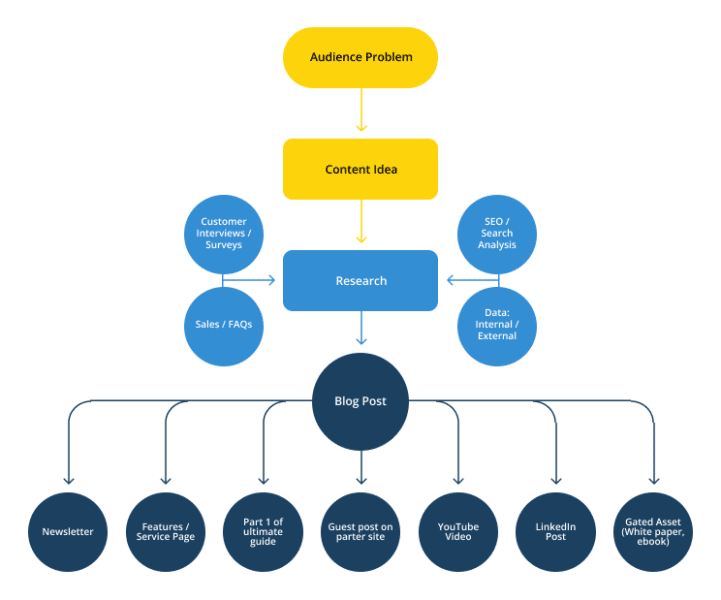
The problem itself will give you an idea for content that you can take into the research stage.

Once your research is conducted, you’ll have what you need to craft content and deploy it in multiple ways. 

The flow looks like this:

content creation workflow

I’d like to call out a couple of themes here:

  • SEO / search analysis is one piece of the research pie. Google wants us to write for our target audience, not for Google. Dig into the qualified and quantified information that helps you achieve that.
  • Truly useful content that isn’t written solely for SERP rankings should be highly engaging on any number of channels and in multiple formats. Don’t stop at a blog post, and don’t just rely on Google for eyeballs.

Resources to use in content development

Presumably, you know how to use Google’s keyword research tools and external tools (e.g., Ahrefs or Semrush). I’ll focus on tools that go beyond keywords to help you develop your content priorities.

Qualitative interviews

Surveys are useful and often expensive if you’re trying to reach an audience outside your CRM. 

You can get great insights if you can facilitate other ways to engage subject matter experts with the same professional experiences, challenges, and responsibilities as your target audience. 

Slack communities, (live or virtual) meet-ups, and memberships in organizations like the AMA or ANA can provide on-the-ground perspectives for your content mapping.

Social media

Not all social media posts are created equal, but understanding your audience includes knowing where your audience likes to engage: Twitter, Reddit, YouTube, TikTok, etc. 

Work those platforms to get information on what your audience is talking about in real-time, and you’ll be able to see trends as they emerge.

Google Search Console 

GSC can provide excellent insight into the performance of your previous content performance and give you data on what people are doing on your site and previous content. This allows you to see underperforming content and top-performing content. 

For the former, consider what might be missing in the content you can address. For the latter, spin-off more content if the theme allows, do internal linking, and build deeper authority on the topic to establish a competitive advantage.

Competitor analysis

Competitor analysis, in this case, doesn’t mean just looking for keywords with low competition. It means assessing:

  • Where your competitors are leaning in.
  • What ground they aren’t covering.
  • What formats they are or aren’t using.
  • What angles they might be taking on broader topics that leave room for your unique point of view. 

Go into your research looking for opportunities to stand apart rather than just copying everything your competitors are doing.

Moving the needle with helpful content

Taking this approach to content may ultimately change how you view content KPIs.

Instead of clicks and impressions, for instance, you may put yourself in a position to report on leads and opportunities generated and influenced. 

Along with burnishing your brand and helping build awareness, valuable content can move the needle at every stage of the buying journey. 

Google’s heavy-handed guidance on helpful content might feel uncomfortable if it forces a pivot in your approach, but in the long run, it may just make us all better marketers.

The post How to build a ‘helpful’ content strategy for 2023 appeared first on Search Engine Land.

Original source: https://searchengineland.com/how-to-build-a-helpful-content-strategy-for-2023-391074