JavaScript rendering and indexing: Cautionary tales and how to avoid them

I recently read Ziemek Bucko’s fascinating article, Rendering Queue: Google Needs 9X More Time To Crawl JS Than HTML, on the Onely blog.

Bucko described a test they did showing significant delays by Googlebot following links in JavaScript-reliant pages compared to links in plain-text HTML. 

While it isn’t a good idea to rely on only one test like this, their experience matches up with my own. I have seen and supported many websites relying too much on JavaScript (JS) to function properly. I expect I’m not alone in that respect.

My experience is that JavaScript-only content can take longer to get indexed compared to plain HTML. 

I recall several instances of fielding phone calls and emails from frustrated clients asking why their stuff wasn’t showing up in search results. 

In all but one case, the challenge appeared to be because the pages were built on a JS-only or mostly JS platform.

Before we go further, I want to clarify that this is not a “hit piece” on JavaScript. JS is a valuable tool. 

Like any tool, however, it’s best used for tasks other tools cannot do. I’m not against JS. I’m against using it where it doesn’t make sense.

But there are other reasons to consider judiciously using JS instead of relying on it for everything. 

Here are some tales from my experience to illustrate some of them.

1. Text? What text?!

A site I supported was relaunched with an all-new design on a platform that relied heavily on JavaScript. 

Within a week of the new site going live, organic search traffic plummeted to near zero, causing an understandable panic among the clients.

A quick investigation revealed that besides the site being considerably slower (see the next tales), Google’s live page test showed the pages to be blank. 

My team did an evaluation and surmised that it would take Google some time to render the pages. After 2-3 more weeks, though, it was apparent that something else was going on. 

I met with the site’s lead developer to puzzle through what was happening. As part of our conversation, they shared their screen to show me what was happening on the back end. 

That’s when the “aha!” moment hit. As the developer stepped through the code line by line in their console, I noticed that each page’s text was loading outside the viewport using a line of CSS but was pulled into the visible frame by some JS. 

This was intended to make for a fun animation effect where the text content “slid” into view. However, because the page rendered so slowly in the browser, the text was already in view when the page’s content was finally displayed. 

The actual slide-in effect was not visible to users. I guessed Google couldn’t pick up on the slide-in effect and did not see the content. 

Once that effect was removed and the site was recrawled, the traffic numbers started to recover.

2. It’s just too slow

This could be several tales, but I’ll summarize several in one. JS platforms like AngularJS and React are fantastic for rapidly developing applications, including websites. 

They are well-suited for sites needing dynamic content. The challenge comes in when websites have a lot of static content that is dynamically driven. 

Several pages on one website I evaluated scored very low in Google’s PageSpeed Insights (PSI) tool. 

As I dug into it using the Coverage report in Chrome’s Developer Tools across those pages, I found that 90% of the downloaded JavaScript wasn’t used, accounting for over 1MB of code. 

When you examine this from the Core Web Vitals side, that accounted for nearly 8 seconds of blocking time as all the code has to be downloaded and run in the browser. 

Talking to the development team, they pointed out that if they front-load all the JavaScript and CSS that will ever be needed on the site, it will make subsequent page visits all that much faster for visitors since the code will be in the browser caches. 

While the former developer in me agreed with that concept, the SEO in me could not accept how Google’s apparent negative perception of the site’s user experience was likely to degrade traffic from organic search. 

Unfortunately, in my experience, SEO often loses out to a lack of desire to change things once they have been launched.

3. This is the slowest site ever!

Similar to the previous tale comes a site I recently reviewed that scored zero on Google’s PSI. Up to that time, I’d never seen a zero score before. Lots of twos, threes and a one, but never a zero.

I’ll give you three guesses about what happened to that site’s traffic and conversions, and the first two don’t count!


Get the daily newsletter search marketers rely on.

<input type="hidden" name="utmMedium" value="” />
<input type="hidden" name="utmCampaign" value="” />
<input type="hidden" name="utmSource" value="” />
<input type="hidden" name="utmContent" value="” />
<input type="hidden" name="pageLink" value="” />
<input type="hidden" name="ipAddress" value="” />

Processing…Please wait.

function getCookie(cname) {
let name = cname + “=”;
let decodedCookie = decodeURIComponent(document.cookie);
let ca = decodedCookie.split(‘;’);
for(let i = 0; i <ca.length; i++) {
let c = ca[i];
while (c.charAt(0) == ' ') {
c = c.substring(1);
}
if (c.indexOf(name) == 0) {
return c.substring(name.length, c.length);
}
}
return "";
}
document.getElementById('munchkinCookieInline').value = getCookie('_mkto_trk');


Sometimes, it’s more than just JavaScript

To be fair, excessive CSS, images that are far larger than needed, and autoplay video backgrounds can also slow download times and cause indexing issues.

I wrote a bit about those in two previous articles:

For example, in my second tale, the sites involved also tended to have excessive CSS that was not used on most pages.

So, what is the SEO to do in these situations?

Solutions to problems like this involve close collaboration between SEO, development, and client or other business teams. 

Building a coalition can be delicate and involves giving and taking. As an SEO practitioner, you must work out where compromises can and cannot be made and move accordingly. 

Start from the beginning

It’s best to build SEO into a website from the start. Once a site is launched, changing or updating it to meet SEO requirements is much more complicated and expensive.

Work to get involved in the website development process at the very beginning when requirements, specifications, and business goals are set. 

Try to get search engine bots as user stories early in the process so teams can understand their unique quirks to help get content spidered indexed quickly and efficiently. 

Be a teacher

Part of the process is education. Developer teams often need to be informed about the importance of SEO, so you need to tell them. 

Put your ego aside and try to see things from the other teams’ perspectives. 

Help them learn the importance of implementing SEO best practices while understanding their needs and finding a good balance between them. 

Sometimes it’s helpful to hold a lunch-and-learn session and bring some food. Sharing a meal during discussions helps break down walls – and it doesn’t hurt as a bit of a bribe either. 

Some of the most productive discussions I’ve had with developer teams have been over a few slices of pizza.

For existing sites, get creative

You’ll have to get more creative if a site has already launched. 

Frequently, the developer teams have moved on to other projects and may not have time to circle back and “fix” things that are working according to the requirements they received. 

There is also a good chance that clients or business owners will not want to invest more money in another website project. This is especially true if the website in question was recently launched.

One possible solution is server-side rendering. This offloads the client-side work and can speed things up significantly. 

A variation of this is combining server-side rendering caching the plain-text HTML content. This can be an effective solution for static or semi-static content. 

It also saves a lot of overhead on the server side because pages are rendered only when changes are made or on a regular schedule instead of each time the content is requested.

Other alternatives that can help but may not totally solve speed challenges are minification and compression. 

Minification removes the empty spaces between characters, making files smaller. GZIP compression can be used for downloaded JS and CSS files.

Minification and compression don’t resolve blocking time challenges. But, at least they reduce the time needed to pull down the files themselves.

Google and JavaScript indexing: What gives?

For a long time, I believed that at least part of the reason Google was slower in indexing JS content was the higher cost of processing it. 

It seemed logical based on the way I’ve heard this described: 

  • A first pass grabbed all the plain text.
  • A second pass was needed to grab, process, and render JS.

I surmised that the second step would require more bandwidth and processing time.

I asked Google’s John Mueller on Twitter if this was a fair assumption, and he gave an interesting answer. 

From what he sees, JS pages are not a huge cost factor. What is expensive in Google’s eyes is respidering pages that are never updated. 

In the end, the most important factor to them was the relevance and usefulness of the content.

The post JavaScript rendering and indexing: Cautionary tales and how to avoid them appeared first on Search Engine Land.

Original source: https://searchengineland.com/javascript-rendering-and-indexing-cautionary-tales-and-how-to-avoid-them-390011

Search Engine Land celebrates its 16th birthday 

Search Engine Land celebrates its Sweet 16 today.

While most of the original team from 2006 has moved on, the mission of Search Engine Land remains nearly the same as it has been since day 1.

As explained by founding editor Danny Sullivan, Search Engine Land was created to be:

  • A place where you can keep up with what’s happening in the search space.
  • A community.
  • An entire new world revolving around the important tools of search engines, a world that continues to grow and be shaped, with such a huge impact on society and our daily lives.

There’s a lot to look forward to in 2023.

But first, let’s take a look back on the past year of Search Engine Land, give some thanks to those who have helped make this year a success, and tease a few things you can expect from us over the next year.

Thank you for reading!

If you’re still reading this, thank you! Yes, you!

Every day, our mission is to bring you the latest news and information as it happens, as well as useful guides and insights to help you thrive and advance in your career, navigate the ever-changing search landscape and understand what’s coming next.

Hopefully, you found our news coverage and articles helpful over the past year. 

And just as a reminder: if you’d like all the latest search news, analysis and intelligence in your inbox, make sure to subscribe to Search Engine Land’s newsletter.

Thanks to the Search Engine Land team

Search Engine Land has a small team. But as the late Steve Jobs once said, “A small team of A+ players can run circles around a giant team of B and C players.”

And I truly we believe we have those A+ players here. 

  • Barry Schwartz. Barry is a legend – he’s been writing on Search Engine Land since the beginning and covering search for an astounding 19 years. He’s written a ridiculous number of news articles (somewhere around 40,000), documenting all the latest updates and developments in our space. His work ethic is beyond impressive and it’s been an honor to work with him this year. 
  • Nicole Farley: Nicole has been a great addition to the team. I was impressed by her when we first met a couple of years ago. Since joining the team, Nicole has well far exceeded my expectations and does a fantastic job staying on top of all the latest developments in the world of PPC.
  • Angel Niñofranco: I was beyond excited to have Angel join the team and to work with her for a second time. Fun fact: Angel now has been my first hire at two different companies. Angel is a truly excellent editor and helps make sure our SME content is worthy of your time and attention. 
  • Kathy Bushman: It’s been great working with Kathy on the SMX events. Her focus never wavers from what’s most important: making sure we deliver top-level content (and experience to match) to everyone who attends our events. I’m already looking forward to thinking about the agendas for SMX Advanced and Next in 2023 – both will be here much sooner than we think!
  • Sarah Slifko-Camarra & Karen DeWeese: I can’t thank them enough for all their help in getting our SME program established and organized. Plus, Sarah and Karen do some great work behind the scenes with SMX.
  • Marc Sirkin: Marc has been a huge ally and sounding board for starting to make some big and much-needed changes to our website and SEO strategy. 
  • Chris Elwell: I truly appreciate Chris for his leadership, for always challenging us to be better, and for the thoughtfulness in how he approaches business decisions and processes. He has truly created a great team and company. (And, in case you didn’t know, he has been a key figure in the development of our entire industry. Watch this video interview he did with Barry in 2020 to learn more.)

There are so many other fantastic humans who are part of the Third Door Media team who I haven’t mentioned. Just know, even if I didn’t mention you, I appreciate you and all you do to help make our company successful.  

Gone, but not forgotten

It has undoubtedly been a year of change for Search Engine Land. I joined Search Engine Land in January. And Nicole and Angel joined around halfway through 2022.

We also bid farewell to some team members. So cue the “In Memoriam” theme for:

  • Henry Powderly, former vice president of content for Third Door Media, the publisher of Search Engine Land and MarTech (August 2018 – June 2022)
  • George Nguyen, former editor (June 2020 – March 2022)
  • Corey Patterson, former editor (November 2021 – June 2022)

Top 3 highlights of 2022

Despite some challenges, I’d say it’s safe to call 2022 an overall success for Search Engine Land.  

SMX Advanced and SMX Next

Both shows had the highest audience ratings in the history of Third Door Media. More than 8,500 search marketers signed up for both events. 

While those numbers are great, what really mattered to me was the feedback we received from people who invested their time in our events. It was overwhelmingly positive for the speakers, content and experience.

It was also great to have Google back at SMX, with keynotes featuring Hyung-Jin Kim and Ginny Marvin.

Plus, the 2022 Search Engine Land Awards revealed some of the truly great work going on in our industry. I can’t wait to see what successes y’all have over the next several months – so make sure to enter next year.

SME program relaunch

One of my top priorities was launching our Subject Matter Expert (SME) program. 

A huge thank you to all of our excellent SMEs for all the great content and insights you shared in 2022. We’ll be highlighting the top 10 most popular SEO and PPC columns of the year – so check back Dec. 29-30, when those will be revealed. I look forward to reading even more great advice and insights from you in 2023! 

Speaking of 2023 – I’ll be looking for new contributors very soon. More details to come. But if you’re interested in becoming a contributor on Search Engine Land, 2023 may just be your year.

Traffic and audience growth

I won’t lie – not that it’s any secret – Search Engine Land has its share of SEO messes to clean up, including a fairly disastrous “consolidation” of categories that was handled with a blowtorch instead of a scalpel. Most of that SEO damage has, thankfully, been dealt with.

Despite our long SEO to-do list, traffic and audience growth are trending in the right direction:

  • Sessions – up 30%
  • Pageviews – up 25%
  • Users – up 16%
  • Organic search traffic – up 22%
  • Direct traffic – up 34%

What’s next for Search Engine Land? 

We’re already looking ahead to 2023. You can expect us to continue providing breaking news coverage and insights on all things search. 

Plus, we’ll be debuting a couple of new regular features we hope you’ll like. 

Also on our to-do list: some long overdue updates to our popular SEO and PPC periodic tables, and accompanying guides.

And save the dates for our SMX events:

  • SMX Advanced: June 13-14.
  • SMX Next: Nov. 15-16.

And there’s plenty more to come.

On behalf of everyone at Search Engine Land and Third Door Media, I wish you a great rest of 2022 and a successful and healthy 2023.

The post Search Engine Land celebrates its 16th birthday  appeared first on Search Engine Land.

Original source: https://searchengineland.com/search-engine-land-16-390247

Maximize your search marketing budget with first-party conversation data by Invoca

Business Finance

Although we are all somewhat uncertain about the economy, marketers are still bullish on 2023. After recovering from the pandemic shutdowns and cutting back on budgets, growth is still predicted for next year. 

That growth may not be exponential, though. Because of that, you need to make the most of every dollar you spend on your campaigns. Marketers have to focus their budgets on the most effective ads and keyword buys, and they can’t afford retargeting converted customers or targeting the wrong audiences.

Consumers have also taken a big hit to their budgets due to inflation. With this all in mind, companies that do not meet customer expectations risk losing their business altogether. According to Invoca’s 2022 Buyer Experience report, 76% of consumers will stop doing business with you after one bad experience.

Today’s buyer journey is multi-channel, with customers using digital channels to discover brands and learn about products and services. But when it comes time to make a purchase or book an appointment, they look for human assistance to ensure they’re making the right decision. To get customers to convert, marketers must make it easy for them to get what they want.

Join Owen Ray, director of content marketing at Invoca, in his informative SMX Next session to learn how to use an untapped first-party data source — customer conversations — to drive more conversions, reduce your CPA and maximize every dollar you spend on search marketing.

After this session, you’ll be able to:

  • Understand what marketing data you can get from customer conversations
  • Accurately measure and reduce your CPA
  • Optimize and automate keyword bidding with conversation intelligence and Google Ads
  • Use conversation intelligence data to reduce wasted ad spend
  • Explain the results marketers see from using conversation data to optimize their marketing

Tune into the session and learn why utilizing conversation data won’t only help you weather the storm that’s coming up and how it’s going to help you come out stronger when the sky is clear.

The post Maximize your search marketing budget with first-party conversation data appeared first on Search Engine Land.

Original source: https://searchengineland.com/maximize-your-search-marketing-budget-with-first-party-conversation-data-390048

Airbnb’s search marketing shift: Should advertisers follow suit?

A recent Wall Street Journal article reported that Airbnb’s “strategy of slashing advertising spending, investing in brand marketing and lessening its reliance on search-engine marketing is continuing to pay off.”

This remark has sparked discussions among many advertisers, wondering if a similar strategy may work for them. 

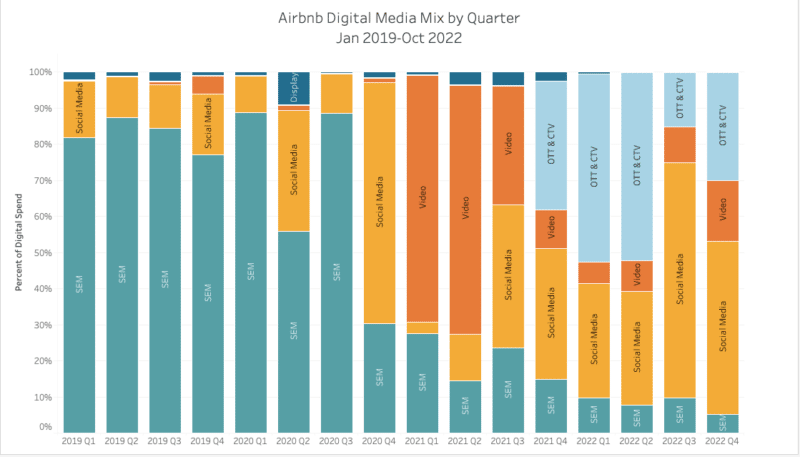
In 2019, Airbnb started to move budget away from search marketing in favor of broader marketing initiatives.

The pandemic accelerated the shift, with video and social media picking up the largest share of digital spend in 2021, according to data gathered from Semrush and Pathmatics.

Airbnb digital media mix by quarter - January 2019 to October 2022

In Q4 2021, The company then expanded its digital strategy into OTT and CTV, further reducing the budget share for PPC.

With CPCs rising across performance media channels, advertisers are left wondering if moving away from performance marketing channels is the right move. 

But before you take a similar leap, let’s look at three key considerations. 

1. What external forces are impacting your business? 

The pandemic played a considerable part in Airbnb’s strategy shift.

The company dropped its marketing spend from April 2020 through November 2020, when it reappeared with a strong social media presence. 

Then in December, Airbnb reminded customers with video ads that the brand will be there when people are ready to travel.

Consumer behavior changed, and Airbnb needed to employ a medium that would reassure and inspire trust. What better way to do that than with video? 

It’s critical to be aligned with the external forces impacting your marketing mix

Are you creating a new category? Or trying to change consumer behavior? 

If so, a shift to brand-heavy advertising may make good sense. 


Get the daily newsletter search marketers rely on.

<input type="hidden" name="utmMedium" value="” />
<input type="hidden" name="utmCampaign" value="” />
<input type="hidden" name="utmSource" value="” />
<input type="hidden" name="utmContent" value="” />
<input type="hidden" name="pageLink" value="” />
<input type="hidden" name="ipAddress" value="” />

Processing…Please wait.

function getCookie(cname) {
let name = cname + “=”;
let decodedCookie = decodeURIComponent(document.cookie);
let ca = decodedCookie.split(‘;’);
for(let i = 0; i <ca.length; i++) {
let c = ca[i];
while (c.charAt(0) == ' ') {
c = c.substring(1);
}
if (c.indexOf(name) == 0) {
return c.substring(name.length, c.length);
}
}
return "";
}
document.getElementById('munchkinCookieInline').value = getCookie('_mkto_trk');


2. Have you reached a tipping point?

Ninety percent of Airbnb’s traffic comes directly to the site. Their market share in the space is nearly 20%, according to Second Measure.

Airbnb had already reached its tipping point. Its category was well-established, and it was a leader in that category. 

Instead of using performance media to drive new customers, they could use it as strategic levers for supply and demand.

Think of their brand awareness spend as the large workhorse and performance media as fine-tuning. 

Before deciding where to spend your marketing dollars, know where you’re coming. 

Are you the leader in your category? Are the majority of your visitors coming directly to your site? 

If so, it makes sense to place a heavier weight on brand advertising and rely on performance media for fine-tuning. 

But if you need to acquire more customers to reach a tipping point, consider a heavier performance media strategy. 

3. Do you have wasted spend? 

Finally, from the outside, it’s difficult to say how much of Airbnb’s performance marketing spend was wasted.

But surveys from Rakuten Marketing and Commerce Signals indicate that marketers routinely waste 25-40% of their marketing budget. 

Simply cutting this wasted spend and reusing the dollars for broader marketing initiatives may give advertisers similar effects to what Airbnb saw. 

Evaluate your existing performance marketing dollars to find the wasted spend hiding in plain sight. Online audit tools can help, as well as audits from marketing agencies. 

Rethink your marketing mix based on your unique situation

It’s worth reemphasizing that Airbnb still spends ~50% of its budget on performance media.

So while their mix shifted from the previous 80%, the company still heavily relies on performance media to help balance supply and demand. 

As advertisers look at whether to move budget to brand awareness, the roles of marketing channels should be reevaluated.

Allowing each channel to play to its superpowers can create a wonderful symbiotic relationship within your marketing mix. 

So if you are considering a strategy shift similar to Airbnb, it’s important to think critically about your business before making the move. 

Think about your category, consumer behavior, and market position. Finally, evaluate any wasted spend.

And if you’re ready to take the plunge, remember to test, measure, evaluate and repeat. 

The post Airbnb’s search marketing shift: Should advertisers follow suit? appeared first on Search Engine Land.

Original source: https://searchengineland.com/airbnb-search-marketing-shift-390069

How to Set a Winning SEO Strategy for a Cryptocurrency Niche

Home Business Magazine Online

The crypto sector is still fresh and fast-evolving, with many investors spotting its potential. A scenario like this provides both benefits and drawbacks. For example, this trend can help your company grow and flourish. On the other side, competition is tough, and if you have a cryptocurrency-related website, SEO is critical regardless of your company’s size or success.

Search Engine Optimization (SEO) is the process of making a website’s search results more visible in a SERP, thereby increasing traffic to the site. In simple terms, we can explain that SEO helps your website rank higher in search engines and attract more visitors. A successful SEO strategy includes numerous factors and СryptoSEO agency can help you implement them. Whether you’ll need to incorporate all of them or not, depends on the current state of your website, your goals, and your budget.

Why Is SEO Important for Crypto?

The first thing people usually do when they have a question is search for it. This trend applies to cryptocurrencies as well and since their popularity is growing, the demand for information about them also increases. In such circumstances, you need to find ways to make your website rank higher in SERP and be visible to potential customers.

A good SEO strategy can help you attract visitors to your website and they will be interested in the products or services that you offer. Furthermore, SEO can increase the conversion rates of the traffic that visits your site, as well. This is why a good SEO strategy for this niche is crucial if you want to succeed and improve your business’s performance.

What Elements Should You Focus On?

There are many ways to optimize a cryptocurrency website for SEO, including using keywords in the title and description tags, creating valuable content that encourages the readers to engage and share the posts, and including high-quality images that quickly load. Moreover, you should make sure to follow all of Google’s guidelines for websites related to cryptocurrencies:

Optimizing Title and Description Tags

You should include keywords in these two tags if you want your website to rank higher in search results. Since the audience of cryptocurrencies is interested in such topics, try to use relevant keywords that will attract their attention and make them click on your links.

Creating Quality Content

Another important factor for SEO success is creating valuable content that people can easily understand and share. The more interaction your posts get from the readers, the better your website’s ranking status.

Using High-Quality Images

Since images are also a part of SEO, you should use high-quality pictures that load quickly on every post or page related to cryptocurrencies. This way, people won’t have to wait too long before they can see the images and they will be interested in your website.

Following Google’s Guidelines

When optimizing a crypto site for search engines, you should follow Google guidelines. Take their instructions, such as creating valuable content that is more than 400 words long, avoiding ambiguous keywords as well as using them only where they are relevant, and putting your brand name in the metadata.

Thus, a successful SEO strategy is important for any website that wants to be successful and visible in this niche. Fortunately, there are many ways to improve its performance, but you still need to know what they are and how they work if you want to implement them efficiently.

SEO
Photo by Myriam Jessier on Unsplash

Additional Tips

Aside from the beforementioned strategies, you should also consider additional approaches to make your SEO achievements even more vivid.

  • Website speed: It needs to be fast enough so you won’t lose any potential visitors because they will leave before having a chance to see anything. According to statistics, 40% of people will leave a website if it takes more than 3 seconds to load. To improve the loading speed of your website, you can use a professional tool such as GTmetrix. Additionally, you can try switching to a faster hosting provider.
  • Link building: This is an important part of SEO that can help you improve your website’s visibility and ranking. Try to develop a link-building strategy that will get your website more recognized by potential customers and search engines as well. This can be done with the help of guest posting, social media marketing, or other link building strategies.
  • Internal linking: Besides external links, you can also use internal links. However, if you will use too many of them, they might decrease the user experience on your website and that is not something you should aim for. So, you should use a few internal links on every post or page of your website and make sure they are placed in the best way for the audience.
  • Optimizing your content for mobile users: Since the number of mobile users is constantly growing, you need to consider their needs as well. Therefore, you should optimize your content for mobile devices and make sure it is fully visible on smaller screens as well.
  • Make sure your website has a good SSL certificate: You need to protect your website if you want your audience to trust it. Otherwise, they won’t do anything about it and you won’t be able to turn them into customers. A good SSL certificate is a great way to secure your website and make sure that all the information shared on it is safe.
  • Promoting your content: You need to promote your content on social media, of course, but also in forums and other online communities. In this way, people are more likely to see it and share it with their friends.

Conclusion

These are just some of the essential tips that you need to pay attention to if you want your cryptocurrency website to be successful. Keep them in mind when developing an SEO strategy that will help you achieve your goals and improve your business’s performance.

The post How to Set a Winning SEO Strategy for a Cryptocurrency Niche appeared first on Home Business Magazine.

Original source: https://homebusinessmag.com/money/cryptocurrency/set-winning-seo-strategy-cryptocurrency-niche/

6 Ways to Make Farming Greener and More Profitable

Home Business Magazine Online

Sustainability is increasingly becoming a primary concern for farmers and their land. By implementing sustainable farming practices, farmers can expect to yield more bountiful rewards than traditional methods. Not only do these processes result in greater yields of healthy harvests, but they also greatly reduce environmental damage, such as soil erosion and loss of biodiversity. This allows for greater bio-diversity in crops, aiding in the continued success of farmers.

Furthermore, sustainable farming operations often demand fewer resources than conventional ones, making them not only better for the environment but more cost-effective as well. In addition, sustainable farming products are highly sought after in the market due to their decreased environmental impact, allowing farmers to easily derive considerable profits from their operations. Here are some of the best ways to make farming more profitable and greener:

1. Conservation agriculture

Conservation agriculture maintains soil health, retains moisture, and reduces the detrimental effects of traditional farming techniques on the environment. This type of farming is focused on minimizing soil disturbance, maintaining a permanent soil cover of vegetation or crop residue, and integrating cropping and off-season activities into a single system. Through the use of no-till planting, various crops, and trapping leftover biomass to improve the soil’s fertility levels and combat weeds, farmers can see both short-term and long-term benefits from sustainable agricultural practices.

The improved soils allow for drought-resistant crops with deeper root systems and higher yields which is advantageous from an economic standpoint as well as in terms of environmental protection. Additionally, conservation agriculture can also help protect farmers from effects related to climate change such as insect infestations and more destructive weather conditions.

2. Precision farming

Precision farming is a powerful tool that farmers can use to increase profits and productivity. By utilizing precise data, such as soil composition, crop health, and moisture levels, farmers can optimize the amount of water, fertilizer, and seed used in their fields. This allows them to maximize yields while preserving resources, resulting in lower costs and higher profits.

Procedural technologies, such as GPS-based guidance systems or robotic equipment, further increase efficiency in tilling, planting, and harvesting crops. The integration of these technologies allows farmers to better manage their land and make informed decisions that add value to their business.

3. Agroforestry

Agroforestry is an innovative type of land management that provides farmers with a variety of ecological and economic benefits, both for farming communities and the environment. By incorporating trees and other plants into agricultural ecosystems, farmers can enhance nutrient cycling, conserve soils, sequester carbon, diversify crop rotations, promote biodiversity, and increase yields across multiple products.

Investing in agroforestry technologies and practices can help smallholder farmers to gain access to new revenue streams from markets for carbon credits and other high-value goods while maintaining their existing agricultural activities. In this way, they can make sustainable farming not only more profitable but also more resilient to shocks such as droughts and floods.

4. Vermicomposting

Vermicomposting is an efficient way for farmers to merge sustainable farming and profitability. By using worms to break down organic matter, a natural compost is created that can be applied to fields as fertilizer. This increases the health of the soil, leading to higher crop yields. There is also an abundance of microbial organisms beneficial to crops that are released in vermicomposting that cannot be found with traditional methods of composting.

The use of vermicomposting also ensures that farms use minimal chemical agents in their farming practices, which benefits wildlife and human health by reducing exposure to toxic chemicals. This environmentally-friendly technique of composting has already proven itself profitable for many farms worldwide, as it produces quality fertilizers for a low cost of production compared to chemical agents.

5. Floating farming

Floating farming involves growing plants and crops in floating rafts on a body of water such as a shallow lake, river, or ocean. Its benefits include fewer pests and diseases due to limited contact with land-based animals and plants, more efficient use of water as runoff from the farmland evaporates less quickly over water than over land, increased production potential due to the easy supply of nutrients, year-round plantations possible in warm climates and the additional real estate available for growing plants that would normally be too far away from shore. In addition, a floating farm can potentially be quite profitable for farmers since its overall cost of construction is lower than other traditional farming methods.

6. Permaculture farming

Permaculture farming mimics natural ecosystems in order to increase yields and improve the health of the land. By using strategies such as companion planting, mulching, and recycling greywater, permaculture can be used to create a closed-loop system that is beneficial to the environment and profitable for farmers. According to Natural Stockcare, this approach minimizes external inputs into the ecosystem and ensures that recycled nutrients are available to future crops, keeping them healthy and producing high yields over time.

Additionally, permaculture farms typically have higher levels of water infiltration and retention than conventional forms of agriculture. By preserving soil moisture, these farms are more resilient to drought which helps counterbalance unpredictable weather patterns caused by climate change. The combination of higher production yields, greater water conservation, and resilience make permaculture farming a fantastic way for farmers to work towards sustainable food production while still achieving profits for their operations.

Differentiating your farm products through eco-friendly and sustainable practices not only allows you to command a higher price point in many instances but also helps you to tap into new markets that are passionate about supporting responsible businesses. If you’re looking for ways to make your farming operation more profitable, going green is a great place to start.

The post 6 Ways to Make Farming Greener and More Profitable appeared first on Home Business Magazine.

Original source: https://homebusinessmag.com/businesses/go-green/6-ways-make-farming-greener-more-profitable/

Content ideas may be coming to Google Search Console

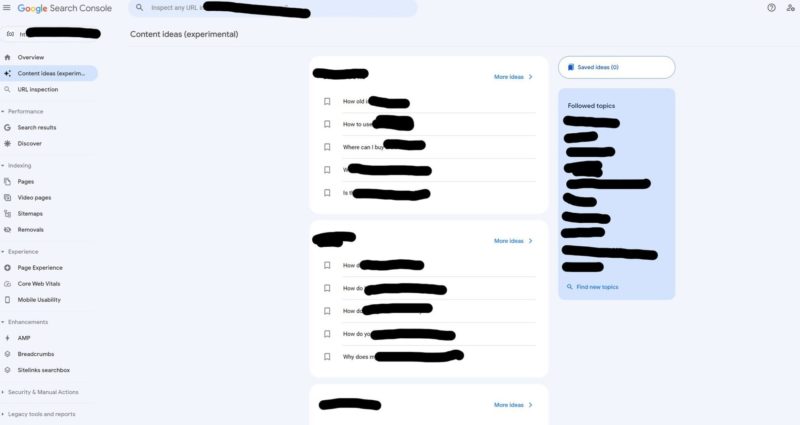
Google Search Console is experimenting with a new feature named “content ideas.” Content ideas give the content creator, publisher, SEO, webmaster, etc., some tips and advice on what new topics they can write about on their site.

Experimental feature. This feature is not live for me in my verified Search Console profiles, but Nicolas Ockier noticed it and posted about it on Mastodon sharing this screenshot:

Alphabet Inc.

Looks like Question Hub. This looks a lot like the Google Question Hub that launched in the US around two years ago.

It gives you topic ideas that you can write about and publish on your website.

What is Question Hub? Google says, “Question Hub is a tool that enables creators to create richer content by leveraging unanswered questions. Question Hub collects these unanswered user questions and surfaces them to bloggers, writers, and content creators like you.”

It is basically a way for Google to enable searchers to tell it that the search results provided are not answering the query. Then, Google takes those questions and feeds them to publishers, who, in turn, can create content that does answer the query.

Content ideas seem similar.

Why we care. Creating content ideas can sometimes be a struggle for writers, which may help content creators with that process. At the same time, this gives Google more content to crawl, index, and potentially rank in its search results. Check your Search Console, it might have this feature, if not, go play with Question Hub until then.

The post Content ideas may be coming to Google Search Console appeared first on Search Engine Land.

Original source: https://searchengineland.com/content-ideas-may-be-coming-to-google-search-console-390244

Things That Affect Employee Productivity and How to Deal with Them

Home Business Magazine Online

There are a lot of things that can affect employee productivity. From stress to noise levels, there are many factors that can impact how well your team works. In this blog post, we will discuss some of the most common things that affect employee productivity and how you can deal with them. By understanding these issues and addressing them, you can help your team be more productive and achieve better results!

10 Things That Affect Employee Productivity

Below are some things that can affect employee productivity:

Lack of Training

One of the primary causes of decreased productivity is lack of training. Without the proper education and guidance, employees may feel overwhelmed or unable to perform their job duties. To ensure optimal performance, companies should offer regular training sessions so that employees are up-to-date on industry developments and techniques.

Inadequate Resources

Many companies do not provide enough resources for employees to do their job. Whether it is from outdated equipment or limited materials, inadequate resources can cause a decrease in productivity. To prevent this, companies should take the time to assess what tools and materials are needed for employees to complete their tasks efficiently.

Workplace Distractions

In any work environment, there will be distractions that impede employee productivity. Things like social media, personal phone calls, and office gossip can all take away focus from the task at hand. It is important to establish policies that limit these distractions during work hours while still allowing for fun and collaboration when appropriate.

You can also invest in acoustic panels from Acoustics by Specfurn if you want to reduce the noise in your office. This way, employees can stay focused on their work and be less distracted by the noise around them.

Unclear Goals

When goals are not communicated clearly, it can lead to confusion or frustration among employees. To ensure productivity, employers should provide clear objectives with measurable milestones to help guide employee performance. This way, they know exactly what they need to do and how to evaluate progress.

Insufficient Rewards

When employees don’t feel like their efforts are being rewarded, it can lead to a decrease in motivation and productivity. Employers should ensure that employees are adequately incentivized for their work. This might include financial rewards, recognition of achievements, or public praise.

Unrealistic Expectations

Managers should be aware of how much work can realistically be accomplished by an employee in a given amount of time. Setting unrealistic expectations will lead to increased stress and decreased productivity. Take the time to review job descriptions and establish realistic goals for each position so that employees can complete their work without feeling overwhelmed.

Lack of Communication

When employees do not feel heard or understood, it can lead to decreased morale and productivity. Employers should make an effort to create a culture where open communication is encouraged so that employees can voice their opinions and needs. This could include regular team meetings or one-on-one conversations with managers.

Lack of Motivation

Another factor that affects employee productivity is a lack of motivation. When employees are not inspired to do their best work, their performance will suffer. Employers should discover what motivates each individual employee and use it as a source of inspiration for peak performance. This could include things like flexible hours, competitive bonuses, or recognition from management.

Uncomfortable Workspace

Another key factor that can affect employee productivity is the workspace. Things like desk setup, lighting, temperature, and noise levels can all have an impact on how comfortable employees feel. To increase motivation and performance, employers should create a workspace that is conducive to productivity. This might include ergonomic desks, adjustable chairs, and access to natural light. By creating a comfortable workspace, employers can ensure that employees are in the best position to do their job.

Unsupportive Environment

Finally, an unsupportive environment can lead to decreased motivation and productivity. Employers should strive to create a supportive work culture that encourages collaboration and feedback. This could include providing flexible schedules or additional mentorship programs for employees.

These are just some of the things that can affect employee productivity and how to deal with them. By taking a proactive approach to the issue, employers can ensure that their employees are working efficiently and effectively.

Bottom Line

There are a lot of things that can affect employee productivity in the workplace, and it is important for employers to be aware of them. Things like poor work-life balance, lack of motivation or incentives, micromanagement, and unclear expectations can all contribute to a decrease in employee productivity. To ensure that employees remain productive and motivated, organizations should focus on creating a positive work environment with clear goals, effective communication, and incentives for employees to stay motivated. Additionally, employers should emphasize a healthy work-life balance so that employees feel supported both in and out of the office. With these strategies in place, organizations can foster an environment of productivity and performance.

The post Things That Affect Employee Productivity and How to Deal with Them appeared first on Home Business Magazine.

Original source: https://homebusinessmag.com/management/how-to-guides-management/things-affect-employee-productivity-how-to-deal/

Car Shipping Guide for the Budding Business Owner

Home Business Magazine Online

Recent world events have raised the price of used cars by a high percentage. If your new business includes connecting used cars in your region with buyers in other states, having a healthy relationship with a professional car shipper can make your tasks easier. However, as a new business owner, you still need to keep costs down.

Ship in the Slow Season

As a general rule, summer is the most expensive time to ship a car. Following that, January is a busy time as well. Shipping space on transport vehicles and train cars is finite. Do make sure you have an accurate quote of the shipping costs before you quote a price to a potential buyer.

Carefully consider the price of the car vs. the price of the transport. If you have found a great school car and the buyer wants it in August for their college student, the shipping cost may be prohibitively high. In such a case, it may make more sense to drive the vehicle part-way to meet up with the buyer and complete the transfer at a mid-point.

One of the biggest benefits of being a small business owner is that you can be flexible. One of the biggest problems in being a small business owner is that you take nearly all the risks on yourself. Do your due diligence and make sure you’ve received payment via wire transfer or other secure means before you set out to meet a buyer.

Go the Distance

Shipping a car under 500 miles costs almost twice as much per mile as shipping one over 1500 miles. To get the most out of your car shipping choices, look for other ways to transport a vehicle under 500 miles.

If driving it is not an option, it may make more sense to tow or haul it yourself in a rental vehicle. Of course, if vehicles and vehicle transport will be the majority of your business, it may make more sense to invest in a truck or SUV with towing capacity for short hauls. A towing dolly can be rented for up to $60 per day, so it may make more sense just to buy one.

The key to starting a small business is to combine activities along the way. If you’ve got a car to deliver one state over, do your best to stop and meet up with other small business owners along the way. You may get the chance to look at other cars or talk to other buyers along your route as well. Taking single trips for a single reason will quickly eat up all your time and a lot of your funds.

Lighten the Vehicle

The more a vehicle weighs, the more it will cost to ship. You will likely be required to load it with no more than a quarter tank of fuel. Leave the spare or the donut, as well as the jack. After that, do your best to pull as much weight out of the vehicle as possible.

Consider also lightening the payment. If your car business is in the early stages and you have a classic car to ship, it may make sense to ship it covered. The cost will be higher, but you can be confident that it will arrive unblemished. Even if the buyer will ultimately cover this cost, you will need to be able to pay for the shipping upfront.

Look for a 0% APR credit card with a long payout window, preferably with points or cash back. If you’re bootstrapping your business, you can cover the shipping expense and pay the minimum until you receive your full payout. When you receive your payout for the car, you can wipe out the shipping debt.

Keep an eye on your mailbox. One of the best benefits of paying off a card and leaving it open is that you will start to get more offers for better cards. Look for those with a welcome bonus so you can apply those bonuses against future business costs.

Confirm the Condition of the Car

Companies that ship cars must be very careful about leaks and drips. If you’re not sure that the vehicle you need to ship is leak-free, take it out for a nice long test drive and park it overnight on a clean piece of cardboard or a clean white sheet. When the engine cools down, look for drips in the morning.

Even a small oil leak or coolant drip can add to your shipping costs. It may also make it hard for the car shipper to provide you with services again. If you can’t confirm that a car will be leak-free during the course of the shipment, it may mean that you have to drain the fluids and ship it as a non-drivable car.

It is possible to ship non-drivable cars, but the cost will be higher. You may also need to have a mechanic meet the vehicle at the other end to refill fluids and get the vehicle back up and running. If you know you’re going to ship a vehicle to the new owner, don’t buy it without an overnight test drive.

Be Willing to Meet the Shipper

Your car shipper will generally charge less if you can meet them in a major transport hub. Shipping by train will also require you to meet a particular schedule or leave the vehicle in a holding lot.

Holding lots are generally secured by a fence. There may also be security on-site. If you’re just starting your business and want to be absolutely sure that your vehicle gets loaded onto that truck or that train car, adjust your schedule so you can meet the shipper and at least witness the loading yourself.

In today’s economy, having a side hustle or a side business is a great way to build your financial future. If you have an eye for cars that can turn a profit, building a strong relationship with a professional car shipper can help you expand your reach.

The post Car Shipping Guide for the Budding Business Owner appeared first on Home Business Magazine.

Original source: https://homebusinessmag.com/businesses/how-to-guides-businesses/car-shipping-guide-budding-business-owner/

YoungPlanet: The app helping parents fill stockings this Christmas

Reading Time: 2 mins

YoungPlanet is making a huge difference this Christmas, to families on low incomes and those hitting hard times financially. The tech-for-good app want to change gifting this year. They’re making it easier for parents to treat their youngsters to the presents they deserve this holiday season.

To do this, YoungPlanet is helping parents fill their children’s stockings for free, amongst toy shortages and rising household costs. We all deserve a treat this year, particularly after the trials and hardships of the last few years. Rising food, fuel and bill costs, as well as supply chain shortages add to the financial strain. Plus, job losses due to the pandemic mean this time of year could cause debt for many.

The YoungPlanet app currently has thousands of toys, including doll’s houses, trucks, books, Lego and plush toys. Parents can claim these for free. The team behind this wonderful initiative are urging parents to embrace the circular economy this Christmas. Plus. they’ll help ease the financial strain on those who may struggle to afford gifts.

The app works by allowing parents to list items they no longer need or want to other parents. Tis the season of giving, after all. Plus, it prevents waste and landfill, allowing people to declutter their homes of toys they no longer use. A sustainable circular economy is created in a time where the need for people to make their consumption habits more sustainable is bigger than ever.

The app’s founders – parents Jason and Emma Ash – hope this call to ‘share and re-gift’ will enable families to enjoy Christmas this year without the financial pressures.

Jason comments:

“Christmas is already set to be a stressful time for so many families. Our aim is to alleviate some of that pressure by providing families with a platform that enables them to get good quality toys that won’t cost a penny. Not only is YoungPlanet helping alleviate some of the pressure on parents who might struggle to get toys and other Christmas essentials this year, but it will also help families to have a more sustainable Christmas.”

By encouraging these circular, cashless transactions, YoungPlanet has helped parents save thousands on children’s essentials and prevented over 20,000 of items from going to landfill. There are currently over 3,000 items up for grab on the app.


The YoungPlanet app is available from the App Store and Google Play Store to download for free. 

To find out more, visit youngplanet.com

The post YoungPlanet: The app helping parents fill stockings this Christmas appeared first on MoneyMagpie.

Original source: https://www.moneymagpie.com/make-money/youngplanet-the-app-helping-parents-fill-stockings-this-christmas