YouTube has launched a global Target frequency feature

YouTube now has a global Target frequency goal option for video campaigns. The new goal allows advertisers to select a frequency goal (up to four per week), which YouTube will optimize towards.

What YouTube says. “Now advertisers can select the frequency target and our systems will optimize towards maximum unique reach at the frequency goal. With our built-in capping, campaigns deliver within a tight distribution range so viewers don’t see the ads too many times. In fact, over 95% of Target frequency campaigns on YouTube successfully achieved their frequency goals when set up following recommended best practices. Not only do the campaigns deliver on their target frequency, but they drive brand impact as well.”

Early testing. YouTube tested this new goal with Triscuit, whose goal was to ensure that its brand stays top of mind with consumers.

According to YouTube, the brand set up a Video experiment to determine the incremental ad recall that a weekly frequency of two could deliver. The Target frequency campaign achieved a 93% higher absolute ad recall lift compared to the non-frequency optimized campaign, at a 40% cheaper cost per lifted user.

Also available in Ads Editor. Google also announced today that the new Target frequency goal was going to be supported in the new Ads Editor v2.2.

Dig deeper. Learn more about the new Frequency goal on the Google Ads & Commerce Blog.

Why we care. Advertisers who use Video ad campaigns should implement the new Target frequency goals to ensure that their videos show an appropriate number of times without exhausting their audiences.

The post YouTube has launched a global Target frequency feature appeared first on Search Engine Land.

Original source: https://searchengineland.com/youtube-has-launched-a-global-target-frequency-feature-389525

3 simple steps to automating content creation for businesses by SE Ranking

artificial intelligence

All parties involved in the content creation process know just how much time, effort and financial resources go into it. Writing a piece of content with a chance of ranking at the top of the search results takes up a good chunk of those resources. As companies grow and develop, the resources available for projects (especially time) can diminish.

In this article, we will discuss how to leverage content research and automation tools to cut corners and preserve valuable resources. Take advantage of these tips and tricks to create quality content that both Google and people will love.

What is content automation, and why do you need it?

Content marketing automation involves identifying repetitive content marketing tasks and then using relevant tools to automate those tasks.

Think about it. If your content automation software is doing all the heavy lifting, SEOs will no longer have to waste hours of their time each week writing out detailed content briefs for content creators. Instead, your copywriters can skip the SEO learning curve and focus on crafting compelling sentences to create even more compelling content. 

With automation software, your SEO and content teams can save time, cut costs, make smarter decisions, and focus on crafting marketing strategies that really make a difference.

From doing research to creating content and optimizing it, content automation tools can improve your productivity across the entire content life cycle.

Creating content is a process that includes some indispensable steps, namely:

  1. Determining the article topic
  2. Creating a content brief
  3. Writing an optimized article copy

Performing these tasks manually would take up a lot of the SEO and content teams’ time. Luckily, content research and automation tools help you cover and fast-track your entire content creation journey—all in one place.

There is a range of content tools on the market, but for the purpose of this article, we’ll illustrate how to automate your content creation by using SE Ranking’s content tool, the Content Marketing Platform. It helps you craft content briefs in just a few minutes and write full-fledged articles in as little as a few hours.

To elaborate, SE Ranking’s Content Marketing Platform relies on AI when analyzing your competitors’ content. It pulls data from top-ranking pages to let you know what to aim for in your content in order to outrank them. 

This tool also uses NLP to suggest the most suitable keywords to use in your content. It points out the terms that both Google and people expect to find on a page relative to the topic.

Let’s move on to dissecting the content creation process.

Step 1. Determine the article topic

Many SEO and content marketing specialists bank a good chunk of their content creation efforts on keyword research. After all, doing keyword research is the first step towards searching for an article topic. It’s how to find out what people are talking about the most. You’re discovering which topics are currently in higher demand. 

By optimizing content pieces for search, SEOs and content marketers generate a steady flow of traffic to their websites. They cover various search intents to help users move down the search funnel. 

To make sure you’re automating the entire process, check to see if your keyword research tool can:

  • Suggest similar, related and long-tail keywords with various search volumes based on a seed keyword.
  • Provide you with complete and accurate data on keyword metrics, including search volume and keyword difficulty.
  • Highlight SERP features for every keyword.
  • Indicate a keyword’s user intent.
  • Show you how volatile a keyword SERP is and how authoritative its players are.

Pay close attention to how large your keyword research tool’s database is and how much you can rely on it in terms of accuracy. 

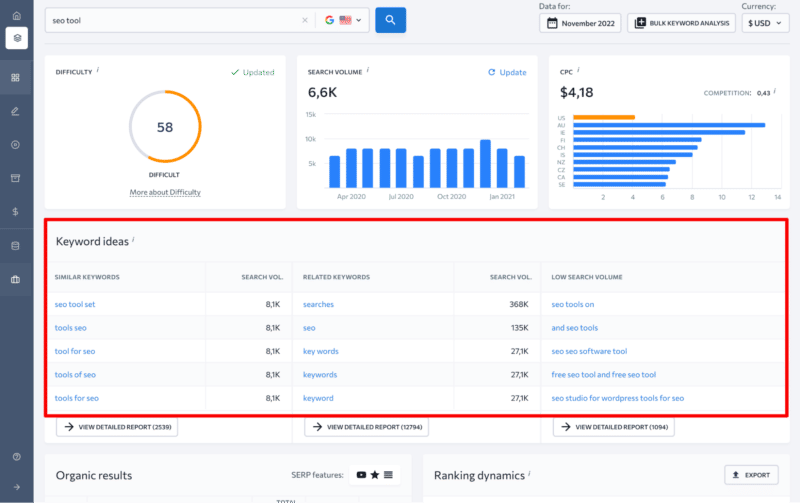
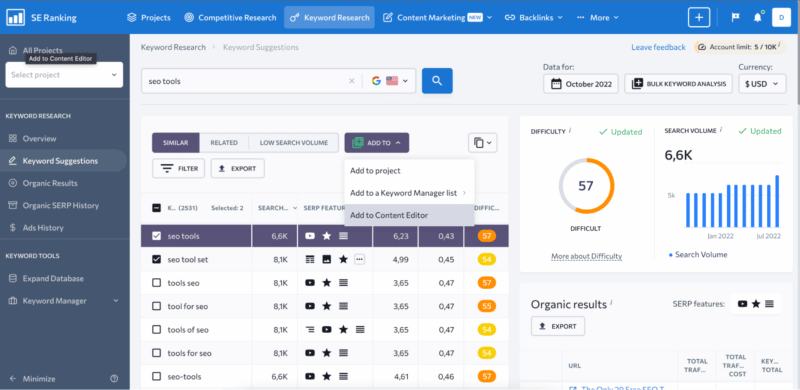
SE Ranking’s Keyword Research tool ticks every box in this respect. Plus, it’s a part of a larger ecosystem of tools, meaning you can seamlessly manage all of your site’s data from one central hub.

automation software

With this tool, you don’t have to export anything to Excel. No more working with data in a dull environment.

Instead, you can directly add the keywords you’re interested in targeting to one of SE Ranking’s tools. These include Keyword Manager, Keyword Rank Tracker and Content Editor (this tool is where all the content creation magic happens).

automation tools

After finishing your research and choosing the main keyword (or several related keywords) that you want to focus your new piece of content on, settle on the article’s main topic. Then, start creating an SEO content brief for your copywriter.

Step 2. Create a content brief

Since your copywriter relies on you to be the SEO expert, specify in the content brief what you want the article to look like.

Start by analyzing the top-ranking SERP players in your selected region to understand what works for them. Use that information to write out a detailed brief. Filter out the competition, so it only includes websites similar to yours in terms of user intent. 

To do this, visit each competitor’s website to make sure they are properly communicating the topic at hand to their audience. Their content should be tailored not just to the right audience, but to the stage they’re at on the buying journey.

Once you’ve selected the right digital rivals, go over your upcoming article’s content parameters. Note that the default values in SE Ranking’s Content Marketing Platform are displayed as an average of every selected competitor, but you are free to change them as you see fit. Consider deciding on your own how many words or characters should be included in the text, how many headings and paragraphs the text should be broken down into, as well as how many images will make the text easier to read.

content automation software

Every SEO pro knows that you should include specific keywords in your text to increase its chances of appearing in Google for a related search. This is where you can get additional help and get a list of NLP keywords that Google considers essential.

Last but not least, analyze competitor page heading structures to create a detailed outline of your upcoming article. You can either copy competitor headings as is or draw inspiration from them and create your own structure with unique headings.

Your copywriters will then have a detailed article outline specifying everything from its length to the number of times a keyword should be used on the page. 

Step 3. Write an optimized article copy

As a content creator, use the detailed SEO content brief as a basis for writing the article copy. 

You can take the traditional route and write the text right on the spot, or you can turn to an AI rewriter for help if you feel stuck. 

Practically every modern content marketing automation tool gives you the opportunity to take a piece of text from a competitor’s website and insert it into your own copy. It then offers plagiarism-free alternatives for you to use in your article.

If you’re in a hurry, you can take this method to its extreme by pulling relevant chunks of texts from competitor articles and letting the AI rewrite plagiarism-free alternatives. But, of course, it’s always better to let the experts do their thing.

Once you, as a copywriter, are happy with the text of your soon-to-be-published article, optimize it to increase its chances of outranking the top competition.

content automation tool

Since all of the requirements are right there next to your text, along with gauges, you can see exactly how well the text is optimized. 

Make sure the copy has enough total words and that specific keywords aren’t used too much. Get rid of any punctuation and grammar mistakes, and make sure the readability level is appropriate.

All data is clearly laid out in the Content Marketing Platform so that content creators don’t have to jump through any additional hoops to create SEO-friendly texts. 

Until the end of the year, you can get a 30% discount on your first purchase of the Content Marketing Platform by using the promo code Content30 at checkout.

Bonus: Keeping track of your pages’ Google rankings

After publishing your brand new piece of content, keep track of its performance in search. This is to gauge the ROI of all the time and effort you put into creating it.

content automation tools

SE Ranking’s Keyword Rank Tracker delivers extensive ranking data with pinpoint accuracy across every major search engine. Add your website, specify the search engines and competitors, and keep daily track of your target keywords’ ranking positions.

This is so you can act quickly if your rankings change or if another competitor pulls out all the stops to outrank your pages.

Recap

The best way to leverage content marketing automation tools is to use them to help humans—not to replace them. Let your content automation tool do most of the heavy lifting so you can automate repetitive manual processes. Free yourself up to do higher-value creative tasks. 

When content marketing automation tools are used correctly, they can skyrocket your digital business’s efficiency, save you a small fortune each month, improve your customer service and improve the overall quality of your products and services. 

Do less and get more done!

The post 3 simple steps to automating content creation for businesses appeared first on Search Engine Land.

Original source: https://searchengineland.com/3-simple-steps-to-automating-content-creation-for-businesses-389373

10 Tips for Hosting a Successful Event

Home Business Magazine Online

When planning a successful event, many factors must be considered. From setting goals, budgeting, and hiring the right emcee — you want your event to be perfect for attendees and sponsors. Here are some tips for hosting your next successful event:

Set goals.

Goals are the foundation of any successful event and should be created with a clear direction for what you want your event to accomplish. Setting goals helps you stay focused on the end goal and stay motivated throughout the process. Your goals should be measurable, realistic, and attainable. For example:

  • Increase sales by 20%;
  • Increase brand awareness by 50%; and
  • Improve customer satisfaction by 10%.

Plan your budget.

Once you’ve committed to hosting an event, planning for all costs associated with the event is essential. Below are a list of some things to consider when preparing your budget:

  • Venue rental fees;
  • Food and beverage costs;
  • Entertainment costs (whether it be a DJ or live music);
  • Travel expenses for guests who are traveling from out of town; and
  • Marketing materials such as signs, banners, or flyers.

Send out invitations early and save the dates.

You’ve booked a venue, ordered supplies, and decided on your theme. Now it’s time to send out invitations! Sending invites early is a great way to build excitement for your event. This will also give you time to get feedback from guests about any concerns or needs they might have — which means you can make any last-minute changes before the big day arrives.

Save-the-dates are another great way to get people pumped up about attending your event! They’re typically sent out around six months in advance and often include some details about the event along with an RSVP deadline. Save-the-dates help ensure that guest lists are accurate so there aren’t any surprises come party day. Plus, they give guests plenty of time to plan their schedules around when they’ll be able to attend without stressing themselves out too much or forgetting altogether!

Make a timeline for your successful event planning.

You can’t just wing it, especially if you want your event to succeed. Planning is key!

If you have never planned or hosted an event before, this is where the research comes in. The first step is determining your goals for the event and how those goals align with your company’s mission statement. From there, creating a timeline for when each task needs to be completed will help keep you on track and prevent missed deadlines from hindering the success of your conference or meeting space rental business’ first venture into hosting events.

A sample timeline might look like this:

  • Six months out: Identify potential venues and work with them on logistics.
  • Three months out: Book transportation services (if needed).
  • 1 month out: Send out invitations.
  • 1 week prior: Confirm food/beverage options & confirmations from presenters/speakers.

Find sponsors for your successful event.

Finding sponsors for your event can be essential in getting the word out and making it a success. Sponsorships are great because they help offset costs, which frees up more money for other parts of your planning process. It’s also likely that if you’re promoting a cause or initiative, having sponsors will make your attendees feel better about attending — they’ll know their money is going toward something worthwhile.

The first step in finding sponsorships is brainstorming potential companies relevant to your event’s theme and audience. For example, if you’re hosting an event about female empowerment, think about well-known companies that sell athletic clothing primarily targeted at women.

The next step is contacting these companies directly and asking if they’d be interested in sponsoring your event with some kind of financial contribution (or by providing goods or services). You may want to start small at first with more minor potential sponsors before moving on to larger ones. Even though big-name brands might not have time for smaller events right now, they may still be open to helping out by donating some promotional items or providing some advertising space around town as part of their sponsorship package!

Hire a professional events emcee.

Once you’ve chosen a venue and organized your event’s food, drinks, and entertainment, it’s time to think about hiring someone to emcee the event. An emcee is essentially a host who introduces guests as they arrive, keeps things running smoothly throughout the night, and closes out by thanking everyone for coming before they leave.

The first step in finding an emcee is ensuring they are qualified, professional, and experienced enough to do the job well. Ask them how many events they have hosted before, and if they offer any references from previous clients. Look at reviews online from other people who have hired them recently; this will give you insight into their past performances as well as their level of professionalism.

A good way to determine whether or not someone is suitable for your particular party’s needs is by getting in touch with them directly via phone call or email (which allows both parties more opportunities than texting). If possible, go meet them face-to-face so there aren’t any miscommunications later on down the line.

Ideally, meet over coffee or tea. Caffeine tends to help sharpen the mind, which makes decision-making easier. Limit how much coffee or tea you consume in order to prevent jitters. Going through stressful situations such as these can make one feel nervous. Everything needs to be done adequately without too much time being spent deliberating about what should happen next. Emcee Singapore is a highly recommend emcee services vendor to support major corporate and private events.

Make sure the venue is perfect for you and your attendees.

The venue can make or break a party when it comes to event planning. Every detail counts, from the size and location to the decor and food options. A bad venue will leave your attendees unsatisfied and uninspired to attend future events. A good and comfortable venue will ensure that all of your guests will enjoy themselves and want to come back for more!

Below are some key points to consider when picking a venue:

  • Make sure it’s large enough for all of your attendees. Even if you’re hosting an intimate gathering with just 50 guests, remember that they’ll probably be bringing their significant others along too! Make sure that no matter how many people show up to your event, there will still be enough space for them all to comfortably stand together.
  • Determine whether or not any special equipment is needed. For example, if someone performs live music during dinnertime, you will need speakers placed strategically in the building.

Don’t forget about logistics, such as catering and transportation.

catering at event
Photo by Israel França from Pexels

A good event planner will think about the following things before planning and executing an event:

  • Catering: Don’t forget about catering! If you are not going to hire a professional caterer, make sure that someone on your team knows how to prepare food for large groups of people. You can also save money by asking friends or family members with cooking skills to help with this task.
  • Transportation: Be sure your venue has parking available for guests who may be driving themselves there. Make sure they know where it is located so they can find their way easily. Also, consider other transportation options such as buses, taxis, or rideshare companies if there isn’t enough space in the parking lot at your venue’s location.
  • Venue amenities: If you are holding an event outdoors but want some shade during certain parts of the day (like during lunch), don’t forget that tents provide excellent shelter from sun exposure while also looking stylish when placed neatly in any outdoor space!

Establish the budget, venue, and timeline.

One of the key things you must do when planning an event is to ensure everyone is aware about the budget, venue, and timeline. Not only will this help prevent misunderstandings and last-minute changes, but it also gives everyone a clear understanding of their role in the event.

Get feedback from attendees after the successful event and use it!

After the event, collect feedback from all attendees. The simplest way to do this is by asking them to complete a survey on the back of their name tags. For example, you want to ask questions like:

  • What did you like?
  • What didn’t you like?
  • How could this event have been improved?

If possible, seek feedback from sponsors and vendors who participated in your event; they may have insight into things that went well or could have been done better. Then, use these insights before planning your next event(s) to improve attendees’ experience and the effectiveness of your organization as a whole!

Conclusion.

Hosting a successful event is a big deal and stressful, but it doesn’t have to be! Follow these tips, and you will go into planning with a clear head and confidence that your event will go off without a hitch.

The post 10 Tips for Hosting a Successful Event appeared first on Home Business Magazine.

Original source: https://homebusinessmag.com/businesses/success-tips/10-tips-hosting-successful-event/

Rubber Products Advance Modern Medicine

Home Business Magazine Online

It is hard to imagine modern society or medicine without rubber products. Rubber parts, seals, and gaskets are ubiquitous in the medical field, and many life-saving procedures are only made possible with rubber products.

In this article, we’ll look at some of the applications of rubber seals and fasteners in the medical industry, what makes medical-grade rubber unique and why you need a trusted partner in the design and manufacture of your rubber parts and seals in medical equipment and devices.

A Few of the Many Ways Rubber Is Used in the Medical Industry

Rubber seals and fasteners are used throughout the medical industry, and each application has unique challenges. New devices and replacement parts require specific and exacting manufacturing for shape, performance, and material composition to ensure the highest quality and reliability of medical equipment. This is true for rubber parts and seals, often under harsh environmental conditions. Selection and use of the correct material and advanced manufacturing can be the deciding factor between the successful use of the medical device and catastrophic failure.

Examples of Life-Saving Equipment That Use Rubber Parts and Seals

Life-saving equipment with rubber parts and seals includes durable items such as ventilators and intravenous (IV) components. Below is a short list of the variety of different life-saving equipment that needs rubber parts and seals to operate:

  • Catheters
  • Pacemakers
  • Drug delivery systems, including IV components
  • Feeding devices
  • Medical pump seals
  • Components within an implant device

What Makes Medical-Grade Rubber Unique?

Medical-grade rubber has to stand up to harsh environments while not causing adverse reactions within the body (biocompatibility). The Federal Drug Administration (FDA) has strict compliance requirements including, but not limited to, the following:

  • Class V or ISA 10993 protocols for applications involving the implantation of medical devices within the human body
  • Class 10000 ISO-07 clean room compliance
  • Quality compliance documentation from the first article to full IQOQPQ

Medical-grade rubber can be specifically formulated to have desired flexibility and strength for comfort and reliability in applications. In addition, medical-grade rubber is formulated to be resilient to various environmental conditions. Whether considering single-use consumable products or durable devices, medical-grade rubber provides resiliency for harsh environmental situations. These conditions include high heat (as it is often associated with sterilization), reliably non-reactive to chemicals (including medications), and the ability to withstand pressure in various situations, including tubing and seals.

Why You Need a Trusted Partner for Your Medical Device Rubber Parts and Seals

Advances in the medical field are due in no small part to advances in rubber parts and seals for durable and consumable medical devices. The public and medical industry have exceptionally high expectations for low failure rates with medical equipment. Medical equipment is expected to perform reliably every time to save lives, including consumable items such as catheters and IV components. The same is true for durable devices, such as ventilators, with rubber seals and parts. The reason for this expectation is that medical equipment failures can lead to long-term disability or death.

Trust is built over time through reliable technical expertise and advanced capabilities in engineering design from prototype to production. Your rubber parts and seals supplier needs to understand the conditions the rubber products need to perform under and be able to test and manufacture to meet federal standards.

Life-Saving Materials

Rubber is a critical component of modern medical equipment, whether single-use devices such as catheters or durable goods such as ventilators. Rubber seals and connectors are used throughout the medical industry and are arguably one of the most important medical advances.

The post Rubber Products Advance Modern Medicine appeared first on Home Business Magazine.

Original source: https://homebusinessmag.com/businesses/equipment/rubber-products-advance-modern-medicine/

6 Tips on the Package to Suit Your HR Needs

Home Business Magazine Online

When it comes to human resources, there are a lot of different needs that businesses may have. For example, some companies may need help hiring and training new employees, while others may need assistance managing benefits and payroll. But no matter what your needs are, there is a package out there that can suit them! This blog post will discuss six tips for finding the right HR package for your business.

1) Determine your needs:

The first step in finding the right HR package for your business is to determine what exactly you need. For example, do you need help with recruiting? Do you need assistance with managing employee benefits? Once you know what your needs are, you can start looking for a package that will suit them.

2) Consider your budget:

Another important factor to consider when choosing an HR package is your budget. There are a variety of different options available, so it’s important to find one that fits within your budget. Don’t be afraid to shop around and compare prices before making a final decision. If your budget allows it, why not consider hr outsourcing? This is an excellent option for businesses that need assistance with a variety of different tasks.

3) Compare features:

Once you’ve determined what your needs are and considered your budget, it’s time to start comparing features. What does each package include? What kind of support do they offer? How user-friendly is the interface? Make sure to take all of these factors into consideration before making your final decision.

4) Read reviews:

Once you’ve narrowed down your options, take some time to read online reviews of the different packages. This can give you a good idea of what others have thought about the package and whether or not it would be a good fit for your business.

5) Get a free trial:

Many HR packages offer free trials, so be sure to take advantage of this! This will allow you to test out the package and see if it’s right for your needs before making a final purchase. In addition, it’s a great way to see if you like the interface and how easy it is to use. Finally, it will give you a chance to see if customer support is helpful and responsive.

6) Ask for recommendations:

Finally, don’t forget to ask for recommendations! Talk to other businesses in your industry and see if they have any suggestions for HR packages. They may have tried something that you haven’t even considered and found to be a perfect fit for their needs.You may also consider consulting with your management team, hear what they have to say and what their suggestions and inputs are.

In conclusion, by following these tips, you’ll be sure to find the right HR package for your business. Keep in mind that it may take some time to find the perfect fit, but it will be worth it in the end. And if you’re ever unsure, don’t hesitate to ask for help from a professional. They can provide you with even more guidance and ensure you find the best solution for your needs.

The post 6 Tips on the Package to Suit Your HR Needs appeared first on Home Business Magazine.

Original source: https://homebusinessmag.com/management/operations/6-tips-package-suit-hr-needs/

The search marketer’s new imperative: Capturing first-party data

Third-party cookies are on their way out. You’ve probably been thinking and talking about this for a few years now. 

And you’ve likely seen many blog posts, articles, webinars, podcasts, etc. talking about how first-party data is the path forward for adapting to the cookieless future

What isn’t being talked about?

The role that search plays in collecting that precious first-party data.

The role of search in capturing first-party data

Oftentimes it’s commerce, loyalty programs, and the like that are deemed responsible for discovering the ins and outs of your customers.

But search plays a critical role, too. It’s uniquely positioned for a few reasons.

Users are purposefully engaging with your site 

So many marketing channels engage with consumers during a non-commerce moment – while they’re sitting on the couch binge-watching The Office, drooling over their best friend’s Insta-perfect pictures from that recent trip to Tuscany, etc. 

Search is a rare exception. The consumers we engage with are actively raising their hands, and we’re helpfully showing up to meet their needs. 

That means that every engagement we have with potential customers is highly intentional. They’ve made the choice to not just look for something we offer, but also to visit our site. What that means is…

Clicks have both high intent and strong timing signals

We can learn a ton of valuable information about a person, even if they don’t immediately make a purchase. 

Clicks are considered a first-party cookie, meaning the advertiser has a consented ability to:

  • Tag the consumer’s browser.
  • Use that information to improve their customer experience and future engagements and interactions with the brand.

We can also very directly and confidently infer interest. 

Someone looking for a tent on our ecommerce website shows a much stronger signal of “interest in buying camping gear” than a person browsing an outdoorsy blog or looking up the top 10 tips for hiking the Appalachian Trail. 

We also know that they’re thinking about buying that camping gear now.

Search is a demand-capture channel that reveals high intent and purposeful engagement with the benefit of a first-party cookie. 

Nothing new, right? 

What’s new is the relative importance of each first-party click that comes through search.

As the opportunities to mine data from third-party cookies become fewer and fewer and walled gardens build their fences taller and taller, that importance will only continue to rise. 

Search has a new responsibility to take its high-intent first-party data and use it across the marketing ecosystem.

Search data on its own can be valuable, but it becomes even more powerful when paired with other first-party data sources. So, what does that look like?

Search + site behavior data = better user experiences

Garnering an ad click is only half of the battle. 

As the consumer digests the website, text, imagery, and value proposition, a lot can happen. 

Sometimes, consumers bounce nearly immediately, while other times, they will view 10+ pages and spend over 15 minutes browsing the site. 

This metadata can and should be used to build customer segments. Purchase propensity scores can be derived based on on-site behavior. 

We recommend using this information to better inform automated customer targeting and suppression lists to be added to digital marketing and remarketing initiatives.


Get the daily newsletter search marketers rely on.

<input type="hidden" name="utmMedium" value="” />
<input type="hidden" name="utmCampaign" value="” />
<input type="hidden" name="utmSource" value="” />
<input type="hidden" name="utmContent" value="” />
<input type="hidden" name="pageLink" value="” />
<input type="hidden" name="ipAddress" value="” />

Processing…Please wait.

function getCookie(cname) {
let name = cname + “=”;
let decodedCookie = decodeURIComponent(document.cookie);
let ca = decodedCookie.split(‘;’);
for(let i = 0; i <ca.length; i++) {
let c = ca[i];
while (c.charAt(0) == ' ') {
c = c.substring(1);
}
if (c.indexOf(name) == 0) {
return c.substring(name.length, c.length);
}
}
return "";
}
document.getElementById('munchkinCookieInline').value = getCookie('_mkto_trk');


Search + CRM = better digital engagement

Extending the view on-site behavior, we can further couple search intent to known online and offline customer engagement. 

Is the consumer on our email list or mailing list, or have they previously purchased? 

If yes, how active have they been, and what metadata and activity can we add to our customer segmentation models? 

These signals can allow brands to alter messaging and value propositions in real time on the website and can also lead to improved customer engagement – a feeling that the brand knows who they are and wants to provide a personalized and tailored experience

Beyond the site, brands will also have the ability to reach these first-party customers in other paid and organic digital experiences, such as custom-tailored social ads and emails.

Search + CRM = better non-digital outreach

When we’ve historically talked about cross-channel marketing, especially when it pertains to search, the typical “other channels” are paid social, e-retail, display, etc. 

We need to start including our offline channels in those conversations, too. 

In today’s data-driven world, every brand-to-consumer touch point short of a friend saying “Hey, check out my new backpack!” can be part of a connected journey.

Take direct mail, for example.

Having the ability to tailor a brand’s direct mail campaign by refining the who, the what, and the how is powerful and performant. 

By understanding the customer’s intent and product/service desires, as well as the fact that their need is now, we have a unique ability to build propensity models. 

Firstly, these customer segment models can be built on the likelihood to purchase – leading to top segments as well as customers to suppress. 

Second, the content can be altered to match the exact products/services the customer has expressed interest in. 

Finally, the physical mail can be tailored to match the individual and their needs. Delivering a postcard flyer, an envelope, or a catalog to different customer segments becomes possible.

The role of search in creating great customer experiences

Search has always been an important channel (in my extremely unbiased opinion), and it’s only getting more critical as its role in creating great customer experiences grows. 

Our guiding light as search marketers has always been to meet hand-raisers with what they’re seeking, when they’re seeking it, in a way that’s responsible for our business. 

Now we have another imperative: taking the data those hand-raisers give us to make all of their experiences with our brand better.

The post The search marketer’s new imperative: Capturing first-party data appeared first on Search Engine Land.

Original source: https://searchengineland.com/capturing-first-party-data-search-389342

The SEO career path: What it may look like and how to level up

People outside of the world of marketing rarely know what SEO is or what the initialism even stands for.

Within the industry, it’s a familiar term to all formidable marketers. Far less is SEO – search engine optimizationactually understood, though. 

First, it’s important to understand that, while SEO stands for search engine optimization, it is also often used interchangeably to describe the people who do SEO (a.k.a., SEO professionals). An SEO – or search engine optimizer – does SEO. SEOs do SEO.

To avoid any further confusion, we’ll refer to the people who do SEO as SEO professionals.

SEO professionals are a special breed of marketers from many walks of life.

But there are some characteristics and experiences many of us have in common that I will attempt to organize as some of the most useful and shared professional qualities possessed by SEO professionals.

I’ll also cover what the career path to becoming one may look like.

How do you start an SEO career?

Historically speaking, most SEO professionals didn’t plan on SEO as a career – at least until recently (starting in the late 1990s and early 2000s). That was because they couldn’t, really. 

Early in their educational journey, a marketer or digital marketer very rarely – if ever – declared, “I want to optimize websites and chase the Google algorithm for brands to revolutionize the way humans and businesses connect forever.”

The latter part of that dubious statement was probably similar to something many marketers-in-training did declare. 

But getting there through website and brand optimization to gain organic visibility on a search engine was not likely the vehicle they had in mind at the time for accomplishing it.

It’s also rare to meet multiple SEO professionals who’ve forged the same path to becoming one.

But there are certainly overlapping journeys, professions and experiences.

Some common previous areas of expertise for SEO professionals that commonly intersection include teaching, journalism, various math-focused professions and the obvious traditional marketing focuses.

But as the worldwide web evolved the way it has over the last 30 years, opportunities to help brands and people in new ways arose in the marketing realm. And some became more specialized – and lucrative – than ever.

Organic search, paid media and social media are all suitable channels for successful marketing strategies. And they indirectly or directly were created (or adapted to be used) for the growth, prominence, and usefulness of websites.

Today, as a result, high schoolers and college students are able to set their aims on a digital marketing gig specializing in SEO. This will continue to become more common as secondary-education institutions evolve with the world’s needs, job demand, and technology.


Get the daily newsletter search marketers rely on.

<input type="hidden" name="utmMedium" value="” />
<input type="hidden" name="utmCampaign" value="” />
<input type="hidden" name="utmSource" value="” />
<input type="hidden" name="utmContent" value="” />
<input type="hidden" name="pageLink" value="” />
<input type="hidden" name="ipAddress" value="” />

Processing…Please wait.

function getCookie(cname) {
let name = cname + “=”;
let decodedCookie = decodeURIComponent(document.cookie);
let ca = decodedCookie.split(‘;’);
for(let i = 0; i <ca.length; i++) {
let c = ca[i];
while (c.charAt(0) == ' ') {
c = c.substring(1);
}
if (c.indexOf(name) == 0) {
return c.substring(name.length, c.length);
}
}
return "";
}
document.getElementById('munchkinCookieInline').value = getCookie('_mkto_trk');


Possible SEO career routes

Like most careers, there are multiple directions an SEO professional can take. 

It’s probably most likely to start at an agency, and that’s a wonderful place to kick off almost any career related to marketing (or design, account management, video production or sales). 

There are typically a bunch of talented people with a plethora of knowledge and direction to share, so it’s like obtaining an education while getting paid.

You also get the chance to really find your niche in whatever facet of digital marketing you end up in, whether that be SEO itself, or a more-specific component within SEO.

Your first couple of years in SEO are likely to shape your long-term future, at least to some extent.

You can also reinforce and/or stand out demonstrating strengths with the critical soft skills mentioned above and your ability to effectively communicate with internal and external stakeholders.

Agency life allows those skills to shine while also finding out if agency life is for you.

You have to be able to juggle multiple deliverables and multiple deadlines constantly, oftentimes jumping between various projects throughout the same day and throughout the week.

The other direction you could go into is directly in-house at a company.

But if you’re looking to strengthen your SEO skillset as a novice, that could prove difficult without a good SEO at the company to guide you and teach you many of the basics needed to be successful.

Bigger companies would be more likely to have multiple skilled SEO professionals hired on a team at once. Getting into an opportunity like that is tough for someone with little to no experience.

One other potential direction an SEO career could go is strictly freelance or as an independent consultant.

This was probably the most common way to get into SEO back when Google and the marvel of search were still in their adolescent years. Today, it’s become harder as search has become more complex and the choices for vendors have increased significantly across the world.

These are three different potential career routes an SEO could follow. They usually overlap at some or multiple points based on what the SEO wants to do which steers them in that direction.

All three directions also offer the ability to work in a variety of environments (i.e., working in a traditional office setting, working at home, or a hybrid set-up).

SEO, like most digital marketing careers, offers flexibility when it comes to the location worked and also the time of day of which you do that work.

SEO job levels and salary ranges

The SEO career path will likely move from entry-level to experienced roles. And when it comes to salary, like all things in SEO, it depends.

Many variables influence compensation, including your location, work environment, whether you work in-house or agency-side, and experience level, among others. (We’ve done our best to put a general range to put at these levels.)

Entry-level

Salary range: $49K–$72K per year

So many jobs start with a basic, lower-tier position, but it’s also a lot like getting paid to continue hands-on education in your specific field.

Landing that first entry-level position is usually the tougher task. Once you assume the post, you’re going to want to learn as much as you can as fast as you can. Make sure you are absorbing everything you can.

Unfortunately, (or fortunately, for the lucky ones) having a great or terrible leader to guide and train you at this critical stage of your early career could make or break you. Make the most of it.

Junior SEO (SEO analyst, SEO specialist, etc.)

Salary range: $62K–$101K per year

Once you have the basics down and carry out the day-to-day with limited assistance, your entry-level position should move up to something a little bit more senior, like an SEO analyst or specialist (it’s not actually a senior position, though). 

These junior SEO positions usually do a lot of the data pulls and living-in-Excel that builds a solid, effective SEO. These are long-winded tasks that build SEO professionals at the core, and they can’t be replaced or abbreviated.

You’ll likely work closely with an SEO manager and their senior SEO leader to:

  • Carry out tasks that can have a big impact on a client but take quite a bit of data-diving.
  • Explain (then recommend and implement) to get the needle moving significantly.

SEO strategist

Salary range: $69K–$110K per year

After time as a junior SEO, be ready for a bit more reasonability, a bit more account ownership, and even some chances to start training other new hires (regardless of experience levels).

Some of the “training” you do will likely not be highly complicated SEO tasks but rather internal tasks related to the SEO process at the company. This could include:

  • Using tools and datasets.
  • Working closely with internal and client stakeholders.
  • Reviewing and delivering client deliverables.
  • And more.

SEO manager 

Salary range: $80K–$120K per year

SEO managers are typically the first managing-oriented SEO roles within agencies. New SEO managers usually oversee one or two SEO professionals to get a feel for their style, effectiveness, strengths and weaknesses.

These managers also usually manage several client accounts and their own workloads, too.

This period in an SEO career can also allow people to see what their next role may look like by identifying things they do and don’t like.

For instance:

  • Some people love the in-the-trenches SEO work more likely tied to an SEO strategist or analyst.
  • Other people clearly prefer the management-oriented role that has a big impact on the teams around them but doesn’t need to get their hands as dirty or as often as the more-junior-level SEO mentioned above.

Senior manager (head of SEO, director of SEO, etc.)

Salary range: $109K–$192K per year

Following successful posts at the helm as an SEO manager, a senior version of that usually follows.

As a senior manager, which could also be a head of SEO or even a director, you assume significantly more responsibilities, not just as an individual, but as a representative of the agency or company you work at, as well as the clients you work with and represent as the leader of their organic initiatives.

These senior managers tend to:

  • Be some of the biggest players in agency-client relationships.
  • Bring some of the best and brightest ideas.
  • Be able to explain – and sometimes even convince – client stakeholders of the best reasons why some of the hardest, most laborious tasks are very much worth the effort and time.

Vice president

Salary range: $124K–$224K per year

VPs tend to be some of the highest-ranking, SEO-focused positions in the climb to the top. 

Whereas VPs of SEO/organic are still highly integrated with SEO efforts and usually oversee entire teams or more in that area, they still are very much responsible for:

  • SEO strategies.
  • Client communication.
  • New business pitches and research.
  • Operational responsibilities.
  • And much more.

C-suite (CMO, CEO, etc.)

Salary range: $192K–$550K per year

This is likely the ultimate goal of many digital marketers, not just SEO professionals.

Some start their own companies, others join companies as veteran thought leaders and try to take said companies to the next level, and others are just so right for the job, there’s nowhere else they really belong.

Good, effective marketers are always going to be in demand, and the better ones are going to be leading the best companies and their organic-growth initiatives.

By the time an SEO makes it to the C-suite, they are likely:

  • Focused on so much outside of SEO, like all marketing channels – usually both paid and organic – the “big picture” and the “bottom line” that guides the company.
  • Working to achieve the most important goals to ensure growth and profitability for that company and their clients, if they have them.

Of course, these are not definitive paths through the SEO ranks.

Every company and agency has its own way of doing things. Sometimes it looks like this, other times it looks slightly different, and occasionally it looks extremely different.

It’s important to stay on the path that works for you and to take the steps needed to get to where you want to be.

Best ways to advance your SEO career

It’s imperative to understand that SEO education never stops. Staying ahead of the game is one shining factor that separates decent from great SEO professionals. 

As such, educating yourself on the many facets of SEO and digital marketing should be a top priority for someone trying to get their feet wet for the first time in the profession.

Stay on top of changes and developments in the industry through online forums and SEO-related news publications. Keep a constant eye on Google’s Search Blog.

From there, once a gig is landed, the most important aspect of building an SEO career comes at you every day: real-life SEO experience with clients, internal stakeholders, vendors, and/or agency partners, among others.

You’ll continue your education after that, too. Pretty much every day you’ll be reading blogs and news in the ever-changing industry.

You’ll attend cutting-edge conferences and virtual seminars. Eventually, you too may be speaking at these events and guiding SEO professionals from around the world. 

SEO professionals love to help each other as much as they love to learn from each other. It is one of the best parts of being an SEO and it’s why you’ll be hard-pressed to find any great SEO who dislikes another great SEO. We’re in this together and there’s plenty to go around!

The everyday trials and tribulations in the field are the best way to find your path as an SEO.

This allows you to learn:

  • The many unique problems that may arise.
  • How to strategically develop solutions.
  • The very real (and sometimes complicated) relationship struggles with clients, stakeholders, vendors, and more.

Most of all, you should know if SEO is right for you early and often. I know I did, and still very much do.

The post The SEO career path: What it may look like and how to level up appeared first on Search Engine Land.

Original source: https://searchengineland.com/seo-career-path-388834

TikTok has launched an in-app ecommerce feature

In addition to its most recent shopping features, TikTok has just launched TikTok Shop, where users can now make purchases directly through the app.

Availability. TikTok officially began testing in the U.S. this week. It was previously only available in the UK and seven countries in Southeast Asia.

Invite only. TikTok is currently inviting select U.S. businesses to participate in the initiative. That means live streamers from places where the feature is not live will need to continue directing shoppers to third-party websites.

What TikTok says. “We’ve seen the positive impact of TikTok Shop, and we’re excited to continue experimenting with this new commerce opportunity to support businesses of all sizes.” 

In other TikTok news. TikTok has released several new features and products this year, including:

Why we care. The new feature is invite-only, but if the Shop feature becomes available to advertisers and brands globally, you should start testing it as an alternative way to promote your products.

The post TikTok has launched an in-app ecommerce feature appeared first on Search Engine Land.

Original source: https://searchengineland.com/tiktok-has-launched-an-in-app-ecommerce-feature-389575

How the Municibid Government Auction Platform Is Helping Business Owners Circumvent Inflation

Home Business Magazine Online

With inflation here and a potential recession just around the bend, many business owners cannot afford to buy the vehicles and equipment they need for their companies. The sky-high prices of gas and other living expenses have made it so difficult to afford long-term car and business loan payments. This has been difficult for many, but there has been one saving grace amidst it all: the Municibid online government auction marketplace.

Municipalities, police departments, and other governmental entities all over the U.S. are auctioning off their surplus items on Municibid — these auctions are helping business owners purchase the vehicles and equipment they need without having to deal with pricey car payments or take out long-term loans. From heavy-duty trucks to used police cars, vans, boats, tractors, lawn mowers, and snow removal equipment, Municibid offers a plethora of vehicles and equipment for über-affordable prices.

Anyone is able to bid in an auction online, 24/7. For example, one winning bidder in Pennsylvania was able to buy the car he needed, which he was unable to do before due to financial troubles. Here is what he had to say:

“Recently, the Law Firm I worked for was unable to maintain sufficient revenue, and I am unable to secure car loans. As a divorced father of three daughters, my credit was killed. Municibid gave me access to vehicles below dealer prices. I have a Crown Vic thanks to Sherriff Rich in Pennsylvania, and nobody cuts in front of me anymore! LOL Thanks Municibid.”

Here is a quick snapshot of just a few of the many used cars currently up for auction on Municibid:

Academic disciplines

And here is a quick snapshot of the construction equipment, agriculture essentials, and other items company founders need to maximize their business success:

agricultural equipment

Founded in 2006, Municibid, a four-time Inc. 5000 member (2018-2021), serves over 4,000 governments and schools across the US who use Municibid to auction off fire trucks, buses, ambulances, heavy machinery, agricultural equipment, and other surplus goods to the public online. www.municibid.com

The post How the Municibid Government Auction Platform Is Helping Business Owners Circumvent Inflation appeared first on Home Business Magazine.

Original source: https://homebusinessmag.com/businesses/success-tips/how-municibid-government-auction-platform-helping-business-owners-circumvent-inflation/

A Guide to Registering a Company in Ireland

Home Business Magazine Online

Ireland is a great country to start a business because of its pro-business environment, with low taxes and regulations. The country has a strong culture of entrepreneurship which means that there is plenty of support and advice available for new businesses. Ireland also has a highly educated workforce, which means that businesses can find the skilled employees they need to grow and succeed. These advantages may prompt you to start a business in Ireland. If you think that Ireland will suit your business style, you can follow the guide below to know how to register a company in Ireland.

Select company name

When you’ve decided to set up a company in Ireland, one of the first things you need to do is choose a name for your business. This may seem like a relatively straightforward task, but it’s important to take the time to select a name that will be both memorable and reflective of your brand. Keep in mind that once you register your company, you will not be able to change the name without going through the process of re-registering. Therefore, it’s worth taking the time to brainstorm a few potential options before making your final decision.

Choose trading name

Apart from your company name, you will also need to select a trading name. This is the name that will be used on all official documents and correspondence, so it is important to choose something that is both memorable and professional. There are a few things to keep in mind when selecting a trading name. First, it should not be too similar to existing company names, as this could lead to confusion. Second, it should be easy to pronounce and spell, so that potential customers can easily find your business. Finally, it should reflect the products or services that your company offers.

Select directors

One of the most important steps in the company registration process is selecting the directors for your company. The directors are responsible for managing the day-to-day operations of the company and ensuring that it meets all legal and financial obligations. When choosing directors, it is important to consider their experience, skill set, and ability to work together as a team. You should also select individuals who you trust to make sound decisions on behalf of the company. Once you have selected your directors, you will need to register them with the Companies Registration Office. This can be done online, and you will need to provide some basic information about each director, such as their name, address, and date of birth.

Confirm registered office

Another important while registering your company in Ireland is choosing the registered office. This is the address that will be used for all official correspondence and filings, so it’s important to choose a location that is convenient and accessible.

Submit appropriate form

The registration of a company in Ireland is a straightforward process that can be completed online in a matter of minutes. The first step is to submit Form A1, which is available on the Companies Registration Office website. The form must be accompanied by a constitution, which outlines the company’s purpose and membership rules. Once Form A1 and the constitution have been submitted, the company will be registered and assigned a unique identification number. The company will then be required to file an annual return with the Companies Registration Office, detailing any changes to its registered address or shareholders.

If you’re registering a business name, it’s important to submit the correct forms to the Business Names Registry. In addition to Form A1, you’ll need to submit Form RBN1: for an individual, Form RBN1A: for a partnership, and Form RBN1B: for a body corporate. This is to ensure that your business name is properly registered and that all the required information is included. Failure to submit the correct forms can result in delays in processing your application or even rejection of your application. So be sure to check the requirements and submit all the necessary forms.

There are four main types of companies that can be formed in Ireland: private companies limited by shares, public companies limited by shares, private companies limited by guarantee, and unlimited companies.

Private companies limited by shares are the most common type of company in Ireland and are suitable for businesses of all sizes. Public companies limited by shares must have at least seven shareholders and are required to float their shares on a stock exchange. Private companies limited by guarantee are not-for-profit organisations, such as charities, and have no shareholders. Unlimited companies do not have a limit on their liability, meaning that their shareholders could be held personally responsible for the debts of the company. When forming a company in Ireland, it is important to choose the right type of company for your business.

It is usually an easy process to register a company in Ireland. You can do it all online and it only takes a few minutes. The process is simple as long as you have all the details handy and the fees are relatively low. Additionally, you will have full control over your company’s management and operations. If you are not sure how to go about the entire process, you can consult with a professional who knows the rules and regulations thoroughly. This will help you avoid the mistakes that many business owners do at the time of registering their companies in Ireland.

The post A Guide to Registering a Company in Ireland appeared first on Home Business Magazine.

Original source: https://homebusinessmag.com/business-start-up/how-to-guides/guide-registering-company-ireland/