Amazon has secured a landmark deal with Reach, the UK’s largest publisher, to access customer data for targeted advertising.
The agreement, one of the first of its kind in Europe, comes in response to Google’s plans to deprecate third-party cookies later this year.
Why we care. As advertisers explore options beyond third-party cookies for targeted ads, this deal offers inspiration for alternative approaches to reach high-value consumers online.
How it works. The agreement will see Reach share “contextual” first-party data with Amazon, such as information about the articles people are viewing. Amazon will then use this data to enhance targeted advertising on the UK publisher’s sites, providing advertisers with more relevant and effective advertising opportunities. Financial details have not been disclosed.
Brand safety. Reach plans to leverage Mantis, a brand safety and contextual advertising tool for publishers, to ensure that ads are shown next to content users are interested in. This collaboration helps Amazon better target specific audiences with relevant advertising across Reach’s publications, such as the Mirror, Daily Star and OK! magazine.
What are third-party cookies? A third-party cookie is a small piece of data placed on a user’s device (computer, cellphone, or tablet) by a website different from the one the user is currently visiting. It tracks the user’s browsing history, enabling personalized ads based on their activities.
Why now? Google Chrome officially began the phased discontinuation of third-party cookies in January, with plans to completely deprecate them by the second half of 2024.
What Amazon is saying. Frazer Locke, Amazon Ads director of EU adtech sales, told the Financial Times:
“As the industry shifts towards an environment where cookies are not available, first party contextual signals are critical in helping us develop actionable insights that enable our advertisers to reach relevant audiences without sacrificing reach, relevancy or ad performance.”
Get the daily newsletter search marketers rely on.
Google will face allegations of using underhanded tactics to secure its position as the world’s leading search engine in a jury trial set for September 9, brought by the U.S. Justice Department and a coalition of states.
The tech giant, which owns a 90% market share in search, is accused of paying massive sums to companies like Apple to make it the default search engine on products like the iPhone. The lawsuit argues that Google should be forced to sell its ad manager suite to make the search engine market fairer.
In response, Google denied the claims and suggested that should the lawsuit succeed, it would “slow innovation, raise advertising fees, and make it harder for thousands of small businesses and publishers to grow.”
Why we care. The outcome of the landmark case could bring significant changes to Google and the future of Search and the Internet. But it’s equally possible the trial will result in no changes and Google will be free to continue operating however it wants.
What Google is saying. Google declined to comment on the jury trial date.
What the States and the Justice Department is saying. The Justice Department, along with Virginia and other states, had sought a July date for the trial in Alexandria, Virginia. However, U.S. District Judge Leonie Brinkema explained in an order that a summer trial would have presented logistical challenges, reports Reuters. Both Google and the Justice Department declined to comment on the jury trial date.
Additional lawsuits. In a separate legal matter, Google is set to go to trial in March 2025 in a U.S. federal court in Texas. This trial involves a similar lawsuit from Texas and other states challenging Google’s ad tech practices.
In a third case, closing arguments are anticipated to be heard in May by a U.S. judge in Washington, D.C. This case involves lawsuits from the U.S. Justice Department, Colorado, and other states, focusing on Google’s dominance in web search.
Get the daily newsletter search marketers rely on.
You may know that you have the right to seek compensation after being injured in a car accident that wasn’t your fault.
As an employee, one thing you could receive damages for is lost income — to cover the time you are unable to work during your recuperation. But what about if you’re self-employed? Can you still claim for lost income?
Claiming Lost Income When You Are Self-Employed
It’s good news. If you’re self-employed and some reckless driver decides to play bumper cars with you, resulting in an injury that keeps you from bringing home the bacon — yes, you can definitely go after lost income.
It’s not like being your own boss disqualifies you from seeking damages for what could have been a fat stack of cash had you not been side-lined.
Can You Claim for Lost Income in Every State?
All US states recognize that just because you wheel and deal on your own terms as a self-employed individual, it doesn’t mean you can’t claim lost income if some not-so-fun car shenanigans land you out of commission.
The catch is that each state might have its own spin on how to go about it — different hoops to jump through, paperwork to file, deadlines, all that jazz. So, while the right to claim exists across the board, the specifics could vary from California all the way over to Maine.
Understanding What Economic Damages Cover
When you’re talking about cashing in on damages after an accident, think of it as a tale of two buckets — economic and non-economic damages.
Economic damages? That’s where lost income hangs out — it’s all the tangible stuff that hits your wallet because you couldn’t work, like actual earnings missed out on, business opportunities that flew away, or even medical expenses that have piled up.
But don’t mix this up with non-economic damages — they’re the hard-to-pin-down pains like suffering, emotional distress, or losing enjoyment in life. Proving non-economic damages is a bit fuzzier compared to showing a clear-cut invoice or ledger for economic losses.
To find out more about both the economic and non-economic damages you could be entitled to in your state after being injured in a car accident, have a free consultation with an experienced personal injury lawyer.
For instance, if you’re Oregon-based, you could contact an attorney at Tillmann Law to find out more about economic damages under Oregon law.
You Need a Lawyer
Following on from the last point, to claim lost income after being injured in a car accident, you need a professional lawyer by your side.
Diving into the legal tangle after an accident on your own is like trying to win at chess blindfolded. So, hiring a lawyer is key — they’re your eyes on the chessboard. These savvy pros know what evidence will make your case for lost income stand out in court.
They tackle the paperwork, negotiate with those stingy insurance companies, and if necessary, battle it out in front of a judge so you can keep peace of mind and focus on getting back on track.
Plus, they understand the fine print of state laws, ensuring you won’t miss out due to some technicality.
Bottom line: A good lawyer is worth their weight in gold when it comes to chasing what you rightly deserve.
Claiming Can Be a Trickier and Lengthier Process When You’re Self-Employed
While you can pursue compensation for lost income as a self-employed person, it’s not as easy as when you’re employed. After all, employees need to merely gather up their pay stubs to prove their income. But self-employed people need to dive into their business records, including tax returns, invoices, and maybe emails or contracts that prove planned work got axed because of the accident.
Showing a consistent income pre-crash helps paint a picture of the work you have missed out on. In turn, you will stand a much better chance of being successful in your claim and receiving the maximum payout.
WorldVia Travel Group, a collection of leading travel brands and host agency in the United States, has unveiled the latest tech enhancements to WorldVia PRO, the company’s cutting-edge business management platform for travel agents and advisors. WorldVia PRO’s newest upgrades will supplement the platform to further serve as an inclusive tool for equipping travel professionals with the resources needed to efficiently manage and plan travel for their clients. The new WorldVia PRO tech features release also commemorates the platform’s launch one year ago and comes on the heels of a prior set of augmented features in November 2023.
The latest updates to WorldVia PRO continue to solidify the platform’s position as a comprehensive business solution for travel advisors. WorldVia PRO was created to simplify business practices, streamline marketing efforts through artificial intelligence (AI) features, expand target audiences, enhance client relationships and ultimately boost travel sales.
Leading the charge in the lineup of new tech enhancements is the native integration of Gmail and Google Workspace into WorldVia PRO. This Customer Relationship Manager (CRM) feature allows travel professionals to communicate with clients directly within WorldVia PRO, eliminating their need to navigate between platforms or email programs. Client and prospect emails from advisors’ CRM contacts are automatically linked to the platform’s “Trips” planning section for streamlined access and organized management of client communications.
Jason Block, Chief Executive Officer of WorldVia Travel Group. Photo Credit: WorldVia Travel Group
“We chose to integrate with Gmail and Google Workspace because our data shows that the large majority of WorldVia members use Google as their email preference,” said Jason Block, CEO of WorldVia. “The new email feature is free for all WorldVia members and stems from WorldVia’s recognition of the need to provide our members with a convenient and efficient way to manage client communications and travel planning.”
WorldVia PRO is also set to integrate with the company’s existing Email Marketing tool, Email+ (powered by Emma) in February 2024. This will enable travel professionals to manage their Email+ contact records from within their CRM contacts. WorldVia PRO users will be able to customize and send email campaign templates, including supplier promotional emails and three-monthly newsletters, or build their own unique email marketing campaigns. Creating email workflows, A/B test emails and website landing pages are other benefits available to travel agents using WorldVia PRO’s Email+.
WorldVia PRO’s “Trips” section, the platform’s CRM tool designed to help users better engage with leads and clients through a seamless, all-encompassing itinerary builder, will also undergo notable enhancements in late January 2024. Improvements to “Trips” include the introduction of a new itinerary view, which will enable users to view specific trips a week or day at a time and add content blocks to each day, such as trip components, destination blocks and text blocks.
“Giving our travel agent members the flexibility to choose how they build and manage trips within the WorldVia PRO CRM is one of the many ways we’re boosting the platform’s aim to provide our members with a comprehensive, integrated suite of business tools,” said Block. “The upgraded itinerary feature provides a more intuitive, visual method for building trips and encourages travel advisors to add personal touches to their client proposals with the new text and destination content block features.”
WorldVia’s release of new WorldVia PRO enhancements is also highlighted by the introduction of a new Insurance Waiver Form feature, which is slated to launch in February 2024. Users will be able to seamlessly send and store insurance waiver forms directly from within the CRM “Trips” section, providing travel planners with a centralized location for easy access and reference.
Joshua Harrell, Chief Marketing Officer of WorldVia Travel Group. Photo Credit: WorldVia Travel Group
“Our new Insurance Waiver From feature was developed at the request of WorldVia’s valued members and is only the beginning of a new “Forms” feature in WorldVia PRO, which will be expanded throughout 2024,” said Joshua Harrell, Chief Marketing Officer of WorldVia.
News of WorldVia PRO’s latest upgrades comes alongside a significant milestone for the platform’s “Content Creator” feature, a popular tool that allows members to effectively market their businesses by leveraging the power of generative AI to create engaging content, such as blog posts, travel itineraries, social media content and more.
“We’re extremely thrilled to have ‘Content Creator’ reach its fifteen-thousandth piece of content generated by WorldVia members,” said Block. “We see most host agencies and even the larger consortia speak of using AI-generated content in agency marketing as a theory and supplement with loose guidance. WorldVia understands its value to travel agency owners and created ‘Content Creator’ to help members attract more clients while saving valuable time.”
WorldVia members can discover more information about WorldVia PRO’s newest enhancements at www.worldvia.pro.
Travel agents and advisors interested in WorldVia PRO can learn more about membership and other key benefits by visiting www.travelquestnetwork.com.
###
About WorldVia Travel Group: WorldVia Travel Group is a collection of leading travel brands and host agency in the United States with a spirited and longstanding commitment to delivering unmatched services, assets and support to its members, clients and partners – including independent travel agent and advisor entrepreneurs, corporate partners and humanitarian organizations – through the company’s two primary divisions: WorldVia, which operates the company’s host agency, and the consumer travel website, worldvia.com. WorldVia’s mission involves simplifying and streamlining travel agency owners’ and travel advisors’ business management practices as well as empowering them to build and cultivate the travel businesses of their dreams. Learn more: www.travelquestnetwork.com, www.worldvia.pro and www.worldvia.com.
While generative AI can streamline and enhance content creation, it raises ethical concerns, particularly regarding the originality and authenticity of the content.
These concerns are valid and important to consider.
Authenticity and misinformation
Generative AI can create highly realistic and convincing content, which raises concerns about the potential for spreading misinformation.
For example, deepfakes (synthetic media where a person in an existing image or video is replaced with someone else’s likeness) can be used to create false narratives or impersonate individuals, potentially leading to serious social and political repercussions.
Intellectual property rights
The New York Times sued Microsoft in December last year over AI use of copyrighted work, as millions of articles were taken to train chatbots that now compete with the NYT.
However, people and businesses generally accept “stealing” copyrighted work from search engines. That’s because there is a clear benefit for everyone involved: Google sends billions of visitors to sites globally.
Visitors are then converted into money, and that’s how the SEO industry was born.
So, how does this fit into the ethical considerations?
Transparency and attribution: Google and other search engines provide a link to websites, which represents the attribution to their work.
Intellectual property is taken more seriously when only one party will benefit from AI-generated content. The important thing is that content is attributed to the original creator with a win-win approach.
AI systems can identify and amplify biases present in their training data. This can lead to unfair or discriminatory outcomes, particularly in sensitive applications like recruitment, law enforcement, and credit scoring.
Bias is commonly referred to as an error in the decision-making process that results in unfair outcomes.
In the context of AI, bias can be found when AI content is the result of discriminatory training.
For example, when prompted to generate images of CEOs, AI models such as Midjourney, OpenAI’s DALL-E and Stable Diffusion predominantly produced images of men, reflecting gender bias. This bias mirrors the underrepresentation of women in CEO positions in the real world.
That’s why it’s important to fact-check AI-written content.
One of the most frequently asked questions about AI content is whether sites are penalized for using it.
The simple answer is yes, they are, but not always.
It depends on a few factors, for example, whether the content is helpful for search engines and readers.
Here are some reasons why Google might penalize your website for using AI-generated content:
Lack of E-E-A-T
Search engines evaluate the experience, expertise, authoritativeness, and trustworthiness (E-E-A-T) of the content for certain topics, particularly in sensitive areas like health, finance, or legal advice.
We have seen many websites losing traffic because of the lack of proof that the authors were knowledgeable.
In a recent viral story, a website went from 1 million organic visitors to 0 in 3 months. This massive traffic loss is attributed to – although not confirmed by the website – incorrect content.
The content, consisting of over 1,000 articles written with AI, displayed erroneous Excel formulas on a large scale, proving unhelpful to readers.
Duplication and plagiarism
Generative AI might inadvertently produce content that is too similar to existing material on the web, leading to issues of duplication or plagiarism.
Search engines penalize websites for content that is not original or is seen as an attempt to manipulate search rankings by copying existing content.
“Scraped content, even from high-quality sources, without additional useful services or content provided by your site may not provide added value to users. It may also constitute copyright infringement. A site may also be demoted if a significant number of valid legal removal requests have been received.”
If Google believes you have violated its policies, it can issue penalties through manual actions.
Google said many times that if you write content with the sole purpose of running on top of search engines, you can be penalized.
You can use AI to create content
Content written with AI can generate results for your website if the criteria described above are met.
Does this mean that you can now generate 1,000 articles using AI? Probably not.
AI tools are not perfect, they need human revision and review. Human touch is still important to the success of your SEO campaigns.
This means you must ensure facts are correct and sources are given the right attribution. You need to meet E-E-A-T criteria for building a bullet-proof content strategy that stands the test of Google’s algorithm updates.
Using AI to generate content is a safe bet, in my opinion. But only if you are involving the right people in the process.
Otherwise, if you want to experiment with AI-generated content, do so on a website that can afford to be hit by a penalty.
In other words, don’t use pure AI on your clients’ or employer’s websites.
Google today released the third iteration of its SEO starter guide. This version is about half the size of the second version and is primarily written for people who are SEO newbies.
Google’s SEO Starter Guide was originally released in 2008 as a PDF version. It was last updated in 2017.
What changed. Google announced that the new version is “pocket-sized version of the SEO Starter Guide.” Google also said this new version has “a better focus on a starter audience and the topics we think a person who’s just dipping their toes in SEO should focus on and why.”
Google removed:
Glossary section: In its place, Google explained the individual terms in context on the page.
Structured data section: Google removed this section because it said this is “more of an advanced topic that starters don’t have to think about.” Plus Google said “if someone is using a content management system (CMS) like Wix or Squarespace, they might try using a plugin and not have to worry about learning how to add code to their website.”
Mobile-friendliness section: Google said, “most new sites and platforms are already mobile friendly,” so Google decided this was not needed anymore.
Analyzing site performance section: Google removed this to keep the document focused on starter SEOs and said this would be a “next step” SEO job and is “more of an advanced topic.”
Google added:
Why do this. Google added sections that lacked an answer to “why should I do this?” and “why is this thing not here?”
“Are you on Google” sections: Simplified to one section that focuses on a quick way to check if your site is on Google, and on the first steps a site owner should take if they don’t see their site in Google Search results.
“Do I Need and SEO” section: Google has a standalone document so Google compressed it into two sentences and linked out to the full guide.
Title links and snippets section: Google shortened this section considerably in favor of the more comprehensive standalone docs.
Images section: For a starter audience, alt text is the more important guidance.
“Opt out of Google Search” section: Google said, “while it’s an important topic that should be mentioned, it’s probably not why the reader is working their way through the guide.”
Links section: Google compressed this section without changing the message about them, and highlighted their useful aspects and why linking is helpful for users and search engines.
Promoting a site: Google also compressed this section while linking out to Google for Creators, as they have a more detailed guide on this topic.
Site structure section: This section was mostly kept unchanged, but Google removed these sections:
Navigation section: Instead, focused on linking important onsite URLs more aggressively.
404 section: Google said, “we really don’t care about 404 pages and site owners should just do whatever makes sense for their users.”
Explicit setup for breadcrumbs: This is more of an advanced topic, so Google removed it.
More to come. Google added that it hopes to never change this starter guide but it will “continue making our documentation clearer and easier to understand in the coming months.”
Why we care. The Google SEO starter guide is something many new and old SEOs have read at some point in their career. Now that it was updated, you all should probably take a quick look through it to see what changed.
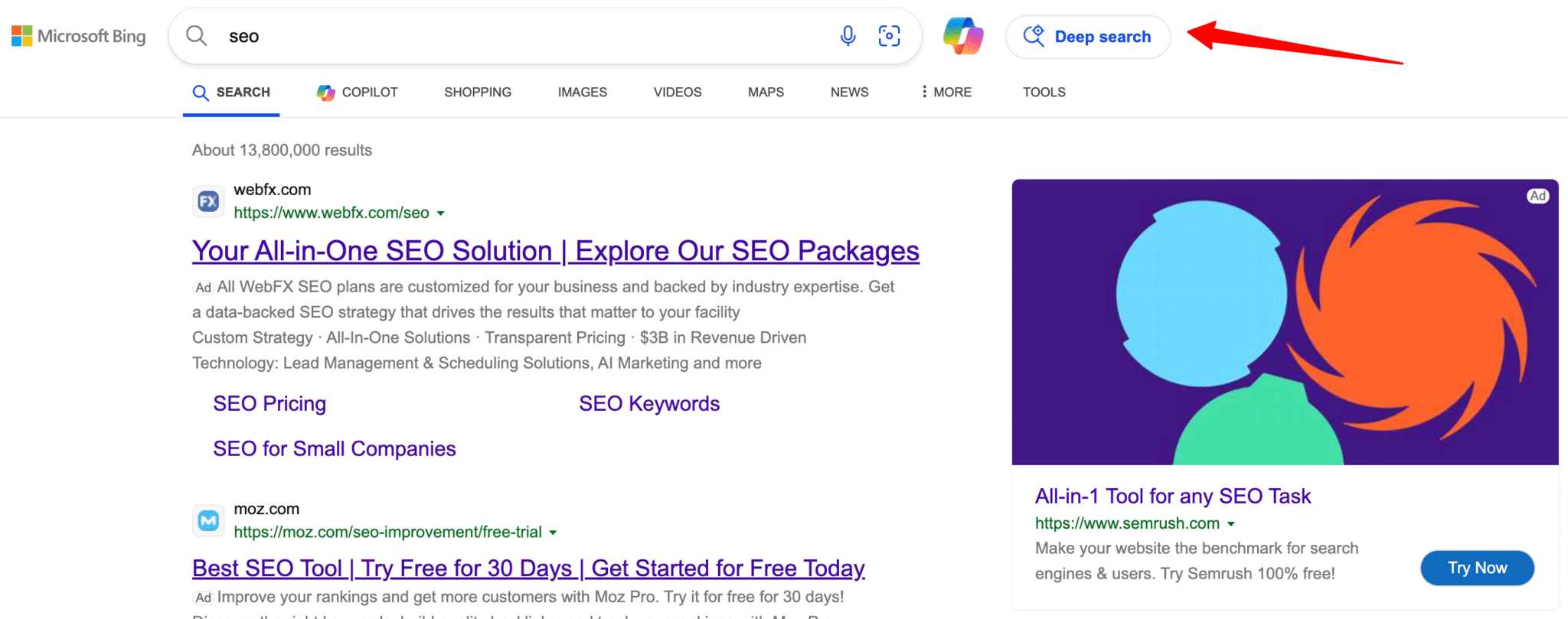
Microsoft’s Deep Search, an optional generative AI feature meant to help searchers with complex questions that don’t have simple answers, seems to have rolled out to more users today. I personally can see the “Deep Search” icon at the top right of the Bing search box after conducting a search in Bing. And I asked others and they can see it too.
What it looks like. Here is a screenshot of the “Deep Search” icon at the top right of the Bing search results page:
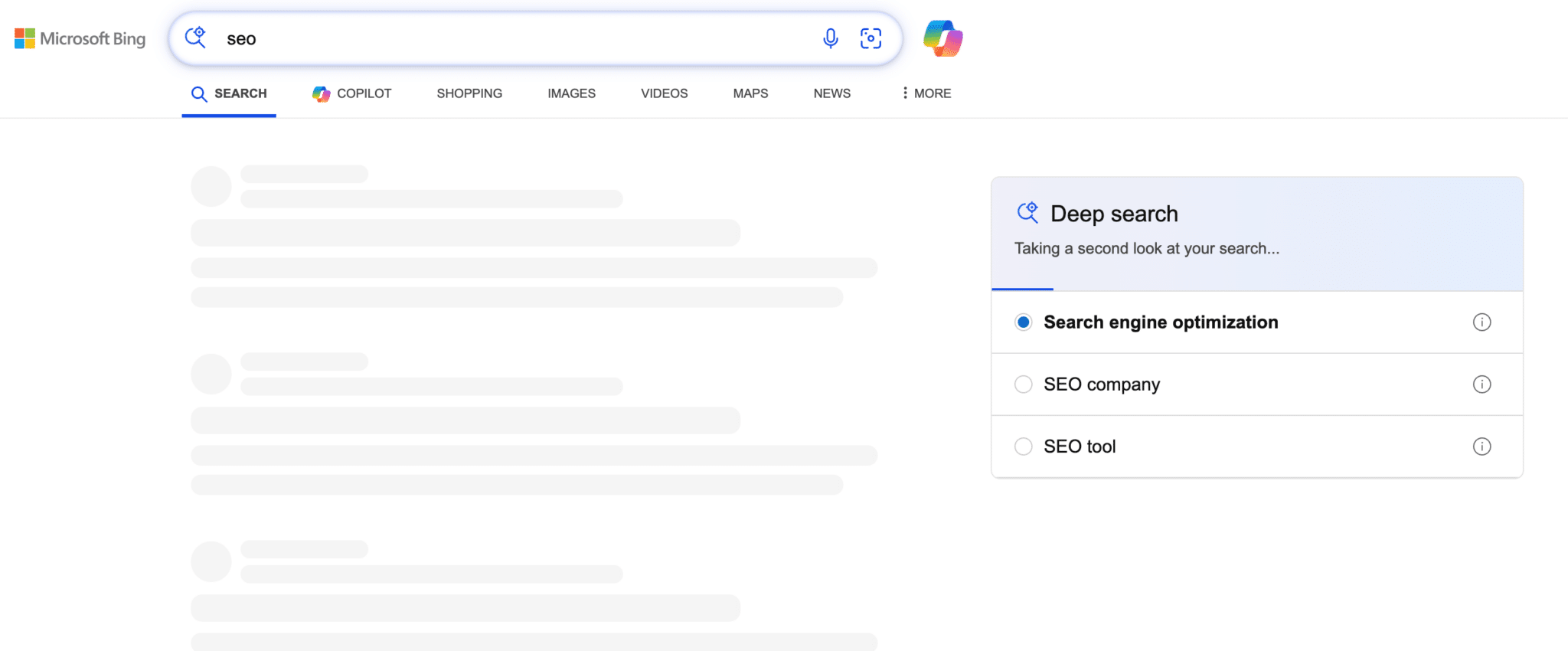
When you click it, it takes you to a screen to refine your search and says “Taking a second look at your search…” and then it does a number of related searches to come up with the search results.
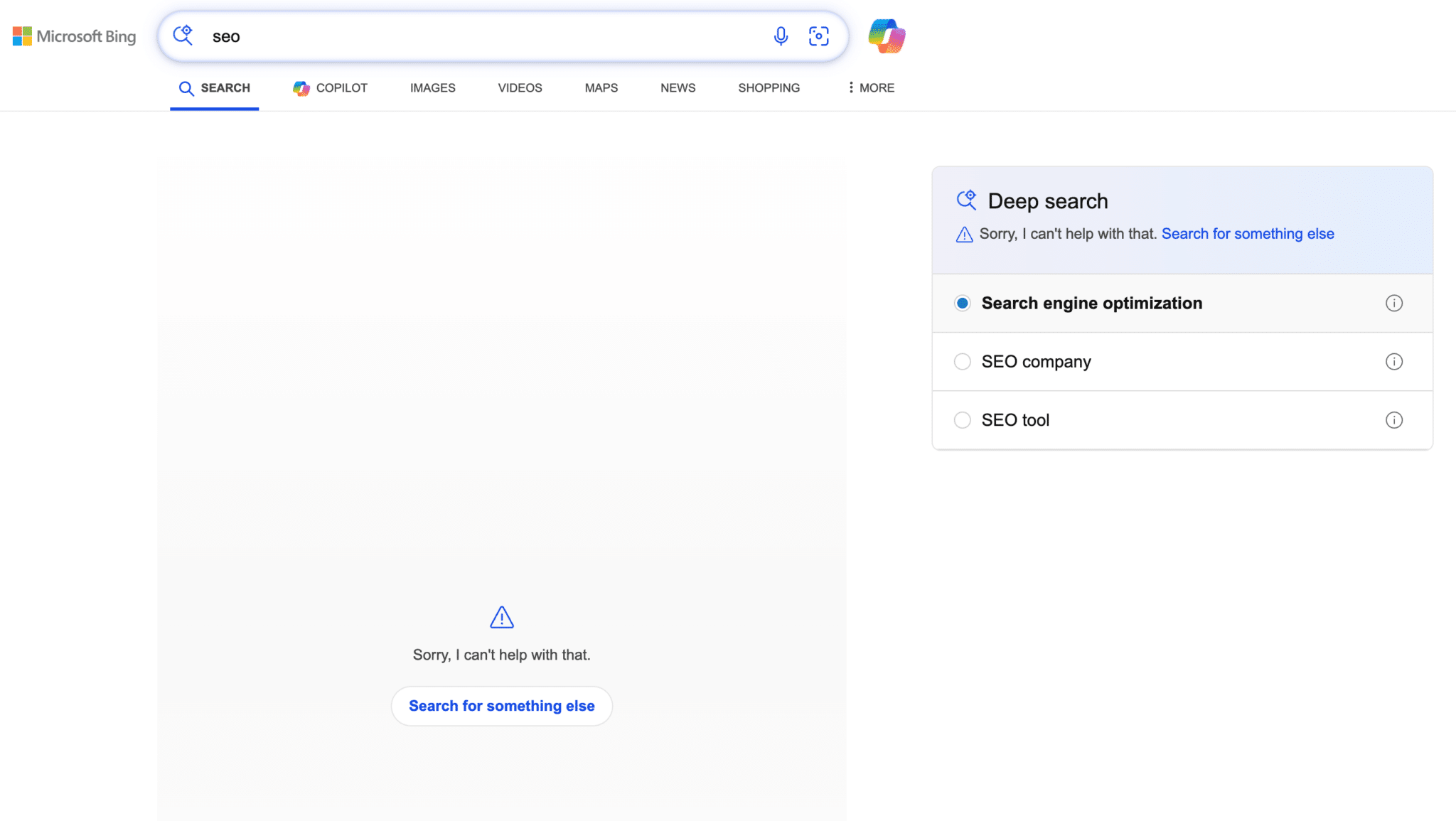
For the [search engine optimization] query, Bing Deep Search is unable to return any results.
But for a search on SEO company, it can:
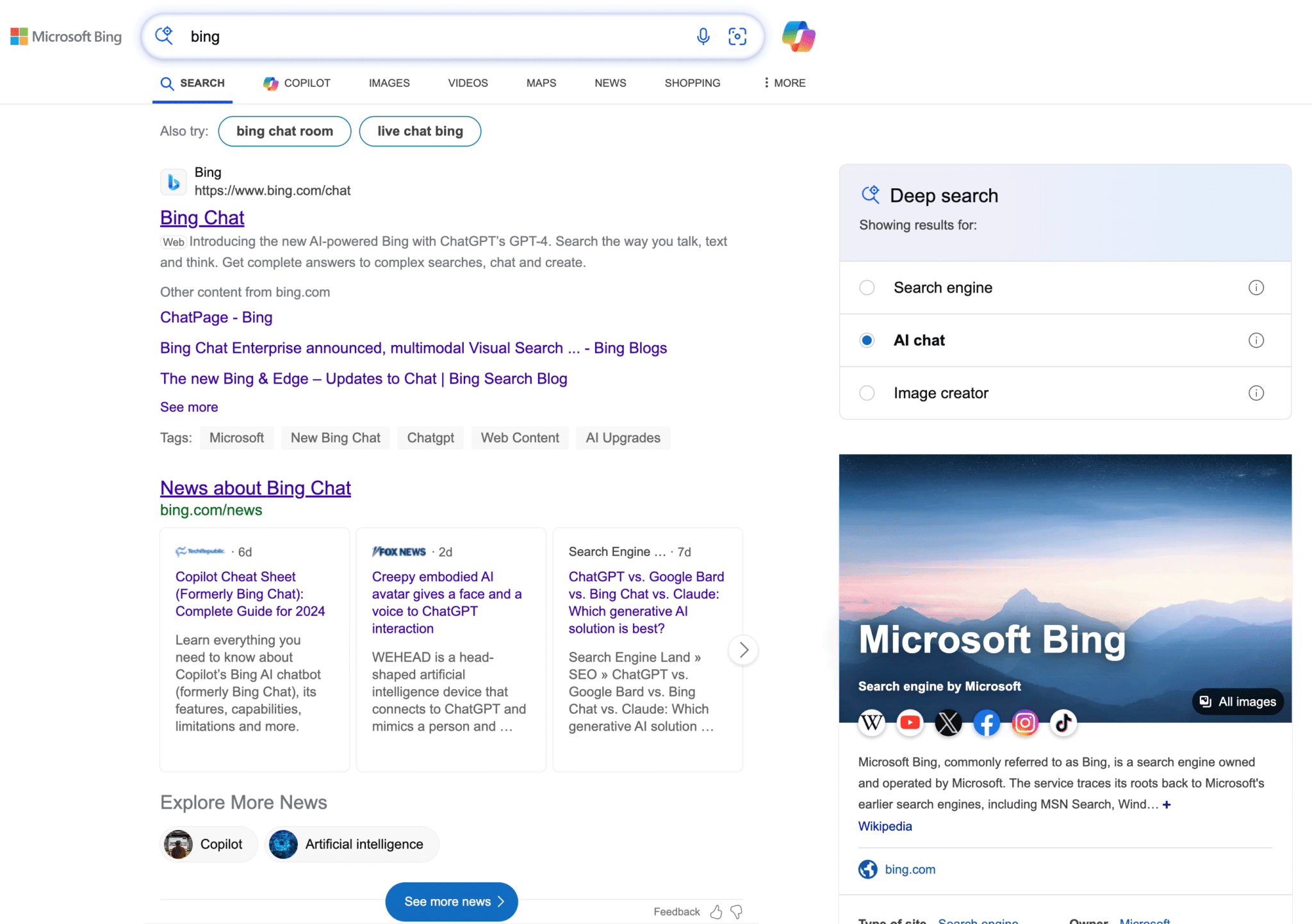
Here is an example of a search for [Bing] that asks me if I want the [AI chat] version:
Live for all? Mikhail Parakhin from Microsoft made it sound like it is not fully live yet, but everyone I asked can see it:
We are testing it everywhere, the plan is to release everywhere, too.
How it works. Deep Search is built on top of Bing’s web index and ranking system. It then uses GPT-4 to discern all the possible intents and variations behind the query and compute descriptions for each of them to create an “ideal set of results.”
After using a combination of querying techniques, Deep Search will surface results that typically wouldn’t appear in Search results.
Deep Search results ranking. The biggest factor is how well a page matches Bing’s expanded description. A few other relevance and quality factors mentioned were:
How well the topic matches.
Whether it has an “appropriate level of detail.”
Whether the source is credible and trustworthy.
Freshness.
How popular the page is.
It is slow, very slow. Deep Search won’t load as quickly as regular search results. It may take Deep Search up to 30 seconds to complete, Microsoft said. This makes the feature sound dead on arrival – as most searchers likely won’t have that much patience.
In my tests, I did a search, put the window in the background and came back later to see the results. It is way too slow.
Why we care. This is another variation of using AI for search results. These search results seem like they would drive more clicks than Bing Chat or Google Bard and even Google SGE. But time will tell.
But being that it is so slow to generate any search results, it might be a deal breaker for most searchers.
Google needs to re-evaluate its approach to automation, according to some advertisers.
The search engine announced several AI-driven updates to Responsive Search Ads (RSAs) earlier this week to help streamline ad creation and boost return on investment.
However, some interpreted this update as another move by Google to promote automation – a direction that doesn’t resonate well with all advertisers.
‘We need choice regarding automation’
Greg Finn, Director of Marketing for Cypress North, explained to Search Engine Land that while generative AI can be a helpful tool, advertisers should have the choice to opt out of automation. Without this level of manual control, there is a risk of detrimental effects on campaign performance and data insight capabilities. He said:
“It’s not that advertisers are concerned about the increase of automation – they’re concerned about automation being the only option.”
“In my experience, we’ve found that auto-applied recommendations can often do more harm than good. Take smart bidding, for example. Sometimes, it can raise bids too high for people in specific industries. So being able to opt out can generally make performance go up – or at the very least, cut waste.”
“Advertisers like to know where how their money is being spent. I know I do. But when you use campaigns like Performance Max, it’s quite blackbox, so you can get some insights but not the full picture.”
“However, the biggest problem advertisers have with automation is bad automation – things you can’t opt out of. This is something that needs to be addressed.”
‘Automation can be risky’
PPC consultant Peter Bowen agreed that while AI can be an effective tool for maximizing campaign performance, advertisers should be able to opt out. Delving into specifics, especially concerning RSA updates – such as the ability to display a single headline based on predicted performance – he expressed general support for the concept. Nonetheless, he stressed that advertisers require more control to achieve optimal results. Speaking to Search Engine Land, he said:
“A single headline will be shown in RSAs if it’s expected to improve performance, but at the moment, the advertiser doesn’t have the ability to define what performance improvement they’re after.”
“When automation operates without clear advertiser-defined constraints, it is risky.”
“Google benefits from improved clickthrough rate but that doesn’t translate directly to improved advertising results, so it’ll be interesting to see who’s interest this automation favours.”
“Of course, automation saves labor, and that’s a good thing. But, automation is only safe when it operates under a set of rules.”
“I think Google is trying to make advertising work for their average customers, but there are a lot of people far away from the average advertiser, so their drive to automation isn’t working as well.”
‘I don’t trust the machine’
Anthony Higman, CEO of online advertising agency Adsquire, also expressed concerns regarding RSAs, highlighting their use of AI for determining ad copy variations. Describing RSAs as “awful,” he substantiated his apprehensions by sharing a screenshot that showcased an instance where an AI error negatively affected ad copy:
Higman emphasized the lack of control for advertisers in addressing or preventing issues seen in the example above, underscoring his worries about the overall quality of Google Ads’ automated features. He told Search Engine Land:
“Advertising is not a one size fits all situation. There are more nuances than what AI decides regarding ad platforms and I think that bad data can skew those metrics. So at this point in time, no I don’t entirely trust the machine.”
“Obviously, we are adapting to the new forced system, but again I think that in a lot of instances, AI can make decisions based on either false data and/or Google’s current goals – and that that is not always ideal for advertisers.”
“I understand that it is a work in progress and Google is working to improve the system, but again, I think that there are just way too many nuances for RSAs to say this is the best headline so this is what we are going to show.”
“I don’t think that the current system really works and it needs to be addressed by Google.”
Google’s advice
In response to marketers’ concerns about the inability to opt out of automation, Search Engine Land interviewed Sylvanus Bent, Group Product Manager, Search Ads, Google. He clarified that for optimal campaign results, a synergistic approach involving both human expertise and AI is the best approach. He said:
“Using AI doesn’t mean advertisers will be completely hands-off – the combination of human expertise and AI-powered insights ensures the inputs provided allow advertisers to guide the AI to drive the best results.”
“AI is a critical part of the Ads ecosystem and we’re committed to providing advertisers with the tools they need to stay in control from the moment they create a campaign using generated assets all the way to AI-powered reporting, insights, and optimization recommendations.”
“By harnessing these tools, advertisers can keep pace with evolving customer behaviors and deliver more tailored messages to their audiences.”
Follow best practice
Responding to concerns about the quality of RSAs, Bent advised advertisers to follow the company’s best practice guidelines. He highlighted the importance of using features like Ad Strength to optimize campaigns, noting that advertisers who enhance their Ad Strength rating from “Poor” to “Excellent” experience an average increase of 12% in conversions.
He encouraged advertisers to leverage this AI-powered tool to enhance the quality of their RSAs for maximum results. Sharing more insights into how advertisers can improve the quality of RSAs, he continued:
“When you provide the most unique headlines possible, you give your RSAs more options to match ads with relevant search queries.”
“And to boost performance further, RSAs can now dynamically display a single headline when predicted to improve results, and will ultimately reduce redundancy where there are multiple headlines.”
“This flexibility, along with providing more headlines and descriptions, enables advertisers to tailor ads more closely to match potential customers’ search queries.”
The future of automation
Sundar Pichai, CEO of Alphabet, acknowledged the pivotal role played by AI in Google’s remarkable achievement of $48 billion in search revenue during the last quarter of 2023. Pichai emphasized the positive influence of Google’s AI investments and expressed optimism regarding the future of automation. Despite this positive outlook, however, some advertisers are wary, concerned that Google might be progressing towards full automation, which may significantly impact their marketing strategies moving forward.
Responding to these concerns, Bent assured that the majority of Google advertisers are already embracing AI. With that in mind, Google remains committed to further investment in this area.
While acknowledging the widespread adoption of AI, Bent urged the advertising community to voice genuine concerns and provide feedback. Google hopes this collaborative approach will enable it to refine its offerings based on valuable insights from advertisers. He added:
“We continue to expand our AI capabilities to improve advertiser results and simplify campaign setup and management.”
“Today, nearly 80% of advertisers already use at least one AI-powered Search ads product. Google AI works best when advertisers provide their expertise about their businesses and customers.”
“We’ll keep listening to advertiser feedback and exploring ways to better serve our users and advertisers; their success remains our core focus.”
Starting a business at home without spending much on equipment, office structure, and other usual office expenses can help you make more money. You can earn from things you enjoy doing or get to follow your dream job. Running a business from home can also help you pay fewer taxes, simplifying things.
If you regularly use part of your home only for business, the IRS lets you subtract some work-related expenses. These expenses include rent, bills, property taxes, repairs, keeping things working well, and other costs related to your business.
Learn how your home business can use these deductions to save money in the long run.
What is the “exclusive test” about?
To qualify for a home office tax deduction, you must show that you only use part of your home strictly for work. The IRS wants proof that you have a specific area of your place dedicated as an office space. Make sure to use it just for your job, and don’t do any personal matters in there if you want that deduction to stick.
For instance, if you have a spare room that’s solely your business office, you can claim it for the home office deduction. But you can’t claim the deduction if you use a bedroom or living room for work and personal affairs.
Exceptions to the “exclusive use” test exist, such as businesses utilizing home spaces for inventory storage, product samples, or operating daycare facilities.
Moreover, you must be a registered business owner or an independent contractor to claim the home office deduction. Employees working from home for a company cannot claim this deduction.
Other things to remember about the exclusive-use rule include:
You’re prohibited from making personal phone calls from the office.
You must immediately leave your office whenever a family member requires your attention.
Who can claim this home office tax deduction?
This tax break applies whether you live in a house, condo, or apartment as long as you reside there. The deduction doesn’t apply if your living situation is more temporary, like staying at a hotel, inn, bed and breakfast, or if you own a rental property but don’t live there yourself.
Exclusive and regular use
Your business area should be solely dedicated to conducting business activities. For instance, using a spare room as your office and a play space for your kids may disqualify you.
However, there are two exceptions. If you offer daycare services for children, the elderly (65 or older), or individuals with disabilities in that part of your house, you might still claim business deductions.
Per IRS guidelines, this applies if you carry certification, a license, or approval as a daycare center.
The other exception is if you use the office area for storing inventory or product samples sold in your business.
Home as principal business address
Your primary business meetings don’t have to be in your home office; they should be your primary place for handling business matters. According to the IRS, that means regularly using the space for paperwork, scheduling appointments, and keeping records.
In the case of a home office situated in a separate building, like a converted garage, meeting clients is not a requirement for deductions. Instead, regular and exclusive use for work qualifies.
Also, if you have a regular job but run a side business from home part-time, you can still qualify even if you spend a lot of time at your regular job. This rule makes it easier for salespeople or tradespeople who primarily work elsewhere to claim deductions for their home office.
Can I get a tax break for working from home as an employee?
No, you can’t snag that home office tax break if you’re an employee working from home. It’s usually just for those who own businesses rather than regular employees.
Before the Tax Cuts and Jobs Act (TCJA), employees could write off work expenses, like the home office deduction, if their employer didn’t cover them. But in 2025, the government will stop allowing those deductions for employee expenses. People running businesses from home usually tick off the usual deductions when they do their taxes.
What expenses can I subtract from my taxes for my home-based business?
Home-based business owners often claim standard deductions on their tax returns. It’s wise to consult an accountant or financial professional to confirm your eligibility for these or other deductions not listed here. Here’s a breakdown of some standard deductions:
Home-related expenses
Figure out the portion of your home used for business by dividing your office space by your home’s total size. Accurate calculations help deduct the correct percentage of expenses.
Maintenance and repairs
You can claim those costs if you fix things for your home office. Direct expenses for your office are fully deductible, while indirect ones benefiting the whole home are prorated.
Other expenses
To be deductible, expenses must be regular and essential for your business. This includes costs like goods sold, business assets, startup expenses, using your car for work, and paying employees. Here is a complete list of items you can include under other expenses.
Cost of goods sold: These are expenses used to calculate the cost of goods sold, including storage, factory overhead, direct labor, and product/raw material costs.
Capital expenses: These are business assets, improvements, and startup costs.
Employee payments: These deductible costs are for employee compensation.
Retirement plans: This is a tax-advantaged savings plan for retirement contributions.
Rent expenses: These are deductible payments for property use without acquiring ownership or equity.
Interest: This pertains to deductible interest expenses on business-related borrowings.
Business taxes: These are deductions for federal, state, local, and foreign taxes directly affecting your trade or business.
Travel for business: The expenses must be related to business and adequately documented. Additionally, costs for supplies and materials used for business purposes within a tax year are deductible.
Supplies and materials: These are deductible costs for business-related supplies consumed within a tax year.
Professional services: These include fees for necessary professional services like accounting, consulting, legal counsel, or contract labor.
Marketing and business development: You can write off expenses for getting new clients and holding onto the ones you already have.
Remember, seeking professional or legal advice ensures you take advantage of all eligible deductions.
Tips on how to claim home business tax write-offs
Claiming tax write-offs for your home business can help you save money. However, businesses are permitted to claim tax deductions for legitimate business expenses.
All deductions should be supported by receipts and documentation showing their business use. As long as deductions are honestly calculated, the business should remain in good standing with the tax authorities. Overly aggressive deduction claims increase the chances of a future audit. Compliance with tax regulations helps companies avoid scrutiny.
Record your taxes
Maintaining a business journal is crucial to handling an audit efficiently. It can be problematic if you’re audited without records to support your deductions.
To avoid this, keep a daily log of your home business activities. Record purchases on printer paper, attach receipts to hardcopy logs or scan them for digital records. Note mileage, phone calls, other expenses, and incoming payments.
Detailed accounts make audits easier. Condense daily reports into monthly tracking sheets to streamline tax preparation. It speeds up tax filing and offers a monthly overview of your business activities.
Invest in new office equipment
You can fully deduct office furniture, software, computers, and equipment in the year of purchase without needing to depreciate them. However, there’s an upper limit, and the items should be primarily used and necessary or beneficial for your business.
While these guidelines are generous, extravagant items like a 4K widescreen TV for the office might not qualify for deductions.
Upgrade your communication lines
If communicating with clients is essential or beneficial for your business, consider getting a second phone line or a dedicated business cell phone—both are fully deductible.
You can still deduct the costs even if your client conversations are occasional. Keep track of these calls’ dates, times, and purposes, and mark them on your regular phone bill for deduction during tax time.
Treat your clients
You can entertain clients and claim a tax deduction. However, business owners’ misuse of this write-off has made some home business owners hesitant to claim it.
Taking a client out for a meal and entertainment is acceptable. However, justifying a $200 deduction for a client who has brought significant business is more acceptable than claiming the same expense for a friend who paid a small amount over the fiscal year.
Hire family members
You can employ family members and deduct their salaries if their work can be accounted for and paid at standard rates. If your business can involve your spouse and kids, utilize their assistance. Typically, you’ll pay less than market rates for their help, and you can also deduct insurance premiums for them.
Children under 17 don’t have Social Security taxes but can contribute to a Roth IRA. This setup allows you to teach them work ethics and saving habits simultaneously.
Photo by Towfiqu barbhuiya on Unsplash
Keep yourself updated on the IRS guidelines
A home business can be fulfilling, offering additional income and valuable tax breaks. Reviewing the IRS small business publications is highly recommended. These resources detail the deductions and the conditions required to claim them.
Maintaining accurate records and adhering to justifiable deductions is crucial. However, it’s also advantageous to maximize your deductions within the rules. While IRS guides might seem challenging, seeking guidance from a competent business accountant can save time and potentially reduce expenses.
By Heidi Moore — Beverage Insurance Specialist & Host of “Wine Crush Podcast”
My venture into podcasting started unexpectedly, blending inspiration with a touch of reluctance. The idea of hosting a podcast was as unfamiliar to me as winemaking intricacies. This journey wasn’t born from a long-standing dream but a chance meeting at the Portland Radio Project — a hub of ideas and innovation whose executive director, intrigued by my work in wine insurance, proposed I develop a podcast.
Admittedly, my experience with hosting or discussing wine was limited. My connection to the wine industry was new, and I was filled with eagerness to learn. As the podcast’s concept took shape, focusing solely on wine insurance quickly felt too narrow. I was more captivated by the vibrant stories of those I met in the wine world. These narratives were the real essence of the industry and steered the podcast’s direction away from technical discussions to celebrate the compelling, human stories behind the wine.
Finding the concept
The journey to conceptualize “Wine Crush” was one of discovery and creativity. Initially, I considered focusing the podcast on wine insurance, but I quickly realized this niche topic might not captivate a broader audience, being too specialized and potentially unengaging.
I aimed to find a concept that resonated deeply both with myself and potential listeners. Delving into the wine industry, I was captivated by the compelling stories of individuals I encountered. These were not the typical wine experts but real, relatable storytellers with unique experiences. It dawned on me these narratives were the essence of what I wanted to capture. Instead of a technical monologue on wine, “Wine Crush” would be a collection of these vibrant, personal stories, giving listeners a rich taste of the wine world’s diversity.
The challenge then was to choose a name that embodied this idea. After much thought, “Wine Crush” stood out — a playful yet meaningful choice, symbolizing both the literal grape-crushing process and my growing fascination with these wine stories.
Leveraging resources and building a team
Transitioning “Wine Crush” from concept to reality hinged on effectively leveraging resources and assembling a dedicated team. Fortuitously, the Portland Radio Project provided a significant boost, offering access to a professional studio and the necessary technical infrastructure. This ensured that, despite my initial inexperience in audio recording, the podcast would benefit from a sound quality that matched our ambitious content.
Crucial to the podcast’s success was the formation of a skilled team. A knowledgeable audio engineer ensured each recording’s clarity, avoiding the pitfalls of amateurish sound quality. Equally important was the role of our producer, who adeptly shaped and structured the episodes, overseeing the production process with a keen eye.
Simultaneously, establishing a robust social media presence became integral to our strategy. These platforms helped promote the podcast and provided a valuable channel for engaging with our audience and gathering feedback.
The journey of “Wine Crush” exemplifies the importance of a holistic approach to podcasting. It’s not just the strength of the idea or the charm of the content that counts, but also the quality of production and the synergy within the team that brings the vision to life.
Developing a unique style
I wanted the “Wine Crush” conversations to flow naturally, allowing each guest’s personality to shine through. This approach required moving away from a strict script and fostering a more organic dialogue, engaging them in a narrative that would captivate our listeners.
Finding my rhythm took time. I leaned into the art of conversation, a skill I had honed from a young age. Being able to talk to anyone about a wide range of topics, a trait my father encouraged, became invaluable and allowed me to connect with guests on various levels, creating a comfortable space for them to share their stories.
Ultimately, the unique style of “Wine Crush” emerged as a blend of structured storytelling and spontaneous conversation, enriched with carefully chosen music that set the mood for each episode. This format made the podcast stand out and allowed me to grow as a host, finding a balance between informative and entertaining.
Essential tips for beginners
For those venturing into the world of podcasting with little to no experience, I offer a distilled essence of my journey with “Wine Crush” in the form of essential tips:
Research your topic thoroughly: Choose a subject that interests you and has the potential to captivate an audience. Invest time in understanding your topic deeply, ensuring it’s worth the time and effort you will pour into it.
Prioritize sound quality: Poor audio is one of the biggest turn-offs for listeners. Seek help from individuals who can assist in producing clean, clear recordings.
Invest in good equipment: High-quality recording equipment is crucial, but it doesn’t have to break the bank. Do your research, read reviews, and don’t hesitate to ask for recommendations on affordable options that can deliver excellent results.
Choose engaging guests: The enjoyability of your podcast often hinges on your guests. People who are engaging in person typically bring that same energy on air.
Establish a social media presence: Social media platforms are invaluable for promoting your podcast, engaging with listeners, and building a community around your content.
Collaborate for cross-promotion: Partnering with others can help reach a wider audience. Cross-promotion is an effective strategy for audience expansion.
Enjoy the journey: Finally, have fun with the process. Be open to stepping outside your comfort zone, trying new things, and making necessary adjustments.
Embracing the podcasting journey
Podcasting is about more than just recording episodes. It’s a journey of discovery, both personal and professional. You’ll find yourself learning new skills, from technical aspects of recording to the art of storytelling. Embrace these growth opportunities, as they are what make the journey enriching.
Along the way, don’t be afraid to experiment and innovate. Your podcast is a canvas for your creativity, and its uniqueness will often stem from your willingness to try new approaches and ideas. Whether it’s experimenting with different formats, exploring diverse topics, or engaging with various guests, each decision shapes the identity of your podcast.
Your podcasting journey is a testament to your voice and vision — a platform to share your passion, engage with a community, and leave a mark in the ever-evolving digital landscape. As you embark on this adventure, hold onto the enthusiasm that sparked your interest in podcasting, and let it guide you through each step of this rewarding journey.