Webinar: Drive smarter engagement across the customer journey by Cynthia Ramsaran

Business Finance

Customers have grown to expect tailored, timely offerings and marketers are challenged with delivering these real-time, personalized experiences to respond to their needs.

As a result of this shift, enterprises are leveraging customer-centric strategies to drive smarter engagement across the full customer journey, capture revenue opportunities and foster long-term loyalty. Those that are truly succeeding are making access to data a movement across their organization, not just a marketing initiative.

Learn how The Washington Post is executing personalized customer experiences as a key engagement driver to power use cases from acquisition to win back.

Register today for “Drive Smarter Engagement with Hyper-Personalization Across the Customer Lifecycle,” presented by ActionIQ.


Click here to view more Search Engine Land webinars.

The post Webinar: Drive smarter engagement across the customer journey appeared first on Search Engine Land.

Original source: https://searchengineland.com/webinar-drive-smarter-engagement-across-the-customer-journey-390001

Here’s Why First Impressions Count in Business

Home Business Magazine Online

Making a good first impression of your business is key to establishing trust among potential clients. Unfortunately, you only have seven seconds to impress people during your first meeting, according to the University of Melbourne. This means if the first impression isn’t a good one, it’s likely your business won’t get a second chance to attract clients. It is, therefore, crucial to make every second count every time you interact with people.

A good first impression doesn’t revolve around complex activities. Something as simple as greeting customers when they walk into your store can help establish a long-term relationship. Dressing to impress and taking time to know your clients are other ideal ways to make a first good impression. Keep reading to understand why exactly first impressions count in business and what you can do to impress customers.

Meet High Expectations of Consumers

Today’s consumers have high expectations when interacting with a business online or in-store. If you put anything out in the market, that’s less than high-quality, it’s likely you won’t make a sale. With this in mind, focus on creating positive and lasting impressions.

Considering first impressions are based on visuals, having a clean and well-organized office, for example, can help you meet customer expectations. In an era where people are more conscious about their health and safety, keeping your commercial space clean and germ-free can go a long way in winning your customers’ loyalty. So, make it a habit to clean and sanitize the workplace. Wipe spills and secure cables in a corner to prevent trips and falls.

While you and your employees can clean the business premise, leveraging commercial pressure washing services is highly advisable. Commercial cleaners specializing in pressure washing will not only clean the interiors but also outdoor surfaces that may look dirty because of grime, oil, and dirt. Pressure washing helps get rid of grime on exterior walls, pavements, and driveways thus restoring the appealing image of your business.

Shows Professionalism

Professionalism is essential in any business because it creates trust and loyalty. And consumers can quickly determine the level of professionalism in your business by how you present yourself. There are several things you can do to showcase professionalism, from providing world-class reception, offering effective solutions to problems, communicating respectfully, maintaining a positive attitude, and dressing appropriately. Punctuality is something you shouldn’t overlook as an entrepreneur. Prospects will determine if you’re reliable based on your ability to arrive in time for your first meeting.

Creates Lasting Impact on Business Branding

Creating a first good business impression entails more than building a perfect website and organizing the office or store. It’s about hiring the right employees and connecting with the right investors through networking. Creating a lasting impression with branding also helps set an image people will remember positively.

To create a memorable brand image, build a website that’s easy to navigate. Consistency in logo design and colors online and offline is vital to boosting your credibility and creating a good impression. Also, be clear on your brand’s value proposition to attract the attention of your target audience.

Creating a first impression for your business is crucial if you want to succeed. That’s because a first good impression shows your commitment to meet the high expectations of customers. Making a positive impression during the first meeting with customers or potential investors reflects high levels of professionalism. It also helps create a lasting impact on target customers when creating brand awareness.

The post Here’s Why First Impressions Count in Business appeared first on Home Business Magazine.

Original source: https://homebusinessmag.com/businesses/success-tips/first-impressions-count-business/

5 Ways to Avoid Overspending

Home Business Magazine Online

Knowing how to manage your money and spend on the necessary things is a life skill everyone should have. If you can save a buck in this hard economy and avoid overspending, it will go an awfully long way.

While it is easy to say that you will make better money decisions, it is not easy to actualize it. We will share a few tips with you here to help you cut down on spending this month. Follow through to learn one or two things about overcoming bad money habits.

1. Use Prepaid Cards with a Spending Tracker

Prepaid cards are the best because they allow you to use the money you already have. The good thing about certain prepaid cards is that they also have additional features like a spending tracker and alert notifications when you reach your spending limit.

Netspend offers reliable prepaid debit cards that will help you manage your spending habits and control how much money you waste. Such debit cards also have no monthly fees, making them convenient to use and have.

2. Take Time Before Making Any Purchases Online

Patience is not something that comes easily to everyone. However, it is a virtue that could save you from many messes, including financial ones. Impulse buyers normally lack patience and therefore want to buy everything they come across at that time.

If you have been struggling with impulse buying, then it’s time you practiced a little patience. Whenever you see something you like online or in a physical shop, take some time to think about it and determine whether it’s something you actually need.

When shopping online, you can do that by putting the items in your cart but not checking out. You can also add them to your wishlist and wait until you have planned for the purchase to pay for it.

3. Disable One-click Buying

One-click buying is convenient but also contributes to overspending. The stores that offer that feature want to make it easy for you to shop so that you can fill your cart with things you do not need and check out in a single step.

However, that would only work in your favor if you buy things you need and have planned for. Therefore, disabling the feature is the first step toward controlling your shopping impulses. A more complicated buying process might make you reconsider, especially if they are not urgent.

4. Remove Saved Credit Card Information Online

Saving your credit card information is also very convenient because you do not have to cram or keep checking your card when you want to buy something online. That means you will not buy things you do not need because getting your card every time takes work.

Getting your card will be easy if you desperately need something. Delete the credit card information on all your browsers today to avoid being tempted to overspend.

5. Mute Deals and Discount Notifications

Marketers have genius ways of making customers shop even when they do not need something. If you have subscribed to the mailing list of your favorite stores, you might be unable to stop overspending due to the constant deal alerts.

The best way to avoid such temptations is to either unsubscribe to the discount and coupon emails and messages or mute the notifications. That way, you can only check for deals when you need them.

Final Thoughts on Avoiding Overspending

Getting rid of your bad spending habits is not easy, but once mastered, it can take you to a new financial security level. Follow the tips above and make a conscious decision to end your bad money habits this month.

The post 5 Ways to Avoid Overspending appeared first on Home Business Magazine.

Original source: https://homebusinessmag.com/money/personal-finance/5-ways-avoid-overspending/

Instacart has launched Coupons and Stock Up & Save promotion campaigns in Ad Manager

Instacart advertisers now have more options to promote their products on the platform. This week, Promotions were launched in the Ad Manager, giving brands access to Coupons, and Stock Up & Save campaigns.

Soon, Instacart will improve on the new Promotions offering with Free Gifts, and Buy One, Get One (BOGO).

What Instacart says. Ali Miller, vice president of ads product at Instacart, believes ordering groceries online should not be a luxury or convenience for some, but an option for everyone — no matter what the budget.

“With the launch of our new Instacart Promotions, all of our brand partners now have the ability to set up coupons and promotions that can drive meaningful business results while also passing on more savings opportunities to consumers,” Miller wrote in a post. “We’re proud to continue expanding our portfolio with additional self-service capabilities, ad formats that drive results, and measurement that brands need to understand the true impact of their campaigns on Instacart.”

Instacart’s new streamlined ad creation process. In October, Instacart launched an easier way for advertisers to create and manage their campaigns. You can read more about the new setup on their blog.

Why we care. New campaign types give advertisers and brands another way to promote their products to consumers and help them save money on a variety of items. If you have or manage a grocery or retail brand, you should test the new ad types in your account as soon as they are available.

The post Instacart has launched Coupons and Stock Up & Save promotion campaigns in Ad Manager appeared first on Search Engine Land.

Original source: https://searchengineland.com/instacart-has-launched-coupons-and-stock-up-save-promotion-campaigns-in-ad-manager-389873

“I Made £270 This Week in Side Hustles”

Reading Time: 5 mins

Sell stuff. Most people around this time of year need more space and more cash, and a great way to create both of these for your festive next is by selling things you’ve already got. You may have shelves of books or a cupboard stuffed with clothes you never wear. In my case, I realised last month that I had a few drawers of old DVDs that I either never watched, or watched once but never again, or even ungraded to blu-ray over the last decade.

Over the past few years, I’ve curated myself a little routine of selling online, on various platforms, so here are some insights into that process. I had a particularly successful week last week as it’s coming up to Christmas and I’ve really gone to town searching my home for mine and my partner’s unwanted items, and created this ‘Week in the Life of a Side Hustler’ for MoneyMagpie.

A Week in the Life of a Side Hustler

I have a full-time job, so this had to be something that fits around my paid work, and not something I relied on to pay the rent and bills: more like, well, a side hustle! So here are my profits for this particularly good selling week.

The Platforms I used to sell stuff

side hustle
Vinted

My partner and I have a Vinted account that we add items of clothing to nearly every week as we clear out the cupboard for the new season. This week I’ve added two tops from Warehouse for £11 each, a Skagen watch for £70 and an All Saints shawl for £85. They may take a while to sell, but they’re up there for people to see. This month I sold some Office shoes for £20, a Monsoon dress for £10 and (this past week) a French Connection coat for £50: This was an average selling month for me, and on average I make between £80 – £100 a month this way from Vinted alone.

Total this week: £50

sell stuff on eBay

I had some old Star Wars roleplaying games books that I wanted to shift, which were over thirty years old, rather yellowing and unused since the 90s. So I had a good search on eBay for similar items and realised there were collectors out there who really wanted these items, whatever condition they were in. For books I bought as a teen for about a fiver each, their value had doubled, trebled and sometimes even quadrupled (and more!) in the ensuing years.
Seeing the top prices for some of these books were between £30 and £60, I priced mine in the middle and asked for a set price of £35 each. Thankfully, this was a good call and I had interest in the books as a job lot of 5, totalling £150 (I discounted them from £175 when purchased together), and bingo: another £150 to add to the pot.

Total this week: £150

Music Magpie

digital downloads

I’d used Music Magpie before, about ten years ago to sell a bunch of CDs when I needed a few hundred quid to move house (and to create more space), and I’d managed to tot up the tidy sum of £300 for about 100 CDs. Now, most of these were somewhat unusual film soundtracks, which bagged me about £3 each, but the non-soundtrack ones – pop, rock, etc – netted between 30p and £1.50 each at the lowest end of things. Still, I ended up with a nice bit of extra cash.
This time, I had a few drawers of DVDs that I’d since replaced with blu-rays over the past decade, so I downloaded the Music Magpie app and used the barcode to scan the three or four piles of discs in boxes I’d accumulated. Some they didn’t want, so I created a reject pile of around 15 discs, but the others totalled about 35 discs and a selling price of about £30 the lot. This doesn’t seem like much, considering I made a few hundred on those CDs, but times have changed and so has the price of physical media, driven down by streaming availability and depreciation. But £30 was better than nothing, so I can add that to the weekly total. They also collect your box of discs for free, which really helps.

Total this week: £35

side hustle
Facebook Marketplace

Finally, this has been a reliable and occasional source of income for me as I’ve sold everything from concert tickets for gigs I couldn’t attend, to trinkets, furniture and used mattresses. It’s a really great way of putting things up for sale, discussing the sale on your terms with interested parties, and then agreeing on a price.
This week, I wanted to get rid of a small chest of drawers that, since I moved house, just never really fit anywhere. It was low and wide and pine, and I thought £35 was a fair price. Thankfully, so did two buyers who contacted me about it. One of them couldn’t make it over to collect (and I wasn’t prepared to deliver) so I went with the second buyer, who agreed that £35 and a self-pickup was a good deal. They came that evening to take it away and had paid before they drove over, although you can also ask for cash.

Total this week: £35

TOTAL SALES THIS WEEK: £270.

My conclusion

Two hundred and seventy quid. Now that’s not bad for a week’s selling, and I put everything online on the Monday (although I had some of the clothing up there on Vinted already: a further note about Vinted is that they don’t charge and fees, so that’s pure profit on each sale. £270 is a solid monthly average but I could also shift a few more items that are already on my sites, or find more stuff to sell around the house.
How much I sell does depend on the time I have available to do all this, and as I say, this month I decided to go for it and really sell everything I could in one week, and I’m more than happy with the results. Even for a month’s selling, I’d be happy with an extra £270. One day I’m sure I’ll run out of stuff to sell but I’ll keep looking, and I urge you to do the same! Someone probably wants something you don’t!


To read more ideas about how to make money from your old stuff – read our free eBook here.

The post “I Made £270 This Week in Side Hustles” appeared first on MoneyMagpie.

Original source: https://www.moneymagpie.com/make-money/i-made-270-this-week-in-side-hustles

Hiring a Brand Ambassador

Home Business Magazine Online

Brand ambassadors represent a brand and its ideals. They should be sincere and care about people. By doing so, they ensure a positive experience for customers. They should also maintain a high professional standard and ask engaging questions. This way, their genuine intentions are apparent to others. These are qualities that you can benefit from, especially if you are planning to hire a brand ambassador.

Benefits of hiring a brand ambassador

Hiring a brand ambassador is a great way to reach your target audience and build a community around your brand. They can also help you promote your new products and services and influence the direction your brand takes.

Since they’re on the front lines of retail, brand ambassadors are valuable resources because they have first-hand knowledge of what your customers like and dislike. Click the link: https://trocglobal.com/blog/brand-ambassadors/ for more information. They’re your company’s “sounding board,” so they can give you feedback about the effectiveness of your marketing efforts.

Employees can also serve as brand ambassadors, which has several advantages for your company. First of all, employee followers are more likely to convert than other leads. Second, they have insider knowledge about your brand, its products, and its goals. Third, they can help your company gain exposure and recruit qualified applicants.

Company spokespersons can also help you get access to a new market. They can help you promote your business by attending events that relate to your products and services.

You can also offer these ambassadors monetary incentives, and send them free samples of your products or services. This can create a good relationship between you and the company spokesperson, and it will also attract other ambassadors.

While company spokespersons have historically been used by consumer-facing businesses, B2B organizations have also begun to use them. With the growing use of social media, buyers increasingly use social networking websites to discover new products and services. Using a company spokesperson can help your business reach a wider audience and make it more accessible to younger consumers.

A company spokesperson acts as the face of your brand, creating instant recognition and engagement with your target audience. They can influence customer purchase decisions and boost your social media presence. Click here for more information. A company spokesperson can be a person within your company or someone external to it.

Qualifications required

Business Person
Photo by Charlotte May from Pexels

If you’re interested in a career as a company spokesperson, you’ll need to be highly creative and able to learn quickly about the products and services that a corporation represents. You should also enjoy creatively promoting the products in person and online. Generally, the minimum qualifications for this position are a high school diploma or an associate degree, but a bachelor’s degree is preferred. Experience in retail is also preferred.

Company spokespersons are expected to know the mission and goals of the company they represent. They should be knowledgeable about the products and services, and they should be able to answer questions from the public.

They should also be able to build trust with their audience and communicate their genuine love for the brand they represent. As a company spokesperson, you’ll be asked to give speeches and presentations about the company’s products and services.

To be a company spokesperson, you must have excellent communication skills and a personable personality. You may need a car and a valid driver’s license, since you’ll need to travel to various locations to represent the brand. In addition, most employers prefer applicants with previous experience in sales, customer service, or public relations.

One of the most important qualifications for company spokespersons is confidence. People tend to gravitate to confident individuals. Therefore, it’s important to never appear nervous or uneasy in public. Make sure you write recommendations in a clear and convincing manner and follow all rules and policies that apply to promoting product lines. You should also be willing to accept constructive criticism graciously, as this will show that you’re eager to learn and grow.

Moreover, company spokespersons should have a passion for the product line they represent. In addition, they should be personable, as they’ll be interacting with potential customers and providing feedback on their products. They should also be knowledgeable about marketing trends and how they can make a positive impact on sales.

Cost

Company spokespersons can be a powerful addition to your creative team, elevating word-of-mouth marketing efforts and creating focused momentum for your product line. To make the most of this powerful resource, you need to understand exactly how to maximize the cost of your ambassador program.

Consider using creative company spokespersons who produce content that is engaging and useful to consumers. Such content has a long shelf life and can be shared multiple times. Consider creating a content calendar and scheduling uploads to maximize the potential of each ambassador. Social media superstars can expose your product line to tens of thousands and even millions of followers.

The post Hiring a Brand Ambassador appeared first on Home Business Magazine.

Original source: https://homebusinessmag.com/marketing/branding/hiring-brand-ambassador/

How to Boost Conversions by Redesigning Your SaaS Product

Home Business Magazine Online

If you’re like most business owners, you’re always looking for ways to increase your conversions. After all, more conversions mean more sales, and more sales mean a healthier business.

What is a conversion, and why do you need to boost them?

A conversion is simply when a website visitor takes the desired action. This could be making a purchase, signing up for a newsletter, or filling out a contact form. The key word here is “desired” — in order for a conversion to take place, your visitors need to want to do what you’re asking them to do. If they don’t see the value in what you’re offering, they’re not going to convert. That’s why it’s so important to have a well-designed product that is easy to use and provides value to the customer. If your product is hard to use or doesn’t offer what the customer is looking for, you’re not going to see many conversions.

How can you boost conversions by redesigning your SaaS product?

1. Make it easy to use

The first step to increase conversions is to make sure your product is easy to use. If it’s complicated or difficult to navigate, customers are going to get frustrated and give up. We gathered key steps to prevent that from happening:

  1. Make sure your product is designed with the user in mind.
  2. Use clear and concise language.
  3. Don’t make assumptions about what the user knows.
  4. If there are features that are not essential, consider removing them or making them optional. The goal is to make your product as simple and straightforward as possible.

2. Focus on the customer’s needs

The second step is to focus on the customer’s needs. What are they looking for in a product like yours? What pain points are they trying to solve? Your product should be designed to address these needs and solve these problems. If it’s not, customers are not going to see the value in it and will go elsewhere.

3. Create a sense of urgency

The third step is to create a sense of urgency. Why should the customer buy your product now? What’s going to happen if they wait? Answering these questions will help you create a sense of urgency that will motivate customers to convert.

4. Offer a free trial

The fourth step is to offer a free trial. This allows potential customers to try out your product before committing to a purchase. Free trials are a great way to increase conversions because they remove the risk from the equation. If a customer doesn’t like your product, they can simply cancel their trial and never be charged. But if they do like it, there’s a good chance they’ll convert into paying customers.

5. Make it easy to purchase

The fifth and final step is to make it easy to purchase your product. The checkout process should be simple and straightforward, and there should be no hidden fees or surprises.

You should also offer a variety of payment options to make it convenient for customers. The more options you offer, the more likely it is that customers will find a method that works for them.

Identify the areas of your product that need improvement

Now that you know how to boost conversions by redesigning your SaaS product, it’s time to take a look at your own product and identify areas that need improvement.

Start by taking a close look at your conversion rate. If it’s low, there’s a good chance your product could use some work.

Then, take a look at your product itself and see if there are any areas that could be made simpler or more focused on the customer’s needs. Once you’ve identified areas that need improvement, it’s time to start making changes.

Hire UX experts and redesign your product with the steps above in mind, and you’ll be on your way to increasing your conversion rate in no time. If you discuss the product redesign process, it is important to mention the following:

  • User research

The first step in any redesign process is user research. You need to understand who your users are and what they want from your product.

User research can be conducted in a variety of ways, but some common methods include interviews, surveys, and focus groups.

  • Defining business goals

The next step is to define your business goals. What do you want to achieve with your redesign?

Are you looking to increase conversions, reduce churn, or improve customer satisfaction? Once you’ve defined your goals, you can start to think about how to achieve them.

  • Competitor analysis

Competitor analysis is another important step in the redesign process. You need to understand what your competitors are doing and how they’re designing their products.

This will help you identify areas where you can improve and differentiate your own product.

  • Creating personas

Once you’ve conducted your user research and competitor analysis, it’s time to start creating personas. Personas are fictional characters that represent your target users. They help you understand the needs, goals, and motivations of your users.

  • Designing user flows

After you’ve created your personas, it’s time to start designing user flows. User flows are the paths that users take as they interact with your product.

Designing user flows helps you understand how users will interact with your product and identify potential areas of improvement. All these steps are important in order to create a successful product redesign.

Make changes to those areas accordingly

When you’ve identified areas of your product that need improvement, it’s time to make changes. This could involve anything from redesigning your user interface to adding new features or functionality.

Whatever changes you make, be sure to keep the steps above in mind. Your goal is to create a product that is easy to use, addresses the customer’s needs, and creates a sense of urgency. If you can do this, you’ll be well on your way to increasing your conversion rate.

Don’t forget to test

Once you’ve made changes to your product, it’s important to test them to see how they impact your conversion rate. This can be done through A/B testing, which is a method of comparing two versions of a product to see which one performs better.

Analyze the results and make further changes as needed

It can be a bit of a trial-and-error process, but it’s the best way to ensure that your changes are actually having the desired effect.

Keep in mind that you don’t have to make huge changes to see results. Sometimes, even small changes can have a big impact on your conversion rate. So don’t be afraid to experiment and see what works best for your product.

Person looking at website
Depositphotos

Rinse and repeat!

That’s it! By following the steps above, you should be able to boost conversions and improve your SaaS product. Just remember to keep your customer’s needs in mind, create a sense of urgency, and offer a free trial. And don’t forget to test your changes before making them permanent.

Do you have any tips on how to boost conversions? Share them in the comments below!

The post How to Boost Conversions by Redesigning Your SaaS Product appeared first on Home Business Magazine.

Original source: https://homebusinessmag.com/businesses/how-to-guides-businesses/how-to-boost-conversions-redesigning-saas-product/

What it takes to be a subject matter expert in search marketing

Search marketing continues to be a rapidly evolving space. 

There is a great demand for search marketing talent – specifically for people with subject matter expertise. 

I always hear it from recruiters and colleagues: “There just aren’t enough people who truly know what they are doing.” 

But is this true?

What does it take to be a subject matter expert?

What is a subject matter expert?

A subject matter expert, or SME, is a person who has a deep understanding and specialized knowledge of a particular topic.

SMEs develop and demonstrate competence through years of professional experience and continuing education. 

So what does it mean for search marketing? I think there are three components to this:

  • Years of experience.
  • Certifications.
  • Talent.

The combination of these three areas (not just one) can define a subject matter expert. Let’s break down each in more detail.

Years of experience 

This is probably the easiest to identify from afar and the hardest to manipulate. Simply put, how long have you been doing this specific skill? 

Regardless of the line of work you are in, the more time you spend on a field, the better you become at it. This is true of chefs, athletes, carpenters, software engineers, and search marketers. 

You have the advantage of seeing more situations and knowing how to respond. 

What do you do if your account’s CPC starts to spike or your rankings decline overnight? 

With more on-the-job experience, you will have had the opportunity to go through these situations. 

The longer you are in the game, the more opportunities you will have to go through that same situation multiple times and know how to ensure the optimal outcome. 

Certifications

Many search marketing platforms offer a way to become certified in that skill, platform, or subject matter.

Earning and maintaining certifications is a great way to demonstrate that you have mastered the skill, at least academically. 

While earning a certification doesn’t necessarily mean you understand how to apply those skills and knowledge to a real-world problem, I feel this is necessary to maintain for most search marketers. 

The platforms and tools are evolving so quickly. Earning and maintaining certifications is one way to force yourself to validate that knowledge, so it doesn’t become stale. 

You can provide these certifications to a potential employer or client to show you have done the hard work necessary to be certified in that field or tool. 

Here are a few certification examples that are worth looking into:

Talent

This is the hardest to identify in an interview and yet the most important. Some people are just built to do a certain thing. 

You could send LeBron James to the worst high school or college, training camp, and basketball strategy class, and he would still be LeBron James. He was built to play basketball at an elite level. 

This is true for every other skill as well. You can’t teach talent.

In an interview, you can sometimes sense a person’s talent by the depth they answer your questions.

The details they provide give clues to how much a person has a grasp of that specific area. 

Subject matter experts can see a problem before it happens and think through ways to tie business objectives to the strategies and tactics available in a specific platform. 

Talent also has the widest amount of gray area to it. It’s not you are either talented or not talented. There is every permutation possible available. 

You can also evolve and maximize your talent level with hard work and strong mentorship. I’ve seen people who aren’t as talented as some of their coworkers outwork and out-hustle their peers. 

You can argue that this work ethic is a part of one’s talent, but even so, it’s a key element. You can use the tools available to you to improve your subject matter expertise. This means online resources and the network around you (or that you build). 

Don’t forget that no one who is a subject matter expert did it by themselves. There are always support systems helping someone find the right resources, get the right opportunities, and push them to improve their craft.


Get the daily newsletter search marketers rely on.

<input type="hidden" name="utmMedium" value="” />
<input type="hidden" name="utmCampaign" value="” />
<input type="hidden" name="utmSource" value="” />
<input type="hidden" name="utmContent" value="” />
<input type="hidden" name="pageLink" value="” />
<input type="hidden" name="ipAddress" value="” />

Processing…Please wait.

function getCookie(cname) {
let name = cname + “=”;
let decodedCookie = decodeURIComponent(document.cookie);
let ca = decodedCookie.split(‘;’);
for(let i = 0; i <ca.length; i++) {
let c = ca[i];
while (c.charAt(0) == ' ') {
c = c.substring(1);
}
if (c.indexOf(name) == 0) {
return c.substring(name.length, c.length);
}
}
return "";
}
document.getElementById('munchkinCookieInline').value = getCookie('_mkto_trk');


So, are you a subject matter expert?

You might ask yourself, “Am I a subject matter expert?” or “How can I identify a subject matter expert?” 

I think you should consider the combination of the three areas – years of experience, certifications, and talent – in the context of what you are looking for and/or where you are in your career. 

If you are just starting and looking to break into an area, you have to compensate for your lack of experience with certifications. 

If you are more seasoned in your career and have let your certifications expire because of the experience you have, you can still call yourself a subject matter expert. 

Not everyone needs someone who has a Google Ads certification, has been doing paid search for 10 years, and was dropped on this planet to optimize a keyword list. 

Budgets and team structure don’t require all those areas in every circumstance. Sometimes just being certified is enough. 

How to grow as an SME in search marketing

Subject matter experts evolve as they progress in their careers. 

Ultimately, given the pace of change and innovation in search marketing, you must continue to stay a practicing professional, read the latest blogs, and test new platforms and betas. 

Keeping those elements going and maintaining your subject matter expertise will be key to growing your search marketing career.

But before establishing a level of expertise and gaining technical proficiency in a domain, the challenge can be deciding which direction to take and what opportunities to pursue.

There’s also apprehension that if you are an SME in just one area, you can get typecast and stuck in that specific skill. 

On the other hand, if you choose to grow broader, you will lose what got you to this point – subject matter expertise. 

There is no right or answer to this decision. The image below is helpful as you think about these types of decisions. 

While it may seem to close some opportunities, many more are ahead of you.

Here are a few tips to help you navigate your search marketing career as a subject matter expert.

  • Define what subject matter expertise means based on the role.
  • Think through what motivates you day in and day out.
  • Identify what the business needs the most.
  • Don’t feel any pressure to conform.
  • Keep learning.

Define what subject matter expertise means based on the role

Subject matter expertise is relative to the role. 

For example, explaining how PPC works can be considered subject matter expertise if you are talking to someone unfamiliar with paid search. 

But, let’s say you are talking to someone who has been in paid search for even a few months. Then sharing such information is not subject matter expertise. This is important to grasp because you might lose perspective as your career evolves. 

Since at one point, you could log into Google Ads and know exactly where all the levers and knobs are, but now the UI is different since you last logged in. 

You suddenly don’t feel like an expert, but in exchange for losing touch with Google Ads base details, you have gained subject matter expertise into how paid search impacts total web traffic or merchandising. 

This is important to wrap your head around when thinking about your career and your level of knowledge. There is too much to learn about any specific discipline to expect yourself to be a deep expert. 

Think through what motivates you day in and day out

You probably already know the answer to this question. 

You know if you love to get into spreadsheets or data visualization tools. 

You know if you like to know a little about many topics, but go deep into one area. 

You spend a lot of time at work. The more you like what you are doing, the better you will be at it. This is fairly cliche, but it is true. 

Understanding your strengths and weaknesses and what motivates you is important on this subject matter expertise journey.

Identify what the business needs the most

Depending on the company that you are working in, the opportunities to grow will be a good indicator of the type of knowledge and skills needed. 

For example, some companies will have a search department that includes SEO and PPC. 

Others will separate PPC and any other type of paid media. Some will keep it all together as one “paid media department.” 

The type of organizational structure gives good clues at the level of depth of skill in any one discipline that will be needed to advance your career. 

Don’t feel any pressure to conform

I have had many conversations with team members who felt they needed to expand broader to grow their career. 

However, once they did that, they felt unfulfilled in that role. They didn’t enjoy the subject matter expertise. They didn’t have an appreciation for what motivated them. 

They were instead chasing something they think they wanted. This is not easy to avoid and, in some cases, might even be worth trying to better understand your interests. 

Taking a risk and trying something new will teach you something. Even in failure, you will learn and grow.

Keep learning

The other thing to remember is subject matter expertise is fluid

Things are changing rapidly. Search marketing overall is still in its infancy. 

It’s hard to remember that text ads had a fixed number of characters for headlines or bids were set manually. Things are constantly evolving. 

So even if you are in a broad job encompassing many areas, you must still learn and evolve. 

This can be through keeping base certifications current, sitting in on a webinar on a new topic, or just reading the newsletter from a publication like Search Engine Land. 

These are all ways to keep up with what is happening in the space and refresh your subject matter expertise. 

You don’t need to be able to actually tweak the dials to know they exist. Keep learning, and you will be rewarded with new opportunities and knowledge that will inform your future plans.

Subject matter expertise: What comes next?

Being an expert in anything is hard. Most people are just trying to keep up and know just a little more than the person they are talking to. 

To grow and develop your career, be open to new opportunities and continue your quest for new information. 

We are lucky to work in such a dynamic space that is rapidly growing and evolving. 

This forces us all to learn and push the entire industry forward, whatever your subject matter expertise path may be.

The post What it takes to be a subject matter expert in search marketing appeared first on Search Engine Land.

Original source: https://searchengineland.com/search-marketing-subject-matter-expert-389883

YouTube SEO: How to find the best traffic-generating keywords

Video marketing is not a “nice-to-have” marketing strategy anymore. It has become a digital marketing necessity for almost every business – from financial planners to physicians.

If you haven’t jumped into the video-making pool yet, now is the time to take that plunge.

Why?

People love to watch videos. No matter what type of business you have, videos can help you sell more products or services. And if you think that video marketing doesn’t fit your industry, it’s time to put your creative mind to work. 

For example, if you’re a plumber and you post videos on simple plumbing hacks that people can use to solve their minor plumbing issues, what plumbing company do you think they will call when they have a big plumbing problem? Yup. You! (See how that works?)

And you’ll find that many YouTubers are die-hard fans. They’re watching all sorts of videos about how to jimmy a locked door, make the perfect smash burger, and everything in between. 

You can find a video about how to do almost anything on YouTube. And if you look, you’ll find that most of these videos are tied to some type of business – like a locksmith or a burger joint.

"how to make a smash burger" YouTube video search results

So if you want people to watch your videos and take action – whether it’s to look at more videos on your YouTube channel or to go to a link that’s in your video’s description – you need to get people to your video.

That means you need to attract YouTube’s algorithm to your video.

Like Google’s algorithm, YouTube’s algorithm comprises hundreds of factors that determine a video’s ranking position.

But just like a search on Google, everything starts with words – keywords and keyword phrases.

To get your video found on YouTube, you need to master finding the right keywords to target for your video and then put those keywords strategically where they need to go. 

How to do your YouTube keyword research

Keywords are an important ranking factor for YouTube videos.

Similar to Google’s search engine, YouTube wants to show people the most relevant videos according to the keywords or keyword phrases people are searching for. 

When doing keyword research for YouTube, you want to find keywords that will drive traffic to your video – phrases that people are searching for frequently.

One of the best (and free) places to look for keywords is YouTube itself.

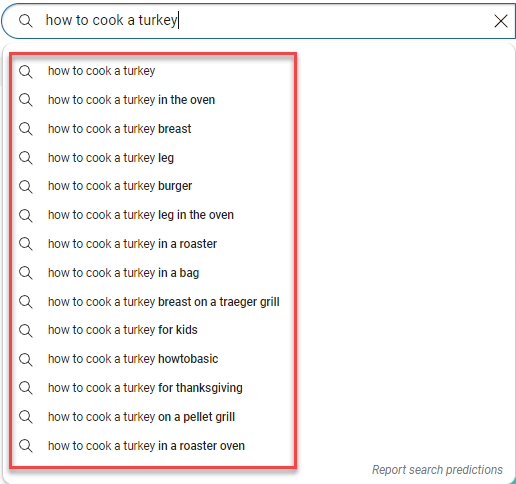
When you’re on YouTube and start a search, YouTube will offer up “search predictions.” These are keyword phrases that people on YouTube are actually searching for. 

If you’re on a tight budget, this is a great way to find some keywords as a starting point! (It’s also a good way to get video content ideas.)

YouTube search predictions for "how to cook a turkey"

But if you’re serious about ranking your videos on YouTube, you should use paid keyword research tools (like Semrush, SE Ranking, Moz or others.)

These types of tools will give you more robust information about the keywords so you can be more strategic about the keywords you’re targeting.

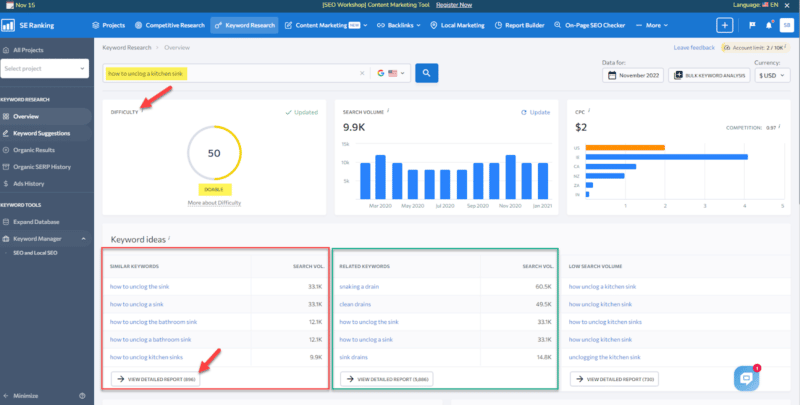
Let’s take a look at SE Ranking as an example. This is a traditional SEO software tool, but we can still glean some great insights on what types of keywords we should focus on for our YouTube videos.

For instance, when we enter “how to unclog a kitchen sink” as a keyword phrase, we will get keyword ideas and semantically related keyword phrases. 

average monthly search volume

When you click on View detailed report, you’ll see a ton of information about each of the keyword phrases.

Even though this info is related to Google search, you can still extrapolate it and use it for YouTube. 

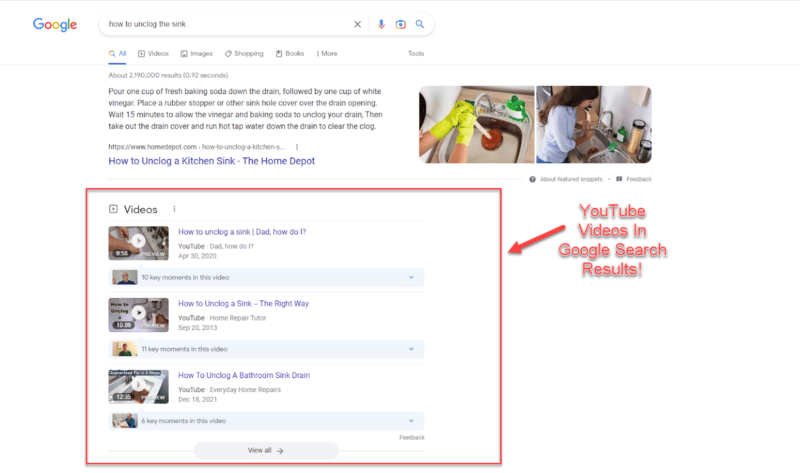
One important thing to look for in this view is videos that appear in the SERP features. 

SE Ranking - Videos in SERPs

You can see live results or copy to the clipboard and paste the SERP results in a new window to see what types of videos appear in Google search results. 

Youtube videos in serps

If videos show up on the first page of Google, then those are great keywords to target. (If you check out the videos on the SERPs, more than likely they are YouTube videos.)

These are perfect keywords for optimizing your YouTube videos because you know that Google is already showing videos in search results.

Not only can you rank your videos on YouTube, but you also have a chance of getting your videos to show up on Google search results.

Now all you have to do is make your video better and more informative than your competitors and optimize your YouTube video options more strategically to (hopefully) take over their spots in the Google SERPs.

Using traditional SEO tools can make your keyword research for YouTube life a lot easier.

Use YouTube SEO tools to find the right keywords for your video optimization

If you want to find the right keywords for YouTube videos, try out some tools specifically created for YouTube marketing.

Keyword Search

You can discover keywords using Keyword Search’s “AI algorithm,” developed by a top YouTube marketing expert.

The tool:

  • Bases all its data directly on YouTube search results from the user’s perspective.
  • Scrapes and analyzes YouTube data to help you find the best keywords to use when optimizing your videos on YouTube.

And because your top-ranking rivals often know something you don’t, you can even conduct “Competitor Research” on their keywords, rankings, YouTube channels and videos.

This lets you better develop your video marketing content strategy and plan which keywords you’ll target.

You can also use the tool’s “Collections” feature to keep track of all your keywords, videos and the competitors you’re tracking.

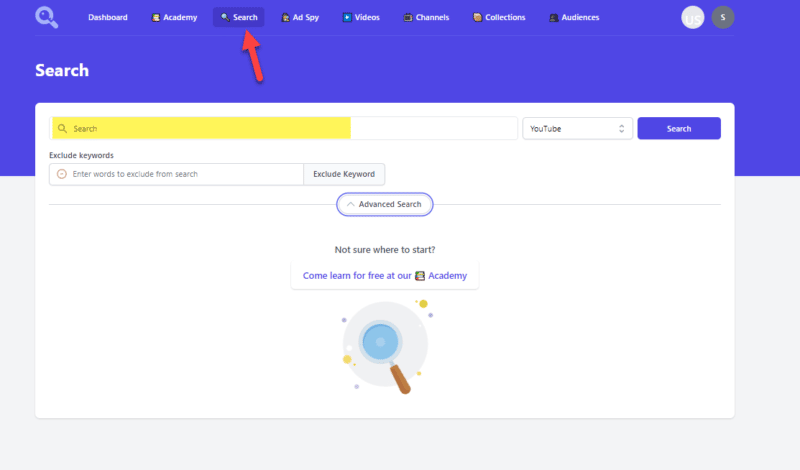
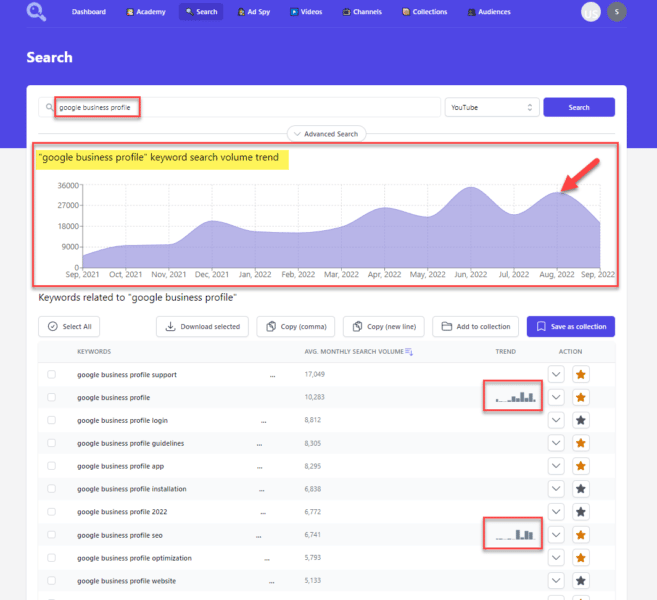
At its most basic level, using Keyword Search is as easy as entering a keyword phrase in the search field:

Keyword Search - Search Interface

You’ll then get a slew of keyword phrases to review and see the average monthly search volume on YouTube for each keyword.

Keyword search volume trends

As you’re analyzing the keyword results you get, if you see keywords with “trends,” click on the down arrow to see the trends in detail – the high and low points. 

As you’re analyzing the keyword results you get, if you see keywords with “trends,” click on the down arrow to see the trends in detail – the high and low points. 

Detailed trends

If you spot a hot and trending topic over the past month (or now), get behind your camera, do a video, and optimize for those trending keyword phrases.

Creating and optimizing a video for a trending topic will boost the chances of your video getting searched for and found on YouTube!

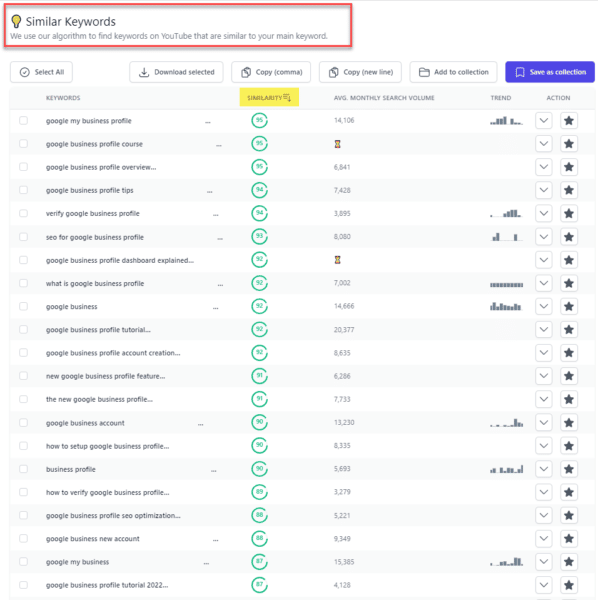
To get some semantic keywords to target, Keyword Search also uses its algorithm to give you similar keywords.

These are additional words to consider optimizing your videos for. You can see:

  • How similar the word is to your original search query.
  • The average search volume.
  • Trends, if any.
Similar Keywords

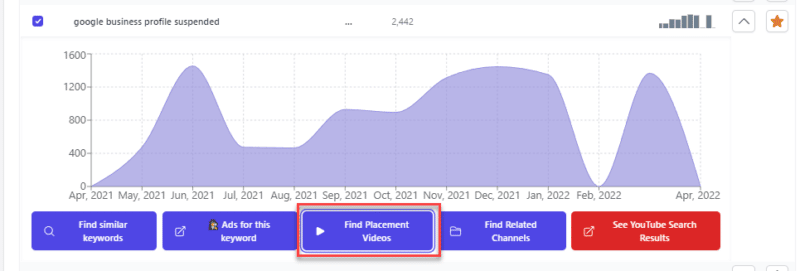
Another handy feature is the “Find Placement Videos” feature. When you click on this button under a keyword, a new window opens up showing the top-ranked videos for that keyword phrase.

Find Placement Video

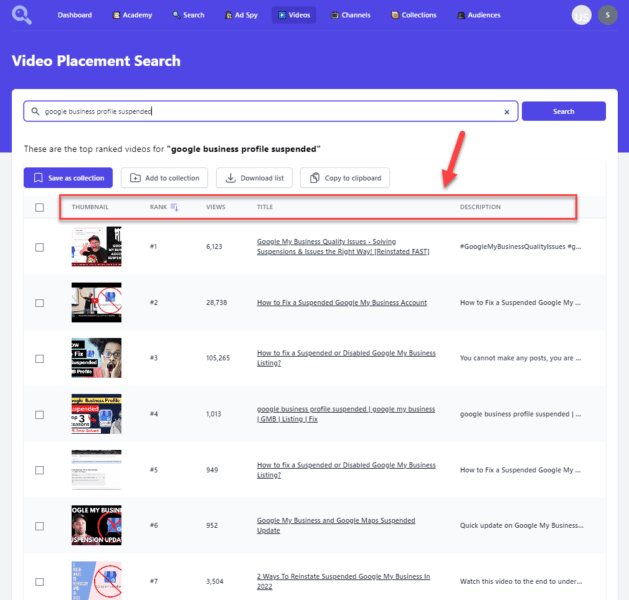
This information is invaluable because you can see:

  • The videos ranking for the keyword phrase.
  • The number of views each video received.
  • Their video titles and a partial description of the videos.

All this without having to go to YouTube.

video placement search

As an extra special bonus, clicking on the title link opens a pop-up where you can watch the video.

Keyword Search is one of my favorite YouTube keyword research tools by far. But there are other YouTube-specific software tools you should also check out.

vidIQ and TubeBuddy

Both used in the YouTube platform, vidIQ and TubeBuddy have a free version and several paid options. Each tool has pros and cons, so if you can afford it, I recommend you use them both.

TubeBuddy and vidIQ are great for finding the keywords – and related keywords – you should use to optimize your YouTube videos.

When looking at your high-ranking competitors’ videos, both tools show you keyword information that will help you determine what keywords you should target for your video.

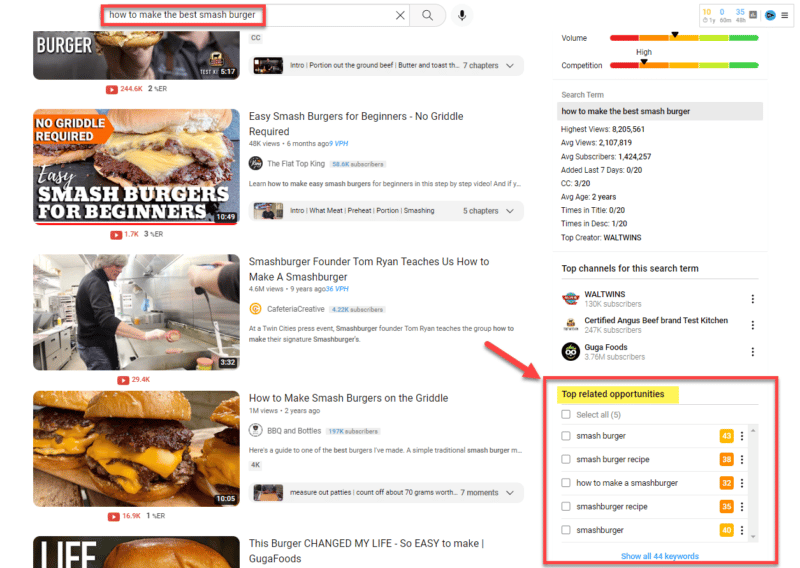
For example, in our “how to make the best smash burger” example, vidIQ shows us the “top related opportunities” keywords you should consider targeting.

vidiq top keyword opportunities

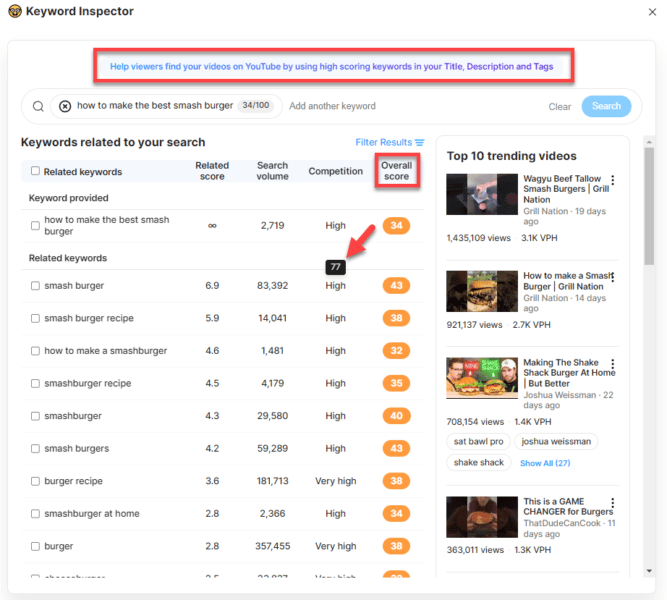
And if you click “Show all 44 keywords” you will get even more details about:

  • The keywords you might want to work into your title, description and tags.
  • Which keywords might be too competitive to target.

(As you can see, trying to rank for the keyword “smash burger” by itself is just too competitive at a High Competition score of 77.)

vidIQ "smash burger" keyword inspector details

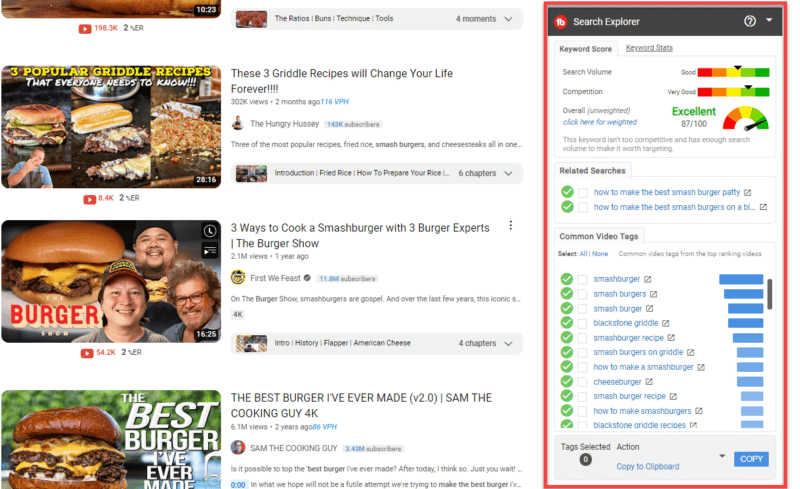
TubeBuddy also shows you related keyword search phrases and tags for your video keyword optimization strategy.

tubebuddy smashburger

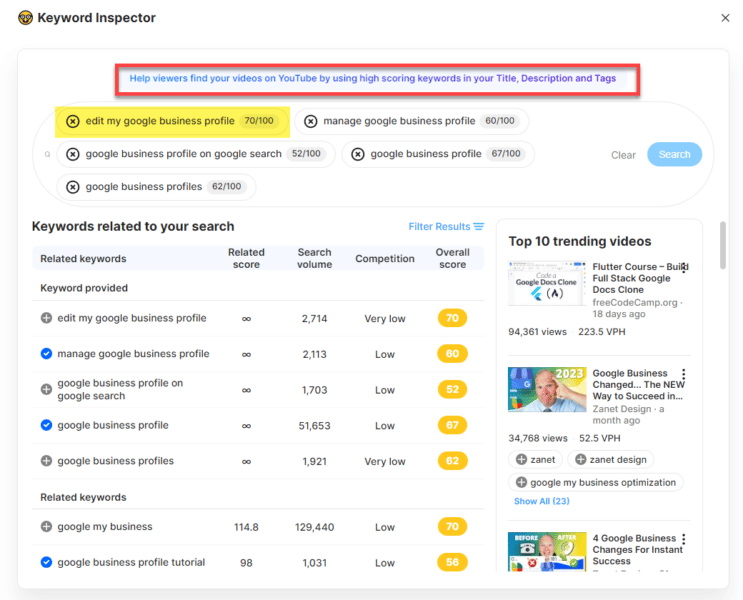
In vidIQ’s Keyword Inspector, you can:

  • Enter keyword phrases you want to evaluate and see related keywords, the score, search volume, competition, and the top ten trending videos.
  • Search up to five keywords at a time.

When determining which keywords to target, look for the high-scoring keywords. 

In the example below, “Edit My Google Business Profile” had the highest score of 70/100:

vidIQ GBP keyword

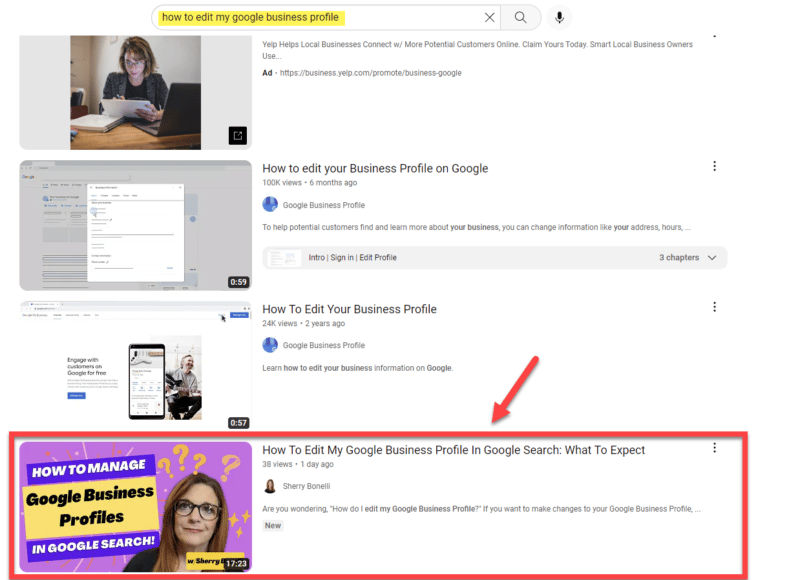
To test out this keyword strategy, I used that keyword phrase in the title of my recent Google Business Profile YouTube video:

GBP YouTube video title

Within three days, my Google Business Profile video ranked third for the keywords “how to edit my google business profile.” Boom!

YouTube video ranking

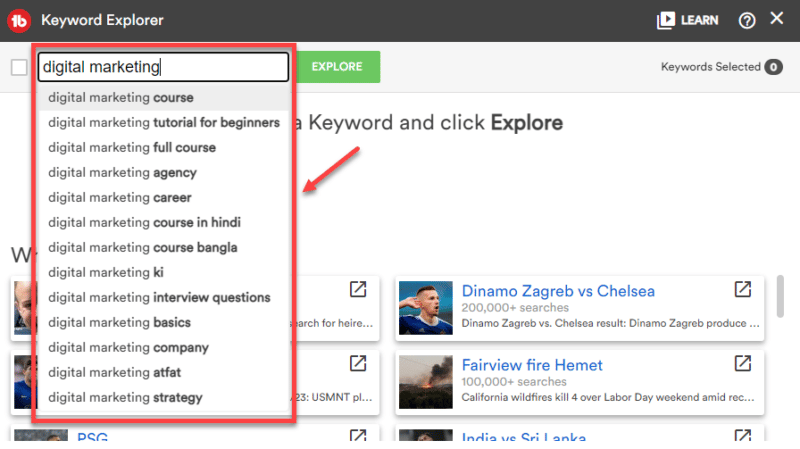
TubeBuddy also has a Keyword Explorer feature. When you start typing your keyword, TubeBuddy shows possible keywords you may be targeting.

Just continue entering your keyword phrase or select the one you’re interested in from the dropdown.

Keywords TubeBuddy

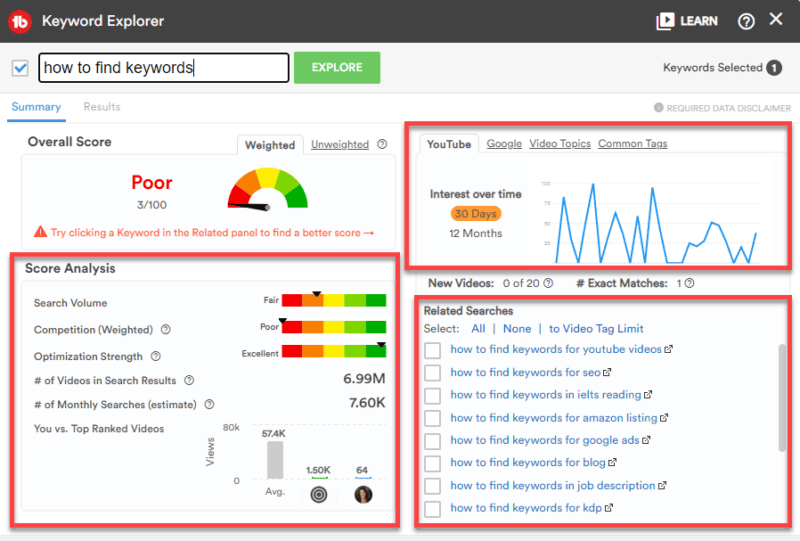
In TubeBuddy’s Summary page, ignore the overall score and focus more on the Score Analysis, Interest Over Time and Related Searches sections.

TubeBuddy video metrics

Let’s delve into TubeBuddy a little deeper. 

When you look at YouTube search results for “How to Find Keywords for YouTube Videos,” you can see that there’s only one exact match in the top search results – and that happens to be Brian Dean’s video.

make money online

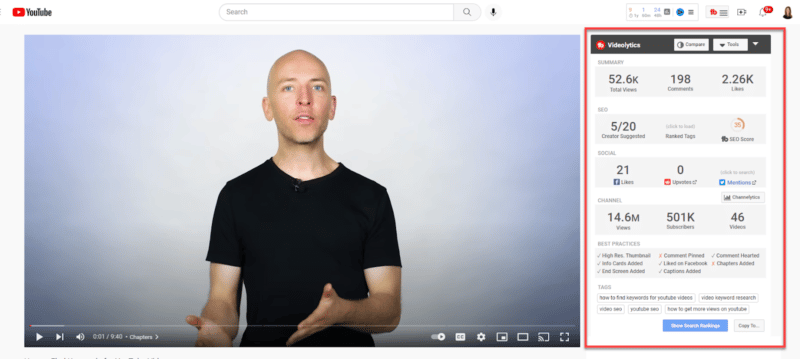
Clicking on Dean’s video, you can see TubeBuddy’s analysis of the video – which is quite extensive.

TubeBuddy analysis

From this, you can see what his video is doing from a YouTube optimization perspective and what he’s missing so you can try and improve yours.

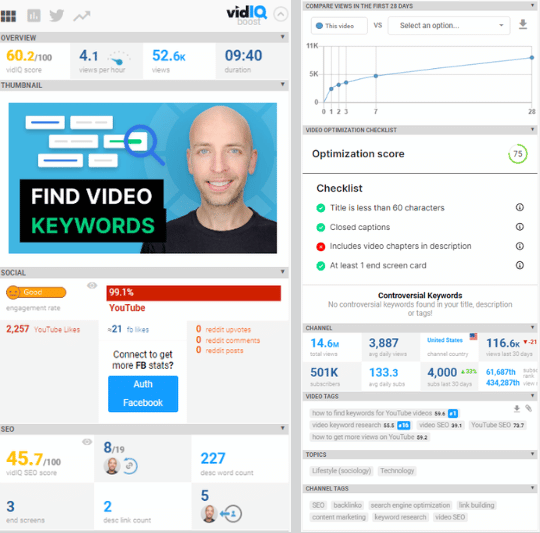
VidIQ also provides an extremely comprehensive analysis of the video.

vidIQ analysis

By using TubeBuddy or vidIQ (or both), you can:

  • Find awesome keywords.
  • Evaluate your competitors and their weaknesses.
  • Capitalize on those flaws to make your video optimization stronger. 

These tools go way beyond just keyword research, which will give your YouTube videos and channel a great advantage.

Where to put your keywords on YouTube for ultimate optimization

Once you find about 2-6 targeted keywords (and a few semantic keywords that complement those targeted keywords), it’s time to put those keywords to work in your video marketing.

Let’s talk about where you should strategically put your keyword phrases on YouTube.

Put keywords in your video’s title on YouTube

Your video’s YouTube title gives YouTube’s algorithm, users and search engines a “first impression” of your video and tells everyone what your video is about.

A well-optimized video title will make YouTube’s algorithm happy and attract more traffic, which can turn into more views.

When optimizing your title, include the most important keywords people are searching for as close to the front of your title as possible – this helps your video get ranked and suggested.

The keywords you most want to rank for should be included within the first 60 characters of your title. (Your title can be up to 100 characters, so the closer you put your keywords to the front of the title, the better.)

When writing your title, be as concise as possible. Five words or less is best. 

If possible, use words in your title that connects the video to other videos in the same category.

Also, having a title that is catchy, compelling, and accurately represents the contents of your video can also help attract searchers. (No bait and switch, please.) 

Strategically work keywords into your video’s description

With so many videos on the same topic, it’s often hard for your video to stand out.

Your video’s description is one way to make your video jump out among the crowd – and help your video rank.

Write a short – but detailed – description of what the video is about, what the watcher will learn and how your video is different or stands out from the other videos on the subject.

When it comes to keywords, putting the right keywords in your description will help your video get more views and visibility. 

Remember that partial descriptions can also appear in search results, so be sure to put your keywords as close to the beginning of the description as possible.

That means:

  • The main keywords you’re targeting should be within the first 200 characters of your description.
  • The most important keywords should be in the first 25 words of the description because partial descriptions can appear in search results.

(Your video description can have 5,000 characters total. But if it is too long, it probably won’t be read in its entirety anyway.)

Throughout your description, it’s key to include partial matches of your targeted keywords in the description, too.

So write a description that is an overview of your video writing naturally using related and similar keywords to your targeted keywords.

That means breaking the words up, using semantic – or similar – keywords and using them individually in addition to the main target keywords you’re aiming for.

YouTube (and Google) use your text descriptions to determine the content of your video.

So if you don’t include a description, the search engines (and viewers) won’t know what your video is about. This will negatively impact your rankings.

GBP video description

In the description, you can also link to other related content you have (i.e., website, blog, social media channels, etc.). Remember to include your full URL (including the https:// or http://).

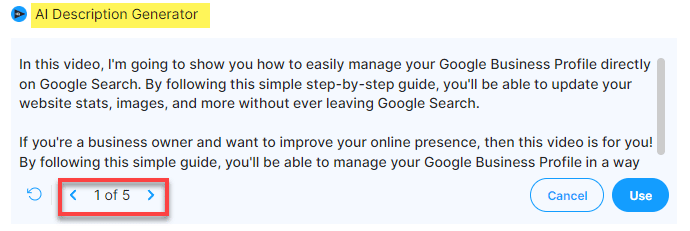
And if you’re at a loss for what to write, you can get a jumping-off point by using vidIQ’s AI Description Generator Feature.

vidiq ai description generator

Hashtag it!

Many people like to search with hashtags. So for those people, adding appropriate hashtags in your description helps them find your videos when searching for specific hashtags.

YouTube hashtags

Add a few appropriate hashtags to your description.

When you start typing in the hashtags, YouTube will show you the number of videos and channels that use each hashtag. That way, you can scope out your hashtag competition.

Hashtags in description

Ironically, no matter where you put hashtags in your description, the hashtags you entered show up directly under your video.

Hashtags-under-video

Keywords in tags: Do tags matter?

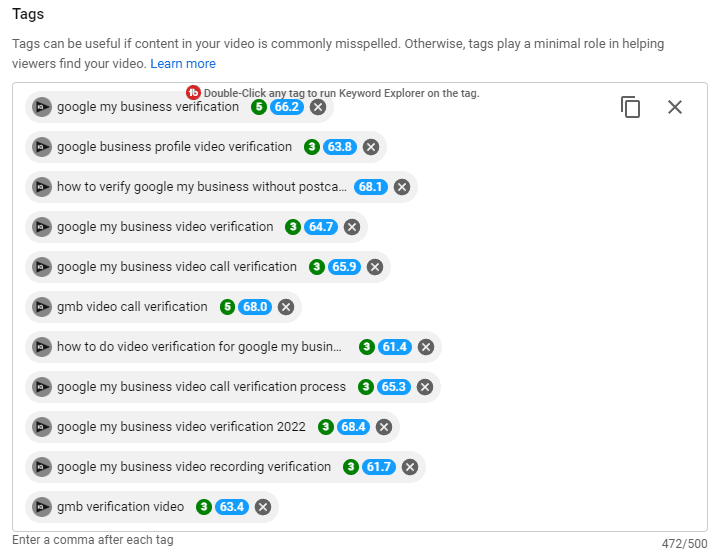
Tags can help categorize your video by keywords or phrases, but they’re primarily meant to help correct common spelling mistakes or synonyms (i.e., Google Business Profile vs. GBP or U-Haul vs. UHaul.)

Other than that, tags play a negligible role in helping people find your videos, according to YouTube. (Still, you want to include tags when optimizing your YouTube videos!)

YouTube allows you to include Tags to help categorize your video by keywords, but it limits the number of tags you can include. (There is a character limit of 500 characters.) 

When you’re using tags, you should include your most important exact target keyword (or keyword phrase) as the first tag. That lets YouTube know what keyword phrase is the most important one.

It’s also recommended that you include partial matches of your target keyword as tags.

You’ll also want to include multiword tags (i.e., long-tail keywords) that relate to your video’s topic.

You should also use single-word and broad-term tags that relate to your video’s broader topic. 

(Note: Do not use trademarks or copyrighted material unless you have explicit permission from the owner to use it.)

search predictions

YouTube is effective at semantically understanding your tags – so you don’t need to go overboard.

One great way to get tag ideas is to look at the top-ranking YouTube videos that directly compete with your video. However, YouTube hides the video tags, which makes it more difficult to “spy” on your competitors and see their keyword/tag secret sauce.

Luckily, vidIQ and TubeBuddy lets you see the tags competitors are using to get their videos to rank high.

Get your video keyword and optimization strategy in place

By having a YouTube keyword research and optimization strategy in place, you can increase the chances of your videos showing up in YouTube’s search results.

Play your cards right, and you might even reach the top of Google search results.

Video marketing will continue to grow. Mastering YouTube’s ranking algorithm is a great way to kick your efforts into high gear.

The post YouTube SEO: How to find the best traffic-generating keywords appeared first on Search Engine Land.

Original source: https://searchengineland.com/youtube-seo-find-traffic-generating-keywords-389947

Twitstorm timeline: The latest on Elon Musk’s Twitter 2.0

Ever since Elon Musk took over as CEO of Twitter, there have been a lot of changes to the platform.

Some people love it. Others are not so sure. Many marketers have even said their goodbyes to Twitter.

As far as brands are concerned, many have left the platform or temporarily paused ads due to increased hate speech, safety concerns, and Musk’s overall lax approach to content moderation, account suspensions, and other issues.

Here’s a rundown of all the changes that have happened so far. Whether you’re a fan or not, it’s worth keeping up with what’s happening with Twitter 2.0.

The latest in the Twitstorm:

What happened:

  • In January, Elon Musk started investing in Twitter, securing a 9.2% stake, making him the largest shareholder in the company.
  • Musk reached an acquisition deal with Twitter in April but raised concerns over spam accounts on the platform, claiming Twitter had not provided him with an accurate estimate of their number.
  • Also, in April, Twitter announced that Musk would join the company’s board of directors. Shortly after, Musk said he would not be joining the board after all.
  • By mid-April, Musk offers to buy Twitter at $54.20 per share, valuing the company at about $43 billion, according to a securities filing.
  • Twitter adopts a poison pill provision to prevent the Musk acquisition but then accepts Musk’s offer to acquire the company and values the deal at $44 billion.
  • In May, when Musk said the deal was on “temporary hold” over bot concerns. Musk posted a Reuters report about a public filing from Twitter earlier in May that said fake accounts made up less than 5% of users on the platform. Musk then says he wants “details supporting calculation that spam/fake accounts represent less than 5% of users.” Two hours later, Musk says he’s “still committed” to the deal.
  • Fast forward to July, Musk moves to terminate his acquisition of Twitter, pointing to the issue of fake accounts. Twitter sues Musk to force him to complete the deal.
  • By October, after a months-long effort to terminate the deal, Musk proposes to complete the deal at the original offer price of $54.20 a share at a total cost of roughly $44 billion.
  • At the end of October, Musk closed a deal to acquire Twitter on the final day before the trial would have moved forward. Additionally, many of Twitter’s top executives were fired, including CEO Parag Agrawal, chief financial officer Ned Segal, chief legal officer Vijaya Gadde and general counsel Sam Edgett, according to a source.
  • Musk said that he would forgo any significant content moderation or account reinstatement decisions until after forming a new committee devoted to the issues. “Twitter will be forming a content moderation council with widely diverse viewpoints,” Musk tweeted. “No major content decisions or account reinstatements will happen before that council convenes.”
  • In November, Twitter began massive layoffs, cutting its staff of 7,500 to nearly half.

The post Twitstorm timeline: The latest on Elon Musk’s Twitter 2.0 appeared first on Search Engine Land.

Original source: https://searchengineland.com/twitstorm-timeline-the-latest-on-elon-musks-twitter-2-0-389881