Google Search adds new spam policy: Policy circumvention

Google has added a new spam policy to its search spam policies today, the new spam policy is named “Policy circumvention.” In short, if you find ways to get around the current spam prevention measures, Google may take action on your content, site, or account.

The new policy. Google posted the new policy over here, it reads:

“If you engage in actions intended to bypass our spam or content policies for Google Search, undermine restrictions placed on content, a site, or an account, or otherwise continue to distribute content that has been removed or made ineligible from surfacing, we may take appropriate action which could include restricting or removing eligibility for some of our search features (for example, Top Stories, Discover). Circumvention includes but is not limited to creating or using multiple sites or other methods intended to distribute content or engage in a behavior that was previously prohibited.”

The penalty. Google said if you violate this new policy, Google may restrict or remove the content from showing up in search or for some search features.

What is a policy circumvention? In short, it sounds like any action you take to bypass the other Google Search spam or content policies. This includes creating new sites, using other sites or other methods to distribute that content, maybe on third-party sites or other avenues.

Why we care. Knowing Google’s spam and content policies is a prerequisite for performing SEO services and other marketing services on Google Search. This is a new policy but the fundamentals of logic behind the policy match most of the already published Google Search spam policies. In short, don’t try to manipulate Google Search’s ranking algorithms and if you do, you run the risk of having your site removed or downgraded in Google Search.

The post Google Search adds new spam policy: Policy circumvention appeared first on Search Engine Land.

Original source: https://searchengineland.com/google-search-adds-new-spam-policy-policy-circumvention-389759

Marketing in a recession: How to avoid 5 common mistakes

It’s hard not to be anxious about the macroeconomy right now. 

Unless you’re a brand marketer in a thoroughly recession-proof industry or an agency marketer with a portfolio of clients in recession-proof industries, you’re working against an undercurrent of stress and performance pressure.

These emotions may help some marketers achieve hyper-focus. But they’re also leading many to make hasty decisions that run counter to the short- and long-term health of their businesses. 

In this article, you’ll learn some common mistakes marketers make and more thoughtful alternatives that will position brands to survive and thrive over the long haul.

Mistake 1: Cutting instead of reducing

You’ve likely heard that marketing is a flywheel.

What that means, especially with major platform algorithms’ self-learning capabilities, is that cutting spend implies a hard reset that will have last ramifications well beyond the time it takes to turn campaigns back on.

What to do instead

Wherever possible, keep the lights on in campaigns you know are providing results. If you need to reduce spend: 

  • Understand that you’re in good company.
  • Take a deep breath and start by dialing back (but not cutting altogether) where you’ll see a less immediate impact. 

If you can’t clearly see opportunities within specific campaign segments, you may need more precise segmentation:

  • Top of funnel, middle of funnel or bottom of funnel at the campaign level.
  • By objective at the ad set level. 

This will help you assess where performance is relatively poor and eligible for reductions.

Mistake 2: Cutting without referencing account history

It’s an especially tough time for startups. Without a lot of benchmarking data, they’re unable to reference past account history for smarter budget reductions. 

There are fewer excuses for more established brands not to dig into the history of account performance (especially if the history goes back to other frenetic times, like the first six months of the COVID-19 pandemic), but I’ve seen it happen.

What to do instead

If you are a startup and don’t have a helpful archive of performance data, but you do have an agency running your account, lean heavily on them to pull insights from similar accounts they may have had in the past. (Make sure you’re involving your agency in any big decisions, of course.)

If you have a more established set of accounts, go back at least to your 2020 data to analyze: 

  • How you reallocated budget then.
  • What worked in the short and long terms.
  • What had lasting effects (good or bad). 

This will give you a good strategic starting point for product or service campaigns that remain relevant to your business.


Get the daily newsletter search marketers rely on.

<input type="hidden" name="utmMedium" value="” />
<input type="hidden" name="utmCampaign" value="” />
<input type="hidden" name="utmSource" value="” />
<input type="hidden" name="utmContent" value="” />
<input type="hidden" name="pageLink" value="” />
<input type="hidden" name="ipAddress" value="” />

Processing…Please wait.

function getCookie(cname) {
let name = cname + “=”;
let decodedCookie = decodeURIComponent(document.cookie);
let ca = decodedCookie.split(‘;’);
for(let i = 0; i <ca.length; i++) {
let c = ca[i];
while (c.charAt(0) == ' ') {
c = c.substring(1);
}
if (c.indexOf(name) == 0) {
return c.substring(name.length, c.length);
}
}
return "";
}
document.getElementById('munchkinCookieInline').value = getCookie('_mkto_trk');


Mistake 3: Cutting without referencing CRM data

I’ve seen this a lot over the years and not just in recessions: marketers who react to surface-level metrics without understanding actual business impact make poor budget decisions.

Examples: 

  • A B2B brand throws more budget at a source of cheap CPLs instead of understanding which source is driving the most qualified leads that evolve into opportunities.
  • An ecommerce brand reduces budget for their highest-CPA audience without realizing that the audience in question carries an average LTV 50% higher than other audiences.

In times where spend reductions are widespread, kneecapping your most valuable audiences, segments or campaigns may achieve your immediate budget goals, but it’ll crater your revenue over the long term.

What to do instead

If you haven’t synced your marketing data with your CRM data, it’s high time to get that nailed down. 

At the very least, make sure you have an understanding (on the B2B side) of which channels are driving your most qualified leads (which you can keep track of on a simple Excel sheet if you’re waiting on dev resources) so you can prioritize other areas for spend reductions.

Mistake 4: Cutting new campaigns prematurely

In today’s algorithm-heavy marketing world:

  • Campaigns need time and data to optimize. 
  • Tests need enough time to return statistically significant results. 

Early indicators are not the full picture and shouldn’t be all the information you need to make your decisions.

What to do instead

Rather than panicking and cutting, rotate in fresh creative and messaging while adjusting bidding types. Go through all the usual optimization options you normally would, and resist the urge to cut without understanding the true performance ceiling of your campaigns.

In B2B, where data density takes longer to build, set some higher-volume growth indicators that will return information more quickly. 

Even CTR can be a decent proxy metric to start with (as long as you react to high CTR/low conversion scenarios by optimizing the weak point in your funnel).

Mistake 5: Going blind to opportunity

While it may feel like a worst-case scenario for many marketers, the likelihood is that at least one of your competitors is in poorer shape – which means they may be leaving market share and/or lower costs on the table for you to grab. 

(If you’re working for a recession-proof brand and have a full budget on hand, this is relevant to you as well, since you may see lower CPMs and CPCs in your social channels once the election and holiday seasons have elapsed).

Yes, many of us are on the defensive for good reason. But spending all of your energy on preservation means you might miss out on opportunities to expand.

What to do instead

Make sure you’re paying attention to weekly cost trends so you can quickly identify (and jump on) any market softness. 

Keep close tabs on industry news, particularly concerning platforms you haven’t yet tested, that indicate any general downward cost trends making those platforms more viable. 

The other thing to watch for is emerging trends and market shifts that you can address in your campaigns. If your traditional ideal customer profile (ICP) is developing new pain points: 

  • Make sure your marketing addresses those.
  • Communicate the developments to your executive team so they can consider shifting any offers accordingly. 

Above all, do your best to approach your campaigns with an eye toward the long term, which will help keep you from spending all of your time and money on sheer survival tactics.

Great marketers emerge from recessions

You may notice that every one of these mistakes should be avoided at all times, not just during economic upheaval

There’s a reason for the adages about great marketers emerging from recessions

Whether the recession forces you into good new habits or you brought good habits that helped keep your company ahead of the curve, the foundations of great marketing persist. 

Keep them top of mind as you wade through the news cycles and tough internal meetings.

The post Marketing in a recession: How to avoid 5 common mistakes appeared first on Search Engine Land.

Original source: https://searchengineland.com/marketing-recession-common-mistakes-389542

Google’s formula for navigating economic uncertainty involves “doubling down”

Google’s formula for success requires a balance of doubling down on what’s working, and “placing calculated bets to unlock future growth.” The formula comes directly from Google’s best practices playbook.

advertising channels

1. Directly connect your marketing goals to real business outcomes

To maximize ROI, start with defining the value of different conversions based on what they’re really worth to your business. Setting the right goals helps you point Google Ads to place the right bids so you can get the most out of your campaign budgets.

Revisit your success metrics regularly to identify the most important conversions and drive the best performance possible.

2. Lay the measurement foundation that enables better performance

Google recommends three steps to unlock more accurate, privacy-centric measurements as third-party cookies and other identifiers are phased out:

  1. Measure impact while preserving user trust: Set up sitewide tagging with the Google tag, and supplement it with enhanced conversions to collect consented, user-provided data. Rely on conversion modeling to learn from your first-party data and fill in conversion gaps when observable data isn’t available.
  2. Understand what’s driving performance: Make better bidding decisions across channels by switching to data-driven attribution so you can assign conversion credit to multiple touchpoints that are the most incremental.
  3. Get more actionable insights: Make sure you upgrade to Google Analytics 4.

3. Capture existing demand now and generate new demand for the future

To help fully optimize your Search campaigns, combine broad match keywords with Smart Bidding and responsive search ads. This helps you unlock incremental sources of conversions and ROI. Then, go beyond Search using Performance Max campaigns to multiply conversions across Google’s full range of advertising channels and inventory.

4. Evaluate and expand what’s working

Watch your optimization score and recommendations to identify ways to improve performance, and automatically apply the recommendations that matter most to your bottom line. Finally, check the Insights page frequently to discover performance and consumer trends that are uniquely customized to your business. 

Dig deeper. You can read the entire playbook here.

Why we care. Though there are some good tips here, make sure you are making the best decisions possible for your own business. Don’t always auto-apply recommendations without reviewing them, and use broad match and smart bidding where necessary.

The post Google’s formula for navigating economic uncertainty involves “doubling down” appeared first on Search Engine Land.

Original source: https://searchengineland.com/googles-formula-for-navigating-economic-uncertainty-involves-doubling-down-389681

B2B Wholesalers – How to Find Them?

Home Business Magazine Online

As you probably know, wholesaling is all about selling products for resale. The products are generally available at lower prices than at retail. This is because they are purchased in large quantities, resulting in reduced costs for the buyer. Wholesalers are often manufacturers of goods, but not always. They can also mediate transactions between vendors and producers. How to find good suppliers? There are several ways to do it.

B2B Wholesalers – Who Are They?

Let’s start with the basics. Who are business-to-business wholesalers? Their jobs are to buy products from manufacturers and sell them to retailers. Thus, they perform important functions in the supply chain. What do they not do? They do not deal with sales to end consumers.They usually specialize in selected industries, such as clothing, electronics, furniture, or cosmetics. It is worth having them as partners to reap many benefits for your business.

So let’s make it clear. B2B wholesalers sell products bulk to other companies, so that they can sell them to the end customers. When buying from them, you can count on quantity discounts, which means lower transaction costs.

Link Between Manufacturers and Retailers

This may surprise you, but when buying from a B2B wholesaler, you can often get more favorable terms than if you buy directly from the manufacturer. We are not only talking about lower prices, but also better cooperation, which is often due to the B2B wholesalers’ experiences as well as their networks of profitable business relationships. Instead of selling to a large number of small customers, manufacturers often choose to sell huge quantities of their products to just a few large B2B wholesalers. This means bigger discounts and, as a result, better prices for end consumers.

Developing long-term relationships with established wholesalers can undoubtedly contribute to the success of your business and make it easier for you to source products. However, how do you make it happen?

Contact Them Online

Finding trustworthy B2B wholesalers may be easier than you think. Look online for B2B trading platforms that contain offers from numerous goods sellers. One of them is Merkandi. At Merkandi, plenty of unique bargains are available. They come from distributors, suppliers, and wholesalers from all over the world. You can easily get in touch with them, regardless of locations or languages. This is because Merkandi operates in multiple languages and ensures the security of all transactions.

The platform connects buyers and sellers from different countries. It works intuitively and is user-friendly. To take full advantage of it, it is necessary to create an account. This step will allow you to view the contact information of B2B wholesalers once you have selected the best deals for you. You will be able to discuss the terms of the deal directly with them. As you can see, using trading platforms is the fastest and most convenient way to find global B2B wholesalers and make a deal with them.

Wholesalers Market on the Internet – Sourcing Without Limits

You can find almost anything on the online wholesale market. However, in order to buy at heavily discounted prices, you should choose to buy goods, coming from clearance sales, customer returns, end of line stocks, excess stocks, etc. By buying them in large packages, you can save a lot, and at the same time enrich your offer with high-quality goods from various product categories. Such bargains are available on Merkandi and other platforms that you can easily find online.

Final Comments

The right choice of wholesalers and the quality of relationships with them can make the difference in the success of your company. Therefore, you should take a closer look at the wholesalers’ markets and find the best partners for your business. B2B trading platforms are safe spaces for successful transactions with global reach. All you have to do is create an account and gain access to numerous opportunities.

The post B2B Wholesalers – How to Find Them? appeared first on Home Business Magazine.

Original source: https://homebusinessmag.com/businesses/how-to-guides-businesses/b2b-wholesalers-how-to-find-them/

The Reason Behind Why Your Recruitment Strategy Needs a Revamp

Home Business Magazine Online

Generally, when you search up the definition of recruitment you usually read something along the lines of a process where you actively seek out candidates to hire them. This task requires businesses to find and hire candidates. However, with recent unfortunate developments regarding the workforce, are they taking things too far?

The way the recruitment and hiring process has changed is drastically different from what it used to be. What companies are doing now is searching for “passive candidates” that can fill in gaps when they are created and using phantom job opportunities to do so.

Thanks to this age of information, businesses have also found ways to sift and do background checks on applicants and potential candidates in ways that may even be ethically controversial. If they are doing so much with recruitment and hiring more than ever before, then why are employers unsatisfied?

The Root of the Problem

There is one big reason why employers have started complaining and it is only slightly related to the importance of onboarding. The real reason is that they are hiring externally rather than promoting internally, something that has come to be through a shift in history.

In the past, businesses would use HR experts to do the whole process. This included putting possible hires through tests and extensive interviews. It created an environment where they could fill vacancies in their workforce with individuals who were already working for the company, which meant a promotion.

This also means that the companies were training their employees to fill in the gaps at work, suggesting that those promoted were typically not as qualified as they should have been.

These promotions meant the company had to spend time and money on training. In contrast to the past, businesses now hire externally. The reason is that the candidates will already be qualified for the vacant position. Therefore, the company won’t need to spend on training.

This lack of scaling means that most job advertisements aren’t looking for fresh graduates but rather people with experience. It leads to low retention rates thanks to companies hiring from the competition and essentially trading employees.

Why is voluntary turnover so prominent you may ask? The answer is simple: Employees want to advance in their own careers, and the lack of internal promotions is hindering that.

Business Person
Photo by RODNAE Productions from Pexels

How to Increase Retention

Start keeping a tally

Start by monitoring your new hires. This is something companies have stopped doing which leads to them being in the dark on whether their positions are filled mostly internally or not and whether new hires are worth the expenses.

Being aware of the talents of employees means you as an employer become able to assess whether you can post new openings within the company or not, rather than simply promoting someone likely unqualified for the job. However, that isn’t usually the case.

New hires have been found to take longer to perform equally to an internal employee, even though they are paid more sooner. This is the underlying problem smaller-scale companies seem to be constantly committing presently.

Maintaining good hires will also depend on diversity, since there is large-scale discrimination against anyone who isn’t a white male in many industries. Diversity will allow your company to find actual talent in every crevice, rather than relying on empty prejudices and creating a toxic workplace environment.

Stop relying on technology in the hopes of fewer costs

Many companies primarily use software that tracks applications for keywords managers are searching for. This method has been shown as not being effective in finding adequate candidates since most if not all won’t hit the target keywords fully.

List your expectations clearly

When sifting through potential hires, the main things you look at are their skills and their experience. For fresh graduates, this would mean they lack experience, so how should you decide whether to hire them over candidates with experience?

You should only be mentioning non-negotiable skills on your job listings, so you can find candidates that fit the necessary expectations you have for the position in question. This will also give you a larger number of viable candidates.

Make sure your leadership is solid

As mentioned throughout the article, companies need to stop searching excessively, which leaves them another option: to start attracting. If you have leadership that is competent and in touch with their employees whilst also keeping the team running efficiently and striving for success, then you are able to attract proper candidates more easily.

Remove filled position listings

Many companies leave filled job listings up online in hopes of fishing for potential candidates for the future or for candidates they may want to add to the team. The implication of all these listings being kept up online is that it creates the illusion there are more jobs than there are in reality that is frustrating for job seekers.

Make notice of the difference in job seekers

There are two types of candidates: active and passive. Companies nowadays focus mostly on passive job seekers, ergo people who already have jobs and are likely to switch if they receive higher income.

This proves to be ineffective regarding cost and efficiency, since there are no studies backing up the fact they truly make the job switch as active job seekers would. Active candidates are actively seeking work due to ambitions within their careers and wanting to improve, making them better candidates to seek by companies.

Conclusion

The main takeaway is to become a company focused on revamping its recruitment strategy. It should make job opportunities as well as maintain a good environment for employees to grow and have ambitions hopefully within the company rather than leaving.

Adapting a work culture where promotions are available to those who are capable of filling in higher positions will desaturate the over-saturated domain that is recruitment and hiring. Moreover, it allows employees to experience growth. This will open new positions for capable candidates, both active and passive.

The post The Reason Behind Why Your Recruitment Strategy Needs a Revamp appeared first on Home Business Magazine.

Original source: https://homebusinessmag.com/management/employees/reason-behind-why-recruitment-strategy-needs-revamp/

5 best practices for tracking offline conversions in Google Ads

Risk-taking is part of any marketer’s job. No strategy is guaranteed to work.

I like to think of myself as a calculated risk-taker. Because I have TSA PreCheck and monitor my flight status from home, I arrive at the airport just an hour before my flight. I try new restaurants in town, but don’t get in the car until I’ve scoured review sites and scanned the menu. 

My approach to taking risks at work is similar. Testing the latest bidding strategies excites me, but my moves are deliberate to avoid disturbing performance.

Major changes to a Google Ads account send the algorithms into a learning phase and create volatility as it re-learns.

Like many marketers who want results yesterday, my patience can be short. But to keep clients happy, balancing future-forward strategies with the risk of upsetting KPIs is imperative.

By now, we know that offline conversion tracking (OCT) is a must-have in any account. 

When setting it up for the first time, swapping out web-based campaign optimization goals for CRM-based goals can be tricky. Here are five best practices to mitigate the risk. 

1. Add values to your conversions

Maximizing the potential of OCT requires assigning each action a value.

If you can’t use actual and dynamic values from your CRM, Google has a calculator that can help with estimations.

The values don’t have to be precise for the algorithms to benefit from this provided direction.

The assigned values tell machine learning how much each conversion is worth. Therefore, the system can bid accordingly with value-based bidding strategies. 

Even if you’re not ready for target return on ad spend (tROAS) or Maximize conversion value, setting these values from the get-go allows for an easy launch when you’re ready.

2. Optimize for all funnel stages

Once all stages of your marketing funnel feed into Google Ads with their respective values, begin optimizing campaigns for all funnel stages. 

This tactic will generate more conversion data for your campaigns and speed up the learning phase.

A risk-taker might change the optimization across the account all at once. Go ahead and rip the bandage off: 

  • If you can stomach performance fluctuations.
  • If the account is brand new.
  • Or if conversion volume is already dismal.

I prefer to set up an experiment for any major bidding changes to cut down the volatility in the account. 

Experiments should run for at least two weeks before determining a winner, but this can take longer if your budgets are small or the conversion lag is long. 

A lift in backend conversions should be measured as the key success metric of this experiment.


Get the daily newsletter search marketers rely on.

<input type="hidden" name="utmMedium" value="” />
<input type="hidden" name="utmCampaign" value="” />
<input type="hidden" name="utmSource" value="” />
<input type="hidden" name="utmContent" value="” />
<input type="hidden" name="pageLink" value="” />
<input type="hidden" name="ipAddress" value="” />

Processing…Please wait.

function getCookie(cname) {
let name = cname + “=”;
let decodedCookie = decodeURIComponent(document.cookie);
let ca = decodedCookie.split(‘;’);
for(let i = 0; i <ca.length; i++) {
let c = ca[i];
while (c.charAt(0) == ' ') {
c = c.substring(1);
}
if (c.indexOf(name) == 0) {
return c.substring(name.length, c.length);
}
}
return "";
}
document.getElementById('munchkinCookieInline').value = getCookie('_mkto_trk');


3. Optimize for the lowest conversion point possible

Once the full-funnel approach is successful, you can begin optimizing for one conversion event at a time. Treat each campaign uniquely and adjust the campaigns ready to move down the funnel. 

To ease performance fluctuations, set up an experiment that optimizes to the lowest point in the funnel possible, given Google’s need to have at least 15 conversions in the past 30 days.

Creating custom columns in the Google Ads interface allows you to sort and visualize your data easily. Analyze each campaign independently. 

In this example, the top two campaigns have enough MQL volume to optimize for MQLs exclusively rather than the entire funnel.

Optimize for the lowest conversion point possible

Consider that not all keywords are created equal. Top-of-funnel keywords will generate pipeline slower than your high-intent non-brand or brand terms. 

Individual campaigns’ optimization goals and bidding strategies should align with the funnel stage, and what’s working best.

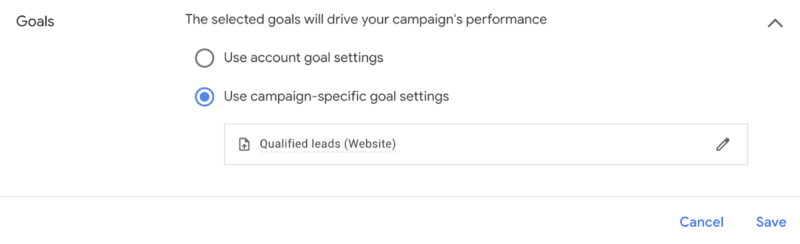
The UI doesn’t allow OCT goals to be set as single conversion events but rather as the conversion category as a whole. Therefore, custom goals should be created when optimizing toward a single point in the funnel. 

For example, if your OCT conversion is “sales,” you should create a custom goal for “sales.”

Google says “[…] using custom goals in campaigns might make your bid strategy work less efficiently,” but if your account is well-established with sufficient data, custom goals should work to your benefit.

Use campaign-specific goal settings

4. Continue to drive lower-funnel results

As time goes on and data collects, you can continue to push the limits and optimize for lower points in the funnel. 

Any bidding strategy can be tested alongside this tactic, but it’s critical that the experiment you create only changes one variable at a time. 

For example, the control campaign is on target cost-per-action (tCPA) and optimized for MQLs. The test campaign should remain on tCPA but optimize for the next stage in the funnel (Meeting Scheduled). After a winner is determined, test another variable by conducting a separate experiment.

Depending on the size of the account, nailing down the perfect combination of optimization goals and bidding strategies can take several months. Seeing little to no performance improvement after the initial two weeks can be worrisome, but running experiments for three full cycles is recommended to determine a winner. 

This means if it takes an average of two weeks for an MQL to become a “Meeting Scheduled,” you should run the experiment for at least six weeks before calling it quits. Check out Google’s path metrics report to view how many days each conversion takes. 

Google Ads Path metrics report

5. Test value-based bidding

Once you are comfortable optimizing for lower-funnel conversion points, step up your game with Maximize conversion value or tROAS bidding strategies. 

These smart bidding strategies adjust bids automatically to predict the value of a potential conversion when a user searches for keywords you’re bidding on. 

These bidding strategies can and should be tested in an experiment, especially if you’re terrified of breaking the algorithm.

Despite the risks associated with performance fluctuations, the benefits should outweigh the volatility. 

With some patience and breathing exercises, one of my clients saw a 74% improvement in cost per MQL since optimizing for backend conversions with OCT. 

When their brand campaign had more than 15 MQLs in a month, we switched to optimizing for MQLs only, resulting in a 4x boost in conversion value on that campaign.

So, get out there and take calculated risks. Be smart, bold and eager to set up experiments when you’re feeling apprehensive.

The post 5 best practices for tracking offline conversions in Google Ads appeared first on Search Engine Land.

Original source: https://searchengineland.com/google-ads-tracking-offline-conversions-best-practices-389544


YouTube just announced its 2023 class of #YouTubeBlack Voices Fund creators

Earlier this year, YouTube announced a new fund aimed at helping black creators find dedicated partner support, seed funding invested into the development of their channels, and the opportunity to participate in bespoke training, workshops and networking programs. This week they named the first 30 creators for the 2023 class.

Meet the class. One of the creators from the 2023 class is Jasmine Taylor from Baddies & Budgets. Taylor shares the highs and lows of becoming financially free as someone who grew up in poverty and wasn’t taught financial literacy.

Taylor teaches other women how to take control of their personal finances through tools and coaching. About being part of the new class or creators, Taylor said:

“This fund is going to open my business up to many opportunities. Exposure is everything and YouTube is amazing for enabling black creators to grow their platform. This experience will enable to further monetize and grow my business and brand. I’m so excited to get started. A major part of my brand is education and outreach, more channel exposure means that I can reach more women and in turn help more women to take control of their personal finances.” 

Other creators included in the new class are:

  • Studio Jibby. Jibby is a plant-based fitness trainer and lifestyle content creator who loves sharing health tips with her audience. 
  • Smokin’ & Grillin with AB (Aaron Brown). Aaron Brown took to YouTube to share humble cooking videos from his kitchen. The positive and inspirational nature of his videos helped him gain a huge following.
  • BeautifulBrwnBabyDol (Dr. Nina Ellis-Hervey). Dr. Nina’s YouTube channel is centered around providing real-world lifestyle solutions that reflect living a mentally, physically, spiritually, and emotionally balanced life through transparent talks, storytelling, and tutorials dedicated to beauty, fitness, and psychological wellness. 
  • iBelongOutdoors (Emmanuel Williams). Williams’ love of being outdoors on the water influenced him to create an energetic, adventurous YouTube channel that produces fun, inspirational content on the water.

Dig deeper. Meet the rest of the 2023 class on the YouTube Blog. Check out videos from the class here.

Why we care. The new fund will help black creators gain more visibility on the platform, increasing the subscribers to their channels, expanding their communities, and making more money through donations, and sponsorships.

If you’re interested in participating in an upcoming class, stay tuned for more information on how to apply. In the meantime, congrats to all of the creators in the class of 2023. If you want to support the creators, subscribe to their YouTube channels and show support by donating using the Super Thanks button.

The post YouTube just announced its 2023 class of #YouTubeBlack Voices Fund creators appeared first on Search Engine Land.

Original source: https://searchengineland.com/youtube-just-announced-its-2023-class-of-youtubeblack-voices-fund-creators-389673

Ten Organization Tips to Help You Make the Most of Your Space

Home Business Magazine Online

The cost of living is going up dramatically, which means any space you rent or own is a real investment and you can’t afford to go wasting so much as a square foot of it. There is certainly no room for clutter, mess, and dysfunctional spaces that become unusable because they are so untidy, which is why we’re going to give you a helping hand to reclaim every bit of your space with these 10 organization tips:

1. Go High

It is so important you go high and not across when it comes to storage. There is infinitely more space for storage going upwards than if you are trying to store everything on the floor. This is especially true with affordable self storage units where you need to use the whole space as well as possible so you’re getting the most out of your money.

2. Never Have Useless Furniture

Some furniture looks nice, but it creates a large use of space that could otherwise be used for both furniture and storage purposes. For example: You have a large bed that is just enough off the floor for a gap of space that looks nice. However, that bed and the space underneath could otherwise be used as both a bed and quite a substantial amount of storage if you switched it to a more efficient bed frame. There are also sofas that contain lots of storage inside, as well as other larger pieces of furniture designed to be more multi-functional.

3. Don’t Just Do *a* Declutter

One major trap some people fall into is thinking decluttering is a one time event that results in a more decluttered house. Whilst that is true, the fact is that there has to be regular decluttering in order for a house to remain clean and tidy. Additionally, the spaces that become cluttered need to be more functional so that they don’t continue to cause clutter. Marie Kondo is a master at nailing this style of house tidying. She not only deals with the house clutter but helps to transform spaces so that they are more functional, and therefore less likely to be “clutter traps.”

4. Go Seasonal with Storage

A helpful thing to do to make the most of storage space that you do have is to go seasonal with it. So, don’t just have everything you own stored at any one time. Instead, for example, why not have your winter clothes in affordable self storage in London, and your summer wardrobe at home. Then swap them over when the time is right. You can also use affordable London self storage for items like garden furniture to protect them in winter, and items like camping gear that you only need once or twice a year in the warmer seasons. You can find out about self storage prices here.

5. Don’t Get Hung Up on Hidden Storage

Hidden storage is fantastic, but all too often we can become a little obsessed with trying to hide everything, rather than embracing open storage, which can look really cool. For example, open wardrobes can be really great at giving a room a more open and modern look, as can rolling towels and storing them on an open shelf.

6. Be Mindful of Items You Use for Storage

It can be all too easy to buy lots of organization systems and by-accident clutter up your space with those items. Too many tubs, shelves, baskets take up space and actively work against the very reason you’ve purchased the item. The best thing to do is declutter, tidy, and organize. Then assess what organization tools/ furniture you need, as it will be more apparent at that stage and you won’t just be using new furniture or accessories for the sake of it.

7. Do It Now

One of the most useful tips you can ever have when it comes to organization in any space, is to do it now. If you’re in the space and you know you have five minutes to get the job done, don’t hesitate. Procrastination is the biggest preventer of organization and decluttering tasks getting done. Therefore, if you always stick with the commitment to just “doing it now,” you will find that you do little and often, rather than have to commit a whole weekend to a job that’s built up over time.

8. Never Be Afraid to Rework a Room

Never be afraid to rework a room so that it works better in regards to functionality and organization. We often end up working with the furniture as we have it, and forget that we can totally rearrange things if we need to. Don’t be afraid to get creative so you’re better able to enjoy the space.

9. Label Everything

Labelling is not just for moving house and placing your boxes right in the new home, or in affordable self storage. Labelling is for literally everywhere, and it is so helpful with organization. Use chalkboards, sticky labels, whiteboards, and stuck on paper labels — whatever looks good and helps you easily identify your things.

10. Change Your Spending Habits

When it comes to staying organized, try to think more minimalist in your approach. Often, organization has a lot to do with what you bring into your house, and how you use your house, rather than what you do with unwanted or unneeded items. In such a consumerist society we are all buying, buying, buying, without thinking about the impact that has on our bank balance, our lives, and on the planet. too.

The less you buy, the less there is to organize. This leads to a much simpler, easier life at home — not dictated by adding unnecessary “things” to your life all the time.

Final Thoughts

Now you are ready to organize and tidy any space, whilst also improving the quality of your house, local self storage, garage, shed, and more by adjusting your tidying and spending habits. With the right approach, you can organize any space, any time, for exceptional results.

The post Ten Organization Tips to Help You Make the Most of Your Space appeared first on Home Business Magazine.

Original source: https://homebusinessmag.com/lifestyles/home-improvement/ten-organization-tips-help-make-most-space/

13 Top Qualities to Look for When Choosing a Cleaning Service for Your Office

Home Business Magazine Online

By using an office cleaning service, you can keep your workplace tidy, clean, and hygienic. This will enhance the working environment’s health and boost staff productivity. However, not every cleaning service can give you that positive after-effect.

You must pick the right provider if you want to get the most from your investment when hiring an office cleaning service. Here are some of the most important qualities to look for when choosing a cleaning service for your office.

Experience Cleaning in a Commercial Setting

There are many cleaning service providers out there. Be sure to choose the right one, which has a specialty in cleaning office areas. Usually providers each have their own specialty or niche. Some might be exceptionally skilled in cleaning residential properties. However, that does not imply that they have the knowledge, experience, or tools to give the same results when cleaning business settings.

Flexibility in Scheduling

The office cleaning service must accommodate the timetable which your company has. They must not interfere with your business processes or obstruct customers. So, before hiring you need to make sure that they have flexibility in scheduling. You need a team that can arrive at the time you designate, not the other way around.

Consistency

To maintain a spotless office, it will likely require a thorough cleaning at least once a week. Ensure that the cleaning team you employ will consistently deliver high-quality services.

Affordable

When acquiring any kind of service for your company, financial considerations are crucial. Pick a business that is within your company’s budget and that will deliver high-quality work. You do not want your expenditure to get out of hand.

Extensive Services

Perhaps you will want to have your office floor polished, windows washed, or even thoroughly disinfected. Make a list of the services you may require in the future before you employ a company. Check to see if they offer them.

Experience in Your Industry

For certain businesses, a more specific kind of cleaning might be necessary. For example, if your company is in the medical industry, you might want to hire a provider who has the required specialized tools or equipment.

Proper Communication Standards

Pick a cleaning service that is easy to contact and makes you feel at ease when communicating with them. This will help when exchanging queries or concerns. It will make it easier for you to establish a great working relationship.

Safety Training for Their Employees

Every sector needs to value safety above all. Make sure the cleaning provider you employ has trained their employees well regarding safety.

High Employee Standards

Inquire about the company’s hiring procedures. Do they work with in-house staff or outside contractors? Do they carry out thorough background checks? Their cleaning teams will frequently be in your building. Therefore, they must be dependable and trustworthy when handling your assets and confidential information.

Insurance and Licenses

The cleaning service provider you select must have a license to operate in your state or city. On top of that, they also need to have insurance to cover any potential problems that might occur while cleaning your office. Though they may be the utmost professionals, unfortunate things can happen out of the blue.

Access to High-Quality Supplies

The materials and tools can have a significant impact on the quality of work. Make sure they use top products. Ask about the tools they use and how frequently they are replaced.

Green Cleaning Alternatives

Select a business that makes use of eco-friendly cleaning supplies. This lessens the presence of potentially hazardous chemicals in your office, and also helps to reduce the total carbon footprint of your business.

Positive Customer Reviews

Last but not least, this is the most important factor to look for. Find a cleaning service company that has lots of positive customer reviews. You can read the customer testimonials to get a sense of how other clients felt about their experience after employing the cleaning service.

If you are currently on the lookout for a professional and trusted cleaning service provider, take the time to find a suitable company and make inquiries regarding their service.

The post 13 Top Qualities to Look for When Choosing a Cleaning Service for Your Office appeared first on Home Business Magazine.

Original source: https://homebusinessmag.com/management/operations/13-top-qualities-look-choosing-cleaning-service-office/

Budget Restaurant Furniture

Home Business Magazine Online

Every new restaurant or established restaurant that is refurnishing its space needs to work according to a budget. Ask yourself what furniture you need in the restaurant, and then ask what is the best quality furniture you could get with the budget you have. Careful planning is essential if you want to fill your restaurant with good restaurant chairs and tables but still not find yourself spending money you don’t have. There is a wide variety of tables and chairs across many price points. Remember when we talk about “cheap” chairs we’re talking about the cost, not the quality.

Must-Have Restaurant Furniture

There is certain furniture that a restaurant cannot operate without. The minimum furniture for a restaurant is tables and seating. Seating could be chairs, stools, benches, booths, or banquettes. Tables could be communal, individual, or countertops.

Budget Restaurant Chairs

Choosing your restaurant chairs can be a challenge. You want them to be practical, attractive, comfortable, and fit into your budget. Here are a few examples of low-cost quality restaurant chairs.

  • Metal: The double-braced metal folding chair can be customized to fit your restaurant’s aesthetic. It comes in black, beige, gray, and red, and costs less than $30. These chairs are great for casual restaurants and when you need chairs that can be folded away.
  • Wood: The wood folding chair with a padded seat has roughly the same design as the double-braced metal folding chair except it is made from wood, and has a padded seat. It can be customized to suit the rest of the furniture in your restaurant, and the wood can be stained mahogany, natural, walnut, or white. These folding chairs are affordable at $44 apiece.
  • Chiavari: The lowest-priced Chiavari chair is a metal ballroom chair with a padded seat. The seat comes in a wide range of colored vinyl or fabric. This chair costs under $80.
  • Stack Chairs: Commercial stack chairs with a 1.5” cushion cost less than $55 and are extremely comfortable as well as practical. The vinyl seat covering is available in about six colors.
  • Industrial-Style Chairs: If you’re looking for an industrial-style chair then the metal ladder back chair with three slates is your most economical option at under $100.
  • Bolt-Down Chairs: This is not the cheapest option for those on a budget. Bolt-down chairs tend to be more pricey than regular chairs. The most budget-friendly bolt-down chair for restaurants is the X-back bolt-down swivel metal chair at under $155.
  • Arm Chairs: Restaurant armchairs are not as expensive as you may think. You can get the window back metal chair with arms for under $100. The metal frame comes in a range of colors. And the seat can be wood, padded vinyl, or padded fabric.
  • Patio Chairs: The most economical patio chairs for outdoor seating are the rattan patio chairs made from aluminum. Not only are they durable, and attractive but they cost less than $60 each.

Budget Restaurant Tables

Your restaurant tables must match your chairs, and be the appropriate height. Generally, you can choose your table tops and table bases separately. Here are some of the most budget-friendly tabletops for restaurants.

  • Wood Table Tops: Get stunning teak wood table tops and choose the size and shape you want. You can have all your tables in the same material but with different shapes and sizes. These table tops cost $100-$120 depending on the shape and size.
  • Laminated Table Tops: Laminated table tops are the easiest to clean, and will probably last you longer than other types of tables. Consider getting reversible table tops with a mahogany finish on one side and a black finish on the other for under $50 (24”x24”). For under $100 you can get the larger size (36”x36”).
  • Resin Table Tops: Another durable tough tabletop is the resin table. For under $55 you can get a resin table top that resembles wood grain.

Budget Restaurant Furniture Doesn’t Mean Bad Quality

Even if you are on a tight budget it is vital that you furnish your establishment with the best quality tables and chairs that you can afford. How do you get good quality on a budget? You look for a reliable supplier of commercial furniture. You also look for sales and discounts. Perhaps choose a mix of seating options including more expensive chairs and less expensive booths, or counter stools. You could also buy the minimum amount of furniture necessary, and at a later date, when your budget has grown, you can add to your restaurant furniture. Buying low-quality restaurant chairs and tables is cheap in the short run but expensive in the long run when they have to be replaced frequently.

The post Budget Restaurant Furniture appeared first on Home Business Magazine.

Original source: https://homebusinessmag.com/businesses/equipment/budget-restaurant-furniture/