A comfortable and functional home is every homeowner’s dream. However, achieving this doesn’t just happen by chance; it requires careful planning, creativity, and investment in essential household appliances. These appliances not only make your home more comfortable and convenient, but they also help you save time and energy.
From kitchen appliances to cleaning tools, there are plenty of appliances that every household needs to make daily tasks easier and more efficient. Whether you’re moving into a new home or upgrading your existing appliances, it’s essential to have a good understanding of the kinds of the best household appliance that you should prioritize.
Refrigerator: A refrigerator is one of the most important appliances in any home. It keeps your food fresh and prevents spoilage. When choosing a refrigerator, consider the size, energy efficiency, and features like ice makers and water dispensers. Look for a model with adjustable shelves and drawers that can accommodate a variety of food items.
Oven and Stove: Another essential appliance for any home is an oven and stove. Whether you’re baking, roasting, or cooking on the stove, this appliance is a must-have. Look for a model with multiple burners and oven racks, and consider features like convection cooking or a self-cleaning oven.
Microwave: While not essential for cooking, a microwave can be incredibly convenient for reheating leftovers or cooking frozen meals. Look for a model with multiple power settings and defrost options.
Dishwasher: Hand-washing dishes can be time-consuming and tiring. A dishwasher can save you time and effort while keeping your dishes clean. When choosing a dishwasher, look for a model with adjustable racks and multiple wash settings.
Washing Machine and Dryer: A washing machine and dryer are essential for keeping your clothes clean and fresh. When choosing a washing machine, consider the size and capacity, as well as features like energy efficiency and wash settings. Similarly, when choosing a dryer, look for a model with multiple heat settings and drying options.
Photo by Lisa Fotios from Pexels
Air Conditioner: An air conditioner is a must-have appliance for hot and humid climates. It can help keep your home cool and comfortable during the summer months. When choosing an air conditioner, consider the size of your home and the type of unit that will work best for your needs.
Heater: A heater is an essential appliance for cold climates. It can keep your home warm and cozy during the winter months. When choosing a heater, consider the size of your home and the type of unit that will work best for your needs.
Vacuum Cleaner: A vacuum cleaner is an essential appliance for keeping your home clean and free of dust and debris. Look for a model with a powerful motor and multiple attachments for cleaning carpets, upholstery, and hard floors.
Toaster: A toaster is a must-have appliance for breakfast lovers. It can quickly and easily toast bread, bagels, and other breakfast items. Look for a model with multiple heat settings and slots that can accommodate different sizes of bread and bagels.
Coffee Maker: A coffee maker is a must-have appliance for coffee lovers. It can brew a fresh cup of coffee in just a few minutes, making it the perfect way to start your day. Look for a model with multiple brewing options and a programmable timer.
In 2018, Google announced it had enabled mobile-first indexing for more websites.
This was the first time Google had confirmed it was moving a large number of sites to this mobile-first indexing process. Google told us in October 2017 that a limited number of sites had been moved over.
Websites that were migrated in this batch were following mobile-first indexing best practices and were notified of the change via a Google Search Console message.
2019: Google was retiring the info command because it “was relatively underused” and said the new URL inspection tool gave users much of that data now anyway.
2014: Video Campaigns report in Google Analytics gave advertisers more insights into the performance of their YouTube TrueView ads that are managed through AdWords for Video campaigns.
2009: The Google Webmaster Tools Access Provider Program was renamed Google Services for Websites and expanded to include AdSense, Custom Search and Site Search.
2007: Yahoo created a “starter” tool that was extremely simple to use (template driven) and offered enough design choices to make it viable and interesting.
2007: Travelocity clarified that 20% of its bookings came from non-branded terms. When Travelocity bought a branded term, 4% of those got an “assist” or a click that converted after someone made an earlier visit via a non-branded term.
2007: ZipLocal was a consolidated “Web 2.0” local search destination growing out of a number of earlier local search sites including Zip411.net and redToronto.com.
2007: UK yellow pages publisher and local search purveyor, Yell.com announced that it launched PPC ads on its site as well as targeted banner inventory.
Past contributions from Search Engine Land’s Subject Matter Experts (SMEs)
These columns are a snapshot in time and have not been updated since publishing, unless noted. Opinions expressed in these articles are those of the author and not necessarily Search Engine Land.
The 2023 local search ranking factors survey is now out, it is a survey of what local SEO experts rank the most important ranking factors are for both ranking in the Google local pack and also in the Google organic local results.
More survey details. This survey was conducted by Whitespark and surveyed 44 different local SEO experts. It asked these local SEO experts to rank 149 potential local search ranking factors in order of importance across both the local pack and organic rankings.
Local pack factors. The local pack findings showed that these were ranked the most important ranking factors for Google’s local pack:
Primary Google Business Profile category
Keywords in your Google Business Profile title/name (which may be against the Google guidelines)
Proximity of address to the point of search
Physical address in the city of search
Removal of spam listings through spam preventative mechasims
High numerical Google ratings
Additional Google Business Profile categories
Verification in Google Business Profiles
and more
Local organic factors. The local organic ranking factors showed these these were ranked the most important ranking factors for Google’s local pack:
Dedicated page for each service
Internal linking across website
Quality and authority of inbound links to the domain name
Geographic keyword relevance of domain content
Keywords in Google Business Profile landing page title
Quantity of inbound links to domain from locally relevant domains
Topical keyword relevance across entire website
Volume of quality content on service page
and more
Disclaimer. Search ranking factor studies can and have been somewhat controversial over the years. This study asked local SEOs to rate what they think are the most important factors for ranking well in Google’s local results. So keep that all in mind and make sure to read the study in full before just accepting these results as is.
Why we care. While there may be a lot of debate between SEOs and local SEOs as to what are the most important ranking factors, going through a survey like this may help you think about areas that you may not have thought about prior. So give it a read and hope you come up with some new ideas to implement for your clients.
Track your baby’s sleep trends. The Dream Sock is worn for every nap and bedtime and uses trusted technology to track your baby’s sleep, including wakings, heart rate, sleep quality, and total hours slept.
Receive a personalized sleep program. From 4-12 months old, access Owlet’s award-winning sleep program. Take an assessment, choose from 3 proven methods, and receive an adaptable sleep schedule tailored to your baby’s needs. See better sleep in as few as 7 days.
Review how long & how well Baby slept. See a breakdown of each of your baby’s sleep sessions and spot patterns that can help you make changes to your baby’s schedule as they grow
Connects to Devices on 2.4 GHz - For setup, both your Owlet device and phone or tablet need to be connected to 2.4 GHz. Perform set up within 10 feet of your router. After setup, you may move your phone or tablet back to 5 GHz.
Use sleep data & expert tips for better sleep. View your baby’s sleep data and helpful sleep tips from Owlet sleep experts to support your baby as they learn to embrace sleep and develop life-long healthy sleep habits.
Owlet Dream Duo Smart Baby Monitor - Video Baby Monitor with HD Camera & Dream Sock:…
In a recent survey, Pew Research Center found that “81% of the public say that the potential risks they face because of data collection by companies outweigh the benefits.” And “79% of consumers are concerned about how companies use the data collected.”
It’s clear – businesses need to prioritize customer trust and data privacy.
The e-book, In Data We Trust, shows you how customer data platforms (CDP) help obtain customer trust through privacy-driven personalization.
Check out the e-book to discover how a CDP can benefit your brand and keep reading to discover the five key ways a CDP establishes trust.
5 ways a CDP establishes trust in data with customers
1. Reduce risk from siloed data
Data silos result in costly processes and increased risk in multiple areas, such as inaccurate customer insights, including privacy preferences. With a CDP, first-party data is collected, meaning it’s consented and directly from the source.
2. Propagate privacy preferences
If your consent data is not real-time, you could breach privacy regulations while consent preferences are waiting to be updated. For example, if someone requests their data to be deleted and it takes your organization longer than is legally mandated to fulfill that request, your brand can face significant penalties for non-compliance. A CDP propagates privacy preferences throughout the entire customer journey across all channels and maintains them through the lens of the customer.
3. Enable operational efficiency and business agility
To be a privacy-driven organization, businesses must break down communication and data silos to understand what data is being processed and why. Some CDPs enforce a common nomenclature for data, allowing business and IT units to speak one common language. This shared language prevents departments from falling behind whenever privacy requirements change or new technology investments call for new integrations.
4. Give customers transparency and control over their data
Customers are empowered by global privacy regulations to manage when their data is collected, stored, and utilized. A CDP becomes a trusted repository of customer data and the governed supply chain that connects customer devices to the platforms that deliver value. As a trusted steward of their data, your customers will have access to the most accurate set of their personal data when they request it.
5. The ultimate customer experience
A CDP helps brands better understand customer behavior and preferences through a single customer view. Customers want to be known and understood regardless of where and how they’re engaging with your brand. That said, customer data can reside in different systems with different privacy settings. CDPs enable you to collect trusted customer data from all touchpoints to produce a 360 view of your customers, enabling real-time engagement on any channel based on customer preferences. And this level of personalization can be done at scale through a vendor-neutral, real-time CDP like Tealium, which you can learn more about here.
However, the fact that Google was granted this patent didn’t necessarily mean it was being used by Google at the time, or that it hadn’t been modified since the application was filed.
In short, it was about looking at inbound links and how many search queries were made about a particular page/resource, and it modified the “initial scores” for the pages/resources being ranked.
Slawski explained the patent had many parts that worked together:
Determining, for many groups of resources, a count of independent incoming links to help in the group
Deciding, for each of the plurality of groups of resources, a count of reference queries
Choosing, for each of the plurality of groups of resources, a respective group-specific modification factor, wherein the group-specific modification factor for each group get based on the count of independent links and the count of reference queries for the group
Associating, with each of the plurality of groups of resources, the respective group-specific modification factor for the group, wherein the respective group-specific modification for the group modifies initial scores generated for help in the group in response to received search queries
2021: Between March 10 and 23 there was a data issue with the crawl stats report, no Google Search performance issues were associated with this data bug.
2021: Google came up with new structured data and Search Console reporting to help educational websites understand which pages had these content types.
2019: Google released its annual webspam report last week to highlight advances against content that seeks to manipulate ranking algorithms and harm users.
2016: The latest images showing what people eat at the search engine companies, how they play, who they meet, where they speak, what toys they have and more.
2014: BrandVerity added a process to its paid search ad monitoring system to give clients direct feedback from Google and the Yahoo Bing Network on trademark violation complaints.
2013: After over a year of the blocked sites feature not working (and two months after Google promised it would return) Google officially declared they were discontinuing the feature.
2011: “To make our schedule to ship the tablet, we made some design tradeoffs,” said Andy Rubin, vice-president for engineering at Google and head of its Android group.
2011: Facebook was testing new ad targeting options that displayed creative beside content that was contextually relevant, similarly to Google’s AdSense.
2011: He spent a fair amount of time talking about the “misconception” that advertisers can access your personal information, but rather, that Facebook does the targeting based on advertiser selection.
2011: The latest images showing what people eat at the search engine companies, how they play, who they meet, where they speak, what toys they have, and more.
2008: Google did not win any of the 700MHz bandwidth, although it secured the right of open access for third-party devices and software on the C Block.
2008: Google, Yahoo, and News Corp.’s MySpace joined forces to announce that OpenSocial, the social networking platform alternative to Facebook’s platform, was going to become a non-profit foundation.
Past contributions from Search Engine Land’s Subject Matter Experts (SMEs)
These columns are a snapshot in time and have not been updated since publishing, unless noted. Opinions expressed in these articles are those of the author and not necessarily Search Engine Land.
In the world of business, logistics plays a crucial role in ensuring the smooth and efficient movement of goods and services. Inbound logistics, in particular, refers to the process of receiving, storing, and distributing raw materials and goods from suppliers to the manufacturing or production facility.
This involves a complex web of transportation, warehousing, and inventory management systems that must be carefully coordinated to optimize the flow of materials and reduce costs. For those seeking further insight into inbound logistics, you can read through this link, https://www.dhl.com/discover/en-my/e-commerce/logistics. With the rise of e-commerce and globalization, inbound logistics has become more complex, and companies need to adopt innovative strategies to remain competitive.
Cost Reduction
One of the primary roles of inbound logistics is to reduce costs associated with transportation, warehousing, and inventory management. Effective inbound logistics can help reduce transportation costs by consolidating shipments, optimizing routing, and negotiating better rates with carriers. Similarly, efficient warehousing practices can help reduce storage costs by maximizing space utilization, minimizing handling, and improving inventory accuracy. Effective inventory management can also help reduce costs by ensuring that the right products are available in the right quantities at the right time, thereby minimizing stockouts, overstocking, and obsolescence.
Streamlined Production Processes
Inbound logistics also plays a vital role in streamlining production processes by ensuring that raw materials and components are delivered to the manufacturing facility on time and in the right quantity. This enables businesses to minimize inventory levels and reduce the risk of stockouts, which can cause production delays and increased costs. By optimizing inbound logistics, businesses can improve the efficiency of their production processes and reduce the time required to produce and deliver products.
Improved Customer Service
Inbound logistics also plays a critical role in improving customer service by ensuring that products are delivered to the customer on time and in the right condition. Effective inbound logistics can help reduce lead times, improve order accuracy, and provide real-time visibility into shipment status, thereby enhancing customer satisfaction. Furthermore, inbound logistics can help improve product quality by ensuring that only high-quality raw materials and parts are used in the manufacturing process.
Enhanced Supply Chain Visibility
Inbound logistics also provides enhanced supply chain visibility by enabling real-time tracking and monitoring of shipments. By leveraging advanced technologies such as GPS, RFID, and IoT sensors, companies can gain real-time visibility into the location, condition, and status of shipments. This enables them to proactively identify and address issues such as delays, damage, and quality issues, thereby improving supply chain efficiency and reducing costs.
Photo by Kristina Gain from Pexels
Supply Chain Optimization
Inbound logistics also plays a critical role in supply chain optimization by enabling companies to streamline their processes and improve collaboration with suppliers. By establishing effective partnerships with suppliers, companies can optimize their sourcing strategies, reduce lead times, and improve product quality. Furthermore, by leveraging advanced technologies such as predictive analytics and machine learning, companies can optimize their inventory levels, minimize stockouts, and reduce the risk of obsolescence.
Competitive Advantage
Inbound logistics can provide a significant competitive advantage for businesses by improving their overall efficiency and effectiveness. By reducing costs, improving supply chain visibility, enhancing customer service, and streamlining production processes, businesses can become more competitive in the market. This can lead to increased sales and market share, improved profitability, and enhanced brand reputation.
The kitchen is a hub of any venue so it needs more attention than any other place for efficient business functioning. There are many horrible things commercial kitchens can hide which are not apparent even in a clean-looking kitchen. Every venue has nooks and crevices that can harbour bacteria and grime that can impact the health and well-being of all building users along with profitability. That’s why, beyond regular cleaning, deep cleaning is a must, especially as all commercial food businesses must adhere to strict government hygiene legislation. To get started or to analyse if your business is on the right track, take a look at the advice on Best Practices and Techniques below.
Ensure Your Team Is Fully Trained
Running an entertainment or hospitality venue requires a team effort. One person can’t do everything, but when every staff member in a venue — including management to waitstaff, and the kitchen team — is on the same routine, everything is certainly more manageable. Part of this comes with providing all members of the team with high levels of training, from general cleanliness, safety, compliance and more. This is especially important when you want your team to undertake a deep clean as it’s not your usual kitchen cleaning event and uses different processes and procedures. With the correct training, skills development, and clear and precise expectations, an entire team can clean to the required high levels while adhering to health and safety standards. Daily cleaning will also benefit from the enhancement as cleaning to a high standard at a shift’s end makes a significant difference to daily kitchen functioning.
The Best Possible Cleaning Supplies Are Essential
Using the best commercial cleaning equipment and products, including any detergents, cleaning agents, and sanitisers will make a big difference to cleanliness in a kitchen. This is doubly true for a deep clean service where the products are often stronger or more specialised to give the space an even deeper and more thorough clean. Great professional products that are designed for commercial kitchen cleaning are essential to gain the desired effect and keep the space at the highest level possible. Therefore, it’s important to take professional advice or research which commercial-grade products would be best for your type of commercial kitchen and the outcomes you wish to achieve. Additionally, it’s advisable never to scrimp on quality as top-notch products will make your cleaning job easier each and every time. It’s also essential to remember any complementary or required PPE depending on your product selection, as many of those products are only suitable for use with gloves and other protective gear. Commercial grills, ovens, and the myriad of cooking surfaces that can be found in a commercial kitchen each have different cleaning requirements depending on the material they’re made from, so it’s essential to use the correct cleaning products. This will extend the equipment’s lifespan while simultaneously keeping each in top condition.
Ventilation Cleaning for Your Space
Equally important to consider, but an often overlooked aspect of kitchen cleaning is the kitchen ventilation and extraction system. Airflow quality and refreshing are necessary for kitchen safety and cleanliness as these systems extract steam and other pollutants while ensuring the air coming in is fresh. However, the extraction and ventilation system can get easily clogged by grease and grime due to day-to-day use or irregular cleaning schedules. Kitchen duct and ventilation cleaning is a kitchen maintenance essential that is also under heavy regulation as any lack of breathable air poses health hazards with serious consequences for non-compliance both legally and personally. Of course, no employer wants anything to happen to an employee, whether that’s injury or death, that could have easily been avoided with regular maintenance. Additionally, the buildup of contaminants that are breathed in can range from grease and grime to pests and rodents who leave a mess that’s continually circulated, along with bacteria and toxins. These can all have terrible effects on people in the building. With this in mind, it’s easy to see the need for regular deep cleaning by a professional to accomplish the best job possible.
Sanitise Everywhere After Cleaning
While cleaning ensures that a kitchen is hygienic and fit for use, sanitising then destroys bacteria and viruses that can stay on kitchen surfaces. This is an essential step to eliminate any possible lingering contamination risks while ensuring the kitchen is in the best shape possible. Keeping a kitchen environment safe from preventable viral issues will stop contamination in its tracks. Correct sanitisation will help prevent kitchen staff from falling ill and taking time off work, while also protecting customers who dine in the venue. No one will return to a venue if they are sick after eating there, which is another preventable issue with correct hygiene and cleaning practices in place. Sanitising can be taken up a level with spraying during a deep clean to really reach every corner and crevice in a kitchen.
Eliminate Fire Hazards
Grease and grime are well-known fire hazards, so it is essential to keep hazardous or flammable substances off surfaces to protect workers and venue users. The best way to do this is with regular deep cleaning throughout every aspect of the kitchen and the ventilation systems. Actions can include ensuring grease traps are regularly deep cleaned and sanitised, ducts and vents are free of buildup, and airflow is at maximum capacity. Regular deep cleaning will ensure any issues that arise that are a threat to venue safety will be dealt with before they can become serious and life-threatening problems.
Professional Cleaning Makes a Difference
Having venue staff clean each day is one thing, but professional cleaning and regular deep cleaning are another. Regular professional cleans are vital to ensure effectiveness that can make a difference in a venue while elevating cleanliness and ensuring legal compliance.
Need Professional Help?
When considering a professional cleaning company consider J&I Grease Gone — the UK’s leading cleaning specialist proudly delivering trustworthy solutions that comply with all legalities and requirements.
If your brand is like most, you create various types of content across multiple channels.
You might even have more than one creator on your content marketing team.
How do you ensure the content you publish stays consistent in look, feel, and sound anywhere it appears online? How do you make sure it stays true to your brand voice and style no matter who creates it?
If you want consistency in your brand content and presence – and you should! – you need to create brand style guidelines. This guide will explain how.
What are brand style guidelines?
Brand style guidelines are a set of rules that govern how your content looks, feels, and sounds. Think standards: for your brand voice and tone, your logo and color palette, grammar rules, how to use and spell your brand name, how to use visuals in content, and more.
Usually, these guidelines are recorded in a shared document that your whole team can access. Each creator follows your guidelines to ensure your content stays consistent no matter who touches it.
Why you need brand style guidelines in your content strategy
A well-developed, thoughtful set of brand style guidelines is one of the key ways your brand identity is cemented in place.
When each piece of content you create adheres to these guidelines, it contributes to your overarching, consistent reputation across the web.
That’s no small feat, as brand consistency can increase revenue by 10-20%.
On the other hand, what happens if you don’t have brand style guidelines in place?
You risk creating a jarring or confusing experience for people who interact with your brand.
For example, let’s say you publish a blog with a serious, facts-driven tone, but your brand voice is actually casual and light-hearted. That’s a big disconnect that will give your audience a mixed message.
The same will happen if your content and platforms have various styles, tones, voices, and stylistic choices. Your brand identity will be like a shifting sea versus a strong, steady pillar people can trust.
At the end of the day, that’s what we’re most concerned with. Trust.
Consistency builds trust. Inconsistency kills it. And brand style guidelines help you cultivate consistency.
How to create brand style guidelines
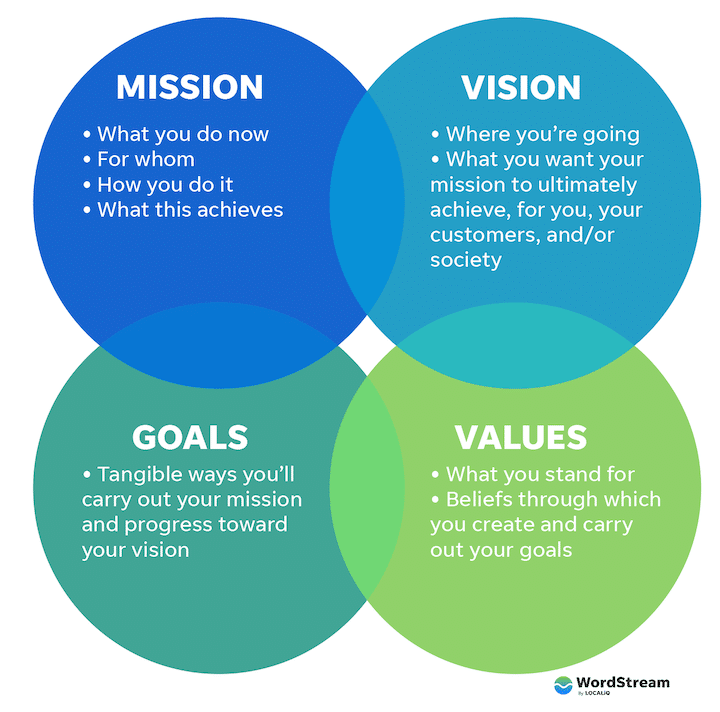
Before you can create brand style guidelines, you must first have a firm grasp of your brand’s identity, including your mission, values, audience, and goals. These things form the foundation on which you’ll base your guidelines.
The point of a brand style guide is to cement your identity in place, so you must figure out each piece before you can document them. Don’t continue onward until you’ve accomplished this.
1. Brand identity: Mission, vision and ‘About us’
To start your brand style guidelines, record your business’s mission statement, vision for the brand, and the values underlying everything you do.
This section can also include your brand’s story or “About us” (how was it founded? Why was it started?).
Here’s a quick list with definitions:
Mission statement: A short statement that details why/how your business exists. Who do you serve? How do you serve them? What’s the outcome of serving them?
Vision statement: A short statement that sums up your brand’s vision for the future. What do you hope to achieve, ultimately? Instead, think about your larger impact on the world beyond revenue or customer goals.
Values: What values are important to the brand? What values do you try to uphold while doing business?
Story: How did the brand get started? Who started it, and why? How have you grown and changed since? What have you accomplished?
We include these elements in your guidelines because they can directly inform your brand’s personality, voice, and style. They can also guide how you approach creating content.
For example, say your brand was started out of your founder’s basement. Say the idea came from a group of friends hanging out and spitballing. When relevant, creators can take this story and weave it into your content. It might also inform your brand voice – i.e., casual, friendly, down-to-earth. This story is an important part of the brand personality, so it has a place inside the brand style guidelines.
Bottom line: Paint an overarching picture of your brand, so anyone who reads and follows your guidelines understands the heart of the business and what you stand for.
2. Audience
Next, include an overview of your audience. This part must be based on audience research, so if you haven’t done that yet, now’s the time.
If you’ve already created some business personas based on segments of your audience, add them here. For example, Mozilla Firefox’s brand style guidelines include written descriptions of their two personas: adventurous amplifiers and caring confidentials.
This piece of the puzzle is important for any content creators who will work with your brand. You can’t write or create targeted content without first understanding the target audience.
Get the daily newsletter search marketers rely on.
function getCookie(cname) {
let name = cname + “=”;
let decodedCookie = decodeURIComponent(document.cookie);
let ca = decodedCookie.split(‘;’);
for(let i = 0; i <ca.length; i++) {
let c = ca[i];
while (c.charAt(0) == ' ') {
c = c.substring(1);
}
if (c.indexOf(name) == 0) {
return c.substring(name.length, c.length);
}
}
return "";
}
document.getElementById('munchkinCookieInline').value = getCookie('_mkto_trk');
3. Visual elements: Logo, color palette and typography
Your brand style guidelines can also include rules for using visuals, like how your logo appears in content and your brand color palette and preferred fonts.
This information is super-important when you work with graphic designers or web developers. Standard visual rules will help your content look cohesive across channels, whether you’re posting on your blog or social media, creating ads, building presentations, sharing videos on YouTube, etc.
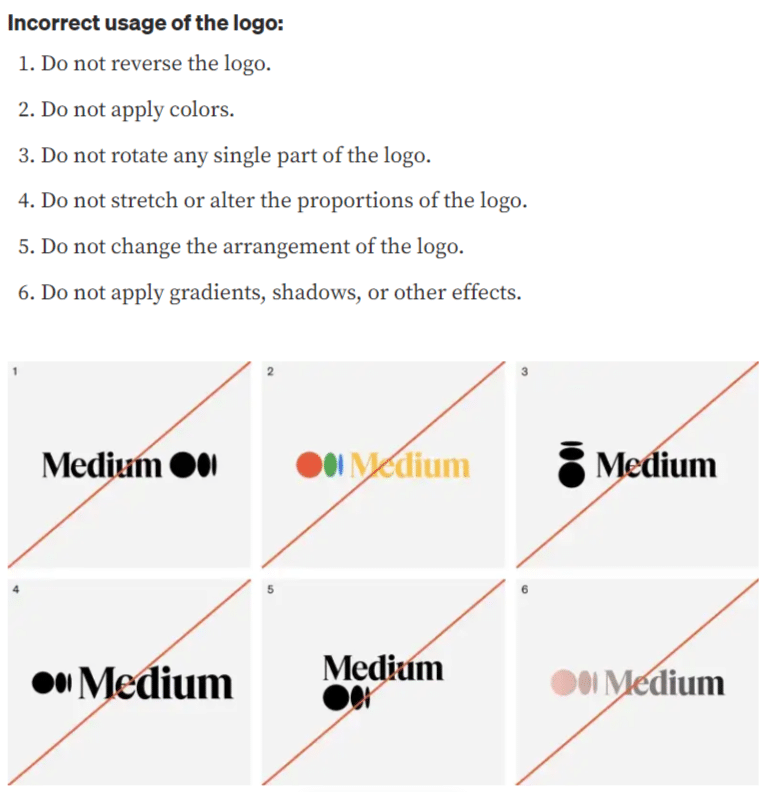
For example, Medium has strict guidelines on how its logo can and cannot be used.
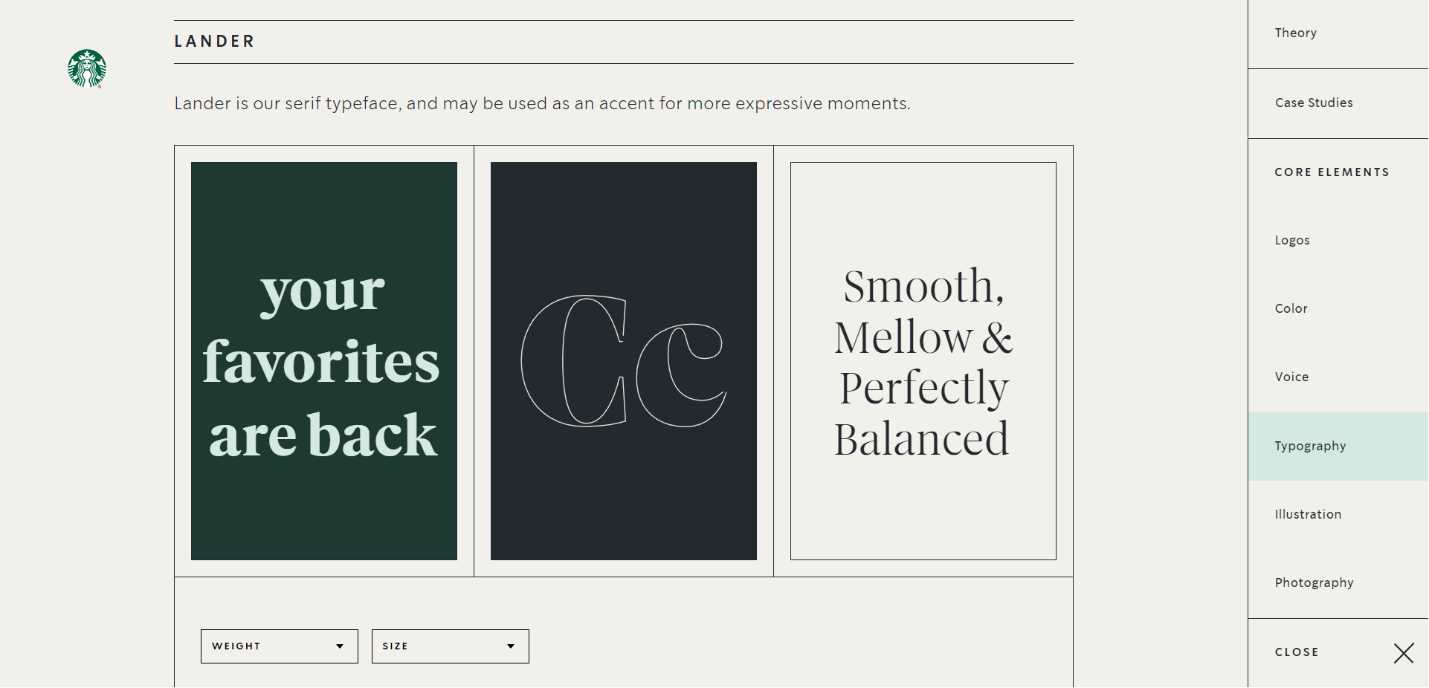
And Starbucks has guidelines showing their preferred fonts and how to use them.
4. Brand voice, tone, and style
Next, you’ll need to include rules guiding how creators present your brand to the world through content. Stipulating brand voice, tone, and style is one of the main ways to keep your messaging consistent across channels.
Brand voice
Your brand voice is essentially your brand personality.
It determines how you come across to customers when you communicate with them, whether through writing or speaking.
For instance, maybe your brand is spunky and funny, sophisticated and mysterious, or intellectual and nerdy.
Even further, your guidelines should explain how your unique brand voice will show up in content.
For example, a brand with a spirited, fun voice might insert jokes or puns in the content. They might use GIFs and emojis.
Their sentences might trend on the short side, and their explanations will be clear and down-to-earth.
Brand tone
Your brand tone determines how your voice is delivered.
For example, if you come up with a great promotion for customers, you might tell them about it excitedly.
Or, if you have to deliver bad news, your tone might be apologetic or subdued.
Generally, your brand voice doesn’t change because it’s associated with your brand personality, which stays pretty consistent. But your tone can change because different situations call for adopting different tones. You can stipulate which tones to use for different circumstances in your brand style guidelines.
Brand writing style
Your brand writing style includes your preferred word usage, grammar, spelling, and formatting rules.
Word usage: Which words should creators avoid altogether? (For instance, maybe they should avoid slang words like “gonna” or “shoulda.”) How should they speak about or refer to your products/services? How should they use and refer to your brand name?
Grammar and spelling rules: Does your brand use Oxford commas? How should writers approach abbreviated terms? Can they use contractions (i.e., don’t versus do not)? Should numbers be written or spelled? Etc.
Formatting rules: What are your rules for using numbered and bulleted lists? Do you have any rules for using headers? What about links?
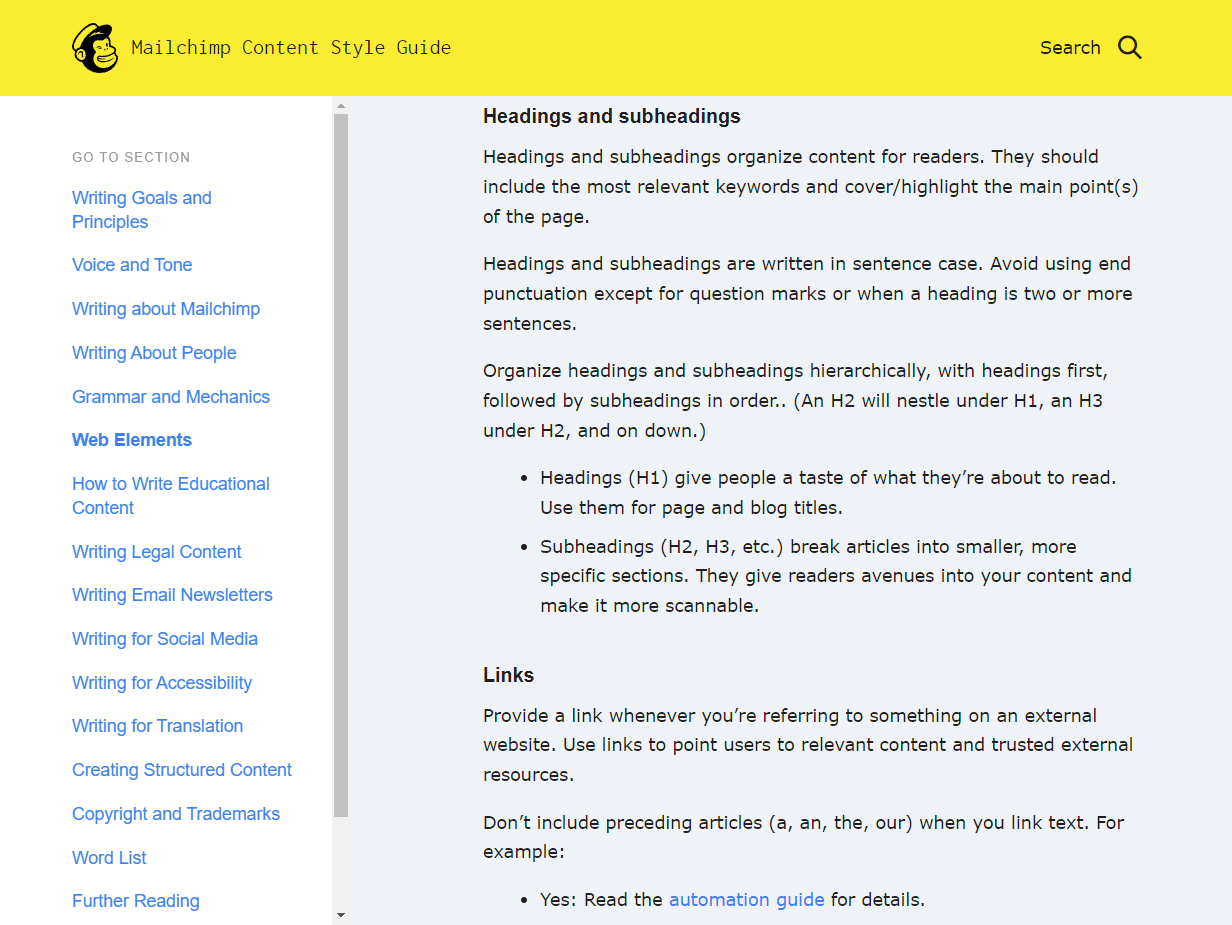
Mailchimp has a fantastic example of comprehensive brand writing style guidelines to check out for inspiration. They go so deep, they’re a completely separate guide.
For instance, Mailchimp has detailed rules about their voice and tone, how to use specific web elements (such as headings and subheadings) in their content, a detailed grammar guide, and much more.
A few tips to keep in mind about this part of your brand style guidelines:
Tip 1: If your writing guidelines are also this in-depth, consider creating a separate document/resource just for writers, as Mailchimp did. Otherwise, the rest of your team will have to wade through pages and pages of irrelevant information.
Tip 2: No time to create an encyclopedia of writing style rules? It may be helpful to choose a pre-existing, standardized style manual to base yours on, instead.
Large publishing entities have already developed robust style guides that you can use to underpin your own, like APA, MLA, or Chicago Style. Use these as the foundation and layer your unique brand voice guidelines on top. Each manual has subtle differences, so vet them carefully to choose the best match for your brand.
5. Other guidelines to consider
Lastly, consider these other helpful sections to add to your brand style guidelines.
Rules for using visuals in content
Consider adding rules for how you want creators to source images for blogs and other content. Can they use stock photos? Should all images be custom graphics? Are screenshots allowed? Is there a specific look/feel you want all visuals to have?
Rules for sourcing and citing statistics, studies, research, and other data
A great task to keep consistent across content like blogs is how writers source and cite research like studies, expert quotes, data, or surveys.
For example, are any sources off-limits (like Wikipedia or low DA websites)? How should creators mention and link to sources in content?
Use cases
If you can, show the people using your guidelines use cases and examples of do’s/don’ts when writing and creating brand assets and content.
Show correct and incorrect uses of your logo, good and bad examples of brand voice, good and bad visual usage, the right and wrong way to link to sources in content, etc.
In Mozilla Firefox’s guidelines, there are specific examples of how to use the brand voice/tone, for instance, correctly.
It might not be the most exciting part, but it’s mega important to keeping your brand presence consistent across the web.
And consistency matters far more than you may think. Consistency is a major reason your audience will trust you because a consistent voice and presence build credibility.
A steady presence is always better than a wavering one. You can trust it to remain reliable and true, no matter the circumstances.
So, the question remains: Do you want your brand to be seen as reliable, trustworthy, and constant – or scattered, confused, and unreliable?
Whether you have a clear set of brand style guidelines in place can help determine which category you fall into.
Google search advocate John Mueller has always downplayed the value of HTML sitemaps. Recently, he reiterated his dissatisfaction with HTML sitemaps, saying:
“I changed my mind on HTML sitemaps over the years, they should never be needed. Sites small [and] large should always have a clear navigational structure.”
“When it comes to SEO … for small sites, your site should be crawlable anyway (and if you’re using a common CMS, it’ll almost always be fine) & for large sites, they’re not going to be useful anyway (use sitemaps, use normal cross-linking, check with a crawler of your choice).”
While Mueller makes a good point, in my opinion, we can’t just completely dropHTML sitemaps. Links and website usability still matter.
I also like what former Googler and now popular SEO expert Pedro Dias said in response to Mueller’s remarks, which reflects the reality of the web:
“Unfortunately it’s not easy to change the architecture on complex and large websites. Often, something like this, [sic!] can take years to change, as it depends on multiple teams. So, HTML sitemaps are often a welcome and temporary-ish solution. I used to dislike them… Nowadays, I see their use-cases.”
There is a compromise between both HTML and XML sitemaps, so as always in SEO, “it depends.”
Read below why, when and how to use sitemaps to benefit your website and its users.
What are sitemaps and why did they get invented?
In the early days of the web, many websites grew organically.
Websites weren’t appropriately planned by information architects according to UX best practices.
They started from scratch, and webmasters added content whenever needed in often far-from-usable ways.
Those were the days before blogs, social media or content management systems. When you built a site, you did it yourself using HTML.
In most cases, you were manually coding the HTML in a text editor, using a messy WYSIWYG editor like Dreamweaver or one of the first often custom-built and pretty cumbersome CMS tools. Either way, website structures quickly became confusing.
So out of necessity, people started adding sitemaps to their websites to make some sense of the increasing disorder. Those sitemaps were created in plain HTML and looked like any other webpage, part of the fact that they displayed a map instead of written content.
Later search engines introduced so-called XML sitemaps meant to replace manual “search engine submission.”
More than 25 years later, HTML sitemaps are less preferred. But can we really stop using HTML sitemaps, just like we dropped guest books or webrings?
HTML vs. XML sitemaps – the visible vs. the invisible
To make it short and simple, the main difference between HTML and XML sitemaps is that an HTML sitemap is usually visible to website visitors while an XML sitemap is not. (The latter primarily made for search engines.)
The XML sitemaps standard was introduced at the end of 2007 by search engines like Google, Yahoo and Bing (then MSN).
By default, they are formatted in a way that does not display well or is readable for humans. Instead, such sitemaps are used mainly to ensure proper and faster indexing by search engines.
On the other hand, just because a resource is on an XML sitemap does not mean Google and Bing will index it, or it will be findable even if it’s in the index.
Another SEO colleague Rob Watts added a tongue-in-cheek, first-hand account to the debate by saying:
“I had sites do well for years that were absent of html or xml sitemaps. I removed my tin foil hat and began using xml sitemaps and enjoyed seeing how long it took for urls to appear in serps. I don’t think I saw any noticeable improvement performance wise for their use, but it made some analyses/reports slightly easier.”
So with XML sitemaps only theoretically ensuring crawling and indexing, do we have to focus on them and neglect visible or visual sitemaps?
Get the daily newsletter search marketers rely on.
function getCookie(cname) {
let name = cname + “=”;
let decodedCookie = decodeURIComponent(document.cookie);
let ca = decodedCookie.split(‘;’);
for(let i = 0; i <ca.length; i++) {
let c = ca[i];
while (c.charAt(0) == ' ') {
c = c.substring(1);
}
if (c.indexOf(name) == 0) {
return c.substring(name.length, c.length);
}
}
return "";
}
document.getElementById('munchkinCookieInline').value = getCookie('_mkto_trk');
Why should we create sitemaps solely for Google?
Over the years, Google spokespeople told us to create websites for users, not search engines. Why make an exception when it comes to sitemaps and only create them for Google and other search engines?
It makes me wonder whether other SEO tactics that display one thing for search bots and something different for website visitors may also be a good idea.
Anyway, Google said so, so we must listen, right? Not really.
There must be a reason why Google dislikes HTML sitemaps and prefers XML.
XML sitemaps are usually automated and include all the content published as soon as it’s online.
On WordPress, numerous tools create sitemaps for you. Yoast SEO also covers you, for example, even the basic free version.
In 2020, WordPress finally added XML sitemap support to its core, so you won’t even need external plugins.
The XML code format is also machine-readable, while HTML is messy. HTML has to work despite errors, while XML breaks when you forget a character.
So at the end of the day, the XML sitemap creation works mostly behind the scenes without error-prone human hands interfering.
Also, most people will never see your XML sitemap, they wouldn’t even know where to find it as it’s not linked anywhere visibly on the site.
Making XML sitemaps work for people
Luckily, there is always some middle ground. You don’t have to make XML sitemaps invisible.
You can format XML sitemaps with stylesheets just like you do with any HTML pages.
Indeed for a while, it seemed that XML would replace HTML as the web standard, or it was a compromise called XHTML.
For compatibility reasons, that didn’t happen. Even though the XHTML format was cleaner and less error-prone. When an error happened, the website did break.
With HTML5 introduced instead, browsers embraced sloppily coded websites to make publishing easier but at the expense of automatic crawling.
Now you have ideally created an XML sitemap that can be read by people without coding skills. Remember that it’s still a bland list of all the content you have.
You may still consider creating a readable HTML sitemap for your website visitors.
When to use visual or HTML sitemaps
It’s not either/or. You can:
Decide to separate both visible and invisible sitemaps instead of making your XML sitemap visible to people.
Create both visible (HTML) and invisible (XML) sitemaps on your site for different reasons.
Have more than one HTML or XML sitemap.
It depends on what your site looks like and what your objectives are.
Use these questions as a guide to making a decision:
Do you want to create a quick overview page of your site? Use an HTML sitemap!
Do you want to get indexed as soon and as deeply as possible? Create an XML sitemap.
That said, there are edge cases, and many websites do not conform to typical standards.
Here are example use cases for visual or HTML sitemaps.
Legacy and/or hard-coded sites
Believe it or not, there are still legacy sites from decades ago on the web, and even hard-codedsites made manually in HTML, CSS and/or JavaScript.
In fact, you’ve probably used one quite often.
Amazon.com is almost the same site it was many years ago. It has been continuously refreshed over the years and improved to this day.
Some basic legacy sites may have difficulty creating an XML sitemap on the fly. So it’s not a problem when they have a hard-coded HTML sitemap instead.
Do you have to remove it because Google says so? Of course not.
Large sites
When Mueller said that you needed proper site navigation, he was generally right. But it does not always apply to larger sites.
You can’t possibly fit a highly complex site with thousands of pages into a menu without it quickly spiraling out of control.
For better findability, it’s useful for both humans and search bots to have sitemaps that reflect the overall site structure.
You don’t have to list every page, as that would make it too large.
Alternative to mega menus
Many sites attempt to fit as much as possible into their site navigation and end up having so-called mega menus.
You hover your mouse over the navigation, and the menu suddenly covers the whole site.
Users get quickly overwhelmed visually with dozens of options to select from.
Also, sometimes, if a user is not fast enough to point at the right menu item, it will disappear when they lose the level one menu.
Mega menus are tempting, especially with large companies where every stakeholder wants to be on top.
But they are often a user experience nightmare, as Smashing Magazine founder Vitaly Friedman clearly demonstrates.
Sites without internal search
When doing web outreach, you might notice that many sites make it quite hard to contact them.
Such is often the case with sites having no internal search feature. You will often struggle to locate their contact page.
A search feature would be a logical solution, yet surprisingly some sites do not have one, even those run on WordPress, which has built-in functionality.
Some themes or website owners simply remove the search input.
When I can’t find a standard page in your menu and there is no search feature available,a visual sitemap would be nice.
Orphan pages
When you manage to create a menu that is usable without becoming so huge that it does not fit some screens anymore, you will often end up with orphan pages.
Orphan pages are webpages that are not linked internally from the menu structure or inside the content.
This happens when content gets removed and updated, and some links disappear.
Oftentimes, orphan pages should be removed altogether.
Others still make sense but might not be as significant to place into the main menu or the footer links.
Such orphan pages would be fine when linked in a visible, readable sitemap so that people looking for them can find and access them.
Faster indexing
Let’s be honest! Just because a page or other resource (think image or video) is listed on an XML sitemap does not mean Google will index it.
Your site may not have enough authority to get all its content into the Google index.
This was quite a common issue for new sites in the past. Especially with newly created sites and Google having more limited computing power, some content did not make it into the index on purpose.
It’s less of an issue now, but you still may want to link content internally to boost your chances of getting indexing.
Link to the more important content on top, prominently, and/or more often.
Better link equity
When we talk about authority, we refer to the link equity that some SEOs still call “link juice.”
An HTML sitemap that shows some links on top and others at the bottom regulates link equity flow to some extent.
Pages linked on top are expected to have and receive more authority than pages at the bottom.
With XML sitemaps, there is no such hierarchy, as far as I know. All resources listed on it are just that, items in a list.
The item on top is merely the latest one, not necessarily the most important one or the one needing the highest authority.
There is no inherent hierarchy on XML sitemaps unless you code one into it by declaring that some resources are more important and, thus, should be crawled more often than others.
A visible HTML sitemap allows you to link those resources on top that matter most and thus send more users and authority their way, just like in your site navigation. So it’s not “latest” on top but most important on top, ideally.
Usability
As we are talking SEO here, the most important aspect of sitemaps, improving usability, comes at the end.
This is Search Engine Land and not UX Collective, after all. They advocate creating an (internal) UX sitemap for every website project, at least while establishing the information architecture.
These are still the strongest use cases for HTML sitemaps, just like in the ‘90s, way before Google started using links for indexing and ranking and long before XML sitemaps were introduced.
Older users (I admit I’m among them) may even prefer clear and page-style sitemaps instead of shaky menus that vanish when you don’t touch them or search features showing irrelevant items.
Some elderly people cannot use mouse-over and mouse-click actions efficiently.
People with disabilities, particularly the visually impaired, need as few mouse actions as possible. Thus, a one-page overview might be best for them.
Useful sitemap examples in the wild
The New York Times
I often use the New York Times as an example because almost everybody knows the publication, and it’s such an authority.
This time I want to show the NYT as an example simply because they managed to do something right and stand out.
The NYT uses visible HTML sitemaps in a way that is really helpful for readers, search users and search engine bots alike.
The NYT has several sitemaps highlighted by fellow SEO Chris Long of Go Fish Digital on LinkedIn. It is a prime example of using sitemaps to benefit a website.
“60 Second SEO: The New York Times has one of the best HTML sitemaps I’ve seen. Here’s an example of how an article from 1912 is only 5 steps away from [their] home page:”
I don’t want to go too much into detail here, as Long has done an excellent job already at it.
Apple.com
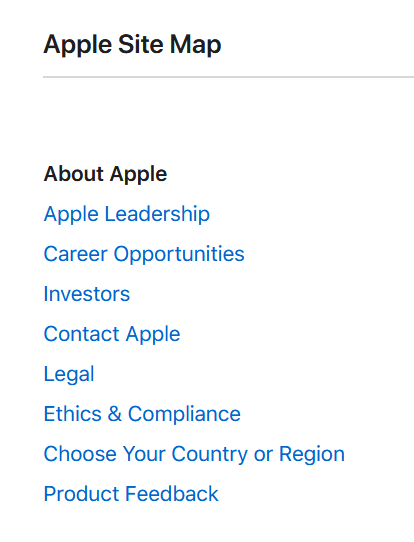
Another great example of sitemap usage for a large site is Apple.com. Their plain and simple text sitemap is useful for people and search engines.
However, note how much the sitemap differs from the actual top navigation the Apple site has above the content.
The “Apple sitemap” starts with “About Apple” (not linked) and the following links:
The site navigation starts with the shop and specific products in contrast:
Apparently, the SEO team decided to make the shop and products more visible to website visitors and search bots. At the same time, the true structure or importance of the pages seems to be completely different.
In any case, the huge Apple sitemap gives users a good overview of the site contents without overloading the page despite more than a hundred links.
Moreover, they have another sitemap in the footer reflecting the top menu structure instead of the standalone “sitemap” on the dedicated page.
It is smaller both by the font size and by the number of links listed but still very useful.
So no matter where you end up, you always have a site navigation or sitemap to help you.
An “everything is easy to find” user experience is central to the Apple website design.