Since Search Engine Land launched, we have given SEO experts a platform to share their in-depth knowledge and timely insights – with the goal of helping you solve problems, manage challenges and understand the constantly shifting SEO landscape.
That’s why one of my top priorities this year was to help relaunch the Search Engine Land Subject Matter Expert program, which had been on pause for the most part for the past few years.
Below you’ll find links to the 10 most-read, must-read Search Engine Land SEO columns of 2022 that were contributed by our fantastic group of Subject Matter Experts.
I have to give some recognition to Olaf Kopp, who authored three of the 10 most popular SEO columns of the year. Amazing!
Analyzing the SERPs for these micro intents will help you create the right content that a searcher will want to find. (By Olaf Kopp. Published July 18.)
Google has reframed its definition of YMYL, revamped its definition of low-quality pages and more. Here are the details. (By Lily Ray. Published July 28.)
Gain powerful insights to inform your marketing efforts. Use the following advanced Google search operators and commands to your advantage. (By Jon Clark. Published Oct. 3.)
Is MUM Google’s next step toward becoming a purely semantic search engine? Learn what MUM could mean for the future of SEO. (By Olaf Kopp. Published April 15.)
Want to understand how machine learning impacts search? Learn how Google uses machine learning models and algorithms in search. (By Dave Davies. Published May 2.)
Get the daily newsletter search marketers rely on.
function getCookie(cname) {
let name = cname + “=”;
let decodedCookie = decodeURIComponent(document.cookie);
let ca = decodedCookie.split(‘;’);
for(let i = 0; i <ca.length; i++) {
let c = ca[i];
while (c.charAt(0) == ' ') {
c = c.substring(1);
}
if (c.indexOf(name) == 0) {
return c.substring(name.length, c.length);
}
}
return "";
}
document.getElementById('munchkinCookieInline').value = getCookie('_mkto_trk');
SEOs may be in for another shakeup similar to Penguin’s launch 10 years ago. Here’s what you need to know about Google’s new update. (By Marie Haynes. Published Aug. 22.)
Want to set up your WordPress site for better traffic and rankings? Make sure you’re following these site settings to improve your SEO. (By John McAlpin. Published Sept. 15.)
See the results of a comparison of four leading SEO tools’ keyword coverage for domains in the pharmaceutical space. (By Tylor Hermanson. Published Sept. 19.)
Reports suggest two-thirds of consumers are planning to cut their spending in 2023. This is the result of ever-growing concern about the cost-of-living. Accountancy firm KPMG surveyed 3,000 people, finding that a whopping 61% of respondents said they were preparing to reduce their spending in the new year.
This, of course, is discretionary spending, and not spending on essentials such as food and bills. Such spending includes going out for dinner, holidays and other non-essentials. This poll highlights the pressure on both families and the wider economy as inflation remains high and wallets are squeezed.
Overall, 42% of respondents said they would reduce the amount they spend on clothes. 46% said they would reduce the frequency they eat out, and a further 42% said the same for takeaways.
The survey found that people were concerned over the cost of essentials and basics needed in everyday life. Costs such as food, energy, housing and fuel are deterrents for spending in other areas of life. In fact, one in 10 people surveyed highlighted their concern for energy bill prices after April 2023, when the government’s energy support scheme ends.
Households have already faced huge bill hikes, as well as food costs soaring and inflation sitting at over 10%. This has caused many to tighten their purse strings and put others into dire financial straits. In fact, official forecasts for the future of the economy show living wages will be reduced by 7% in real terms by the end of March 2024, destroying eight years of continuous growth.
The poll by KPMG also showed one in 10 adults have no savings, and just 4% of respondents said they would be able to increase their non-essential spending in the new year. One quarter of those polled said their non-essential spending would likely remain the same as in 2022.
The results of the survey also showed that a third of those surveyed said they would buy more own-brand and value products in 2023, and another third suggested they may buy fewer items altogether.
43% of those with savings said they were using them to meet everyday costs, rising to a staggering 80% amongst lower-income households. This further highlights the disproportionate impacts the cost-of-living crisis is having on those living on lower incomes.
Linda Ellett, UK head of consumer markets, retail and leisure at KPMG, said:
“Current essential costs, fears of how high they’ll rise – including concerns about mortgage rate and energy price changes next year – are all factors in why two-thirds of consumers that we surveyed said they have to reduce their non-essential spending in 2023.
“To do so, consumers are increasingly changing how they shop to save money – including switching to cheaper retailers, buying more value or promotional produce, and swapping eating out for meals in. Understanding these swaps is critical for brands and retailers looking to still be the first choice for spend.”
Are you planning to cut spending in the new year? Let us know in the comments!
Was 2022 the year of AI – or perhaps the official dawning of the age of AI? For the last month, it’s been hard not to read about or avoid the temptation to spend hours playing with ChatGPT.
We also had our usual share of algorithm updates, new tools and features, acquisitions, and plenty more changes.
One constant through it all? For 16 years, Search Engine Land has covered all the biggest stories, just as we did again in 2022.
Here’s our look back at the biggest SEO news of 2022 – from Google and other search engines, tool providers and the community.
Google news
Google Search Essentials and more documentation changes
Google did a major refresh of its 20-year-old Webmaster Guidelines and also renamed it to Google Search Essentials. The updated guidelines were streamlined, simplified, and updated “to ensure people have clear guidance for how to build sites that serve people well.”
While Search Essentials was the biggest of Google’s documentation updates in 2022, there were plenty more.
Google updated several Feature Guides help documents:
“The addition of ‘experience’ indicates that content quality can also be evaluated through the lens of understanding the extent to which the content creator has first-hand experience in the topic.
With this reframing of E-E-A-T, Google also states that “trust” is at the center of this concept and is the “most important member of the E-E-A-T family.”
Before E-A-T became E-E-A-T – we learned from Google that E-A-T is synonymous with “good content quality.”
“E-A-T is a template for how we rate an individual site. We do it to every single query and every single result. It’s pervasive throughout every single thing we do,” according to Hyung-Jin Kim, VP of Search, Google, who spoke at SMX Next in November. Dig deeper: in 7 takeaways from the SMX Next keynote with Hyung-Jin Kim, VP Search at Google.
While this is decidedly not new, it is always good for SEO professionals to understand why Google does the things it does.
Continuous scroll, multisearch, featured snippets and more search feature changes
Google is constantly testing its SERPs, all in the name of making sure users have a great experience and find the information or answer they are looking for.
For feature snippets, Google now uses MUM to determine whether there is general consensus for information. Google also reported that MUM helped reduce false premise results by 40%
Oh and if you ever have trouble keeping track of all the parts that make up Google’s user interface, Google launched a visual gallery documenting 22 elements.
Here’s a look back at even more features that were added or tested in Google’s search results in 2022:
The page experience update for desktop: In February.
At SMX Next, we learned from Google’s Kim that Google’s Panda algorithm evolved into a new algorithm called Coati. Although this was new information about something fairly old in the Google algorithm world, it was still an interesting discovery.
Also, Google’s John Mueller confirmed that Google no longer used the 2010 and 2018 page speed signals. They were replaced by Core Web Vitals.
Google also introduced a new “algorithmic improvement” for how it selects titles for the search result snippets for multi-language or transliterated titles or where the title element is written in a different language or script from its content.
Read Barry Schwartz’s recap to dig deeper into the year in algorithm updates. And make sure to check out our history of Google algorithm updates page for all our latest news and guidance around the latest algorithm updates.
AI & machine learning
ChatGPT was all the talk in the SEO world in the final weeks of 2022. And you can bet we’ll be hearing more about the (and other) exciting AI technologies in 2023, especially with GTP-4 not far away.
Microsoft Bing continued to push its IndexNow initiative, adding co-sharing of URLs with Yandex, announcing in August that more than 16 million websites were using it (publishing more than 1.2 billion URLs per day to the IndexNow API), as well as adding multiple new integrations:
In case you missed all the thousands of reminders to adopt Google Analytics 4 until now, now is the time to adopt GA4. Because Universal Analytics ceases to exist July 1, 2023. Hope you are ready.
In an odd bit of rebranding, Google Data Studio was renamed Looker Studio. Google said it was “unifying” the Google business intelligence products – including the popular Google Data Studio product – “under the Looker umbrella.”
Google Search Console
Google Search Console had plenty of new additions – tools, features and reporting improvements. Here are links to our coverage:
Early in 2022, it looked like we were in for a busy year of acquisitions. Things slowed down around mid-year, but check out the major changes we saw this year with some of the largest SEO technology companies:
A DMCA request removed SEO tool Moz from Google search for just under 12 hours. To be removed from Google search for your branded term is the stuff of SEO nightmares, no matter how long it lasts.
Ahrefs made big news when it revealed details about its own general-purpose search engine, Yep. While it’s no Google killer, more alternative search engines is a good thing.
Meanwhile, DuckDuckGo, the most well-known privacy search engine, seemed to be continuing its steady growth, finally passing 100 billion searches in January. Until April. That’s when DuckDuckGo fell below 100 million daily average searches per day. And in the months since, DuckDuckGo has been unable to get back to that level.
In memoriam
In 2022, we lost influential SEO pioneer and expert Bill Slawski on May 17. He was best known for helping the community make sense of search patents, mostly on SEO By The Sea. Thankfully, that treasure trove of information lives on, after it briefly went offline. In the wake of his passing, we also discovered some upsetting Google search results for [bill slawski obituary].
Another incredibly sad loss was that of Tatiana Perebeinis, the chief accountant of SE Ranking, who was one of four people killed in a Russian attack in Irpin, Ukraine.
SMX Advanced & Next
We ran two digital events this year – SMX Advanced in June and SMX Next in November. Both shows were packed full of actionable SEO tips and insights.
Below are links to our coverage of the SEO track from Advanced.
And you can expect to read lots of coverage of the SEO track from SMX Next over the coming weeks on Search Engine Land.
SEO in 2023
As we look ahead, here’s what we know:
Unless you plan to abandon Google Analytics, you need to accept and fully adopt GA4 – because the current GA goes away in July. And if you haven’t migrated yet? You’re going to have an extra hard time comparing year-on-year data. Also: make sure you save whatever historical GA data you need, because Google will delete it all. And once it’s gone, it’s gone.
Should be excited or terrified by ChatGPT? Yes. I mean, it depends. Just remember, ChatGPT it’s only useful for things up until 2021. But GPT-4 is coming soon.
With the rise of AI tools, it will be interesting to see how Google responds to what could potentially be a flood of duplicative AI-generated content. If that does happen, spoiler: it won’t go well for those sites. Because there are plenty of tools that are good at detecting AI content – and Google is well aware of what’s happening.
We also know there will be Google algorithm updates. Google has confirmed 10 major updates in 2021 and 2022. We know there will be core updates and probably more coming with the helpful content update. And when it happens, Search Engine Land will be first to report on it.
Since Search Engine Land launched, we have given PPC experts a platform to share their in-depth knowledge and timely insights – with the goal of helping you solve problems, manage challenges and understand the constantly shifting landscape of paid search, paid social and display.
That’s why one of my top priorities this year was to help relaunch the Search Engine Land Subject Matter Expert program, which had been on pause for the past few years.
Below you’ll find links to the 10 most-read, must-read Search Engine Land PPC columns of 2022 that were contributed by our fantastic group of Subject Matter Experts.
Before that, I have to give some special recognition to PPC expert Melissa Mackey, who authored the most viewed column of the year, which published Nov. 9 – 10 things to eliminate from your life to be more productive at work. That article isn’t included on our top 10 list because the insights can apply to anyone really – not just search marketers. Regardless, the article did monster numbers – in large part thanks to Google Discover.
Also, congratulations to Anthony Tedesco for authoring three of the top 10 most-read articles this year on Search Engine Land. Amazing.
Responsive Search Ads are a huge shift from the ETA format. Learn how RSAs work and get tips on how to get more out of them. (By Mona Elesseily. Published April 14.)
SEO and PPC are often at odds. Yet the things they “bicker over” are actually areas for improved workflow and channel optimization. (By Navah Hopkins. Published June 29.)
Learn the benefits of RSAs, how the transition from ETAs impacts you search strategy and how to write effective RSAs (By Jenny Mallory. Published May 3.)
Google Ads has clarified what identical keywords are. But does this tactic go against what Google has been preaching for years? (By Greg Finn. Published June 29.)
Learn how to use Excel pivot tables to QA bulk sheets, plus some tips and shortcuts to enhance your pivot table skills. (By Anthony Tedesco. Published Nov. 7.)
Get the daily newsletter search marketers rely on.
function getCookie(cname) {
let name = cname + “=”;
let decodedCookie = decodeURIComponent(document.cookie);
let ca = decodedCookie.split(‘;’);
for(let i = 0; i <ca.length; i++) {
let c = ca[i];
while (c.charAt(0) == ' ') {
c = c.substring(1);
}
if (c.indexOf(name) == 0) {
return c.substring(name.length, c.length);
}
}
return "";
}
document.getElementById('munchkinCookieInline').value = getCookie('_mkto_trk');
Investment in brand keywords is critical because it allows you to directly influence your brand’s presentation on the SERP. (By Anthony Tedesco. Published July 5.)
Set yourself up for more success. Learn how to take your PPC dashboard from good to great using Google Looker Studio. (By Amy Hebdon. Originally published March 10, updated and republished Oct. 31.)
Maximize your performance with Google Ads Performance Max. Here’s everything you need to know to set up PMax for success. (By Menachem Ani. Published July 22.)
Use these tips to quickly analyze performance data and identify high-impact PPC optimizations that will move the needle. (By Anthony Tedesco. Published Aug. 24.)
Fleet tracking technology has helped the trucking industry in a number of ways, from improved safety and efficiency to cost savings and productivity. By enabling business owners and fleet managers to monitor and manage their vehicles, fleet tracking technology has made it easier to track trucks, identify improvement areas, reduce fuel costs and improve fleet performance. Read on to learn more about how fleet tracking technology has helped the trucking industry.
Fleet tracking technology helps improve safety by providing detailed location and speed information so drivers can be monitored in real time. This allows businesses to stay updated on location information and identify unsafe driving habits such as speeding or hard braking. Additionally, with detailed reports about driving behaviors such as excessive idle time, dispatchers can ensure that all vehicles operate safely and efficiently.
Not only does fleet tracking technology give businesses insights into driver behavior behind the wheel, but it also helps with productivity management in other ways. Automatic reporting capabilities generate data for efficient route optimization and help create a paperless work environment by eliminating manual paperwork requirements for drivers throughout the trip. Further still, GPS navigation capabilities help dispatchers accurately plan routes from start to finish to ensure timely deliveries with less downtime spent idling at unplanned stops or taking wrong turns due to poor routing decisions.
Overall, with an improved understanding of each vehicle’s behavior on the road combined with real-time data regarding location history and performance indicators (e.g., idle time), businesses have been able to benefit from reductions in both fuel costs and labor costs due to higher levels of efficiency across their fleets thanks to effective deployment of fleet tracking technology solutions.
Benefits of Fleet Tracking Technology
Fleet tracking technology has revolutionized the trucking industry over the past few years. It has enabled trucking businesses to gain real-time insights into their fleet performance and operations. This has resulted in streamlined processes, improved customer service and increased profitability. Let’s delve into the various benefits fleet tracking technology offers the trucking industry.
Improved Safety
Fleet tracking technology has significantly improved safety within the trucking industry due to its comprehensive functionality. This form of data-driven technology can track vehicles, alert drivers in areas with hazardous climates or road conditions, and monitor driver behavior.
The most advanced fleets take advantage of GPS-based tracking systems to ensure drivers follow safe and cost-effective routes. It also allows for real-time awareness about the location of drivers and their vehicles. Sensors placed on trucks can alert drivers to changes in tire pressure, engine temperature, and other important metrics, helping them abide by the industry’s safety regulations.
By using vehicle installation data such as accident reports, real-time mapping systems allow dispatchers to monitor risky sections of roads with potential hazards like sharp curves or pre-accident conditions like wet or icy surfaces. Integrating the software into a fleet tracking system also assists managers in keeping informed on current DOT standards and industry regulations related to safe hours and route assignments while monitoring idling times throughout shifts.
By utilizing telematic information such as GPS location data combined with driver metrics, including braking patterns, an analytics system can accurately detect aggressive driving habits, which can then be rectified through coaching programs that are tailored specifically for each driver based on their abilities and preferences. Overall, fleet tracking technology has improved safety within the trucking industry by offering operators a range of benefits that greatly enhance efficiency while driving down overhead costs associated with poor decisions in terms of safety compliance requirements.
Increased Efficiency
Fleet tracking technology is one of the most important trends in the trucking industry; it provides up-to-date data about fleet performance and increases efficiency. Using GPS technology, motor carriers can track the exact location of their trucks and cargo, store vehicle information, set routes for driver compliance, and more. Additionally, fleet tracking technology can detect traffic delays, poor driving behavior, and excessive idling. This increased visibility into the trucking operations enhances safety on roadways and helps drivers stay compliant with government regulations.
The trucking industry continues to reap numerous benefits from utilizing fleet tracking technology. With real-time notifications about the fuel consumption, motor carriers are able to reduce fuel costs by keeping fuel usage under control. Accurate ETA times allow for better customer service, with deliveries arriving on time or earlier than expected. Driver compliance with regulations allows carriers to avoid fines and penalties that result in decreased revenue. Fleet tracking also significantly reduces dispatch time by improving productivity and eliminating manual paperwork. The reduced freight cycle times decrease operating costs while allowing businesses to meet customer demands faster, resulting in an overall increase in profitability.
Reduced Costs
Fleet tracking technology helps in reducing the costs associated with the trucking industry. This can be done in several ways, including using GPS-based systems for route optimization and telematics-based systems for preventative maintenance and other cost savings measures.
Route optimization software uses GPS data to calculate the most efficient routes from any given point A to B, helping to reduce fuel costs and, in some cases, even time spent on the road. By having accurate forecasts that take into account traffic delays or closures, fuel consumption can be reduced dramatically.
Meanwhile, telematics-based systems provide real-time data about a vehicle’s systems, including engine performance and maintenance needs. Thanks to this data, companies are better able to monitor vehicle health and anticipate any maintenance needs before they become an issue. This helps to avoid unnecessary downtime and keep costs down since expensive repairs can be avoided by taking care of issues at their earliest signs of trouble.
With fleet tracking technology capable of monitoring every aspect of a truck’s performance while it’s on the road, companies are able to reduce operational costs through greater efficiency with reduced manual labor requirements. By gaining a better understanding of how vehicles behave under different conditions (such as weather during different times of day or night), companies can gain insight into better methods that make sure action is taken only when necessary while also streamlining processes that would have previously required manual efforts from staff members.
Improved Customer Service
Using fleet tracking technology helps trucking companies improve customer service. Companies can provide customers with accurate arrival and delivery times, get real-time updates on the status of their shipments and make fast decisions in case of delays. For example, a truck may run into a mechanical issue during its travel. However, the company can quickly reroute it to a nearby location for repairs and still keep its customer informed.
This level of service also allows transportation companies to gain customer feedback about their experience. The tracking system collects data on views such as estimated arrival time that can be used to pinpoint any discrepancies or areas for improvement in customer satisfaction. Companies will then be able to adjust and revise their processes accordingly, improving quality control and efficiency. Moreover, better customer service can lead to higher ratings and enhanced reputation overall.
Photo by Marcin Jozwiak from Pexels
How Fleet Tracking Technology Works
Fleet tracking technology has revolutionized the trucking industry by providing owners, operators, and drivers with real-time data and insights on vehicle location, driver behavior, safety, and more. This technology comprises onboard devices and GPS that can monitor and track vehicles and their drivers, giving companies a better understanding of their operations and an improved ability to manage their fleets. Let’s take a closer look at how fleet tracking technology works.
GPS Tracking
GPS tracking is one of the most important components of fleet tracking technology. The GPS satellites, created and maintained by the U.S. Department of Defense, constantly broadcast signals that can be used to determine a position anywhere on the planet. Fleet tracking systems use these signals to locate each vehicle in the system and track its movements.
The pinpoint accuracy of global positioning satellite (GPS) systems allows them to detect specific locations within yards or even feet — far better than other navigation systems available today. GPS data is usually relayed in two ways: via a basic text-based transmission containing latitude and longitude information; or an Enhanced Data Transmission containing more elaborate information like driver identification, speed, and direction.
GPS loggers are often attached to vehicles for continuous monitoring, meaning real-time updates on each vehicle’s location and travel times are available 24/7. This is particularly useful for fleet logistics companies with multiple vehicles who must stay on top of their arrival times at final destinations as accurately as possible.
Advanced fleet tracking technology can also offer additional features such as geo-fencing, which allows virtual geographic boundaries to be set up around designated areas and triggers notifications when a vehicle moves outside these boundaries; fleet management tools that permit remote control over multiple vehicles; email alerts based on speeds, directions, stops and driver behavior; route optimization for fuel consumption optimization; logbook management software for digital “driver” record keeping; smartphone apps transfers fleets into virtual worksites, enabling easier communication with drivers from any location at all times; automated vehicle maintenance schedules to alert managers when it’s time for services or repairs on their vehicles; customizable reports that can help uncover relationships between changes in driver behaviors & patterns with fuel efficiency & mileage performance. All these features make GPS-enabled fleet tracking much more efficient than other conventional platform approaches for managing mobile assets & workforces.
Telematics
Telematics is a branch of technology that combines telecommunications and informatics, or information technology. In the context of fleet tracking, telematics collects data from trucks and other vehicles using GPS (Global Positioning System) technology, then transmits that information back to the office or dispatch center. This allows fleet managers to accurately track their vehicles’ location and status in real time.
Telematics also includes more than just GPS tracking alone; this system has multiple sensors inside each vehicle that track vehicle performance and driver behaviors. Data such as fuel efficiency, speed, engine idle time, aggressive driving behaviors, air pressure in tires, load capacity, and more can be monitored to ensure optimal performance and safety across your entire fleet. By collecting this data in real time, managers can make informed decisions about their operations that can help save money on labor costs and fuel expenses.
In addition to monitoring basic operation metrics, telematics can also provide analytics such as route/task optimization to improve profits by reducing outbound delivery times and enabling better tracking of schedules/tasks so shipments get delivered on time with no accountability gaps or delays due to last-minute changes. This advanced data is all displayed in an easy-to-understand dashboard, along with instant notifications when something within the fleet doesn’t meet standards set by the company itself. The extensive benefits of telematics are why it has become an industry standard within trucking fleets across all levels, including local small businesses up to huge global corporations.
Automated Logging
Fleet tracking technology has revolutionized the trucking industry. Automated logging with telematics is companies’ most common type of fleet tracking software. This technology provides insights into driver habits, vehicle performance, and more. It improves safety by recording and storing driver activity, ensuring they comply with hours of service regulations.
Automated logging systems allow trucking companies to see where their drivers are and what they do while in transit. These systems utilize GPS to track routes, locations, stops, start times, end times, idle time, speed limits, and more. It also helps ensure that trucks are not overloaded or driven too long without a break. For example, suppose the loaded weight exceeds federal guidelines. In that case, trucks will be flagged automatically at weigh stations via automated onboard system scanners linked to the GPS device in the vehicle’s logging device.
By using reliable hardware components such as sensors and an assortment of telematics software solutions that can be integrated into a trucking company’s existing IT infrastructure, automation becomes possible. With data collected from participating vehicles, an automated reporting system can be set up so that reports about individual drivers or whole fleets can easily be accessed for analysis purposes or for customer service assistance when required. The collected data can also be used in determining road safety concerns within specific areas or through providing assistance with backup vehicle dispatch solutions when necessary, helping reduce time lost due to accident response or breakdowns along a planned route, quickly identifying any related issues allowing them to be addressed in a timely manner before a substantial loss occurs as a result of delayed deliveries.
Photo by 500photos.com from Pexels
How Fleet Tracking Technology Has Helped the Trucking Industry
The trucking industry has seen a significant boost in performance and efficiency thanks to the introduction of fleet tracking technology. This technology has revolutionized the industry by allowing operators to monitor the performance of their vehicles, track inventory, and optimize routes. It has also improved safety, increased cost-effectiveness, and reduced driver fatigue. Let’s take a look at what fleet tracking technology can do for the trucking industry.
Improved Safety
Fleet tracking technology has revolutionized the trucking industry. In addition to providing effective cost-saving strategies and competitive insights, fleet tracking has also improved safety standards for commercial truck drivers.
Fleet technology helps diminish the dangers of accidents due to driver fatigue or error by monitoring a driver’s overall behavior. Some systems use sensors to detect and monitor a driver’s current state and alert them when they need a break or are in danger of an accident. The data collected by these systems can be used to develop driver safety profiles over time, allowing critical trends or issues with drivers to be identified quickly, reducing risks, and improving safety performance across an entire fleet of trucks.
Fleet tracking technology also provides real-time insights into hazardous weather conditions or other known dangers on the road. Incidents can be mapped out ahead of time, making it easier for management teams to plan routes and adjust schedules accordingly, ensuring their drivers’ safety while on job duties. By proactively monitoring traffic patterns, speed limits, route selection accuracy, and other critical information, potential collisions caused by poor route selection are dramatically reduced.
Overall, fleet tracking technology helps improve safety measures by monitoring a driver’s overall performance and providing route optimization suggestions that address changing conditions on the road quickly and accurately. Such proactive measures help ensure safe driving conditions for all involved parties wherever commercial vehicles may roam.
Increased Efficiency
Fleet tracking technology has allowed the trucking industry to become more efficient. This type of technology helps to monitor and track all vehicles within a fleet and can provide a variety of types of data, such as vehicle location and driver behavior. This means dispatchers can better organize their workforce, identify optimized routes, and reduce fuel consumption.
Fleet tracking technology has contributed to increased efficiency by reducing the paperwork involved with tracking vehicles, goods, and services. By automating the process, businesses can better allocate resources according to demand and more accurately predict future trends. This type of optimization allows businesses to operate more efficiently, saves them money in the long run, and increases overall customer satisfaction levels via an improved performance from their infrastructure systems.
The GPS capability in these systems also allows for real-time updates on drivers’ locations so that businesses are able to respond quickly when customers require their services urgently; this feature also allows for planned delays or pickup changes as needed with much less stress or effort applied by workers. With fleet management software, managers can be informed immediately should maintenance or repairs be necessary, ensuring that vehicles remain on the road safely while minimizing any potential production risks associated with unexpected machine failure or inspection-related events. Finally, better route planning capabilities improve delivery time accuracy while reducing wasted energy due to undirected driving patterns.
Cost Savings
The use of fleet tracking technology provides numerous cost savings opportunities for the trucking industry. With Fleet tracking technology, companies can maximize their vehicle’s fuel efficiency, reduce the need for unnecessary maintenance and repairs and accurately track driver performance.
Fuel savings can be achieved through more efficient routing and dispatching options that are available through fleet tracking software. By reducing fuel costs, companies can save money in various ways. Furthermore, real-time mileage measurement can be used to accurately assess driver performance and promote higher degrees of efficiency from their drivers. This information is also beneficial when analyzing vehicle service histories to identify areas where repairs can be made sooner or avoided entirely for extended durations of time.
In addition to reduced operational costs, fleet tracking technology permits the accurate tracking of driver timesheets for payment records or for meeting delivery deadlines. With shared data about a vehicle’s location, delivery schedules can be managed more efficiently, helping companies uphold their commitments to customers without any interruption in service quality or cost issues along the way.
By implementing fleet tracking technology into operations, trucking businesses are able to significantly reduce operational expenses while improving customer experience with better responsiveness and services at reduced rates.
Improved Customer Service
Fleet tracking technology is driving change and improving the customer experience in the trucking industry. By integrating tracking data with transportation management systems (TMS), transportation companies can gain valuable insights into the current state of their operations, creating better communication between all involved parties. This means they can provide better services to their customers by creating a real-time picture of the products they are transporting.
Fleet tracking technology enables customers to access shipment information quickly and easily, resulting in improved communication with shippers. Through this technology, customers receive timely updates about their shipments, allowing them greater peace of mind, and eliminating questions about expected delivery times and other shipment details. The ability to provide detailed reports and timelines lets customers know when their shipments arrive or depart from a certain location, enabling them to make informed decisions about their supply chain needs.
Not only does fleet tracking keep customers up-to-date with shipment information, but it also aids fleet owners and managers in optimizing routes for cost savings from fuel costs and improved utilization of assets. Improved access to data through this technology allows dispatchers to quickly create a plan based on current conditions that take into account traffic restrictions or road closures due to construction or maintenance projects.
Overall, fleet tracking has enabled increased efficiency among shippers while improving customer service and satisfaction levels at the same time. This level of innovation has helped transform the trucking industry for all parties involved — from shippers and carriers down to end-customers who are able to quickly access more detailed information regarding deliveries worldwide.
Conclusion
Fleet tracking technology has provided numerous cost-saving and efficiency gains to the trucking industry. Benefits include improved employee visibility, driver safety, and optimized route planning. Additionally, better driver coordination leads to faster response times, increased productivity, decreased fuel consumption, and lower maintenance costs. Trucking operators can maximize the efficiency of their fleet’s operations and profitability by leveraging the power of GPS tracking data in combination with sophisticated analytics tools like artificial intelligence or machine learning algorithms.
Fleet tracking technology is truly transforming the industry in many positive ways, and modern fleets are now operating more efficiently than ever before. With real-time data at their fingertips, trucking operators armed with the right information can confidently make informed decisions that ultimately lead to higher profits for their businesses.
by Ibi Montesino, Executive Vice President, Distributor and Customer Experience and Chief of Staff, Herbalife Nutrition
The world has learned many lessons from the pandemic. One of the most important is the role that local communities serve in helping to bridge isolation, form relationships, grow businesses, contribute to ending food inequity, and support education. The value of community lies in the connections we form that root us in our neighborhoods. By investing in our communities and being active participants, we build bonds of belonging.
Education
The lifeblood of every community is education. A strong school system creates an educated workforce, but it also helps to ensure the vibrancy of future generations. Education provides students with the life skills and information they need to succeed, especially as we live in an interconnected and technology-rich world. Research has shown that over 40 years, income per capita is 23 percent higher in a country with equal education. Access to education is one of the most potent tools to lessen the impact of poverty and reduce economic inequality.
As a business owner or CEO, one of the most important things you can do for your business is to continue investing in your own continued education. Evidence shows that Education provides entrepreneurs with the cognitive skills to better evaluate and take advantage of entrepreneurial opportunities, increase the level of self-confidence, and reduce perceived risks. This can come from general education, or even just participating in industry-related events and seminars to keep you on top of what’s trending in your field.
Connection
Communities give people a sense of belonging. Being part of a group of neighbors eases isolation, builds bridges, and fosters an understanding of others. By prioritizing connecting with your community, the greater your chances of growing your customer base and in turn, your chances for success. The insights you can learn from your customers is invaluable, whether it’s feedback on your service, what you can improve on, or what you may be able to offer that is new. Even trusted peers or mentors in your own industry can help you navigate challenges that can bloom into lucrative opportunities or efficiencies. Connections strengthen not only our relationships but our health as well. Studies have shown that strong social connections can increase longevity by 50%. Social relationships give people a sense of purpose, deepen ties with their neighbors, and strengthen neighborhoods.
Service
Whether you are an individual, social group, or corporation, giving to others, or even better supporting your own employees, is not only the right thing to do, but it also drives stronger connections with others. Food banks sent out urgent requests for donations to support those who lost their incomes or financial providers during the pandemic. In 2020, it was estimated that one in six children was facing hunger in the United States, and globally, according to Feed the Children, one in nine of our neighbors lacks the food they need to thrive.
Acceptance
Strong communities allow residents to learn from others in their town or city. Working and living alongside other people — many of whom may be outside your social circle — creates moments where a group of strangers comes together to make their community stronger. The result is meeting people of all ages, lifestyles, and careers — and opening our minds and hearts to new ideas and a broader sense of acceptance.
Expand
If you are a businessperson, engagement in your community can also benefit your career. You can connect with local leaders and potential consumers as not just a salesperson but as a neighbor. People can meet in low-pressure environments and learn about one another, building relationships and allowing business owners to share information about their services or products that directly meet that individual’s needs. Working alongside others in your community on a project to build your neighborhood expands your network and increases your chances for business success.
A thriving community takes care of its residents’ education, health, and welfare and creates opportunities for neighbors to know, learn from, and support each other. Relationships fuel people’s sense of belonging and develop new prospects for businesses to flourish. Being a good neighbor means doing what you can to help your community, which is the lifeblood of a thriving economy and the fabric of a nation, thrive.
This year had different stresses accompanying the Google algorithm updates, fewer pandemic stresses, and more recession-related stress. We had ten confirmed Google algorithm updates this year, the same number of confirmed algorithm updates we had in 2021. This year, we had a brand new ranking system named the helpful content update, and we had two of them.
Also similar to last year, Google rolled out two big algorithm updates at the end of the year.
Google confirmed algorithm update summary
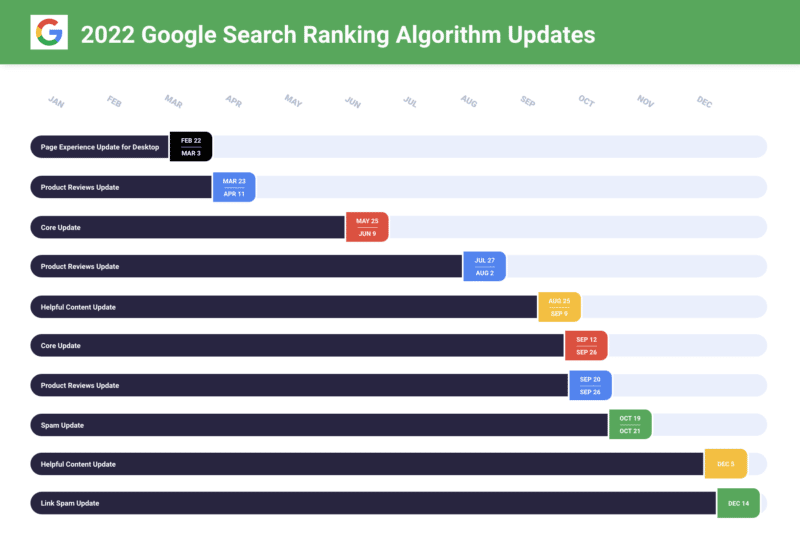
We whipped up this timeline documenting all the confirmed Google search algorithm updates in 2022, so you can visualize the updates over the year. Please note, the last two updates have not completed yet, when they are finished, I will update this story.
Google’s May and September core updates were big updates
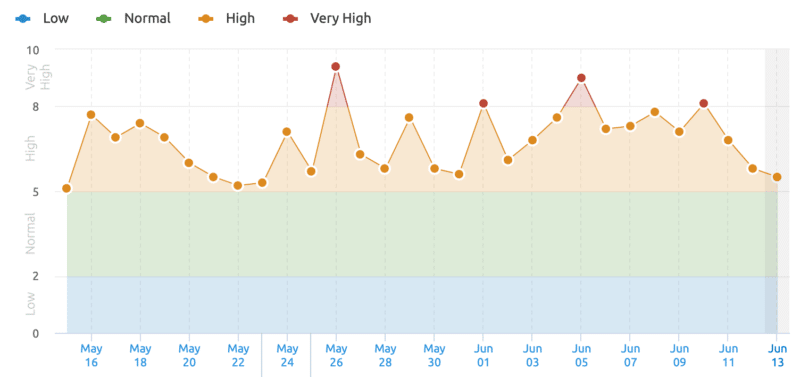
May 2022 core update. On May 25, 2022, Google released the first core update for the 2022 year, the May 2022 core update. That update took 15 days to roll out, ending on June 9, 2022. This update was a big update and rolled out quickly for many queries the data providers track. We did see some “tremors,” shifts in volatility, after the initial update, the largest tremors were around June 5th and that should be the final sets of volatility you would see from the initial broad core update release.
September 2022 core update. On September 12, 2022, Google released the second core update for the 2022 year, the September 2022 core update. That update took two full weeks to roll out, ending on September 26, 2022. This update hit fast, but was less impactful than previous updates. While there was some rank volatility, the consensus was that it was weaker than past Google core updates.
At least we are not expecting any additional core updates by year’s end.
Google’s new two helpful content updates seemed tame
Google released a new algorithm update named the helpful content update, which aim to demote content that is written to rank on search engines and not written to help people.
August 2022 helpful content update. On August 25, 2022, Google released the new helpful content update. The helpful content update will target websites that have a relatively high amount of unsatisfying or unhelpful content, where the content has been written for search engines rather than humans. This update took 15 days to roll out, ending on September 9, 2022. This update did not feel tremendously widespread, but Google did say it was a big update that did not cause a huge shakeup.
December 2022 helpful content update. On December 6, 2022, Google released the second helpful content update, the December 2022 helpful content update. This update is not yet done rolling out but when it is done, I will update this story. (This update took X days to roll out, ending on December X, 2022.) This update also did not feel widespread or all that impactful compared to core updates or product review updates.
Google’s March, July and September product review updates shuffled the shelves
While Google only had two core updates in 2022, it pushed out three product reviews updates in 2022. That is one more product reviews update than in 2021.
March 2022 product reviews update. On March 23, 2022, Google released the first product reviews update for 2022, the March 2022 product reviews update. This update took 19 days to roll out, ending on April 11, 2022. Technically, this was the third product reviews update in history with the first product reviews update was launched on April 8, 2021, and the second was launched on December 1, 2021.
With the third release of the product reviews update, Google said this update “builds on” the work of the first two product review updates to enhance Google’s “ability to identify high quality product reviews.” “This will make it easier for us to get sound purchasing advice in front of users, and to reward creators who are earnest in being helpful,” Alan Kent of Google said.
July 2022 product reviews update. On July 27, 2022, Google released the second product reviews update for 2022, the July 2022 product reviews update. This update only took six days to roll out, ending on August 2, 2022. We saw very limited changes from the tracking tools and honestly, while some sites seemed to get hard by this update, it does not seem there was a lot of SEO community chatter around ranking changes due to this update. In fact, we saw a spike on August 3rd but that was after this update was complete.
September 2022 product reviews update. On September 20, 2022, Google released the third product reviews update for 2022, the September 2022 product reviews update. This update also only took six days to roll out, ending on September 26, 2022. This update did not feel as big as the two previous ones but it also overlapped with a core update.
Google’s spam and link spam updates sparked fear
Like with any spam updates, SEOs and content creators become scared and nervous that their sites or content may be hit.
October 2022 spam update. The first spam update of the year was released on October 19, 2022, the October 2022 spam update. This update took only 48 hours to roll out, ending on October 21, 2022. Google used SpamBrain, a form of artificial intelligence, to better detect spam and not rank it in Google Search. This spam update did not feel huge, but it was targeting spam and not content written by normal people for normal purposes.
December 2022 link spam update. Then on December 14, 2022, Google released a link spam update named the December 2022 link spam update. This update is not yet done but when it finished, I will update this story. (This update took X days to roll out, ending on December X, 2022.) This is the first time Google used SpamBrain AI to detect and neutralize link spam. It did seem to have an impact on links and rankings.
Google’s page experience update for desktop
We only had one-page experience update this year, and it was to bring the page experience signals to desktop. This page experience update for deskop was launched on February 22, 2022, and took nine days to roll out, completed on March 3, 2022. This update will include all the current signals of the mobile version of the page experience update, outside of the page needing to be mobile-friendly. Google said all of the page experience factors for mobile would be included, with the exception of the mobile-friendliness requirement, which is obvious.
Other Google algorithm changes, updates, tweaks or topics
Another busy year for the Google Search team, with over 5,500 changes in 2021 alone, and I suspect that number will be higher for the 2022 year.
We learned that the Panda update eventually evolved into the Coati algorithm, although both are now baked into the core algorithm. We actually learned a lot from speaking with Hyung-Jin Kim, VP Search at Google, at SMX, a lot. Google also started to use MUM in more areas, like for featured snippets and more. And Google also updated its title algorithm for multi-lingual or transliterated pages.
Common Criteria for Information Technology Security Evaluation (CC) is an internationally accepted and scalable set of cybersecurity certification standards (ISO 15408). Common Criteria certification ensures that the assessments of the relevant IT product were completed to consistently high criteria, in a rigorous, standardized, and repeatable manner. This article provides insight into this topic and presents 7 interesting facts about Common Criteria.
1. Internationally recognized IT security certification
Originally, Common Criteria was developed in collaboration with six countries: Germany, France, the United Kingdom, the Netherlands, Canada, and the United States. Today, Common Criteria are the driving force behind the broadest mutual acceptance of secure IT products available. It is recognized by the 31 CCRA member countries and valued by their Federal and Government entities.
2. CC evaluation process can improve the assessed IT product
The Common Criteria evaluation process enhances an IT product or system by exposing vulnerabilities that may be fixed before introducing it to the market. This also helps to avoid costly post-release updates. Furthermore, Common Criteria certification is an effective tool for keeping the business environment competitive. In order to compete with other well-established cybersecurity solutions that have previously been assessed, CC evaluation and certification are critical for the given IT product.
3. Three essential parties are involved in a Common Criteria certification process
There are three primary parties involved in the Common Criteria evaluation process:
The Certification Body is responsible for issuing Common Criteria certifications.
Sponsors and developers that submit their system or IT product for evaluation. In the case of large companies, this role is often the same.
The independent and authorized laboratory that carries out the assessment.
4. A total of 7 Evaluated Assurance Levels are defined in the Common Criteria
Before starting the assessment procedure, the Sponsor or Developer has to select the Evaluated Assurance Level against which the Common Criteria evaluation will be performed.
There are 7 EAL levels defined in the Common Criteria:
EAL1: Functionally Tested
EAL2: Structurally Tested
EAL3: Methodically Tested and Checked
EAL4: Methodically Designed, Tested, and Reviewed
EAL5: Semi-Formally Designed and Tested
EAL6: Semi-Formally Verified Design and Tested
EAL7: Formally Verified Design and Tested
5. There is a slow but steady growth in the number of Common Criteria certifications worldwide
Since 2010, a total of 1645 IT products have been certified, with 589 of them being ICs, smart cards, smart card-related devices, and systems. Other popular product categories include Network and Network-Related Devices (237 Common Criteria certifications) and Multi-Function Devices (233 CC certifications). Aside from these, several Operating Systems, Databases, Access Control Devices, Boundary Protection Devices, and Systems passed the Common Criteria assessment process successfully.
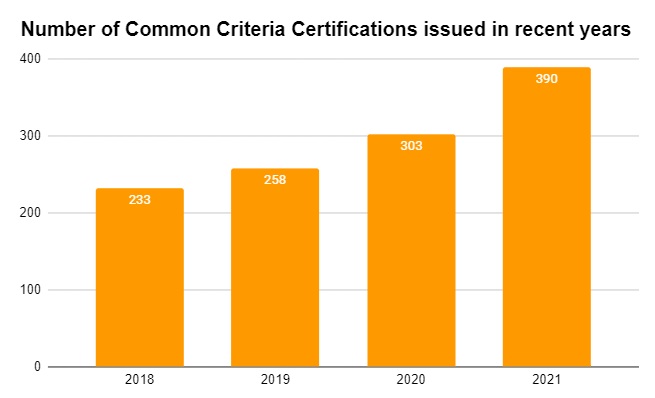
In recent years, the number of issued certifications has increased by an average of 10%.
6. New Zealand became a certificate-consuming country
After many years of the close alliance between Australia and New Zealand in managing the Australasian Certification Authority, New Zealand has opted to give up its authorizing position and remain a certificate-consuming nation in the CCRA. This is to more accurately represent New Zealand’s contribution to the Australasian Information Security Evaluation Program (AISEP) and the CCRA. The AISEP program name has been modified from ‘Australasian’ to ‘Australian’ to better represent the program’s status as a certificate authorizing nation of the CCRA. These modifications took effect in October 2021.
7. EUCC is replacing the European SOGIS mutual recognition agreement
The EUCC cybersecurity system developed by ENISA (the European Union Agency for Cybersecurity) will take the place of the existing European SOGIS mutual recognition agreement (Senior Officers Group for Information Systems). EUCC is a Common Criteria-based certification system that combines the globally acknowledged, proven methodologies of Common Criteria with new concepts to give stakeholders a contemporary and flexible solution, such as patch management for certified systems and products.
This year, consumer prices have risen the most in four decades while the cost of a mortgage has more than doubled. As such, there’s little doubt that, in 2023, many Americans will be forced to rely on credit for everyday purchases and tap the equity in their home for larger ones.
“The cost will vary widely depending on credit scores,” according to Chris Bridges, founder and CEO of fintech VITAL, which will soon issue the first credit card for the content creator economy. “Now is the time for Americans to get serious about their credit health, and VITAL aims to give them a head start.”
Leveraging friends and family
Bridges believes that banking in the age of social media means building a community — not just a brand. “By ‘community,’ we don’t mean people who happen to live in the same neighborhood, or shop at the same stores,” he says. “We envision a global community where members lift each other up, while expanding their own financial horizons and raising their credit scores.”
To that end, VITAL’s platform is based on a revenue share model that reserves 1% of the total community “spend” each month and gives it back to the community in the form of a “referral” game, in which members refer the app to friends and family members. “Your referral score determines how much cash you get every month,” Bridges explains. “The more you share, the higher your score and the larger piece of the 1% cash-back pie you get.”
As consumers become familiar with VITAL’s benefits, Bridges hopes that they will share — a lot. What Bridges calls VITAL’s “cache of rewards” includes not only referral cash but also the chance to earn 2 or 3% cash back on all spending for three-month periods. The company estimates that if one customer refers 10 friends and/or family members, who then refer four of their friends, rewards could exceed $500 per month.
Passively improve your credit health
Once those friends and family members join the VITAL community, they are also classed in credit health, in the form of personalized tips and tools to build their credit score, a process the company refers to as “toning.” Bridges says that the app will celebrate progress along with its members by giving them credit health rewards, including personalized credit analyses, milestone awards, cash awards for smart financial decisions, and cash for credit card increases.
Another essential part of VITAL’s health credit program is what the company promises to not to do. “We have designed a credit card that will raise your credit score, rather than your monthly payments,” Bridges promises. “That’s why our cardholders will never be charged an annual fee, a late fee, or any of those hidden charges that tend to sabotage building credit health. We want to succeed together.”
Gamification meets innovation
Indeed, rather than financial land mines, VITAL’s members can expect gems in the form of fun, gamified incentives. “We think that gamification can get people to make better financial decisions, not just spend more money,” says Bridges, who is also a 15-year fintech veteran and avid tech fan. “By making better decisions, our members improve their credit health even more, which lowers their cost of borrowing and increases their ability to save. Overall, it’s a win/win/win scenario.”
VITAL’s main “credit score” game works by linking members’ bank accounts and credit cards with the VITAL app. As they spend, VITAL’s algorithm analyzes patterns — which it calls “VITAL signs” — and sends suggestions in real-time on how to improve credit health. Bridges promises that gamification makes improving one’s behavior painless, even fun, and everyone who avoids the punishment of a low credit score will feel like a winner.
“The way that these scores are calculated is a closely-guarded secret and the credit bureaus can change their algorithm at any time,” Bridges says. “But because we are gathering so much data, our app can sleuth the credit scoring system in real-time, sending our members actionable information without them having to do any research, all while they are earning rewards. Applying may be the hardest part, but we’ve made that remarkably easy. Unlike many credit cards these days, we want to be inclusive, not exclusive.”
Whether you have a leaky faucet, a water leak in your basement, or are having some plumbing problems in your home, you’ll need to find a plumber to help you. There are a few things you need to know before hiring a plumber.
Pay attention to customer service
Having the best customer service can be a game changer for your business. Not only will you increase customer retention, you will also increase your bottom line. Having a stellar customer service department can also help you make the most of your marketing budget by making it easier to acquire new customers.
A good customer service department will be proactive in handling customer complaints and concerns and will be responsive to inquiries. If possible, the customer should be able to speak to a real person. The customer should also be able to speak to a technician and have the ability to track their progress throughout the day or night.
The best customer service department should also have a website that answers customer questions about their job, provides tips and a FAQ section. It should also have a blog section with interesting posts on plumbing topics of interest to the industry as well as a thriving community of like-minded folks. It’s well worth a look, for sure.
It’s also a good idea to make sure that the plumbing company is active in your community. By doing this, you’ll be more likely to get new customers referred to you by word of mouth. It also helps to keep your local community a healthy place to live and work.
Verify a plumber’s license
Whether you are dealing with an emergency plumbing situation or are looking to hire a plumber for a long-term project, you want to make sure that the person you hire is licensed. An unlicensed contractor can cause major damage to your property and end up making mistakes that could cost you money.
There are several resources you can use to verify a plumber’s license before hiring him. These include the Better Business Bureau, local review sites, and personal referrals. You should also check with the consumer protection agency in your state to see if there have been any complaints against the contractor.
Plumbers have years of training. Before they become licensed, they must complete an apprenticeship program for two to five years. They learn how to pull permits, perform plumbing repairs, and follow state laws. These apprentices work under the supervision of experienced licensed plumbers.
Plumbing contractors must also have liability insurance and a surety bond. This insurance will cover any costs associated with accidents, injuries, or damage to your property. You may also want to ask the contractor to send you a copy of his insurance certificate. This certificate must include commercial general liability coverage and workman’s compensation coverage.
Photo by Kindel Media from Pexels
Determine whether the issue is an emergency or if it can wait a few days
Taking care of your plumbing problems should be a priority. A leaky faucet or broken pipe can be hazardous to your family’s health and safety. It can also lead to a lot of wasted water.
There are many ways to determine whether your problem is an emergency or just something you should take care of later. First, do you know exactly what the problem is? If you do, you might have an idea of the best time to call a plumber. You might also want to try to fix the problem on your own before calling in a professional.
Compare bids
Whether you are shopping for a residential or commercial plumbing contractor, there are many factors to learn more about and consider before you sign on the dotted line. The price of labor is one of the most important factors to consider. This means that you should compare bids and prices to find the best deal possible.
The same goes for the materials and equipment required to complete the job. It may not be the easiest task, but you can make it easier on yourself by comparing bids and prices first. If you are working on a tight budget, you may want to ask the contractor to estimate the amount of time and materials it will take to complete the job.